Publisher: Taylor & Francis
Journal: Expert Opinion on Orphan Drugs DOI: 10.1080/21678707.2016.1241707
Drug Evaluation: The combination of vemurafenib and
cobimetinib in advanced melanoma
Lavinia Spain, Emily Goode, Yevette McGovern, Kroopa Joshi, James Larkin*
Royal Marsden NHS Foundation Trust, Fulham Road, London SW3 6JJ,
United Kingdom (all authors)
*corresponding author: [email protected]; ph: +44 20 7352 8171
Disclosures:
JL is a non-remunerated consultant for Novartis, Pfizer, BMS, MSD and
Roche/Genentech and receives institutional research support from Pfizer, BMS, Novartis, MSD. LS, EG, YM and KJ have no relevant disclosures. No funding has been received in relation to this manuscript.
The combination of vemurafenib and cobimetinib
in advanced melanoma
Lavinia Spain, Emily Goode, Yevette McGovern, Kroopa Joshi, James Larkin*
Royal Marsden NHS Foundation Trust, Fulham Road, London SW3 6JJ, United
Kingdom (all authors)
*corresponding author: [email protected]; ph: +4420 7352 8171
Abstract
Introduction: Advanced melanoma with aBRAF V600mutation responds to
treatment with BRAF inhibitors such as vemurafenib, with great improvement in
tumour response and patient survival. Despite early and often dramatic
responses, resistance to vemurafenib develops. Concurrent inhibition of a
downstream protein, MEK, also involved in the MAPK oncogenic signalling
pathway, defers development of resistance. The MEK inhibitor cobimetinib has
been successfully and safely combined with vemurafenib, further improving
response rate and survival when compared to vemurafenib monotherapy.
Areas covered: This article covers the mechanism of action of both vemurafenib
and cobimetinib, in addition to describing results from the key Phase I and
Phase III studies which led to registration of the combination in the US and
Europe as a therapeutic option for advanced BRAF mutant melanoma. The safety
profile of these agents is also discussed in detail, including similarities with and
differences from the competitor compounds dabrafenib and trametinib.
alternative BRAF/MEK blockade. The combination is tolerable, safe and effective
and results in fewer skin toxicities than vemurafenib monotherapy.
Keywords
Vemurafenib, cobimetinib, advanced melanoma, BRAF mutation, MAPK pathway
1.1 Introduction
Malignant melanoma is the most aggressive form of cutaneous malignancy with
approximately 132,000 new cases diagnosed globally each year. In the UK, it is
the 5th commonest cancer accounting for nearly 13,000 cases and over 2000
deaths a year.1 The incidence of melanoma is rising steadily with a doubling of the number of cases every decade, a rate of increase more rapid than any other
form of solid cancer. Historically, advanced cutaneous melanoma has been
associated with an extremely poor outlook; until recently the median survival
of such patients was in the order of 6 to 9 months, with only 10-15% of patients
alive at 3 years.2
Approximately 50% of cutaneous melanomas harbour a BRAF V600 mutation
resulting in constitutive BRAF activation, integral to oncogenic signalling via the
mitogen activated protein kinase (MAPK) pathway.3, 4 This discovery has led to
the development of several molecular targeted therapies in recent years. The
BRAF inhibitors vemurafenib and dabrafenib demonstrated a significant
improvement in progression-free and overall survival as compared with
standard chemotherapy alone in patients with advanced BRAF V600E mutated
Despite the impressive initial responses demonstrated with BRAF inhibition in
advanced melanoma, these are short-lived for the vast majority of patients with
most developing resistance to therapy within 6 to 9 months.5, 6 Multiple
mechanisms of acquired resistance are described; amongst these reactivation of
the MAPK signalling pathway accounts for acquired resistance in the large
majority of patients.7 MEK is a protein downstream of BRAF and one such mode of MAPK reactivation. Accordingly, large-scale clinical trials have demonstrated
combination BRAF/MEK inhibitor therapy to have superior clinical efficacy than
BRAF inhibition alone with an improvement in progression-free survival and
overall survival in patients with BRAF-mutated melanoma.8-10 This article
focuses on the combination of vemurafenib with cobimetinib.
1.2 Overview of the market
In a renewed era of cancer immunotherapy, the FDA approval of novel
immunomodulatory antibodies targeting T cell immune checkpoint molecules
has led to a change in the management of BRAF-mutated melanoma with
anti-CTLA-4 and anti-PD-1 therapy incorporated into various clinical guidelines. The
recommendation from the European Society for Medical Oncology (ESMO) for
the treatment of BRAF-mutated melanoma comprises first-line anti-PD-1
treatment or combined BRAF/MEK inhibitor therapy.11 In the United States,
National Comprehensive Cancer Network (NCCN) guidelines recommend using
any of the following regimens in the first-line setting for patients with BRAF
inhibition, single agent anti-PD-1 therapy or combined anti-PD-1 and
anti-CTLA-4 therapy.
In addition to clinical concerns regarding drug resistance, toxicity and
tolerability of currently available molecular targeted drugs and immune
checkpoint antibodies, well-defined treatment algorithms regarding the optimal
sequence and timing of immunotherapy and molecular targeted therapy in
BRAF-mutated melanoma remain a significant unmet clinical need in the
management of metastatic melanoma.12 In patients with BRAF-mutated
melanoma, in the context of symptomatic, large volume, rapidly progressive
disease most clinicians favour use of targeted molecular therapy in the first
instance where the priority is to achieve a rapid response. On the contrary,
checkpoint blockade may be adopted first-line in patients with more indolent
disease, reserving molecular targeted agents as salvage therapy at the time
of disease progression.
Two different BRAF/MEK inhibitor combinations are currently in use:
dabrafenib/trametinib and vemurafenib/cobimetinib. Encorafenib plus
Binimetinib is currently being tested in a phase III trial and data is awaited
(NCT01909453). Several second-generation immune checkpoint modulators
are being tested in clinical trials including anti-LAG-3, anti-4-1BB and anti-GITR
therapies reflecting the significant interest in cancer immunotherapy following
the recent clinical successes of various anti-PD-1 therapies.13
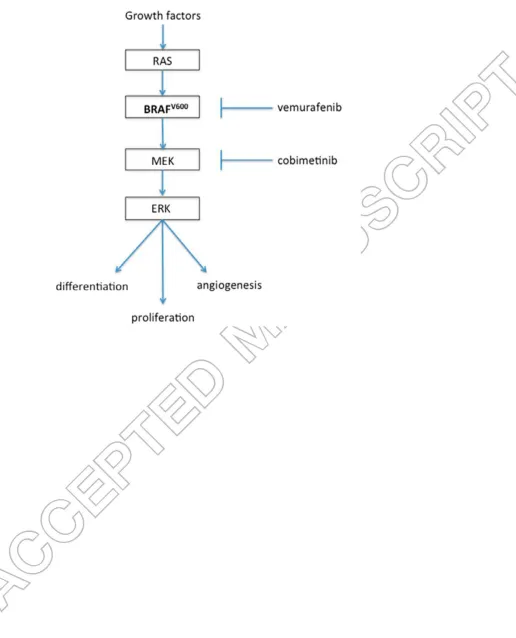
Vemurafenib and cobimetinib inhibit BRAF and MEK proteins, respectively,
within the MAPK pathway. This is the key growth signalling pathway in BRAF
V600-mutated melanoma cells and is represented in Figure 1.
Vemurafenib is an oral tyrosine kinase inhibitor administered twice a day at a
dose of 960mg (each tablet contains 240mg), continuously. Cobimetinib is an
oral tyrosine kinase inhibitor targeting the MEK protein. It is administered at a
dose of 60mg (each tablet contains 20mg) daily, for three weeks out of four.
Melanoma cells eventually develop resistance to BRAF inhibitor monotherapy
via one of several mechanisms, for example by reactivation of the MAPK
pathway through MEK signalling7, 14, CRAF upregulation15 and development of
NRAS mutations16, 17, amongst others. Combined blockade of BRAF and MEK proteins defers development of resistance, allowing prolonged MAPK inhibition
and therefore more durable tumour control. Concurrent blockade not only
defers resistance, it also alters the side effect profile of both agents.
2.2 Chemistry
Vemurafenib has the chemical name propane-1-sulfonic acid
[3-[5-(4-chlorophenyl)-1H-pyrrolo[2,3-b]pyridine-3-carbonyl]-2,4-
difluoro-phenyl]-amide and the molecular formula C23H18ClF2N3O3S.18
Cobimetinib fumarate has the chemical name chemical name (S
)-[3,4-difluoro-2-(2-fluoro-4-292 iodophenylamino)phenyl]
C
46
H46
F6
I2
N6
O8
(2 C21
H21
F3
IN3
O2
.
C4
H4
O4
).192.3 Pharmacodynamics
Vemurafenib targets the mutant BRAF protein, inhibiting downstream protein
phosphorylation of MEK. Ultimately this induces cell cycle arrest and apoptosis
and thereby inhibits cellular proliferation and unregulated tumour growth.
Vemurafenib was specifically engineered to provide greater inhibition of the
mutant BRAF protein over the wild-type BRAF protein.20, 21 This enables
higher drug concentration exposure, without serious side effects imposed upon
BRAF wild-type tissues.22
Cobimetinib binds to active, phosphorylated MEK 1/2 proteins in a selective
manner.23 In doing so it prevents downstream phosphorylation of ERK and resultant oncogenic signalling. The dependency of BRAF mutated tumours on
MEK signalling makes this a particularly rational combination.24
Inhibition of MEK concurrent with BRAF results in less hyperkeratotic skin
toxicity, including reduced development of squamous cell carcinomas. This
toxicity is due to a paradoxical increase in MAPK signalling induced by BRAF
inhibition, with secondary lesions often demonstrating a mutation in RAS,
especially HRAS.25 Mutant RAS-driven increased signalling may also precipitate the development of RAS-mutant tumours, such as colorectal and pancreatic
cancer.26, 27 It is possible that MEK inhibition can mitigate but not completely
2.4 Pharmacokinetics and metabolism
The pharmacokinetics of vemurafenib and cobimetinib are summarised in Table 1.
Vemurafenib is a moderate CYP1A2 inhibitor and can also induce CYP3A4, its main
metabolic pathway. Prescribers need to be aware of potential increased side effects
and decreased efficacy of concurrent medications metabolised by these pathways.
Concurrent use of medications with strong CYP3A4 inhibitory properties should be
avoided in conjunction with cobimetinib, or if essential, close monitoring for
adverse events should be instituted.
3.0 Clinical efficacy
3.1Phase I trial
A phase 1b study in advanced BRAF mutated melanoma assessed the safety of
combination vemurafenib/cobimetinib with dose escalation in patients that were
either naïve to BRAF inhibition (n=63) or had previously progressed on
vemurafenib (n=66).28 Efficacy of combination therapy was measured as a
secondary end point. Ten dosing regimens were chosen and 2 were escalated:
vemurafenib 720mg BD with cobimetinib 60mg, 21 days on ad 7 days off, and
vemurafenib 960mg BD with cobimetininb 60mg BD, 21 days on and 7 days off. The
overall response rate (ORR) was 15% in patients who had previously received
vemurafenib and 87% in BRAF inhibitor naïve patients, with a complete response
(CR) rate of 10% and median progression free survival (PFS) of 13.7 months (95%
CI 10.1-17.5) in this latter group. This was notably longer than the median PFS with
(95% CI 2.6-3.4).29, 30 After extended follow up, the median OS in BRAF inhibitor
naïve patients was reported as 31.2 months, with an OS of 37% at 3 years.31
3.2 Phase III trial
Larkin et al demonstrated the superior clinical efficacy of
vemurafenib/cobimetinib in the Phase 3 coBRIM study in 2014.32 Four hundred
and ninety five patients with unresectable locally advanced or metastatic BRAF
V600 mutated melanoma were assigned to receive either
vemurafenib/cobimetinib (combination) or vemurafenib/placebo (control) in
the first line setting. The combination group had a significantly improved
median PFS of 9.9months compared to 6.2 months, with HR of 0.51 for death or
disease progression (95% CI 0.39-0.68, p<0.001). The rate of partial response
(PR) or CR was 68% compared to 45% in the control group. Consistent with the
phase 1 results, there was a non-significant increase in grade 3 or 4 adverse
events in the combination group, including elevated creatine kinase and liver
function tests, with no increased rate of discontinuation of treatment.
Furthermore, there was a decreased incidence of squamous cell carcinoma (SCC)
incidence in the combination group.
Updated coBRIM results at 14.2 months’ follow-up confirmed the clinical
benefit of combination treatment.33 The median PFS was 12.3 months in the
combination group, compared to 7.2 months in the control group, HR 0.58 (95%
CI 0.46-0.72). The ORR was 70% in the combination group versus 50%, with CR
in 16% vs 11% in the control group. At 18.5 months follow up the median OS
CI, 0.55-0.90; P = .005), and 2 year OS 48% versus 38%.34 Clinical benefit was seen consistently across mutation types, including BRAF V600E and V600K and
presence of RAS or RTK mutations did not affect clinical outcomes.35
In addition, health related quality of life was assessed with the EORTC QLQ-C30
questionnaire and reported better scores in all functioning domains of the
questionnaire in the combination group after baseline, but not all reached
clinically meaningful (CM) criteria.36 The CM criteria were met for
improvements in insomnia, fatigue, social functioning and pain but as predicted
the combination group had worsening of diarrhoea.
Post-marketing surveillance is yet to be reported for this combination,
although a large safety study on vemurafenib monotherapy did not raise any
new safety signals.37
Table 2 summarises the efficacy results from the Phase I and III trials of
vemurafenib/cobimetinib and dabrafenib/trametinib.
3.3 Ongoing trials
There are a number of other ongoing studies assessing BRAF and MEK
inhibition with combination vemurafenib and cobimetinib, including a second
Phase 3 study (NCT02427893) comparing this combination with 10 days of
The optimisation of dosing and sequencing is also being explored in a phase 2
study comparing intermittent and continuous dosing (NCT 02583516).
Intermittent vemurafenib was shown to increase drug tolerability without
obviously limiting efficacy in a small case series.38 Therefore, intermittent
dosing of vemurafenib in combination treatment may provide a similar benefit.
Intermittent combination treatment was given safely to a patient with BRAF
mutant melanoma who developed rapid progression of NRAS-mutant leukaemia
on vemurafenib. He received a further 35 weeks of combination treatment with
vemurafenib and cobimetinib. Response has been maintained at nearly twenty
months, illustrating that there is potential for such an approach.39
There is also an ongoing trial (NCT02537600 CONVERCE) to determine the
intracranial efficacy of this combination in BRAF mutated metastatic melanoma
patients with brain metastases. Another similar phase 2 study was unfortunately
terminated early due to slow accrual (NCT02230306 coBRIM-B).
Surgery continues to play an important role in Stage I to III melanoma as well as
in selected cases of Stage IV disease. The potential role of combination targeted
therapy in the treatment paradigm requires consideration, for example to
optimize the surgical approach or convert from unresectable to resectable
disease. Combination vemurafenib and cobimetinib is being assessed in the
neoadjuvant setting with patients who have palpable lymph nodes (stage
IIIB/IIIC) receiving 2 months of treatment prior to surgery and adjuvant
combination treatment to a maximum of 12 months (NCT02036086). Another
in stage IIIC/IV disease and also aims to identify predictive and prognostic
biomarkers (NCT02303951). A phase III trial of dabrafenib and trametinib
following surgery for patients with high risk BRAF V600 mutation positive
melanoma (COMBI-AD) is ongoing and results are awaited (NCT01682083).
Similarly, a phase III study of vemurafenib monotherapy given to patients with
BRAF V600 mutant melanomain the adjuvant setting has closed to accrual
andoutcomes are pending (NCT01667419).
Whilst the combination of vemurafenib and cobimetinib has shown promising
results, further research into maximising response rates and efficacy by adding
other targeted treatments is important. The phase 2 study examining the benefit
of additional bevacizumab was terminated due to toxicity and slow accrual
(NCT01495988). However, there are active studies to assess the safety and
efficacy of future combinations, including the addition of decitabine, which
disrupts DNA methylation (NCT01876641) and may give benefit to BRAF
inhibitor resistant melanoma patients.
Finally, with the success of immunotherapy in melanoma treatment in the
last decade it is important to investigate the impact of targeted therapies on
the tumour immune microenvironment.
A Phase 2 study (NCT01813214) will explore the effect of vemurafenib and
cobimetinib on the immune response to melanoma, including T cell infiltration
There is also a Phase 1b study (NCT01656642) comparing vemurafenib alone or
in combination with cobimetinib with the addition of an anti-PD-L1 drug
(atezolizumab) in both cohorts in BRAF mutant metastatic melanoma.
4. Safety and tolerability
Trials of vemurafenib have established the common adverse events observed
with this drug when used as monotherapy. These include rash (42%), fatigue
(45%), arthralgia (58%), photosensitivity (41%), cutaneous squamous cell
carcinoma (19%), nausea (40%) and raised liver function tests (36%).40
Data regarding cobimetinib as a monotherapy in advanced melanoma is not
published, however the MEK inhibitor trametinib was studied in a Phase III trial
by Flaherty et al and the most common adverse events noted included rash
(57%), diarrhoea (43%), fatigue (26%) and peripheral oedema (26%). Other
notable events included reduced ejection fraction/left ventricular dysfunction
(7%) and one case of chorioretinopthy.41 These appear to be class-effects with
MEK inhibitors.
In terms of the combination of vemurafenib with cobimetinib, a Phase Ib study
by Ribas et al of vemurafenib/cobimetinib saw 129 patients treated with ten
different dosing regimens of the combination, in pursuit of the maximum
tolerated dose (MTD).28 This was established as vemurafenib 960mg twice daily
continuously and cobimetinib 60mg daily for 3 out of every 4 weeks – ie using
the maximal single-agent tolerated doses. The study included two populations:
to both compounds. In all dosing regimens the most common adverse events
were diarrhoea (64%), non-acneiform rash (60%), liver enzyme abnormalities
(50%), fatigue (48%), nausea (45%), and photosensitivity (40%). Most events
were of mild-moderate severity. The most common grade 3 or grade 4 events
included cutaneous squamous cell carcinoma (9%), raised alkaline phosphatase
(9%) and anaemia (7%). The combination naïve group had more adverse events
than those previously treated with vemurafenib, likely reflecting a reporting
bias.
In the Phase III coBRIM trial of vemurafenib/cobimetinib compared with
vemurafenib/placebo, the overall rates of adverse events were similar in both
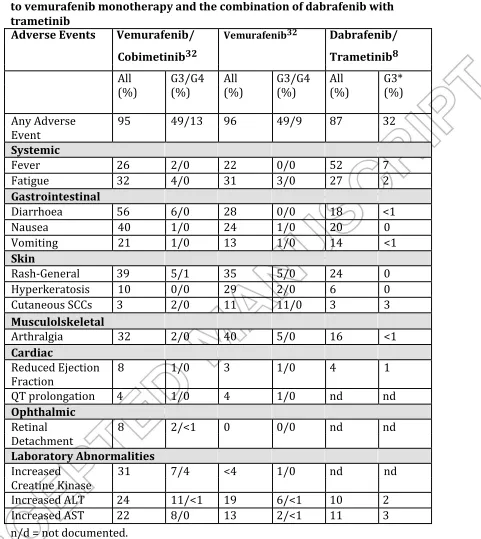
arms for all grades of toxicity.32 The most common adverse events seen with
combination treatment were diarrhoea (56%), nausea (40%), rash (39%),
arthralgia (32%), fatigue (32%), fever (26%), elevated ALT and AST (24 and
22% respectively) and vomiting (21%). The patients receiving vemurafenib
alone had fewer events of diarrhoea (28% vs 56%), nausea (24% vs 40%) and
vomiting (13% vs 21%), but a higher rate of cutaneous squamous cell carcinoma
(11% vs 3%), hyperkeratosis (29% vs 10%) and arthralgia (40% vs 32%). Grade
3 adverse events occurred in 49% in both arms. The majority of Grade 3 events
seen in the combination arm were abnormal blood results with raised creatine
kinase (CK; 7%), raised ALT (11%) and AST (8%), as well as diarrhoea (6%),
rash (5%), and fatigue (4%). In the vemurafenib monotherapy group the most
common grade 3 events were cutaneous SCCs (11%), raised ALT (6%), rash
(5%) and arthralgia (5%). Eight percent of subjects suffered a reduced ejection
1%. The incidence of toxic events requiring drug withdrawal was similar in both
groups (12% in the monotherapy and 13% in the combination group).
The rate of serous retinopathy is greater with vemurafenib/cobimetinib than
vemurafenib alone, with 26% versus 3% of patients impacted in the coBRIM
trial.42 The majority of events were grade 1 or 2 (88%) and mostly picked up on
routine surveillance. In the few cases where drug therapy was interrupted or
reduced, 75% resolved or were resolving at the time of reporting. Median time
to onset was early in treatment at 1 month.
In the coBRIM trial, 9 patients died from treatment-related causes: 3 in the
vemurafenib arm (1%) and 6 (2%) in the combination arm. With such small
numbers, one cannot determine whether this difference is significant. The causes
of death ranged from general disorders including fatigue to cardiac events. Two
neurological events occurred in the combination group: cerebral haemorrhage
and hemiparesis.32
In a Phase III trial of the alternative BRAF and MEK inhibitors dabrafenib and
trametinib in combination compared with dabrafenib alone, the overall adverse
event rates were very similar. Notable differences included higher rates of fever
with the combination (52% vs 25%) but fewer episodes of hyperkeratosis (6%
vs 33%), cutaneous squamous cell carcinoma (3% vs 9%) and alopecia (5% vs
26%) than seen in the dabrafenib monotherapy arm.9 Comparing across studies
of vemurafenib/cobimetinib and dabrafenib/trametinib, fever is seen more
vs 18%), rash (39% vs 24%), nausea (40% vs 20%) arthralgia (32% vs 16%)
and hyperkeratosis (10% vs 6%) are more common with the combination of
vemurafenib/cobimetinib. Hyperkeratosis and squamous cell carcinomas
occurred much less commonly in the combination BRAF/MEK inhibitor groups
of both Phase III trials relative to BRAF inhibitor monotherapy.8, 32
Table 3 outlines adverse events of vemurafenib and cobimetinib compared with
vemurafenib monotherapy and the combination of its competitor dabrafenib and
trametinib.
5. Regulatory affairs
Vemurafenib is licensed in the United States (US), Europe and Australia for use
as monotherapy. Cobimetinib is also now licensed for use in combination with
vemurafenib in the United States (for BRAF V600E and V600K mutations) and
in Europe (for BRAF V600 mutations) for advanced melanoma, but is not yet
licensed in Australia.
6.1 Conclusion
The combination of vemurafenib with cobimetinib is a highly effective treatment
option for patients with advanced BRAF mutant melanoma. The addition of
cobimetinib results in improved response rates as well as significantly longer
progression-free and overall survival. Availability of this combination provides
an alternative to the combination of dabrafenib with trametinib, with the
schedule and toxicity profile differing between the two combinations. The Drug
6.2 Expert opinion
The combination of vemurafenib with cobimetinib provides an alternative to
dabrafenib and trametinib in patients with advanced BRAF mutant melanoma.
Our practice is to reserve these combinations for use in patients with a critical
burden of disease, or brain-predominant disease, given their high objective
response rates (around 70%)8, 32 and the efficacy of BRAF monotherapy in the
treatment of central nervous system lesions43, 44, from which we extrapolate that the combination will be at least as effective. Use of
vemurafenib/cobimetinib upfront, as opposed to addition of cobimetinib later,
is the most appropriate way to initiate this therapeutic combination.
Though similar in efficacy, the adverse event profile of vemurafenib/cobimetinib
differs from dabrafenib/trametinib in a number of areas. Febrile episodes are
less common. On the other hand, its more complex, intermittent dosing schedule
and greater number of tablets (due to relatively less bioavailability than
dabrafenib/trametinib) may make it less preferable to some. The
photosensitivity associated mainly with vemurafenib can be problematic for
anyone regularly exposed to sunlight and the higher rates of diarrhoea, rash,
nausea and arthralgias may have a significant impact on quality of life. The
availability of this combination is unlikely to change current drug-treatment
strategies, however marketplace competition may increase availability of
BRAF/MEK combination therapies as less exclusivity could reduce the price. The
outcome of the Phase III trial with encorafenib and binimetinib (NCT01909453)
Physicians should feel comfortable in prescribing this combination, but need to
counsel patients appropriately regarding expected side effects. Out practice is to
recommend high SPF-factor sunscreen and avoidance of direct sunlight to
prevent photosensitivity, as well as to prescribe prophylactic anti-emetics and
anti-diarrhoeal medication. Although the addition of cobimetinib to vemurafenib
elevates risk of cardiac dysfunction and ocular toxicity, we do not routinely
undertake echocardiograms and ophthalmology review. High risk patients, or
those who develop symptoms suggestive of one of these rare side effects, should
have a prompt clinical assessment. There is also potential for radiation recall and
sensitization when vemurafenib and radiotherapy are combined. The skin is
particularly vulnerable but other organs may be impacted. In November 2015
the UK government issued a specific warning to this effect.45
The careful development of vemurafenib provides an example of how an active
agent may be potentiated to allow greater specificity for a target, resulting in
both superior clinical efficacy and tolerability.21 The ORR of 80% in the Phase I
trial is testament to this.28 The concept of dual MAPK protein blockade to defer
resistance may be further exploited as technology enables us to design effective
RAS and ERK inhibitors. Patients may change their co-inhibitor at -or ideally just
prior to- clinical progression, based on the mechanism of developed resistance.
In terms of alternative scheduling, there is preclinical evidence supporting
evaluation of an intermittent dosing approach. Research in mice has shown that
vemurafenib-resistant melanomas become drug-dependent for their
Although the original study looking at combination vemurafenib with
ipilimumab, an anti-CTLA4 antibody, resulted in significant hepatotoxicity47, the potential for synergy remains and ongoing trials are in progress, as discussed
above. Our understanding of the way in which BRAF inhibition and therapeutic
resistance may alter the tumour microenvironment is expanding.48 Trials such as SECOMBIT (NCT02631447) will enable further insight into the best way of
sequencing BRAF/MEK inhibition with immune checkpoint blockade.
Finally, use of vemurafenib/cobimetinib may not be limited to use in advanced
melanoma patients in future. As already discussed in the Clinical Efficacy
section, use in the neoadjuvant setting may improve both surgical and disease
outcomes and we await results from ongoing trials to elucidate this.
Drug summary box
Drug names (generic) Vemurafenib and cobimetinib
Phase Licensed in the US and Europe
Indication (specific to Advanced melanoma with a BRAF V600 mutation (ie
discussion) unresectable Stage III or Stage IV disease).
Both agents are tyrosine kinase inhibitors targeting MAPK pathway proteins. Vemurafenib selectively inhibits the mutant BRAF protein where cobimetinib
Pharmacology and mechanism binds to MEK in its activated, phosphorylated form. This
of action results in reduced oncogenic signally, tumour cell cyclearrest and apoptosis
and translates into improved clinical outcomes.
Route of administration Both are administered orally in tablet form.
co-BRIM study32: International, randomised, blinded placebo-controlled trial evaluating the benefit of
Pivotal trial combination vemurafenib/cobimetinib overvemurafenib/placebo. This
therapy.
Funding
This paper was not funded.
Declaration of Interests
L Larkin is a non-remunerated consultant for Novartis, Pfizer, BMS, MSD,
Roche/Genentech, GSK and Eisai and receives institutional research
support from Pfizer, BMS, Novartis and MSD. The authors have no other
relevant affiliations or financial involvement with any organization or entity
with a financial interest in or financial conflict with the subject matter or
materials discussed in the manuscript apart from those disclosed.
References
Reference annotations
*Of interest
**Of considerable interest
1. CRUK. Cancer Research UK - Skin Cancer. 2013 [cited 2016 10 May]; Available from:
http://www.cancerresearchuk.org/health-professional/cancer-statistics/statistics-by-cancer-type/skin-cancer
2. Balch CM, Soong SJ, Gershenwald JE, et al. Prognostic factors analysis of 17,600 melanoma patients: validation of the American Joint Committee on Cancer melanoma staging system. Journal of clinical oncology : official journal of the American Society of Clinical Oncology 2001 Aug 15;19(16):3622-34.
3. Davies H, Bignell GR, Cox C, et al. Mutations of the BRAF gene in human cancer. Nature 2002 Jun 27;417(6892):949-54.
*article describing discovery of the BRAF V600 mutation
4. Curtin JA, Fridlyand J, Kageshita T, et al. Distinct sets of genetic alterations in melanoma. The New England journal of medicine 2005 Nov 17;353(20):2135- 47.
5. Chapman PB, Hauschild A, Robert C, et al. Improved survival with vemurafenib in melanoma with BRAF V600E mutation. The New England journal of medicine 2011 Jun 30;364(26):2507-16.
6. Hauschild A, Grob JJ, Demidov LV, et al. Dabrafenib in BRAF-mutated metastatic melanoma: a multicentre, open-label, phase 3 randomised controlled trial. Lancet 2012 Jul 28;380(9839):358-65.
7. Van Allen EM, Wagle N, Sucker A, et al. The genetic landscape of clinical resistance to RAF inhibition in metastatic melanoma. Cancer Discov 2014 Jan;4(1):94-109.
8. Long GV, Stroyakovskiy D, Gogas H, et al. Dabrafenib and trametinib versus dabrafenib and placebo for Val600 BRAF-mutant melanoma: a multicentre, double-blind, phase 3 randomised controlled trial. Lancet 2015 May
29.
9. Long GV, Stroyakovskiy D, Gogas H, et al. Combined BRAF and MEK inhibition versus BRAF inhibition alone in melanoma. The New England journal of medicine 2014 Nov 13;371(20):1877-88.
10. Robert C, Karaszewska B, Schachter J, et al. Improved overall survival in melanoma with combined dabrafenib and trametinib. The New England journal of medicine 2015 Jan 1;372(1):30-9.
11. Dummer R, Hauschild A, Lindenblatt N, et al. Cutaneous melanoma: ESMO Clinical Practice Guidelines for diagnosis, treatment and follow-up. Annals of oncology : official journal of the European Society for Medical Oncology / ESMO 2015 Sep;26 Suppl 5:v126-32.
12. Jones C, Clapton G, Zhao Z, et al. Unmet clinical needs in the management of advanced melanoma: findings from a survey of oncologists. Eur J Cancer Care (Engl) 2015 Nov;24(6):867-72.
13. Sheridan C. Immuno-oncology moves beyond PD-1. Nat Biotechnol 2015 Jul;33(7):673-5.
14. Emery CM, Vijayendran KG, Zipser MC, et al. MEK1 mutations confer resistance to MEK and B-RAF inhibition. Proceedings of the National Academy of Sciences of the United States of America 2009 Dec 1;106(48):20411-6.
15. Montagut C, Sharma SV, Shioda T, et al. Elevated CRAF as a potential mechanism of acquired resistance to BRAF inhibition in melanoma. Cancer research 2008 Jun 15;68(12):4853-61.
16. Nazarian R, Shi H, Wang Q, et al. Melanomas acquire resistance to B-RAF(V600E) inhibition by RTK or N-RAS upregulation. Nature 2010 Dec 16;468(7326):973-7.
17. Trunzer K, Pavlick AC, Schuchter L, et al. Pharmacodynamic effects and mechanisms of resistance to vemurafenib in patients with metastatic melanoma. Journal of clinical oncology : official journal of the American Society of Clinical Oncology 2013 May 10;31(14):1767-74.
18. FDA. Highlights of prescribing information for Zelboraf (vemurafenib). 2011 [cited 2016 10 May]; Available from:
https://www.accessdata.fda.gov/drugsatfda_docs/label/2011/202429s000lbl.p df
19. FDA. Highlights of prescribing information for Cotellic (cobimetinib). 2015 [cited 2016 May 10]; Available from:
http://www.accessdata.fda.gov/drugsatfda_docs/label/2015/206192s000lbl.pd f
20. Bollag G, Hirth P, Tsai J, et al. Clinical efficacy of a RAF inhibitor needs broad target blockade in BRAF-mutant melanoma. Nature 2010 Sep
21. Tsai J, Lee JT, Wang W, et al. Discovery of a selective inhibitor of
oncogenic B-Raf kinase with potent antimelanoma activity. Proceedings of the National Academy of Sciences of the United States of America 2008 Feb
26;105(8):3041-6.
22. Joseph EW, Pratilas CA, Poulikakos PI, et al. The RAF inhibitor PLX4032 inhibits ERK signaling and tumor cell proliferation in a V600E BRAF-selective manner. Proceedings of the National Academy of Sciences of the United States of America 2010 Aug 17;107(33):14903-8.
23. Hatzivassiliou G, Haling JR, Chen H, et al. Mechanism of MEK inhibition determines efficacy in mutant KRAS- versus BRAF-driven cancers. Nature 2013 Sep 12;501(7466):232-6.
24. Solit DB, Garraway LA, Pratilas CA, et al. BRAF mutation predicts sensitivity to MEK inhibition. Nature 2006 Jan 19;439(7074):358-62.
25. Su F, Viros A, Milagre C, et al. RAS mutations in cutaneous squamous-cell carcinomas in patients treated with BRAF inhibitors. The New England journal of medicine 2012 Jan 19;366(3):207-15.
26. Andrews MC, Behren A, Chionh F, et al. BRAF inhibitor-driven tumor proliferation in a KRAS-mutated colon carcinoma is not overcome by MEK1/2 inhibition. Journal of clinical oncology : official journal of the American Society of Clinical Oncology 2013 Dec 10;31(35):e448-51.
27. Carlino MS, Kwan V, Miller DK, et al. New RAS-mutant pancreatic adenocarcinoma with combined BRAF and MEK inhibition for metastatic melanoma. Journal of clinical oncology : official journal of the American Society of Clinical Oncology 2015 Apr 10;33(11):e52-6.
28. Ribas A, Gonzalez R, Pavlick A, et al. Combination of vemurafenib and cobimetinib in patients with advanced BRAF(V600)-mutated melanoma: a phase 1b study. The Lancet Oncology 2014 Aug;15(9):954-65.
29. Flaherty KT, Puzanov I, Kim KB, et al. Inhibition of mutated, activated BRAF in metastatic melanoma. The New England journal of medicine 2010 Aug 26;363(9):809-19.
30. Sosman JA, Kim KB, Schuchter L, et al. Survival in BRAF V600-mutant advanced melanoma treated with vemurafenib. The New England journal of medicine 2012 Feb 23;366(8):707-14.
31. Daud A, Pavlick A, Ribas A, et al. Extended follow-up results of a phase 1B study (BRIM7) of cobimetinib (C) and vemurafenib (V) in BRAF-mutant
melanoma. ASCO; 2016; Chicago: J Clin Oncol 2016.
32. Larkin J, Ascierto PA, Dreno B, et al. Combined vemurafenib and cobimetinib in BRAF-mutated melanoma. The New England journal of medicine 2014 Nov 13;371(20):1867-76.
**phase III results of the combination of vemurafenib with cobimetinib 33. Larkin JMG, Yan Y, McArthur GA, et al. Update of progression-free
survival (PFS) and correlative biomarker analysis from coBRIM: Phase III study of cobimetinib (cobi) plus vemurafenib (vem) in advanced BRAF-mutated melanoma. ASCO 2015; Chicago, US: Journal Clinical Oncology; 2015.
35. McArthur G, Larkin J, Dre ́no B, et al. Impact of baseline genetic heterogeneities on progression-free survival (PFS) in patients (pts) with advanced BRAFV600-mutated melanoma treated with cobimetinib (COBI) + vemurafenib (VEM) in the phase 3 coBRIM study. European Cancer Conference (ECC); 2015; Vienna, Austria: European Journal Cancer; 2015.
36. Dréno B, Bartley K, Ascierto P, et al. Quality-of-life (QOL) assessment in patients (pts) with metastatic melanoma receiving vemurafenib (V) and cobimetinib (C). ASCO; 2015; Chicago: Journal Clinical Oncology; 2015.
37. Larkin J, Del Vecchio M, Ascierto PA, et al. Vemurafenib in patients with BRAF(V600) mutated metastatic melanoma: an open-label, multicentre, safety study. The Lancet Oncology 2014 Apr;15(4):436-44.
38. Dooley AJ, Gupta A, Bhattacharyya M, et al. Intermittent dosing with vemurafenib in BRAF V600E-mutant melanoma: review of a case series. Therapeutic advances in medical oncology 2014 Nov;6(6):262-6.
39. Abdel-Wahab O, Klimek VM, Gaskell AA, et al. Efficacy of intermittent combined RAF and MEK inhibition in a patient with concurrent BRAF- and NRAS-mutant malignancies. Cancer Discov 2014 May;4(5):538-45.
40. McArthur GA, Chapman PB, Robert C, et al. Safety and efficacy of
vemurafenib in BRAF(V600E) and BRAF(V600K) mutation-positive melanoma (BRIM-3): extended follow-up of a phase 3, randomised, open-label study. The Lancet Oncology 2014 Mar;15(3):323-32.
41. Flaherty KT, Robert C, Hersey P, et al. Improved survival with MEK inhibition in BRAF-mutated melanoma. The New England journal of medicine 2012 Jul 12;367(2):107-14.
42. De La Cruz-Merino L, Di Guardo L, Grob J, et al. Clinical features of cobimetinib (COBI)–associated serous retinopathy (SR) in BRAF-mutated melanoma patients (pts) treated in the coBRIM study. ASCO; 2015; Chicago: Journal Clinical Oncology; 2015.
43. Long GV, Trefzer U, Davies MA, et al. Dabrafenib in patients with Val600Glu or Val600Lys BRAF-mutant melanoma metastatic to the brain
(BREAK-MB): a multicentre, open-label, phase 2 trial. The Lancet Oncology 2012 Nov;13(11):1087-95.
44. Dummer R, Goldinger SM, Turtschi CP, et al. Vemurafenib in patients with BRAF(V600) mutation-positive melanoma with symptomatic brain
metastases: final results of an open-label pilot study. European journal of cancer 2014 Feb;50(3):611-21.
45. Government UK. Risk of potentiation of radiation toxicity with Zelboraf (vemurafenib) - Drug Safety Update. 2015 [cited 2016 10 May 2016]; Available from: https://www.gov.uk/drug-safety-update/vemurafenib-zelboraf-risk-of-potentiation-of-radiation-toxicity
46. Das Thakur M, Salangsang F, Landman AS, et al. Modelling vemurafenib resistance in melanoma reveals a strategy to forestall drug resistance. Nature 2013 Feb 14;494(7436):251-5.
47. Ribas A, Hodi FS, Callahan M, et al. Hepatotoxicity with combination of vemurafenib and ipilimumab. The New England journal of medicine 2013 Apr 4;368(14):1365-6.
49. EMA. Summary Product Characteristics - Zelboraf (vemurafenib). 2012 [cited 2015 10 May]; Available from:
http://www.ema.europa.eu/docs/en_GB/document_library/EPAR_-_Product_Information/human/002409/WC500124317.pdf
50. Musib L, Choo E, Deng Y, et al. Absolute bioavailability and effect of formulation change, food, or elevated pH with rabeprazole on cobimetinib absorption in healthy subjects. Mol Pharm 2013 Nov 4;10(11):4046-54.
51. EMA. Summary Product Characteristics - Cotellic (cobimetinib). 2015 [cited 2016 10 May]; Available from:
Table 1: Pharmacokinetics of vemurafenib and cobimetinib
Vemurafenib49 Cobimetinib50, 51
Oral bioavailability High inter-patient 45.9%; not impacted by variability; improved with food intake
high-fat meal; high accumulation at steady state
Half-life 51.6 hours (5th-95th 43.6 hours (range 23.1- percentile range 29.8- 69.6)
115.5)
Volume distribution 91L (64.8% between 806L; 94.8% protein-bound patient variability); in vitro in vitro
>99% protein-bound
Metabolism CYP3A4 identified as main CYP3A oxidation and mechanism in vitro, glucuronidation by UGT2B7 glucuronidation and
glycosylation contribute in vivo
Clearance 29.3L/hour; eliminated in 13.8L/hour; eliminated in faeces (94%) and urine faeces
Table 2: Summary of efficacy results from Phase I and III trials of vemurafenib with cobimetinib, as well as Phase III results of dabrafenib with trametinib
Trial Phase Drugs Number Median Overall Complete Median 1 tested patients PFS response response OS year
(months) rate rate (months) OS Phase 1b28 Vem+Cobi 63 13.7 87% 10% Not 83%
BRAFi reached
naïve
Vem+Cobi 66 2.8 15% 0% 8.3 32% previous
BRAFi
Phase 3 Vem+Cobi 248 12.3 70% 16% 22.3 75% (coBRIM)33,
34 Vem+Plac 247 7.2 50% 11% 17.4 nd
Phase 3 Dab+Tram 211 11.0 69 16 25.1 74% (Combi-D)8 Dab 212 8.8 53 13 18.7 68%
Phase 3 Dab+Tram 352 11.4 64 13 Not 72%
(Combi-v)10 reached
Vem 352 7.3 51 8 17.2 65%
Table 3: Adverse event rates with vemurafenib and Cobimetinib compared to vemurafenib monotherapy and the combination of dabrafenib with trametinib
Adverse Events Vemurafenib/ Vemurafenib32 Dabrafenib/
Cobimetinib32 Trametinib8
All G3/G4 All G3/G4 All G3*
(%) (%) (%) (%) (%) (%)
Any Adverse 95 49/13 96 49/9 87 32
Event Systemic
Fever 26 2/0 22 0/0 52 7
Fatigue 32 4/0 31 3/0 27 2
Gastrointestinal
Diarrhoea 56 6/0 28 0/0 18 <1
Nausea 40 1/0 24 1/0 20 0
Vomiting 21 1/0 13 1/0 14 <1
Skin
Rash-General 39 5/1 35 5/0 24 0
Hyperkeratosis 10 0/0 29 2/0 6 0
Cutaneous SCCs 3 2/0 11 11/0 3 3
Musculolskeletal
Arthralgia 32 2/0 40 5/0 16 <1
Cardiac
Reduced Ejection 8 1/0 3 1/0 4 1
Fraction
QT prolongation 4 1/0 4 1/0 nd nd
Ophthalmic
Retinal 8 2/<1 0 0/0 nd nd
Detachment
Laboratory Abnormalities
Increased 31 7/4 <4 1/0 nd nd
Creatine Kinase
Increased ALT 24 11/<1 19 6/<1 10 2
Increased AST 22 8/0 13 2/<1 11 3