Enhance the performance of wireless sensor
network using EM model for Q-Leach protocol
1
Ankur Pandey,
2Rajesh Sharma,
3Gagan Sharma
Sri Satya Sai College of Engineering, RKDF university Bhopal M.P., India
ABSTRACT
Energy utilization is major issue in wireless sensor network. The wireless sensor network is diverse network to deploy for collection of critical information in geospatial location. The sensor network basically used tiny battery for uses of energy. The maximum consumption of energy expires the life of network[2]. For the improvement of life cycle of sensor network used energy based routing protocol. in series of energy based routing protocol such as LEACH, QLEACH and many more routing protocol. The LEACH protocol basically based on the clustering technique. the cluster head during the communication change it take more energy. The proposed method made in two factor one is measurement of power during formation of cluster head and in second phase used the process of data aggregation with sensor node. The deployment model of sensor node is distributed in different section. The distribution of these sensor node in random fashion according to mobility model of senor network. The modified protocol simulated in MATLAB software. For the process of simulation used two different file one is GUI file is scripted in the form of problem direct implemented in the form of EM model.
Keywords: - WSN, LEACH, EM Model, Routing Algorithms, Communicating Network.
INTRODUCTION
Wireless Sensor Network(WSN) is a prevalent and have capacity to high enter with a few applications zones. It comprises of little hubs having constrained detecting, calculation, and remote correspondences abilities. Sensor hubs regularly detected information and forward detected information to the base station, for example, temperature, sound, vibration, weight, movement or poisons[4-7]. Sensor hubs are asset imperative kind of system and contain extremely modest size of fundamental and not chargeable batteries WSN organize is separated into sub networks\clusters and each group has bunch head which is capable to gather the detected information from his group and forward it to the base station.WSN is the main most reasonable and simple method for sending in remote and hard ranges. Directing is the fundamental costly operation for
hubs vitality utilization [1]. The LEACH convention are extremely effective in worry of vitality sparing and life of system. In any case, the procedure of information proliferation in type of bidirectional and a large portion of hub going in period of rest mode this reason this convention likewise required some change. During the time spent change one convention are accessible is called Q-LEACH convention[3]. The Q-LEACH convention in light of quad bearing of LEACH convention and the procedure of convention in light of variable edge idea. Fundamentally the Q-LEACH convention depend on the idea of area based directing and hierarchal grouping head preparing system. In that period of convention one expand are issue the data of system to the bunch head of system. The fill this expand and adjusted these convention is called M-Q-L-LEACH Protocol[15-16]. The procedure of change in view of the model of likelihood for the procedure of learning in light of the handling of group head and system for the preparing of information[8]. The rest of paper discuss as section II. LEACH and Q-LEACH. In section III. Discuss Modified Proposed Protocol. In section IV discuss the Simulation Process and Result and finally discuss conclusion & future work.
II. Q-LEACH
A = a1 + a2 + a3 + a4……… (1)
an = A(xm, ym)………..(2) Where, n = 4. And m = 100. Hence, overall field is distributed as follows:
Ym=0:50 lim Xm=0:50 an + Ym=0:50 limXm=51:100 an +Ym=51:100limXm=0:50an +Ym=51:100
limXm=51:100an ……..(3)
Distributing of system into quadrants yields in proficient vitality use of sensor hubs. Through this division ideal places of CHs are characterized. Additionally, transmission heap of other sending hubs is likewise diminished. In customary LEACH bunch are subjective in size and a portion of the group individuals are situated far away. Because of this dynamic group development more remote hubs endures high vitality seepage and along these lines, organize execution corrupts. Though, in Q-LEACH arrange is parceled into sub-areas and consequently, groups framed inside these sub-segments are more deterministic in nature[12-14]. In this manner, hubs are very much appropriated inside a particular group and results in productive vitality seepage. Idea of randomized grouping as given in [1] for enhanced vitality waste is connected in every segment. Doling out CH likelihood P = 0.05 we start clustering process. In every individual round nodes decides to become CH based upon P and threshold T(n) given in [1] as:
Algorithm 1 Setup Phase 1: begin
2: if node "G −→ G =nodes which did not become CHs in current EPOCH then
3: if (NODE BELONGS TO ==′ areaA′) then 4: if (NUMBEROFCHs <= _ NK _) then 5: TEMP=random number (0-1)
6: if (temp <= P 1−P(r,mod1/P) ) then 7: node=CH A
8: NUMBER OF CHs = NUMBER OF CHs+1 9: end if
10: else if (NODE BELONGS TO ==′ areaB′) then 11: REPEAT STEP 4: 8
12: else if (NODE BELONGS TO ==′ areaC′) then 13: REPEAT STEP 4: 8
14: else if (NODE BELONGS TO ==′ areaD′) then 15: REPEAT STEP 4: 8
16: end if 17: end if 18: end if
utilized as a part of our reenactments. As indicated by previously mentioned stream diagram, at first all hubs send their area data to BS. BS performs consistent dividing of system on the premise of assembled data. System is separated into four quadrants and communicates data to hubs. On the premise of edge a few hubs are chosen as CH in every division. Ordinary hubs pick their CHs inside their own particular quadrant in light of RSSI. For affiliation hubs sends their solicitations to CHs. TDMA spaces are appointed to each hub for fitting correspondence without blockage. Each hub imparts in its distributed opening with its characterized CH. Algorithm 2 Node Association in Q-LEACH 1: N ∈Group of normal nodes
2: GC ∈Group of CHs 3: if N ∈(A, a1) then 4: Where
5: A = a1, a2, a3, a4 6: Check all possible ACHs 7: Check RSSI of CHs 8: Associate with ACHs 9: then
10: transfer of data occurs 11: end if
12: if N ∈(A, a2) then
13: Repeat step from 5: 8 for BCHs 14: end if
15: if N ∈(A, a3) then
16: Repeat step from 5 : 8 for CCHs 17: end if
18: if N ∈(A, a4) then
19: Repeat step from 5 : 8 for DCHs 20: end if
III. MODIFIED PROPOSED PROTOCOL
In this area talk about the enhanced convention of Q-LEACH convention. The Q-Q-LEACH convention not measures the earlier learning of bunch head choice amid transmission of information for base station. The choice of bunch head handle done by utilizing EM estimation system. The EM strategy assess the vitality level and utilization level amid transmission and determination of bunch hub in singular bunch
gathering. The procedure of individual gathering of hub for choosing the bunch head relies upon least vitality required for the development procedure. Presently procedure of that decreases the vitality utilization and increment the life time of the system. In all aspects of bunch head determination utilizing the gathering of hub utilizing estimation of most extreme entropy for the era of data amid choice of group head and information conglomeration for the transmission of information frame sensor hub to base station. The working calculation talk about in two stage in first stage disk the estimation strategy of vitality and second stage examine the procedure of information accumulation of calculation.
Steps of algorithm
1: Assign values to the coefficients
𝑊1, 𝑊2, 𝑊3, 𝑊4, 𝑊5;
2: For any node 𝑛𝑖 ∈ G make:
3: 𝑛𝑖 forms a list of its neighbors 𝑁(𝑖) through the
Message {𝑤𝑜_𝑎𝑟𝑒_𝑛𝑒𝑖𝑔𝑏𝑜𝑟𝑠}; 4: 𝑁(𝑖) = 𝜑 ;
5: Calculate its energy 𝑃𝑖 :
6: 𝑃𝑖= 𝑤1∗ 𝐵𝐿1 + 𝑤2∗ 𝐵𝐿2 + 𝑤3∗ 𝐵𝐿3 + 𝑤4∗
𝐵𝐿4 + 𝑤5∗ 𝐵𝐿5 ;
7: Initialize EM factor of all nodes 𝑛𝑖 ∈
G 𝑉𝑒𝑐𝑡𝑜𝑟_𝑆𝑡𝑎𝑡𝑒 (𝐼𝑑, 𝐶𝐻, 𝑊𝑒𝑖𝑔𝑡, 𝐿𝑖𝑠𝑡_𝑁𝑒𝑖𝑔𝑏𝑜𝑟𝑠, 𝑆𝑖𝑧𝑒, 𝑁𝑎𝑡𝑢𝑟𝑒)
8: 𝐶𝐻 = 0, 𝑆𝑖𝑧𝑒 = 0; 9: 𝑁𝑎𝑡𝑢𝑟𝑒 = “𝑁𝑜𝑛𝑒”; 10: 𝑹𝒆𝒑𝒆𝒂𝒕
11: Any node
𝑛𝑖 ∈ G 𝐵𝑟𝑜𝑎𝑑𝑐𝑎𝑠𝑡𝑠𝑎𝑚𝑒𝑠𝑠𝑎𝑔𝑒 "𝐻𝑒𝑙𝑙𝑜”;
12: 𝑰𝒇𝑵(𝒊) <> 𝝋𝑻𝒉𝒆𝒏 13: Choose 𝑣 ∈ 𝑁(𝑖) ;
14: 𝑾𝒆𝒊𝒈𝒉𝒕(𝒗) = 𝒎𝒂𝒙 {𝒘𝒆𝒊𝒈𝒉𝒕(𝒘) / 𝒘 ∈
𝑵(𝒊)};
15: 𝑬𝒍𝒔𝒆𝑛𝑖 is a CH of itself.
𝑬𝒏𝒅𝑰𝒇
18: Size = 1; 19: Nature = CH;
20: Send the message “𝐶𝐻𝑚𝑠𝑔” by CH to its neighbors (𝑁[𝐶𝐻]);
21: 𝐽 = 𝐶𝑜𝑢𝑛𝑡(𝑁 [𝐶𝐻]); 22: 𝑭𝒐𝒓𝐼 = 1 𝑡𝑜𝐽𝑫𝒐
23: 𝐼𝑓 (𝑛𝑖∈ 𝑁 [𝐶𝐻] 𝑟𝑒𝑐𝑒𝑖𝑣𝑒𝑠𝑡𝑒𝑚𝑒𝑠𝑠𝑎𝑔𝑒&&𝑛𝑖→
𝐶𝐻 = 0)
24: 𝑻𝒉𝒆𝒏𝑛𝑖𝑠𝑒𝑛𝑑𝑠𝑎𝑚𝑒𝑠𝑠𝑎𝑔𝑒“𝐽𝑂𝐼𝑁𝑚𝑠𝑔”𝑡𝑜𝐶𝐻
25: 𝐼𝑓 (𝐶𝐻 → 𝑆𝑖𝑧𝑒 < 𝑇𝐻𝑅𝐸𝑆𝐻𝑂𝐿𝐷_𝑀𝐴𝑋 ) 26:
𝑇𝑒𝑛𝐶𝐻𝑠𝑒𝑛𝑑𝑠𝑎𝑚𝑒𝑠𝑠𝑎𝑔𝑒“𝐴𝐶𝐶𝐸𝑃𝑇𝑚𝑠𝑔”𝑡𝑜𝑁𝑜𝑑𝑒𝑛𝑖 ;
27: 𝐶𝐻𝑒𝑥𝑒𝑐𝑢𝑡𝑒𝑠𝑡𝑒𝑎𝑐𝑐𝑒𝑠𝑠𝑖𝑜𝑛𝑝𝑟𝑜𝑐𝑒𝑠𝑠; 28: 𝐶𝐻 → 𝑆𝑖𝑧𝑒 = 𝐶𝐻 → 𝑆𝑖𝑧𝑒 + 1;
29: 𝑛𝑖𝑒𝑥𝑒𝑐𝑢𝑡𝑒𝑠𝑡𝑒𝑎𝑐𝑐𝑒𝑠𝑠𝑖𝑜𝑛𝑝𝑟𝑜𝑐𝑒𝑠𝑠;
30: 𝑛𝑖 → 𝐶𝐻 = 𝐶𝐻 → 𝐼𝑑; 31: 𝑬𝒍𝒔𝒆𝑔𝑜𝑡𝑜 10;
𝑬𝒏𝒅𝑰𝒇 𝑬𝒏𝒅𝑰𝒇 𝑬𝒏𝒅𝑭𝒐𝒓
32: 𝑈𝑛𝑡𝑖𝑙 𝐶𝐻 → 𝑆𝑖𝑧𝑒
= 𝑇𝐻𝑅𝐸𝑆𝐻𝑂𝐿𝐷𝑀𝐴𝑋 𝑜𝑟𝑒𝑥𝑝𝑖𝑟𝑒𝑑 (𝑇𝑖𝑚𝑒_𝐶𝑙𝑢𝑠𝑡𝑒𝑟);
𝑬𝒏𝒅.
IV. SIMULATION PROCESS AND RESULT
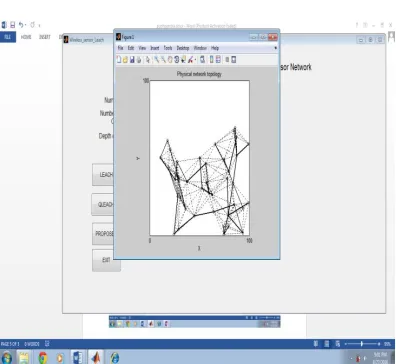
Figure: Shows that the window of Leach Method output figure 1 when we give input of number of
node, number of maximum child and depth of network.
Figure : Shows that the window of Qleach Method output figure 5 when we give input of number of node, number of maximum child and depth of network.
Figure : Shows that the window of Proposed Method output figure 1 when we give input of number of node, number of maximum child and depth of network
.
Method PDR Routing
Overhead
End_to_E nd_Delay
Hop-count
LEACH 0.1567 300 0.5500 470
Q-LEACH 0.2567 280 0.1500 460
PROPOSED 0.3567 270 0.0500 455
Table : Shows the comparative evaluation of Leach method, Qleach method and Proposed method.
Method PDR Routing
Overhead
End_to_End_ Delay
hopcount
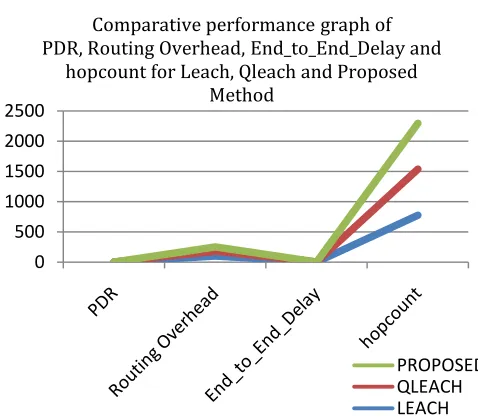
LEACH 0.7740 100 0.0059 774
QLEACH 0.8740 80 0.3941 764
PROPOSED 0.9740 70 0.5941 759
Figure : Shows the comparative performance of PDR, Routing Overhead, End_to_End_Delay and Hopcount using Leach, Qleach and Proposed Method with input value of number of node, number of maximum child (cm) and depth of network (LM).
Figure: Shows the comparative performance of PDR, Routing Overhead, End_to_End_Delay and Hopcount using Leach, Qleach and Proposed Method with input value of number of node, number of maximum child (cm) and depth of network (LM)
.
V. CONCLUSION & FUTURE WORKThis dissertation provides minimization of energy for wireless sensor network in concern of power
consumption and life time of network. The proposed models give a better energy utilization factor for wireless sensor network. The proposed model M-Q-LEACH implies in two section one is base node and another node as sensor. The sensors end request for communication for next node in installed location of BS. M-Q-LEACH is a hybrid model of very famous EM model and LEACH protocol for energy saving in wireless sensor network. Basically M-Q-LEACH work as a power filter, because in modern trend traffic apply by the flooding a power that power is consumed by sensor node. Flooding blocks a provided bandwidth of communication and our network are jam without generation of any interference attack and jamming attack. So we design strong filter for unknown control request power on the time of node mobility. In this process our methods generate a link for connecting a mobile node with their respective speed and all nodes connect our base node, basically base node is a nothing, this is a control section of M-Q-LEACH and maintains all links from mobile node. Link of synchronization provided by clock. Clock maintains network ability for all nodes during communication. If unknown mobile node sends a request to any node, node not reply, node transfer that message to chock section chock scan their power and find this is normal or abnormal and take action for blocking and generating a security alarm for all node.
References
[1] Noor Zaman, Tung Jang Low andTurkiAlghamdi “Energy Efficient Routing Protocol forWireless Sensor Network’’, ICACT,2014, Pp 51-55.
[2] Gnanambigai, N. Rengarajan and K. Anbukkarasi “An Energy Efficient Cluster Based Routing Protocol for Wireless Sensor Networks”, IEEE, 2012, Pp 570-580.
[3] SeemaBandyopadhyay and Edward J. Coyle “An Energy Efficient Hierarchical ClusteringAlgorithm for Wireless Sensor Networks”, IEEE, 2003, Pp 1713-1721.
[4] Shashidhar Rao Gandham, MilindDawande, Ravi Prakashand S. Venkatesan “Energy Efficient Schemes for Wireless Sensor Networks with Multiple Mobile Base Stations”, IEEE, 2003,Pp 3005-301-2000.
[5] Subhadra Shaw (Bose) “Energy-Efficient Routing Protocol in Wireless Sensor Network”,IJSER 2011, Pp 1-6.
[6] Siva D. Muruganathan, Daniel C. F. Ma, Rolly I. Bhasi, andAbraham O. Fapojuwo “A Centralized Energy-Efficient RoutingProtocol forWireless Sensor Networks”, IEEE, 2005, Pp 508-513.
[7] H Srikanth Kamath “Energy Efficient Routing Protocol for Wireless Sensor Networks”, ISSN, 2013, Pp 1-10.
[8] AratiManjeshwar and Dharma P. Agrawaly “APTEEN: A Hybrid Protocol for Efficient Routing and Comprehensive Information Retrieval in Wireless Sensor Networks”, IEEE2000, Pp 1-8.
[9] Wendi RabinerHeinzelman, AnanthaChandrakasan, and
HariBalakrishnan “Energy-Efficient Communication
Protocol forWireless Microsensor Networks”, IEEE, 2000, Pp 1-10.
0 200 400 600 800 1000 1200 1400 1600
Comparative performance graph of PDR, Routing Overhead, End_to_End_Delay and
hopcount for Leach, Qleach and Proposed Method
PROPOSED QLEACH LEACH
0 500 1000 1500 2000 2500
Comparative performance graph of PDR, Routing Overhead, End_to_End_Delay and
hopcount for Leach, Qleach and Proposed Method
[10] Chuan Huang, Rui Zhang, and Shuguang Cui “Optimal Power Allocation for Wireless Sensor Networks with Outage Constraint”, IEEE, 2014, Pp 3062-3080.
[11] DhirendraPratap Singh Vikrant Bhateja, andSurender Kumar Soni “Energy Optimization in WSNs employing Rolling Grey Model”, IEEE, 2014, Pp 306-311.
[12] Noor Zaman, Tung Jang Low, andTurkiAlghamdi “Energy Efficient Routing Protocol for WirelessSensor Network”, ICACT, 2014, Pp 593-597.
[13] SourourTrab,BoumedyenBoussaid, and Ahmed Zouinkhi “Energy minimization algorithm based on Bayesian approach for fault tolerant detection in wirelesssensor network”, IEEE, 2013, Pp 237-242.
[14] Min-Yi Wang, Jie Ding, Wan-Pei Chen, and Wen-Qiang Guan “A Stochastic Election Approach for Heterogeneous Wireless Sensor Networks”, IEEE, 2015, Pp 623-645. [15] Curt Schurgers, and Mani B. Srivastava “Energy Efficient
Routing In Wireless Sensor Networks”, IEEE, 2000, Pp 931-935.
[16] Eugene Shih, SeongHwan Cho, Nathan Ickes, Rex Min,Amit Sinha, Alice Wang, and AnanthaChandrakasan “Physical
Layer Driven Protocol and Algorithm Design