Economic Feasibility Analysis of Lithium Ion
Batteries for Direct Current Power Supply in
Refineries
Nkolika O. Nwazor#1, Joe Samuel Otonye*2
#
Electrical/Electronic Engineering Department University of Port Harcourt, Rivers state, Nigeria
Abstract
The lithium ion battery for energy storage is fast replacing conventional lead acid batteries of recent. This is due to its reliability, durability, cost efficiency and its less maintenance. This dissertation work looks at the economic feasibility analysis of lithium ion batteries to direct current power supply in Refineries. The Port Harcourt Refinery Company at Alesa Eleme, in Eleme Local Government Area, Rivers State of Nigeria was used as a case study. The 16 substations of Port Harcourt Refinery Company (PHRC) uses lead acid batteries. The refinery was visited and different lead acid batteries types were assessed. The cost of the substations lead acid batteries were evaluated, including maintenance and operational cost. The life cycle cost analysis tool was used to analyse and then compared the cost effectiveness of the two storage system for a period of 10 years. The results show that the 12V 200AH Genus batteries and 12V 200AH Flooded wet batteries cost amounted to ₦387.36 million ($) and ₦512.30 million ($) respectively while the 12V 200AH lithium ion batteries capital investment plus its maintenance cost amounted to ₦309.20 million ($). This result shows that using lithium ion battery as a storage device is more cost effective than the conventional lead acid batteries being used. If this analysis is projected to replace the lead acid batteries with lithium ion batteries in all the Nigeria National Petroleum Corporation (NNPC) facilities that are using lead acid batteries, the corporation will save billions of naira.
Keywords - Economic Feasibility Analysis, lithium ion, lead acid batteries, Life Cycle Analysis, Port Harcourt Refining Company PHRC.
I. INTRODUCTION
The substations in Refineries all over the world provide high and lower voltage power to the plants’ equipment. The Power Plant and Utility provides 11KV which is further step down to 415V and 230V. The lower direct current (DC) voltages are 24V DC, 48V DC, 120V DC also knows as DC control voltage for low voltage demanding equipment such as switches, motors, solenoid coil, etc. The substations use lead acid batteries for power storage. Whenever there is power outage the batteries supply DC control
voltages to the 12V DC, 24V DC, and 48V DC equipment through the uninterrupted power supply (UPS). By using these DC Voltages as a control voltage, the Company can increase reliability and safety of her equipment. One reason for this is that these power supplies operate with limiting circuits to protect against short circuits. In the event of a short, they simply shut down. They eliminate the need for fuses and the time needed to replace them. When the short is cleared, DC voltages power supplies function normally, costing the operator less downtime. The various lead acid batteries used in the power substations are the 12V 200AH Genus battery and 12V 200AH flooded wet battery. A substation has 40 pieces of batteries which are serially or parallel connected in banks. The Port Harcourt Refinery Company has about 16 substations with 640 batteries. To provide the DC Voltage power supplies, huge amount of money is being spent in providing the batteries to power the low voltages equipment in order to safe guide and increase the reliability of the plants equipment. The refinery spends millions of naira to provide these batteries for the substations, maintaining and also replacing its. Most of the batteries have shorter lifespan and required the Refinery replacing it with new ones in either two or three year’s intervals.
revenue base of the Refinery and minimize environmental pollution.
This work is on the cost analysis of genus, flooded wet lead acid and lithium ion batteries using Life cycle cost analysis (LCCA). The cost analysis is to cover for a period of 10 years.
II. LITERATUREREVIEW
Various scholars have worked on energy storage using lithium ion battery as a key area of interest. The work in [1] showed that the lithium ion batteries offered almost double the specific energy than that of nickel metal batteries used in hybrid vehicles. The cost analysis done in [2] showed that lithium ion batteries are a cost-effective alternative to lead-acid batteries when the length of operational life – total number of charge/discharge cycles – is considered. The work, [3] reported that lithium BESS can be profitable in certain cases. [4] accessed the cost and performance of the HESS side-by-side with lead acid (PbA) and lithium ion (LI) single energy storage system (SESS) configuration of comparable total energy, using expected vehicle range as the performance metric. The experimental HESS has a total projected cost midway between the SESS PbA Cost and the SESS Li cost, while providing 17% range and 23% efficiency increase over the SESS PbA Vehicle.
The research work undertaken by the various scholars pointed out that the lithium ion batteries are more economically efficient, reliable, durable, have better environmental impact, technical performance and longer lifespan. Based on these reports the dissertation work was carried out on the cost effectiveness and efficiency of the batteries used in Port Harcourt Refinery Company.
III.METHODOLOGY
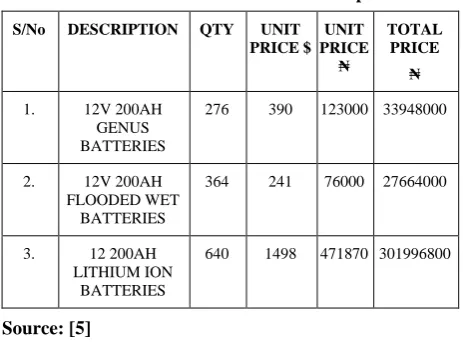
In this research work the various batteries in the PHRC power substations were accessed; the load capacity and the cost of the batteries were evaluated. The Substations are located in Port Harcourt Refining Company (PHRC), at Alessa Eleme, Eleme local Government Area, Rivers State. The batteries investment cost and their capacities are shown in table 3.1. The different batteries were sized, cost price of the batteries obtained and a lithium ion battery as an alternative was also sized and cost obtained. Cost analysis was carried out, using the life cycle cost analysis (LCCA) to assess the financial feasibility of the DC power system for a period of ten (10) years. The LCCA define the present value of capital cost, replacement cost, operational cost, and maintenance cost of a component over the project lifetime of 10 years subtracting the present values of revenues earned over the project lifetime. Sizing and costing of the Genus 12V 200AH, flooded wet acid 12V 200AH and the lithium ion battery 12V 200AH were computed. The results obtained from the three
storage batteries were used to evaluate the total numbers of batteries in the 16 substations of the PHRC and the total costs incurred by the three batteries were compared and the best option adopted.
Table 1: Different batteries and their cost prices
S/No DESCRIPTION QTY UNIT PRICE $
UNIT PRICE
₦
TOTAL PRICE
₦
1. 12V 200AH
GENUS BATTERIES
276 390 123000 33948000
2. 12V 200AH
FLOODED WET BATTERIES
364 241 76000 27664000
3. 12 200AH
LITHIUM ION BATTERIES
640 1498 471870 301996800
Source: [5]
A. Method of Data Analysis
The method applied to analyse the different types of batteries used in the PHRC substations is life cycle cost analysis tool. The tool analyses the cost of the batteries, the routine or maintenance service cost and the replacement cost, which covered for a period of ten (10) years.
B. PHRC Substation Batteries
The batteries used in the substations of the PHRC are lead acid batteries. These batteries are 12V 200AH Genus and 12V 200AH Flooded Wet batteries. Each substation has 40 pieces of the batteries arranged in banks, which are either connected serially or in parallel. Altogether we have 16 substations. These batteries supply 24V DC, 48V DC power to the uninterrupted power supply (UPS) and from the UPS to either 24V DC or 48V DC devices.
C. Life Cycle Cost Analysis for 12V, 200AH Genus Batteries(LCCAGB)
The LCCA for 12V 200AH Genus batteries considered the following variables;
• Cost of the battery and the capacity of it. • cost of routine services
• cost of life replacement of the batteries for every three years
In this cost other factors like general escalation, discounted and the present net valve of the battery was considered.
The Life Genus Battery Cost Analysis is given as:
Ge = General escalation value of 11.6% (CBN, May, 2018)
Dr = discount rate 9.0% (0.090) (CBN, May, 2018) N = the cycle period in year = 1,2,3,4,5,6,7,8,9,10 years
ACGB= Annual cost for genus battery.
Using (2):
TABLE 2:LCCAGB OF GENIUS BATTERY FOR10 YEARS
1) LCCA of Routine Service for Genus Battery.
The genus battery has zero maintenance. Therefore, the life cycle cost for routine service for the genus battery is approximately zero.
2) Life Replacement Cost of Genus Batteries
These costs involve total replacement of the batteries after use for an interval of three years. Replacement takes place every three (3) years. The replacement cost includes the battery cost, transportation cost and the installation cost.
LGBRC = AGBRC
(3)
Where, LGBRC= life genus battery replacement cost.
Ge = escalation rate 11.6% D = Discount rate = 9.0%
N = life generator cycle period.
But, annual genus battery replacement cost,
AGBRC =
(4)
Installation and transportation cost is assumed to be 0.5% of the total cost of the batteries.
That is, 0.005 ×33948000 = ₦169740
Therefore,
AGBRC =
= ₦11372577.
Therefore, the life replacement cost for the period of 10 years is calculated using excel spreadsheet.
D. Life Cycle Cost Analysis for 12V, 200AH Flooded Wet Batteries(LFBC)
Flooded Lead Acid batteries are the most commonly found lead acid battery type and are widely used in the automotive industry. Normal flooded batteries require extra care and regular maintenance in the form of watering, equalizing charges and keeping the terminals clean
The LCCA for 12V 200AH Flooded Wet batteries look at area such as;
Cost of the battery and the capacity of it. cost of routine services (maintenance cost) cost of life replacement of the batteries for
every two years
The Life Flooded Wet Battery Cost is given as
)
Where LCFBC = life cycle flooded wet battery cost Ge = General escalation value of 11.6% (CBN, May, 2018)
Dr = discount rate 9.0% (0.090) (CBN, May, 2018) N = the cycle period in year = 1,2,3,4,5,6,7,8,9,10 years
AGBC= Annual flooded wet battery cost.
(6)
Using the formula (6)
The LCCA of flooded wet battery for a period of 10 years is calculated with the aid of excel spreadsheet.
1)LCCA of Routine Service for Flooded Wet Battery
The routine services take place in every 1464hours (2 months) of operation. This includes filling the batteries with distilled water (watering), equalizing the concentrated sulphuric acid level, physical inspection of the battery, and system electrical connections. The expense of the routine service is assumed to be 1% of the total batteries cost price.
Therefore, the routine service cost is 1% of ₦27664000
That is, RSC = 1% of ₦2766400 = ₦276640
But routine service takes place in every 1464 hours. For a year service, the routine service time will be
No. of years (N) LGBC battery ₦
1 34757768
2 70344622
3 106780335
4 144085158
5 182279821
6 221385549
7 261424074
8 302417646
9 344389047
hours = 6times.
Therefore, the annual service cost (ASC) will be
ARSC = ₦276640 x 6= ₦1659840
Looking at the life routine service cost for a cycle period of 10 years.
LRSC = ARSC (7)
LRSC=₦1659840
(8)
TABLE 2:LRSC OF FLOODED WET BATTERY FOR10 YEARS
2)Life Replacement Cost of Flooded Wet Batteries
These costs involve total replacement of the batteries after usages for two years.
Replacement takes place in every two (2) years.
LFBRC = AFBRC
(9)
Where, LFBRC= life flooded wet battery replacement cost.
Ge = escalation rate = 11.6% D = Discount rate = 9.0% N = life generator cycle period.
But, annual flooded wet battery replacement cost, AFBRC
=
Installation and transportation cost is assumed to be 0.5% of the total cost of the batteries.
That is, 0.005 ×27664000 = ₦138320
=
AFBRC = ₦13901160.
Therefore, the life replacement cost for the period of 10 years was calculated using excel spreadsheet.
E. Life Cycle Cost Analysis for 12V, 200AH Lithium Ion Batteries (LLBC)
The 12V 200AH Lithium Ion Battery features an automatic built in battery protection system (BPS) that keeps the battery running at peak performance and protects the cells for thousands of cycles. The SB200 is plug and play for any application that currently uses a lead acid or gel battery. It has Low Maintenance Cost, maintenance free, centralized monitoring and module installation also to reduce cost for transportation. The life span of the battery is 12 years.
The LCCA for 12V 200AH lithium ion batteries analysis the following:
Cost of the battery and the capacity of it. Cost of routine services
Cost of life replacement of the batteries for every 10 years
The life Cycle Cost Analysis of the battery is stated below:
LLBC=ALBC (10)
Where LLBC = life cycle lithium ion battery cost Ge = General escalation value of 11.6% (CBN, 2018)
Dr = discount rate 9.0% (0.090) (CBN, 2018)
N = the cycle period in year = 1,2,3,4,5,6,7,8,9,10 years
ALBC= Annual lithium ion battery cost. Using equation (2),
Therefore, the life replacement cost for the period of 10 years was calculated using excel spreadsheet. From the excel spreadsheet calculation, the replacement cost of the batteries from year two to year ten is zero because the battery was not replaced throughout the period.
1) LCCA of Routine Service for Lithium ion Battery
The lithium ion battery is a maintenance free battery. Its maintenance cost is zero and therefore the routine service cost is zero.
2)Life Replacement Cost of Lithium Ion Batteries
The lithium ion battery has a life span of about 12 years. Since the battery life span is about 12 years, it does not required replacement. The comparison among the batteries is within 10 years and the lithium ion battery life span is above the considered 10 years. Therefore, the replacement cost is zero.
Number of Year LRSCfloodedwet
1 1699433
2 3439402
3 5220875
4 7044842
5 8912317
6 10824337
7 12781965
8 14786288
9 16838421
3)Total Life Replacement Cost of Lithium Ion Batteries
This is the sum total of the life replacement made in 12V 200AH genus battery, 12V 200AH flooded battery and 12V 200AH lithium ion battery. That is, Total life replacement cost (LRC) =
LRCGENUS + LRCFLOODED + LRCLITHIUM
Where, LRCGENUS = ₦194649204
LRCFLOODED =₦177701621
LRCLITHIUM = ₦0.00
Therefore, LRC = ₦ (194649204 + 177701621 + 0.00 = ₦372350825
IV.RESULTS
The investment costs of the 12V 200AH Genus batteries and 12V 200AH Flooded Wet battery used in the PHRC substations give ₦33948000 and ₦27664000 respectively, for a total of 276 Genus batteries and 364 Flooded Wet batteries used in the 16 substations of PHRC. The batteries considered to replace the 640 lead acid batteries are 640 lithium ion batteries of capacity 12V 200AH with investment cost of ₦301996800. The economic feasibility of the system was analysed using an economic tool known as ‘Life Cycle Cost Analysis’. This tool was utilized to determine the cost effectiveness of using 12V 200AH Genus battery, 12V 200AH Flooded Wet battery or 12V 200AH Lithium ion battery to supply DC control voltages - 12V DC, 24V DC and 48V DC system to the PHRC substations. The costs of the Genus battery, flooded battery and Lithium ion battery were analysed over a period of 10 years. The future costs were estimated to their present worth values. Looking at the graph in figure 1, the initial investment cost of the Genus battery and Flooded battery is ₦33,948,000 and ₦27,664,000 respectively while the Lithium ion battery is ₦301,996,800. Expressing it in percentage, the investment cost of Genus and Flooded batteries is about 16.3% while the lithium ion battery is about 83.7%. That is, the initial investment cost of lithium ion battery is about 83.7% higher than the initial investment cost of the Genus battery and the Flooded Wet battery. As the time progresses other factors such as routine service cost (maintenance cost) and batteries replacement cost increased the investment cost for the Genus battery and the flooded wet battery fig.1.
For the lithium ion battery investment cost, the initial capital cost in year 1 is very high due to high quality of the battery and it is the latest. It is also being imported. From year 2 up on the cost incurred in routine services and replacement is zero or nearly zero for the period under consideration due to zero maintenance advantages while the Genus battery and the Flooded wet battery cost increases arithmetically as result of routine service and replacement. In comparing the investment cost of Genus battery, flooded wet battery and the Lithium ion battery as
Fig. 1 Cost comparison among the genus, flooded and lithium ion batteries (cost in millions naira)
Fig. 2 Bar chart of cost comparison among the genus, flooded and lithium ion batteries (cost in millions naira)
YEAR COST
V. CONCLUSIONS
The dissertation work investigated the PHRC 16 substations lead acid batteries cost effectiveness. The capital and operational cost of using the 12V 200AH Genus battery and 12V 200AH Flooded wet battery were evaluated. The costs of using equivalent capacity lithium ion batteries as an alternative were also evaluated. Cost analysis was carried out on the lead acid batteries and the lithium ion batteries. Using an economic tools known as life cycle cost analysis to evaluate the cost efficiency of the two powering system for a period of 10 years.
The outcome of this research work reveals that the 12V 200AH Lithium ion battery is more cost effective than the 12V 200AH flooded Wet battery and 12V 200AH Genus battery for energy store, the lithium ion battery has a high up-front capital cost but almost zero maintenance cost when compared to the Flooded Wet and Genus batteries. In fig.1, considering year2 to year10 the running cost incurred by using flooded wet battery and Genus battery is by far greater than the running cost incurred by using lithium ion battery. At year 10 (the breakeven point) the costs of flooded wet and Genus lead acid batteries overshoot the cost of lithium ion battery, making lithium ion battery a best option for storing the DC energy for the substations. This is as a result of its cost effectiveness in a long run. Apart from the initial high investment cost for the lithium ion battery, it is humanly and environmentally friendly. The batteries are not yet available in the Nigeria markets as in commercial quantities. Availability is based on demand and importation. That increases the capital cost of procuring the batteries. When the batteries will be available in commercial quantities, the price of the battery is expected to reduce as a result of demand and supply theory.
No matter the high initial investment cost it is considered to be a good replacement for the storage of the DC energy in the PHRC substations. The lead acid batteries (flooded wet and Genus batteries) is faced with some challenges like constants replacement, operation and maintenance cost, environmental and human damages as a result of filling the battery with distilled water and concentrated sulphuric acid. Such challenges generally increase the running cost and thereby affect the revenue base of the Refinery.
Apart from the long run cost advantage, the investment in lithium ion battery will go a long way to reduce environmental pollution and increase energy efficiency.
From the analysis, the lithium ion battery is a better alternative to other lead acid batteries.
REFERENCES
[1] Mehul Oswai, Jason Paul and Runha Zhao, A Comparative
Study of Lithium Ion Batteries, AME 578 Project,
University of Southern California,
http://www.ehcar.net/library/rapport/rapport204.pdf [2] Keshan, Hardik & Thornburg, Jesse & Ustun, Taha Selim.
(2016). Comparison of lead-acid and lithium ion batteries for stationary storage in off-grid energy systems. 30 (7 .)-30 (7 .). 10.1049/cp.2016.1287.
[3] Eduard Ignatev ‘Performance Degradation Modeling and Techno- Economic Analysis of slithium ion battery energy
storage systems, 2016
https://www.semanticscholar.org/paper/PERFORMANCE- DEGRADATION-MODELLING-AND-TECHNO-OF-
Ignatev-Partanen/317eae169b77da039a4e278012d2ca28768ea6c6 [4] Steven Chung (2016) ‘Hybrid Lead Acid/ Lithium Ion
Energy Storage System with Power-Mix Control for Light
Electric Vehicles.
https://tspace.library.utoronto.ca/bitstream/1807/74577/2/Ch ung_Steven_20169_MASc_thesis_first.pdf
[5] https://www.jumia.com.ng/inverters/genus/. (Accessed