1535-9778/11/$12.00 doi:10.1128/EC.00257-10
Copyright © 2011, American Society for Microbiology. All Rights Reserved.
Adjacent Gene Pairing Plays a Role in the Coordinated Expression of
Ribosome Biogenesis Genes
MPP10
and
YJR003C
in
Saccharomyces cerevisiae
䌤
James T. Arnone and Michael A. McAlear*
Department of Molecular Biology and Biochemistry, Wesleyan University, Middletown, Connecticut 06459
Received 8 October 2010/Accepted 15 November 2010
The rRNA and ribosome biogenesis (RRB) regulon fromSaccharomyces cerevisiaecontains some 200 genes, the expression of which is tightly regulated under changing cellular conditions. RRB gene promoters are enriched for the RRPE and PAC consensus motifs, and a significant fraction of RRB genes are found as adjacent gene pairs. A genetic analysis of theMPP10promoter revealed that both the RRPE and PAC motifs are important for coordinated expression ofMPP10following heat shock, osmotic stress, and glucose replen-ishment. The association of the RRPE binding factor Stb3 with theMPP10promoter was found to increase after glucose replenishment and to decrease following heat shock. Similarly, bulk histone H3 clearing and histone H4K12 acetylation levels at theMPP10promoter were found to increase or decrease following glucose replenishment or heat shock, respectively. Interestingly, substitutions in the PAC and RRPE sequences at the MPP10promoter were also found to impact the regulated expression of the adjacent RRB geneYJR003, whose promoter lies in the opposite orientation and some 3.8 kb away. Furthermore, the regulated expression of YJR003Ccould be disrupted by inserting a reporter cassette that increased its distance fromMPP10. Given that a high incidence of gene pairing was also found within the ribosomal protein (RP) and RRB regulons across different yeast species, our results indicate that immediately adjacent positioning of genes can be functionally significant for their coregulated expression.
Cell growth and division are tightly regulated processes that depend upon the proper sensing and integration of environ-mental cues, coupled with the appropriate balancing of meta-bolic pathways necessary to maintain viability and to meet the complex biosynthetic demands of cellular duplication. In the
budding yeastSaccharomyces cerevisiae, favorable conditions
(i.e., when carbon and nitrogen sources are plentiful) lead to the activation of the Ras/PKA and TOR pathways (reviewed in references 31 and 43), which promote cell growth and division, in part, through their activation of the Sch9 kinase and Sfp1 (4, 8, 35). These pathways ultimately target and activate factors that alter the expression of up to 40% of the genome, including the upregulation of over 1,300 gene targets (23, 39). Broadly defined, there is a global upregulation of genes whose products increase the translational capacity within the cell (43). Con-versely, environmental stresses downregulate these same path-ways, thereby allowing cells to divert resources to maintain homeostasis (11).
One of the major targets of this global regulation is the metabolic machinery responsible for the production of ribo-somes. Dividing cells have an increased demand for protein production, and this demand is met by a concomitant increase in ribosome production (21, 28). Rapidly growing yeast cells produce approximately 2,000 of the roughly 4.5-MDa ribo-somes every minute (26, 41), which requires the 137 genes that encode the 79 ribosomal proteins (RPs), some 200 rRNA and
ribosome biogenesis (RRB) genes (38), and the rRNA genes themselves. All three RNA polymerases are required for this process, and together, ribosome production accounts for some 60% of the total transcription events in a dividing yeast cell (41). In addition to the bulk requirement for the synthesis of these varied gene products, cells need to carefully coordinate the levels of production, since ribosomes require equimolar amounts of the RPs and rRNAs. One of the major points of regulation of this pathway is at the level of transcription.
It has long been recognized that the members of the RP regulon are transcriptionally regulated as a group in response to changing cellular conditions (reviewed in reference 40). RP promoters have been characterized and found to be enriched for binding sites for Abf1 or Rap1, and they are bound by the transcriptional activators Fhl1, Ifh1, Hmo1, and Sfp1 (re-viewed in reference 21). Previously, we identified and charac-terized the genes from the distinct RRB regulon (also known as the Ribi regulon), members of which include the proteins involved in the production and modification of the 4 rRNAs as they are assembled into ribosomes. Expression of the members of the RRB regulon is tightly regulated across changing cellu-lar growth conditions (16, 37, 38) in a manner that is related to, yet distinct from, that involved in the RP regulon. There are two highly conserved motifs within the promoter regions of members of the RRB gene set: the polymerase A and C (PAC) motif (6) and the rRNA-processing element (RRPE) (14, 33, 37, 38). These motifs have been found to regulate the tran-scription of RRB and reporter genes in plasmid-based reporter constructs (8, 30, 37). Neither motif on its own appeared to confer any basal level of transcription; however, both motifs can increase transcription in combination with an upstream activating sequence (30). Recently, a series of screens has
* Corresponding author. Mailing address: Department of Molecular Biology and Biochemistry, Wesleyan University, Middletown, CT 06459-0175. Phone: (860) 685-2443. Fax: (860) 685-2141. E-mail: [email protected].
䌤Published ahead of print on 29 November 2010.
43
on September 8, 2020 by guest
http://ec.asm.org/
identified the long sought after binding factors for the RRPE and PAC motifs. Stb3 (Sin three binding protein) has been identified as the RRPE binding factor, and increased Stb3 binding to RRPE-containing promoters is associated with in-creased expression (23). Pbf1 (Tod6) and Pbf2 (Dot6) were identified by two independent groups as the PAC binding fac-tors (9, 44). Both facfac-tors have been shown to play nonredun-dant roles in the transcriptional repression of RRB genes; however, strains bearing deletions in both genes still maintain an attenuated transcriptional repression in response to stress (24).
One of the remaining challenges involved in understanding how ribosome production is controlled lies in connecting the
environmental sensing pathways to the cis- and trans-acting
factors that regulate RP and RRB gene expression. Presum-ably, changing cellular conditions (i.e., nutrient changes or stress) will trigger the relevant signal transduction pathways to engage mechanisms to coordinately and appropriately regulate the expression of the hundreds of RRB and RP genes. For example, when starved yeast cells are prompted to enter a growth phase by the addition of glucose, their genome under-goes significant changes that modulate transcription levels, in-cluding the modification of histone tails (10). Decreasing the acetylation of histone proteins can result in the repression of transcription, and increasing acetylation increases expression (12, 19). The global increase in the acetylation of histone 4 and histone 3 residues is due to the activities of two lysine acetyl-transferases, Esa1 and Gcn5 (10). Likewise, the transcriptional repression achieved during stress involves the activity of the Rpd3 histone deacetylase (HDAC). Rpd3 is recruited to the promoters of repressed genes during stress, and its activity is required for transcriptional repression of RRB genes during the stress response (1, 15). Targeted deacetylation of a pro-moter can create a repressed transcriptional domain within a euchromatic region, which can then allow rapid reactivation of transcription (25). Specific changes in histone acetylation can allow for the differential binding of factors such as the Swi/Snf complex and TFIID, which lead to the recruitment of RNA polymerase II and increased transcription (19). In this way, these changes can modulate the expression of genes that allow rapid growth, including the genes whose transcripts result in the production of ribosomes (21, 43).
An interesting observation that came out of the initial char-acterization of the RRB regulon was the discovery that RRB genes are disproportionately found as adjacent gene pairs (38). Others have noted that adjacent genes that are involved with the same cellular processes are frequently coexpressed (3). Coexpression of adjacent genes could be correlated with the presence of shared upstream activating sequences that were
presumed to exert a regional effect, sometimes across a con-siderable distance (5). However, the significance of these ob-servations and the mechanisms involved need to be further investigated experimentally.
In the present work, we studied the roles that the RRPE and
the PAC elements playin vivoin the regulated expression of
the adjacent RRB gene pairMPP10-YJR003C. We observed
that the PAC and RRPE motifs from the MPP10promoter
were not only important for the regulated expression of the
MPP10gene under changing cellular conditions, they were also
important for the coordinated regulation of the convergently
oriented adjacent geneYJR003C. Coregulation of theMPP10
andYJR003Cgenes could also be interrupted by separating the
two genes with the pCORE reporter cassette. The high inci-dence of adjacent-gene pairing within the RRB and RP regu-lons across divergent yeast species suggests that relative gene positioning may play an important role in their transcriptional coregulation.
MATERIALS AND METHODS
Yeast strains.A complete list of all strains used in this study, as well as their relevant genotypes, is included in Table 1. Strain YMM13 (MATa leu2⌬1 trp1⌬63 ura3-52) was used as a wild type and is the parent strain used to generate theMPP10promoter mutants. The mutations in the promoter ofMPP10were generated using thedelitto perfettomethod (32), where the promoter ofMPP10
was replaced by homologous recombination with a PCR fragment that contained homology to the region flanking theKANr
andURA3genes. This cassette was subsequently replaced by a homologous region of theMPP10promoter, intro-ducing an XhoI restriction site into the RRPE motif (YMM547), an AatII restriction site into the PAC motif (YMM549), or both restriction sites (YMM514). Strain YMM553 was generated using thedelitto perfettomethod, this time targeting the intergenic region between MPP10 andYJR003C. Strain YMM539 was purchased from Open Biosystems.
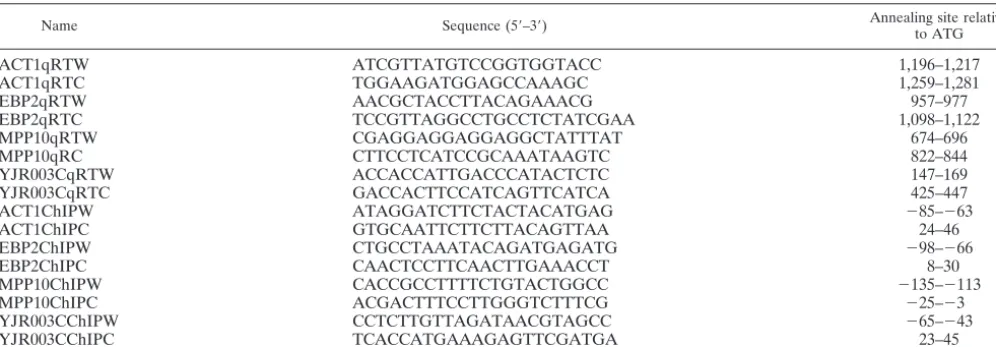
A complete list of the oligonucleotide primers used in this study is provided in Table 2. The primers are named according to their targeted gene, the strand and position that they anneal to (W or C), and whether they were used for mRNA expression studies (quantitative reverse transcription [qRT]) or chromatin im-munoprecipitation (ChIP) assays. ChIP analysis of genomic coding regions was performed using the same primers as for the qRT analysis.
Culture conditions for environmental response.Strains were grown in YPD (1% yeast extract, 2% peptone, 2% dextrose) medium either to early to mid-log phase (optical density at 600 nm [OD600]⫽0.40 to 0.90) for stress induction or
for 72 h (past the diauxic shift) for glucose replenishment. A heat shock time course was induced by growing cultures at 30°C and transferring cells to 37°C medium (11). An osmotic shock was induced by growing cultures at 30°C and adding sorbitol to a final concentration of 1 M (11). Glucose replenishment was performed by adding glucose to a final concentration of 2% (11, 23).
Calculating the statistical significance of gene adjacency. The rRNA and ribosome biogenesis regulon inS. cerevisiaewas defined as described previously (38) and consists of 188 genes. We searched for homologues inCandida albicans
andSchizosaccharomyces pombeand identified 168 and 97 RRB genes, respec-tively. Ribosomal proteins were defined as all genes whose products are consid-ered structural components of the ribosome (both cytosolic and mitochondrial). There were 180 (S. cerevisiae), 118 (C. albicans), and 166 (S. pombe) genes identified in each species. The total number of genes used in the calculations
TABLE 1. Yeast strains used in this study
Strain Promoter of
MPP10 Genotype Source
YMM13 Wild type MATaleu2⌬1 trp1⌬63 ura3-52 37
YMM547 ⌬RRPE MATaleu2⌬1 trp1⌬63 ura3-52 This study
YMM549 ⌬PAC MATaleu2⌬1 trp1⌬63 ura3-52 This study
YMM514 ⌬RRPE⌬PAC MATaleu2⌬1 trp1⌬63 ura3-52 This study
YMM539 Wild type MATahis3-1 leu2-0 met15-0 ura3-0 STB3-TAP::HIS3 Open Biosystems YMM553 Wild type MATaleu2⌬1 trp1⌬63 ura3-52 MPP10::KANr::URA3 This study
on September 8, 2020 by guest
http://ec.asm.org/
included all verified genes in each organism but did not include those that are considered dubious open reading frames. This left us with a total of 5,797 (S. cerevisiae), 6,017 (C. albicans), and 4,970 (S. pombe) genes. The probability that there would bejadjacent genes within a regulon ofMgenes was as follows:
1 ⫺
冘
k⫽0j
冉
M!k!共M⫺k兲!
冊
共pk共1 ⫺p兲M⫺k兲
wherepis equal to (M/N)(2⫺M/N) andNis the total number of genes present within each species. The functionalPvalues were calculated in Mathematica.
RNA preparation and expression analysis.A complete list of oligonucleotides used in this study is provided in Table 2. Aliquots of yeast were obtained across a time coursed and washed at 4°C to remove the medium, and RNA was obtained by a hot acid phenol extraction (2) with the following modifications. Samples were extracted twice with phenol and once with chloroform and then ethanol precipitated prior to resuspension in diethyl pyrocarbonate (DEPC) water. Ten micrograms of RNA was cleared of genomic contaminants by treatment with DNase I according to the manufacturer’s instructions (DNA-free; Ambion) and were checked by PCR using primers directed to theACT1coding region. cDNA was generated with oligo(dT) primers using the Retro-script kit according to the manufacturer’s instructions (Ambion). Linear conditions were identified by the titration of cDNA template for PCR, followed by native PAGE. Quantitative PCR (qPCR) was then performed across the time course, and the products were analyzed by native PAGE stained with Sybr Gold (Invitrogen). Images were obtained on either a Typhoon or a Storm phosphorimager scanner (Molecular Dynamics) and quantified using the manufacturer’s ImageQuant software. Each expression profile represents the normalized average (toACT1) of at least six qPCRs from at least two independent RNA extractions⫾standard error (SE).
Chromatin immunoprecipitation. Yeast cultures were grown as described above, and chromatin was immunoprecipitated as described in reference 34 with the following modifications. Cells were cross-linked in 1% formaldehyde for 30 min at room temperature and quenched with 333 mM glycine for 15 min. Samples were washed twice in cold phosphate-buffered saline (PBS) and resus-pended in high-salt lysis buffer (50 mM HEPES-KOH, 500 mM NaCl, 1% Triton X-100, 0.1% Na deoxycholate, 0.1% SDS, 1 mM EDTA) supplemented with protease inhibitors (Protease Inhibitor Cocktail Set 1; Calbiochem). The cells were lysed by vortexing them with an equal volume of glass beads, and chromatin was sheared by sonication to an average size of approximately 400 to 600 bp. Cellular debris was cleared by centrifugation, and the lysate was transferred to a fresh tube.
Lysates of 50l were precleared with magnetic protein A beads (New England Biolabs) prior to immunoprecipitation. Histones were immunoprecipitated with antibodies specific for total (bulk) histone H3 (Abcam; catalog no. AB1791), H4K12Ac (Abcam; catalog no. AB1761), or H4K16Ac (Millipore; catalog no. 07-329) and STB3p-TAP was immunoprecipitated with an anti-TAP tag antibody (Open Biosystems; catalog no. CAB1001) at 4°C overnight. Immune complexes were harvested by incubating them with protein A magnetic beads, washed twice with high-salt lysis buffer and once with wash buffer (10 mM Tris-HCl, pH 8.0, 250 mM LiCl, 0.5% NP-40, 0.5% Na deoxycholate, 1 mM EDTA), and once with
TE (50 mM Tris, pH 8.0, 10 mM EDTA). DNA was eluted into 30l elution buffer (50 mM Tris, pH 8.0, 10 mM EDTA, 1.0% SDS), and cross-links were reversed by incubation at 65°C overnight.
Samples were purified by extraction twice with phenol-chloroform–isoamyl alcohol and once with chloroform and then ethanol precipitated with glycogen as a carrier. Samples were then resuspended in Tris-EDTA (TE) and diluted 100-fold. Linear conditions were identified as described above. Enrichment of a fragment was determined by calculating the abundance in the immunoprecipi-tated fraction and subtracting the presence in the no-antibody control and is presented as a ratio with the abundance in the whole-cell lysate. Each graph is the normalized average (to a corresponding fragment of theACT1promoter or coding region) of 3 or 4 qPCRs performed on 2 or 3 independent ChIP exper-iments⫾standard deviation (SD).
RESULTS
The RRPE and PAC motifs are not essential for basal MPP10 expression. The RRB regulon consists of some 200 transcriptionally coregulated genes, and their products func-tion at various levels of the rRNA and ribosome biosynthesis pathways. Interestingly, an unusually large fraction (15%) of the RRB genes exist as immediately adjacent gene pairs, in-cluding pairs of genes that are present in divergent, tandem, and convergent gene orientations (37). RRB gene expression is tightly regulated in response to changing cellular conditions, and RRB gene promoters are enriched for the RRPE and PAC promoter motifs. In order to determine the roles that these promoter motifs play in regulating RRB gene expression in vivo, we created a series of isogenic yeast strains that con-tained mutations in one or both of these motifs. We chose the
adjacent RRB gene pairMPP10andYJR003Cfor this analysis
because it allowed us to simultaneously investigate the func-tional significance, if any, of the immediate adjacency of co-regulated and divergent RRB gene pairs. The two genes
ex-hibit similar expression levels, and theMPP10gene promoter
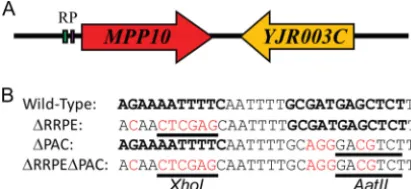
contains sequences matching the PAC and RRPE motif con-sensus sequence between bases 63 and 94 upstream of the
initiator ATG, but theYJR003Cpromoter does not (Fig. 1). To
investigate the activities of these promoter sequences, the
delitto perfettoapproach (32) was used to engineer substitutions
into the RRPE and PAC motifs, respectively, from within the
promoter of theMPP10gene. Each of the strains was created
by alternately integrating and then excising the pCORE
cas-TABLE 2. Oligonucleotides used in this study
Name Sequence (5⬘–3⬘) Annealing site relative
to ATG
ACT1qRTW ATCGTTATGTCCGGTGGTACC 1,196–1,217
ACT1qRTC TGGAAGATGGAGCCAAAGC 1,259–1,281
EBP2qRTW AACGCTACCTTACAGAAACG 957–977
EBP2qRTC TCCGTTAGGCCTGCCTCTATCGAA 1,098–1,122
MPP10qRTW CGAGGAGGAGGAGGCTATTTAT 674–696
MPP10qRC CTTCCTCATCCGCAAATAAGTC 822–844
YJR003CqRTW ACCACCATTGACCCATACTCTC 147–169
YJR003CqRTC GACCACTTCCATCAGTTCATCA 425–447
ACT1ChIPW ATAGGATCTTCTACTACATGAG ⫺85–⫺63
ACT1ChIPC GTGCAATTCTTCTTACAGTTAA 24–46
EBP2ChIPW CTGCCTAAATACAGATGAGATG ⫺98–⫺66
EBP2ChIPC CAACTCCTTCAACTTGAAACCT 8–30
MPP10ChIPW CACCGCCTTTTCTGTACTGGCC ⫺135–⫺113
MPP10ChIPC ACGACTTTCCTTGGGTCTTTCG ⫺25–⫺3
YJR003CChIPW CCTCTTGTTAGATAACGTAGCC ⫺65–⫺43
YJR003CChIPC TCACCATGAAAGAGTTCGATGA 23–45
on September 8, 2020 by guest
http://ec.asm.org/
sette and plating it on the appropriate medium. The final strains contained short substitutions within the RRPE and PAC motifs that also introduced new DNA restriction sites. The integrity of the promoter motif substitutions was verified by restriction digests of PCR products that spanned the pro-moter regions.
TheMPP10gene encodes an essential protein component of
the U3 snoRNP, and disruption analysis indicated that Mpp10 functions in processing of the 18S pre-rRNA at sites A0, A1, and A2 (7). Given that the strains harboring the RRPE and PAC substitutions were viable, the two promoter elements
were not essential for basalMPP10expression. We did,
how-ever, observe that strains bearing substitutions in the PAC and RRPE motifs increased the generation time from 90 min for the wild-type strain (YMM13) at 30°C to 95 min for strains
YMM547 (⌬RRPE) and YMM514 (⌬RRPE⌬PAC), and to
115 min for strain YMM549 (⌬PAC). mRNA levels were also
measured in log-phase cell cultures by reverse transcription followed by quantitative PCR (RT-qPCR) to quantify the
rel-ative steady-state levels of expression of MPP10, YJR003C,
EBP2, and ACT1. The basal expression of MPP10 and
YJR003C(compared to theACT1control) was diminished in
the mutant strains, but on average by only 2- to 3-fold (data not shown).
The RRPE and PAC motifs from theMPP10promoter func-tion in the regulated expression of bothMPP10andYJR003C in vivo. It has long been recognized that the members of the RRB regulon are transcriptionally coregulated across many changing cellular conditions, including heat shock, osmotic stress, and glucose replenishment (11, 37). Because the RRB gene promoter sequences presumably regulate this response to
changing cellular conditions, we monitored MPP10 and
YJR003Cexpression levels in our RRPE and PAC substitution
strains. The expression level of theACT1gene was measured
as an internal control, and we also monitored the expression of EBP2, an independent RRB gene containing both RRPE and PAC promoter motifs. To measure the characteristic induction of expression following glucose replenishment, the strains were grown in YPD medium for 72 h, followed by the addition of glucose. Expression levels were monitored at 10-min intervals following glucose addition by RT-qPCR, and they were
nor-malized toACT1levels. In the wild-type strain, we could
ob-serve the characteristic boost in expression for the three RRB
genesEBP2,MPP10, andYJR003Cbeginning at 10 min (Fig.
2A). This induction of expression was eliminated for the
MPP10 gene in each of the three strains containing either
single or double RRPE and PAC substitutions, indicating that
these motifs do play a critical rolein vivo. Interestingly, these
short substitutions within the MPP10 RRPE and PAC
pro-moter motifs were also found to impact the activation of the
adjacentYJR003Cgene, to the point of eliminating induction
altogether in the⌬PAC and⌬RRPE⌬PAC strains (Fig. 2B to
D). These changes in regulated expression were not due to a global impact on RRB gene regulation, because in each strain the characteristic transient upregulation of expression was
maintained for theEBP2gene.
In order to test the roles that the RRPE and PAC promoter motifs may play in the regulated repression of RRB genes, the same strains were monitored for changes in expression levels following heat shock. The strains were grown at 30°C in YPD and shifted to 37°C, and aliquots of cultures were taken for RT-qPCR analysis for up to 30 min (Fig. 2E to H). Again, the characteristic decline in expression levels was observed for all
three RRB genes (EBP2, MPP10, andYJR003C) in the
wild-type strain (Fig. 2E) and for theEBP2gene in all four different
strains. Substitutions within the RRPE and PAC promoter
motifs fromMPP10were found to significantly abrogate the
heat shock-induced repression of theMPP10gene either singly
or when combined, indicating that these motifs are important for regulating gene repression, as well as activation. Notably,
once again, we observed that the substitutions in theMPP10
promoter also impacted the regulated repression of the
adja-cent gene,YJR003C, this time most profoundly in the⌬RRPE
and⌬RRPE⌬PAC strains (Fig. 2F to H).
Hyperosmotic stress is also known to trigger the regulated repression of RRB genes through the activation of signaling pathways that are distinct from the heat shock response (13). To test whether the RRPE and PAC promoter motifs may be involved in this pathway as well, the four strains were grown to mid-log phase and then sorbitol was added to a final concen-tration of 1 M. Relative expression levels were monitored by RT-qPCR for up to 1 h after the hyperosmotic shock. The
EBP2,MPP10, and YJR003Cgene expression levels were all
found to fall upon osmotic shock, as did theEBP2expression
profile in all four strains. The RRPE and PACMPP10
pro-moter motif substitutions were found to disrupt this regulated decrease in expression, either on their own or in combination,
for both the MPP10 and YJR003C genes (data not shown).
Thus, the PAC and RRPEMPP10promoter motifs not only
play an important rolein vivofor the regulated induction and
repression of theMPP10gene, they also play important roles in
the regulated expression of the adjacent RRB gene,YJR003C,
whose promoter is orientated in the opposite direction and is situated some 3.8 kb away.
Disruption of the adjacency of the MPP10-YJR003C gene pair interferes with their transcriptional coregulation.In or-der to test whether the transcriptional coregulation of the
MPP10-YJR003C gene pair was related to their immediate
adjacency, we engineered a strain that separated the two genes.
To do this, we used the pCORE cassette from the delitto
perfettoapproach to introduce a 3.2-kbKANr-URA3construct
at a position midway between the stop codons of theMPP10
andYJR003Cgenes (Fig. 3A). The integrity of the disrupted
FIG. 1. Mutant construction at the MPP10-YJR003C locus. (A) Relative positions of the RRPE (R) and PAC (P) motifs with respect to theMPP10-YJR003Cgene pair. (B) Sequences of the re-spective promoter regions from bases⫺95 to⫺62 upstream of the coding region forMPP10. The intact promoter motifs are highlighted in boldface, mutated bases are in red, and the restriction sites are underlined.
on September 8, 2020 by guest
http://ec.asm.org/
strain was verified by selective plating and PCR analysis, and it was subjected to expression analysis under changing cellular
conditions. Whereas the MPP10 and EBP2 genes exhibited
similar and characteristic repression responses to heat shock
and osmotic shock, the expression profile of theYJR003Cgene
was significantly disrupted when it was separated from the
MPP10gene (Fig. 3B and C). The response to glucose
replen-ishment was also measured in this strain, and whereas the
EBP2 and MPP10 activation profiles were very similar, the
activation profile of theYJR003Cgene was somewhat
dimin-ished (Fig. 3D). Therefore, the regulated expression of YJR003C, particularly with regard to stress-induced repression, not only depends on the PAC and RRPE motifs from the
MPP10 gene promoter, it also depends upon its immediate
FIG. 2. RRPE and PAC motifs in the promoter ofMPP10mediate the transcriptional response of bothMPP10andYJR003Cto changing environmental stimuli. Gene expression profiles were monitored after glucose replenishment following the diauxic shift in wild-type (A),⌬RRPE (B),⌬PAC (C), and⌬RRPE⌬PAC (D) and following a 30°C to 37°C heat shock in wild-type (E),⌬RRPE (F),⌬PAC (G), and⌬RRPE⌬PAC (H)MPP10promoter strains. The error bars indicate standard errors.
on September 8, 2020 by guest
http://ec.asm.org/
positional adjacency to MPP10. The insertion of the 3.2-kb fragment of the pCORE cassette (which contains two tran-scription units) appears to uncouple the coregulation of the
YJR003C gene from that of MPP10 and the standard RRB
gene response, even though the promoter sequences, coding
region, and 150 bp of the 3⬘untranslated regions ofYJR003C
were unchanged.
Binding of Stb3p to RRPE-containing promoters varies in response to cellular stresses.Although the RRPE and PAC promoter motifs were first described many years ago (6, 14), it is only recently that their respective binding proteins have been
identified: Pbf1 and Pbf2 for PAC and Stb3 for RRPE (23, 44). In order to assess the extent to which the regulated expression of RRB genes is potentially related to the binding properties of these motif binding factors, we monitored Stb3 binding to RRB promoters under changing cellular conditions (Fig. 4). A TAP-tagged Stb3 strain (Open Biosystems) was grown and subjected to glucose replenishment or heat shock for 10 min, and ChIP followed by qPCR was used to measure occupancy of
the promoter regions atACT1,MPP10,YJR003C, andEBP2.
There was a significant (greater than 2-fold) increase in the
occupancy of Stb3 at the RRPE-containingEBP2andMPP10
promoters in response to glucose replenishment (Fig. 4A) and an opposite, greater-than-2-fold decrease in Stb3 binding to the same promoters following heat shock (Fig. 4B). The
occu-pancy at the YJR003C and ACT1 promoters—which do not
contain RRPE motifs—was also monitored, and Stb3 binding was low and did not change significantly. Thus, changes in Stb3 binding were observed for those promoters that contained RRPEs, and increased binding of Stb3 was associated with increased levels of gene expression.
The RRPE and PAC motifs are required for the histone acetylation changes observed in response to cellular stresses.
One of the important consequences associated with the iden-tification of Pbf1, Pbf2, and Stb3 as the PAC and RRPE bind-ing factors is their independent links to histone-modifybind-ing pro-tein complexes, including the Sin3-Rpd3 complex (18, 29). Stb3 was identified in a 2-hybrid screen using Sin3 as bait (18), and Pbf1/Pbf2 were both identified by mass spectrometry in immunoprecipitation experiments as being associated with Rpd3 complexes (29). In genome-wide experiments, the Rpd3L HDAC was shown to be important for the
transcrip-tional repression of RRB genes (includingEBP2,MPP10, and
FIG. 3. Coregulation of theMPP10-YJR003Cgene pair is disrupted when the two genes are separated. (A) Relative positions of theKAN
-URA3 disruption of theMPP10-YJR003C gene pair. (B to D) The transcriptional responses of theEBP2,MPP10, andYJR003C genes were monitored during heat shock (B), hyperosmotic shock (C), and glucose replenishment (D). The error bars indicate standard errors.
FIG. 4. Stb3 is recruited to RRPE-containing promoters during glucose replenishment and diminished following heat shock. Stb3 bind-ing at theEBP2,MPP10, andYJR003Cpromoters was monitored by ChIP analysis at 0 and 10 min (0m, 10m) intervals during glucose replenishment (A) and heat shock (B) (*,P⬍0.05; **,P⬍ 0.01; calculated byttest). The error bars indicate standard deviations.
on September 8, 2020 by guest
http://ec.asm.org/
YJR003C) during the stress response, and histone deacetyla-tion by Rpd3L occurs preferentially at histone 4 lysine 12 (H4K12) and lysine 5 (H4K5) residues (1, 17). Therefore, one potential mechanism for regulating RRB gene expression could be through changes in histone modifications mediated through the recruitment of histone deactylases like Rpd3 via the PAC and RRPE binding factors, and decreased levels of acetylation would be expected to be correlated with decreased levels of gene expression. Since it is conceivable that the re-cruitment of histone-modifying enzymes to a gene promoter could result in the modification of histones at adjacent regions of DNA, including potentially adjacent promoters, we
mea-sured histone acetylation levels by ChIP analysis at the
MPP10-YJR003Cgene pair sequences in response to changing
condi-tions.
We first measured H4K12 acetylation (H4K12ac) levels in the wild-type strain and observed that after 10 min of heat shock there was a significant, 2- to 3-fold decrease in the
H4K12ac levels at theEBP2andMPP10promoters (Fig. 5A).
This drop in acetylation levels is consistent with the stress-induced decrease in gene expression. However, even though
YJR003Cexpression also falls in response to heat shock, we did
not observe a significant change in the H4K12ac levels at its promoter. We performed a similar analysis of the strain
YMM514, which lacked the PAC and RRPE motifs within the
MPP10promoter, and found that while the H4K12ac decline
observed forEBP2remained robust, the heat shock treatment
did not elicit a decline in the H4K12ac status for theMPP10
gene promoter (Fig. 5B). Again, the acetylation status of the
YJR003Cgene promoter—which contains neither RRPE nor
PAC elements—was not significantly affected by heat shock in either strain. Therefore, the heat shock-induced changes in the
acetylation status at theMPP10promoter are dependent on
the presence of the PAC and RRPE motifs.
Similarly, we measured H4K12ac levels in response to
glu-cose replenishment for the wild type and the⌬RRPE ⌬PAC
strain YMM514 (Fig. 5C and D). Glucose replenishment was associated with a roughly 3-fold increase in H4K12ac levels at
theEBP2and MPP10promoters, a change that is consistent
with the associated induction of expression of these genes. A less significant change in the acetylation levels was seen in the
sequence of theYJR003Cpromoter. The⌬RRPE and⌬PAC
substitutions in the mutant strain YMM514 appeared to sig-nificantly reduce the observed changes in H4K12ac levels in
theMPP10promoter, whereas the magnitudes of the changes
observed for theEBP2andYJR003Cpromoters were similar to
those seen in the wild-type strain. Therefore, the RRPE and PAC motifs are important for mediating changes in the histone
FIG. 5. The RRPE and PAC motifs are necessary for the changes in the acetylation of histone 4 K12, but not histone 4 K16, during the response to changing environmental stimuli. The relative levels of histone H4K12ac were monitored by ChIP analysis at theEBP2,MPP10, andYJR003C
promoters following a 10-min heat shock in yeast with wild-type (A) and⌬RRPE⌬PAC (B)MPP10promoter strains. The relative levels of histone H4K12ac were monitored by ChIP analysis at theEBP2,MPP10, andYJR003Cpromoters in cultures following 10 min of glucose replenishment in yeast with wild-type (C) and⌬RRPE⌬PAC (D)MPP10promoter strains. The relative levels of histone H4K16ac were monitored by ChIP analysis at theEBP2,MPP10, andYJR003Cpromoters in cultures following 10 min of glucose replenishment in yeast with wild-type (E) and ⌬RRPE⌬PAC (F)MPP10promoter strains (*,P⬍0.05;**,P⬍0.01; calculated byttest). The error bars indicate standard deviations.
on September 8, 2020 by guest
http://ec.asm.org/
acetylation status in response to changing cellular conditions,
but these effects are greatest at theMPP10 promoter itself,
with little change observed at the YJR003C promoter. The
direction of the changes in the H4K12ac levels we measured are consistent with the expectation that higher H4K12ac levels are associated with higher levels of expression.
In order to test the specificity of the observed histone acet-ylation changes, and as a control for a modification that was not expected to vary, we also monitored the strains for the acetylation of lysine residue 16 of histone 4 (H4K16). We observed that H4K16 acetylation (H4K16ac) status did not change in response to glucose replenishment, nor did it change in the strains bearing the RRPE and PAC substitutions (Fig. 5E and F). Thus, the observed changes in H4K12ac levels were not due to global changes in histone modification.
Histone H3 occupancy changes at theMPP10promoter, but not at theYJR003Cpromoter, under changing cellular condi-tions.Gene activation is typically associated with clearing of nucleosomes from promoter regions, and lower levels of gene expression are typically associated with higher levels of pro-moter nucleosome occupancy (20). In order to assess this
as-pect of the chromatin structure of the MPP10and YJR003C
genes, we measured histone H3 occupancy levels by ChIP assays of both promoter and coding-region sequences under changing cellular conditions. In wild-type cells, the promoter
sequences of theEBP2andMPP10genes showed increased H3
occupancy levels in response to heat shock (Fig. 6A), but H3 levels did not vary significantly over the coding regions of the genes (Fig. 6B). Consistent with the expression profiles, this
increase in H3 promoter occupancy at theMPP10promoter
FIG. 6. The RRPE and PAC motifs are necessary for the changes in histone H3 occupancy seen in the promoters during the response to changing environmental stimuli. The relative levels of total histone H3 were monitored by ChIP analysis at theEBP2,MPP10, andYJR003C
promoters and coding regions following a 10-min heat shock or glucose replenishment. (A, B, E, and F) Wild-type strains. (C, D, G, and H) ⌬RRPE⌬PACMPP10promoter strains.*,P⬍0.05;**,P⬍0.01; calculated byttest. The error bars indicate standard deviations.
on September 8, 2020 by guest
http://ec.asm.org/
was eliminated in the⌬RRPE⌬PAC strain (Fig. 6C). How-ever, H3 occupancy levels did not appear to vary significantly
after heat shock at theYJR003Cpromoter in either strain, and
little variation was seen in the coding regions of the EBP2,
MPP10, andYJR003Cgenes in the mutant strain (Fig. 6D).
We also monitored H3 occupancy levels in the strains and genes under activating conditions of glucose replenishment.
We observed that the promoter regions of the EBP2 and
MPP10genes exhibited decreased levels of H3 occupancy upon
glucose replenishment but that the H3 occupancy at the
YJR003C promoter was not significantly changed (Fig. 6E).
The observed changes in theMPP10promoter were dependent
on the RRPE and PAC sequences, as the decrease was
elim-inated in the⌬RRPE ⌬PAC strain (Fig. 6G). The H3
occu-pancy levels in the coding regions did not change appreciably for any of the genes, in either strain, under changing conditions
(Fig. 6F and H). Therefore, the regulated expression ofMPP10
depends upon its own RRPE and PAC promoter sequences,
and MPP10 gene activation or repression is associated with
expected histone H3 occupancy and histone H4K12 acetylation
changes at theMPP10promoter. However, although the
reg-ulated expression of the YJR003C gene depends upon the
MPP10RRPE and PAC promoter sequences, the mechanism
whereby these motifs regulateYJR003Cdoes not appear to be
mediated by changes in the histone H3 occupancy or H4K12
acetylation status of the sequences in theYJR003Cpromoter.
The gene sets involved in ribosome biogenesis are enriched for adjacent gene pairs. To investigate the extent to which immediate gene pair adjacency may be important in other coregulated gene sets, we investigated the positions of genes across different regulons and different species. As previously reported, the 188 members of the RRB regulon were found to be widely dispersed across the yeast genome, yet 28 of them were found to exist as immediately adjacent gene pairs (Table
3). This is a highly significant enrichment (P⫽3.9⫻10⫺7) and
suggests that the physical arrangement of the RRB genes may play an important role in their function, potentially related to their transcriptional regulation. In terms of orientation, it was not the case that the majority of the gene pairs were arranged divergently, as one might expect for a bidirectional promoter; tandem and convergent gene pair orientations were repre-sented roughly equally within this set of 28 genes. Also, be-cause in no cases were the RRB genes found either as gene pairs separated by one other gene or as adjacent gene triplets, the bias appears to be for adjacent gene pairs.
In order to investigate the degree to which this curious paired arrangement of genes was specific to the RRB regulon
inS. cerevisiae, we investigated the positions of RRB and RP
regulon gene members in different yeast species. We found that there is also a significant enrichment for gene pairs within
the RP regulon in S. cerevisiae(24 of 180 genes;P ⫽4.4 ⫻
10⫺5). While because of an ancestral genome duplication the
majority of the RP genes are present twice in the budding yeast genome, none of these 13 gene pairs (in this case there are two triplets) represent homologous gene partners. In terms of the relationship between the RRB and RP regulons, it was not the case that there was a bias toward gene pairing of RP with RRB members. Given the sizes of these two gene sets, one would expect by chance to find roughly 11 pairs of adjacent genes, and there were 7 such cases.
To gauge the broader evolutionary significance of this phe-nomenon, we looked for a similar arrangement of gene pairs in
the distantly relatedC. albicansand inS. pombe. For this, we
analyzed the sets of 118 genes fromC. albicansand 166 genes
fromS. pombethat have been identified as structural
compo-nents of the ribosome (cytoplasmic or mitochondrial). Because the memberships of RRB regulons have not been as well es-tablished in these organisms, we sought and identified
homo-logues of the 188 RRB genes fromS. cerevisiaeand recovered
sets of 168 and 97 genes fromC. albicans andS. pombe,
re-spectively. Again, we found that for both regulons in both species, there was significant enrichment for adjacent gene pairs, including an impressive 46 (23 pairs) of the 168 putative
RRB genes inC. albicans(P⫽2.3⫻10⫺15). The finding that
over 1/4 of the RRB genes from C. albicans are found as
adjacent pairs argues very strongly for their positional signifi-cance. There were infrequent examples of adjacent gene trip-lets in these regulons—no more than two for each gene set— but overwhelmingly, the arrangements were in gene pairs. In some cases, there was a bias toward divergent orientations (i.e.,
the RRB gene pairs inS. pombe), but tandem and convergent
gene pairings were well represented. Thus, the members of the RRB and RP regulons exhibit significantly enriched paired gene distributions across widely divergent yeast species.
Cou-pled with our detailed analysis of theMPP10-YJR003Cgene
pair, we therefore suggest that immediately adjacent gene pair-ing may play a significant and as yet underappreciated role in the transcriptional coregulation of genes within the ribosome biogenesis pathways.
DISCUSSION
The advent of genome-wide technologies has allowed an increasingly sophisticated understanding of how eukaryotic
TABLE 3. Conservation of gene adjacency and orientation
Species Pair Regulon size (genes)
No. of adjacent
genes Pvalue No. divergent No. tandem No. convergent
S. cerevisiae RRB-RRB 188 28 3.9⫻10⫺7 5 5 4
RP-RP 180 24 4.4⫻10⫺5 4 6 3
C. albicans RRB-RRB 168 46 2.3⫻10⫺15 11 8 5
RP-RP 118 25 1.4⫻10⫺14 4 7 2
S. pombe RRB-RRB 97 20 1.2⫻10⫺10 6 3 1
RP-RP 166 26 1.2⫻10⫺5 5 7 1
on September 8, 2020 by guest
http://ec.asm.org/
cells coordinately regulate the expression of large gene sets under changing conditions, including gene sets that play criti-cal roles in controlling cell fate, cell growth, and cell division. Our analysis of the RRB and RP regulons in yeast contributes to that understanding and reveals that the physical locations of genes, and indeed, their immediate adjacency, can potentially be a relevant factor for their coordinated expression. The co-regulated expression of two genes from a bidirectional pro-moter has been well characterized in budding yeast, and this arrangement is understood to be an efficient strategy to control the expression of genes that are involved in specific pathways
(i.e., the GAL genes and the histone genes) (27, 42). Our
observations extend this paradigm beyond divergently tran-scribed genes to include convergent and potentially tandemly oriented gene pairs. This strategy would still be more efficient than regulating genes individually; however, the implication is that coordinated expression of these adjacent gene pairs would involve mechanisms beyond the recruitment of RNA polymer-ase II to a single bidirectional promoter. Our observation that the coordinated expression is abrogated when the gene pairs are separated from one another reinforces the importance of the immediate adjacency and speaks to the relative paucity of coregulated gene pairs (i.e., RRB or RP regulon members) that are separated by a single unrelated gene. The disruption of adjacency may be related to an increased physical distance between the genes or due to the insertion of additional tran-scription units. The general importance of this phenomenon is bolstered by the observation that in a study of the 416 genes that exhibit cell cycle-dependent periodicity, approximately 25% exist as directly adjacent gene pairs (3). There are other observed cases of coregulated, convergent gene pairs where only one gene contains an identifiable upstream activating se-quence (5). Therefore, the budding yeast genome may be com-prised of many more locally coexpressed domains of gene pairs than expected, and the expression of both genes may depend on the sequences within a single promoter.
Previous genetic studies on the PAC and RRPE promoter motifs showed that both sequences play a role in regulating gene expression in response to changing growth conditions, but these studies were limited to plasmid-based or artificial re-porter constructs (8, 30, 37). Specifically, both the RRPE and the PAC motifs were found to contribute to the activation of a plasmid-based construct in response to fresh medium (30). Our
observations that the RRPE and PAC motifs from theMPP10
promoter are critical for the regulated activation and
repres-sion of both theMPP10andYJR003Cgenes represents the first
characterization of their activities in their normal chromo-somal contexts. Whereas eliminating both motifs consistently
altered the transcriptional response of the MPP10 and
YJR003C genes the most, the roles of the individual motifs
were important and distinct. Mutations in the RRPE most greatly altered the heat and osmotic stress-induced repression of the RRB genes, and mutations in the PAC motif more greatly altered the activation response following glucose re-plenishment. Given that the two promoter motifs are typically close to one another within RRB gene promoters, it is reason-able to suggest that the PAC and RRPE binding factors may well interact with each other and cooperate in the regulated expression of the respective genes. As such, rather than the case where one factor (e.g., Stb3) may be an activator and the
other (e.g., Pbf1 or Pbf1) a repressor, both factors may con-tribute to both activation and repression.
Our ChIP analysis of the binding properties of Stb3 is con-sistent with its suggested role as an RRPE binding RRB gene
regulator. The binding of Stb3 to the RRPE-containingEBP2
and MPP10 promoters increases with conditions associated
with gene activation and decreases with gene repression. Due to the limitations of the ChIP assay and the differences in the primer sequences used for amplification, it is difficult to com-pare the relative Stb3 binding levels between gene sequences, but importantly, the Stb3 binding levels remained low and did
not change appreciably at the YJR003Cpromoter under the
changing conditions. Our results are consistent with the inde-pendent finding that the binding of Stb3 to the
RRPE-contain-ingNSR1 and DBP10promoters is increased in response to
glucose replenishment and that anstb3⌬strain fails to increase
the expression of RRB genes during this environmental change (23). However, a more recent investigation by the same group indicated that Stb3 may also be acting as a repressor, as
over-expression ofSTB3results in decreased expression of
growth-related genes, and this is alleviated by deletion of theHOS2
histone deacetylase (22). In fact, these seemingly contradictory roles are both consistent with our observations that the RRPE sequence is involved in both transcriptional activation and re-pression of the same genes under different circumstances.
The induction of gene transcription in response to glucose replenishment is accompanied by global changes in histone acetylation that are, in part, dependent on the essential lysine acetyltransferase Esa1 (10). In contrast, stress-induced repres-sion of gene expresrepres-sion is dependent upon the activity of the Rpd3 histone deacetylase (1). Rpd3 is found in a complex with the Sin3 protein, and recruitment of this complex results in a local region of deacetylation, particularly on histone 4 lysine 12 residues (17). Our results are consistent with a model in which the RRPE and PAC promoter motifs—presumably through their associated binding proteins (i.e., Stb3)—interact with the Rpd3 complex, thereby modifying the acetylation status of the gene promoters. The wild-type heat shock response yields a rapid decrease in H4K12ac levels at the promoters of the
MPP10 and EBP2 genes, but little change was seen at the
YJR003C promoter. This acetylation change at the MPP10
promoter was lost in the strain that lacked the RRPE and PAC motifs. The reciprocal relationship was observed during glu-cose repletion, that is, H4K12 acetylation levels rose at the
MPP10promoter in a manner that was dependent upon the
RRPE and PAC promoter motifs. In neither case did the RRPE or PAC substitution substantially affect the
acety-lation status of the YJR003C gene promoter. When this is
coupled with the ChIP data, the simplest model would be that glucose replenishment is associated with increased Stb3
bind-ing at theMPP10promoter, as well as increased H4K12
acet-ylation levels and gene activation. Conversely, heat shock is
associated with decreased binding of Stb3 at theMPP10
pro-moter, lower levels of H4K12 acetylation, and gene repression. The findings that promoter motifs from one gene can impact the regulated activation and repression of an adjacent gene whose promoter is oriented in an opposite direction and some 3.8 kb away is a novel one, and the mechanism by which this is effected needs further investigation. Among the possible mech-anisms that may play a role here is the local looping of the
on September 8, 2020 by guest
http://ec.asm.org/
DNA whereby the promoter of theYJR003Cgene could fold
over and interact with factors at theMPP10promoter. Such a
looping mechanism has been postulated to play a role in
si-lencing at theHMRlocus in budding yeast (36), and a similar
mechanism could allow transcriptional regulators to influence expression at both genes. Presumably, there would be a dis-tance constraint on such a looping mechanism, because the
transcriptional coregulation betweenMPP10and YJR003Cis
not preserved when they are separated by the additional 3.2-kb pCORE cassette. Alternatively, there could be a local chroma-tin conformation that is set up to cover a region overlapping the promoters of the gene pairs, and the regulation of that structure could regulate activation or repression of the genes under changing cellular conditions. The physical basis for that potential local chromatin conformation is not known, except that it does not appear to be related to changes in bulk histone H3 occupancy or the acetylation status at histone 4 K12 or K16 residues.
ACKNOWLEDGMENT
We thank Rosemarie Doris for her help in the construction of the promoter mutants.
REFERENCES
1.Alejandro-Osorio, A. L., et al.2009. The histone deacetylase Rpd3p is re-quired for transient changes in genomic expression in response to stress. Genome Biol.10:R57.
2.Ausubel, F. M., et al. (ed.)1993. Current protocols in molecular biology. Wiley Interscience, New York, NY.
3.Cho, R. J., et al.1998. A genome-wide transcriptional analysis of the mitotic cell cycle. Mol. Cell.2:65–73.
4.Cipollina, C., et al. 2008. Revisiting the role of yeast Sfp1 in ribosome biogenesis and cell size control: a chemostat study. Microbiology154:337– 346.
5.Cohen, B. A., R. D. Mitra, J. D. Hughes, and G. M. Church. 2000. A computational analysis of whole-genome expression data reveals chromo-somal domains of gene expression. Nat. Genet.26:183–186.
6.Dequard-Chablat, M., M. Riva, C. Carles, and A. Sentenac.1991. RPC19, the gene for a subunit common to yeast RNA polymerases A (I) and C (III). J. Biol. Chem.266:15300–15307.
7.Dunbar, D. A., S. Wormsley, T. M. Agentis, and S. J. Baserga.1997. Mpp10p, a U3 small nucleolar ribonucleoprotein component required for pre-18S rRNA processing in yeast. Mol. Cell. Biol.17:5803–5812.
8.Fingerman, I., V. Nagaraj, D. Norris, and A. K. Vershon.2003. Sfp1 plays a key role in yeast ribosome biogenesis. Eukaryot. Cell2:1061–1068. 9.Freckleton, G., S. I. Lippman, J. R. Broach, and S. Tavazoie.2009.
Microar-ray profiling of phage-display selections for rapid mapping of transcription factor-DNA interactions. PLoS Genet.5:e1000449.
10.Friis, R. M., et al.2009. A glycolytic burst drives glucose induction of global histone acetylation by picNuA4 and SAGA. Nucleic Acids Res.37:3969– 3980.
11.Gasch, A. P., et al.2000. Genomic expression programs in the response of yeast cells to environmental changes. Mol. Biol. Cell11:4241–4257. 12.Grant, P. A. 2001. A tale of histone modifications. Genome Biol.
2:REVIEWS0003.
13.Hohmann, S.2009. Control of high osmolarity signalling in the yeast Sac-charomyces cerevisiae. FEBS Lett.583:4025–4029.
14.Hughes, J. D., P. W. Estep, S. Tavazoie, and G. M. Church.2000. Compu-tational identification of cis-regulatory elements associated with groups of functionally related genes in Saccharomyces cerevisiae. J. Mol. Biol.296:
1205–1214.
15.Humphrey, E. L., A. F. Shamji, B. E. Bernstein, and S. L. Schreiber.2004. Rpd3p relocation mediates a transcriptional response to rapamycin in yeast. Chem. Biol.11:295–299.
16.Jorgensen, P., et al.2004. A dynamic transcriptional network communicates
growth potential to ribosome synthesis and critical cell size. Genes Dev.
18:2491–2505.
17.Kadosh, D., and K. Struhl.1998. Targeted recruitment of the Sin3-Rpd3 histone deacetylase complex generates a highly localized domain of re-pressed chromatin in vivo. Mol. Cell. Biol.18:5121–5127.
18.Kasten, M. M., and D. J. Stillman.1997. Identification of the Saccharomyces cerevisiae genes STB1-STB5 encoding Sin3p binding proteins. Mol. Gen. Genet.256:376–386.
19.Kurdistani, S. K., and M. Grunstein.2003. Histone acetylation and deacety-lation in yeast. Nat. Rev. Mol. Cell Biol.4:276–284.
20.Lee, W., et al.2007. A high-resolution atlas of nucleosome occupancy in yeast. Nat. Genet.39:1235–1244.
21.Lempiainen, H., and D. Shore.2009. Growth control and ribosome biogen-esis. Curr. Opin. Cell Biol.21:855–863.
22.Liko, D., M. K. Conway, D. S. Grunwald, and W. Heideman.2010. Stb3 plays a role in the glucose-induced transition from quiescence to growth in Sac-charomyces cerevisiae. Genetics185:797–810.
23.Liko, D., M. G. Slattery, and W. Heideman.2007. Stb3 binds to ribosomal RNA processing element motifs that control transcriptional responses to growth in Saccharomyces cerevisiae. J. Biol. Chem.282:26623–26628. 24.Lippman, S. I., and J. R. Broach.2009. Protein kinase A and TORC1
activate genes for ribosomal biogenesis by inactivating repressors encoded by Dot6 and its homolog Tod6. Proc. Natl. Acad. Sci. U. S. A.106:19928–19933. 25.Millar, C. B., and M. Grunstein.2006. Genome-wide patterns of histone
modifications in yeast. Nat. Rev. Mol. Cell Biol.7:657–666.
26.Moore, P. B.1998. The three-dimensional structure of the ribosome and its components. Annu. Rev. Biophys. Biomol. Struct.27:35–58.
27.Osley, M. A., J. Gould, S. Kim, M. Y. Kane, and L. Hereford.1986. Identi-fication of sequences in a yeast histone promoter involved in periodic tran-scription. Cell45:537–544.
28.Rudra, D., and J. R. Warner.2004. What better measure than ribosome synthesis? Genes Dev.18:2431–2436.
29.Shevchenko, A., et al.2008. Chromatin central: towards the comparative proteome by accurate mapping of the yeast proteomic environment. Ge-nome Biol.9:R167.
30.Slattery, M. G., and W. Heideman.2007. Coordinated regulation of growth genes in Saccharomyces cerevisiae. Cell Cycle6:1210–1219.
31.Smets, B., et al.2010. Life in the midst of scarcity: adaptations to nutrient availability in Saccharomyces cerevisiae. Curr. Genet.56:1–32.
32.Storici, F., and M. A. Resnick.2006. The delitto perfetto approach to in vivo site-directed mutagenesis and chromosome rearrangements with synthetic oligonucleotides in yeast. Methods Enzymol.409:329–345.
33.Sudarsanam, P., Y. Pilpel, and G. M. Church.2002. Genome-wide co-occurrence of promoter elements reveals a cis-regulatory cassette of rRNA transcription motifs in Saccharomyces cerevisiae. Genome Res.12:1723– 1731.
34.Suka, N., Y. Suka, A. A. Carmen, J. Wu, and M. Grunstein.2001. Highly specific antibodies determine histone acetylation site usage in yeast hetero-chromatin and euhetero-chromatin. Mol. Cell8:473–479.
35.Urban, J., et al.2007. Sch9 is a major target of TORC1 in Saccharomyces cerevisiae. Mol. Cell26:663–674.
36.Valenzuela, L., N. Dhillon, R. N. Dubey, M. R. Gartenberg, and R. T. Kamakaka. 2008. Long-range communication between the silencers of HMR. Mol. Cell. Biol.28:1924–1935.
37.Wade, C., K. A. Shea, R. V. Jensen, and M. A. McAlear.2001. EBP2 is a member of the yeast RRB regulon, a transcriptionally coregulated set of genes that are required for ribosome and rRNA biosynthesis. Mol. Cell. Biol.
21:8638–8650.
38.Wade, C. H., M. A. Umbarger, and M. A. McAlear.2006. The budding yeast rRNA and ribosome biosynthesis (RRB) regulon contains over 200 genes. Yeast23:293–306.
39.Wang, Y., et al.2004. Ras and Gpa2 mediate one branch of a redundant glucose signaling pathway in yeast. PLoS Biol.2:E128.
40.Warner, J. R.1989. Synthesis of ribosomes in Saccharomyces cerevisiae. Microbiol. Rev.53:256–271.
41.Warner, J. R.1999. The economics of ribosome biosynthesis in yeast. Trends Biochem. Sci.24:437–440.
42.West, R. W., Jr., R. R. Yocum, and M. Ptashne.1984. Saccharomyces cer-evisiae GAL1-GAL10 divergent promoter region: location and function of the upstream activating sequence UASG. Mol. Cell. Biol.4:2467–2478. 43.Zaman, S., S. I. Lippman, X. Zhao, and J. R. Broach.2008. How
Saccha-romyces responds to nutrients. Annu. Rev. Genet.42:27–81.
44.Zhu, C., et al.2009. High-resolution DNA-binding specificity analysis of yeast transcription factors. Genome Res.19:556–566.