Iran J Public Health, Vol. 45, No.7, Jul 2016, pp.885-889
Original Article
The Influential Factor Analysis of Classification Partition
Management Mode on the Emergency Triage
Zhang NA, *Cui HUAIXIN
Xuzhou Central Hospital, Xuzhou Hospital Affiliated to Medical College of Southeast University, Xuzhou, Jiangsu, China
*Corresponding Author: Email: [email protected]
(Received 23 Jan 2016; accepted 15 Jun 2016)
Introduction
The mode of classification partition management put emphasis on the classification process by the degree of disease’s severity, and the partition management, by different methods of disease’s treatment. On the premise of identifying disease and treating correctly, make use of the medical resources to the maximize degree, and make the per capital health care to the maximize degree (1). Nowadays, this mode has been put in use into many grassroots hospitals, municipal and provin-cial hospitals’ emergency department (2).
According to the clinical data conclusion, the classification partition management mode im-proved the treatment success rate and decreased the death rate (3). However, the diversion out-comes differentiate a lot for the different medical levels and emergency triage ability among differ-ent hospitals, and the triage success rate range from 40% to 85% unequally (4).
Through the efficiency of the 1-year management of classification partition in the emergency triage in our hospital and the conclusion of possible risk factors which might influence the triage success Abstract
Background: The aim of the study was to discuss on the influential factors of the mode of classification of partition management in the emergency triage.
Method: Retrospectively analyzing the effects of emergency triage of 156 cases who adopted the classification parti-tion management mode during Oct 2014 to Oct 2015 in Xuzhou Central Hospital (Xuzhou, Jiangsu Province, China). They were divided into triage success group of 108 cases and triage failure group of 48 cases. Comparing the single factor analysis and multi-factor analysis, and selecting possible influential factors.
Result: According to the single factor analysis, for the patients who came to the doctor in the daytime and working days, the higher education degree and compliance they had, the faster the back-show time of emergency inspect and check came back, the more comprehensive the body examination and disease history taking were done, the simpler the disease condition was, the higher triage success rate they received. Compared to the emergency observation time be-tween two groups, the difference was not statistically significant. According to the multi-factor analysis, the emergency check and examination back-show time, the comprehensive degree of body examination and disease history taking and the complexity degree of disease could be the independent risk factors for triage success.
Conclusion: Simplify the examination procedure, improve the efficiency of back-show and acquire detail disease in-formation are important methods for the improvement of triage success.
rate, this research offer reference to guide the im-proving of problems existing in the clinic work.
Materials and Methods
Objective data
Analyzing the emergency triage effect of 156 cas-es retrospectively, who adopted the classification partition management mode during Oct 2014 to Oct 2015 in Xuzhou Central Hospital (Xuzhou, Jiangsu Province, China).
The outcomes were divided into several grades as follows: A: observed continually in the emer-gency room until recovered and discharged; B: continually observed and then transferred into relative department; C: arranged to correct de-partment for further treatment; D: arranged into improper department for treatment until dis-charged; E: arranged into improper department until transferred into correct department for fur-ther treatment. Grade A and C were regarded as triage success, and B, D, E were regarded as tri-age failure. Among which, there were 108 cases of triage success in total, 34 cases of A and 74 cases of C respectively, 48 cases of triage failure in total, 13 cases of B, 8 cases of D and 27 cases of E respectively. There were 59 males and 49 females in success triage group with the mean age of 56.0 years, which ranged from 12 to 88 years, the mean time of disease onset was 0.6±3.2 h, ranging from 1h to 3 h. there were 23 males and 25 females in the triage failure group with the mean age of 57.2 years and ranged from 10 to 89 years, the mean time of disease onset was 11.2±3.5 h, ranging from 30 min to 3.5 days. Re-garding the gender, age and onset time between two groups, the differences were not statistically significant.
Research method
Selecting patients with thorough clinic data and without treatment discontinued or demanding to transfer to other hospital. Collecting the time pa-tients went to hospital, and 8:00 am to 6:00 pm was set as daytime period, 6:00 pm to 8:00 am was set as nighttime period, Monday to Friday were set as working day, and Saturday and
Sun-day were set as Sun-day off. The process of registra-tion, queue up, payment, visiting the doctor, con-ducting examination, diagnosis and relative treat-ment were called emergency observation time. The education degrees were divided into below primary school, between primary school to high school, college and above college. According to order when visiting doctor, attitude in the pro-cess of offering disease information, and the co-operation degree the patients showed that during the process of body examination and treatment, compliance table was accomplished by treating physician and admission nurse. The compliance table was made by our hospital and passed the reliability and validity examination and enjoyed higher operability and accuracy. The back show time of emergency check and examination in-cluded various blood and fluid samples, ECG, Imaging and ultrasound respectively. The thor-ough degree of body examination and history inquiry was based on the disease recording data after the final treatment, and compared with in-formation collected in the emergency triage on the aspects of completeness and accuracy, and was judged together by the first treating physician and final treatment physician, and was divided into basic comprehensive, lacking in some parts and more wrong those three degrees. According to the disease types, development conditions and the suggestion of the severe degree of emergency disease condition, the complexity degree of disease was divided into very serious, generally serious and slight those three degrees. Single factor and multi-factor analysis were adopted to do comparison and selected possible influential factors.
Statistical methods
SPSS 20.0 (Chicago, IL, USA) was adopted for statistical analysis. For quantitative data, mean±Standard deviation was adopted to express it, and independent sample t-test for comparison between groups. Qualitative data was expressed by case or (%), and X2 test was adopted to do
Results
Single-factor analysis
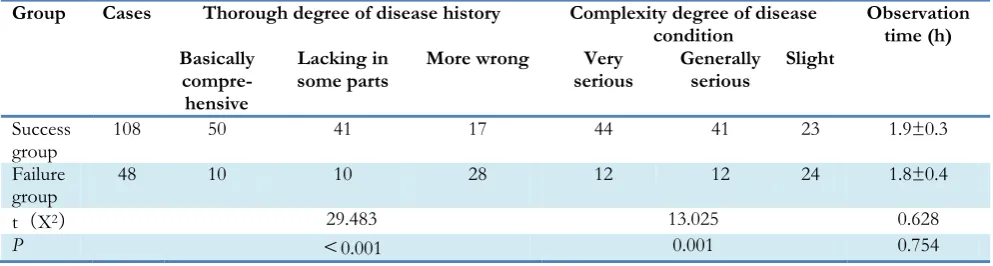
For the patients who came to doctor in the day-time and working days, the higher education de-gree and compliance they had, the faster the emergency check and examination back show time, the more comprehensive the body examina-tion and disease history taking were done, the simpler the disease condition was, the higher tri-age success rate they received. Compared the
emergency observation time between two groups, the difference was not statistically significant (Ta-ble 1-2).
Multivariate regression analysis
The emergency check and examination back-show time, the comprehensive degree of body examination and disease history taking and the complexity degree of disease could be the inde-pendent risk factors for triage success (Table 3).
Table 1:Single-factor analysis
Group Cases Daytime Working
day Education degree Compliance show-back Check time (min)
Examination show-back time (min)
Bel
ow p
ri
mar
y
sch
oo
l
Betwee
n
pr
i-mar
y
sch
oo
l to
high
sch
oo
l
Co
llege
an
d
ab
ov
e
G
oo
d
Bad
Success
group 108 43(39.8) 86(79.6) 29 34 45 73 35 36.5±10.2 59.7±16.7
Failure
group 48 11(22.9) 31(64.6) 23 13 12 20 28 52.4±15.9 76.5±18.5
t(X2) 4.193 4.012 7.163 9.278 5.927 6.324
P 0.041 0.045 0.028 0.002 0.039 0.033
Table 2:Single factor analysis
Group Cases Thorough degree of disease history Complexity degree of disease
condition Observation time (h) Basically
compre-hensive
Lacking in
some parts More wrong serious Very Generally serious Slight
Success
group 108 50 41 17 44 41 23 1.9±0.3
Failure
group 48 10 10 28 12 12 24 1.8±0.4
t(X2) 29.483 13.025 0.628
P <0.001 0.001 0.754
Discussion
The success rate of emergency triage is an im-portant index to judge the capacity of hospital’s integrated emergency response. The application of classification partition management mode can
Table 3:Multivariate regression analysis
Factor β Wald P OR 95% CI
Emergency check back show time 0.123 5.947 0.029 1.625 0.967~2.301
Examination back show time 0.324 5.326 0.033 1.123 0.637~1.968
Comprehensive degree of history taking 0.254 4.512 0.038 1.082 0.645~1.758
Complexity degree of disease condition 0.167 6.987 0.014 2.632 2.104~3.325
The emergency triage is related with the close co-operation among emergency department, ICU, emergency check and examination window, cardi-ovascular, orthopedics, obstetrics and gynecology, pediatrics and the situation of emergency consul-tation (7). Thus, the application of classification partition management mode in the emergency tri-age is not only the treating condition of single disease, but also the connection among circles during the whole process of technique and the ability of dealing with problems (8).
The current research adds the possible influential factor for the triage success rate in the process of classification partition management, which is rarely referred before. We concluded as follow: for the patients who came to doctor in the day-time and working days, the higher education de-gree and compliance they had, the faster the emergency check and examination back shows came out, the more comprehensive the body ex-amination and disease history taking were done, the simpler the disease condition was, the higher triage success rate they received. The emergency check and examination back-show time, the com-prehensive degree of body examination and dis-ease history taking and the complexity degree of disease could be the independent risk factors for triage success.
During the period of daytime and working day, there was more medical staff in position, and every medical affair were settled in order, and specific staff can be arranged to deal with the emergency condition in time, which was both confirmed in the aspects of theory and practice (9). The higher education degree and compliance the patient has, the more truthful and credible they might learn about their disease condition and feedback to the medical staffs, the higher compliance to the doctor’s suggestion and
medi-cal orders, the more fluent the medimedi-cal activity has done, the more benefits to the triage success (10). The faster the feedback of emergency in-spection and check come back, the more helpful to medical personnel to judge the disease accu-rately, although more comprehensive body check and inquiry of disease history are of great signifi-cance to correct diagnosis and triage, but for emer-gency condition objective examination data are par-ticularly important to final diagnosis (11). Such as acute myocardial infarction, elevated myocardial in-jury markers and positive ECG change is the "gold standard" to diagnose acute myocardial infarction (AMI), while the signs like chest pain, sweating, syn-cope are often confused with aortic dissection, acute cerebrovascular diseases (12).
The complexity of the disease in the decision of emergency triage success or not is very important (13). Diseases identified difficultly, such as sud-den systemic weakness of emergency patients can possibly be the central or peripheral paralysis, hypokalemia paralysis, Guillain Barre syndrome (14), diseases of easy missed-diagnosis, such as seeing a doctor because of acute chest pain, the possibility of pulmonary embolism is very lager (15); the coexistence of a variety of diseases, such as serious cardiac, renal insufficiency with severe traumatic hemorrhage, cannot make single deci-sion in what disease or organ treated first (16). At this point, multidisciplinary joint consultation is necessary, it is not appropriate to decide to turn patients into a department simply (17).
Conclusion
Ethical considerations
Ethical issues (Including plagiarism, informed consent, misconduct, data fabrication and/or fal-sification, double publication and/or submission, redundancy, etc.) have been completely observed by the authors.
Acknowledgements
The present study received no financial support.
References
1. Ramos JG, Perondi B, Dias RD, Miranda LC, Cohen C, Carvalho CR, Velasco IT, Forte DN (2016). Development of an algorithm to aid triage decisions for intensive care unit ad-mission: a clinical vignette and retrospective cohort study. Crit Care, 20:81.
2. Twomey M, Wallis LA, Myers JE (2007). Limita-tions in validating emergency department tri-age scales. Emerg Med J, 24:477–479.
3. Streiner DL, Norman GR (2006). “Precision” and “accuracy”: two terms that are neither. J Clin Epidemiol, 59:327–330.
4. Shum HP, Chan KC, Lau CW, Leung AK, Chan KW, Yan WW (2010). Triage decisions and outcomes for patients with Triage Priority 3 on the Society of Critical Care Medicine scale. Crit Care Resusc, 12:42–49.
5. Parenti N, Reggiani ML, Iannone P, Percudani D, Dowding D (2014). A systematic review on the validity and reliability of an emergency department triage scale, the Manchester Tri-age System. Int J Nurs Stud, 51:1062–1069. 6. Christ M, Grossmann F, Winter D, Bingisser R,
Platz E (2010). Modern triage in the emer-gency department. Dtsch Arztebl Int, 107:892– 898.
7. Farrohknia N, Castren M, Ehrenberg A, Lind L, Oredsson S, Jonsson H (2011). Emergency department triage scales and their
compo-nents: a systematic review of the scientific evi-dence. Scand J Trauma Resusc Emerg Med, 19:42. 8. Piers RD, Azoulay E, Ricou B, Dekeyser Ganz F, Decruyenaere J, Max A (2011). Perceptions of appropriateness of care among European and Israeli intensive care unit nurses and phy-sicians. JAMA, 306:2694–2703.
9. Graff I, Goldschmidt B, Glien P, Bogdanow M, Fimmers R, Hoeft A (2014). The German version of the Manchester Triage System and its quality criteria – first assessment of validity and reliability. PLoS One, 9:e88995.
10. Mirhaghi A, Heydari A, Mazlom R, Ebrahimi M (2015). The reliability of the Canadian Triage and Acuity Scale: meta-analysis. N Am J Med Sci, 7:299–305.
11. Escher M, Perneger TV, Chevrolet JC (2004). National questionnaire survey on what influ-ences doctors’ decisions about admission to intensive care. BMJ, 329:425.
12. Ebrahimi M, Heydari A, Mazlom R, Mirhaghi A (2015). The reliability of the Australasian Tri-age Scale: a meta-analysis. World J Emerg Med, 6:94–99.
13. Reith FC, Van den Brande R, Synnot A, Gruen R, Maas AI (2016). The reliability of the Glas-gow Coma Scale: a systematic review. Intensive Care Med, 42:3–15.
14. Riley R, Holman C, Fletcher D (2014). Inter-rater reliability of the ASA physical status clas-sification in a sample of anaesthetists in West-ern Australia. Anaesth Intensive Care, 42:614– 618.
15. Gomersall CD, Joynt GM (2011). What is the benefit in triage? Crit Care Med, 39:911–912. 16. Mohan D, Angus DC, Ricketts D, Farris C,
Fischhoff B, Rosengart MR (2014). Assessing the validity of using serious game technology to analyze physician decision making. PLoS One, 9:e105445.