R E S E A R C H
Open Access
Programme theory development and
formative evaluation of a provincial
knowledge translation unit
Denise Thomson
1*, Stephanie Brooks
2, Megan Nuspl
3and Lisa Hartling
1Abstract
Background:Research shows a significant gap between healthcare research and evidence-based healthcare policy and practice. Knowledge translation (KT) has an important role in addressing this gap by bolstering evidence-informed healthcare. Canada’s Strategy for Patient-Oriented Research (SPOR) is a nationally mandated and supported initiative developed to respond to the gap between research and practice. One aspect of SPOR is the provincial/territorial SUpport for People and Patient-Oriented Research and Trials (SUPPORT) Units, intended to assist local health researchers and systems to reach the goal of improving the quality and quantity of patient-oriented research in Canada. This article presents the programme theory development and a formative evaluation of the KT Platform in Alberta’s SPOR SUPPORT Unit.
Methods:We used a mixed-methods approach to develop the KT Platform’s programme theory and subsequently conducted the formative evaluation. An extensive needs assessment, comprised of 59 qualitative interviews with researchers and health systems employees in Canada with an interest in KT, served as the basis for our programme theory design. Three years after launching the KT Platform, we hired an evaluation consultant to conduct a formative evaluation of the Platform’s programme theory and operations. The evaluation was performed by conducting nine interviews with KT Platform service users (n= 6) and KT experts acting in advisory capacities to the KT Platform (n= 3). Results:The KT Platform developed a‘4C Model’as a summary of the Platform’s programme theory. This model is designed to meet local needs for capacity-building, a community of practice, consultation services, and contributions to KT science. This suite of services was found to help the local health system implement health evidence with measurable positive health outcomes. However, the community remains hesitant about their capacity as individuals to design and perform important KT activities independently.
Conclusions: With the mandate and support provided by SPOR, the KT Platform was able to design a strong programme theory based on evidence from an extensive needs assessment of the local community. The resulting 4C Model has provided a framework for KT work to assist in improving local health outcomes and can be considered by others designing KT programmes as a useful model to follow. Ongoing monitoring and assessment are required to continue to identify and respond to local needs.
Keywords:Knowledge translation, Patient-oriented research, Evidence-based decision-making, Implementation science, Health research capacity-building, Communities of practice, Health research funding agencies, Evidence-informed practice, Needs assessment, Formative evaluation
© The Author(s). 2019Open AccessThis article is distributed under the terms of the Creative Commons Attribution 4.0 International License (http://creativecommons.org/licenses/by/4.0/), which permits unrestricted use, distribution, and reproduction in any medium, provided you give appropriate credit to the original author(s) and the source, provide a link to the Creative Commons license, and indicate if changes were made. The Creative Commons Public Domain Dedication waiver (http://creativecommons.org/publicdomain/zero/1.0/) applies to the data made available in this article, unless otherwise stated.
* Correspondence:[email protected]
1
Alberta Research Centre for Health Evidence, Department of Pediatrics, University of Alberta and Alberta SPOR SUPPORT UNIT Knowledge Translation Platform, 4-476 Edmonton Clinic Health Academy (ECHA), 11405 87 Ave NW, Edmonton, AB T6G 1C9, Canada
Background
Research shows a significant gap between healthcare re-search and evidence-based healthcare policy and practice [1, 2]. Slow uptake of evidence into practice has been connected to scarce training opportunities, lack of policy support and insufficient dissemination infrastructure [3, 4]. Health systems, funders and research communities increasingly place value and efforts on implementation science – the effective synthesis and implementation of evidence–to bridge the gap between evidence-based in-terventions and their uptake in clinical practice [3–7]. In order to increase evidence-based healthcare decisions and protocols, including improving practices and know-ledge of implementation strategies, the Canadian Insti-tutes of Health Research (CIHR) established the Strategy for Patient-Oriented Research (SPOR) in 2013 [8].
Patient-oriented research is defined as a“continuum of research that engages patients as partners, focuses on patient-identified priorities and improves patient out-comes. This research, conducted by multidisciplinary teams in partnership with relevant stakeholders, aims to apply the knowledge generated to improve healthcare sys-tems and practices”[8]. SPOR is a nation-wide initiative with various forms of support existing at the federal, provincial and territorial levels. The healthcare system in Canada is governed at the provincial and territorial level. Thus, SPOR initiated provincial and territorial multidis-ciplinary platforms called SPOR SUPPORT (Support for People and Patient-Oriented Research and Trials) Units to help implement principles of patient-oriented research in order to improve health outcomes [8]. SUPPORT Units provide expertise to pursue patient-oriented re-search that meets local health needs and priorities while building capacity following the broader SPOR vision. SUPPORT Units incorporate staff and university faculty with expertise in patient engagement, data, methods, pragmatic clinical trials, research services, career develop-ment and knowledge translation (KT). Together, the SUP-PORT Units work towards the overarching goal of increasing the quantity and quality of patient-oriented re-search in Canada. This article describes the efforts of the province of Alberta’s SUPPORT Unit’s KT Platform to identify and meet provincial needs.
KT is defined by CIHR as “a dynamic and iterative process that includes the synthesis, dissemination, ex-change and ethically sound application of knowledge to improve health, provide more effective health services and products, and strengthen the health care system”[9]. The KT Platform directly aligns its operations with this definition [10], basing its research and services on patient-oriented research needs for knowledge synthesis, knowledge mobilisation, and knowledge implementation. In health research, knowledge synthesis is the process of systematically collecting and analysing existing health
literature to identify best practices in health policies/pro-cedures. Knowledge mobilisation is the process of communicating findings from knowledge synthesis to relevant stakeholders with the goal of informing mean-ingful change in policy or practice. Finally, knowledge implementation is the act of designing and implement-ing new protocols, policies or practices based on best evidence identified in the knowledge synthesis. The breadth of activities involved with KT is coupled with an equally broad field of potential practice and capacity re-quirements depending on which element of KT is being performed. However, for ease of reading, the remainder of this article will use the term KT to encompass all three elements.
To optimise operations, the KT Platform worked to identify stakeholder KT needs during the establishment of the province of Alberta’s SUPPORT Unit. Subse-quently, the KT Platform developed and implemented a programme to address those needs. This article presents (1) the development of the Alberta KT Platform programme theory in light of a needs assessment of the local community with an interest in KT and (2) a forma-tive evaluation of the services provided by the KT Plat-form in the first 4 years of operation. Programme theory is the product of “making explicit the underlying as-sumptions about how programs are expected to work” [11], which can then be used to guide the evaluation of programme function and impact. The results are dis-cussed in relation to existing literature to present oppor-tunities and ongoing challenges faced by a KT Platform that has dedicated funding and support in place.
Methods
(Alberta Health, Alberta Health Services), funders (Alberta Innovates Health Solutions), units within our health service provider organisation (Alberta Health Services) that facilitate research and improved quality of care (Strategic Clinical Networks), KT researchers and practitioners, and local health organisations [13].
Using an open interview structure, we asked interviewees to share perspectives on their current KT capacity and prac-tices and ways to move forward, focusing on what supports were required to increase current KT efforts in Alberta. Perspectives were captured with detailed written notes and comprised the basis of the KT Platform programme theory development. The programme theory was designed to align with the current needs of the Albertan KT community (presented in theResultssection).
From May to July 2017 (3 years after beginning KT Platform operations), an external evaluation consultant conducted a formative evaluation by interviewing a sam-ple of programme users to assess the extent to which the KT Platform was progressing according to the programme theory [12]. Nine qualitative interviews were conducted, all of 30 to 60 min in length. Interviewees included KT ex-perts acting in advisory capacities to the KT Platform (n= 3) and clients of the KT Platform who had received KT Platform services beyond simple advice (n= 6). Perspec-tives collected from both the theory development and the formative evaluation took place in one-on-one interviews either in-person or over the telephone.
Data collected from interviews were entered into NVivo 11 qualitative data management software and coded in-ductively to conduct thematic analyses [14]. The needs as-sessment and formative evaluation of activities fall under article 2.5‘Activities Not Requiring REB Review’in Canad-ian Institutes of Health Research, Natural Sciences and
Engineering Research Council of Canada, and Social Sci-ences and Humanities Research Council of Canada, Tri-Council Policy Statement: Ethical Conduct for Re-search Involving Humans, December 2010, which states “Quality assurance and quality improvement studies, pro-gram evaluation activities, and performance reviews, or testing within normal educational requirements when ex-clusively for assessment, management or improvement pur-poses, do not constitute research for the purposes of this Policy, and do not fall within the scope of REB review”. Therefore, a formal ethics review was not required. How-ever, before commencing each interview, interviewees were informed that their participation was completely vol-untary and that their identities would remain anonymous.
Results
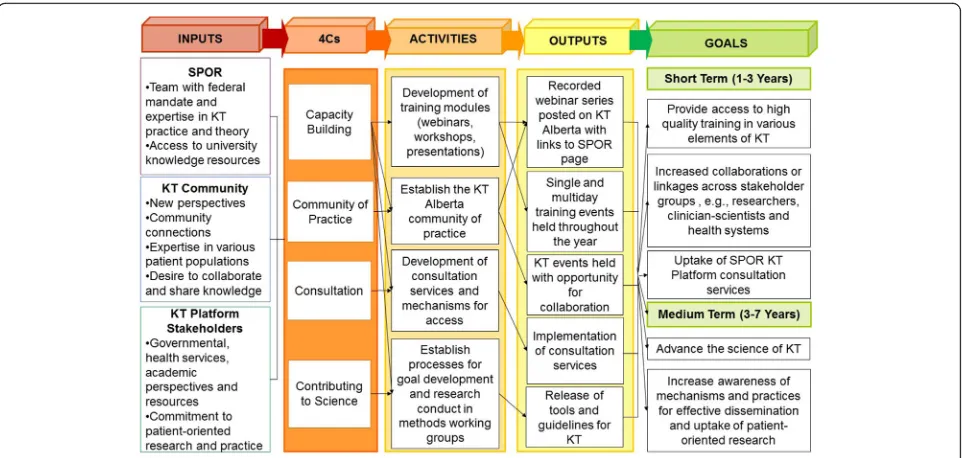
Needs assessment and programme theory development From the needs assessment, interviewees identified four prior-ity areas of need in Alberta, namely (1) capacprior-ity-building for trainees, practitioners and non-academic personnel in indus-try and government; (2) more opportunities to collaborate and share knowledge; (3) better science for evidence-based KT planning; and (4) development of consultation services to guide effective KT. These needs overlap in various ways. For example, the need for capacity-building is present in all areas. However, there are also distinct characteristics in each area. To ensure that both overarching and distinct needs were met, the KT Platform created what we called a‘4C Model’to guide its operations (Fig.1). The 4C Model was developed to meet local needs for capacity-building, a community of practice, consultation services, and contributions to KT science. Rather than operationalising any existing models of large-scale KT initiatives, the 4C Model is the product of a community-based approach that meets the needs of the local context, which the KT Platform was designed to serve.
Capacity-building
Regardless of profession or location, interviewees stated concern about availability and accessibility of training and capacity-building. They acknowledged that opportunities to conduct KT activities exist across fields and at different levels of research and governance. In turn, interviewees emphasised the need for training opportunities, both within and outside of academia, for students, early career researchers, health professionals, administrators, govern-ment employees and people working in industry.
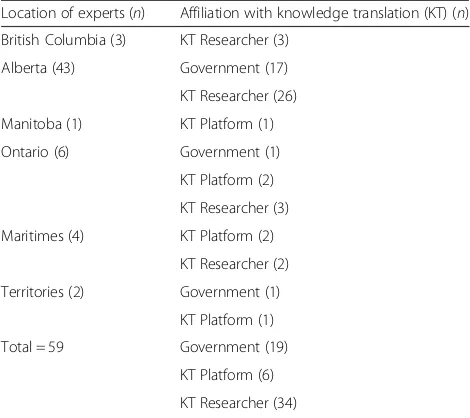
KT Platform responseIn efforts to maximise accessibility and reach of KT training modules, the KT Platform de-cided to deliver training in various levels of formality and duration using varied formats, including webinars, work-shops, lunch and learn sessions, conferences, and other training events. For example, the KT Platform developed and released a series of webinars and workshops to support Table 1Experts consulted
Location of experts (n) Affiliation with knowledge translation (KT) (n)
British Columbia (3) KT Researcher (3)
Alberta (43) Government (17)
KT Researcher (26)
Manitoba (1) KT Platform (1)
Ontario (6) Government (1)
KT Platform (2)
KT Researcher (3)
Maritimes (4) KT Platform (2)
KT Researcher (2)
Territories (2) Government (1)
KT Platform (1)
Total = 59 Government (19)
KT Platform (6)
the development of KT practitioner skills [15]. Additionally, the KT Platform partnered with other organisations, such as KT Canada and Cochrane, to develop and deliver train-ing content on advanced KT topics and knowledge synthe-sis methods through workshop series.
Community of practice
Capacity-building through collaboration was emphasised in that there is no central place or established mechanism to connect, share knowledge, learn from one another, and build stronger KT teams/efforts through collective action. Specif-ically, interviewees emphasised that, to conduct effective KT activities, they would need to improve or cultivate collabor-ation with other SPOR platforms, between researchers at dif-ferent institutions, with end users and patients, and with health delivery services. At the time of the interviews, partici-pants did not feel connected enough with others in the prov-ince to establish these important partnerships.
KT Platform response To help initiate and foster capacity-building and collaboration opportunities for those interested in KT and implementation science in Alberta, the KT Platform developed an online community of prac-tice–KT Alberta [16]. KT Alberta is an inclusive, interdis-ciplinary community including researchers, practitioners, administrators, policy-makers and patients. The commu-nity of practice connects practitioners and organises train-ing and networktrain-ing events to facilitate knowledge shartrain-ing of KT experience in Alberta. In this way, KT Alberta ef-forts aim to address the time and challenges of developing
important collaborations required to conduct high-quality KT and implementation science.
Consultation
Given the lack of training opportunities, the community called for services to provide expert input into designing, evaluating and implementing KT activities. The require-ment for KT services came in two forms. First, related to the above discussion on collaboration, potential service users stated a need for consultation on who to contact as potential research users or partners and how to volve these groups. Second, again related to capacity, in-terviewees discussed a need for direct consultation or assistance with KT research and implementation. Com-mon topics for consultation and direct research assist-ance included articulating KT plans in grant writing, evaluating KT interventions, choosing knowledge syn-thesis methods, and conducting KT planning and imple-mentation based on best practices.
KT Platform responseThe direction from Alberta Inno-vates and CIHR for the provincial/territorial SUPPORT Units mandated the provision of support services, as de-scribed in the Background section [8, 10]. The KT Plat-form’s services acknowledged provincial needs by developing two streams of consultation services, namely (1) a knowledge synthesis stream staffed to support a var-iety of review products with diverse purposes (e.g. support grant applications, practice guidelines and clinical path-ways), and (2) a knowledge mobilisation and implementa-tion stream designed to assist with both integrated and
Fig. 1KT Platform 4C programme theory.SPORstrategy for patient-oriented research,KTknowledge translation,4Cscapacity-building, community of
end-of-grant KT planning and grant writing, provide in-formation on best practices for KT, advise on stakeholder engagement and help evaluate KT interventions [10]. Consultation is especially important for demanding aca-demic tasks such as knowledge synthesis, evidence ap-praisal and programme evaluation design. Depending on the needs of a given client, consultation activities operate on a spectrum from simple advising to embedding a KT Platform staff member into a health science/service team for a period of time. At the latter end of the spectrum, an embedded KT expert can help to build capacity by provid-ing on-site experiential trainprovid-ing to team members or they may conduct a piece of work as appropriate. For ex-ample, a KT Platform statistician regularly performs meta-analysis for teams that would not need a statis-tician more frequently.
Contribution to science
In discussing needs for capacity-building, collaboration opportunities and consultation services, interviewees commonly mentioned the lack of resources or KT scien-tists in the province that could provide information on best practices in KT, especially on KT theories. Specific-ally, interviewees stated needs for access to more evi-dence/guidance on how to efficiently synthesise research findings, and confidently design, evaluate and implement KT plans.
KT Platform response The KT Platform has funding dedicated to KT methods development, and thus has established a number of methods working groups to cre-ate knowledge around the various elements of KT. The methods working groups are a KT Platform initiative guided by participatory principles in which topics of KT research are identified, through discussion and consen-sus, by community members or a formally established advisory board. In addition, working group membership is varied to involve platform staff, academics, trainees and health service employees province-wide with an interest in implementation science. Methods working groups meet every 2 to 3 weeks (on average) over the course of each project to collectively conduct research from topic conceptualisation through manuscript devel-opment. One example of a working group project was the development of a practical guide for use of different KT models and frameworks to collect, interpret and re-port evidence [17]. Current working groups are examin-ing different strategies for knowledge mobilisation (e.g. narrative, social media) and methods to increase efficien-cies in knowledge synthesis. As the consultancy services expand, the KT Platform will be in a unique position with the ability to test and monitor KT activities from real-world KT efforts.
Formative evaluation
In terms of addressing needs in the KT field, the forma-tive evaluation showed that the KT Platform consult-ation services were successful in assisting in KT with measurable changes in practice and improved patient outcomes across a number of Alberta Health unit sites. For example, one of the participants represented a pro-ject the KT Platform supported with an embedded KT expert to co-create a strategy to implement a new ther-apy (basal bolus insulin therther-apy) to improve in-hospital management of individuals with diabetes. Since imple-mentation, this programme produced a 13% absolute in-crease in ordering of the therapy with a significant 2% reduction of hyperglycemic patient-days resulting in a 14% decrease (2.4 days) in length of hospital stay [18]. The participants reported KT Platform support as an important part of this success, particularly around iden-tifying barriers and enablers and possible strategies to address them.
In contrast, however, other findings from the formative evaluation underscored the ongoing need for capacity-build-ing and traincapacity-build-ing opportunities in the province. While yieldcapacity-build-ing desired results in terms of patient outcomes, consultation in itself did not equal KT capacity-building in the KT Platform clients interviewed for the evaluation. This was especially true for those seeking assistance with knowledge synthesis requirements such as building and conducting literature searches and analysing collected literature. Furthermore, cli-ents did not feel they could independently apply KT frame-works to support the implementation of research findings on the ground.
The interviewees in the formative evaluation had more concrete experience with the KT Platform than those in the needs assessment. When asked about future direc-tions given the KT Platform’s services and goals, the par-ticipants had very specific areas of interest based on their profession. Those from academia tended to focus on the continuation of project-specific consultation ser-vices, grant-writing support and training development for students. In contrast, KT practitioners were inter-ested in implementation science, specific collaborations to build and maintain, and training for non-academics including clinician-researchers working in health set-tings. Finally, those with policy perspectives focused on systems-level issues in KT such as scalability and gener-alisability of KT interventions.
Discussion
[4,19]. KT training programmes and repositories designed to improve capacity have emerged in Canada, including the KT Canada Summer Institute [19], the Scientist Knowledge Translation Training [20], and the National Collaborating Centre for Methods and Tools [21]. How-ever, remembering that KT encompasses knowledge syn-thesis, mobilisation and implementation, the breadth of required capacity complicates any one initiative’s ability to offer comprehensive capacity-building programmes. For example, those working in knowledge synthesis need knowledge and confidence in information science and database searching. Their work also often requires skills in statistics to bring together results from multiple complex studies in meaningful ways. Conversely, individuals work-ing in knowledge mobilisation benefit from understand-ings of social science. They also require experience using various media to formulate evidence-based messages that reach different stakeholders in ways that are understandable and meaningful. Finally, those in knowledge implementa-tion have skills in organisaimplementa-tional culture and management, as well as in programme design and evaluation. This is by no means a comprehensive list of capacities required to successfully perform KT activities; therefore, it is not surprising that gaps in capacity-building efforts persist [19, 22]. Researchers continue to call for further capacity-building opportunities that address barriers such as the need for core competencies versus special-isation [23], accessibility of training programmes and the need to adapt to the rapidly changing implementa-tion science field [4,7].
The results of our needs assessment and subsequent for-mative evaluation reflect the needs and barriers described in the broader KT literature. Indeed, Alberta’s neighbour-ing province, British Columbia, conducted a needs assess-ment for KT in the health system broadly [24] and for capacity-building specifically [7]. They found that their population also requires funding and support in advancing KT science, building capacity in KT, managing KT pro-jects, funding KT activities, and advocating for KT. A broader report compiling KT efforts from 15 countries worldwide to identify strategies to strengthen KT also found that lack of sustainable funding impacts the success of KT efforts [25]. Along with Australia, the United States and other countries in Europe, Asia and South America, Canada was highlighted in this study for its advanced KT landscape. This study found that “to be fully ef-fective, policies and programs to encourage increased research translation need to be part of a stable na-tional innovation strategy and administered by an in-dependent agency” ([25], p. 15), similar to the SPOR programme in Canada. With national and provincial funding for the SPOR programme, the KT Platform is uniquely positioned to test how funding and mandate, as repeatedly called for in the KT literature, impact a
community’s ability to increase KT to support patient-oriented research.
Through SPOR, the KT Platform has been able to build a programme theory based on local needs and begin to roll out relevant programme activities and services. However, our formative evaluation shows that our client base requires on-going support before users will feel confident undertaking KT activities independently. One of the challenges related to this, and the gaps identified above, is that KT as defined in Canada has a broad scope with a vast number of activities and responsibilities in its remit. KT activities include know-ledge synthesis, dissemination, translation, implementation, evaluation and ongoing monitoring, as well as stakeholder (including patient) engagement. The scope of elements in-volved in KT suggests that multi-disciplinary team-based ap-proaches to KT are required, as well as varied skill sets, expertise and mixed methods.
The need for such an approach became especially ap-parent in the formative evaluation as the interviewees, based on their professions, stated a range of goals they felt most pertinent to future KT Platform programme refine-ment. Consistent with other KT needs assessments [7, 23], the divisions of interest range in (1) scope, from project-specific to policy level; (2) focus, including collab-oration, planning, dissemination, application, training and science; and (3) degree of technicality requiring beginner to advanced KT skills and knowledge. The variety of KT activities and ongoing needs stated across the literature, and in our own results, highlights the need for the KT Platform to continue development and delivery of varied training opportunities as well as consultation services with the ability to embed experts into project teams. Further-more, the establishment and upkeep of KT Alberta, the community of practice, will be vital to connect those with KT interests and needs to KT training opportunities, col-laboration, knowledge and supports.
changes, as recommendations or practice changes may be met with resistance at organisational or gov-ernmental levels [34]. Nevertheless, such communi-ties have been shown to be successful if localised as they are increasingly relevant and dynamic in rela-tion to changing local contexts [35]. Moving forward, the KT Platform is working to further es-tablish and strengthen KT Alberta.
In line with existing KT literature, our interviewees in the needs assessment as well as the formative evaluation called for theoretical developments in KT in order to de-velop strategies and better predict outcomes of KT prac-tices on the ground [36,37]. KT activities are performed throughout the process of translating health research from clinical studies to practice, often with the intent to change practices, requiring behaviour changes. Studies show that behavioural research often does not account for real world barriers and facilitators [38], and thus is not considered useful by stakeholders [39]. In turn, such research can have little uptake and impact on health out-comes [40]. To develop necessary theoretical underpin-nings of KT activities, research and testing is required around (1) knowledge synthesis methods that efficiently identify best intervention strategies [36, 41]; (2) under-standing causal pathways operating in given interven-tions and their related contexts [5, 36, 42, 43]; (3) how to effectively de-implement non-evidence-based prac-tices [44]; and (4) evaluation and monitoring of out-comes in newly implemented policies and practices [45]. Our methods working groups are conducting studies to help build understanding of KT operations such as gen-eralisability and validity of implementation strategies [41]. They are also working towards contributing to frameworks and theories in the context of various imple-mentation settings. Furthermore, our consultation ser-vices meet ongoing needs of ‘design for dissemination’, the practice of designing research, interventions and programmes in ways that consider how, where and by whom they will eventually be used [3,46]. As we initiate methods working group studies connected to our con-sultation services, we hope to offer new understandings to implementation science from real-world settings and continue to be responsive to the needs and questions presented by our local stakeholder groups.
Strengths and limitations
Strengths
The KT Platform operations resulted from a well-struc-tured programme theory driven by an extensive needs as-sessment. Our multi-faceted approach allowed us to respond to widespread needs, capacity-building, for ex-ample, from different angles, while also developing re-sponses to more distinct and specific needs such as
furthering implementation science on topics specific to Albertan needs. The results from our needs assessment match those commonly reported in KT literature. The positive outcomes associated with our programme ac-tivities to address these common KT needs suggest that our programme may be a model for other juris-dictions to consider when identifying and addressing local KT needs. Of course, KT approaches and activ-ities have to be adapted to local context and needs, but our programme development methods and programme model are worth considering by others in KT programme planning stages.
Limitations
While our needs assessment was extensive and the findings were in accordance with the KT literature and other Canadian needs assessments, our list of KT experts was not necessarily comprehensive as terminology in KT varies to the point that it is often unclear with regards to (1) who may be conducting KT activities regularly and (2) whether a given individual would identify as a KT practitioner or researcher [47]. Similarly, the small sample of partic-ipants in the formative review limits the generalis-ability of our results. To ensure we continue to meet our stakeholders’ needs as they arise, we have developed a system of ongoing evaluations and programme refinements.
Conclusion
the needle to help meet the needs of the KT community and the goals of SPOR. Continued efforts to further de-velop KT Alberta will help strengthen this work by acting as a knowledge and training module repository and facili-tating collaboration and community across KT stakeholder groups in the province.
Abbreviations
CIHR:Canadian Institutes of Health Research; KT: Knowledge translation; SPOR: Strategy for Patient-Oriented Research; SUPPORT: Support for People and Patient-Oriented Research and Trials
Acknowledgements
We acknowledge SPOR and the Alberta SUPPORT Unit support of the KT Platform and thank the participants of both the needs assessment and the formative evaluation for sharing their experiences and expertise in efforts to further knowledge translation and patient-oriented research in Alberta.
Funding
This work was supported by the Alberta SPOR SUPPORT Unit KT Platform with funding by the Canadian Institutes for Health Research and Alberta Innovates.
Availability of data and materials
The data are not publicly available due to them containing information that could compromise participant confidentiality and anonymity.
Authors’contributions
DT designed the needs assessment and conducted the interviews in the needs assessment. MN coordinated the needs assessment and coded needs assessment interviews. DT and LH interpreted results and developed the 4C Programme Model. SB prepared the draft manuscript. LH, DT and SB conceptualised the manuscript, edited subsequent drafts, and finalised the manuscript. All authors read and approved the final manuscript.
Ethics approval and consent to participate
Informed consent was not required for the needs assessment and formative evaluation performance review of activities and thus falls under article 2.5 “Activities Not Requiring REB Review”in Canadian Institutes of Health Research, Natural Sciences and Engineering Research Council of Canada, and Social Sciences and Humanities Research Council of Canada, Tri-Council Policy Statement: Ethical Conduct for Research Involving Humans, December 2010, which states,“Quality assurance and quality improvement studies, program evaluation activities, and performance reviews, or testing within normal educational requirements when exclusively for assessment, management or improvement purposes, do not constitute research for the purposes of this Policy, and do not fall within the scope of REB review.”However, before commencing each interview, interviewees were informed that their participation was completely voluntary and that their identities would remain anonymous.
Consent for publication Not applicable.
Competing interests
The authors declare that they have no competing interests.
Publisher’s Note
Springer Nature remains neutral with regard to jurisdictional claims in published maps and institutional affiliations.
Author details
1
Alberta Research Centre for Health Evidence, Department of Pediatrics, University of Alberta and Alberta SPOR SUPPORT UNIT Knowledge Translation Platform, 4-476 Edmonton Clinic Health Academy (ECHA), 11405 87 Ave NW, Edmonton, AB T6G 1C9, Canada.2Alberta SPOR SUPPORT UNIT
Knowledge Translation Platform, 3-62B Heritage Medical Research Centre (HMRC), 11207 87 Ave NW, Edmonton, AB T6G 2S2, Canada.3Alberta SPOR
SUPPORT UNIT Knowledge Translation Platform, 4-482D Edmonton Clinic Health Academy, 11405 87 Avenue, Edmonton, AB T6G 1C9, Canada.
Received: 20 September 2018 Accepted: 10 March 2019
References
1. Straus SE, Tetroe J, Graham ID. Knowledge translation: What it is and what it isn’t. In: Straus SE, Tetroe J, Graham ID, editors. Knowledge Translation in Health Care: Moving from Evidence to Practice. 2nd ed.
West Sussex: Wiley; 2013. p. 3–13.
2. Armstrong R, Waters E, Crockett B, Keleher H. The nature of evidence resources and knowledge translation for health promotion practitioners. Health Promot Int. 2007;22(3):254–60.
3. Holtrop JS, Rabin BA, Glasgow RE. Dissemination and implementation science in primary care research and practice: contributions and opportunities. J Am Board Fam Med. 2018;31:466–78.
4. Glasgow RE, Vinson C, Chambers D, Khoury MJ, Kaplan RM, Hunter C. National Institutes of Health approaches to dissemination and implementation science: current and future directions. Am J Public Health. 2012;102(7):1274–81.
5. Kothari A, McCutcheon C, Graham ID. Defining integrated knowledge translation and moving forward: a response to recent commentaries. Int J Health Policy Manag. 2017;6(5):299–300.
6. Bowen S, Graham ID. Backwards design or looking sideways? Knowledge translation in the real world. Int J Health Policy Manag. 2015;4(8):545–7. 7. Holmes BJ, Schellenberg M, Schell K, Scarrow G. How funding agencies can
support research use in healthcare: an online province-wide survey to determine translation training needs. Implement Sci. 2014;9:71. 8. Canadian Institutes for Health Research: Strategy for Patient Oriented
Research. 2017.http://www.cihr-irsc.gc.ca/e/41204.html. Accessed 20 Aug 2018.
9. Canadian Institutes for Health Research: Knowledge Translation. 2017.
http://www.cihr-irsc.gc.ca/e/29529.html. Accessed 20 Aug 2018.
10. Alberta Innovates. Knowledge Translation Platform.https://albertainnovates. ca/our-health-innovation-focus/the-alberta-spor-support-unit/knowledge-translation-platform/. Accessed 20 Aug 2018.
11. Rogers PJ, Petrosino A, Huebner TA, Hacsi TA. Program theory evaluation: practice, promise, and problems. New Dir Eval. 2000;2000(87):5–13. 12. Creswell JW. Qualitative Inquiry and Research Design: Choosing Among Five
Approaches. 2nd ed. Thousand Oaks: Sage; 2007.
13. Alberta SPOR SUPPORT Unit. The Alberta SPOR SUPPORT Unit Business Plan. 2012. https://ktalberta.ca/s/2014-02-Alberta-SPOR-SUPPORT-Unit_FINAL-15-March-2013.pdf. Accessed 20 Aug 2018.
14. Guest G, MacQueen KM, Namey EE. Applied Thematic Analysis. Thousand Oaks: Sage; 2012.
15. KT Alberta. Webinar Archive from KT Platform 2015-2017.https://ktalberta. ca/kt-alberta-webinar-archive. Accessed 20 Aug 2018.
16. KT Alberta. KT Alberta.https://ktalberta.ca. Accessed 20 Aug 2018. 17. Slaughter SE, Zimmermann GL, Nuspl M, Hanson HM, Albrecht L,
Esmail R, et al. Classification schemes for knowledge translation interventions: a practical resource for researchers. BMC Med Res Methodol. 2017;17:161.
18. Helmle KE, Chacko S, Chan T, Drake A, Edwards AL, Moore GE, et al. Knowledge translation to optimize adult inpatient glycemic management with basal bolus insulin therapy and improve patient outcomes. Can J Diabetes. 2018;42(5):505–13 e1.
19. Straus SE, Brouwers M, Johnson D, Lavis JN, Légaré F, Majumdar SR, et al. Core competencies in the science and practice of knowledge translation: description of a Canadian strategic training initiative.
Implement Sci. 2011;6:127.
20. SickKids. Scientist Knowledge Translation Training Workshop: SickKids Hospital. 2014.http://www.sickkids.ca/Learning/AbouttheInstitute/Programs/ Knowledge-Translation/2-Day-Scientist-Knowledge-Translation-Training/ index.html. Accessed 20 Aug 2018.
21. National Collaborating Centres for Methods and Tools. National Collaborating Centre for Methods and Tools. 2018.www.nccmt.ca.
Accessed 20 Aug 2018.
22. Tabak RG, Padek MM, Kerner JF, Stange KC, Proctor EK, Dobbins MJ, et al. Dissemination and implementation science training needs: insights from practitioners and researchers. Am J Prev Med. 2017;52(3):S322–S9. 23. Padek M, Colditz G, Dobbins M, Koscielniak N, Proctor EK, Sales AE, et al.
implementation research training programs: an exploratory analysis using card sorts. Implement Sci. 2015;10:114.
24. Holmes B, Scarrow G, Schellenberg M. Translating evidence into practice: the role of health research funders. Implement Sci. 2012;7:39.
25. Australian Council of Learned Academies; Bell J, Dodgson M, Field L, Gough P, Spurling T. 2015. Translating Research for Economic and Social Benefit: Country Comparisons.https://acola.org.au/wp/saf09/. Accessed 20 Mar 2019. 26. Wenger E, McDermott RA, Snyder W. Cultivating Communities of Practice: A
Guide to Managing Knowledge. Boston: Harvard Business Press; 2002. 27. Bazemore A, Neale AV, Lupo P, Seehusen D. Advancing the science of
implementation in primary health care. J Am Board Fam Med. 2018;31:307–11.
28. Li LC, Grimshaw JM, Nielsen C, Judd M, Coyte PC, Graham ID. Evolution of Wenger’s concept of community of practice. Implement Sci. 2009;4:11. 29. Conklin J, Lusk E, Harris M, Stolee P. Knowledge brokers in a knowledge
network: the case of Seniors Health Research Transfer Network knowledge brokers. Implement Sci. 2013;8:7.
30. Bentley C, Browman GP, Poole B. Conceptual and practical challenges for implementing the communities of practice model on a national scale-a Canadian cancer control initiative. BMC Health Serv Res. 2010;10:3. 31. Kothari A, Sibbald SL, Wathen CN. Evaluation of partnerships in a
transnational family violence prevention network using an integrated knowledge translation and exchange model: a mixed methods study. Health Res Policy Syst. 2014;12:25.
32. Yousefi-Nooraie R, Dobbins M, Brouwers M, Wakefield P. Information seeking for making evidence-informed decisions: a social network analysis on the staff of a public health department in Canada.
BMC Health Serv Res. 2012;12:118.
33. Mairs K, McNeil H, McLeod J, Prorok JC, Stolee P. Online strategies to facilitate health-related knowledge transfer: a systematic search and review. Health Inf Libr J. 2013;30(4):261–77.
34. Kothari A, Boyko JA, Conklin J, Stolee P, Sibbald SL. Communities of practice for supporting health systems change: a missed opportunity. Health Res Policy Syst. 2015;13(1):33.
35. Bramwell A, Hepburn N, Wolfe DA. Growing Innovation Ecosystems: University-Industry Knowledge Transfer and Regional Economic
Development in Canada. Toronto: Social Sciences and Humanities Research Council of Canada; 2012. https://tspace-library-utoronto-ca.login.ezproxy. library.ualberta.ca/bitstream/1807/80099/2/Bramwell%20et%20al_2012_ Growing%20Innovation%20Ecosystems.pdf. Accessed 20 Aug 2018. 36. Rychetnik L, Bauman A, Laws R, King L, Rissel C, Nutbeam D, et al.
Translating research for evidence-based public health: key concepts and future directions. J Epidemiol Community Health. 2012;66(12):1187–92. 37. Brownson RC, Jacobs JA, Tabak RG, Hoehner CM, Stamatakis KA. Designing
for dissemination among public health researchers: Findings from a national survey in the United States. Am J Public Health. 2013;103(9):1693–9. 38. Buscemi J, Janke EA, Kugler KC, Duffecy J, Mielenz TJ, St. George SM, et al.
Increasing the public health impact of evidence-based interventions in behavioral medicine: new approaches and future directions. J Behav Med. 2017;40(1):203–13.
39. Green LW, Glasgow RE, Atkins D, Stange K. Making evidence from research more relevant, useful, and actionable in policy, program planning, and practice. Am J Prev Med. 2009;37(6):S187–S91.
40. Kessler R, Glasgow RE. A proposal to speed translation of healthcare research into practice. Am J Prev Med. 2011;40(6):637–44.
41. Colditz GA, Emmons KM. The promises and challenges of dissemination and implementation research. In: Brownson RC, Colditz GA, Proctor EK, editors. Dissemination and Implementation Research in Health. 2nd ed. New York: Oxford University Press; 2018. p. 1–18.
42. Lewis CC, Klasnja P, Powell BJ, Lyon AR, Tuzzio L, Jones S, et al. From classification to causality: advancing understanding of mechanisms of change in implementation science. Front Public Health. 2018;6:136. 43. Gagliardi AR, Berta W, Kothari A, Boyko J, Urquhart R. Integrated knowledge
translation (IKT) in health care: a scoping review. Implement Sci. 2016;11:38. 44. Niven DJ, Mrklas KJ, Holodinsky JK, Straus SE, Hemmelgarn BR, Jeffs LP, et al.
Towards understanding the de-adoption of low-value clinical practices: a scoping review. BMC Med. 2015;13:255.
45. Damschroder LJ, Aron DC, Keith RE, Kirsh SR, Alexander JA, Lowery JC. Fostering implementation of health services research findings into practice: a consolidated framework for advancing implementation science. Implement Sci. 2009;4:50.
46. Dearing JW, Kreuter MW. Designing for diffusion: how can we increase uptake of cancer communication innovations. Patient Educ Couns. 2010; 81(S1):S100–10.
47. Estabrooks CA, Thompson DS, Lovely JJE, Hofmeyer A. A guide to knowledge translation theory. J Contin Educ Heal Prof. 2006;26(1):25–36. 48. Kerner JF. Knowledge translation versus knowledge integration: a“funder’s”