R E S E A R C H
Open Access
What pre-deployment and early post-deployment
factors predict health function after combat
deployment?: a prospective longitudinal study of
Operation Enduring Freedom (OEF)/Operation
Iraqi Freedom (OIF) soldiers
Lisa M McAndrew
1,2*, Elizabeth D
’
Andrea
3, Shou-En Lu
2, Bhavna Abbi
1, Grace W Yan
1, Charles Engel
4and Karen S Quigley
5,6Abstract
Background:Physical and mental function are strong indicators of disability and mortality. OEF/OIF Veterans returning from deployment have been found to have poorer function than soldiers who have not deployed; however the reasons for this are unknown.
Methods:A prospective cohort of 790 soldiers was assessed both pre- and immediately after deployment to determine predictors of physical and mental function after war.
Results:On average, OEF/OIF Veterans showed significant declines in both physical (t=6.65, p<.0001) and mental function (t=7.11, p<.0001). After controlling for pre-deployment function, poorer physical function after deployment was associated with older age, more physical symptoms, blunted systolic blood pressure reactivity and being injured. After controlling for pre-deployment function, poorer mental function after deployment was associated with younger age, lower social desirability, lower social support, greater physical symptoms and greater PTSD symptoms.
Conclusions:Combat deployment was associated with an immediate decline in both mental and physical function. The relationship of combat deployment to function is complex and influenced by demographic, psychosocial,
physiological and experiential factors. Social support and physical symptoms emerged as potentially modifiable factors.
Keywords:Health function, Quality of life, Veterans, Military, Prospective, SF-36, Iraq, Afghanistan, Combat
Health function refers to one’s ability to conduct normal daily activities and fulfill usual roles [1]. Health function is a strong predictor of disability and mortality, even after controlling for objective health outcomes, such as illness status [2-4]. It is also a useful indicator of successful reinte-gration into civilian life in Operation Enduring Freedom (OEF) and Operation Iraqi Freedom (OIF) veterans [5]. Historically, veterans seeking treatment at Veterans Affairs
facilities have poorer functioning than the general popula-tion, [6-10] however the reasons for this are unclear. In a non-treatment-seeking sample, Kline et al. found that those deploying to OEF/OIF after a previous deployment, were twice as likely to have poor physical function (i.e., below national norms) as those with no previous deployment, suggesting that deployment adversely impacts function [11]. Other work suggests that OEF/OIF veterans with PTSD and chronic pain have lower physical [12,13] and mental [14,15] function compared to healthy controls.
This study was designed to determine factors related to health function after deployment and fill two import-ant gaps. First, no study has used a prospective design to examine pre-deployment factors related to physical or * Correspondence:[email protected]
1
Department of Veterans Affairs, NJ War Related Illness & Injury Study Center, 385 Tremont Ave. Mailstop 129, East Orange, NJ 07018, USA
2
School of Public Health, University of Medicine & Dentistry of New Jersey, Piscataway, NJ, USA
Full list of author information is available at the end of the article
mental function after deployment. Second, few studies have examined demographic, psychosocial, deployment experiences, and physiological factors contributing to function after deployment. To address these limitations, we report on two waves (pre-deployment, immediate post-deployment) of a prospective longitudinal cohort study of military personnel. Our pre-deployment data permit us to both assess and control for possible base-line individual differences in function. Based on existing cross-sectional literature, we hypothesized that demo-graphic factors such as age, psychosocial factors such as coping skills, physiological factors such as blood pres-sure reactivity to stressors, and experiential factors such as deployment experiences would be related to physical and mental function immediately after a combat deploy-ment. We also hypothesized that individuals who reported experiencing more post-traumatic stress and physical symptoms also would report lower overall health function, although this was not expected to fully explain poorer function.
With almost 2 million OEF/OIF Veterans having returned from combat, understanding factors contributing to health function after war is critical. This study is a ne-cessary first step toward identifying individuals who may be at increased risk for poor function after deployment, and provides knowledge that will be important for practi-tioners attempting to reduce poor functional health and disability for veterans.
Methods
We used a prospective longitudinal observational cohort design to assess soldiers who were preparing for deploy-ment to Iraq or Afghanistan at Fort Dix, NJ or Camp Shelby, MS. Data were obtained at 4 time points: pre-deployment (Phase 1, 2005–2008), immediately post-deployment (Phase 2, 2007–2009), 3 months after return from deployment (Phase 3, 2007–2010), and 1 year after return (Phase 4, 2008–2011). In this report we focus on the factors contributing to physical and mental function immediately after deployment (i.e., we report here only data from Phases 1 and 2). The protocol was approved by Institutional Review Boards of all participating facilities.
Participants
We recruited 790 Army National Guard and Army Reserve enlisted Soldiers (ages 18–60 years) with testing either dur-ing or just after their on-base pre-deployment medical processing. The Phase 1 exclusion criteria were current self-reported depression, taking medications with cardio-vascular and/or autonomic effects, history of schizophrenia or bipolar disorder, or current cancer, high blood pressure, or pregnancy. Deployments typically lasted 12–13 months. Four hundred twenty-two soldiers were able to be tracked and completed Phase 2 (53%). Of those who did not
complete Phase 2, 23 did not wish to continue and the remaining could not be found.
Procedures
At Phase 1, soldiers completed the informed consent process, then completed several computerized surveys (20–30 minutes), followed by a stress reactivity protocol (20 minutes) and then the remaining surveys (20–30 mi-nutes). We conducted Phase 2 surveys at the Army in-stallation where possible (45 minutes). We attempted to contact soldiers who did not return to either installation using contact information provided at Phase 1. Those successfully reached through their contact information at home completed the measures via mailed surveys and phone follow-up. Measures that were completed at the military installation were completed using a custom-designed computer program (Labview, National Instru-ments, Austin, TX), which detected if responses were not within a valid range and prompted for corrections. A research assistant was available to answer questions. At any time, participants with responses to individual survey items that suggested the possibility of severe de-pression or anxiety were provided referral resources as needed.
Outcome measure
Our primary outcome measures for these analyses were the Veteran’s Rand-36 (VR-36 [3]) which was derived from the Medical Outcomes Survey Short-Form-36 (SF-36 [16]) a commonly used measure of mental and physical func-tional status. The VR-36 provides two composite scores, physical function and mental function with higher scores indicating better function. Composite scores are normed to a mean of 50 and a SD of 10.
Survey measures
psychosocial variables was chosen based on the prior lit-erature as likely to be related to health function. Deploy-ment variables were measured immediately after return from deployment and included: deployment experiences (from the Deployment Risk and Resilience [DRRI] After-math of Battle subscale) [19], combat experiences (from the DRRI Combat Experiences subscale) [19], unit cohe-sion [24], PTSD symptoms [25,26] and physical symptoms [22]. Injury in theater was determined from a single item “Did you have any injuries (including minor injuries or in-juries for which you did not seek treatment) during your deployment from any of the following: vehicular accident (including airplane), fall or fight involving a blow to the head, fragment, bullet, blast, other”. Again, we chose these variables as potential predictors of physical and mental function based on prior literature.
At Phase 2 we also asked about smoking status at Phase 1, and years of education. We also again collected data on negative emotionality, social desirability, social support, coping style and physical symptoms.
Physiological measures
Prior research has suggested that both exaggerated [27] and blunted blood pressure reactivity [28] to laboratory stressors can be related to later problematic health out-comes. Our goal was to determine the impact of blood pressure reactivity to a series of stressors at pre-deployment on physical and mental function post-deployment. Partici-pants completed a set of stress reactivity tasks before de-ployment. These tasks included a speech planning task and a speech task where participants first planned (4 minutes) what they would say when later required to speak to a friend whom they imagined had stolen money from them. The participant then spent 4 minutes speaking into a microphone in front of a computer monitor as if speaking to the friend. Another task was a 4 minute serial subtrac-tion mental arithmetic task where participants were asked to count backwards by a given subtrahend (e.g., sevens) and informed when they were incorrect, with numbers changed each minute during the task to maintain engagement. The final task was a hand cold pressor task where participants were asked to place their hand in icy cold water for up to 2 minutes. Blood pressure was recorded once per minute for five minutes during a resting baseline (pre-stressor levels) and at one minute intervals during these common labora-tory stressors using standard psychophysiological methods [29]. Baseline systolic and diastolic baseline blood pressure values were operationalized as the mean of the five baseline blood pressure readings. The blood pressure response to tasks with strong social evaluation/performance anxiety components (speech planning, speech and math) correlated highly with one another, and served as our measure of blood pressure reactivity. Blood pressure reactivity was operationalized as the mean systolic and diastolic blood
pressure during the 12 minutes of the speech planning, speech and math tasks minus the mean baseline blood pressure.
Data analysis
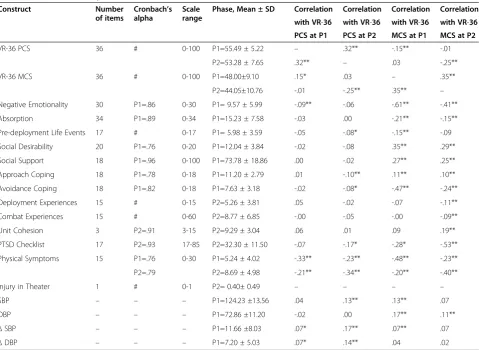
Descriptive statistics for all measures are reported in Table 1. We also examined the bivariate relationships be-tween all continuous variables using Pearson correlation coefficients. Variables that correlated at p ≤ 0.10 with physical or mental function were used in the two multi-variate models predicting physical and mental function, respectively.
We used stepwise hierarchical linear regression models with variables added in three conceptually defined steps to arrive at two final multivariate models, one for physical function and one for mental function. In step one, we in-cluded the hypothesized demographic factors, and then used backward elimination of variables, one by one in sub-sequent steps, until only demographic variables that contributed significantly to the models were retained (i.e., those significant at p < 0.05 or better, after removing the variable with the highest p value one at a time). We next added the pre-deployment psychosocial and physiological factors, again with backward elimination of variables until only variables contributing significantly to the model were retained. Lastly, we added the deployment-related factors to the models, again with backward elimination until we arrived at final models of physical and mental function, re-spectively. BMI and smoking status were included as con-trol variables for blood pressure and eliminated only when they and any blood pressure variable no longer contrib-uted significantly to the overall model. Multicollinearity was assessed and variables were included only if the variance inflation factor was < 4 [30]. Missing data was handled using multiple imputation with imputed data gen-erated using a sequential regression imputation method via the software package IVEware [31]. Multiple sets of imputed results were combined using Rubin’s rule which was implemented in SAS v9.2 MIANALYZE [31-33].
Results
Representativeness of the sample
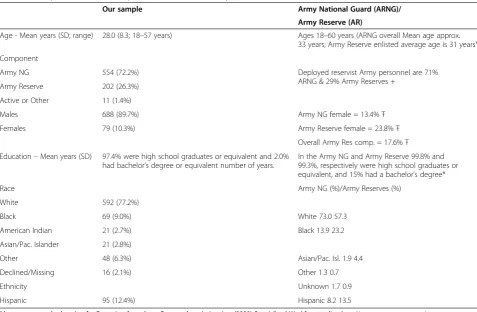
The demographic characteristics of the sample, and a comparison with the demographics of the overall Army National Guard and Reserves, are shown in Table 2. Our sample was generally representative of the U.S. reservist component at the time of data collection, albeit with a somewhat larger proportion of males and Caucasian par-ticipants. More than half of the sample (56%) was deploying for the first time.
their overall health. We dichotomized the general health question into excellent/very good vs. good/fair/poor. A Chi-square test showed no significant difference in the proportion of males and females in the participant and non-participant groups (χ2=1.89, P= .17). However, par-ticipants were somewhat less likely than non-parpar-ticipants to report that they were in excellent/very good health (70% of participant sample vs. 76% of non-participant sample; χ2
= 4.98,P< .03).
Outcome and psychosocial measures
In Table 1 we provide the Cronbach’s alpha reliability coef-ficients (where applicable), the means and standard devia-tions for the outcome and psychosocial measures used in our models, and correlations with physical and mental function at Phases 1 and 2.
Both physical and mental function showed a statistically significant decrease immediately following deployment
relative to pre-deployment levels. On average, physical health function declined by 2.2 points from pre- to immedi-ate post-deployment (t = 6.65,P<.0001), and mental health function declined by 4.0 points (t = 7.11,P<.0001). Consid-ering only the subsample of individuals for whom we have data for both phases (i.e., unimputed data), we still see de-clines of 2.1 points (t = 6.14, P <.01) in physical function and 2.6 points (t = 4.93,P<.01) in mental function.
Unadjusted relationship of predictors to physical and mental function
We examined the relationships between the continuous predictor variables and our two outcome variables at both Phases 1 and 2 (see Table 1) using Pearson’s correlation coefficients. Demographic variables that were related to poorer physical function included older age (r = −.19,
P<.01), greater BMI (r =−.11,P<.05) and a larger number of previous deployments (r = −.13, P <.01). Psychosocial
Table 1 Measures, descriptive statistics and correlations
Construct Number
of items
Cronbach’s alpha
Scale range
Phase, Mean ± SD Correlation Correlation Correlation Correlation
with VR-36 with VR-36 with VR-36 with VR-36
PCS at P1 PCS at P2 MCS at P1 MCS at P2
VR-36 PCS 36 # 0-100 P1=55.49 ± 5.22 – .32** -.15** -.01
P2=53.28 ± 7.65 .32** – .03 -.25**
VR-36 MCS 36 # 0-100 P1=48.00±9.10 .15* .03 – .35**
P2=44.05±10.76 -.01 -.25** .35** –
Negative Emotionality 30 P1=.86 0-30 P1= 9.57 ± 5.99 -.09** -.06 -.61** -.41**
Absorption 34 P1=.89 0-34 P1=15.23 ± 7.58 -.03 .00 -.21** -.15**
Pre-deployment Life Events 17 # 0-17 P1= 5.98 ± 3.59 -.05 -.08* -.15** -.09
Social Desirability 20 P1=.76 0-20 P1=12.04 ± 3.84 -.02 -.08 .35** .29**
Social Support 18 P1=.96 0-100 P1=73.78 ± 18.86 .00 -.02 .27** .25**
Approach Coping 18 P1=.78 0-18 P1=11.20 ± 2.79 .01 -.10** .11** .10**
Avoidance Coping 18 P1=.82 0-18 P1=7.63 ± 3.18 -.02 -.08* -.47** -.24**
Deployment Experiences 15 # 0-15 P2=5.26 ± 3.81 .05 -.02 -.07 -.11**
Combat Experiences 15 # 0-60 P2=8.77 ± 6.85 -.00 -.05 -.00 -.09**
Unit Cohesion 3 P2=.91 3-15 P2=9.29 ± 3.04 .06 .01 .09 .19**
PTSD Checklist 17 P2=.93 17-85 P2=32.30 ± 11.50 -.07 -.17* -.28* -.53**
Physical Symptoms 15 P1=.76 0-30 P1=5.24 ± 4.02 -.33** -.23** -.48** -.23**
P2=.79 P2=8.69 ± 4.98 -.21** -.34** -.20** -.40**
Injury in Theater 1 # 0-1 P2= 0.40± 0.49 – – – –
SBP – – – P1=124.23 ±13.56 .04 .13** .13** .07
DBP – – – P1=72.86 ±11.20 -.02 .00 .17** .11**
ΔSBP – – – P1=11.66 ±8.03 .07* .17** .07** .07
ΔDBP – – – P1=7.20 ± 5.03 .07* .14** .04 .02
Correlations are between the measure (row) assessed at the phase listed in column 5 and the measure (column) assessed at the phase listed in the column title. ***Note. P1 = Phase 1, P2 = Phase 2, VR-36 = Veteran’s Rand-36, PCS = Physical Composite Score (Physical Health Function), MCS= Mental Composite Score (Mental Health Function), SBP=systolic blood pressure mean during three stressor tasks, DBP=diastolic blood pressure mean during three stressor tasks,
ΔSBP=systolic blood pressure reactivity during three stressor tasks,ΔDBP=diastolic blood pressure reactivity during three stressor tasks, *=P<.05, **=P<.01 Numbers for P1 include the full sample (maximum N=790) and numbers for P2 are for the subsample with P2 data (maximum N=422).
factors that were related bivariately to poorer physical func-tion at Phase 2 included poorer physical funcfunc-tion at Phase 1, more pre-deployment stressful life events, greater avoid-ance coping, less approach coping, more PTSD symptoms and greater physical symptom severity. Higher baseline Phase1 systolic blood pressure and blunted Phase 1 systolic and diastolic blood pressure reactivity to the stressor tasks also were related to poorer physical health function at Phase 2.
Demographic variables related to poorer mental health function included younger age (r = .20,P<.01) and lower BMI (r = .11,P <.01). Most of the hypothesized Phase 1 psychosocial and physiological variables were related to mental health function at Phase 2. The strongest bivariate predictors of poorer mental health function at Phase 2 were greater negative emotionality, greater avoidance cop-ing, poorer mental health function at Phase 1, more PTSD symptoms, greater physical symptom severity, lower social support and lower social desirability.
Minority status was not related to either physical or mental function at Phase 1 or 2. Gender was not related mental health function at Phase 1 or physical health
function at Phases 1 or 2, but females did have poorer mental health function than males at Phase 2 (diff =−3.73 (SE =1.68); p = .03). Having an injury was related to poorer physical health function at Phase 2 (diff =−3.78, SE =1.05); p = .00), but not related to physical function at Phase 1 or mental function at Phases 1 or 2.
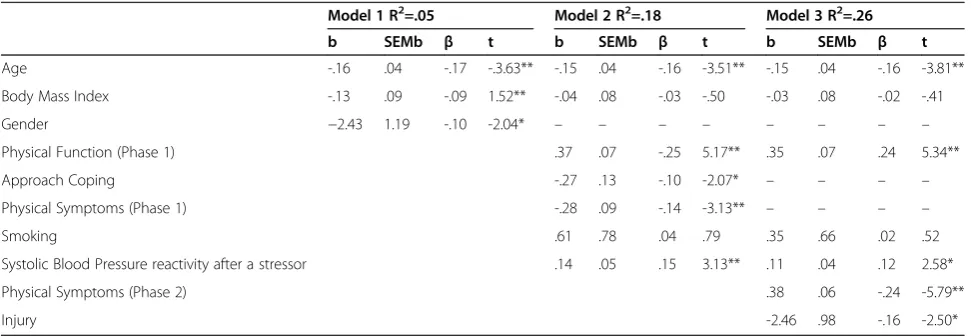
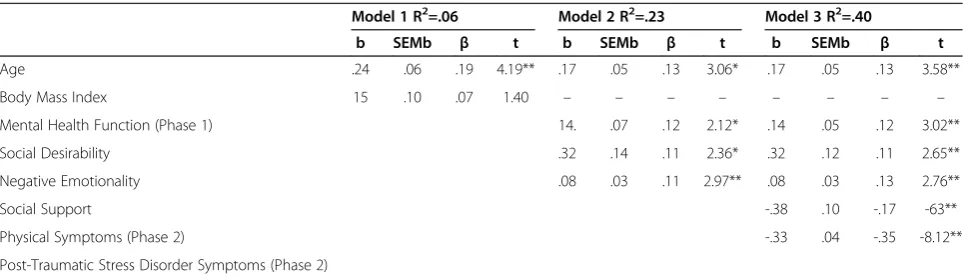
Adjusted predictors of physical and mental function For the models predicting physical and mental function, all hypothesized variables with a significant bivariate rela-tionship (atP<.10) with the outcome (physical or mental function) were entered into each of the two models as de-scribed above. Results after each step of each model are summarized in Tables 3 (physical function) and 4 (mental function).
The final model for physical function demonstrated that, controlling for the other predictors, poorer physical func-tion at Phase 2 was associated with older age, poorer phys-ical function at Phase 1, blunted systolic blood pressure reactivity to a lab stressor, greater physical symptom sever-ity, and being injured.
Table 2 Comparison of this sample, and the overall Army National Guard and Reserves
Our sample Army National Guard (ARNG)/
Army Reserve (AR)
Age - Mean years (SD; range) 28.0 (8.3; 18–57 years) Ages 18–60 years (ARNG overall Mean age approx. 33 years; Army Reserve enlisted average age is 31 years*)
Component
Army NG 554 (72.2%) Deployed reservist Army personnel are 71%
ARNG & 29% Army Reserves + Army Reserve 202 (26.3%)
Active or Other 11 (1.4%)
Males 688 (89.7%) Army NG female = 13.4%Ŧ
Females 79 (10.3%) Army Reserve female = 23.8%Ŧ
Overall Army Res comp. = 17.6%Ŧ
Education–Mean years (SD) 97.4% were high school graduates or equivalent and 2.0% had bachelor’s degree or equivalent number of years.
In the Army NG and Army Reserve 99.8% and 99.3%, respectively were high school graduates or equivalent, and 15% had a bachelor’s degree*
Race Army NG (%)/Army Reserves (%)
White 592 (77.2%)
Black 69 (9.0%) White 73.0 57.3
American Indian 21 (2.7%) Black 13.9 23.2
Asian/Pac. Islander 21 (2.8%)
Other 48 (6.3%) Asian/Pac. Isl. 1.9 4.4
Declined/Missing 16 (2.1%) Other 1.3 0.7
Ethnicity Unknown 1.7 0.9
Hispanic 95 (12.4%) Hispanic 8.2 13.5
*Average age and education for Reservists from Army Reserve Association, Inc. (2008) Specialized Workforce onlinehttp://www.armyreserve.org/ SPECIALIZED_WORKFORCE.html.
+ Proportions based on numbers of Army NG and Army Reserve troops serving in Iraq and Afghanistan as of January 2, 2008. Waterhouse & O’Bryant
(January 17, 2008) Congressional Research Service Report for Congress National Guard Personnel and Deployments: Fact Sheet (utilizing data from Department of Defense, Office of the Joint Chiefs of Staff, Legislative Affairs, January 2, 2008).
The final model for mental function demonstrated that, controlling for the other predictors, poorer mental health function at Phase 2 was associated with younger age, lower social desirability, lower social support at Phase 1, poorer mental health function at Phase 1, more physical symp-toms and more PTSD sympsymp-toms.
Discussion
This study was designed to prospectively identify psycho-social and physiological factors associated with physical and mental function after deployment. On average, phys-ical function in OEF/OIF soldiers declined by 2.2 points and mental function declined by 4.0 points from just be-fore to just after a combat deployment. A two to three point difference on these measures is considered a min-imal clinically important difference [16,34]. Thus, over the course of a year-long combat deployment, these individ-uals showed an average decline in physical and mental function that was meaningful, particularly in light of their young average age, and pre-deployment good health (com-pared to veteran norms). This is also notable in light of re-cent evidence showing that physical and mental function continue to decline over time since deployment [35-38]. This is the first prospective study to show the effects of combat deployment on health function. Moreover, it is im-portant to identify, as we have done here, both pre- and early post-deployment factors that are associated with poorer physical and mental function to determine who is at greatest risk, and to determine which of these factors could be addressed by health care personnel or other caregivers.
We predicted that the effect of combat deployment on physical and mental function would be influenced by multiple demographic, psychosocial, physiological and
deployment factors. After controlling for pre-deployment physical function, we found that poorer physical function after deployment was associated with older age, lower (i.e., blunted) systolic blood pressure reactivity to stressors, greater concurrent physical symptom severity, and being injured. In contrast, previous cross-sectional studies have suggested a variety of other factors to relate to physical function including PTSD diagnosis or symptoms [39,40], social support [41] and other psychosocial factors [42]. These previous studies often measured physical function many years after deployment raising the possibility that the effects of psychosocial factors occur over an extended time. Our findings do suggest that older Army enlisted personnel are at modestly greater risk for poor physical function after deployment. In our adjusted model (Model 3 in Table 3) soldiers showed a decrease in physical function of 0.15 units for every one year increase in of age leading to a clin-ically significant decline (2.5 point decrease) for every 17 years of age. Injured soldiers also showed a clinically sig-nificant decline in physical function (2.46 point difference) as compared to those with no injuries.
Blunted systolic blood pressure responses to laboratory stressors were associated with poorer physical health func-tion after deployment. From one perspective, this may seem surprising given that greater cardiovascular re-sponses to stressors have frequently been associated with poorer cardiovascular health [27]. However, recently sev-eral investigators have also demonstrated that blunted blood pressure responses to stressors can relate prospect-ively to poorer health outcomes, in particular depression, obesity, and overall poorer self-reported health [28].
Immediately after deployment these soldiers, on average, reported poorer mental function than before deployment. The final model, controlling for pre-deployment mental
Table 3 Models predicting phase 2 physical function
Model 1 R2=.05 Model 2 R2=.18 Model 3 R2=.26
b SEMb β t b SEMb β t b SEMb β t
Age -.16 .04 -.17 -.3.63** -.15 .04 -.16 -3.51** -.15 .04 -.16 -3.81**
Body Mass Index -.13 .09 -.09 1.52** -.04 .08 -.03 -.50 -.03 .08 -.02 -.41
Gender −2.43 1.19 -.10 -2.04* – – – – – – – –
Physical Function (Phase 1) .37 .07 -.25 5.17** .35 .07 .24 5.34**
Approach Coping -.27 .13 -.10 -2.07* – – – –
Physical Symptoms (Phase 1) -.28 .09 -.14 -3.13** – – – –
Smoking .61 .78 .04 .79 .35 .66 .02 .52
Systolic Blood Pressure reactivity after a stressor .14 .05 .15 3.13** .11 .04 .12 2.58*
Physical Symptoms (Phase 2) .38 .06 -.24 -5.79**
Injury -2.46 .98 -.16 -2.50*
**P< .001, *P< .05. Each successive step accounted for a significant increase in variance over the prior model (all ps < .05 or better). Overall final model adjusted R2
health function, showed that this lower mental health function was associated with younger age, lower social de-sirability, lower social support at pre-deployment, greater physical symptom severity, and having more PTSD symp-toms. In our adjusted model (Model 4 in Table 4) we found a clinically significant difference in mental health function (i.e., 2.5 points) for every 15 years difference in age, but unlike for physical function, younger individuals were at greater risk for poor mental health function. Also unlike physical function, social support remained a signifi-cant predictor in the final model for mental health adding to a growing literature on the importance of social support both in- and out of the theater of war for OEF and OIF veterans [43,44]. We observed a 0.08 point change in men-tal function for every one point change in social support, or a clinically significant change in mental health function (2.5 point change) for about every 1.5 standard deviation (SD=18.9) difference in social support (Model 3 in Table 4). Thus, soldiers with poor social support may need additional resources prior to deployment or during deployment to buffer against declines in mental function. Moreover, sol-diers reporting PTSD symptoms after deployment should also be assessed for declines in mental function. A clinically significant decrease in mental health function (2.5 point change) was associated with a 7.5 point increase in PTSD symptoms (Model 3 in Table 4). To provide context, the suggested cut off for a potential PTSD diagnosis on this measure is 33 points above the minimum score.
A strongest predictor of poorer physical and mental function was greater concurrent physical symptom sever-ity. Physical symptoms are caused not only by the physical demands of combat, such as carrying heavy equipment, but also by psychosocial and environmental factors [45,46]. Scores on the physical symptom scale can be used to determine minimal (PHQ score = 0–4), low (PHQ score = 5–9), medium (PHQ score = 10–14) and high
(PHQ score = 15–30) severity subgroups as suggested by Kroenke et al. [22]. Our adjusted data show a 0.38 point decline in mental and physical health function for every one point increase in physical symptoms, or alternatively a 5.7 point (i.e., double the minimal clinically significant change) difference between the lowest and highest symp-tom subgroups (Model 3 in Table 3). Clinicians should be aware that Veterans returning from a combat deployment with numerous or severe physical symptoms likely have significant impairments in mental and physical health function. Although physical symptoms were a primary focus of post-deployment health care for Persian Gulf War veterans (e.g., [47]) there has been much less em-phasis on physical symptoms, broadly defined, and their impact on OEF/OIF veterans. In large part, this is because the literature on OEF/OIF Veterans has focused more on PTSD, mTBI (including associated physical symptoms often called post-concussive symptoms) and more recently on the co-morbidity of PTSD and/or mTBI with chronic pain (e.g., [48-50]). Our findings suggest that physical symptoms are an important contributor to both physical and mental function after war, over and above other fac-tors, and thus may deserve additional focused attention.
This study was designed to address limitations of prior cross-sectional studies in combat veterans where many samples were treatment-seeking, assessments were obtained long after deployment, and/or there was a lack of pre-deployment data. This study has its own limitations, including the absence of a non-deployed comparison co-hort, and loss-to-follow up due to a number of units and individuals who did not return to the stateside Army in-stallations from which they deployed. To have a relatively healthy pre-deployment sample and to minimize con-founds with our physiological variables, we also excluded from participation those participants with depression, schizophrenia, bipolar disorder or current hypertension
Table 4 Models predicting phase 2 mental function
Model 1 R2=.06 Model 2 R2=.23 Model 3 R2=.40
b SEMb β t b SEMb β t b SEMb β t
Age .24 .06 .19 4.19** .17 .05 .13 3.06* .17 .05 .13 3.58**
Body Mass Index 15 .10 .07 1.40 – – – – – – – –
Mental Health Function (Phase 1) 14. .07 .12 2.12* .14 .05 .12 3.02**
Social Desirability .32 .14 .11 2.36* .32 .12 .11 2.65**
Negative Emotionality .08 .03 .11 2.97** .08 .03 .13 2.76**
Social Support -.38 .10 -.17 -63**
Physical Symptoms (Phase 2) -.33 .04 -.35 -8.12**
Post-Traumatic Stress Disorder Symptoms (Phase 2)
which could have resulted in some range restriction on health function at baseline. However, respondents were somewhat more likely to report having poor general health than non-respondents, suggesting that any bias due to health exclusions may have been balanced by a modest tendency for those with poorer health to be more likely agree to participate. Although it does not currently include physiological measures such as those reported here, the large prospective epidemiological study, the Millennium Cohort Study [51] does not exclude potential participants for health conditions, and thereby will provide broadly generalizable results at least for self-report measures. In addition, collecting data at the mobilization site does not provide an optimal, non-stressful baseline. Social desirabil-ity, or the tendency to present oneself in an especially fa-vorable way, was a significant predictor of mental function, as has been reported previously [52]. This suggests that like non-veterans, some military personnel present themselves as having better mental function than may in fact be true due to their biased reporting style. Another potential limi-tation is that for logistical reasons, we had to use different assessment methods (e.g., in-person computer surveys vs. in-person paper or phone surveys) at different time points which may have introduced additional measurement error.
In conclusion, this study sought to understand pre-deployment and early post-pre-deployment predictors of phys-ical and mental function immediately after deployment. We found that deployment was associated with a decline in both physical and mental function. The demographic, psychosocial, physiological and deployment experiences of OEF and OIF veterans are multifaceted and highly varied, and the effects of these factors on physical and mental function appear to be complex. Social support emerged as a potentially modifiable pre-deployment factor for mental function, and across both physical and mental function, increased physical symptom severity was an indicator of poorer post-deployment function even accounting for baseline function. These data suggest that health care pro-viders should be aware that greater physical symptom se-verity, lower social support, more PTSD symptoms and having had a deployment injury all are important clinical features that may suggest the need for further functional evaluation for a veteran returning from a recent combat deployment to Iraq or Afghanistan.
Competing interests
The authors declare that they do not have any conflicts of interest.
Authors’contributions
LMM collected data, designed the analysis plan, wrote the initial draft and contributed extensively to the writing; ED collected data and contributed to the writing; SL conducted the data analysis and contributed to the writing, BA contributed to the writing, GY contributed to the writing, CE contributed to the study design and the writing, KQ designed the study, collected the data, designed the analysis plan, and wrote parts of the initial draft and contributed extensively to the writing. All authors read and approved the final manuscript.
Disclaimer
The views expressed in this article are those of the authors and do not necessarily reflect the position or policy of the Department of Veterans Affairs, the Department of Defense or the United States government.
Financial disclosure
This study was supported by grants from the Department of Veterans Affairs, Health Services Research & Development Service (IIR 0202–296 to K. Quigley); the NJ War Related Illness and Injury Study Center, the NJ REAP (REA 03–021); and the Deployment Health Clinical Center, Walter Reed Army Medical Center.
Author details
1Department of Veterans Affairs, NJ War Related Illness & Injury Study Center, 385 Tremont Ave. Mailstop 129, East Orange, NJ 07018, USA.2School of Public Health, University of Medicine & Dentistry of New Jersey, Piscataway, NJ, USA.3Philadelphia VA Medical Center, Philadelphia, PA, USA.
4Department of Psychiatry, F. Edward Hebert School of Medicine, Uniformed Services University, Bethesda, MD 20814, USA.5Department of Veterans Affairs, Bedford Memorial Hospital, Bedford, MA, USA.6Interdisciplinary Affective Science Laboratory, Northeastern University, Boston, MA, Canada.
Received: 10 January 2013 Accepted: 4 April 2013 Published: 30 April 2013
References
1. Leidy NK:Functional status and the forward progress of merry-go-rounds: toward a coherent analytical framework.Nurs Res1994,43:196–202. 2. Hays RD, Hahn H, Marshall G:Use of the SF-36 and other health-related
quality of life measures to assess persons with disabilities.Arch Phys Med Rehabil2002,83:S4–S9.
3. Kazis LE:The Veterans SF-36 Health Status Questionnaire: Development and Application in the Veterans Health Administration.Medical Outcomes Trust Monitor2000,5:1–18.
4. Singh JA, Nelson DB, Fink HA, Nichol KL:Health-related quality of life predicts future health care utilization and mortality in veterans with self-reported physician-diagnosed arthritis: the veterans arthritis quality of life study.Semin Arthritis Rheum2005,34:755–765.
5. Sayer NA, Frazier P, Orazem RJ, Murdoch M, Gravely A, Carlson KF, Hintz S, Noorbaloochi S:Military to civilian questionnaire: a measure of
postdeployment community reintegration difficulty among veterans using Department of Veterans Affairs medical care.J Trauma Stress2011,
24:660–670.
6. Kazis LE, Miller DR, Clark J, Skinner K, Lee A, Rogers W, Spiro A III, Payne S, Fincke G, Selim A,et al:Health-related quality of life in patients served by the Department of Veterans Affairs: results from the Veterans Health Study.Arch Intern Med1998,158:626–632.
7. Agha Z, Lofgren RP, VanRuiswyk JV, Layde PM:Are patients at Veterans Affairs medical centers sicker? A comparative analysis of health status and medical resource use.Arch Intern Med2000,160:3252–3257. 8. Rumsfeld JS, MaWhinney S, McCarthy M Jr, Shroyer AL, VillaNueva CB,
O'Brien M, Moritz TE, Henderson WG, Grover FL, Sethi GK,et al: Health-related quality of life as a predictor of mortality following coronary artery bypass graft surgery. Participants of the Department of Veterans Affairs Cooperative Study Group on Processes, Structures, and Outcomes of Care in Cardiac Surgery.JAMA1999,281:1298–1303. 9. DeSalvo KB, Fan VS, McDonell MB, Fihn SD:Predicting mortality and healthcare utilization with a single question.Health Serv Res2005,
40:1234–1246.
10. Seal KH, Bertenthal D, Miner CR, Sen S, Marmar C:Bringing the war back home: mental health disorders among 103,788 US veterans returning from Iraq and Afghanistan seen at Department of Veterans Affairs facilities.Arch Intern Med2007,167:476–482.
11. Kline A, Falca-Dodson M, Sussner B, Ciccone DS, Chandler H, Callahan L, Losonczy M:Effects of repeated deployment to Iraq and Afghanistan on the health of New Jersey Army National Guard troops: implications for military readiness.Am J Public Health2010,100:276–283.
12. Jakupcak M, Luterek J, Hunt S, Conybeare D, McFall M:Posttraumatic stress and its relationship to physical health functioning in a sample of Iraq and Afghanistan War veterans seeking postdeployment VA health care.
13. Vasterling JJ, Schumm J, Proctor SP, Gentry E, King DW, King LA:
Posttraumatic stress disorder and health functioning in a non-treatment-seeking sample of Iraq war veterans: a prospective analysis.J Rehabil Res Dev2008,45:347–358.
14. Schnurr PP, Lunney CA, Bovin MJ, Marx BP:Posttraumatic stress disorder and quality of life: extension of findings to veterans of the wars in Iraq and Afghanistan.Clin Psychol Rev2009,29:727–735.
15. Ouimette P, Coolhart D, Sugarman D, Funderburk JS, Zelman RH, Dornau C:
A pilot study of posttraumatic stress and associated functioning of Army National Guard following exposure to Iraq warzone trauma.
Traumatology2008,14:51–56.
16. Ware JE, Kosinski M, Bjorner JB:User's Manual for the SF-36v2 Health Survey. 2nd edition. Lincoln, RI, USA: QualityMetric; 2007.
17. Waller NG, Tellegen A, McDonald RP, Lykken DT:Exploring nonlinear models in personality assessment: development and preliminary validation of a negative emotionality scale.J Pers1996,64:545–576. 18. Tellegen A, Atkinson G:Openness to absorbing and self-altering
experiences ("absorption"), a trait related to hypnotic susceptibility.
J Abnorm Psychol1974,83:268–277.
19. King DW, King LA, Vogt DS:Manual for the Deployment Risk and Resilience Inventory (DRRI): A collection of measures for studying deployment-related experiences of military veterans.Boston: National Center for PTSD; 2003. 20. Strahan R, Gerbasi KC:Short, homogeneous versions of the
Marlow-Crowne social desirability scale.J Clin Psychol1972,28:191–193. 21. Sherbourne CD, Stewart AL:The MOS Social Support Survey.Soc Sci Med
1991,32:705–714.
22. Kroenke K, Spitzer RL, Williams JBW:The PHQ-15: Validity of a new measure for evaluating the severity of somatic symptoms.Psychosom Med2002,64:258–266.
23. Moos RH:Coping Responses Inventory: Adult Form Manual.Lutz, FL: Psychological Assessment Resources; 1992.
24. Wright KM, Cabrera OA, Adler AB, Bliese PD, Hoge CW:Stigma and barriers to care in soldiers postcombat.Psychological Services2009,6:108–116. 25. Weathers FW, Huska JA, Keane TM:The PTSD Checklist-Military version
(PCL-M).; 1993.
26. Weathers FW, Litz BT, Herman D, Huska JA, The KTM:The PTSD Checklist (PCL): Reliability, validity and diagnostic utility. Paper presented at the Annual Convention of the International Society for Stress Studies.TX: San Antonio; 1993.
27. Chida Y, Steptoe A:Greater cardiovascular responses to laboratory mental stress are associated with poor subsequent cardiovascular risk status: a meta-analysis of prospective evidence.Hypertension2010,
55:1026–1032.
28. Phillips AC:Blunted cardiovascular reactivity relates to depression, obesity, and self-reported health.Biol Psychol2011,86:106–113. 29. Stern RM, Ray WJ, Quigley KS:Psychophysiological recordings.New York:
Oxford University Press; 2001.
30. Slinker BK, Glantz SA:Missing data in two-way analysis of variance.Am J Physiol1990,258:R291–R297.
31. Raghunathan T, Solenberger P, van Hoewyk J:IVEware: Imputation and variance estimation software user guide.Ann Arbor, MI: Survey Research Cenber, Institute for Social Research; 2002.
32. Rubin D:Multiple Imputation for Nonresponse in Surveys.New York: Wiley & Sons; 1987.
33. Raghunathan T, Lepkowski J, van Hoewyk J, Solenberger P:A multivariate technique for multiply imputing missing values using a sequence of regression models.Survey Methodology2001,27:85–95.
34. Ware JE Jr, Sherbourne CD:The MOS 36-item short-form health survey (SF-36). I. Conceptual framework and item selection.Med Care1992,
30:473–483.
35. Falvo MJ, Serrador JM, McAndrew LM, Chandler HK, Lu SE, Quigley KS:A retrospective cohort study of U.S. service members returning from Afghanistan and Iraq: is physical health worsening over time?BMC Public Health2012,12:1124.
36. Milliken CS, Auchterlonie JL, Hoge CW:Longitudinal assessment of mental health problems among active and reserve component soldiers returning from the Iraq war.JAMA2007,298:2141–2148.
37. Seal KH, Metzler TJ, Gima KS, Bertenthal D, Maguen S, Marmar CR:Trends and risk factors for mental health diagnoses among Iraq and Afghanistan veterans using Department of Veterans Affairs health care, 2002–2008.Am J Public Health2009,99:1651–1658.
38. Thomas JL, Wilk JE, Riviere LA, McGurk D, Castro CA, Hoge CW:Prevalence of mental health problems and functional impairment among active component and National Guard soldiers 3 and 12 months following combat in Iraq.Arch Gen Psychiatry2010,67:614–623.
39. O'Toole BI, Catts SV:Trauma, PTSD, and physical health: an
epidemiological study of Australian Vietnam veterans.J Psychosom Res 2008,64:33–40.
40. Schnurr PP, Spiro A III:Combat exposure, posttraumatic stress disorder symptoms, and health behaviors as predictors of self-reported physical health in older veterans.J Nerv Ment Dis1999,187:353–359.
41. King LA, King DW, Fairbank JA, Keane TM, Adams GA:Resilience-recovery factors in post-traumatic stress disorder among female and male Vietnam veterans: hardiness, postwar social support, and additional stressful life events.J Pers Soc Psychol1998,74:420–434.
42. Ren XS, Skinner K, Lee A, Kazis L:Social support, social selection and self-assessed health status: results from the veterans health study in the United States.Soc Sci Med1999,48:1721–1734.
43. Van Voorhees EE, Dedert EA, Calhoun PS, Brancu M, Runnals J, Beckham JC:
Childhood trauma exposure in Iraq and Afghanistan war era veterans: Implications for posttraumatic stress disorder symptoms and adult functional social support.Child Abuse Negl2012,36:423–432. 44. Hinojosa R, Hinojosa MS:Using military friendships to optimize
postdeployment reintegration for male Operation Iraqi Freedom/Operation Enduring Freedom veterans.J Rehabil Res Dev2011,48:1145–1158. 45. Quigley KS, McAndrew LM, Almeida L, D'Andrea EA, Engel CC, Hamtil H,
Ackerman AJ:Prevalence of environmental and other military exposure concerns in Operation Enduring Freedom and Operation Iraqi Freedom veterans.J Occup Environ Med2012,54:659–664.
46. McAndrew LM, Teichman RF, Osinubi OY, Jasien JV, Quigley KS:
Environmental exposure and health of Operation Enduring Freedom/ Operation Iraqi Freedom veterans.J Occup Environ Med2012,54:665–669. 47. Kang HK, Natelson BH, Mahan CM, Lee KY, Murphy FM:Post-traumatic
stress disorder and chronic fatigue syndrome-like illness among Gulf War veterans: a population-based survey of 30,000 veterans.Am J Epidemiol2003,157:141–148.
48. Hoge CW, Terhakopian A, Castro CA, Messer SC, Engel CC:Association of posttraumatic stress disorder with somatic symptoms, health care visits, and absenteeism among Iraq war veterans.Am J Psychiatry2007,
164:150–153.
49. Fear NT, Jones E, Groom M, Greenberg N, Hull L, Hodgetts TJ, Wessely S:
Symptoms of post-concussional syndrome are non-specifically related to mild traumatic brain injury in UK Armed Forces personnel on return from deployment in Iraq: an analysis of self-reported data.Psychol Med 2009,39:1379–1387.
50. Helmer DA, Chandler HK, Quigley KS, Blatt M, Teichman R, Lange G:Chronic widespread pain, mental health, and physical role function in OEF/OIF veterans.Pain Med2009,10:1174–1182.
51. Gray GC, Chesbrough KB, Ryan MA, Amoroso P, Boyko EJ, Gackstetter GD, Hooper TI, Riddle JR:The Millennium Cohort Study: a 21-year prospective cohort study of 140,000 military personnel.Mil Med2002,167:483–488. 52. Bardwell WA:Ancoli-Israel S, Dimsdale JE: Response bias influences
mental health symptom reporting in patients with obstructive sleep apnea.Ann Behav Med2001,23:313–317.
doi:10.1186/1477-7525-11-73
Cite this article as:McAndrewet al.:What pre-deployment and early