S T U D Y P R O T O C O L
Open Access
Dentists United to Extinguish Tobacco (DUET): a
study protocol for a cluster randomized,
controlled trial for enhancing implementation of
clinical practice guidelines for treating tobacco
dependence in dental care settings
Jamie S Ostroff
1*†, Yuelin Li
1and Donna R Shelley
2*†Abstract
Background:Although dental care settings provide an exceptional opportunity to reach smokers and provide brief cessation advice and treatment to reduce oral and other tobacco-related health conditions, dental care providers demonstrate limited adherence to evidence-based guidelines for treatment of tobacco use and dependence. Methods/Design:Guided by a multi-level, conceptual framework that emphasizes changes in provider beliefs and organizational characteristics as drivers of improvement in tobacco treatment delivery, the current protocol will use a cluster, randomized design and multiple data sources (patient exit interviews, provider surveys, site observations, chart audits, and semi-structured provider interviews) to study the process of implementing clinical practice guidelines for treating tobacco dependence in 18 public dental care clinics in New York City. The specific aims of this comparative-effectiveness research trial are to: compare the effectiveness of three promising strategies for implementation of tobacco use treatment guidelines—staff training and current best practices (CBP), CBP + provider performance feedback (PF), and CBP + PF + provider reimbursement for delivery of tobacco cessation treatment (pay-for-performance, or P4P); examine potential theory-driven mechanisms hypothesized to explain the comparative effectiveness of three strategies for implementation; and identify baseline organizational factors that influence the implementation of evidence-based tobacco use treatment practices in dental clinics. The primary outcome is change in providers’tobacco treatment practices and the secondary outcomes are cost per quit, use of tobacco cessation treatments, quit attempts, and smoking abstinence.
Discussion:We hypothesize that the value of these promising implementation strategies is additive and that
incorporating all three strategies (CBP, PF, and P4P) will be superior to CBP alone and CBP + PF in improving delivery of cessation assistance to smokers. The findings will improve knowledge pertinent to the implementation, dissemination, and sustained utilization of evidence-based tobacco use treatment in dental practices.
Trial registration:NCT01615237.
Keywords:Dental care, Clinical practice guidelines, Treatment of tobacco dependence, Tobacco cessation
* Correspondence:[email protected];[email protected] †Equal contributors
1Department of Psychiatry and Behavioral Sciences, Memorial Sloan-Kettering
Cancer Center, 1275 York Avenue, New York, NY 10022, USA
2Department of Population Health, New York University School of Medicine,
227 East 30th Street, 7th floor, New York, NY 10016, USA
Background
Evidence-based approaches for the treatment of tobacco dependence exist
The 2008 United States (US) Public Health Service (PHS) Guideline, Treating Tobacco Use and Dependence, pro-vides strong evidence that provider delivery of tobacco de-pendence treatment, including cessation pharmacotherapy and brief counseling, can produce significant and sus-tained reductions in tobacco use and should be delivered to all smokers seeking routine healthcare [1]. Provider ad-herence to the PHS Guideline recommendations involves asking all patients about tobacco use, advising smokers to quit, assessing readiness to quit, providing cessation assist-ance, and arranging follow-up (the so-called 5As) [1].
Inadequate adoption of evidence-based treatment contributes to disparities in tobacco related illnesses Despite the existence of effective tobacco dependence treatments, inadequate adoption, particularly among low-income and ethnic/racial minority smokers, has contrib-uted to growing disparities in smoking prevalence and tobacco-related illness [2-4]. Citing persistent missed op-portunities to promote tobacco cessation, the Institute of Medicine’s (IOM) report [5],‘Ending the Tobacco Prob-lem: A Blueprint for the Nation,’called for greater efforts to implement effective tobacco cessation interventions in healthcare settings. These recent health policy reports highlight the need and potential public health value of reducing health disparities through dissemination of evidence-based tobacco cessation interventions in health-care delivery systems serving low-income and other high-risk smokers [5,6].
Dental healthcare settings are an important but underutilized venue for tobacco use treatment
Dental care settings have several advantageous features for delivery of tobacco cessation treatment including: broad reach with 62.8% of 18 to 64 years olds reporting at least one annual dental visit [7]; access to patients who do not receive other healthcare services (10% of dental patients do not regularly see a physician) [8]; the dental team routinely provides preventive services; and controlled trials have demonstrated the efficacy of dental office-based cessation interventions [9]. Moreover, den-tal professionals have a credible role in providing to-bacco cessation advice and treatment because of the oral hazards of tobacco use. A recent national survey found that 89% of dentists and 96% of dental hygienists re-ported that treating tobacco use was an important pro-fessional responsibility [10]. There are approximately 475 federally-funded, community or neighborhood health centers with dental clinics and another 250 community dental clinics throughout the US [11]. These commu-nity dental health centers serve predominantly
low-income populations known to have a high prevalence of smoking [12]. The potential impact of implementing to-bacco clinical practice guidelines in these public health dental clinics is substantial [9].
Treatment of tobacco dependence in dental care settings remains suboptimal
Although national surveys indicate that dental providers are increasingly screening for tobacco use and offering brief advice, full adherence to the PHS guidelines is in-consistent with only 10% to 25% dental care providers routinely delivering cessation assistance (e.g., cessation pharmacotherapy prescriptions and/or referral for cessa-tion counseling) [10,13]. These findings are consistent with international findings demonstrating that treatment of tobacco dependence in dental settings is lacking [14]. Dentists most often cite lack of training and inadequate reimbursement to explain their limited provision of to-bacco cessation interventions [15]. PHS guideline imple-mentation is likely affected by both provider attitudes and organizational priorities that impact provider behav-ior [1,13,16-18].
Closing the gap between research and practice is sty-mied by the paucity of research on systems changes needed to implement tobacco treatment in routine dental care. Drawing from a burgeoning implementation science literature, including studies focusing on implementing to-bacco cessation counseling in dental care settings [19,20], the current research protocol will compare the cumulative benefit of three, promising systems-level strategies: staff training, practice facilitation and clinical reminders (CBP), provider feedback and pay-for-performance (financial in-centives), that have been widely endorsed by an IOM re-port and the PHS Guidelines [1,21,22].
Staff training and clinical reminder systems (CBP)
The PHS Guideline strongly recommends staff training, clinical reminder systems, referral pathways and other practice supports as CBP for screening and treating to-bacco dependence in all healthcare settings [1,16].
Performance feedback (PF)
In recent randomized trials conducted in primary medical care settings, clinical audit and feedback with regard to to-bacco treatment performance have been associated with a twofold increase in providers’adherence to cessation assist-ance and referral to cessation quitlines [16-18,21,23-25]. The potential value of these strategies has not yet been fully examined in dental practice. A single arm, pilot study tested the feasibility and promise of implementing CBP plus provider feedback in six public dental clinics in New York City [26]. The main outcome measure—pro-vider adherence to tobacco use treatment guidelines— was assessed by auditing a random selection of dental
chart documentation pre and post-adoption of this im-plementation strategy. Following imim-plementation of CBP and PF, providers were significantly more likely to offer advice (28% pre, 49% post), assess readiness to quit (18% pre, 30% post), and offer assistance (7% pre, 16% post) [26,27].
Pay for performance (P4P)
P4P or providing financial incentives for meeting predeter-mined performance goals has attracted much interest as a strategy to improve quality of care [28,29]. The European Workshop on Tobacco Use Prevention and Cessation for Oral Health Professionals emphasized the importance of appropriate compensation (incentives) of tobacco use treat-ment [30]. Several studies have demonstrated a positive as-sociation between P4P and adherence to recommended tobacco use treatment [31-33], including increased referrals to statewide tobacco quitline services [31].
Using a three-arm cluster randomized controlled trial design, the overall objective of this protocol is to com-pare the effectiveness of three promising implementation strategies designed to address organizational and pro-vider level challenges for effective treatment of tobacco de-pendence. Guided by a multi-level, conceptual framework that emphasizes both provider beliefs and organizational characteristics, the trial will be conducted in 18 public den-tal care clinics in New York City and information about implementation outcomes and processes will be captured with multiple data sources (patient exit interviews, pro-vider surveys, site observations, chart audits, and semi-structured provider interviews) in order to examine factors that influence the implementation process.
The specific aims of this comparative effectiveness re-search trial are to:
1. Compare the effectiveness and cost of three promising strategies for implementation of the PHS tobacco use treatment guidelines on dental provider delivery of cessation assistance:
a) Staff training and CBP; b) CBP + provider PF; and
c) CBP + PF + provider reimbursement for delivery of tobacco cessation treatment (pay-for-performance; P4P)
2. Use a mixed-methods approach to examine potential theory-driven mechanisms at the organizational and provider level hypothesized to explain the comparative effectiveness of three strategies for implementation; 3. Identify baseline organizational factors that influence
the implementation of evidence-based tobacco use treatment practices in dental clinics.
The central hypothesis is that the value of these prom-ising implementation strategies is additive and that
instituting all three strategies (CBP, PF, and P4P) will be superior to CBP alone and CBP + PF in increasing delivery of cessation assistance to smokers. The ultimate goal is to provide critical new knowledge to facilitate the widespread implementation, dissemination and sustained utilization of evidence-based tobacco use treatment strategies in den-tal practices.
Methods
Overview of study design
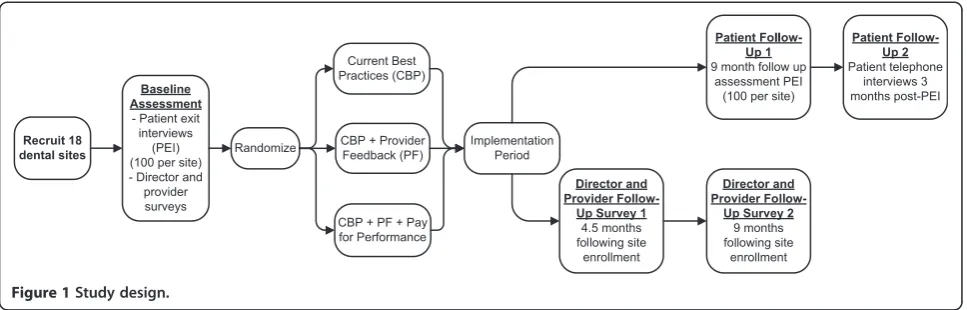
As shown in Figure 1, a three-arm cluster randomized con-trolled trial will examine the tobacco treatment guideline implementation process and compare the cost and effect-iveness of three implementation strategies: Staff training and CBP in implementing PHS Guidelines; CBP + PF; and CBP + PF + pay-for-performance (provider reimbursement for tobacco cessation treatment delivery). Guided by Organizational Change Theory and the Theory of Planned Behavior (TPB) [34-37], multi-level factors that facilitate or impede the implementation process will be identified. The primary outcome is improvement in dental provider deliv-ery of tobacco cessation treatment. Secondary outcomes are cost per quit, use of tobacco cessation treatments, quit attempts and smoking abstinence. A mixed methods (sur-vey, semi-structured interview, chart audit, site observation and NYS Quitline referral report) approach will be used to examine implementation processes (aim two).
Conceptual framework
This study’s multi-level, conceptual framework and corre-sponding selection of process measures are informed by both the Organizational Change Model [37] for studying organizational priority and practice improvements and the Theory of Planned Behavior for understanding the role of provider attitudes, norms, perceived behavioral control, and intentions on provider behavior [34]. Guided by these two complementary theoretical models and prior reviews of the implementation science literature [35,36,38-42], the proposed implementation strategies are hypothesized to operate at both the individual health provider level and the organizational level (see Figure 2).
As shown in Table 1, arm one (e.g., provider training, chart reminders, practice support for referral to the Quit-line or other local cessation programs) is hypothesized to impact perceived behavioral control. The addition of pro-vider performance feedback, (arm two) is hypothesized to enhance provider adherence to the tobacco use treatment guidelines through changes in subjective norms and atti-tudes. Arm three, which adds financial incentives, is ex-pected to impact the relative priority that organizations and providers attribute to tobacco use treatment by ad-dressing a frequently cited organizational barrier (i.e., lack of reimbursement).
Description of intervention conditions
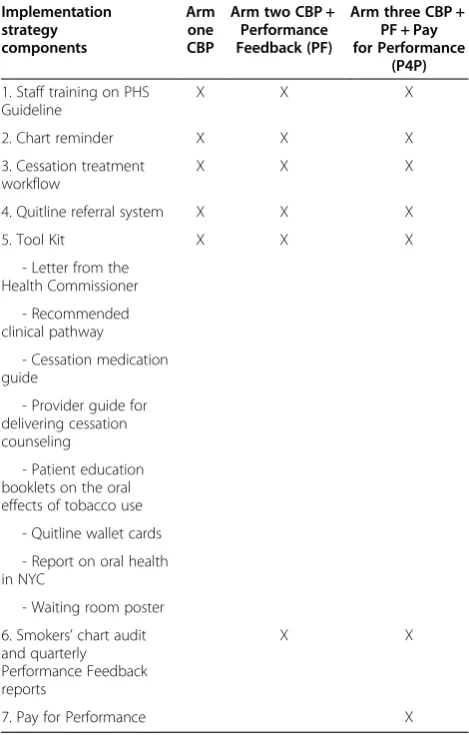
Table 2 summarizes the implementation strategy compo-nents for each treatment arm.
Arm one: staff training and CBP
All dental clinic sites will receive CBP for training and onsite technical assistance in promoting adoption of clinical practice guidelines for treating tobacco depend-ence. In New York state (NYS), the scope of dental prac-tice includes tobacco cessation treatment. The CBP tobacco use treatment protocol that will be implemented is consistent with the PHS recommended guidelines. The dental care team will assess smoking status, deliver advice to quit, assess readiness to quit, provide patient
education materials, provide a prescription for cessation pharmacotherapy and/or make referral to the NYS Quit-line, and document findings and treatment plan on the chart system. In NYS, all cessation medications except the nicotine lozenge, are covered by Medicaid and the Quitline provides eligible clients at least a two-week sup-ply of free nicotine patches. Details of CBP are summa-rized as the following.
Staff training
All clinical (i.e., dentists, dental hygienists, and/or dental assistants) and support staff will be trained in the use of the intervention protocol during a one-hour, slide pres-entation. The didactic training is based on the PHS guide-line [1] and will include content on prescribing smoking cessation pharmacotherapy, how to use the Refer-to-Quit system and other local cessation referral resources, and a review of NYS health insurance coverage for cessation treatment. The protocol includes the provision of pharma-cotherapy consistent with American Dental Association (ADA) recommendations [51]. The initial training presen-tation will be standardized and conducted by the study co-leaders (DS/JO) and offered onsite at each individual field site. To reinforce the new clinical protocol for docu-menting and treating tobacco use, each site will receive a 30-minute booster training session approximately three months after the initial training presentation.
l l
l
l l
ll
ll
l ll
l
ll
l ll
l
l l
l
Figure 1Study design.
Figure 2Conceptual framework.
Chart reminder system
The charting system is designed to remind the clinician to ask those questions required for assessing readiness to quit and to offer each smoker cessation advice. To en-hance uptake and sustainability, a tobacco treatment chart prompt will be integrated into the existing chart system (i.e., paper or electronic). Most of the partnering dental health clinics are currently using an electronic
health record. Most sites already have billing codes for treating tobacco use, and the remaining sites have agreed to add chart documentation system and billing codes for tobacco dependence.
Quitline referral system
Quitlines substantially increase abstinence rates com-pared to minimal or no counseling [1]. Started in 2000, the NYS Quitline counseled 82,776 current and former smokers in 2012 [52]. The Refer-to-Quit program sim-plifies the healthcare provider referral process by offer-ing clinical practices a strategy to easily link patients to the NYS Quitline using either a secure online website or a pre-printed fax referral form. The Quitline makes five attempts to reach patients within one week after receiv-ing the fax or online referral. If the Quitline is unable to reach a patient, a letter is sent encouraging the individ-ual to contact the Quitline for assistance. Smoking ces-sation counselors at the NYS Quitline provide one proactive telephone counseling session and distribute a two-week supply of free nicotine replacement therapy (NRT). A list of local community referrals for high-risk smokers needing more intensive cessation and/or psy-chosocial services is also provided.
Tool kits
All dental providers will receive a Smoking and Oral Health Quit Kit developed specifically for dental care providers by the New York City Department of Health and Mental Hygiene (NYC-DOHMH) [53]. The toolkit contains a call to action letter from the Commissioner of the NYC-DOHMH confirming that treating tobacco use, including prescribing cessation medications, is within dentists’scope of practice, a provider resource guide for delivery of cessation counseling, patient education book-lets describing the oral health effects of tobacco and the benefits of quitting, a pharmacotherapy prescribing in-formation card tailored for dental providers, a summary of oral health in New York City, and a waiting room poster. In addition, our project added Fax/Refer-to-Quit forms to facilitate referral to the NYS Quitline, and a brief version of the PHS Guideline for Treating Tobacco Dependence [1].
Tailored clinical pathway
After the baseline data (patient exit interviews and clinic surveys) are collected, we will meet with each site dental director to develop a clinical pathway for treating to-bacco use tailored to the site’s current chart system and staffing. The deliverable will be a workflow diagram of the recommended clinical pathway and a detailed table indicating which staff member is responsible for each step in the clinical pathway. For example, we will docu-ment who will place the clinical reminder on the charts Table 1 Theory-driven mechanisms hypothesized to
explain the effect of the implementation strategies Implementation strategy Theory-driven hypothesized
mechanism(s) of change
Arm one Staff training and current best practices (CBP)
Increases perceived behavioral control
Arm two CBP + audit and performance feedback (CBP + PF)
Increases perceived behavioral control AND modifies providers’subjective norms and attitudes
Arm three CBP + PF + pay for performance (CBP + PF + P4P)
Increases perceived behavioral control, provider attitudes AND increases organizational change priority
Table 2 Specific implementation strategies by treatment arm
Implementation strategy components
Arm one CBP
Arm two CBP + Performance Feedback (PF)
Arm three CBP + PF + Pay for Performance
(P4P)
1. Staff training on PHS Guideline
X X X
2. Chart reminder X X X
3. Cessation treatment workflow
X X X
4. Quitline referral system X X X
5. Tool Kit X X X
- Letter from the Health Commissioner
- Recommended clinical pathway
- Cessation medication guide
- Provider guide for delivering cessation counseling
- Patient education booklets on the oral effects of tobacco use
- Quitline wallet cards
- Report on oral health in NYC
- Waiting room poster
6. Smokers’chart audit and quarterly Performance Feedback reports
X X
if there is a paper system, which staff member will offer advice and cessation assistance and specifics about how the Refer-to-Quit system will be implemented in the context of current practice. (i.e., who will help the pa-tient complete the form and who will fax/submit the Quitline referral forms). The new systems and tobacco treatment clinical pathway will be presented during the on-site, staff trainings.
Arm two: CBP + audit and PF
Chart audit and quarterly feedback reports
Clinic sites randomly assigned to arm two will also re-ceive quarterly performance reports on provider delivery of cessation services using chart audit procedures. The research team will work with each of the study sites to develop a system that will allow smokers to be readily identified and placed in a smokers’registry. This system will vary depending on whether or not the site uses an electronic or paper chart. Quarterly queries of the regis-try by trained clinic staff will be conducted using a stan-dardized chart audit tool to evaluate documentation of cessation assistance. Each site will be provided and trained on an audit and feedback protocol and the process for disseminating feedback to individual pro-viders. The PF report (see Appendix) will show individ-ual and aggregated clinic performance summaries of targeted 5As provider behaviors benchmarked against other similar clinics and a recommended standard of practice (80%). Quitting assistance will be demonstrated by chart documentation of any of the following provider behaviors: making a referral to the NYS Quitline, or other community-based cessation program; providing cessation counseling; and/or discussing and or prescrib-ing cessation medications [54]. Quarterly reports will be given to the dental director, who will be instructed to circulate and discuss them with the field site’s dental providers within 30 days.
Arm three: CBP + PF + financial incentive (P4P) Pay for performance
Clinic sites randomly assigned to arm three will receive CBP, quarterly PF reports, and financial incentives for documenting delivery of adherence to clinical practice guidelines. Using the same chart auditing procedures de-scribed above, charts of all smokers will be reviewed for documentation of cessation assistance (i.e., prescription given for cessation medication, the provision of brief cessation counseling and/or a referral to the NYS Quit-line or other local cessation support programs). Sites will receive $20 for each patient with chart documentation of receiving tobacco cessation assistance. The P4P reim-bursement bonus will be offered quarterly with an an-nual cap of $5,000 per dental clinic. The P4P procedures are guided by published work done by Roski (2003). The
incentive amount is also consistent with the current Medicare and New York State Medicaid reimbursement [55,56] schedule for 10 minutes of smoking cessation counseling and represents an amount deemed appropri-ate by members of our advisory committee representing the ADA and the dental insurance industry.
Eligibility and recruitment of field sites
The selection of clinic sites is guided by our intent to insure that findings will be generalizable to real-world dental healthcare settings serving diverse population of smokers. The trial will be conducted in partnership with 18 public health dental clinics employing at least two full-time dentists, not fully adherent to PHS guidelines, able to accept additional compensation if assigned to the P4P arm and serving low-income patients in the New York metropolitan region. For practical (cost and staff-ing) reasons, clinic sites will be recruited in six succes-sive waves with three sites enrolled per wave. Site randomization will be conducted using the random per-muted block method with stratification by clinic volume (small, medium, large). Prior to enrollment, clinics will be categorized as small (100 to 400 patients per week), medium (401 to 750 patients per week) or large (>750 pa-tients per week) based on the number of adult papa-tients seen per week per the dental director. Clinics whose patient vol-ume is less than 100 patients per week will be excluded. Matching the clusters has several practical and statistical advantages. Of particular importance is that matching of-fers some control for background effects (e.g., cigarette pri-cing and other public policy changes) contemporaneous of the current trial [57]. Baseline data collection will be com-pleted prior to randomization. If the baseline providers’ as-sessment reveals that the site assists more than 60% of patients who smoke, then the clinic will be excluded and replaced with an alternate site of similar patient volume.
Evaluation plan
The evaluation plan is intended to compare the effective-ness of three promising strategies for implementation of the tobacco use treatment guidelines, to examine multi-level, theory-driven mechanisms (organizational priority, provider beliefs) hypothesized to explain the effectiveness of the three strategies for implementation, and finally to identify multi-level barriers and facilitators that that may influence the implementation of evidence-based tobacco use treatment practices in dental care settings. Mixed methods (i.e., site observational, interview and survey) data will be collected from patients, providers, dental directors, dental charts and Quitline referral data. For clarity, the as-sessment plan is organized according to following evalu-ation domains: primary outcomes, secondary outcomes, process outcomes, organizational setting moderators, im-plementation fidelity, and provider demographics.
Outcome evaluation (aim one) Primary outcome
To assess the primary outcome of provider adherence to tobacco use treatment guidelines, we will conduct and compare pre- and post-intervention patient exit inter-views conducted with eligible smokers at each of the 18 clinic sites. Prior to beginning of the implementation intervention, we will conduct 100 patient exit interviews (n = 1,800 pre-intervention) at each clinic site. Then, after each site has completed the planned intervention, another independent sample of 100 smokers will complete patient exit interviews (n = 1,800 post-intervention). Patient inter-views conducted at the point of service are considered to be the optimal non-observational method for measuring provider delivery of outpatient treatment [58,59]. A modi-fied patient exit interview (PEI) [60] will be used as a brief patient-reported measurement tool for the assessment of provider delivery of tobacco use screening and treatment. A PEI index (summary) score is determined by adding the number of tobacco treatment behaviors each patient ports that the provider implemented during the most re-cent visit. PEI index will scores range from 0 to 8. The questions assess the full spectrum of PHS guideline rec-ommended care (i.e., 5As). For example, patients are asked if their provider advised them to quit, offered cessa-tion counseling and/or discussed cessacessa-tion medicacessa-tions. The PEI has well-established validity as evidenced by strong correlation with more costly audio-taped assess-ment of physician-patient interactions (r = 0.67, p < 0.001) and has been commonly used to accurately measure pro-viders’delivery of tobacco cessation assistance efforts dur-ing office practice, and to monitor providers’adherence to tobacco cessation treatment guidelines in clinical trials. Prior to and approximately nine months following each site’s enrollment, consecutive patients will be approached during their clinic visits by trained research study assis-tants (RSA), to determine current smoking status and to obtain consent for the PEI. Patient eligibility will include those: age 18 or over; English- or Spanish-speaking; current smokers defined as those who report smoking within the past seven days; New York State residents; and who have an appointment with a dentist or hygienist for routine non-emergent care. Immediately after their dental visit, patients will complete the PEI to assess provider ad-herence to the PHS Guideline (5As). We expect that most surveys will be administered using a computer tablet with a password protected, web-based data entry portal (RED-Cap) [61]; however, paper surveys will be available, as needed.
Cost analysis
Following recommendations for cost assessment meth-odology described by Ritzwoller et al., [62] research costs (e.g., labor and other inputs associated with grant
administration, IRB approval, manuscript preparation), and direct clinical intervention costs (e.g., dental pro-vider time associated with counseling patients, staff training, IT costs, reimbursement costs) will be esti-mated. Templates have been developed to capture data prospectively to improve accuracy and precision of cost assessment. The NYS Quitline has estimates of their counseling cost per quit. The costs of the medications taken by the patients as part of their cessation attempt (reported at the three-month telephone survey) will be estimated. In addition, as part of the follow-up assess-ment, patients will complete the EQ5D, which is a com-monly used patient self-report measure of health status. Applicable to a wide range of health conditions, this measure provides a single index value for health status that can be used in the clinical and economic evaluation of healthcare.[63].
Secondary outcomes
To assess patient utilization of cessation services and smoking abstinence, follow-up telephone interviews, three months post-clinic visit, will be conducted with smokers who complete the post intervention PEIs. A standardized interview will be used to collect patient-reported cessation outcomes including seven-day abstin-ence and 24-hour quit attempt and use of cessation treatment during the past three months.
Implementation process evaluation (aim two)
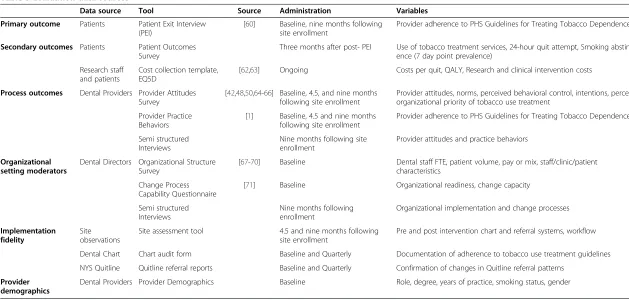
The process evaluation encompasses three areas: TPB processes; Solberg’s construct of Organizational change priority; and acceptability of and satisfaction with the implementation strategies. The multiple data sources (Table 3) include: surveys with participating dentists and dental directors; de-identified data from quarterly chart audits conducted by clinic administrative staff of clinical documentation of tobacco treatment delivery; site obser-vations; de-identified monthly reports from the NYS Quit-line summarizing the number of referrals received; and semi-structured interviews with dental clinic directors.
Dental director and provider surveys
Table 3 Evaluation data sources
Data source Tool Source Administration Variables
Primary outcome Patients Patient Exit Interview (PEI)
[60] Baseline, nine months following
site enrollment
Provider adherence to PHS Guidelines for Treating Tobacco Dependence
Secondary outcomes Patients Patient Outcomes Survey
Three months after post- PEI Use of tobacco treatment services, 24-hour quit attempt, Smoking abstin-ence (7 day point prevalabstin-ence)
Research staff and patients
Cost collection template, EQ5D
[62,63] Ongoing Costs per quit, QALY, Research and clinical intervention costs
Process outcomes Dental Providers Provider Attitudes Survey
[42,48,50,64-66] Baseline, 4.5, and nine months following site enrollment
Provider attitudes, norms, perceived behavioral control, intentions, perceived organizational priority of tobacco use treatment
Provider Practice Behaviors
[1] Baseline, 4.5 and nine months
following site enrollment
Provider adherence to PHS Guidelines for Treating Tobacco Dependence
Semi structured Interviews
Nine months following site enrollment
Provider attitudes and practice behaviors
Organizational setting moderators
Dental Directors Organizational Structure Survey
[67-70] Baseline Dental staff FTE, patient volume, pay or mix, staff/clinic/patient
characteristics
Change Process Capability Questionnaire
[71] Baseline Organizational readiness, change capacity
Semi structured Interviews
Nine months following enrollment
Organizational implementation and change processes
Implementation fidelity
Site observations
Site assessment tool 4.5 and nine months following
site enrollment
Pre and post intervention chart and referral systems, workflow
Dental Chart Chart audit form Baseline and Quarterly Documentation of adherence to tobacco use treatment guidelines
NYS Quitline Quitline referral reports Baseline and Quarterly Confirmation of changes in Quitline referral patterns
Provider demographics
Dental Providers Provider Demographics Baseline Role, degree, years of practice, smoking status, gender
Ostroff
et
al.
Implemen
tation
Science
2014,
9
:25
Page
8
o
f
1
3
http://ww
w.implemen
tationscien
ce.com/cont
may influence provider behavior [42]. Semi-structured interviews will be done after completion of the interven-tion period with the dental director at each of the par-ticipating dental clinics. The interviews will focus on site-specific barriers and facilitators of strategy imple-mentation, the process of integrating and customizing the implementation strategy into the clinic site workflow as well as acceptability and satisfaction.
Baseline organizational characteristics (aim three) Organizational change capacity
The Change Process Capability Questionnaire (CPCQ) will be used to assess baseline measures of organizational capacity to change [71]. The survey measures several do-mains of change capacity: history of change, plans for con-tinuous organizational refinement, ability to initiate and sustain change, and strategies for process improvement.
Organizational structure
At baseline, data on organizational variables shown to influence implementation of provider practice guidelines including number of full-time equivalent staff, insurance payer mix, hospital-based or freestanding clinic, aca-demic affiliation, clinic volume, and staff characteristics will be collected [67-70,72]. Dental directors will complete surveys in order to identify pre-intervention clinical sys-tems and policies (e.g., electronic or paper chart system).
Implementation fidelity
We will use several approaches to measure fidelity of the three implementation strategies [73].
Current best practices
At baseline, site observations will be conducted to assess clinical processes and workflow (e.g., patient registration, how referrals are handled, who currently screens pa-tients for tobacco use) and these site observations will be repeated at 4.5 and 9 months following site enroll-ment. During these site visits, use of the dental chart system and Refer-to-Quit forms will be determined. NYS Quitline data will be used as an additional source of infor-mation to confirm increases in referral rates in the post intervention period. The NYS Quitline provides monthly reports that include the number of referral forms received by a specific site and provider. In addition, the percentage of clinical staff members who attend the CBP initial and booster training will be recorded.
Chart audits and PF
The dental directors will be queried at three, six, and nine months to confirm date of distribution of the quar-terly PF reports.
Pay for performance
The dental directors assigned to P4P will be also asked at 3, 6, and 9 months to confirm receipt of the quarterly financial incentive earmarked to performance of tobacco treatment interventions.
Statistical considerations and analytic plan General approach
Eighteen dental clinic sites will be recruited and randomly assigned to one of three implementation strategies in a cluster-randomized design. The general statistical paradigm for assessing outcomes will be based on a Multi-Level Model (MLM) approach [74] (also known as‘hierarchical linear model’) [8,32,75,76]. MLM adjusts for the clustering effects across multiple levels (patients, providers, dental clinics) of hierarchical data structure. Before the imple-mentation strategies are rolled out, 100 patients per site will be assessed through standardized PEIs to establish the baseline level of dental provider assistance in tobacco ces-sation. Then each site will be randomly assigned and will receive their intervention condition for nine months. Fol-lowing the intervention period, 100 new patients from each site will be recruited for assessment of post-intervention changes in provider adherence to the guidelines.
MLM approach to address the primary aim
A two-level MLM will test of the effectiveness of the im-plementation strategies. The primary outcome is the summary score of the PEI assessment of provider assist-ance (score range 0–8). At level one, we will enter each patient’s PEI score of dental provider assistance as a func-tion of intervenfunc-tion and time (pre and post intervenfunc-tion), thereby allowing each site to serve as its own pre-implementation control, an added benefit to minimize an order effect, (e.g., sites that enter the active implementa-tion phase later may derive greater benefits due in part to improved efficiency in logistics coordination) [75-77]. Additional covariates may also be included (e.g., patients’ age, gender, and education).
Statistical power and sample size considerations
Statistical power was calculated to ensure sufficient sam-ple size to address two key components of study aims: de-tect an omnibus effect on the primary outcome of PEI scores across three intervention conditions, against the null hypothesis that providers’ assistance behaviors are equal across intervention conditions; and detect the differ-ences in provider assistance rates (e.g., Quitline referral).
group reported an average PEI provider assistance score of 8.40 (SD = 1.93) versus an average of 6.24 (SD = 2.12) in the Usual Care group, which translates to an estimated ef-fect size of 1.02 (using the larger SD = 2.12). Using this 1.02 effect size, we estimated an 86% statistical power to detect such an effect at a two-sided Type-I error rate of 0.01 (to control for multiple comparisons) for 18 sites (six sites randomized to each intervention condition) and 100 post-intervention patients per site [80].
Statistical power was also estimated for provider assist-ance behaviors in a generalized estimating equation (GEE) approach. Bentzet al. [23] reported that 10.5% of providers randomized to the control condition gave ac-tive assistance (e.g., referrals to quitlines); and 20.1% of providers randomized to their feedback condition gave active assistance. Roski et al.[33] reported a 31.4% ces-sation assistance rate for sites randomized to a provider incentive condition. Hence, provider assistance rates are estimated to be 10%, 20%, and 30% (rounded to the near-est decimal point) for the CBP, CBP + PF, and CBP + PF + P4P arms, respectively. Horton’s simulation method [81] was applied to calculate the statistical power of a logistic GEE model. The simulated statistical power was 82% stat-istical power to detect a 20% versus 10% difference in a GEE model comparing CBP + PF versus CBP alone. The corresponding statistical power for the 30% versus 20% difference between CBP + PF + P4P and CBP + PF is 73%. The statistical power for the larger 30% versus 10% differ-ence between CBP + PF + P4P and CBP alone is 97%. Other parameters in the simulations included a two-sided Type-I error rate of 0.01 to control for multiple compari-sons and an intra-class correlation of 0.22, in prior work [23] that closely resembles our trial design.
Using the indicators described in the evaluation plan (See Table 3), relevant process data describing the imple-mentation fidelity of the intervention strategies (CBP, PF, and PFP) will be summarized. All reporting of trial out-comes data will be consistent with cluster randomized CONSORT guidelines [82].
Ethical review
The Institutional Review Board (IRB) of New York University School of Medicine is the IRB of record and has reviewed and approved the study protocol. Memorial Sloan-Kettering is the Data Coordinating Center and their IRB has also reviewed and approved the study protocol. There is much variation in the policies and procedures for oversight of human subjects’ research among the 18 community-based, dental clinics. In those instances where the dental clinic has an existing affiliation with either an academic center or a private IRB, those IRBs will also pro-vide review and approval. In those instances, where a den-tal clinic has no affiliation with an IRB, the New York University School of Medicine IRB will provide single
project inclusion under their Federal Wide Assurance agreement.
Trial status
Funded in March 2012, much progress has been made in recruiting community-based dental clinics in New York City, finalizing the evaluation plan, finalizing the provider training plan, finalizing the tool kit for imple-mentation strategies and developing the data manage-ment plan for web-based, multi-level data collection. Baseline data collection began in March 2013 and was completed in August 2013 for the first wave of three clinic sites. Fifty-six dental care providers have been en-rolled and have completed the baseline provider survey. Four dental directors completed baseline surveys. Staff members at the individual clinic locations have received initial as well as booster training in CBP, and the imple-mentation period is ongoing. Site recruitment and base-line data collection for wave two has begun, and we expect to enroll three additional clinic sites in the Spring of 2014.
Discussion
Using a cluster randomized controlled trial design and a multi-level conceptual framework combining organizational priority and provider attitudes, norms, perceived behavioral control and intentions, the study protocol will compare the cost and effectiveness of three promising strategies for implementing tobacco treatment guidelines in routine den-tal care settings serving low-income smokers: Staff training and CBP in implementing PHS Guidelines; CBP + provider PF; and CBP + PF + P4P (provider reimbursement for to-bacco cessation treatment delivery). The study builds upon prior research [19,26] and tests practical, multi-level strat-egies to optimize the implementation of tobacco depend-ence treatment in dental settings.
The study is innovative in four areas: Dental practices are underrepresented settings in studying implementa-tion of clinical guidelines for treating tobacco depend-ence; public dental health clinics represent a novel channel for reaching minority and low-income popula-tions who are at greatest risk for tobacco use; the use of a multi-level, theoretical framework for examining pro-vider and practice-level processes for PHS guideline im-plementation is rare. A recent review of imim-plementation research found that only 10% of prior studies have pos-tulated an explicit theoretical rationale for selection of assessment tools and intervention development [83]. As such, our attention to process data will provide critical information about how the intervention works as well as multi-level barriers and facilitators of implementation, thus providing empirical guidance needed for future ad-aptations essential for optimizing sustainability and dis-semination. Finally our training and clinical assistance
model represents a substantive enhancement to the status quo of didactic continuing professional education by implementing and evaluating enhanced systems-level strategies to improve the delivery of tobacco treatment in dental clinics.
Some limitations and potential pitfalls need mention. First, although letters of support were obtained from 21 dental directors (18 plus three alternates) and several prominent community public health stakeholders who have pledged their commitment to recruiting additional community-based dental practices, enrollment of dental clinics as field sites may be challenging. Second, it is possible that variation in implementation fidelity will be observed. To reduce this likelihood, training and technical assistance will be standardized and a detailed implementa-tion fidelity measurement plan will assess whether key implementation strategies are delivered. Any variations or adaptations will be documented and these variables will be included in planned analyses. Finally, unforeseen changes in tobacco prevalence (e.g., dual tobacco use) and tobacco policy (e.g., tobacco tax, changes in Medic-aid reimbursement, healthcare reform) may affect im-plementation outcomes. Data on providers’ delivery of cessation assistance will be collected from each site prior to enrollment. This will allow each site to serve as their own control and thereby allow us to analyze for any historical threats to internal validity. Despite limita-tions, the findings have potential for high impact by identifying best practices for implementing tobacco use treatment in public health dental clinics and providing key stakeholders with the data they need to make deci-sions regarding implementation of effective tobacco de-pendence treatment guidelines.
Abbreviations
CBP:Current best practices; P4P: Pay-for-performance; PF: Performance feedback; PHS: Public health service; IOM: Institute of Medicine; USDHHS: United States Department of Health and Human Services; TBP: Theory of planned behavior; NRT: Nicotine replacement therapy; NYS: New York State; ADA: American Dental Association; NYC-DOHMH: New York City Department of Health and Mental Hygiene; PEI: Patient exit interview; RSAs: Research study assistants; CPCQ: The change process capability questionnaire; MLM: Multi-level model; GEE: Generalized estimating equation; IRB: Institutional review board.
Competing interests
The authors declare that they have no competing interests.
Authors’contributions
JO and DS have made equal intellectual contributions to the
conceptualization, design and writing of the current protocol. YL assisted in the protocol design and is responsible for the analytic plan. All authors read and approved the final manuscript.
Authors’information
Drs. Donna R Shelley and Jamie S Ostroff are Multiple Principal Investigators who have made equivalent scientific contributions to the design of this research protocol and the writing of this manuscript.
Acknowledgements
This project is supported by a grant (R01CA162035) from the National Cancer Institute,‘Implementing Tobacco Use Treatment Guidelines in Public Health Dental Clinics’awarded to DS/JO. The authors acknowledge the insightful contributions to the study’s conceptual formulation and research design made by our Consultants, Karen Emmons, PhD, Leif Solberg, MD, Bryan Weiner, PhD, David Albert, DDS, MPH.and our External Advisory Committee Rick Curro, DDS, Mark Crabtree, DDS, Susan Kansagra, MD, Sayone Thihalolipavan, MD, MPH, Michael Monopoli, DMD, MPH, Kathleen V. Rankin DDS, CTTS and John Yamamoto, DDS. We also thank the community-based dental directors as well as our research staff, Deanna Jannat-Khah, MPH Sarah Borderud, MPH and Bharat Narang, MPH for their support of this project. Finally, we thank Lou-Anne David for her assistance in preparing this manuscript for submission.
Received: 21 October 2013 Accepted: 12 February 2014 Published: 21 February 2014
References
1. Fiore M:United States Tobacco Use and Dependence Guideline Panel: Treating
tobacco use and dependence: 2008 update.Rockville, MD: U.S. Dept. of
Health and Human Services, Public Health Service; 2008.
2. Lopez-Quintero C, Crum RM, Neumark YD:Racial/ethnic disparities in report of physician-provided smoking cessation advice: analysis of the 2000 National Health Interview Survey.Am J Public Health2006,
96:2235–2239.
3. Fagan P, Moolchan ET, Lawrence D, Fernander A, Ponder PK:Identifying health disparities across the tobacco continuum.Addiction2007,
102(Suppl 2):5–29.
4. Centers for Disease Control and Prevention (CDC):Vital signs: current cigarette smoking among adults aged >or=18 years–- United States, 2009.MMWR Morb Mortal Wkly Rep2010,59:1135–1140.
5. Institute of Medicine:Ending the Tobacco Problem: A Blueprint for the Nation. Washington, DC: National Academies Press; 2007.
6. U.S. Department of Health and Human Services:Ending the Tobacco Epidemic: A Tobacco Control Strategic Action Plan for the U.S. Department of
Health and Human Services.Washington, DC: Office of the Assistant
Secretary for Health; 2010.
7. Manski RJ, Cooper PF:Dental care use: does dental insurance truly make a difference in the US?Community Dent Health2007,24:205–212. 8. Strauss SM, Alfano MC, Shelley D, Fulmer T:Identifying unaddressed
systemic health conditions at dental visits: patients who visited dentists but not general healthcare providers in 2008.Am J Public Health2012,
102(2):253–255.
9. Gordon JS, Lichtenstein E, Severson HH, Andrews JA:Tobacco cessation in dental settings: research findings and future directions.Drug Alcohol Rev 2006,25:27–37.
10. Tong EK, Strouse R, Hall J, Kovac M, Schroeder SA:National survey of U.S. health professionals’smoking prevalence, cessation practices, and beliefs.Nicotine Tob Res2010,12:724–733.
11. Gordon JS, Andrews JA, Lichtenstein E, Severson HH:The impact of a brief tobacco-use cessation intervention in public health dental clinics.J Am Dent Assoc2005,136:179–186. quiz 230–171.
12. Gordon JS, Andrews JA, Albert DA, Crews KM, Payne TJ, Severson HH:
Tobacco cessation via public dental clinics: results of a randomized trial.
Am J Public Health2010,100:1307–1312.
13. Albert D, Ward A, Ahluwalia K, Sadowsky D:Addressing tobacco in managed care: a survey of dentists’knowledge, attitudes, and behaviors.
Am J Public Health2002,92:997–1001.
14. Amemori M, Korhonen T, Michie S, Murtomaa H, Kinnunen TH:
Implementation of tobacco use cessation counseling among oral health professionals in Finland.J Public Health Dent2013,73:230–236. 15. Albert DA, Severson H, Gordon J, Ward A, Andrews J, Sadowsky D:Tobacco
attitudes, practices, and behaviors: a survey of dentists participating in managed care.Nicotine Tob Res2005,7(Suppl 1):S9–S18.
16. Curry SJ, Keller PA, Orleans CT, Fiore MC:The role of healthcare systems in increased tobacco cessation.Annu Rev Public Health2008,29:411–428. 17. Grimshaw J, Eccles M, Thomas R, MacLennan G, Ramsay C, Fraser C, Vale L:
18. Curry SJ:Organizational interventions to encourage guideline implementation.Chest2000,118:40S–46S.
19. Amemori M, Virtanen J, Korhonen T, Kinnunen TH, Murtomaa H:Impact of educational intervention on implementation of tobacco counselling among oral health professionals: a cluster-randomized community trial.
Community Dent Oral Epidemiol2013,41:120–129.
20. Amemori M, Korhonen T, Kinnunen T, Michie S, Murtomaa H:Enhancing implementation of tobacco use prevention and cessation counselling guideline among dental providers: a cluster randomised controlled trial.
Implement Sci2011,6:13.
21. Fiore MC, Keller PA, Curry SJ:Health system changes to facilitate the delivery of tobacco-dependence treatment.Am J Prev Med2007,
33:S349–S356.
22. IOM (Ed):Crossing the Quality Chasm: A New Health System for the 21st
Century.Washington, DC: National Academy Press; 2001.
23. Bentz CJ, Bayley KB, Bonin KE, Fleming L, Hollis JF, Hunt JS, LeBlanc B, McAfee T, Payne N, Siemienczuk J:Provider feedback to improve 5A’s tobacco cessation in primary care: a cluster randomized clinical trial.
Nicotine Tob Res2007,9:341–349.
24. Wadland WC, Holtrop JS, Weismantel D, Pathak PK, Fadel H, Powell J:
Practice-based referrals to a tobacco cessation quit line: assessing the impact of comparative feedback vs general reminders.Ann Fam Med 2007,5:135–142.
25. Solberg LI, Brekke ML, Fazio CJ, Fowles J, Jacobsen DN, Kottke TE, Mosser G, O’Connor PJ, Ohnsorg KA, Rolnick SJ:Lessons from experienced guideline implementers: attend to many factors and use multiple strategies.
Jt Comm J Qual Improv2000,26:171–188.
26. Shelley D, Anno J, Tseng TY, Calip G, Wedeles J, Lloyd M, Wolff MS:
Implementing tobacco use treatment guidelines in public health dental clinics in New York City.J Dent Educ2011,75:527–533.
27. Shelley D, Jannat-Khah D, Wolff M:Tobacco-use treatment in dental practice: how healthy people 2020 aligns federal policy with the evidence.J Am Dent Assoc2011,142:592–596.
28. Petersen LA, Woodard LD, Urech T, Daw C, Sookanan S:Does pay-for-performance improve the quality of healthcare?Ann Intern Med2006,
145:265–272.
29. Sonnad SS:Organizational tactics for the successful assimilation of medical practice guidelines.Health Care Manag Rev1998,23:30–37. 30. Ramseier CA, Warnakulasuriya S, Needleman IG, Gallagher JE, Lahtinen A,
Ainamo A, Alajbeg I, Albert D, Al-Hazmi N, Antohe ME,et al:Consensus report: 2nd European workshop on tobacco use prevention and cessation for oral health professionals.Int Dent J2010,60:3–6. 31. An LC, Bluhm JH, Foldes SS, Alesci NL, Klatt CM, Center BA, Nersesian WS,
Larson ME, Ahluwalia JS, Manley MW:A randomized trial of a pay-for-performance program targeting clinician referral to a state tobacco quitline.Arch Intern Med2008,168:1993–1999.
32. Coleman T:Do financial incentives for delivering health promotion counselling work? Analysis of smoking cessation activities stimulated by the quality and outcomes framework.BMC Public Health2010,10:167. 33. Roski J, Jeddeloh R, An L, Lando H, Hannan P, Hall C, Zhu SH:The impact
of financial incentives and a patient registry on preventive care quality: increasing provider adherence to evidence-based smoking cessation practice guidelines.Prev Med2003,36:291–299.
34. Ajzen I:The theory of planned behavior.Organ Behav Hum Decis Process 1991,50:179–211.
35. Damschroder LJ, Aron DC, Keith RE, Kirsh SR, Alexander JA, Lowery JC:
Fostering implementation of health services research findings into practice: a consolidated framework for advancing implementation science.Implement Sci2009,4:50.
36. Greenhalgh T, Robert G, Macfarlane F, Bate P, Kyriakidou O:Diffusion of innovations in service organizations: systematic review and recommendations.Milbank Q2004,82:581–629.
37. Solberg LI:Improving medical practice: a conceptual framework.Ann Fam Med2007,5:251–256.
38. Ferlie EB, Shortell SM:Improving the quality of healthcare in the United Kingdom and the United States: a framework for change.Milbank Q 2001,79:281–315.
39. Simpson DD:A conceptual framework for transferring research to practice.J Subst Abuse Treat2002,22:171–182.
40. Simpson DD:A conceptual framework for drug treatment process and outcomes.J Subst Abuse Treat2004,27:99–121.
41. Simpson DD, Dansereau DF:Assessing organizational functioning as a step toward innovation.Sci Pract Perspect2007,3:20–28.
42. Weiner BJ:A theory of organizational readiness for change.Implement Sci 2009,4:67.
43. Bandura A (Ed):Social foundations of thought and action: A social cognitive theory.Englewood Cliffs, NJ: Prentice-Hall; 1986.
44. Ajzen I:Perceived behavioral control, self-efficacy, locus of control, and the theory of planned behavior.J Appl Soc Psychol2002,32:665–683. 45. Manstead ASR, van der Pligt J:Should we expect more from
expectancy-value models of attitude and behavior?J Appl Soc Psychol1998,
28:1313–1316.
46. Godin G, Belanger-Gravel A, Eccles M, Grimshaw J:Healthcare professionals’intentions and behaviours: a systematic review of studies based on social cognitive theories.Implement Sci2008,3:36. 47. Grimshaw J, McAuley LM, Bero LA, Grilli R, Oxman AD, Ramsay C, Vale L,
Zwarenstein M:Systematic reviews of the effectiveness of quality improvement strategies and programmes.Qual Saf Health Care2003,
12:298–303.
48. Grimshaw JM, Zwarenstein M, Tetroe JM, Godin G, Graham ID, Lemyre L, Eccles MP, Johnston M, Francis JJ, Hux J,et al:Looking inside the black box: a theory-based process evaluation alongside a randomised controlled trial of printed educational materials (the Ontario printed educational message, OPEM) to improve referral and prescribing practices in primary care in Ontario, Canada.Implement Sci2007,2:38. 49. Walker AE, Grimshaw JM, Armstrong EM:Salient beliefs and intentions to
prescribe antibiotics for patients with a sore throat.Br J Health Psychol 2001,6:347–360.
50. Francis JJ, Eccles MP, Johnston M, Whitty P, Grimshaw JM, Kaner EF, Smith L, Walker A:Explaining the effects of an intervention designed to promote evidence-based diabetes care: a theory-based process evaluation of a pragmatic cluster randomised controlled trial.Implement Sci2008,3:50.
51. ADA:Summary of policy and recommendations regarding tobacco - 1964 to
present.Chicago, IL: American Dental Association; 2013.
52. New York City Department of Health and Mental Hygiene - Bureau of Tobacco Control:New York State Smokers’Quitline Annual Report 2012.New York, NY: New York State Department of Health; 2013.
53. New York City Department of Health and Mental Hygiene. NYC Dental Toolkit.[http://www.nyc.gov/html/doh/html/living/smoke-oral-providers. shtml]
54. Kiefe CI, Allison JJ, Williams OD, Person SD, Weaver MT, Weissman NW:
Improving quality improvement using achievable benchmarks for physician feedback: a randomized controlled trial.JAMA2001,285:2871–2879. 55. Theobald M, Jaen CR:An update on tobacco cessation reimbursement.
Fam Pract Manag2006,13:75–76. 78.
56. New York State Medicaid Program Update - August 2008.
[http://www.nyhealth.gov/health_care/medicaid/program/update/2008/ 2008-10.htm#med]
57. Balzer L, Petersen M, van der Laan M:Why match in individually and cluster randomized trials?.UC Berkeley: Division of Biostatistics Working Paper Series; 2012.
58. Conroy MB, Majchrzak NE, Silverman CB, Chang Y, Regan S, Schneider LI, Rigotti NA:Measuring provider adherence to tobacco treatment guidelines: a comparison of electronic medical record review, patient survey, and provider survey.Nicotine Tob Res2005,7(Suppl 1):S35–S43. 59. Stange KC, Zyzanski SJ, Smith TF, Kelly R, Langa DM, Flocke SA, Jaen CR:
How valid are medical records and patient questionnaires for physician profiling and health services research? A comparison with direct observation of patients visits.Med Care1998,36:851–867.
60. Pbert L, Adams A, Quirk M, Hebert JR, Ockene JK, Luippold RS:The patient exit interview as an assessment of physician-delivered smoking intervention: a validation study.Health Psychol1999,18:183–188. 61. Harris PA, Taylor R, Thielke R, Payne J, Gonzalez N, Conde JG:Research
electronic data capture (REDCap)–a metadata-driven methodology and workflow process for providing translational research informatics support.J Biomed Inform2009,42:377–381.
62. Ritzwoller DP, Sukhanova A, Gaglio B, Glasgow RE:Costing behavioral interventions: a practical guide to enhance translation.Ann Behav Med 2009,37:218–227.
63. The EuroQol Group:EuroQol–a new facility for the measurement of health-related quality of life. The EuroQol Group.Health Policy1990,
16:199–208.
64. Amemori M, Michie S, Korhonen T, Murtomaa H, Kinnunen TH:Assessing implementation difficulties in tobacco use prevention and cessation counselling among dental providers.Implement Sci2011,6:50. 65. Klein KJ, Conn AB, Sorra JS:Implementing computerized technology: an
organizational analysis.J Appl Psychol2001,86:811–824. 66. Park E, Eaton CA, Goldstein MG, DePue J, Niaura R, Guadagnoli E,
MacDonald Gross N, Dube C:The development of a decisional balance measure of physician smoking cessation interventions.Prev Med2001,
33:261–267.
67. Bride BE, Abraham AJ, Roman PM:Organizational factors associated with the use of contingency management in publicly funded substance abuse treatment centers.J Subst Abus Treat2011,40:87–94. 68. D’Aunno T:The role of organization and management in substance
abuse treatment: review and roadmap.J Subst Abus Treat2006,
31:221–233.
69. Knudsen HK, Roman PM, Oser CB:Facilitating factors and barriers to the use of medications in publicly funded addiction treatment
organizations.J Addict Med2010,4:99–107.
70. Roman PM, Ducharme LJ, Knudsen HK:Patterns of organization and management in private and public substance abuse treatment programs.J Subst Abus Treat2006,31:235–243.
71. Solberg LI, Asche SE, Margolis KL, Whitebird RR:Measuring an
organization’s ability to manage change: the change process capability questionnaire and its use for improving depression care.Am J Med Qual 2008,23:193–200.
72. Knudsen HK, Ducharme LJ, Roman PM:Early adoption of buprenorphine in substance abuse treatment centers: data from the private and public sectors.J Subst Abus Treat2006,30:363–373.
73. Bellg AJ, Borrelli B, Resnick B, Hecht J, Minicucci DS, Ory M, Ogedegbe G, Orwig D, Ernst D, Czajkowski S:Enhancing treatment fidelity in health behavior change studies: best practices and recommendations from the NIH Behavior Change Consortium.Health Psychol2004,23:443–451. 74. Johnson KM, Lando HA, Schmid LS, Solberg LI:The GAINS project:
outcome of smoking cessation strategies in four urban Native American clinics. Giving American Indians no-smoking strategies.Addict Behav 1997,22:207–218.
75. Laird NM, Ware JH:Random effects models for longitudinal data.
Biometrics1982,38:963–974.
76. Pinheiro JC, Bates DM:Mixed-effects models in S and S-PLUS.New York: Springer-Verlag; 2004.
77. Fitzmaurice GM, Laird NM, Ware JH:Applied Longitudinal Analysis.Hoboken, NJ: John Wiley & Sons; 2004.
78. Pbert L, Fletcher KE, Flint AJ, Young MH, Druker S, DiFranza J:Smoking prevention and cessation intervention delivery by pediatric providers, as assessed with patient exit interviews.Pediatrics2006,118:e810–e824. 79. Pbert L, Flint AJ, Fletcher KE, Young MH, Druker S, DiFranza JR:Effect of a
pediatric practice-based smoking prevention and cessation intervention for adolescents: a randomized, controlled trial.Pediatrics2008,
121:e738–e747.
80. Donner A, Klar N:Statistical considerations in the design and analysis of community intervention trials.J Clin Epidemiol1996,49:435–439. 81. Horton NJLS:Review of software to fit generalized estimating equation
regression models.Am Stat1999,53:160–169.
82. Campbell MK, Piaggio G, Elbourne DR, Altman DG:Consort 2010 statement: extension to cluster randomised trials.BMJ2012,345:e5661. 83. Davies P, Walker AE, Grimshaw JM:A systematic review of the use of
theory in the design of guideline dissemination and implementation strategies and interpretation of the results of rigorous evaluations.
Implement Sci2010,5:14.
doi:10.1186/1748-5908-9-25
Cite this article as:Ostroffet al.:Dentists United to Extinguish Tobacco (DUET): a study protocol for a cluster randomized, controlled trial for enhancing implementation of clinical practice guidelines for treating tobacco dependence in dental care settings.Implementation Science
20149:25.
Submit your next manuscript to BioMed Central and take full advantage of:
• Convenient online submission
• Thorough peer review
• No space constraints or color figure charges
• Immediate publication on acceptance
• Inclusion in PubMed, CAS, Scopus and Google Scholar
• Research which is freely available for redistribution