R E S E A R C H
Open Access
Development and validation of the
openness to the future scale: a prospective
protective factor
C. Botella
1,2,3*, G. Molinari
1,3, J. Fernández-Álvarez
3,5, V. Guillén
2,4, A. García-Palacios
1,2,3, R. M. Baños
2,3,4and J. M. Tomás
4Abstract
Background:Most of the research on psychopathology has provided an incomplete picture of mental health by focusing on vulnerability factors and omitting the transversal processes that may explain human adapted
functioning. Moreover, research has not sufficiently addressed prospective protective factors for mental health. New theoretical and empirical endeavors aim to incorporate this perspective, particularly in the realm of emotional disorders. A positive view of the future is an indispensable process in attaining desired goals and wellbeing. Openness to the Future is a construct characterized by positive affectivity towards the future, which can be a protective factor for mental health. Although some scales assess future orientations, the complexity of this concept has not yet been captured; therefore, there is a need for new instruments. This study presents the development and validation of a scale for measuring Openness to the Future in clinical (n= 412) and community (n= 890) samples.
Methods:Psychometric properties of the OFS were analyzed using Confirmatory Factor Analysis (CFA) and Item Response Theory (IRT) analyses, establishing cut-off points to better classify these two groups. Moreover,
convergent and discriminant validity were examined by correlating the OFS with theoretically related constructs.
Results:Results support a unidimensional structure and indicate that the items function similarly across clinical and community samples. Moreover, the Openness to the Future scale shows good convergent and discriminant validity.
Conclusions:These findings suggest that the Openness to the Future scale is a valid and brief measure of
openness to the future for use with clinical and community samples, and it could help to fill a gap in the literature regarding attitudes towards the future and their implications. Openness to the Future is presented as an empirically feasible and theoretically consistent construct that includes both prospective and protective factors in the
psychopathological chart.
Keywords:Future-thinking, Assessment, Positive illusions, Prospective factors, Transdiagnostic, Optimism, Openness
Background
Most research on psychopathology has provided an in-complete picture of mental health by focusing mainly on vulnerability factors and omitting processes that may
ex-plain human adaptive functioning and well-being [1].
Moreover, protective prospective factors have not been
sufficiently addressed. New theoretical and empirical en-deavors aim to incorporate this comprehensive perspec-tive, particularly in the realm of emotional disorders. A good example is the updated generic cognitive model
[2], which postulates that psychological problems and
clinical disorders are merely an accentuation of normal adaptive functioning. This model establishes a solid framework, not only to coherently conceptualize the di-mensional nature of adaptability, but also to incorporate a set of principles, mechanisms, and formulations stem-ming from diverse theoretical roots, in order to better * Correspondence:[email protected]
1
Jaume I University, Av. Vicent Sos Baynat s/n, 12071 Castelló de la Plana, Spain
2CIBER of Physiopathology of Obesity and Nutrition, an initiative of ISCIII
(CB06/03), Madrid, Spain
Full list of author information is available at the end of the article
understand mental functioning [3]. The model compre-hensively explains how information processing functions as a fundamental, core transversal process that leads to adaptive or maladaptive biases. From this perspective, the difference between normal and pathological func-tioning would be mainly quantitative. The interplay be-tween information processing and the other transversal processes in the cognitive, affective, motivational, and behavioral systems may help to explain dysfunctional or positive functioning [2].
Focus on vulnerability factors
The transdiagnostic perspective arose to examine the emergence and maintenance of psychopathological dys-functions [4, 5], but this perspective has often neglected other processes that may be related to adaptation and normal functioning. Some classical psychological dimen-sions, such as extraversion, conscientiousness, or opti-mism [6–8], have been related to good mental health. However, the focus in psychopathology has been mainly on maladaptive dimensions, such as the construct of anxious apprehension proposed by Barlow [9, 10] as a fundamental element in anxiety disorders. The core psy-chopathology of this construct is a sense of uncontrolla-bility of potentially threatening future events and the resulting state of helplessness. Thus, anxious
apprehen-sion is conceptualized as a future-oriented negative
mood state in which an individual is cognitively, emo-tionally, and physiologically ready to deal with upcoming negative situations. The process comprises a shift in the individual’s attention to a self-evaluative focus, increased arousal, the activation of hypervigilance, and a set of cognitive biases. Barlow [9,10] includes this sense of un-predictability and uncontrollability as the core of anxiety in the Triple Vulnerability Model.
This perspective agrees with the [2] self-protective mode, a network concerned with early detection and re-sponse to possible threats related to dangerous situa-tions. In this case, the self-protective mode is a dimension that could comprise anxious apprehension. Another personality mode that is concerned with adap-tation and the enhancement of personal resources is the
self-expansive mode [2]. The negative pole of
self-expansion is characterized by withdrawal, devaluation of the self, and conditional beliefs intimately linked to negative outcomes. These negative beliefs or pessimistic thoughts about the probability of obtaining expected or desired goals could lead to depression. The positive pole of the self-expansive mode is associated with the achievement of goals and objectives, increased self-esteem, and pleasure. The evaluation or devaluation of the self is a unifying theme in the self-expansive mode.
In sum, there are developments that propose trans-diagnostic factors from a vulnerability perspective.
However, the dimensional nature of mental health re-quires additional constructs that can conceptualize simi-lar processes, but from a perspective of adaptation,
normal functioning, and even flourishing [11].
Trad-itionally, psychology has mainly been interested in how people think, remember, interpret, and reconstruct the past; however, researchers are increasingly interested in
how people think about the future [12]. Therefore, a
shift in perspective to include a “forward-looking”
framework that examines positive human functioning factors may be useful, and navigation into the future to develop more effective prospection (the mental repre-sentation of possible futures) is seen as a fundamental organizing principle [13–15].
Focus on protective factors
Research has shown that normal individuals have three characteristics related to the future-oriented disposition: unrealistically positive views of themselves, an exagger-ated belief in their ability to control their environment, and a view that their future will be far better than the average person’s [16, 17]. These three characteristics have been defined as positive illusions. Furthermore, in-dividuals who are moderately depressed consistently show an absence of these illusions. Thus, the capacity to develop and maintain these positive illusions is consid-ered an adaptive coping mechanism, especially in threat-ening circumstances, and it could be considered a valuable human resource that should be promoted, ra-ther than an error-prone processing style that should be corrected [18].
People’s belief in their capacity to control things more than they really can is known as the Illusion of Control [16, 19], associated with important clinical outcomes such as less pain, less disability, and reduced depression [20]. By contrast, as in anxious apprehension, when the future is viewed as uncontrollable, threatening, or dan-gerous, the person can enter a state of helplessness [9,
10]. Therefore, clinical manifestations of anxiety can be interpreted as an extreme on a continuum, where clinic-ally anxious individuals infer threats more readily than non-anxious individuals. However, from an evolutionary perspective, anxiety is an emotion that individuals need because it can counteract helplessness, forcing the indi-vidual to prepare to deal with possible future conse-quences [21]. In the same vein, sadness, the core feature of depressive states, should be considered an adaptive emotion for evolutionary purposes. However, when un-justified sadness appears recurrently, it may result in psychopathological forms due to faulty information pro-cessing interconnected with the affective, motivational, cognitive, and behavioral systems (e.g. [14,22,23])
the interaction with contextual factors and the individ-ual’s cognitive structure, may lead to adaptive or
mal-adaptive functioning [2]. For example, estimates of
future life events are often unrealistically optimistic: healthy individuals tend to overestimate the likelihood of positive events and underestimate the likelihood of nega-tive ones [25,26]. This phenomenon is known as the
op-timism bias and stems from the difference between a
person’s expectations and the subsequent outcome. Data show that humans exhibit this optimism bias when an-ticipating what will happen to them in the future [27], and these optimistic illusions are the only kind of misbe-liefs that are adaptive [28], or even crucial, from an evo-lutionary perspective [29]. The emergence of conscious foresight is thought to be indissolubly associated with the recognition of what awaits us as human beings in the future: aging, sickness, fading, and death. The logical fear (or terror) when faced with this perspective would be a“dead-end evolutionary barrier”that would interfere with all the daily activities necessary for survival. There-fore, the evolution of mankind might have ended with-out optimistic illusions [29], so that these illusions would be considered“normal”evolved misbeliefs[28].
Optimism is also related to a person’s belief in his/her control over future outcomes. Overestimating one’s con-trol over events is thought to increase optimism, whereas not having a sense of control over the environ-ment can induce depression [14, 30]. Individuals’ posi-tive view of themselves and their future plays an important role in the way they engage with life and pur-sue and achieve goals [31]. Research has confirmed this enhanced positivity of future events and its relationship with personal goals and self-enhancement, regardless of time, distance, type of event, or age [32]. Carver, Scheier and Segerstrom proposed a self-regulatory model in which all human activity involves the identification and adoption of goals and the regulation of actions to achieve these goals [33,34]. In addition, Liddell [21] em-phasizes that the human capacity to make plans for the future and enjoy past achievements is the path to build-ing culture [6].
Openness to the future construct
In summary, the way we perceive and project our future has an influence on psychopathology, but also on health and well-being [14, 15, 17, 18, 20, 35]. Taking this into consideration, we propose a construct that implies show-ing openness and trust in the future. We define this
con-struct as “Openness to the Future” (OF), an active
cognitive-affective mood state that involves positive ex-pectations about what life may bring, a sense of compe-tence and ability to cope with events, the anticipation, planning and perseverance to reach an outcome even in the face of adversity, and the acceptance of what cannot
be resolved or predicted. It means considering the future as a time that will arrive and is completely open, assum-ing multiple possibilities while beassum-ing aware that what we do now (our actions, attitudes, plans, work, beliefs, etc.) greatly determines who we will be and what can happen to us later in life.
OF is conceptualized as a positive affective state with five domains:(1)Illusion of Control, a perceived sense of being in control and feeling confident about facing un-certain future situations; (2)Acceptance,being open and
accepting what the future may bring; (3) Engagement in
life and planning, the tendency to make plans and work to achieve them; (4) Positive orientation toward the fu-ture,the tendency to make positive interpretations about the future; (5)Self-efficacy regarding future plans, confi-dence in personal abilities to make plans and fulfil them. OF could be understood as “positive affectivity towards the future”. We propose that OF can protect individuals from the pathological process of emotional disorders. This argument agrees with proposals by Miloyan et al. [23] about the benefits of episodic foresight: the mental construction of threat-related future scenarios, even in the absence of present threat cues, enables one to plan, prepare, and more effectively manage the likelihood and/or consequences of a potential catastrophe.
More-over, it is compatible with the pragmatic prospection
framework proposed by Baumeister, Vohs and Oettingen [13], which argues thatpeople think about the future in order to guide actions to bring about desirable outcomes. This pragmatic prospection requires two steps: first, to imagine a desirable and optimistic outcome; and second, to anticipate steps, potential problems, and obstacles. Therefore, this second step involves a more cautious, and even pessimistic, approach, if the individual thinks that he/she cannot overcome obstacles along the way.
OF could lead to a flexible cognitive-affective structure in the individual, for example, by promoting the ability to flexibly upregulate or downregulate positive emotions based on one’s personal goals and the characteristics of the situation [36]. Thus, being open to the future could also generate new, more flexible, and adaptive patterns for solving problems. Following the broaden and build
theory of positive emotions [37, 38], this positive
affectivity towards the future could not only improve the experience of positive emotions in the present, but also
help to strengthen the individual’s resources to cope
with negative events and emotions in the future.
Although various measures of future-oriented thinking have been developed, most of them have focused on one specific component (e.g. cognitive future orientations [39,40], optimism [41], hope [42] and hopelessness [43], intolerance to uncertainty [44], or positive illusions
[45, 46]). Thus, the complexity of the OF construct
framework of these factors is needed. An essential as-pect to take into consideration in developing such a complex measure is its brevity, both for research and practical purposes. For future research and develop-ment, particularly clinical research, brief but
compre-hensive future-oriented measures are important [47].
In fact, advances in prospective measures have been considered a priority for research [14].
For this reason, the goal of the current study is to
de-velop the “Openness to the Future Scale” (OFS) and
evaluate its psychometric properties in Spanish clinical and community samples, establishing cut-off points to better classify these two groups. Moreover, convergent and discriminant validity are examined by correlating the OFS with theoretically related constructs.
Method
Questionnaire development and item selection
A group of clinician-researchers with extensive experi-ence working on psychological treatments designed to promote well-being (authors 1, 5 and 6) identified five potential relevant domains, considering previous ques-tionnaires related to the research area (e.g. Life Orienta-tion Test, Adult Hope Scale, General Self Efficacy Scale). Seven items were written in each domain, yielding thirty-five items in all, 15 positively worded and 20 nega-tively worded, reflecting the five relevant domains: (1) Illusion of Control (e.g., “I think I have enough control over the direction my life takes”); (2) Acceptance(e.g., “I calmly accept that good and bad things will happen to me in life”); (3) Engagement in life and planning(e.g., “I have a lot of illusions and future plans”); (4) Positive orientation toward the future (e.g., “I feel hopeful about what the future may bring”); and (5)Self-efficacy towards the future,(e.g.:“I know that I will encounter obstacles in life, but I trust that I can overcome them”). Items were randomly ordered to create the first version of the ques-tionnaire. A five-point Likert-type scale was selected for item responses (from 1“Strongly disagree”to 5“Strongly agree”).1 Both the Spanish and English versions of the scale can be found in Additional files1and2.
Measures Hopelessness
The Spanish version of the Beck Hopelessness Scale (BHS) [43,48] consists of 20 true–false items that measure gener-alized negative expectations about the future. It can be used as an indicator of suicidal risk in depressed people. The BHS was selected as a good measure of discriminant valid-ity. The alpha coefficient in the present study was .85.
Anxiety and depression
The Overall Anxiety Severity and Impairment Scale
(OASIS) [49] was adapted for the Spanish-speaking
population by the research group. It consists of 5 items that measure the frequency, severity, avoidance, and interference of anxiety on a 5-point scale. The alpha in the present study was .90.
Depression was measured with a Spanish adaptation of the Overall Depression Severity and Impairment Scale (ODSIS) [50]. The ODSIS consists of 5 items that meas-ure the frequency, severity, avoidance, and interference of depression on a 5-point scale. The alpha in this study was .95. Anxiety and depression are both characterized by a tendency to generate and fixate on threat-related future scenarios, which would appear to be the opposite of OF.
Worry. The Spanish version of the Penn State Worry
Questionnaire (PSWQ) [51] is a 16-item questionnaire
that assesses self-reported trait worry on a Likert scale ranging from 1 (not at all typical of me) to 5 (very typ-ical of me). The total score on the scale ranges from 16 to 80. It has shown good psychometric properties [52]. Worry is an apprehensive expectation about the future, characterized by negative emotions and thoughts about future outcomes. Therefore, the PSWQ was used as a measure of discriminant validity, and a negative correl-ation was hypothesized. In the present study, the in-ternal consistency coefficient was .74.
Future expectations
The Subjective Probability Task (SPT) [53] was used as a measure of positive and negative future expectations. The SPT is divided into two subscales: 20 items refer to
negative outcomes (e.g. “You will have a serious
dis-agreement with a good friend”), and 10 items refer to
positive outcomes (e.g. “You will make good and lasting friendships”) rated on a 7-point Likert scale from 1 (“not at all likely to occur”) to 7 (“extremely likely to occur”). An independent subtotal for each subscale has to be cal-culated. The negative expectancies subtotal score ranges from a minimum of 20 to a maximum of 140, whereas the positive expectancies subtotal score ranges from a minimum of 10 to a maximum of 70. The SPT has shown good internal consistency and discriminant valid-ity. Our alphas were .93 for negative expectancies and .87 for positive expectancies.
Optimism
The Life Orientation Test-revised (LOT-R; [41]; Spanish version: [54]) assesses dispositional optimism and in-cludes 10 items (4 of which are fillers) with a 5-point re-sponse scale (from 0 = strongly disagree to 4 = strongly agree). The total score ranges from 0 to 32. The alpha coefficient for the LOT-R in the present study was .72.
positively correlated with the OFS, whereas the SPT-NEG items would be negatively correlated with it.
Positive and negative affect
The Positive and Negative Affect Schedule (PANAS) (Spanish version: [55]) consists of two subscales, with 10 items in each, that measure positive and negative affect. The PANAS subscales have been shown to be uncorre-lated, with good internal consistency and test-retest reli-ability [56]. Positive affect items would be positively correlated with the OFS, whereas negative affect items would be negatively correlated with it. The alphas in this study were .90 for negative affect and .92 for positive affect.
Self-efficacy
The General Self Efficacy Scale-12 (GSES-12; [57];
Spanish version: [58]) has 3 factors: Initiative (willing-ness to initiate behavior), Effort (willing(willing-ness to make an effort to complete the behavior), and Persistence (persevering to complete the task in the face of adversity). The total scale obtained a Cronbach’sαof .86.
Self-esteem
The Rosenberg Self-Esteem Scale (RSES) [59] is a unidi-mensional instrument to measure self-esteem that cap-tures subjects’global perception of their own worth on a 10-item scale, 5 positively worded items and 5 negatively
worded items. The Spanish validation [60] was used in
the present study. Only one item was used: “On the
whole, I am satisfied with myself”. In the Spanish valid-ation study, this item was able to discriminate as well as the total score.
The GSES-12 is a well validated measure of self-efficacy, and the RSES is one of the most widely used in-struments to assess confidence in personal abilities. These measures were used to validate the OFS items examining confidence in personal abilities to make plans and fulfil them, and a positive correlation with the OFS was expected.
Psychological well-being
The Ryff Scales of Psychological Well-Being (RPWB) [61] focus on measuring multiple facets of psychological well-being, including autonomy, environmental mastery, personal growth, positive relations with others, purpose in life, and self-acceptance. Respondents rate statements on a scale from 1 to 6, with 1 indicating strong disagree-ment and 6 indicating strong agreedisagree-ment. For the present study, the Spanish adaptation of the 29-item version was used [62]. Internal consistency coefficients were .88 for autonomy, .73 for environmental mastery, .82 for per-sonal growth, .85 for positive relations, .89 for purpose
in life, and .88 for self-acceptance. Ryff’s Scale of
Psychological Well-Being was used to cover different areas of eudaimonic well-being related to the OFS, and a
positive correlation between the OFS and Ryff’s
sub-scales was expected.
Procedure
The community sample (CS) (university students and their relatives) was recruited from the university com-munity in Spain (Valencian Comcom-munity). In the case of university students, participants were recruited by post-ers on the Univpost-ersity Campus and through the Internet and social media. Students completed the questionnaires in a designated room with a researcher present (authors 2 and 3). Twenty five groups of 30 students were assessed. Then, students were asked to inform their rela-tives about the research and encourage them to partici-pate. Likewise, relatives of our research team members volunteered to participate.
Participants from the clinical population (CP) were at-tending two clinical services (Emotional Disorders Clinic at Universitat Jaume I and Previ Clinical Psychology Center) and had been diagnosed with emotional disor-ders (anxiety, depression) and/or personality disordisor-ders. They were receiving treatment when they were assessed. They were informed that a research study was being conducted, and they were invited to participate. Patients completed the questionnaires before treatment in a pri-vate office, and they were supervised by a researcher in case they needed any clarification.
Before the questionnaires were administered, demo-graphic data were collected. Then, the OFS was adminis-tered, followed by theBeck Hopelessness Scale (BHS), the Life Orientation Test-Revised (LOT-R), the General Self-efficacy Scale (GSES-12), theRyff Scales of Psychological
Well-Being (RPWB), the Rosenberg Self-Esteem Scale
(RSES), the Penn State Worry Questionnaire (PSWQ),
the Positive and Negative Affect Schedule (PANAS), the Subjective Probability Task (SPT), the Overall Anxiety Severity and Impairment Scale (OASIS), and theOverall
Depression Severity and Impairment Scale (ODSIS). All
measures were filled out by the participants, both in the clinical and clinical sample. Participants in the non-clinical sample took an average of 25 min to complete all the questionnaires. The average time for the clinical sample was 30 min. All participants provided voluntary and informed written consent. No specific inclusion and exclusion criteria were established, and no incentives were offered for participation. The research protocol was approved by the Ethical committee at the University Jaume I.
Data analysis
Analysis (CFA), a procedure based on Classical Test Theory (CTT), and Item Response Theory (IRT) ana-lyses. CFA models were estimated using the EQS pro-gram, version 6.1 with maximum likelihood and robust corrections (MLR), given the non-normality and five-point response scale. After establishing which model fit the observed data better, this model was tested separ-ately in each group (CS and CP). After good fit had been determined for each group, a standard measurement in-variance routine was applied by running a set of increas-ingly restrictive CFA and testing whether differences between these models were significant, either from a statistical or a practical point of view. In this case, a practical view was used to determine whether there were significant differences among the invariance models [63]. This set of models started with an unconstrained model tested simultaneously for both groups, the configural in-variance model. The aim of this model was twofold: to test for configural equivalence (same structure), and to establish a baseline model fit to compare constrained models. Then, factor loadings were constrained across groups (weak or metric invariance). Metric invariance tests whether respondents in the two groups assign the same meaning to the factor under study. Finally, a model with constrained item intercepts is tested for strong or scalar invariance, which implies that both the meaning and the levels (intercepts) of the items are the same across groups, and, therefore, the level of the groups in
the latent dimensions can be compared [64]. Model fit
was evaluated using several criteria, specifically, the chi-square, CFI, TLI, and RMSEA. The following cut-offs were used to determine good fit: CFI and TLI above .90 (better if above .95) and RMSEA below .08 (better if below .05) [65].
In addition to these indexes, the acceptability of the model was evaluated according to the strength and in-terpretability of the parameter estimates and the absence of large and meaningful modification indices. Two the-oretical structures were tested for the original 35 items on the OFS scale: a theoretical five-factor solution and a more parsimonious one-factor solution. However, model fit for the 35 items and one factor was still not adequate, and quite a large number of items had very poor psycho-metric properties (lack of consistency and discriminant power, for example). Given that the aim was to generate a manageable scale that would also have contents from the five theoretical dimensions in the construct, a first step consisted of item reduction. The 35 items were ex-amined theoretically and psychometrically, in order to estimate how well the items fit the underlying construct. As mentioned above, the 35 items reflect five relevant content areas: Illusion of Control, Acceptance; Engage-ment in life and planning, Positive illusions, Positive
orientation towards the future, and Self-efficacy.
Accordingly, item reduction was conducted using both statistical (keeping the best behaving items using the cri-teria of factor loadings above .40, item-total correlations above .30, enough variability, and no floor or ceiling ef-fects) and content-related criteria (to maintain the essen-tial meaning of the five content areas). The iniessen-tial CFA model for the original 35 items was crucial for item re-duction. CTT models have been widely used in educa-tional and psychological testing, but they have some limitations that can be overcome by IRT models. First of all, the two item statistics, which play essential roles in CTT models (difficulty and discrimination), are group dependent because they depend on the surveyed sam-ples. Another important limitation of the CTT model is that the test score and true score are test dependent. In other words, the examinee’s score depends on a particu-lar set of test items being administered. In IRT models, item parameters are group independent, and the values for each item parameter estimated from different groups of examinees are the same. Thus, the item parameters are group invariant. This property is important because if we have a part of the item curve, we can recover the rest of it. Another basic feature of IRT models is that the examinee’s ability is invariant with respect to the items used to determine it [66].
Graded Response Models [67], two-parameter IRT
lo-gistic models (2PL), were estimated with maximum like-lihood and robust corrections. Mplus was also used to estimate the Graded Response Models. The Graded Re-sponse Model is an extension of the original 2PL model for use with polytomous items with no right answer
[68]. 2PL models estimate two types of parameters for
each item: discrimination (a) and difficulty (b). The dis-crimination parameter (a) determines the slope on which responses to the items change as a function of the“ abil-ity”level or latent construct measured. These slopes typ-ically range from 0 to 3, and values above 1.0 are considered highly discriminant. Item difficulty (b) pa-rameters determine how challenging each item is. Given that the OFS employs a 5-point rating scale, there are 4 response thresholds for each indicator. These thresholds indicate the level of the latent variable at which an indi-vidual has a 50% chance of scoring at or above a particu-lar response category. Model fit of the Graded Response was established using the Likelihood Ratio Test (LRT) and several information criteria, specifically, the Akaike Information Criterion (AIC), the Bayesian Information Criterion (BCI), and the BCI adjusted version (ABIC).
reliability [69]. Regarding the IRT framework, measure-ment accuracy was estimated with information functions: item and total information curves were calculated. These curves represent the amount of information an indicator or a scale provides across various levels of the latent vari-able. To assess classification accuracy, a Receiver Operat-ing Characteristics curve (ROC curve) was used. The ROC curve is a plot that displays the trade-off between sensitivity (true positive rate) and specificity (false positive rate) on a series of cut-off points. The area under the ROC curve is considered an effective measure of the in-herent validity of a diagnostic test. For our purposes, this curve is useful for (a) evaluating the test’s discriminatory ability to correctly distinguish between community sample participants and clinical participants; and (b) finding the optimal cut-off point to classify these groups. Additionally, t-tests and Chi square tests were calculated to compare the two subsamples. Moreover, correlations among the OFS and other variables of its nomological net were calcu-lated. We hypothesized that the OFS would show a medium to high positive correlation with positive future expectancies, positive affect, self-efficacy, self-esteem, and psychological well-being; and a medium to high negative correlation with hopelessness and negative future expect-ancies, worry, anxiety, depression, and negative affect. These correlations were calculated in SPSS 21.
Results Sample
The sample was composed of 1302 volunteers (75% women), 890 participants from the community (univer-sity students and their relatives) and 412 patients who had requested psychological treatment in a clinical cen-ter. Participants from the clinical population were indi-viduals receiving treatment for emotional disorders
(anxiety disorders and/or depression) (n= 192) or
per-sonality disorders (cluster b and c) (n= 220). The
partici-pants’ mean age was 27.49 years (SD = 10.11); 73.2%
were single, 20.1% were married, and 6.8% were sepa-rated or divorced. With regard to their educational pro-file, 8.2% participants had elementary education, 22% had high school education, and 69.7% had a university degree. Regarding occupation, 53.4% were employed, 33. 5% were unemployed, and 13% had never worked before.
Group comparisons
Regarding the sociodemographic characteristics, signifi-cant differences were found in sex and age. The clinical group includes a larger proportion of women (88% vs 69%) (χ2(1) = 53.136, p < .001) than the community sample, and clinical patients were older than the community sample (31.6 years vs. 25.6 years old; (t(1252) =−10.122, p < .001, d =−0.82). Significant
differences were also detected in educational level. The community sample had a higher educational level (76.6%) than the clinical group (53.7%) (χ2(2) = 106.705.p <.001). No significant differences were detected in marital status.
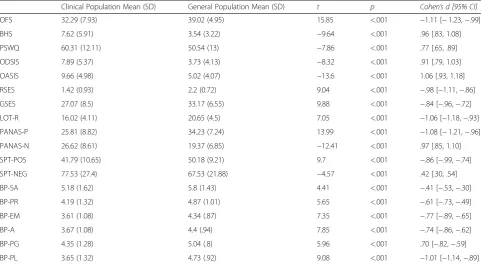
Regarding the other variables, as Table 1 shows, the
community sample had lower BHS, OASIS, PANAS-N, and SPT-NEG scores, and higher scores on all the other measures used in the present study.
Factor structure
First, two completely a priori CFA models were esti-mated for the 35 original items in the OFS. These models were: a) the theoretical a priori model with five dimensions, in which the dimensions were thought to be oblique (correlations among the dimensions were hy-pothesized and tested; b) and the second model, which was a more parsimonious, one-factor model that could also serve as a baseline model. Results clearly showed that the more parsimonious, one-factor model was a bet-ter representation of the data. Model fit for the five
fac-tor model was: χ2(550) = 8116.67, p< .001; RMSEA
= .127, 90% CI [.124–.129]; CFI = .847; TLI = .838. This fit was not adequate, and moreover, the correlations
among the factors were all large (p< .001). Some of
them even cast doubt on the independence of the factors (three of them were larger than .8, one larger than .9, and, in all, 6 of the ten correlations were over .7). On the other hand, the one-factor model did not fit the data well either, but its fit was better than that of the one with five dimensions: χ2(560) = 5378.9, p < .001;
RMSEA = .138, 90% CI [.136–.141]; CFI = .871; TLI
= .858. Because the more parsimonious model fit the data from the 35 items better than the theoretical five-factor model, and the correlations among the dimen-sions were extremely large, the one-factor model was retained as the best representation of the items. How-ever, given that model fit was still not adequate, and that a large number of items were not well related to this la-tent variable, after these confirmatory tests, item reduc-tion was conducted. Levels of missing data (incomplete data) were under 7%, which may be considered a high response rate (Newman, 2009). This process led to a re-duction in the initial 35 items to a total of 10 items that were core indicators of the construct, with two items per content area.
a unidimensional structure in mind. There are a number of reasons to retain two items per dimension. First, given that the results of 35-items pointed out that a one-factor solution better fit the data, there is no reason to have a long scale to measure an overall construct. Second, two indicators are a minimum in some statistical models (for example structural equation models) to identify a factor within a multivariate model. And third, two of the di-mensions only had two items with adequate psychomet-ric properties (factor loadings and reliability). Therefore, in order to maintain the balance of items per dimension, two items per dimension were chosen. These 10 items were the two best psychometrically behaving items for each of the five theoretical dimensions that tap openness to the future. These ten items were factor analyzed in both samples.
In the community sample, a single-factor model re-sulted in adequate model fit: χ2(35) = 137.08, p< .001; RMSEA = .058, 90% CI [.048–.068]; CFI = .979; TLI = .97. Factor loadings showed that all the items were strongly related to this factor, with values ranging from .43 to .79. We called this factor “Openness to the future”. In the
clinical sample, the same single-factor model resulted in ad-equate model fit: χ2(35) = 172.56, p < .001; RMSEA = .100,
90% CI [.085–.115]; CFI = .966; TLI = .96. Each item
displayed salient loadings on the latent factor (.34 to .82). The factorial invariance routine used the retained one-factor solution. Table2shows the sequence of models, their fit, and their differences from the baseline (configural) model. Given that the fit of the configural model was ad-equate, the sequence of nested models was then tested. Fit indices for the metric invariance model were similar to those of the configural model, with some showing even bet-ter fit (RMSEA) or negligible differences (ΔCFI< .01). Metric invariance was, therefore, tenable. Scalar invariance was then tested, and this model was better than the config-ural model, with a difference in CFI of .014.
Graded response model
The 2 parameter logistic model or graded response model was fitted to the data in both samples. Fit mea-sures for the graded response model in the community
group were: LRT (1997) = 544.24, p= 1, AIC = 3843.88,
BIC = 3927.65, and ABIC = 3857.87. Model fit statistics
Table 1Descriptive statistics of the OFS and all the study measures
Clinical Population Mean (SD) General Population Mean (SD) t p Cohen’s d [95% CI]
OFS 32.29 (7.93) 39.02 (4.95) 15.85 <.001 −1.11 [−1.23,−.99]
BHS 7.62 (5.91) 3.54 (3.22) −9.64 <.001 .96 [.83, 1.08]
PSWQ 60.31 (12.11) 50.54 (13) −7.86 <.001 .77 [.65, .89]
ODSIS 7.89 (5.37) 3.73 (4.13) −8.32 <.001 .91 [.79, 1.03]
OASIS 9.66 (4.98) 5.02 (4.07) −13.6 <.001 1.06 [.93, 1.18]
RSES 1.42 (0.93) 2.2 (0.72) 9.04 <.001 −.98 [−1.11,−.86]
GSES 27.07 (8.5) 33.17 (6.55) 9.88 <.001 −.84 [−.96,−.72]
LOT-R 16.02 (4.11) 20.65 (4.5) 7.05 <.001 −1.06 [−1.18,−.93]
PANAS-P 25.81 (8.82) 34.23 (7.24) 13.99 <.001 −1.08 [−1.21,−.96]
PANAS-N 26.62 (8.61) 19.37 (6.85) −12.41 <.001 .97 [.85, 1.10]
SPT-POS 41.79 (10.65) 50.18 (9.21) 9.7 <.001 −.86 [−.99,−.74]
SPT-NEG 77.53 (27.4) 67.53 (21.88) −4.57 <.001 .42 [.30, .54]
BP-SA 5.18 (1.62) 5.8 (1.43) 4.41 <.001 −.41 [−.53,−.30]
BP-PR 4.19 (1.32) 4.87 (1.01) 5.65 <.001 −.61 [−.73,−.49]
BP-EM 3.61 (1.08) 4.34 (.87) 7.35 <.001 −.77 [−.89,−.65]
BP-A 3.67 (1.08) 4.4 (.94) 7.85 <.001 −.74 [−.86,−.62]
BP-PG 4.35 (1.28) 5.04 (.8) 5.96 <.001 .70 [−.82,−.59]
BP-PL 3.65 (1.32) 4.73 (.92) 9.08 <.001 −1.01 [−1.14,−.89]
Applying a Bonferroni correctionp= .002 is needed to achieve a significant result. Accordingly, allt-tests were statistically significant.OFSOpenness to the Future Scale;BHSBeck Hopelessness Scale. Score 0 to 3 (none or minimal); 4 to 8 (mild),PSWQPenn State Worry Questionnaire. Total score ranges from 16 to 80;ODSIS
Overall Depression Severity and Impairment Scale. Total score ranges from 0 to 20. Higher scores are indicative of greater depression-related severity and impairment,
OASISOverall Anxiety Severity and Impairment Scale. Total score ranges from 0 to 20. Higher scores are indicative of greater anxiety-related severity and impairment;
and indices for the clinical group were: LRT (2007) = 625.42, p = 1; AIC = 3881.1, BIC = 3926.8; ABIC = 3888.8. Item discrimination and difficulty estimates are
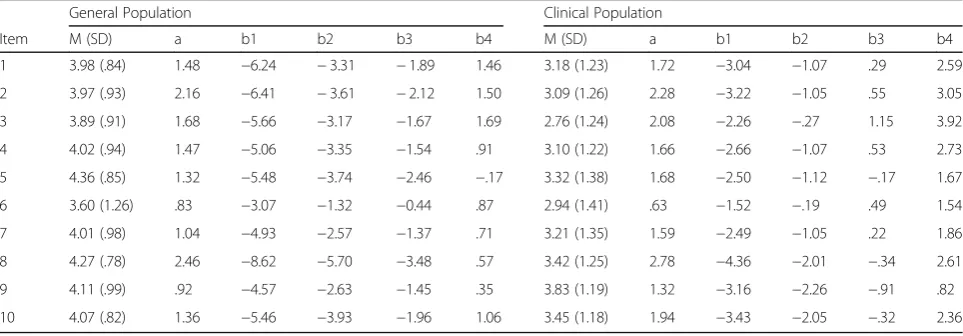
pre-sented in Table 2. In both samples, all items had
dis-crimination values above 1.0, and they can be
considered highly discriminant, with the exception of item 6 (“Sometimes I get scared and feel that I’m losing control when I think about what life may bring”) in both samples and item 9 (“I agree with the statement: every day is a new day”) in the community sample. The most discriminant items were items 2 (“I usually trust that things will work out”) and 8 (“I know I can overcome the obstacles I encounter in life”) in both samples. The four difficulty parameters are also presented in Table3. They are all monotonic, indicating adequate psychometric behavior.
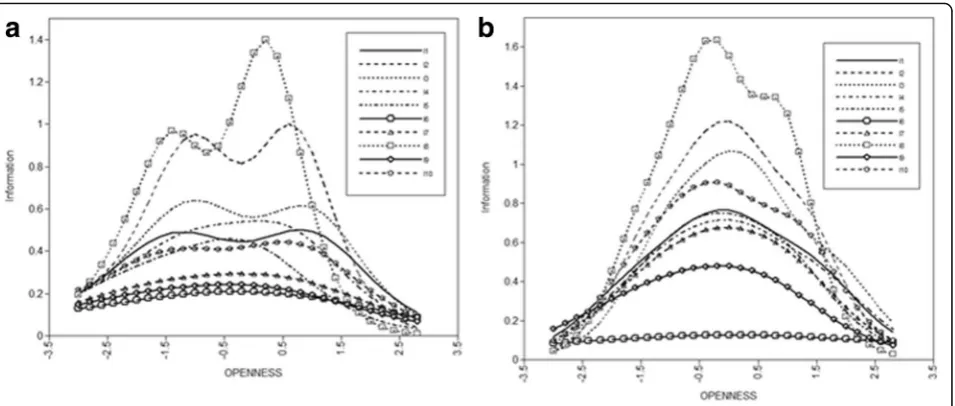
Item Characteristic Curves (ICC) for both samples are shown in Fig. 1. These ICCs, added up, form the test’s
Total Information Curves (TIC), presented in Fig.2 for
both samples. Figure 2 reveals that the test gives more
information about the clinical sample than it does about the community sample.
Reliability: Internal consistency
Cronbach’s alphas for the 10-item scale were acceptable for both the clinical (.82) and community samples (.87). In addition to alphas, CRIs were also calculated, and re-sults were .89 for clinical patients and .86 for the
community group. According to the CRI, internal consistency seems adequate.
ROC curve
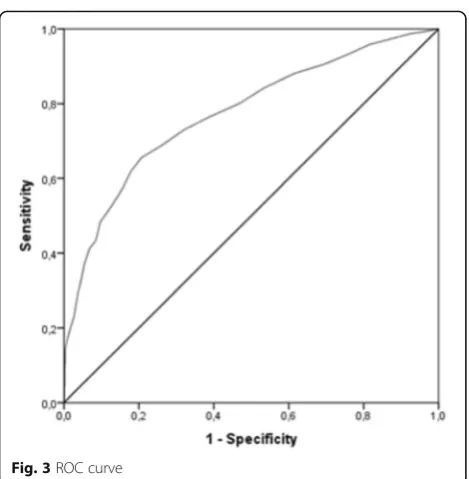
A ROC curve was generated, with the OFS total score as the continuous variable and the diagnostic status (clinical
vs. community group) as the gold standard. Figure 3
shows the corresponding sensitivity and specificity (1-spe-cificity) estimated in the ROC curve. A cut-off point from 37.5 to 38 on the OFS gave the best trade-off for sensitiv-ity (.70) and specificsensitiv-ity (.74). The area under the curve was .774 (SE = 0.80, p< .001, CI 95% of .746–.802). This area under the curve can be considered fair and almost good (values between .70 and .80 are considered fair, whereas values from .80 to .90 are considered good.
Convergent validity
Table4 summarizes the correlation coefficients. Positive correlations were found between the OFS and positive affect, positive future expectations, esteem, self-efficacy and psychological wellbeing. A negative correl-ation was found between the OFS and anxiety,
depres-sion, worry, negative affect, and negative future
expectations. OFS was strongly associated with purpose in life and hopelessness.
Discussion
The purpose of this study was to present openness to the future (OF), a construct characterized by positive
Table 2Set of hierarchical models to test for measurement invariance across general and clinical populations
Model χ2 df Δ χ2 Δdf p CFI ΔCFI RMSEA 90% CI SRMR
Configural 274.42 70 .929 .068 .059–.076 .047
Metric 308.05 79 33.63 9 <.001 .921 .008 .067 .060–.075 .067
Scalar 373.73 87 99.31 17 <.001 .943 .014 .071 .063–.079 .073
dfdegrees of freedom,Δdifferences
Table 3Means, standard deviations, item difficulty (a), and discrimination (b) of the 10 items in the OFS
General Population Clinical Population
Item M (SD) a b1 b2 b3 b4 M (SD) a b1 b2 b3 b4
1 3.98 (.84) 1.48 −6.24 −3.31 −1.89 1.46 3.18 (1.23) 1.72 −3.04 −1.07 .29 2.59
2 3.97 (.93) 2.16 −6.41 −3.61 −2.12 1.50 3.09 (1.26) 2.28 −3.22 −1.05 .55 3.05
3 3.89 (.91) 1.68 −5.66 −3.17 −1.67 1.69 2.76 (1.24) 2.08 −2.26 −.27 1.15 3.92
4 4.02 (.94) 1.47 −5.06 −3.35 −1.54 .91 3.10 (1.22) 1.66 −2.66 −1.07 .53 2.73
5 4.36 (.85) 1.32 −5.48 −3.74 −2.46 −.17 3.32 (1.38) 1.68 −2.50 −1.12 −.17 1.67
6 3.60 (1.26) .83 −3.07 −1.32 −0.44 .87 2.94 (1.41) .63 −1.52 −.19 .49 1.54
7 4.01 (.98) 1.04 −4.93 −2.57 −1.37 .71 3.21 (1.35) 1.59 −2.49 −1.05 .22 1.86
8 4.27 (.78) 2.46 −8.62 −5.70 −3.48 .57 3.42 (1.25) 2.78 −4.36 −2.01 −.34 2.61
9 4.11 (.99) .92 −4.57 −2.63 −1.45 .35 3.83 (1.19) 1.32 −3.16 −2.26 −.91 .82
10 4.07 (.82) 1.36 −5.46 −3.93 −1.96 1.06 3.45 (1.18) 1.94 −3.43 −2.05 −.32 2.36
affectivity towards the future that can be a prospective protective factor for mental health, and the development and validation of the Openness to the future scale (OFS), designed to operationalize and measure this construct.
The OF construct is theoretically considered a protect-ive factor and, thus, should discriminate between clinical and general populations. At the core of this construct is the capacity to perceive the future and life simply as
“life”, viewing it as something “normal” (rather than threatening), a time that will arrive, and completely open. People who are open to the future perceive them-selves as having the ability to live life with confidence (which implies being able to accept anything life brings) and the capacity to feel illusion and continue to feel op-timistic about life and events and plan steps to achieve
objectives. These people have the ability to engage in daily meaningful activities and plans, perceiving chal-lenges as opportunities rather than threats. This
con-struct would be related to the self-expansive mode
presented by Beck and Haigh [2,43]. Therefore, OF may
help to broaden the repertoire of an individual’s
thoughts, capacities, and actions, and it may also lead to decreasing the constraints or limitations (e.g. avoidance, escape) that negative emotions can cause, as in the nega-tive relationship between helplessness and OF, particu-larly in the clinical group. The OF construct is consistent with expectancy-value theories [70, 71] that encompass two premises: (a) the behavior reflects the pursuit of goals, and (b) the confidence that a goal can be achieved reflects a positive expectancy about future
Fig. 1Item information Curves for all the items in the community group (a) and the clinical group (b)
outcomes. OF tries to expand these models. This con-struct would also be related to the Miloyan et al. [23] proposal about the benefits of episodic foresight, and to the pragmatic prospection framework proposed by Bau-mesteir et al. [13].
The operationalization of this construct can be a good measure of protective human resources and a positive indicator of mental health and psychological adjustment [72] or, on the contrary, an indicator of psychopathology such as depression and anxiety. This paper describes the development and validation of the OFS, a measure de-signed to assess OF. In order to study the psychometric properties of this instrument, Classical Test Theory (CTT) and Item Response Theory (IRT) approaches were combined. IRT has the advantage that it allows for more realistic assumptions about measurement error, and it offers parameter estimates that are sample
inde-pendent [73]. However, it has some shortcomings. For
example, Zickar and Broadfoor [74] mentioned its need
for large sample sizes and its strong assumption about unidimensionality. They also demonstrated that the
CTT approach has tools such as structural models, which are not available in IRT models and justify the ap-plication of IRT models. The CFA (structural model framework) gives important information about unidi-mensionality and equal discrimination parameters. In other words, psychometric results from CTT and IRT frameworks reinforce each other.
With regard to the factor structure and dimensionality of the OFS, the original item bank of 35 items, 7 from each of the 5 relevant content areas (Illusion of Control, Acceptance, Engagement in life, Positive orientation, and Self-efficacy) was first reduced to the 10 core indicators of the OF construct, including two items per content di-mension. Results from CFA suggested a good fit for a unidimensional factor structure in both clinical and community samples. Further tests of measurement variance in both samples were then performed. This in-variance routine showed that the one-factor structure of the OFS was not only metric invariant, but also scalar invariant, in both samples. This is important given that meaningful group comparisons are only tenable when scalar invariance is present among the groups. Within the CTT framework, internal consistency was also esti-mated, and the OFS was shown to be a reliable measure in clinical and general population samples, at both the scale (alphas) and item levels (factor loadings).
With regard to the graded response model (IRT), re-sults showed that the OFS has highly discriminant items, items 2 (“I usually trust that things will work out”) and 8 (“I know I can overcome the obstacles I encounter in life”) in both samples, and that the difficulty parameter was adequate. However, the IRT model also indicated that the amount of information given by the test was greater for the clinical sample than for the community group. Nevertheless, ROC analysis allowed us to estimate the cut-off point that best discriminates (and predicts) be-tween individuals with and without psychological dis-order diagnoses (clinical and community samples). A cut-off point of 37.5 on the OFS correctly achieved the necessary sensitivity/specificity criterion.
Regarding convergent and discriminant validity, OFS was positively related to a variety of positive measures
Fig. 3ROC curve
Table 4Correlation between the OFS and measures of depression, anxiety, worry, hopelessness, positive and negative affect, self-esteem, self-efficacy, future expectations, optimism, and psychological wellbeing
ODSIS OASIS PSWQ BHS PA NA RSES GSES LOT-R PE NE BP-A BP
EM BP PG
BP PR
BP PL
BP SA
GP −.23** −.25** −.27** −.46** .53** −.37** .33** .50** .54** .44** −.34** .38** .41** .51** .29** .59** .28**
CP −.44** −.41** −.40** −.74** .58** −.49** .56** .57** .67** .60** −.48** .41** .63** .67** .43** .76** .33**
GPGeneral population,CPClinical population,ODSISOverall Depression Severity and Impairment Scale,OASISOverall Anxiety Severity and Impairment Scale,
PSWQPenn State Worry Questionnaire,BHSBeck Hopelessness Scale,PA and NApositive and negative affect scale,RSESRosenberg self-esteem scale,GSESGeneral self-efficacy total scale,LOT-RLife Orientation Test,PE and NEpositive and negative future expectations,BP-ARyff Scales of Psychological Well-Being, autonomy subscale,BP-EMenvironmental mastery subscale,BP-PGpersonal growth subscale,BP-PRpositive relations with others subscale,BP-PLpurpose in life subscale,
BP-SAself-acceptance subscale **
(positive affect, self-esteem, self-efficacy, optimism, posi-tive future expectancies, and psychological well-being), and negatively associated with measures of anxiety, de-pression, worry, negative future expectancies, and nega-tive affect, in both clinical and community samples. Moreover, the OFS also demonstrated a large negative correlation with a well-validated indicator of hopeless-ness (BHS) and a large positive correlation with one of the dimensions of psychological well-being, the belief that one’s life is purposeful and meaningful (BP-PL) [58]. These associations were higher in the clinical sample than in the community sample. From a theoretical point of view, hopelessness, purpose in life, and OF have sev-eral commonalities given their shared focus (specifically, their future orientation). In this sense, we may expect that individuals high in OF would have greater confi-dence in their ability to attain goals and a sense of di-rectedness, therefore, this contributes to the belief of a purposeful life. On the contrary, individuals low in OF would have difficulties in making future and significant plans, with a tendency to make more negative interpre-tations about what the future may bring. These results encourage us to continue analyzing the differential ef-fects of the future thinking constructs and that was the purpose of the development of the OFS. Future research has to investigate how hopelessness, purpose in life and OF relate to each other. Our findings contribute to a large and growing body of literature indicating that people who have higher scores on measures of positive future thinking show less psychopathology and better emotional and subjective well-being [14, 33], and they engage in more purposeful and meaningful activity. OF may be an important variable to examine further, in order to better understand psychological functioning and well-being [75].
OF can be considered a transdiagnostic process due to its dimensional nature from adaptability to maladapta-tion. However, this has to be confirmed by additional empirical research. The model presented by Beck and Haigh [2] highlights the continuity between adaptation and maladaptation, and it provides an articulation to better conceptualize and test this dimensionality through the introduction of the theory of modes. Based on this model, it is possible to include protective factors that have traditionally been underestimated, such as OF.
One contribution of this study is related to the current discussion about transdiagnostic approaches, both in terms of psychopathological understanding and clinical implications. As Harvey et al. [76] stated, at least two distinctions can be made in transdiagnostic approaches: processes in which causal effects can be found, including how they work (mechanistic processes); and processes that are identified in diverse clinical profiles, but lack these additional explanations (descriptive processes).
Taking our data into account, OF could be considered a
“descriptively transdiagnostic” construct, present in di-verse clinical samples (Botella et al. manuscript under preparation). As a future line of research, it would be relevant to study whether the OF construct could be considered a“mechanistically transdiagnostic” construct to be taken into consideration as a shared mechanism in
the treatment of emotional disorders [5], providing
the basis for the construction of prospection-based techniques [14].
An additional aspect that remains to be studied con-sists of determining the possible conceptualization of OF as a change mechanism in the treatment of emotional
disorders. As Lemmens, Müller, Arntz and Huibers [77]
stated, 39 potential mediators in 12 different treatment modalities have been studied for depression, but apart from hopelessness, none of them have considered the prospective affective, cognitive, and motivational dispos-ition. With regard to anxiety disorders, a greater em-phasis is placed on the prospective dimension due to the core emotion involved, which is precisely future-oriented (i.e. intolerance to uncertainty) [78]. Even so, the number of studies that explicitly refer to intolerance to uncertainty is low. Thus, including future-oriented variables could help to identify mediators that, in turn, would be useful in establishing shared treatment mecha-nisms. An important step in this direction is the
recog-nition that prospection is a crucial and
under-appreciated transdiagnostic process in the study of depression, and possibly in other psychological disorders and chronic diseases such as chronic pain. Therefore, it is necessary to determine whether and how the patient’s faulty prospection drives or shapes psychopathology, and how pragmatic prospection can be improved [13,14].
This study has strengths and limitations. One strength is the presentation of OF, a new future-oriented con-struct that can be useful from both research and applied points of view. A second strength is the development of a brief scale to operationalize and measure this prospective construct, validated not only in commu-nity samples, but also with clinical groups that suffer
from different mental disorders. Finally, another
strength is the use of several statistical frameworks to
study the scale’s psychometric properties, IRT, CTT,
and Roc analysis, and the large sample sizes included. Among the limitations, first, the development of the potential domains of the OFS and the items related to each was carried out only by the authors of the study. Nevertheless, this process was conducted based on a thorough search of the scientific literature and using a method similar to that of other studies de-signed to develop and validate similar instruments
[79, 80]. Second, the OFS was not administered
evaluations of test–retest reliability or sensitivity to change were not possible. Considering the large num-ber of additional instruments to measure convergent and divergent validity, a further limitation is the lack of a pilot study that could have provided preliminary results about the acceptability of the study with the full battery of instruments. Furthermore, it would have been ideal to perform cognitive interviews to
as-sess the acceptability and comprehension of the items’
wording and instructions. However, experienced clini-cians and researchers supervised the completion of the scale, and none of the participants expressed diffi-culties in understanding any of the items. Another limitation is that the community sample was limited to university students and their families, without ex-cluding them if they had any psychological problems. We acknowledge that this was not an optimal sample recruitment procedure, but our aim was to obtain a more representative sample of the community group. Finally, another limitation is that the scale has only been validated in Spanish. Future studies will have to validate it in samples that speak other languages. Due to its ability to distinguish between clinical and com-munity groups, future studies should analyze whether a person’s level of OF is a stable trait, or whether it is susceptible to life events, circumstances, or psycho-logical intervention. In this sense, it would be inter-esting to test change sensitivity and measurement invariance of the OFS over time.
All emotions, cognitions, emotion regulation strat-egies, and any other psychological processes, including the new OF construct, tend to be adaptive as long as the individual has the flexibility to explicitly deploy the ne-cessary resources [81,82]. For example, anxiety and sad-ness are considered relevant emotions that can be
adaptive or maladaptive [2]. OF must also be
contem-plated from this dimensional perspective, taking into ac-count the possible detrimental effects of extreme levels of this construct and whether they could potentially ex-acerbate or cause psychopathology.
As McGinn and Hofmann stated [3], Cognitive
Be-havior Therapy (CBT) is effective, but it also has many shortcomings and challenges. Thus, it is neces-sary to deepen the connection between
psychopatho-logical advances and clinical applications by
incorporating new developments that can stem from different theoretical perspectives. OF is constructed with this in mind, and its core essence undoubtedly lies in cognitive theory, not only adding traditional behavioral integrated contents (self-efficacy), but also humanistic principles (much more related to self-engagement and acceptance). Furthermore, this con-struct broadens the traditional focus on the
dysfunc-tional realm because it is conceptualized as a
protective factor from the prospective dimension, a crucial area of study in the coming years.
This construct is not only relevant for understand-ing normal and psychopathological functionunderstand-ing, but it also represents an essential step in incorporating pro-spective aspects into therapeutic approaches. In terms of the way the OFS could be used in clinical practice and research, the operationalization and assessment of this construct may provide a useful measure of hu-man resources and a positive indicator of mental health and psychological adjustment. If the OFS is shown to express a protective factor in different psy-chological disorders, it could be very useful for
mak-ing decisions in case formulation, treatment
prognosis, and the treatment plan. For example, if ap-propriately supported with further empirical evidence, low levels of OF could indicate the need to incorpor-ate more therapeutic contents relincorpor-ated to positive affect and positive emotions, in order to teach people how to improve those aspects that do not develop naturally. The development of prospective-based tech-niques may enhance current transdiagnostic treatment
strategies for depression [14] and other disorders.
However, this can only be achieved after rigorous the-oretical and empirical understanding of the constructs involved, as in the case of OF. Moving forward, the construct and the measure might be useful in relation to several problems (e.g. sleep, pain, substance use etc.), and age, work status, education, and health liter-acy may be important variables in individuals’ level of OF. As this study shows, this important research pro-gram is already under way [83].
Conclusions
Endnotes
1
Although the instrument was developed in Spanish and the entire sample consisted of native Spanish speakers, we performed translation and back-translation for the current study in order to ensure that the OFS can potentially be used and validated in other samples. The person involved in the translation process is a native English speaker who has been living in Spain for many years and is fluent in both languages. In addition, the whole process was supervised by researchers with ex-perience in the field (authors 1, 5 and 6), who are also the original developers of the instrument. Both the Spanish and English versions of the scale can be found in Additional files1and2.
Additional files
Additional file 1:Openness to the future Scale. (DOCX 22 kb)
Additional file 2:Escala de Apertura hacia el Futuro. (DOCX 16 kb)
Funding
This study was funded by the Ministry of Economy, Industry and Competitiveness (PSI2014–54172-R), the Excellence in Research Program PROMETEO II (Generalitat Valenciana. Conselleria de Educación, 2013/003), and by the CIBER of Physiopathology of Obesity Nutrition, an initiative of ISCIII (ISCII CB06 03/0052).
Availability of data and materials
The datasets used and/or analyzed during the current study are available from the corresponding author on reasonable request.
Authors’contributions
CB developed the study concept. CB, RMB and AG design the construction of the scale. GM and JF coordinated the data-collection and prepared the dataset for the analyses. GM, JF and VG analyzed and interpreted the data. CB, RMB and AG critically revised the manuscript for intellectual content. JMT implemented and supervised data-analysis and critically revised the manuscript. All authors read and approved the final manuscript.
Ethics approval and consent to participate
All participants provided voluntary and informed written consent. The research protocol was approved by the Ethical committee at the University Jaume I.
Competing interests
The authors declare that they have no competing interests.
Publisher’s Note
Springer Nature remains neutral with regard to jurisdictional claims in published maps and institutional affiliations.
Author details
1Jaume I University, Av. Vicent Sos Baynat s/n, 12071 Castelló de la Plana,
Spain.2CIBER of Physiopathology of Obesity and Nutrition, an initiative of
ISCIII (CB06/03), Madrid, Spain.3Spanish Excellence Research Network PROMOSAM (PSI2014-56303-REDT), MINECO, Madrid, Spain.4University of
Valencia, Av. Blasco Ibáñez, 21, 46010 Valencia, Spain.5Catholic University of
the Sacred Heart, Milan, Italy.
Received: 4 October 2017 Accepted: 2 April 2018
References
1. Keyes C, Shmotkin D, Ryff CD. Optimizing well-being: the empirical encounter of two traditions. J Pers Soc Psychol. 2002;82:1007–22. 2. Beck AT, Haigh EAP. Advances in cognitive theory and therapy: the generic
cognitive model. Annu Rev Clin Psychol. 2014;10:1–24.
3. McGinn LK, Hofmann SG. New Frontiers in cognitive behavioral therapies: introduction. Int J Cogn Ther. 2016;9:99–106.
4. Harvey AG, Watkins ER, Mansell W, Shafran R. Cognitive behavioural processes across psychological disorders: a transdiagnostic approach to research and treatment. Oxford: Oxford University Press; 2004.
5. Sauer-Zavala S, Gutner CA, Farchione TJ, Boettcher HT, Bullis JR, Barlow DH. Current definitions of“Transdiagnostic”in treatment development: a search for consensus. Behav Ther. 2017;48:128–38.https://doi.org/10.1016/j.beth. 2016.09.004.
6. Hudek-KneževićJ, Kardum I. Five 2009. Five-factor personality dimensions and 3 health related personality constructs as predictors of health. Croat Med J. 2009;50(4):394–402.https://doi.org/10.3325/cmj.2009.50.394. 7. De Neve KM, Cooper H, De Neve KM, Cooper H. The happy personality:
Ameta analysis of 137 personality traits and subjective well-being. Psychol Bull. 1998;124:197–229.
8. Bogg T, Roberts BW. Conscientiousness and health-related behaviors: a meta-analysis of the leading behavioral contributors to mortality. Psychol Bull. 2004;130:887–919.
9. Barlow DH. Anxiety and its disorders. New York: Guilford Press; 1988. 10. Barlow DH. Anxiety and its disorders: the nature and treatment of anxiety
and panic. 2nd ed. New York: Guilford; 2002.
11. Seligman MEP, Csikszentmihalyi M. Positive psychology: an introduction. Am Psychol. 2000;55:5–14.
12. Baumeister R, Vohs K. Introduction to the special issue: the science of prospection. Rev Gen Psychol. 2016;20:1–2.
13. Baumeister RF, Vohs KD, Oettingen G. Pragmatic prospection: how and why people think about the future. Rev Gen Psychol. 2016;20:3–16.https://doi. org/10.1037/gpr0000060.
14. Roepke AM, Seligman MEP. Depression and prospection. Br J Clin Psych. 2016;55:23–48.https://doi.org/10.1111/bjc.12087.
15. Seligman MEP, Railton P, Baumeister RF, Sripada C. Navigating into the future or driven by the past. Perspect Psychol Sci. 2013;8:119–41.doi.org/10. 1177/1745691612474317
16. Taylor SE, Brown JD. Illusion and well-being: a social psychological perspective on mental health. Psychol Bull. 1988;103:193–210.
17. Taylor SE, Brown JD. Positive illusions and well-being revisited: separating fact from fiction. Psychol Bull. 1994;1:21–7.
18. Taylor SE. Adjustment to threatening events: a theory of cognitive adaptation. Am Psychol. 1983;38:1161–73.
19. Langer EJ. The illusion of control. J Pers Soc Psychol. 1975;32:311–28. 20. Taylor SE, Kemeny ME, Reed GM, Bower JE, Gruenewald TL. Psychological
resources, positive illusions, and health. Am Psychol. 2000;55:99–109. 21. Liddell HS. The role of vigilance in the development of animal neurosis. In:
Hoch P, Zubin I, editors. Anxiety. New York: Grune Stratton; 1949. 22. Nesse RM. Why has natural selection left us so vulnerable to anxiety and
mood disorders? Can J Psychtry. 2011;56:705–6.
23. Miloyan B, Bulley A, Suddendorf T. Episodic foresight and anxiety: proximate and ultimate perspectives. Br J Clin Psych. 2015;55:4–22.https://doi.org/10. 1111/bjc.12080.
24. Haselton MG, Nettle D, Murray D. The evolution of cognitive bias. In: Buss DM, editor. The evolutionary psychology handbook. 2nd ed. Hoboken: Wiley; 2015. p. 968–88.
25. Weinstein ND. Unrealistic optimism about future life events. J Pers Soc Psychol. 1980;39:806–20.https://doi.org/10.1037/0022-3514.39.5.806. 26. Jefferson A, Bortolotti L, Kuzmanovic B. What is unrealistic optimism?
Conscious Cogn. 2017;50:3–11.https://doi.org/10.1016/j.concog.2016.10.005. 27. Sharot T. The optimism bias. Curr Biol. 2011;21:941–5.
28. McKay RT, Dennett DC. The evolution of misbelief. Beh Brain Sc. 2009;32: 493–561.
29. Varki A. Human uniqueness and the denial of death. Nature. 2009;460(7256): 684.