R E S E A R C H
Open Access
The association between XPC Lys939Gln gene
polymorphism and urinary bladder cancer
susceptibility: a systematic review
and meta-analysis
Kun Dou
1*†, Qingzhu Xu
2†and Xiaolu Han
3Abstract
Background:Numerous epidemiological studies have been conducted to explore the association between the Lys939Gln polymorphism of Xeroderma pigmentosum group C (XPC) gene and urinary bladder cancer susceptibility. However, the results remain inconclusive. In order to derive a more precise estimation of this relationship, a large and update meta-analysis was performed in this study.
Methods:A comprehensive search was conducted through researching MEDLINE, EMBASE, PubMed, Web of Science, China Biomedical Literature database (CBM) and China National Knowledge Infrastructure (CNKI) databases before June 2013. Crude odds ratios (ORs) with 95% confidence intervals (CIs) were calculated to estimate the strength of the association.
Results:A total of 12 studies with 4828 cases and 4890 controls for evaluating the XPC Lys939Gln polymorphism and urinary bladder cancer were included. Overall, there was significant associations between the XPC Lys939Gln polymorphism and urinary bladder cancer risk were found for homozygous model (OR = 1.352, 95% CL = 1.088-1.681), heterozygous model (OR = 1.354, 95% CL = 1.085-1.688), and allele comparison (OR = 1.109, 95% CL = 1.013-1.214). In subgroup analysis by ethnicity and source of controls, there were still significant associations detected in some genetic models.
Conclusion:Our meta-analysis suggested that the XPC Lys939Gln polymorphism contributed to the risk of urinary bladder cancer.
Virtual slides:The virtual slide(s) for this article can be found here: http://www.diagnosticpathology.diagnomx.eu/vs/ 1001118393101798.
Keywords:Bladder cancer, XPC, Polymorphism, Susceptibility, Meta-analysis
Introduction
Bladder cancer is one of the most frequently occurring neoplasms in men. The established risk factors for bladder cancer include cigarette smoking, occupational exposure to certain chemical carcinogens such as aromatic amines and uptake of drugs such as phenacetin and cyclophos-phamide. These carcinogens can cause DNA damage,
introducing bulky adducts, crosslinks and single or double strand breaks [1]. Tobacco smoke and occupational expo-sures are the major risk factors in Western countries, whereas schistosoma hematobium infection is the major etiologic factor in developing countries, particularly in Africa and the Middle East [2]. Although many people are exposed to the risk factors, only a fraction of exposed indi-viduals will develop bladder cancer, suggesting an individ-ual susceptibility to the effects of carcinogens.
The xeroderma pigmentosum complementation group C (XPC) protein is involved in the recognition and initi-ation of the global genome repair pathway of nucleotide * Correspondence:[email protected]
†Equal contributors 1
Department of Urology, Kunming General Hospital of Chengdu Military Command, Kunming 650032, China
Full list of author information is available at the end of the article
excision repair. XPC binds to HR23B to form the stable XPC-HR23B complex, which recognizes and binds to damaged DNA [3]. XPC gene is located at chromosome 3p25 and contains 16 exons and 15 introns, which is one of the eight core genes (XPA, XPB, XPC, XPD, XPE, XPF, XPG and ERCC1) in the NER pathway. Polymorphisms in XPC gene have been evaluated as risk factors in bladder cancer in a number of epidemiological studies, however the conclusions were controversial. Therefore, in the pre-sent study, we performed this meta-analysis of all the pub-lished studies on bladder cancer to draw a more precise estimation of this association.
Methods Literature search
A comprehensive search was conducted through re. searching MEDLINE, EMBASE, PubMed, Web of Science, China Biomedical Literature database (CBM) and China National Knowledge Infrastructure (CNKI) databases be-fore June 2013. Relevant publications were searched using
follow terms: “XPC”, “Xeroderma pigmentosum group
C”, “polymorphism”, “variant”, “bladder cancer”, “bladder tumor”,“bladder carcinoma”and“bladder neoplasm”. We evaluated all associated publications to retrieve the most eligible literatures. The reference lists of reviews and re-trieved articles were hand searched at the same time. We did not include abstracts or unpublished reports. When overlapping data of the same patient population were in-cluded in more than one publication, only the most recent or complete study was used in this meta-analysis.
Inclusion and exclusion criteria
Studies included in our meta-analysis had to meet the following inclusion criteria: (1) evaluate the association between XPC Lys939Gln polymorphism and bladder cancer risk; (2) case–control designed studies; (3) suffi-cient information to estimate odds ratios (ORs) and their 95% confidence intervals (CIs). Studies were excluded if one of the following existed: (1) no control population; and (2) duplicate of previous publication.
Data extraction
Information was carefully assessed and extracted from all eligible publications according to the inclusion criteria by two investigators independently. For conflicting evaluation, an agreement was reached following discussion during a consensus meeting with a third reviewer. The following in-formation was collected from each study: first author's name, year of publication, country of origin, ethnicity, con-trol source (hospital-based or population-based), genotyp-ing methods, and numbers of cases and controls with the XPC different genotypes distribution. The stratification analysis was conducted by ethnicity and control source.
Statistical methods
Crude odds ratios (ORs) with their corresponding 95% CIs were used to assess the strength of association be-tween the XPC Lys939Gln polymorphism and bladder cancer risk. The pooled ORs and 95% CIs were calculated for Lys939Gln polymorphism using homozygous model (Gln/Gln vs. Lys/Lys), heterozygous model (Lys/Gln vs. Lys/Lys), recessive model [Gln/Gln vs. (Lys/Gln + Lys/ Lys)], dominant model [(Lys/Gln + Gln/Gln) vs. Lys/Lys], as well as allele comparison model (Gln vs. Lys). Pooled OR estimate of each study was calculated by both
the fixed effects model (the Mantel–Haenszel method)
[4] and the random effects model (the DerSimonian and Laird methods) [5]. The fixed-effects model would be adopted when the studies were found to be homoge-neous (with P > 0.10 for the Q test). Otherwise, the random-effects model would be applied. Heterogeneity between studies was evaluated by Chi square-based Q-test [6]. Heterogeneity was considered statistically sig-nificant if P < 0.10. Heterogeneity was quantified using
theI2metric, which was independent of the number of
studies in the meta-analysis (I2< 25% no heterogeneity, I2= 25–50% moderate heterogeneity, andI2> 50% large
or extreme heterogeneity). Subgroup analyses were performed by ethnicity and source of control to explore the reasons of heterogeneity. The funnel plot was gener-ated to examine the potential publication bias by using the standard error of log (OR) of each investigation plot-ted against its log (OR), and the asymmetry of funnel plot was assessed by the method of Egger’s linear regres-sion test [7]. Sensitivity analyses were performed to as-sess the stability of the results. All statistical tests were performed with Stata (Version 12.0, Stata Corporation, College Station, TX), using two-sided P-values.
Results
Study characteristics
A total of 71 potentially relevant publications were idenfied from the databases listed above. After screening the ti-tles or abstracts, 59 publications were excluded because of duplicate data, case reports, or reviews, or non-relevance research. All studies included in the present meta-analysis used a case–control design. Finally, 12 studies were identi-fied for eligibility and were included in our meta-analysis, with a total of 4,828 cancer cases and 4,890 controls [8-19] (Table 1). All patients in cases groups were histo-logically or pathohisto-logically confirmed, and controls were mainly matched by age, sex and ethnicity. The genotype distribution of the Lys939Gln polymorphism was in com-pliance with HWE in the controls of all studies.
Meta-analysis results
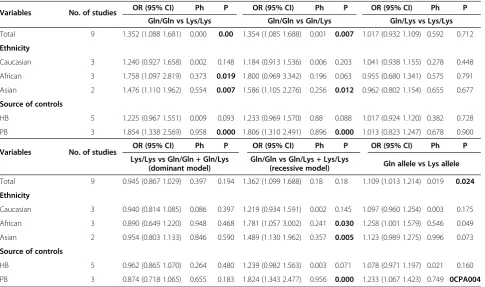
polymorphism and increased risk of bladder cancer (Table 2). Overall, there is statistically significant associ-ation was found between XPC Lys939Gln polymorphism and the bladder cancer risk in homozygous model (OR = 1.39, 95% CI = 1.08-1.79) (Figure 1), heterozygous model (Gln/Gln vs Gln/Lys: OR = 1.42, 95% CI = 1.11-1.83)
(Figure 2), and allele comparison model (OR = 1.12, 95% CI = 1.003-1.24) (Figure 3), but not in other models (Table 2). In the subgroup analysis by ethnicity, statisti-cally significant associations were observed in African populations for homozygous model (OR = 1.758, 95% CI = 1.097-2.819), and recessive model (OR = 1.781, 95% CI = Table 1 Main characteristics of these studies on the associations between XPC Lys939Gln polymorphism and bladder cancer risk
First author Year Country Ethnicity Study type
Genotype method
Sample size PHWE
Case Control
Sanyal et al. 2004 Sweden Caucasian PB PCR-RFLP 309 246 0.294
Sak et al. 2005 England Caucasian HB TaqMan 532 561 0.191
Garcia-Closas et al. 2006 Spain Caucasian HB TaqMan 1137 1138 0.470
Wu et al. 2006 USA Caucasian HB TaqMan 606 596 0.744
Zhu et al. 2007 USA Caucasian HB Taqman 550 554 0.668
Fontana et al. 2008 French Caucasian HB TaqMan 51 45 0.456
de Verdier et al. 2010 Sweden Caucasian PB PCR-RFLP 305 328 0.147
Gangwar et al. 2010 India Asian HB PCR-RFLP 208 245 0.054
Rouissi et al.1 2011 Tunisia African HB PCR-RFLP 193 193 0.537
Rouissi et al.2 2011 Tunisia African HB PCR-RFLP 125 125 0.449
Mittal et al. 2012 India Asian PB PCR-RFLP 212 250 0.073
Liu et al. 2012 China Asian HB PCR-RFLP 600 609 0.824
PBPopulation-Based Study,HBHospital-Based Study,PHWEP value of Hardy–Weinberg equilibrium.PCR-RFLPPolymorphism Chain Reaction- Restriction Fragment Length Polymorphism.1,2Different studies.
Table 2 Main results of pooled odds ratios (ORs) with confidence interval (CI) in the meta-analysis
Variables No. of studies OR (95% CI) Ph P OR (95% CI) Ph P OR (95% CI) Ph P Gln/Gln vs Lys/Lys Gln/Gln vs Gln/Lys Gln/Lys vs Lys/Lys
Total 9 1.352 (1.088 1.681) 0.000 0.00 1.354 (1.085 1.688) 0.001 0.007 1.017 (0.932 1.109) 0.592 0.712
Ethnicity
Caucasian 3 1.240 (0.927 1.658) 0.002 0.148 1.184 (0.913 1.536) 0.006 0.203 1.041 (0.938 1.155) 0.278 0.448
African 3 1.758 (1.097 2.819) 0.373 0.019 1.800 (0.969 3.342) 0.196 0.063 0.955 (0.680 1.341) 0.575 0.791
Asian 2 1.476 (1.110 1.962) 0.554 0.007 1.586 (1.105 2.276) 0.256 0.012 0.962 (0.802 1.154) 0.655 0.677
Source of controls
HB 5 1.225 (0.967 1.551) 0.009 0.093 1.233 (0.969 1.570) 0.88 0.088 1.017 (0.924 1.120) 0.382 0.728
PB 3 1.854 (1.338 2.569) 0.958 0.000 1.806 (1.310 2.491) 0.896 0.000 1.013 (0.823 1.247) 0.678 0.900
Variables No. of studies OR (95% CI) Ph P OR (95% CI) Ph P OR (95% CI) Ph P Lys/Lys vs Gln/Gln + Gln/Lys
(dominant model)
Gln/Gln vs Gln/Lys + Lys/Lys
(recessive model) Gln allele vs Lys allele
Total 9 0.945 (0.867 1.029) 0.397 0.194 1.362 (1.099 1.688) 0.18 0.18 1.109 (1.013 1.214) 0.019 0.024
Ethnicity
Caucasian 3 0.940 (0.814 1.085) 0.086 0.397 1.219 (0.934 1.591) 0.002 0.145 1.097 (0.960 1.254) 0.003 0.175
African 3 0.890 (0.649 1.220) 0.948 0.468 1.781 (1.057 3.002) 0.241 0.030 1.258 (1.001 1.579) 0.546 0.049
Asian 2 0.954 (0.803 1.133) 0.846 0.590 1.489 (1.130 1.962) 0.357 0.005 1.123 (0.989 1.275) 0.996 0.073
Source of controls
HB 5 0.962 (0.865 1.070) 0.264 0.480 1.239 (0.982 1.563) 0.003 0.071 1.078 (0.971 1.197) 0.021 0.160
PB 3 0.874 (0.718 1.065) 0.655 0.183 1.824 (1.343 2.477) 0.956 0.000 1.233 (1.067 1.423) 0.749 0CPA004
1.057-3.002). Similarly, statistically significant associations were observed in Asian populations for homozygous model (OR = 1.476, 95% CI = 1.110-1.962), heterozygous model (Gln/Gln vs Gln/Lys: OR = 1.586, 95% CI = 1.105-2.276), and recessive model (OR = 1.489, 95% CI = 1.130-1.962). However, no statistical associations were found in Caucasian populations for other genetic models (Table 2). In population-based populations, statistically significant
associations were found for homozygous model (OR = 1.854, 95% CI = 1.338-2.569), heterozygous model (Gln/ Gln vs Gln/Lys: OR = 1.806, 95% CI = 1.310 -2.491), reces-sive model (OR = 1.489, 95% CI = 1.130-1.962) and allele comparison model (OR = 1.233, 95% CI = 1.067-1.423), while there are no statistical associations were found in hospital-based populations for all kinds of comparison models.
Figure 1Forest plots for XPC Lys939Gln polymorphism and risk of bladder cancer in overall populations (homozygous model for Gln/ Gln vs Lys/Lys).
Heterogeneity analyses
Substantial heterogeneities were observed in the over-all analysis evaluating the association between XPC Lys939Gln polymorphism and bladder cancer risk in homozygous model (P = 0.000), heterozygous model (Gln/Gln vs Gln/Lys: P = 0.007), and allele comparison (P = 0.007), except for the heterozygous (Gln/Lys vs
Lys/Lys: P = 0.348), dominant model (P = 0.397), and re-cessive model (P = 0.18).
Sensitivity analyses
We next performed a leave-one-out sensitivity analysis to determine whether a particular study or studies would result in heterogeneity. It was found that one study [13]
Figure 3Forest plots for XPC Lys939Gln polymorphism and risk of bladder cancer in overall populations (allele comparison for Gln allele vs. Lys allele).
with small sample size, 51 cases and 45 controls, and obvi-ous genotype frequency deviation may qualitatively change the pooled ORs for Lys939Gln polymorphism. After this study was dropped, the degree of heterogeneity dramatic-ally decreased, without altering the overall estimates.
Publication bias
Begg’s funnel plot and Egger’s test were performed to as-sess the publication bias. The shape of funnel plots did not reveal any evidence of obvious asymmetry in all compari-son models, and the results of Begg’s test did not show any evidence of publication bias (Figure 4).
Discussion
It is well recognized that there is a range of individual sus-ceptibility to the same kind of cancer even with identical environmental exposure. Host factors, including polymor-phisms of genes involved in carcinogenesis, may have accounted for this difference. Therefore, genetic suscepti-bility to cancer has been a research focus in scientific community.
This meta-analysis, including 4,828 cancer cases and 4,890 controls from 12 published case–control studies, explored the association between the XPC Lys939Gln polymorphism and bladder cancer risk. Overall, we found that there was evidence that the variant genotypes of the XPC Lys939Gln were associated with a significant increased overall risk of bladder cancer. In the subgroup analysis based on ethnicities, significant associations were found between both African and Asian populations for some genetic models, suggesting that XPD Lys939Gln polymorphism play similar roles in populations with dif-ferent genetic backgrounds and living environment. Sim-ultaneously, our results also showed that significantly increased bladder cancer risk in homozygous, heterozy-gous, recessive and allele comparison models were noted in the population-based studies but not in hospital-based studies.
There are some limitations should be acknowledged in this meta-analysis. Firstly, bladder cancer is a multi-factorial disease that results from complex interactions between many genetic and environmental factors. It suggests that there will not be single gene or single environmental factor that has large effects on bladder cancer susceptibility. Sec-ondly, in the subgroup analyses by ethnicity and source of controls, the number of subjects was relatively small, not having enough statistical power to explore the real associ-ation. Thirdly, the controls were not uniformly defined. Al-though most of the controls were selected mainly from healthy populations, some had respiratory disease. There-fore, non-differential mis-classification bias was possible be-cause these studies may have included the control groups who had different risks of developing bladder cancer. Fourth, our meta-analysis is similarly with other works
[20-22], while a more precise analysis should be conducted if individual data were available, which would allow for the adjustment by other covariates including age, sex, family history, environmental factors and lifestyle. Furthermore, other pathological type of urinary bladder cancer should be considered [23-25], which may be the source of publication. In addition, as in most meta-analyses, publication bias must be considered because only published studies were included in the meta-analysis.
Despite some limitations listed above, our meta-analysis had several advantages. First, sufficient number of cases and controls were pooled from different studies, which significantly increased the statistical power of the analysis. Second, no publication biases were detected, indicating that there is no bias among the pooled results.
Conclusion
In conclusion, this meta-analysis indicates that XPC Lys939Gln polymorphism may be contributed to the devel-opment of bladder cancer risk. However, a study with the larger sample size is needed to further evaluated gene-environment interaction on XPC Lys939Gln polymorphism and bladder cancer risk.
Competing interests
None of the authors have any conflict of interests to declare.
Authors’contributions
KD and QX carried out the meta-analysis study, drafted the manuscript and involved in revising the manuscript critically for important intellectual content. XH and QX participated in the design of the study and revised the manuscript. KD and QX carried out the meta-analysis study and drafted the manuscript. KD participated in the design of the study, drafted the manuscript and revised the manuscript. All authors read and approved the final manuscript.
Acknowledgement
No external funding was either sought or obtained for this study.
Author details 1
Department of Urology, Kunming General Hospital of Chengdu Military Command, Kunming 650032, China.2Department of Urology, the Second Hospital of Tianjin Medical University, Tianjin Institute of Urology, Tianjin 300211, China.3Department of Urology, The First People’s Hospital of Kunming City, Kunming 650211, China.
Received: 14 June 2013 Accepted: 18 June 2013 Published: 2 July 2013
References
1. Bosetti C, Pira E, La Vecchia C:Bladder cancer risk in painters: a review of the epidemiological evidence, 1989–2004.Cancer Causes Control2005,
16(9):997–1008.
2. Parkin DM:The global health burden of infection-associated cancers in the year 2002.Int J Cancer2006,118:3030–3044.
3. Sugasawa K, Ng JM, Masutani C,et al:Xeroderma pigmentosum group C protein complex is the initiator of global genome nucleotide excision repair.Mol Cell1998,2:223–232.
4. Mantel N, Haenszel W:Statistical aspects of the analysis of data from retrospective studies of disease.J Natl Cancer Inst1959,22:719–748. 5. DerSimonian R, Laird N:Meta-analysis in clinical trials.Control Clin Trials
1986,7(3):177–188.
6. Cochran WG:The combination of estimates from different experiments.
7. Egger M, Davey Smith G, Schneider M, Minder C:Bias in meta-analysis detected by a simple, graphical test.BMJ1997,315:629–634. 8. Sanyal S, Festa F, Sakano S, Zhang Z, Steineck G, Norming U, Wijkstrom H,
Larsson P, Kumar R, Hemminki K:Polymorphisms in DNA repair and metabolic genes in bladder cancer.Carcinogenesis2004,25:729–734. 9. Sak SC, Barrett JH, Paul AB, Bishop DT, Kiltie AE:Comprehensive analysis of
22 XPC polymorphisms and bladder cancer risk.Cancer Epidemiol Biomarkers Prev2006,15:2537–2541.
10. Garcia-Closas M, Malats N, Real FX, Welch R, Kogevinas M, Chatterjee N, Pfeiffer R, Silverman D, Dosemeci M, Tardon A, Serra C, Carrato A, Garcia-Closas R, Castano-Vinyals G, Chanock S, Yeager M, Rothman N:Genetic variation in the nucleotide excision repair pathway and bladder cancer risk.Cancer Epidemiol Biomarkers Prev2006,15:536–542.
11. Wu X, Gu J, Grossman HB, Amos CI, Etzel C, Huang M, Zhang Q, Millikan RE, Lerner S, Dinney CP, Spitz MR:Bladder cancer predisposition: a multigenic approach to DNA-repair and cell-cycle-control genes.Am J Hum Genet
2006,78:464–479.
12. Zhu Y, Lai M, Yang H, Lin J, Huang M, Grossman HB, Dinney CP, Wu X:
Genotypes, haplotypes and diplotypes of XPC and risk of bladder cancer.
Carcinogenesis2007,28:698–703.
13. Fontana L, Bosviel R, Delort L, Guy L, Chalabi N, Kwiatkowski F, Satih S, Rabiau N, Boiteux JP, Chamoux A, Bignon YJ, Bernard-Gallon DJ:DNA repair gene ERCC2, XPC, XRCC1, XRCC3 polymorphisms and associations with bladder cancer risk in a French cohort.Anticancer Res2008,28:1853–1856. 14. de Verdier PJ, Sanyal S, Bermejo JL, Steineck G, Hemminki K, Kumar R:
Genotypes, haplotypes and diplotypes of three XPC polymorphisms in urinary-bladder cancer patients.Mutat Res2010,694:39–44.
15. Gangwar R, Mandhani A, Mittal RD:XPC gene variants: a risk factor for recurrence of urothelial bladder carcinoma in patients on BCG immunotherapy.J Cancer Res Clin Oncol2010,136:779–786.
16. Rouissi K, Bahria IB, Bougatef K, Marrakchi R, Stambouli N, Hamdi K, Cherif M, Ben Slama MR, Sfaxi M, Othman FB, Chebil M, Elgaaied AB, Ouerhani S:The effect of tobacco, XPC, ERCC2 and ERCC5 genetic variants in bladder cancer development.BMC Cancer2011,11:101.
17. Rouissi K, Ouerhani S, Hamrita B, Bougatef K, Marrakchi R, Cherif M, Ben Slama MR, Bouzouita M, Chebil M, Ben Ammar Elgaaied A:Smoking and polymorphisms in xenobiotic metabolism and DNA repair genes are additive risk factors affecting bladder cancer in Northern Tunisia.Pathol Oncol Res2011,17:879–886.
18. Mittal RD, Mandal RK:Genetic variation in nucleotide excision repair pathway genes influence prostate and bladder cancer susceptibility in North Indian population.Indian J Hum Genet2012,18:47–55. 19. Liu Y, Wang H, Lin T, Wei Q, Zhi Y, Yuan F, Song B, Yang J, Chen Z:
Interactions between cigarette smoking and XPC-PAT genetic polymorphism enhance bladder cancer risk.Oncol Rep2012,28:337–345. 20. Liwa Y, Jianqiu C:Association of MHTFR Ala222Val (rs1801133)
polymorphism and breast cancer susceptibility: an update meta-analysis based on 51 research studies.Diagnostic Pathology2012,7:171. 21. Xue Q, Qiliu P, Aiping Q, Zhiping C, Liwen L, Yan D, Li X, Juanjuan X, Haiwei L,
Taijie L, Shan L, Jinmin Z:Association of COMT Val158Met polymorphism and breast cancer risk: an updated meta-analysis.Diagnostic Pathology2012,7:136. 22. de Matos L, Adriana Del G, Carolina M, de Lima Farah M, Auro Del G, da
Silva Pinhal M:Expression of ck-19, galectin-3 and hbme-1 in the differentiation of thyroid lesions: systematic review and diagnostic meta-analysis.Diagnostic Pathology2012,7:97.
23. Cristina C, Piero P, Dario G, Eleonora A, Rosario C, Daniela M, Lorenzo M:Large cell neuroendocrine carcinoma (LCNEC) of the urinary bladder: a case report.Diagnostic Pathology2013,8:19.
24. Somak R, Smith MA, Cieply KM, Acquafondata MB, Parwani AV:Primary bladder adenocarcinoma versus metastatic colorectal adenocarcinoma: a persisting diagnostic challenge.Diagnostic Pathology2012,7:151. 25. Malini S, Parwani AV:Diagnostic utility of p63/P501S double sequential
immunohistochemical staining in differentiating urothelial carcinoma from prostate carcinoma.Diagnostic Pathology2011,6:67.
doi:10.1186/1746-1596-8-112
Cite this article as:Douet al.:The association between XPC Lys939Gln gene polymorphism and urinary bladder cancer susceptibility: a systematic review and meta-analysis.Diagnostic Pathology20138:112.
Submit your next manuscript to BioMed Central and take full advantage of:
• Convenient online submission
• Thorough peer review
• No space constraints or color figure charges
• Immediate publication on acceptance
• Inclusion in PubMed, CAS, Scopus and Google Scholar
• Research which is freely available for redistribution