R E S E A R C H
Open Access
Improving medication management in
multimorbidity: development of the
MultimorbiditY COllaborative Medication
Review And DEcision Making (MY COMRADE)
intervention using the Behaviour Change Wheel
Carol Sinnott
1*, Stewart W. Mercer
2, Rupert A. Payne
3, Martin Duerden
4, Colin P. Bradley
1and Molly Byrne
5Abstract
Background:Multimorbidity, the presence of two or more chronic conditions, affects over 60 % of patients in primary care. Due to its association with polypharmacy, the development of interventions to optimise medication management in patients with multimorbidity is a priority. The Behaviour Change Wheel is a new approach for applying behavioural theory to intervention development. Here, we describe how we have used results from a review of previous research, original research of our own and the Behaviour Change Wheel to develop an intervention to improve medication management in multimorbidity by general practitioners (GPs), within the overarching UK Medical Research Council guidance on complex interventions.
Methods:Following the steps of the Behaviour Change Wheel, we sought behaviours associated with medication management in multimorbidity by conducting a systematic review and qualitative study with GPs. From the modifiable GP behaviours identified, we selected one and conducted a focused behavioural analysis to explain why GPs were or were not engaging in this behaviour. We used the behavioural analysis to determine the intervention functions, behavioural change techniques and implementation plan most likely to effect behavioural change.
Results:We identified numerous modifiable GP behaviours in the systematic review and qualitative study, from which active medication review (rather than passive maintaining the status quo) was chosen as the target behaviour. Behavioural analysis revealed GPs’ capabilities, opportunities and motivations relating to active medication review. We combined the three intervention functions deemed most likely to effect behavioural change (enablement, environmental restructuring and incentivisation) to form the MultimorbiditY COllaborative Medication Review And DEcision Making (MY COMRADE) intervention. MY COMRADE primarily involves the technique of social support: two GPs review the
medications prescribed to a complex multimorbid patient together. Four other behavioural change techniques are incorporated: restructuring the social environment, prompts/cues, action planning and self-incentives.
Conclusions:This study is the first to use the Behaviour Change Wheel to develop an intervention targeting multimorbidity and confirms the usability and usefulness of the approach in a complex area of clinical care. The systematic development of the MY COMRADE intervention will facilitate a thorough evaluation of its effectiveness in the next phase of this work.
* Correspondence:[email protected]
1Department of General Practice, University College Cork, Cork, Ireland Full list of author information is available at the end of the article
Background
Multimorbidity, the presence of two or more chronic conditions, affects over 60 % of patients in primary care [1]. In a healthcare system that has evolved around the management of single chronic diseases, this presents major challenges to healthcare provision, research and medical education [2]. In 2014, the US Department of Health and Human Services recognised these challenges by stating the need to better equip clinicians in the man-agement of multimorbidity, making specific reference to medication management [3]. Multimorbidity frequently leads to the prescription of multiple long-term medica-tions [4]. The resulting polypharmacy is an independent risk factor for negative health outcomes such as adverse effects and drug interactions [5]. For prescribers, this creates a tension between keeping the number of medi-cines to a minimum while still prescribing what evidence-based guidelines advocate as being in the pa-tient’s best interest [6]. This is especially the case for general practitioners (GPs), who must coordinate and oversee the medications prescribed by numerous doctors involved in the care of a multimorbid patient [7].
Despite the prevalence of multimorbidity, few inter-ventions have been developed to improve medication management in this field to date. A recent systematic re-view, which focussed on interventions to optimise out-comes in patients with multimorbidity in primary care, found only two that specifically addressed medication management. However, both interventions related to en-hanced involvement of pharmacists, rather than the pre-scribing actions of GPs [8]. Thus, the development of interventions to improve GPs’ contribution to medi-cation management in patients with multimorbidity is a priority.
In the past, interventions that aimed to change health-care professionals’behaviour have resulted in suboptimal effects, due to a lack of theoretical consideration at the development stage [9]. The UK Medical Research Coun-cil (MRC) guidance for the development of complex in-terventions in healthcare emphasises the importance of using theory in intervention design [10]. However, the MRC document does not put forth any specific sugges-tions on how to do this which leaves intervention de-signers, many of whom are interested in theory only to the extent that it can help them achieve improvements in clinical care, with an array of dilemmas [11]. The large pool of available theoretical models means that critical theories may be missed, and there is little clarity on how to choose the most appropriate theory for the behaviour in question [12]. In addition, intervention de-velopers have traditionally had little to guide them on the specification of intervention content [13].
Over the last few years, this gap has been addressed by an approach known as the Behaviour Change Wheel
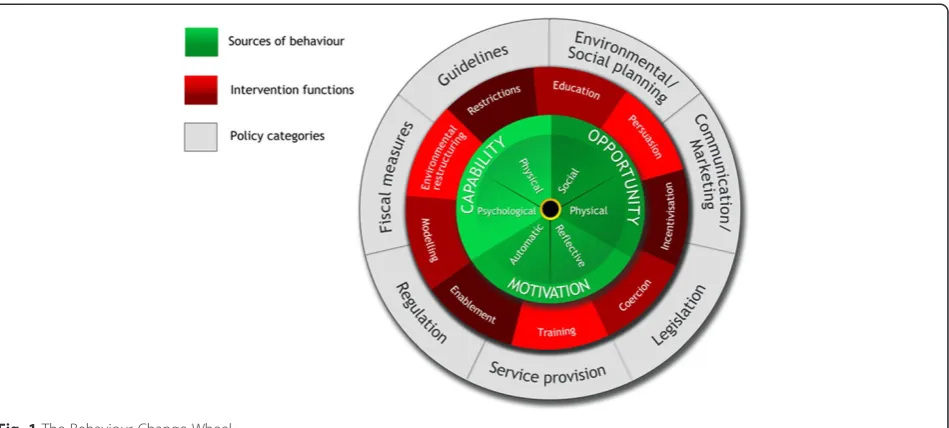
(BCW), which explicitly integrates behavioural theory with the development and description of behavioural change interventions [14]. A core feature of the BCW is a theoretical model which is used to conduct an analysis of the behaviour in question. The model is based on the hypothesis that the interaction between one’s capability (C), opportunity (O) and motivation (M) can provide ex-planations for why a particular behaviour (B) is or is not performed (COM-B). Each of these components can be further subdivided (Fig. 1). Capability may be physical (the physical skill, strength and stamina) or psycho-logical (the knowledge or psychopsycho-logical skills, strength or stamina to engage in the necessary mental processes). Opportunity may be physical (afforded by the environ-ment, including resources, locations, time etc.) or social (afforded by interpersonal influences, social cues, and cultural norms that influence the way we think about things). Motivation may be reflective (plans, self-conscious intentions or evaluations) or automatic (reflex responses, impulses, drive states). The COM-B behav-ioural analysis guides the choice of intervention func-tions (or strategies) most likely to achieve behavioural change. Additionally, the intervention functions have been linked to a taxonomy of 93 replicable behavioural change techniques [15], and those techniques particu-larly suitable for each intervention function have been highlighted [14]. Following this structured approach lends transparency to the process of intervention devel-opment and facilitates its subsequent implementation and evaluation [12].
Since its original publication in 2011, the BCW has re-ceived a lot of academic interest, and a number of groups have already used it to develop or study the im-plementation of interventions by healthcare profes-sionals [16–19]. To our knowledge, there are no published examples of using the BCW to develop a de novo intervention targeted at healthcare professionals in the complex field of multimorbidity. As the application of the BCW may vary according to the setting and target behaviour, examples of the generalizability of the ap-proach are required. Furthermore, published examples of its use will contribute to the ongoing development and refinement of the method.
In this paper, we describe the development of an inter-vention to improve medication management in multi-morbidity by GPs, in which we applied the steps of the BCW to enable a more transparent implementation of the MRC framework for design and evaluation of com-plex interventions.
Methods
(and if necessary, new) evidence and modelling process and outcomes [10]. Like the MRC framework, the BCW [14] also has three broad stages but they involve differ-ent tasks (i.e. understanding the behaviour, iddiffer-entifying intervention options and identifying content and imple-mentation options) and are subdivided into a further eight steps (i.e. defining the problem in behavioural terms, selecting the target behaviour, specifying the tar-get behaviour, identifying what needs to change, identify appropriate intervention functions, identifying policy categories, identifying behavioural change techniques and determining the mode of delivery) [14]. As we were using the BCW within the overarching framework of the MRC, we mapped the eight BCW steps directly on to the three development stages of the MRC to en-hance the clarity and generalizability of our approach (see Table 1).
MRC stage 1: identifying the evidence base
To begin, we reviewed the existing evidence on medica-tion management in multimorbidity and supplemented this with new evidence in order to clearly define our problem of interest and then select and specify the be-havioural target for intervention.
BCW step 1: define the problem in behavioural terms We searched for relevant published literature, in particu-lar existing systematic reviews, to help us understand the problems associated with medication management in multimorbidity in primary care. While we identified two relevant quantitative reviews [8, 20], we also found a number of pertinent qualitative studies. Therefore, we conducted a systematic review and synthesis of the rele-vant qualitative evidence, the methods of which have been published elsewhere [21].
Fig. 1The Behaviour Change Wheel
Table 1Mapping steps of Behaviour Change Wheel to the three stages of intervention development in the UK Medical Research Council guide on complex interventions in healthcare
MRC development stage [10] BCW steps [14] BCW stages
1. Identify the evidence base 1. Define the problem in behavioural terms 1. Understand the behaviour
2. Select the target behaviour
3. Specify the target behaviour
2. Identify/develop theory 4. Identify what needs to change
5. Identify appropriate intervention functions 2. Identify intervention options
6. Identifying policy categories
3. Model process and outcomes 7. Identifying behavioural change techniques 3. Identify content and implementation options
We addressed the gaps identified from the qualitative synthesis by conducting a qualitative interview study with GPs, specifically to generate further information on their approaches to prescribing in multimorbidity. The methods for the interview study have also been pub-lished elsewhere [22].
BCW step 2: select the target behaviour
From the aggregated qualitative synthesis and interview data, we (CS and CB) identified the modifiable GP be-haviours relating to medication management in multi-morbidity and selected one key behaviour to target in our intervention. This judgement was informed by cri-teria set out in the BCW guide which are the likelihood that behavioural change would be implemented, the likely impact of changing the behaviour, the spillover or knock on effect of change on other behaviours and the ease with which each behaviour could be measured [14].
BCW step 3: specify the target behaviour
Once the target behaviour was decided, we specified in greater detail what and who needs to change and where and when this change should happen.
MRC stage 2: identifying/developing theory
In the next stage, we used the COM-B (capability, op-portunity, motivation—behaviour) model to develop a theoretical understanding of the target behaviour and guide our choice of intervention functions.
BCW step 4: identify what needs to change to achieve the desired behaviour
We used the COM-B model to frame our qualitative be-havioural analysis of the qualitative synthesis and inter-view data. We (CS and CB) coded empirical data relevant to GPs’ psychological and physical capabilities (C), social and physical opportunities (O) and reflective and automatic motivations (M) to highlight why GPs were or were not engaging in the target behaviour and what needed to change for the target behaviour to be achieved. Where multiple COM-B components were po-tentially relevant to one section of the data, the compo-nent whose definition (as set out in the BCW guide, [14]) best fit the context of our data was chosen. The re-sults of this analysis was presented to the other authors at a consensus meeting and refined accordingly.
BCW step 5: identify intervention functions to achieve the desired behaviour
The BCW incorporates a comprehensive panel of nine intervention functions, shown in Fig. 1, which were
drawn from a synthesis of 19 frameworks of
behavioural-intervention strategies. We determined which intervention functions would be most likely to
effect behavioural change in our intervention by map-ping the individual components of the COM-B behav-ioural analysis onto the published BCW linkage matrices [14]. Each intervention function seen to be potentially relevant to our data was considered in detail. We used the affordability, practicability, effectiveness and cost-effectiveness, acceptability, side effects/safety and equity (APEASE) criteria, another component of the BCW ap-proach, to grade the potentially relevant intervention functions into first and second line options [14].
BCW step 6: policy categories
The BCW also includes matrices which signpost the seven broad policy-level interventions for achieving be-havioural change, shown in Fig. 1. As we were not pri-marily concerned with changing policy in this study, we did not undertake this step in detail, other than listing the options that may be relevant to levering our inter-vention in the future.
MRC stage 3: modelling process and outcomes
In this third stage, we specified our intervention content in more detail and identified an appropriate way of implementing the intervention within our context.
BCW step 7: identify behavioural change techniques The selected intervention functions represented our broad approach to achieving behavioural change, but we required fine-grained techniques to operationalise these functions. We used the links previously drawn between the BCW and the taxonomy of 93 behavioural change techniques [14, 23] to list those techniques most fre-quently used with our selected intervention functions. We held an expert panel consensus meeting to review the suitability of each of these techniques, in the light of our previously collected qualitative data, the context of the intervention and by referring to the APEASE criteria. Each member of the panel had expertise in one or more areas of relevance (clinical pharmacology and prescrib-ing (CB, MD, RP), general practice (CB, CS, MD, RP, SM), behavioural science and intervention design (MB) and multimorbidity (CS, RP, SM)).
BCW step 8: identify mode of delivery
agreement was reached by discussing each option, with reference to the APEASE criteria [14].
Results
MRC stage 1: identifying the evidence base
BCW step 1: define the problem in behavioural terms We identified two existing systematic reviews which were relevant. Patterson et al. reviewed existing inter-ventions to improve prescribing and polypharmacy in older patients [20]. Only one of the included studies in-volved GPs and showed that computer decision support reduced inappropriate drug initiation in primary care [24]. The authors suggested that future polypharmacy interventions must address the complexity of clinical sit-uations and the individuality of prescribers. Smith et al. reviewed interventions to improve patient outcomes in multimorbidity in primary care. Two included studies addressed medication management but these involved pharmacists rather than GPs. Here, the authors sug-gested that future interventions should target specific problems relating to multimorbidity, be integrated into existing healthcare systems and be embedded with inter-professional collaboration [8].
Our qualitative synthesis included ten studies from seven countries involving a total of 275 GPs [21]. A key theme was GPs’ sense of professional isolation in the management of multimorbid patients. This emanated from the interplay between four aspects of the manage-ment of patients with multimorbidity: (i) the disorgan-isation and fragmentation of healthcare between primary and secondary care, (ii) the inadequacy of guidelines and evidence-based medicine for multimorbidity, (iii) chal-lenges in delivering patient-centred, rather than disease-focused, care and (iv) barriers to shared decision-making.
In the qualitative interview study, we interviewed 20 GPs about 51 multimorbid cases [22]. We found that GPs responded to clinical dilemmas in multimorbidity by‘satisficing’, i.e. accepting care that they deemed satis-factory and sufficient for a particular patient, yet ac-knowledging that aspects of that care may not be optimal. In patients with changing disease trajectories, satisficing was manifested as relaxing targets for disease control, negotiating compromise with the patient, or making ‘best guesses’about the most appropriate course of action to take. In multimorbid patients perceived as stable, GPs’default approach was to‘maintain the status quo’rather than actively rationalise medications.
BCW step 2: select the target behaviour
The numerous modifiable GP behaviours relating to medication management in multimorbidity are shown in Fig. 2.‘Maintaining the status quo’was observed in all of the qualitative interviews despite best practice guidelines
which state that patients receiving long-term medicines need medication reviews at regular intervals. Targeting this behaviour would likely result in behavioural change as the qualitative study showed GPs extant discomfort with it [22]. Furthermore, it would be desirable to see GPs adopt a less-passive approach to medication man-agement even if it did not always lead to downstream changes to medications. There was a high possibility of ‘spill over’of the actions of medication review for multi-morbidity into other prescribing activities. Lastly, chan-ging this behaviour would be relatively easy to measure. We judged that the other modifiable behaviours were not as attractive: adopting practice protocols would have a big impact and high spillover, but given current finan-cial and staffing pressure on practices would be a diffi-cult organisational change to achieve; relaxing targets and negotiating compromise may be argued to be appro-priately patient-centred in multimorbidity and trying to change these, in a healthcare system where progressively less appears to be patient-centred, may be resisted by GPs; addressing shared decision-making has merit but requires interventions targeting GPs’ communication skills (rather than prescribing) which was not our spe-cific focus.
BCW step 3: specify the target behaviour
The target behaviour was specified as active, purpose-ful medication review instead of passive ‘maintaining the status quo’ for patients with multimorbidity, to be conducted by GPs, in routine general practice, on a regular basis.
MRC stage 2: identifying/developing theory
BCW step 4: identify what needs to change to achieve the desired behaviour
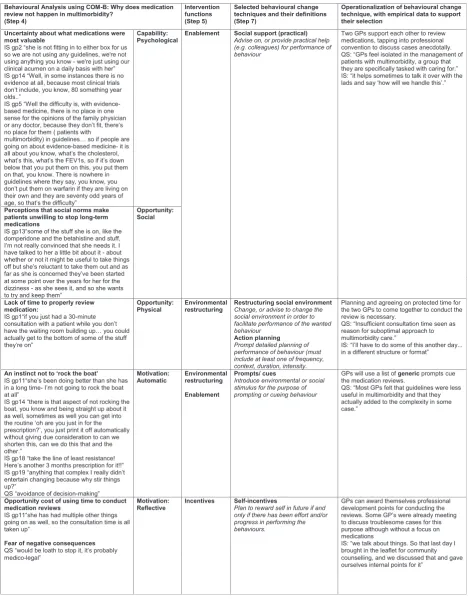
We used COM-B to identify GPs’capabilities (C), oppor-tunities (O) and motivations (M) for engaging, or not engaging, in active medication review. The themes that emerged from this analysis are shown in Table 2, with il-lustrative quotes from the qualitative synthesis and the interview study. For example, GPs adopted a passive ap-proach to medication management due to their uncer-tainty (lack of psychological capability) about which medications were most valuable in patients with multi-morbidity, especially given the absence of satisfactory guidelines in this field. Insufficient time within the con-sultation led to a lack of physical opportunity to review medications. GPs also found medication review difficult because of a cultural milieu which holds that treatment for chronic disease is lifelong (lack of social opportun-ity). This was especially the case if the patient had been compliant with their medications for many years. Many GPs had developed a habitual response to ‘not rock the boat’in patients with multimorbidity, an approach which involved not making changes to medications unless there was a pressing reason to do so. This response was reinforced by their experiences of the negative conse-quences of stopping or changing medications for pa-tients with multimorbidity in the past (automatic motivation). GPs’ reflective motivations against medica-tion review included the opportunity cost of using their professional time for this purpose and a fear of negative consequences from rationalising medications. GPs also had motivations to review medications which included improving patient outcomes, reassuring themselves that they are delivering best care, and guarding against medico-legal repercussions.
BCW step 5: identify intervention functions
We found that all nine intervention functions listed in the BCW were relevant to our behavioural analysis. Additional file 1 shows our assessment and grading of each intervention function using the APEASE criteria into first and second line options. The three intervention functions most relevant for our intervention were en-ablement, environmental re-structuring and incentivisa-tion. The relationship between the components of the COM-B behavioural analysis and the three selected intervention functions are shown in Table 2.
BCW step 6: policy categories
The broad policy options, signposted by the BCW matri-ces as being potentially useful for achieving behavioural change, were communication/marketing, service provision policy, legislation, guidelines and regulation.
MRC stage 3: modelling process and outcomes
BCW step 7: identify behavioural change techniques From the taxonomy of 93 behavioural change tech-niques, we listed the techniques most frequently used to deliver the three intervention functions we had selected [14, 23]. The resulting 32 potentially relevant techniques are listed in Additional file 2. In the expert panel, we reviewed how each technique could be applied to the context of medication man-agement in multimorbidity. The panel’s choice of techniques was influenced principally by the key findings of the qualitative studies: GPs’ sense of iso-lation in the management of multimorbid patients revealed in the qualitative synthesis [21], and GPs’ lack of certainty and efforts to ‘share the onus of re-sponsibility’ seen in the interview study [22]. Thus,
we focused on options that would enhance GPs’
means of professional support. Although enhanced communication between GPs and pharmacists is be-ing investigated in other healthcare systems [25, 26], it is not currently an option in Irish general practice due to the lack of community pharmacists. Similarly, communication between GPs and the specialists in-volved in multimorbidity patient care was seen in both qualitative studies to be fraught with poor ac-cess and a single-disease approach. A useful source of support for some GPs in the interview study was their GP colleagues. These interactions occurred on an informal basis within practices and were notable for their ready accessibility and generalist nature [22]. We were unaware of any work exploring col-laborative decision-making between GPs in multi-morbidity, so focused on this approach. From the list of 32, we considered which techniques would pragmatically facilitate collaborative decision-making between GPs. Additional file 2 shows how many were quickly eliminated as not being relevant to the context or purpose of the intervention. The five techniques eventually selected as ‘active ingredients’ were social support (practical), restructuring the so-cial environment, use of prompts/cues, action plan-ning and self-incentives. The definition of each technique and qualitative data to support their selec-tion are shown in Table 2. The combinaselec-tion and inte-gration of each technique into the overall intervention, named MultimorbiditY COllaborative Medication Re-view And DEcision Making (MY COMRADE), is shown in Table 3.
BCW step 8: identify mode of delivery
described in Additional file 3. In summary, the fol-lowing implementation plan was formulated:
1. What prompts should be used to guide medication review in MY COMRADE?
After reviewing eight different prescribing tools and checklists (listed in Additional file3), it was agreed that a modified version of the seven prompts in the NOTEARS [27] checklist for medication review would be used to cue the review.
2. How should GPs choose which patients to review using MY COMRADE?
After reviewing multiple options (see Additional file
3), it was agreed that GPs should choose patients prescribed ten or more regular medicines or four or more medicines with at least one other complicating factor (i.e. meets criteria for potentially
inappropriate prescribing, at risk of a well-recognised drug-drug interaction, has poor adher-ence or receiving end-of-life or palliative care), in line with recommendations from the Kings Fund re-port on Polypharmacy and Medication Optimisation [28].
3. How should the behavioural change technique
“action planning”be operationalised?
One of the behavioural change techniques, action planning, specifically relates to implementation and was selected to account for the wide variety of structures and systems that occur in general practice. Each GP will be given clear guidance on how to tailor MY COMRADE to suit their practice. This will involve asking them to choose a particular day, time of the day and office in which to do the review. They will decide on the number of cases to review in one sitting, and the GP pairs that will conduct reviews within a practice. In advance of
trialling MY COMRADE, GPs will be asked to consider what they envision as problematic for its implementation, and how these problems could be tackled, knowing their own practice.
4. How should the intervention be evaluated? The initial evaluation will focus on intervention implementation (i.e. did medication review take place?). The behavioural change techniques and other causal or contextual mechanisms associated with behavioural change will be determined using qualitative methods. If MY COMRADE is shown to be effective, future evaluations will assess other health outcomes such as the number of/type of medication changes made and changes in rates of healthcare utilisation.
Discussion
This paper describes the systematic, structured develop-ment of an intervention to improve medication manage-ment for multimorbid patients by GPs. The intervention is called MY COMRADE. It is, to our knowledge, the first intervention directed at the management of multi-morbidity in primary care, developed by using the Be-haviour Change Wheel to clearly implement the framework of the MRC guide on complex interventions.
MY COMRADE involves collaborative decision-making by two GPs who support each other in the review of medications prescribed to a complex multi-morbid patient, guided by cues which relate to safe prescribing. The broad functions of the intervention (enablement, environmental restructuring and incenti-visation) are theoretically based. These functions will be achieved using five specific behavioural change techniques: social support (practical), restructuring the social environment, use of prompts/cues, action planning and self-incentives. The technique of colle-gial social support is a crucial feature of our
interven-tion, which we expect will greatly enable GPs’
capabilities in conducting active medication reviews. It may be particularly important in de-prescribing medications or prioritising patient-centred rather than disease-focused care in multimorbidity which are challenging aspects of medication management, not least because of the fear of litigation which this inter-vention may now help ameliorate.
Comparison with other work
Since its publication in 2011, the BCW has been used in the development of interventions targeting healthcare pro-fessionals in a variety of ways. For example, Alexander et al. used COM-B to understand barriers and enablers to preventative health examinations for young children in Australian general practice, with a view to designing an
Table 3Description of final intervention
The final intervention is called MultimorbiditY COllaborative Medication Review And DEcision Making (MY COMRADE)
It involves the following (relevant behavioural change techniques are in brackets):
implementation intervention to increase the conduct of these examinations [16]. They did not describe later steps of the BCW, such as choice of intervention functions, and did not describe in detail how their implementation inter-vention would look. In contrast, we used the BCW to highlight areas for improvement in professional practice and then develop an intervention targeted to these areas, rather than simply increasing the implementation of a pre-existing intervention.
Murphy et al. used COM-B to develop a capacity-building programme to enhance pharmacists’ roles in mental health care [19]. This group felt that implemen-tation processes must be prioritised during the early stages of intervention development, and they wove theor-ies of behavioural change and implementation together in an iterative way. While we agree that implementation should be considered at all stages of development work, we did not find it necessary to use a specific implementa-tion framework. The initial steps of the BCW revealed multiple areas for improvement in GPs’professional prac-tice. Once one had been chosen, the remaining steps of the BCW involved developing an implementation inter-vention to enhance the performance of this desired behav-iour. Additionally, by incorporating the behaviour change technique of action planning, implementation was expli-citly integrated into our intervention. Action planning re-quires an individual GP to plan the frequency, duration and intensity of the planned intervention activity [14]. Thus, rather than a prescriptive implementation strategy, action planning will allow each GP to adapt the interven-tion for use within their own practice. The variainterven-tion in im-plementation, as well as fidelity to other behavioural change techniques, will be evaluated in the next phase of this work and will help to inform the debate on optimal approaches to implementation planning in intervention development.
Strengths and weaknesses
We began this work with the broad aim of developing an intervention to improve medication management in multimorbidty, but we did not have a predefined idea of what the intervention would be at the outset. Adhering to the guidance of the MRC by using a the-oretical approach, which was chosen a priori, lent dir-ection, structure and transparency to this process in multiple ways.
First, the MRC states the need to identify the evi-dence base and supplement this with new evievi-dence if necessary. In doing this, we generated much needed data on the management of medications in multimor-bidity, increased our understanding of the problematic areas experienced by GPs and revealed how they cur-rently respond to these difficulties. Second, we then
used this empirical data to directly influence the de-velopment of the intervention. Following the steps of the BCW allowed us to develop a list of options for behavioural change and to clarify what we were, and what we were not, trying to achieve. Third, we bene-fitted from using the links between the BCW model and the taxonomy of behavioural change techniques. The taxonomy highlighted novel strategies for behav-ioural change, many of which we would heretofore not have considered. Although only five techniques are ultimately included in the description of the final intervention, many of the others influenced other as-pects of intervention development and the implemen-tation strategy.
Despite the highly systematic and structured approach of the BCW, there are challenges associated with its use and it is not a magic bullet for intervention develop-ment. For example, the researcher must make a series of subjective and pragmatic decisions throughout the process. These‘real life’decisions can seem at odds with the scientific approach. To counter this and to improve the transparency and generalizability of our methods, we recorded in detail the multiple options available to us at each step of the BCW and expanded on why options were or were not taken.
Furthermore, the multiple steps of intervention devel-opment involved a lengthy process: from the beginning of our systematic review to the final refinements of the intervention spanned almost 3 years. Such a prolonged course must be factored in by those pursuing and fund-ing evidence-based intervention development. Other intervention developers have used a‘top-down’approach of applying classical behavioural theories such as social cognitive [29] or control theory [30] to inform their choice of intervention functions and behavioural change techniques. In contrast, we employed a ‘bottom-up’ ap-proach to theory development in which the framework of the BCW guided our use of existing evidence and our own qualitative explorations. This led to an intervention which was logical and practical yet still theoretically based.
In addition to the COM-B, the BCW also includes an optional, more detailed framework for behavioural analysis known as the Theoretical Domains Framework [14]. After completing our intervention development, we conducted a validation using the Theoretical Domains Framework (see Additional file 4) which reassuringly demonstrated similar associations between our qualitative data, and our chosen intervention functions and behavioural change techniques.
Implications for future research
how this shift could be achieved. Our experience con-firms the usefulness and generalizability of this ap-proach. Multimorbidity presents many challenges to GPs, particularly relating to the conflicts between patient-centred and disease-focused care but the BCW approach was not hampered by these complexities. Based on our experience, the method is potentially ap-plicable to intervention developers across disciplines as long as sufficient contextual and empirical data exists or can be generated.
Throughout this study, we adhered to the‘less is more’ maxim of intervention design [14]. We could have taken a more complex multi-faceted approach, such as incorp-orating other stakeholders, i.e. pharmacists or specialists. Instead, we adopted the recommendations from the sys-tematic review by Smith et al. that changes targeting specific problems are more likely to be effective [8]. Smaller changes can be achieved, sustained and built upon in future interventions, and substantial behavioural change is more likely to result from the aggregation of these smaller changes [14]. We applied the same tenets to our assessment of outcomes—rather than initially looking at downstream effects such as changes in pre-scribing, we will concentrate first on proximal changes such as implementation of the intervention. Once we are assured that it is acceptable, feasible and leads to be-havioural change, we can assess outcomes in prescribing safety and polypharmacy at a later stage.
To date, there is limited evidence available on which behavioural change techniques are most effective in spe-cific settings. We expect that characterising the active components in the MY COMRADE intervention using the taxonomy of behavioural change techniques [15] will aid implementation and replication of the intervention. The clear specification of the intervention will also facili-tate a thorough evaluation of the impact of the selected behavioural change techniques and will help to inform evidence-based strategies for intervention development in the future.
In this study, we did not undertake the sixth step of the BCW relating to policy options in detail. How-ever, if the intervention is shown to be effective in our ongoing feasibility and pilot work, scaling-up of the intervention will require greater consideration of the external context of healthcare policy and wide-spread implementation.
Conclusion
This paper describes the development of an intervention to improve medication management in multimorbidity by GPs. The intervention, which is called MY COMRADE, is based on purposively collected data on behaviour in context and a novel approach to intervention design, the Behaviour Change Wheel. While the Behaviour Change
Wheel is not a magic bullet for intervention design, this paper confirms the usability and usefulness of this ap-proach in a complex area of clinical care. The systematic, transparent approach used in the development of the MY COMRADE intervention will facilitate a thorough evalu-ation of its effectiveness in the next phase of this work.
Additional files
Additional file 1:BCW step 5: identify intervention functions using APEASE criteria.(DOCX 26 kb)
Additional file 2:BCW step 7: identify behavioural change techniques.(DOCX 24 kb)
Additional file 3:BCW step 8: identify mode of delivery using expert panel.(DOCX 33 kb)
Additional file 4:Validation of the chosen intervention functions and behavioural change techniques using the theoretical domains framework.(DOCX 32 kb)
Abbreviations
BCW:Behaviour Change Wheel; COM-B: capability, opportunity, motivation—behaviour. Refers to a model comprised of three
components—capability, opportunity, motivation—that are necessary for a given behaviour to occur; GP: general practitioner; MRC: Medical Research Council.
Competing interests
The authors declare that they have no competing interests.
Authors’contributions
CS designed the study, conducted data analysis and wrote initial draft of the paper. CB contributed to study design, data analysis and revising the manuscript. MB contributed to study design, analysis and revising the manuscript. SW, MD and RP contributed to data analysis, judgements on intervention design and revising the manuscript. All authors have given final approval of the version to be published and agree to be accountable for all aspects of the work.
Acknowledgements
This work was supported by the Irish Research Council New Foundations scheme and the Health Research Board (HRB/NSAFP/2011/3 to CS). The funding bodies had no role in the study design, collection, analysis or interpretation of data. The support of the South East GP Training Programme in facilitating Dr. Sinnott's clinician academic fellowship is gratefully acknowledged.
Author details
1Department of General Practice, University College Cork, Cork, Ireland. 2
General Practice and Primary Care, Institute of Health and Wellbeing, University of Glasgow, Glasgow, UK.3Cambridge Centre for Health Services Research, Institute of Public Health, University of Cambridge, Cambridge, UK. 4Centre for Health Economics and Medicines Evaluation, Bangor University, Bangor, UK.5Health Behaviour Change Research Group, School of Psychology, National University of Ireland, Galway, Ireland.
Received: 12 June 2015 Accepted: 9 September 2015
References
1. Glynn LG, Valderas JM, Healy P, Burke E, Newell J, Gillespie P, et al. The prevalence of multimorbidity in primary care and its effect on health care utilization and cost. Fam Pract. 2011;28:516–23.
3. Bayliss EA, Bonds DE, Boyd CM, Davis MM, Finke B, Fox MH, et al. Understanding the context of health for persons with multiple chronic conditions: moving from what is the matter to what matters. Ann Fam Med. 2014;12:260–9.
4. Payne RA, Avery AJ, Duerden M, Saunders CL, Simpson CR, Abel GA. Prevalence of polypharmacy in a Scottish primary care population. Eur J Clin Pharmacol. 2014;70:575–81.
5. Tinetti ME, Bogardus Jr ST, Agostini JV. Potential pitfalls of disease-specific guidelines for patients with multiple conditions. N Engl J Med. 2004;351:2870–4.
6. Boyd CM, Darer J, Boult C, Fried LP, Boult L, Wu AW. Clinical practice guidelines and quality of care for older patients with multiple comorbid diseases. JAMA. 2005;294:716–24.
7. Smith SM, O’Kelly S, O’Dowd T. GPs’and pharmacists’experiences of managing multimorbidity: a‘Pandora’s box’. Br J Gen Pract. 2010;60:285–94. 8. Smith SM, Soubhi H, Fortin M, Hudon C, O’Dowd T. Interventions for
improving outcomes in patients with multimorbidity in primary care and community settings. Cochrane Library. 2012;4:CD006560.
9. Michie S, Johnston M, Abraham C, Lawton R, Parker D, Walker A. Making psychological theory useful for implementing evidence based practice: a consensus approach. Qual Saf Health Care. 2005;14:26–33.
10. Craig P, Dieppe P, Macintyre S, Michie S, Nazareth I, Petticrew M. Developing and evaluating complex interventions: the new Medical Research Council guidance. BMJ. 2008;337:a1655.
11. Davidoff F, Dixon-Woods M, Leviton L, Michie S. Demystifying theory and its use in improvement. BMJ Qual Saf. 2015;24(3):228–38.
12. Michie S, van Stralen MM, West R. The behaviour change wheel: a new method for characterising and designing behaviour change
interventions. Implement Sci. 2011;6:42.
13. Michie S, Abraham C, Eccles MP, Francis JJ, Hardeman W, Johnston M. Strengthening evaluation and implementation by specifying components of behaviour change interventions: a study protocol. Implement Sci. 2011;6:10. 14. Michie S, Atkins L, West R. The behaviour change wheel: a guide to
desiging interventions. Great Britain: Silverback Publishing; 2014. 15. Michie S, Richardson M, Johnston M, Abraham C, Francis J, Hardeman W, et al.
The behavior change technique taxonomy (v1) of 93 hierarchically clustered techniques: building an international consensus for the reporting of behavior change interventions. Ann Behav Med. 2013;46:81–95.
16. Alexander KE, Brijnath B, Mazza D. Barriers and enablers to delivery of the Healthy Kids Check: an analysis informed by the Theoretical Domains Framework and COM-B model. Implement Sci. 2014;9:60. 17. Fleming A, Bradley C, Cullinan S, Byrne S. Antibiotic prescribing in
long-term care facilities: a qualitative, multidisciplinary investigation. BMJ Open. 2014;4:e006442.
18. English M. Designing a theory-informed, contextually appropriate intervention strategy to improve delivery of paediatric services in Kenyan hospitals. Implement Sci. 2013;8:39.
19. Murphy AL, Gardner DM, Kutcher SP, Martin-Misener R. A theory-informed approach to mental health care capacity building for pharmacists. Int J Ment Health Syst. 2014;8:46.
20. Patterson SM, Hughes C, Kerse N, Cardwell CR, Bradley MC.
Interventions to improve the appropriate use of polypharmacy for older people. Cochrane Database Syst Rev. 2012;5:CD008165.
21. Sinnott C, Mc Hugh S, Browne J, Bradley C. GPs’perspectives on the management of patients with multimorbidity: systematic review and synthesis of qualitative research. BMJ Open. 2013;3:e003610. 22. Sinnott C, Hugh SM, Boyce MB, Bradley CP. What to give the patient
who has everything? A qualitative study of prescribing for multimorbidity in primary care. Br J Gen Pract. 2015;65:e184–191. 23. Colquhoun H, Leeman J, Michie S, Lokker C, Bragge P, Hempel S, et al.
Towards a common terminology: a simplified framework of
interventions to promote and integrate evidence into health practices, systems, and policies. Implement Sci. 2014;9:51.
24. Tamblyn R, Huang A, Perreault R, Jacques A, Roy D, Hanley J, et al. The medical office of the 21st century (MOXXI): effectiveness of
computerized decision-making support in reducing inappropriate prescribing in primary care. CMAJ. 2003;169:549–56.
25. Improving the management of patients with multimorbidity in general practice. In Current Controlled Trials web site. http://www.controlled-trials.com/ISRCTN06180958; 2014.
26. Avery AJ, Rodgers S, Cantrill JA, Armstrong S, Cresswell K, Eden M, et al. A pharmacist-led information technology intervention for medication errors (PINCER): a multicentre, cluster randomised, controlled trial and cost-effectiveness analysis. Lancet. 2012;379:1310–9.
27. Lewis T. Using the NO TEARS tool for medication review. BMJ. 2004;329:434. 28. Duerden M, Avery A, Payne R. Polypharmacy and medicines optimisation.
Making it safe and sound. The King’s Fund: London, UK; 2013.
29. Lakshman R, Griffin S, Hardeman W, Schiff A, Kinmonth AL, Ong KK. Using the Medical Research Council framework for the development and evaluation of complex interventions in a theory-based infant feeding intervention to prevent childhood obesity: the baby milk intervention and trial. J Obes. 2014;2014:646504.
30. Gray NM, Allan JL, Murchie P, Browne S, Hall S, Hubbard G, et al. Developing a community-based intervention to improve quality of life in people with colorectal cancer: a complex intervention development study. BMJ Open. 2013:3(4).
Submit your next manuscript to BioMed Central and take full advantage of:
• Convenient online submission
• Thorough peer review
• No space constraints or color figure charges
• Immediate publication on acceptance
• Inclusion in PubMed, CAS, Scopus and Google Scholar
• Research which is freely available for redistribution
![Fig. 2 Modifiable GP behaviours in medication management inmultimorbidity identified in qualitative synthesis [21] and interviewstudy [22]](https://thumb-us.123doks.com/thumbv2/123dok_us/680433.1564229/5.595.306.540.88.294/modifiable-behaviours-medication-management-inmultimorbidity-identified-qualitative-interviewstudy.webp)