!
Carnivalesque expressions in musical
composition:
A Colombian perspective
Analytical Commentary
Vol. I
!
C
AROLINA
N
OGUERA
P
ALAU
!
!
A thesis submitted in partial fulfilment of the requirements of the
Birmingham City University for the degree of Doctor of
Philosophy.
September 2011
"!
A
BSTRACT#!
A
CKNOWLEDGEMENTSIt is a pleasure to thank the many people who made this thesis possible.
First and foremost I offer my sincerest gratitude to my main Ph.D. supervisor, Lamberto Coccioli for his experience, comprehension, inspiration and generosity. He and his family have always offered me a Colombian warm home here in England. I will never forget that.
This thesis would never have taken shape without the constant support from Richard Causton, my second supervisor. Throughout my research, he provided me not only with his extensive knowledge and technical advise but also with great encouragement and support.
I would like to acknowledge the input and wise words from Edwin Roxburgh, my third supervisor. I had the most exciting time during the Orchestral Project under his conducting and general guidance. I would also like to thank Guy Woolfenden for his invaluable advice in writing for wind orchestra.
My eternal gratitude goes to our Head of Composition Joe Cutler, who has always supported the projects of composition students, finding exciting performance opportunities for all. He has always been incredibly helpful in the face of any difficulty and supremely generous with his time, his patience and his ideas to make the Department constantly thrilling.
I humbly acknowledge the performers who were involved in this project, for their priceless advice and essential contribution in making my music alive.
$! academic musical research. I would also like to thank Professor Peter Johnson for his inspiring lectures on aesthetics and philosophy and his constant encouragement and enormous support, especially during my MMus and the first years of this research. My grateful acknowledgement to Liz Reeve for her excellent job as Research Administrator; thanks for being always helpful and concerned.
I am very grateful to all the members of staff from the Conservatoire, particularly the Library, IT and Registry staff. Their support throughout the years I've spent at the Conservatoire has been really significant.
Also, in my daily work I have been gifted with a friendly and cheerful group of fellow students and I am very proud of the research community we have created. I have made the most wonderful friends at the Conservatoire who will always have an important place in my heart and my flat in Bogotá! Thanks a lot for making the last three years the most pleasant and lovely memory. I specially want to thank Murphy McCaleb, Veleka Algar, Joanna Szalewska and her husband Pierre for their helpful comments on a draft of my dissertation and their constant support, and to Toni Bates for her immense assistance with the recordings of my portfolio.
I wish to thank my entire extended family for always believing in me and always caring about me. I want to say a big thank you to my darling Natalia for being always the most supportive and encouraging friend and sister. I would like to express my humble gratitude to Juan and Cecil and, above all, to my mother and my father for being the most unconditional, loving and caring parents of the world. Thanks for being so supportive and always assuring me you are there for me.
%!
C
ONTENTS OFP
ORTFOLIO1. Pedazos de Chonta (2008) for piano quartet Vol. II
2. Elegía errante (2009) for solo viola Vol. III
3. Nocturno (2009) for large ensemble Vol. IV
4. Chirimías metálicas (2009)for solo flute Vol. V
5. Masks (2009) for mezzo-soprano and Bb clarinet Vol. VI
6. My Lonely Cumbia (2009) for seven instruments Vol. VII
7. Murmullos Atómicos (2009) for large ensemble Vol. VIII
8. Cuarteto Palenquero (2010) for string quartet Vol. IX
9. Autumn Whisperings (2010) for large orchestra Vol. X
10. Furias (2011) for violin and piano Vol. XI
&!
C
ONTENTS OFC
OMPACTD
ISCPedazos de Chonta (2008) for piano quartet
Schubert Ensemble
Elegía errante (2009) for solo viola
Garth Knox (va)
Nocturno (2009) for large ensemble
Orchestra of the Swan, David Curtis (cond)
Chirimías metálicas (2009)for solo flute
Shanna Gutiérrez (fl)
Masks (2009) for mezzo-soprano and Bb clarinet
Helena Raeburn (mezzo), Benjamin Graves (cl)
My Lonely Cumbia (2009) for seven instruments
Interrobang Ensemble, Simon Cummings (cond)
Murmullos Atómicos (2009) for large ensemble
Thallein Ensemble, Chi-Hoe Mak (cond) fragment
Cuarteto Palenquero (2010) for string quartet
Emily Davis (vl 1), Benjamin Harte (vl 2), Rose Redgrave (vla) and Clare O’Connell (vc)
Autumn Whisperings (2010) for large orchestra
Birmingham Conservatoire Symphony Orchestra Edwin Roxbourgh (cond.)
Furias (2011) for violin and piano
'!
C
ONTENTSAbstract 2
Acknowledgements 3
Contents of Portfolio 5
Contents of Compact Disc 6
Introduction 9
I. General theoretical context 11
The relevance of the concept of carnival to my research 11
Folk and Popular music 12
Adapting folk traditional elements into Classical language 13 Problematisation of the relation between folk traditions and avant-garde
languages 16
My perspective on the problematisation of the relation between the two
traditions 19
The role of transcription in my compositional process 20 Ethnicity and geography of the folk and popular sources 22
II. Commentaries on the pieces of my portfolio 28
Individual analysis of the pieces 30
Pedazos de Chonta 30
Cuarteto Palenquero 33
Nocturno 36
Murmullos Atómicos 39
Elegía errante 45
Masks 48
My Lonely Cumbia 50
Chirimías Metálicas 53
Furias 55
(!
Conclusions 62
Appendix 1: Geographical and Political Map of Colombia 65 Appendix 2: Courses and Residences, and Teaching Experience 66
Appendix 3: Prizes and Grants 67
Appendix 4: Publications and Recordings 68
Appendix 5: Participations in Conferences 69
Appendix 6: Recent Performances (2007-2011) 70
)!
I
NTRODUCTIONTo a considerable level, my work consists of reflection on my own cultural heritage. Accordingly, the main criterion in my selection of folk and popular repertoire for analytical purposes is the degree to which this type of music has nourished my musical and cultural background. Thus, the portfolio of thirteen collated pieces, together with the corresponding commentary, constitute a deep process of understanding both the folk/popular and the academic influences I have absorbed. This has involved musing on their meaning, analyzing their musical components and their aesthetic impact on my voice, transforming them in a creative way, remembering and forgetting them to some extent, and even ‘misunderstanding’ them in order to clear imaginative space for myself, to borrow from Harold Bloom’s reflections on poetry (Bloom, 1973).
Although I do not want to unequivocally define myself as a postmodern composer, there are some ways of thinking integral to this type of approach that fit the kind of exploration I am undertaking. This is the case with Richard Kearney’s remarks on the significance of Postmodernism:
Postmodernism is to be understood (…) not simply as that which comes after
modernism, but as that which parodically reiterates our cultural traditions. (Kearney, 1994, p. 21)
*+! in my music, to evoke and explore a time in which bourgeois and intellectual prejudices and aspirations had not formed. Somehow, I found myself feeling a little foreign to my own musical language. This was compounded by the feeling of being an actual foreigner in the UK, at a great geographical distance from my home country. I suppose I felt melancholic and an urge to be really truthful revealed itself.1
However, the idea of ‘initial forgetting’ constituted merely a starting point in my project. Later on, it evolved into a keen interest in understanding two musical components of my life: the Classical and the Folk-Popular Colombian musical traditions, and in bringing them together in an imaginative way. The comprehension of these two types of influence demanded a deep observation and appreciation of their differences without adapting or absorbing one tradition into the other. The aim of this project is what I call a
problematisation of the musical features that inform the fascinating but abstruse
relationship between Western classical music and Colombian folk and popular music. As I will explain in the following section, this conflicting but suggestive relationship is embodied in the notion of ‘carnivalesque’. The pieces of this portfolio are the expression of this reflection.
The following discussion presents (Chapter 1) a theoretical contextualisation of the relevance of the concept of carnival to my research, making a pertinent distinction between folk and popular music and different tendencies of inclusion of folk traditional elements into Classical languages. This chapter also elaborates on the concept of the problematisation of the relationship between folk traditions and Western contemporary languages and how I use it creatively in my compositional work. Chapter 2 will offer a descriptive analysis of the pieces of my portfolio on the basis of the aforementioned conceptual background.
!!!!!!!!!!!!!!!!!!!!!!!!!!!!!!!!!!!!!!!!!!!!!!!!!!!!!!!!
1 Harold Bloom offers an insightful reflection on the creative impulse of melancholy. He claims that the
**!
I. G
ENERAL THEORETICAL CONTEXTThe relevance of the concept of Carnival to my research
Carnivals were originally intended to mark the beginning of the Christian Lent ritual and its command to reject the bodily aspect of human existence. The Latin term carnem-levare
means “to remove one’s self (levare) from flesh or meat (carnem)” (Mauldin, 2004, p. 3). However, from the first manifestations of carnivals – which according to the oldest known written description dates back to the 12th-century –!they were conceived as a farewell to the body, so ironically they amounted to a final celebration of the bodily existence that was at odds with their intended function. One of the main features of this celebration is its inversion of social hierarchies and roles (the town’s fool becomes king, men dress as women and vice versa). In this sense Ivanov observes that carnivals are moments in which “certain groups (or categories) of people, usually occupying an inferior position, exercise ritual authority over their superiors.” (Ivanov, 1984, p. 11) During the Middle Ages, as Bakhtin has pointed out, due to the assertion of hierarchies, moral values, norms and prohibitions, the carnival—the true feast of the people—had to be tolerated outside the official sphere and had to be turned over to the popular sphere of the low strata of the populus, represented in the marketplace (Bakhtin, 1984). However, carnivals cannot be understood as political manifestations with civic or militant functions. They are not meant to transform the socioeconomic conditions of the lower strata of the population. In this sense, Umberto Eco says that the concept of carnival is deeply influenced by the definition of comic. According to Eco, carnivals are paradigmatic situations in which we are momentarily suspended from social norms and rules.
By assuming a mask, everyone can behave like the animal-like characters of comedy. [But] the comic is only an instrument of social control and can never be a form of social criticism. (…) Our tension for the tragedy is mitigated by the ridiculization of the majesty of sorrow through the ridiculization of the zoomorphic little men. They are the mask through which we can pass over in laughter the difficulty of living.
*"! Although the notion of carnival refers to the specific festivities in which these aforementioned expressions take place, one can derive a broader notion of ‘carnivalesque’ that designates the spirit of any cultural expression celebrating the body and the unofficial, uncanonized, inverted relationships—and not only the actual traditional carnivals (Danow, 2004). In this sense, ‘carnival’ “can be used to describe a resistance to dominant discourses, or a playful, even subversive use of language” (Babin and Harrison, 1999, p. 136). I will use this conceptual form of the term in relation to musical expression. Several instances of folk and popular music are carnivalesque in this sense. In particular, I will exploit Colombian folk and popular music as a general source of musical materials, insofar as it carries its aforementioned spirit, even though some of this music is neither exclusively nor necessarily performed in Carnivals.
Folk and Popular music
It is not easy to find or tailor a completely satisfying definition of the notions of folk and popular music. In their ordinary use and even in their technical use there is a great deal of ambiguity and overlap between them. According to The New Grove Dictionary of Music and
Musicians, the concept of folk has been widely developed and defined within different
*#! As for popular music, the Oxford Companion to Popular Music states that it is a type of music “in relation to the understanding, taste, or means of ordinary people”, with a high level of activity (continuous production, reproduction, massive distribution, etc.). For the purpose of this chapter, I will follow this definition but I will only consider a specific type of Colombian popular music, which has its roots in folk music and is not influenced by the modern genres usually associated with the label ‘popular music’ in Europe and North America. I intend to explain this further when I present the particular folk or popular elements I am using in my own compositions.
The development of classical music has always been associated to the practice of folk music. In this regard, the inclusion of folk musical elements into Western classical music has always occurred. However, particularly during the last and current centuries this integration has taken very varied forms. Let me distinguish roughly between these two general tendencies. Whilst there are bound to be cases that do not fit entirely within either tendency, these categories can provide a useful framework for the ensuing discussion.
Adapting folk traditional elements into Classical language
The first tendency is characterized by the fact that the integration of folk music into the classical language operates by “adapting” folk traditional elements so that they fit into the pitch-tempered system and traditional Western rhythmic parameters. In this way, the folk tradition is smoothly absorbed into the language of classical music, where it can function as a very rich source of inspiration and exotic originality, sometimes contributing to the exploration of harmony, timbre and rhythm—within certain boundaries. A remarkable historical example is Béla Bartók’s work, which masterfully turns “both diatonic and non diatonic folk modes of Eastern Europe into octatonic, whole-tone, and other abstract pitch constructions of contemporary art music” (Antokoletz, 2000, p. 5). In the case of Colombia, the nationalistic phenomenon of assimilation of folk traditional music into classical practice, together with the influence of European and North American neoclassicism, has been the source of several valuable compositions, such as Sonatina Boyacense (1935) by Antonio María Valencia, Tres Ballets
*$!
Preludio y Danza Colombiana (1956) by Luis Carlos Figueroa, Paráfrasis sobre un Bambuco
Colombiano (1984)by Blas Emilio Atehortúa and Tumbaos (2007) by Diego Vega, among
many others.
In my view, however, this adaptation-based approach to folk music very often leaves aside important musical aspects of folk music, associated with the idiosyncrasies of its performance and the affective palette that constitutes its expressive possibilities. When the two traditions, classical and folk, are compared, bearing in mind aspects such as the location or spaces of performance, the attitude expected from listeners and performers, the process of their creation and preservation, usually a set of dichotomies emerges: levity vs. seriousness, spontaneity vs. control, improvisation vs. predetermination, collective creation vs. individual composition, and, especially, total or partial absence of notation vs. detailed notation.
The role of notation in the creation and preservation of music is a very important aspect of reflection for my research. As Trevor Wishart (1996) has pointed out, the sole mnemonic function of musical notation is no longer its primary reason of existence. Instead, the restrictions of its limited symbols and constructions have predetermined the nature of the prevailing musical languages and ideas. This is undoubtedly associated with the fact that the primary parameters in musical organisation have consistently been pitch and duration, which appeared most accessible to analytic assimilation. Consequently, this approach to musical notation has left fundamental aspects of sound experience out of the score and, therefore, out of the musical work. Wishart actually compares the musical context with the history of human thought and communication, which “has been inextricably bound up with the use of the written word” (1996, p. 11). Furthermore, he asserts that some of the most important divisions of society are related to the institution of writing:
In the long era of scribery, all people regarding themselves as ‘cultured’ or ‘civilised’, as opposed to illiterate peasants or craftsmen, have lived within the confines of an enormous library whose volumes have laid down what was socially acceptable and, in effect, possible to know and to mean. Whilst those lying on the margins of ‘civilisations’ retain some subcultural independence – variously labelled as ‘ignorance’, ‘backwardness’, ‘superstition’, ‘folklore’ or ‘folkculture’ – they equally had no access to the pages of history, and hence whatever the significance of their cultural world, it was devalued by default.
(Wishart, 1996, p. 12)
*%! musics as technically limited modes of music-making, and in some cases this has been accompanied by the implication of an inferior moral position.2 In this sense, much of
what Mikhail Bakhtin has shown regarding the relation between the official ‘high culture’ and the popular folk low strata since the Middle Ages, is also valid for the corresponding musical genres. I find it plausible that this social and moral hierarchy that writing carries has a strong connection with the way folk music has been incorporated into the work of many composers, and particularly the aforementioned Colombian composers whose work involves certain ‘adaptations’ of one genre to another. Here the presence of folk materials comes in the form of dances from the Andean region of the country (Pasillo
and Bambuco dances), predominantly. Although the music from this region still preserves
its indigenous content, it has a very strong Spanish influence and has acquired a great level of refinement. As a matter of fact, it is very common to find transcriptions and compositions for piano in these genres, as I will later explain further. For composers from the urban areas who are educated in conservatoires – such as the aforementioned composers3 – this fact plays an important role in the process of becoming familiar with
national folk traditions. Commonly, the potential sonic possibilities of these overlooked genres are less likely to be preserved in the integration process of the composition, and parameters such as pitch and duration turn out to be the most distinctive features to be considered, which are already adjusted to the tempered system of the piano. Other more raw and less European-influenced types of popular music have been less accessible at the level of classical musical training, partly as a consequence of geographical, ethnic and historical circumstances, as will be discussed later on.
!!!!!!!!!!!!!!!!!!!!!!!!!!!!!!!!!!!!!!!!!!!!!!!!!!!!!!!!
2 This tendency has receded significantly in the last decades, but it is still far from disappearing.
3 It is worth noticing that the composers I am considering in this interpretation are established figures in
*&! Problematisation of the relationship between folk traditions and avant-garde languages
Although the adaptation-based approach has played a very important role in the integration of folk music into classical music worldwide (not only in Colombia), there are other significant ways in which such a process has taken place. In many cases the integration of the popular folk tradition into the Classical has taken the form of what I would like to call a problematisation of their relation. “To problematise” strictly means to consider something as if it were a problem: a difficulty that has to be resolved or dealt with. Michel Foucault used the term “reflective problematisation” to refer to the phenomenon in which the subject “stands back” to consider him- or herself as an object of thought in order to understand his or her own nature. This would commonly entail a confrontation with a set of exterior objects and a practical transformation of the being of the subject concerned (Han, 2002). Accordingly, the phenomenon in which a representative of a musical tradition – particularly a composer – explores and confronts it with other traditions may be suitably described as problematisation. In the context of my research these traditions are Classical and Folk. The result of this operation is a work that makes the confrontation explicit by incorporating and exploring their differences and tensions in a musical and, to a certain extent, socio-cultural sense. The work sheds light on the nature of each tradition, without absorbing one into the other.
*'! dominium of a false and cynical society.” (Maiguashca, 1971, my translation). Some of his most representative works are El Oro (1992), El Negro Bembón (2008), Milonga de los
Parciales (2005) and Reading Castañeda (1993).
In relation to the Colombian cases I presented earlier, it is worth mentioning a very interesting exception, Wayra (1994) by Guillermo Carbó Ronderos, who has a wide-ranging career and experience not only as a composer but also as an ethnomusicologist, and who has also extensively manipulated electro-acoustic media. In this particular piece he explores and amplifies musical gestures of indigenous instrumental performance practice of the quena (pan flute), such as sharp attacks, microtonality, multiphonics, breathy sounds and modal scales, which he develops in a contemplative and thoughtful musical experience.
The above-mentioned Latin American cases do not exist in isolation. There are widely known precedents to this type of problematisation in music. Such is the case of the American composer Charles Ives. In some works he created his so-called ‘strata’ textures by combining literal popular quotes with original classical ideas. The result is an impression of uneasy coexistence, a collage of different moments, traditions and places. Ives explored spatial forms rather than temporal ones, involving “relationships that are simultaneous, reciprocal and reflective in nature rather than successive, sequential and unidirectional” (Morgan, 1977. p. 146). The result is a static structure of pictorial character that clearly conveys the awkwardness of the coexistence of those contrasting worlds. This is particularly evident in Central Park in the Dark (1906-09), The Unanswered
Question (1906 rev. 1934) and Three Places in New England (1910-14 rev. 1929).
*(! homage, but rather incorporates the material into his own language. He claims that “the best way to analyse and comment on a piece is to do something, using materials from that piece” (ibid. p. 107).
I am particularly interested in the way Berio recreates the different moods and intonations of pre-existing material, as he does in his Folk SongsI (1964) and Voci (Folk
Songs II) (1984). In the first work the rawness and spontaneity of accentuations and
singing of the original voices are not only recreated but also enriched with harmonic colours and strange timbres from contemporary techniques of orchestration. This piece is not a simple arrangement of the songs themselves and their features are not just adapted to Berio’s classical tradition. On the contrary, Berio creates a new expression, a magic space where bizarre, unknown and contemporary sounds converge with the authentic, emotional and spontaneous expression of popular folk traditional culture in music from different places of the world. Voci on the other hand, takes folk material from a single source, Sicily. Instead of using words or the original folk melodies, he is able to capture the gestures, fragments and emotional mood of the original performance, transforming it into his own. The general texture of the piece makes the song’s fragments float into the space between the two instrumental groups and the anxious and permanent percussion, which shadows the general discourse of the piece in a constant expressively edgy atmosphere. This gloomy flow recalls some of the advice violist Kim Kashkashian received from Sicilian viola player Aldo Bennici, who gave the first performances of the piece: "one of the things he said to me, kept trying to say over and over again in different ways, is that the Sicilian personality is highly touched by the degree of intense sunlight in the land, and that that produces actually a shadow side to the personality so that there is a constant preoccupation with death." (Berio, 2001, CD notes).
Regarding the presence of noise as a primary element of expression in combination with the folk evocations, I have considered the work of Helmut Lachenmann, particularly
Tanzsuite mit Deutschlandlied (1970-80). This suite of dances is a very interesting
*)! the dances become the main material to develop. This allows the composer to conceive and achieve, at some points, completely abstract, pointillist or even very dark sonic situations, which are absolutely not related to the dances, giving them a new perspective of poetic and expressive deterioration, corruption and indetermination. I have also explored the way Iannis Xenakis approached dense, massed textures and the control of chaotic conditions. I have particularly examined the way in which he departed from the classical sense of the dramatic and classical expressivity in many of his works (e. g.
Metastasis (1953-4), Persephassa (1969), N’Shima (1976), Troorkh (1991), Antikhthon (1971)
and Tetras (1983), among others). This disruption is usually associated with his interest in
reflecting the dynamics of natural phenomena, but it can also be found in his use of technical and expressive folk musical elements, as in Embellie (1981).
My perspective on the problematisation of the relation between the two traditions
Notwithstanding the value of all the aforementioned explorations, by no means do they exhaust the possibilities that a problematisation of the relation between popular folk and classical traditions can open for the composer. My project is therefore an attempt to follow up and develop this creative endeavour of problematisation in relation to aspects which to my knowledge have not been exploited so far, and which are related to some very basic conditions that lie at the base of the conflictive relationship between these traditions.
"+! distance between the musical source and its receptor, either because the performers are moving, as in a parade, or because so is the listener, who is usually not restricted to the immobility of sitting in an auditorium. All these conditions generate a wide range of timbral, acoustic, rhythmic, intonational and textural phenomena that are frequently involuntary and can even pass unnoticed by performers and listeners.
Therefore, in my research problematisation involves identifying, exploring and extensively exploiting features of folk traditions for creative purposes—and not only those that are more superficial and easier to assimilate (melodic, harmonic and rhythmic general parameters). Since these features reflect some of the most basic differences between the folk and popular traditions, on the one hand, and the Classical, on the other, the result of its creative exploitation should preserve this conflictive character and not fall back into simple assimilation.
It is important to note that my work not only draws on the work of the composers mentioned above in relation to the problematisation approach, but also on other composers whose work exploits sonic phenomena similar to those that I identify in folk music. For this reason, the analysis of the work of certain composers can provide some of the necessary tools to take advantage of the acoustic events described above. It is very interesting and stimulating to examine the way some composers have introduced spectral music techniques to exhibit and elaborate on the hidden noise that is naturally present in harmonic sound. Such is the case of Les Espaces Acoustiques (1974-85), and Vortex
Temporum (1994-96) by Gérard Grisey, The Wheel of Emptiness (1997) by Jonathan Harvey,
At First Light (1985) by George Benjamin, Winter Fragments (2000), and Gondwana (1980)
by Tristan Murail, among others.
The role of transcription in my compositional process
"*! terms. In this regard, the entire development of our culture is a history of translations. Translations allow us to access other cultures and obtain knowledge and experiences from others.
All culture has to possess everything, therefore it translates everything: languages of all kinds, things, concepts, facts, emotions, money, the past and the future, and, of course, music.
(Berio, 2006, p. 31).
But it is very important to note that transcriptions can be done on different levels, depending on how active, complex or creative is our act of accessing the Text. When the transcription derives from a piece of the oral traditional repertoire it amounts to a
translation to another language. The result is a new Text, which necessarily excludes some
elements because of the approximations and generalisations to the visual-grammatical system of classical notation. This kind of transcription can give rise to a more complex one, for it is possible to greatly enrich the transcription with new musical elements and developments.
There are other indirect forms of transcription that imply more elaborated processes and have different functions. Such is the case of the transcription as a commentary, in which the reference to an external Text has a thematic importance and the foreign elements and experiences from the past are assimilated or antagonized. In a different manner, a transcription that enriches and transforms the original source can also be considered a form of analysis. In this respect, Berio says that the best possible commentary on a symphony is another symphony. He claims, for instance, that the third movement of his
Sinfonia is the best and deepest analysis that he could have hoped to make of the Scherzo
from Mahler’s Second Symphony. Similarly, Alfred Schnittke allows the presence of borrowed material from varied styles in his compositions. He says that he dreams of a unified style where fragments of serious music and music for entertainment would coexist in a diverse musical reality, using individual effort to rise above materials that are taboo. This, according to Schnittke, compels a universality of culture that connects with the change in our perceptions of time and space.
By making contact with the creative work of our distant ancestors we have a different sense of time, of time as an unbroken line, almost as a “simultaneous chord.”
""! Additionally, a composer may transcribe his or her own work, in order to attain a better assimilation, profundity, clarity or perspective on the original text. Such is the case of Berio’s Chemins, which are pieces with a concertante structure that are based on his
Sequenzes for solo instruments. For Berio, the Chemins alternatively expand, amplify,
unfold, distort, reflect, project, hide or uncover different aspects of the Sequenzes.
The majority of my pieces are based on a form of transcription. In some of them I have made the actual exercise of transcribing a pre-existing tune to my own terms (rhythmic approximations, dynamic interpretations, expressive indications, etc.) after different stages4 that allow me to understand the material for my own aesthetical needs. In other
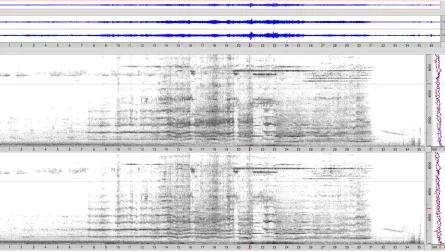
pieces the concept of transcription works indirectly, as I use pre-existing styles or dance-patterns to write my own tune and further explore it, making it alien to its original genre and closer to my own vision. Furthermore, some compositional processes consisted not only in registering ideas on paper and translating them into notation, but in looking closely at the particularities of every sonic event, with the assistance of spectrograms. I used this type of procedure in my expansions and reflections on folk material, but also to capture the peculiarities of environmental sounds and noises, from insects to trains, car horns and so on.
Ethnicity and geography of the folk and popular sources
As mentioned above, one of the most important aspects of my project is that it draws heavily on Colombian folk and popular music as a general source of musical and sonic elements, which attempts to make visible the corresponding aesthetical, sociological and cultural tensions between this tradition and the Classical. In order to understand the nature of the sources as well as their sociological context, it is important to explain Colombian ethnicity as well as its geographic distribution. These factors have shaped the Colombian folk and popular traditions as well as their socio-economic background. Understanding these underpinning factors allows us to add more layers of meaning to this music.
!!!!!!!!!!!!!!!!!!!!!!!!!!!!!!!!!!!!!!!!!!!!!!!!!!!!!!!!
4 These different stages usually comprise, in the first place, meter, as well as pitches and rhythmic
"#! The ethnicity of most of the Colombian population is self-defined as Mestizo. This term comes from the Latin mixticius, which means mix and its translation to English is Mestee (or Métis in the context of Eastern Canada). The Mestizo ethnicity corresponds to the mix between Indigenous Amerindians, Afro descendants and Spanish. In addition to the
Mestizo population there are some groups who belong to the Indigenous and the Afro
descendant communities that remained in relative isolation, unmixed, retaining most of their cultural heritage. Their isolation is partly the result of the territories they have occupied, thus a comprehension of the geographical distribution of the country becomes relevant.
Figure 1: Colombia’s natural regions
"$! Pacific oceans. In my project I will consider as geographical influences only the regions with which I have more familiarity and that have been close to my own musical and cultural background, that is, the Pacific, the Andean, and the Caribbean regions.
Figure 2: Political Map of Colombia
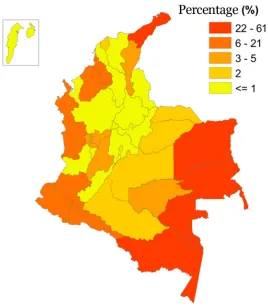
"%! occupy the region, where they found the optimal climatic and best conditions for exploiting gold, as well as potential indigenous labour. The Amerindian populations diminished rapidly because of abuses, illness, expropriation, miscegenation and over-exploitation. As a consequence of this the Spanish Crown was forced to legally protect the remaining indigenous population and endowed them with the right to farming their land. After this protection and further resistance to colonisation, indigenous people ended up organized as minorities in resguardos indígenas, or indigenous reserves, which are usually located in geographically isolated territories of the country. 14.3% of the population of the Andean Region is indigenous. This population belongs to 13 different ethnicities (see Figure 3)5. It is worth noting that although there is a strong Muisca
inheritance in the Altiplano Cundiboyacense (a plateau encompassing most of the Boyacá and Cundinamarca Departments, where Bogotá stands), only a few people recognize themselves as indigenous.
A number of rivers run from the Andean highlands to the sea, traversing the Caribbean region. Among these rivers is Colombia's principal river, the Magdalena, which disgorges at the main port of Barranquilla. The Caribbean region is also the location of the port cities of Santa Marta and Cartagena, which were some of the first cities founded by the Spanish in the country. While generally low-lying and humid, the region also includes the Sierra Nevada de Santa Marta mountain range and the Guajira Desert.
The Pacific region is highly humid; its precipitation is among the highest in the world. The majority of its population is of African descent, although it also includes several indigenous settlements. The economy is based on mining (gold and platinum), timber, cattle raising, agriculture and fishing.
Regarding the coastal population of Colombia, both Caribbean and Pacific regions are the areas of higher density of black people who were brought as slaves during the Colony Period in the sixteenth-century from Equatorial Africa to Colombia. Afro-descendant slaves were allocated in warm wild zones, in similar environments to their places of origin (the territories now belonging to Congo, Nigeria and Gabon, among !!!!!!!!!!!!!!!!!!!!!!!!!!!!!!!!!!!!!!!!!!!!!!!!!!!!!!!!
5 As stated by the Departamento Administrativo Nacional de Estadística DANE (National Statistics
"&! other countries). There are four different territories occupied by Afro-Colombians: The Pacific region, San Andrés, Providencia and Santa Catalina Archipelago, The San Basilio de Palenque community in the Caribbean and some of the most productive cities of the country, as Figure 4 shows. It is worth noting that the economy in both the Pacific Region and the Palenque territories has been floundering since the importation of slavery during the Spanish Colonization.
Figure 3: Indigenous population in Colombia
"(!
II. C
OMMENTARIES ON THE PIECES OF MY PORTFOLIOIndividual pieces of my portfolio
Pedazos de Chonta (2008) for piano quartet 2’ . . . p. 30
Elegía errante (2009) for solo viola 9’ . . . p. 44
Nocturno (2009) for large ensemble 5’ . . . p. 36
Chirimías metálicas (2009)for solo flute 7’ . . . p. 53
Masks (2009) for mezzo-soprano and Bb clarinet 5’ . . . p. 48
My Lonely Cumbia (2009) for seven instruments 6’ . . . p. 50
Murmullos Atómicos (2009) for large ensemble 10’ . . . p. 39
Cuarteto Palenquero (2010) for string quartet 8’ . . . p. 33
Autumn Whisperings (2010) for large orchestra 7’ . . . p. 57
Furias (2011) for violin and piano 7’ . . . p. 55
Total Duration: 78’
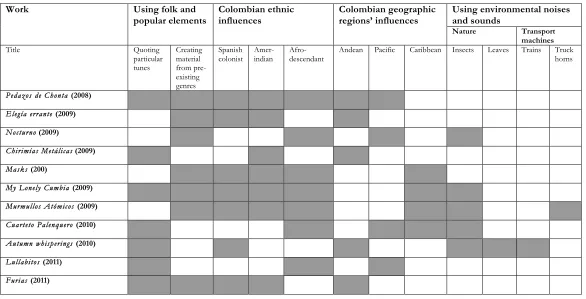
The pieces included in my portfolio can be analysed according to five different categories, as the table on the following page shows. The first exposes how the folk elements are employed; thus, if the pieces are based on transcriptions of pre-existing tunes or if their main compositional materials are original fragments composed in a specific folk or popular style, genre or dance pattern. The second shows the ethnic origins of these materials and the third their geographical location in the country. Finally, the fourth of these categories exhibits the type of environmental sounds and noises that are used in the pieces.
!
Figure 5: Categories for the analysis of the pieces included in my portfolio.
!
Using environmental noises and sounds
Work Using folk and
popular elements Colombian ethnic influences Colombian geographic regions’ influences
Nature Transport machines
Title Quoting particular tunes
Creating material from pre-existing genres
Spanish colonist
Amer- indian
Afro-descendant
Andean Pacific Caribbean Insects Leaves Trains Truck horns
Pedazos de Chonta (2008)
Elegía errante (2009)
Nocturno (2009)
Chirimías Metálicas (2009)
Masks (200)
My Lonely Cumbia (2009)
Murmullos Atómicos (2009)
Cuarteto Palenquero (2010)
Autumn whisperings (2010)
Lullabitos (2011)
!"#
# #
Individual Analysis of the pieces
Pedazos de Chonta (2008) for piano quartet
Pedazos de Chonta, as well as Bordón y Requinta (the first movement from Cuarteto Palenquero), are based on a detailed transcription of pre-existing material. With these pieces I intend to develop a particular approach to transcribing a Currulao, that is, a typical musical dance from the Afro-Colombian community living in the Colombian Pacific Coast. These transcriptions led me not only to explore and develop a wider range of compositional techniques with specific aesthetic goals but also deepened my understanding of the material itself and my relationship to it. One of my main interests was to transcribe – or translate – the timbral quality of the original source. In order to do this I had to develop different types of textural expansion that affected parameters such as rhythm, harmony, register, dynamics and density.
The rhythmic meter of the Currulao is 6/8 time, although sometimes it could be felt as 2/4 and is usually played by the Conjunto de Marimba (Marimba Ensemble). This ensemble is composed by a Marimba de Chonta, two cununos, two bombos and guasás. The
Marimba de Chonta isa specific kind of marimba, the keys of which are cut in such a way that its timbre is rather cracked, as opposed to the more homogeneous timbre of the traditional marimba. The wood that is used to construct this instrument is called chonta
and the dimensions of the keys as well as the way they are cut have a religious function: they are meant to give a resultant intonation that keeps ghosts or evil spirits away. The
cununos are conical wooden drums topped with deerskin that resemble small congas, and which are plugged with wood at the bottom to give them a denser and richer sound. The
!$#
# #
the texture of the Currulao, whose rhythm is a very fluid motor-rhythm structure that provides simplicity and clarity to the form.
All these elements create something of an integrated duality: on the one hand we have a very clear and simple melodic line and on the other a somewhat explosive sound quality, whose spectral impurities enfold the melody in a shadowy, noisy atmosphere.
From my description of the Currulao, I decided to maintain some elements, and to modify and transform others. I decided to keep the melody, as well as the harmonies implied by it. In any case, the main aesthetic goal of this piece is to represent the cracked sound of the Marimba de Chonta and the percussive character of the entire sonority of the ensemble. In general, I find this timbre is somewhat uneven and a bit noisy, features that I translated as fragmentation of the line developed by means of a pointillist and polyrhythmic counterpoint based on a microtonal structure. I created this sonority by using hoquetus technique, motivic fragmentations and a wide range of registers and dynamic levels. Additionally, I created a general polyrhythmic texture, using irrational units as triplets and quintuplets, as well as a great number of acciaccaturas. Moreover, the general percussive medium is represented by the use of different types of pizzicato on the strings (such as Bártok pizz., nail pizz., pizz. sul ponticello, pizz. behind the bridge, normal pizz., left hand pizz.) and clusters in the piano part. In addition to the timbral relationships already discussed, other elements of the Currulao also remain recognisable: the general rhythmic percussive pattern of the pieces (usually played by the piano on the left hand and the cello), a sense of heterophonic texture (provided by the type of relationship between the percussive pattern and the melody of the piece), the melody and its harmonic implications, although they appear slightly shadowed by seconds and microtonal intervals.
!%#
# #
Example 1 represents the transcription of a Currulao that José Antonio Torres “Gualajo” usually performs with his Marimba de Chonta. This is a transcription of pitches and durations, adapted to the tempered system and a metric bar of 6/8 which is the one in which Currulaos are usually transcribed.
Example 2 illustrates the processes applied to Pedazos de Chonta from the transcription of the original Currulao.
Example 2: Pedazos de Chonta, bars 1-7.
The melody in Pedazos de Chonta is usually played by the violin, the viola and the piano right hand. The form, namely ABA, is similar but not identical to that of the typical
Currulao. Sections A are made of the aforementioned elaborations on Currulao, whereas section B is constituted by a completely new material. This contrasting material is original composition – not quotation – based on the sound of a popular musical genre,
Guasca. Guasca is a popular peasant genre from a different region in Colombia, the Department of Antioquia in the Andean region. Its instrumentation comprises tiple
(small 12-stringed guitar), guitar, maracas, raspa (percussion instrument similar to the güiro) and voice. As the instrumentation of this genre is not mainly percussive – as Currulao is – I decided to use arco instead of pizzicato for its evocation. The musical construction of
Guasca is very simple and it has a strong influence from Mexican popular music.
!!#
# #
thirds with constant pitch bends gives this music a peculiar sonority. Some people define it as naïve and tawdry, but I find it rather genuine. The reason for interpolating this
Guasca section is that it provides contrast while maintaining a certain coherence. On the one hand, the harmonic texture on parallel thirds gives a sense of unity between this section and the previous one. On the other, the contrast between the percussive and dry general sound attack and the mellow and bending sonority revitalizes the piece. Example 3 corresponds to the beginning of section B of Pedazos de Chonta (bars 25 to 32).
Example 3: Pedazos de Chonta, bars 25 - 32.
Cuarteto Palenquero (2010) for string quartet
Cuarteto Palenquero consists of three movements, ‘Bordón y Requinta’, ‘Intemperies’ and ‘Etelvina Maldonado’. ‘Bordón y Requinta’ is based on a type of transcription of a Currulao
and uses a similar compositional methodology to that described above. The original material is a solo marimba de chonta. As in Pedazos de Chonta, one of the main compositional goals is a timbral translation of the original source, by means of exploring possibilities of textural fragmentation in relation to rhythm, harmony, register, dynamics and density. The fascinating fragmented and noisy sound of the marimba de chonta is also translated as a shadowed arrangement using a microtonal pointillist and polyrhythmic counterpoint, just as I did in Pedazos de Chonta. I further developed the use of hoquetus
!&#
# #
Chonta – as well as bowing with the wood and even playing on the body of the instrument.
Example 4: Cuarteto Palenquero, ‘Bordón y Requinta’, bars 111 to 117.
Example 5: Cuarteto Palenquero, ‘Intemperies’, bars 3-12.
However, in the case of ‘Bordón y Requinta’ the form, as well as the general pitch-related and rhythmic material, remained identical to the source, and in this case (unlike in
!'#
# #
preservation is an interest in exploring the stillness and regularity of the repetitiveness of the Currulao, and its further possibilities of transformation, once its bordón (or motor-rhythm) has established its familiarity through endless repetitions. At the end of the movement, I used this placid and static quality to prepare the ground for further developments. Thus, the second movement, ‘Intemperies’, consists of the addition of new material to the almost decaying bordón. The new material comprises fragmented, percussive and widespread gestures that create a sombre atmosphere. Its development seems to be driven by discontinuous impulses, producing a tangled texture: a sort of landscape of nettlesome insects from which the theme of the third movement will eventually emerge. Example 4 shows moto perpetuo of the ending of ‘Bordón y Requinta’ and Example 5 shows the disintegration of this material into noisy fragments that construct a sparse texture in ‘Intemperies’. The material that connects these two ideas is in violin 2.
‘Etelvina Maldonado’, the third movement of this string quartet, is a different type of exploration of the aforementioned transcribing procedure. Like Nocturno for large ensemble, the music arises from an interaction between two kinds of activity. On the one hand, a dense activity derived from the developments of the second movement, characterised by noisy timbres, greyish harmony, a polyrhythmic texture and great use of extended techniques in the instruments. On the other hand, there is a singular activity that emerges from the former mass, contouring a melody in G. The melodic material comes from a transcription of a performance of a song by cantaora Etelvina Maldonado, who was a folk singer from the Afro-descendant community of the Colombian Caribbean. She used to sing tangos, boleros and bullerengues6 while working in wealthy houses cleaning and ironing clothes. The transcription I made is from a bolero, Junto al mar, by Mexican composer Ernesto Domínguez. I paid special attention to the peculiarities of Etelvina Maldonado’s performance. Consequently, although the notes of the bolero are part of the transcription, the most important part of this exercise consisted in translating the natural gestures and sonic elements of her singing into musical notation. The compositional process involved the aforementioned transcription together with other procedures of ornamentation, fragmentation and microtonal and chromatic shadowing of the melodic line, as well as amplifications of the expression
########################################################
6Bullerengue is a musical dance genre from the Colombian Caribbean, El Darién province and Panamá. It is
!(#
# #
gestures such as vibratos and glissandos. (See in Example 6). Additionally, the natural
rubato that Etelvina makes use of in the song is precisely written out in the score, making the rhythmic flux rather fluctuating and unstable.
Example 6: Cuarteto Palenquero, ‘Etelvina Maldonado’, bars 9-12.
Nocturno (2009) for large ensemble
Nocturno comprises an interaction between two kinds of activity. On the one hand, a mass-like activity characterised by noisy timbres, piercing textures, sombre harmony, a development driven by discontinuous impulses, and the absence of easily discernible individual patterns. On the other hand, there is a singular activity that emerges from the former mass, contouring a melody in Eb minor (Ex.7).
Example 7: Nocturno’s melodic material.
!)#
# #
It is important to outline the programmatic idea behind the piece. I imagine a lonely little girl trying to sleep during a scary night in a humid tropical region full of disturbing insect sounds. She wishes a motherly woman be there, singing a lullaby that would help her sleep and feel safe. The child is in a predicament: if the light is turned off the insects will come to her and she will feel the unpleasant and disturbing texture of the insects on her skin. But if the light is turned on, the bugs will feel attracted by the light, fly around it and as a consequence of the optical effect, the room will be inundated by their immense scary shadows. Fortunately, there is a particular insect, a butterfly perhaps, that calls the child’s attention with a soothing effect, and somehow takes the place of the longed-for female chant. The Eb minor melody represents the chant of the absent woman, which is sometimes confounded with the flight of the butterfly. The sprightly activity, for its part, resembles to a certain extent the kind of background environmental noise of the landscape where this scene is supposed to take place, and which consists, in part, of insect sounds.
The reference to the female voice is important in the conception of this piece because an important goal of Nocturno is to capture a number of peculiarities of the voice of a folk singer. I took as a particular reference the voice of cantaoras (female singers) from the Colombian Pacific coast region, a humid tropical area. In this regard, some of the elements that interested me were the persistent vibratos, the thick colour of the low voice, the constant glissandos to reach the structural notes of the songs, the flexibility of the tempo, the involuntary microtonal intonations, among others.
This Eb minor melody is the main structural device that gives this piece formal unity. It provides a horizontal coherence and induces different levels of tension and expression. These different intensities not only originate all the vertical expansion through orchestrational procedures but also, in some cases, an elongation of the phrasing, acting as an emotional dilation or proliferation of rhythmically contrapuntal elements.
!*#
# #
the listener, as if he or she were able to touch it, only a part of the melody would be audible – even only a single sound – but its timbral texture will be very rich. If I represent the melody as being very far away, the whole melody is presented but in a blurred and confusing way.
In a similar fashion, as the butterfly symbolized by the melody is moving all around (sometimes flying, sometimes standing, sometimes only perceptible as a shadow or a reflection on a window or a sewer) its characteristic volatility is represented by the way the melody travels through the ensemble all the time. This is reminiscent of the Schoenbergian Klangfarbenmelodie but with identifiable and referential dramatic purposes.
Example 8: Nocturno, bars 19-22.
!+#
# #
Finally, in bar 22 it is taken up by violin 2 a semitone higher (E min. instead of Eb min.) and presented as a secondary voice (Nebenstimme) that basically takes the form of an echo, due to the fact that it is played in artificial harmonics, ppp, col legno tratto, with no doublings, in a very high register and articulated in a less clear and faster rhythmic figure than usual (septuplet).
The differences between Examples 7 and 8 illustrate other ways in which Nocturno
incorporates characteristic features of the Colombian folk tradition. From the rhythmic point of view, it is noticeable how in Example 8 the notation specifies what in Example 7 was simply indicated as rubato. The goal is to recreate the type of “irregularity” and “imprecision” characteristic of cantaoras’ singing. The rhythmic figures have become elastic and the rhythmic phrasing is longer and more fluid. Similarly, from the point of view of the intonation, a general instability of pitch is achieved by the constant glissandi on the main voice and the presence of ‘echoes’ in different tonalities. This sense of instability is also reached by the constant timbral transformations. The use of different tonal layers also generates a sense of discontinuity as well as different levels of definition of the melodic line, especially when combined with timbral modifications and density variations, as a consequence of doublings.
Murmullos atómicos (2009) for large ensemble
This piece is an attempt to establish a resemblance between two types of sound that have always fascinated me: the first one could be labelled as ‘equivocal mass texture - sonority’. I used it in a piece for brass quintet and percussion, called atómik, a piece I wrote in 2002 and that I directly quote in Murmullos atómicos. It is highly influenced by Iannis Xenakis’ texts, music, and György Ligeti’s music, some of Samuel Beckett’s characters, and the imagery used by filmmaker David Cronenberg.
&"#
# #
indigenous woodwind instruments (usually gaitas that are like ‘pipes’, and flautas de millo, a sort of rough flute).
According to Amparo Lotero (1989), the 19th-century porros used to be performed by native Indians and African slaves in their breaks from the long journeys and in holiday festivities. In contrast, the members of the upper class, Spanish and Spanish descendants, used to have private parties, usually when they were celebrating the bullfights. In these parties they used to have wind band ensembles performing European mazurkas and polkas. Throughout the nineteenth century, as slavery started to disappear, both types of celebrations started to conflate. Peasants started to get involved in the bullfights and also to learn how to play the European brass instruments and clarinets. The musicians that used to play in the upper-class parties started to learn how to play the porro repertoire. Given the volume they were able to reach, the European instruments were more suitable for outdoors performance than the indigenous. These changes have determined the modern porro. The indigenous wind instruments were replaced by clarinets, trumpets, euphoniums, tubas and trombones. The instrumentation also includes snare drum, bombo golpeador (an indigenous tenor drum) and a pair of cymbals.
The economy of the region has had a paradoxical impact on the music. San Pelayo is not a very affluent region, so there has not been much money to invest in music. At the beginning of the twentieth century second-hand instruments were imported and the first band, created in 1902 by Alejandro Ramírez, was called ‘pior es nada’, which means something like ‘better than nothing’ or ‘could be worse’ (Lotero, 1989). According to a number of reports, all the instruments had patches and repairs. In present times there are luthiers in the village but lots of people still can only afford second-hand instruments that often are not in a very good condition. This fact, in my opinion, contributes to the characteristic sound of the genre. These are the features I find particularly attractive in Pelayera music:
- The way the brass section and clarinets attack the notes is somewhat careless. This produces two effects: an abrupt and flat sound, and minor alterations in the tuning.
&$#
# #
sharp, bright and homogeneous vivacity of the solo trumpets, and the absence of lyricism in dull, flat and rather clumsy euphonium solos.
- The roll of the percussion has a very intense, loud, and constant presence that adds a sense of precipitation and euphoria to the whole piece as well as a somewhat noisy atmosphere.
- The tempo varies slightly but frequently, in an apparently involuntary way, making it flexible or rather elastic. The effect is usually one of pulling back.
Some of these features are the result of the level of the performers, for some of them are amateurs. The quality of the sound is also affected by the fact that the musicians are always walking and sometimes dancing. Besides, since this music is played outdoors, while people are dancing, singing, shouting, talking, laughing, or even while the members of other bands are playing nearby or warming up, the musicians have to play very loud and their capacity to hear themselves and one another, and thereby of controlling their sound, is reduced. It is also important to conceive all these “accidental” environmental sounds an integral part of the musical experience, since they constitute its natural context—as opposed to the concert hall, for instance. In this sense, the memory I have of this music is always delightfully blurred and confusing, and this is an aspect I want to draw into my work.
I believe this particular sonority exhibits not only a very apparent sense of vitality but also, and perhaps paradoxically, of fragility and deterioration. The fragility is related to the lack of definition of the sound and my blurred memory of it. The corruption relates precisely to how this fragility gives the idea that the music is close to collapsing, and to the way the sounds are constantly altered without clear control.
&%#
# #
- I “bend” or transform quickly the sound, regarding different parameters: pitch, dynamic and timbre (In this last case, for instance, by gradually muting or adding air to the sound in order to transform it into a breathy noise).
- I constantly add rests to the line, in order to evoke a sense of interruption; of incapacity to carry on.
- I focus on dissonance.
- I tend to privilege the mass texture, in terms of density and rhythmic complexity, over clear or very defined single lines. Furthermore, I limit the pitch range to an interval of major third cluster.
- In more specific cases I fragment and mix the lines, redistributing them as in a
hoquetus, and I superpose unrelated lines with very different levels of activity to inject the mass with random level of density.
It is important to note that among the very obvious differences between the two sound worlds that I have been discussing, the most noticeable is that whereas the mass texture sound does not have distinguishable lines or melodies but lots of unclear lines that together create a crowd of strange and disturbing elements, the folk sound is a regular dance, with typical roles such as a recognisable pattern both in the bass line and the percussion, with a melody, a tonal harmony with very clear dominant and tonic functions, and subordinated melodies or counterpoints. Although all these elements are delivered in a chaotic and confusing environment, we are still able to recognise them as such.
&!#
# #
Example 9 and 10 illustrate some of these procedures. The lines connecting across the instruments in the first of the two bars of the example are exhibiting the cluster harmony being used.
Example 10: Murmullos Atómicos, bars 38-40.
I draw on both the similarities and differences between these two sound worlds in Murmullos atómicos. In the first section I create a progressive accumulation of grotesque, equivocal clumsy lines, and I multiply and superpose them until they reach a dense mass texture. The second section has two quotations from El Pilón, a traditional anonymous
&&#
# #
the festive atmosphere of San Pelayo, this section has noisy juxtapositions (like very long notes from the first section of the piece in the trombones) and more rhythmic activity (the piano is prepared with foil paper to simulate a snare-drum playing the line of the original Porro). The third section starts right after a truck horn-like sound in the trombones part, and consists of a mixture of the two types of sound I have mentioned.
Example 11: Murmullos Atómicos, bars 43-49.
Elegía errante (2009) for solo viola
&'#
# #
culture. As it was mentioned before, Guasca is an example of the Mexican influence, of which Elegía also appropriates some elements that can be better explained by reference to the foreign sources.
One of the most important characteristics of Mexican Mariachi is the conceited, almost boastful and self-indulgent expressivity. It can actually be regarded as vulgar or ‘cheesey’ in some circles but I believe that this generous release of affection opens up an incredibly interesting and strange new world of acoustic phenomena. The features that represent this musical behaviour the most are, in my view, the Canto Huapango style and the parallel harmonic movement in thirds. I took those musical elements from the Mexican sources and the general rhythmic pattern and phrasing from the Argentinian
Zamba, which I also used for my piece Masks.
Canto Huapango is most commonly known in Mariachi music, although it is also related to Son Huasteco and Conjunto Norteño music. One of its distinctive characteristics is the use of a very wide and magnified falsetto in the singer, which I further amplified in Elegía errante (bars 19-20, 37-43 and 45-51). A general instrumental and vocal feature is the excessive and melodramatic vibrato. Both characteristics are used in my piece in the section corresponding to bars 87-118.
In addition to providing the rhythmic pattern of Elegía, Argentinian Zamba contributes to the evolution of the general mood of the piece. Although the main theme is mainly based on the dramatic expression of Mexican Mariachi, most of the developments and contrasting sections of Elegía errante tend to decay in sorrowful, frightful and almost nauseous dissonances and distortions. This process is a pronounced overstatement of the melancholic atmosphere of the Zamba, and stands in contrast to the brave proclamation of the musical discourse characteristic of Mariachi. This is particularly noticeable in bars 56-80, 119-148 and 149-190. The first and the last sections clearly express a mournful character, whereas the second progressively disintegrates.
&(#
# #
B’ and A’ sections working as codas. A not only expounds the totality of the theme (unlike A’ in which only the two last phrases appear) but also unfolds and expands on expressive points of the melody, similar to the compositional process of Nocturno. In
Elegía, however, unlike Nocturno, I do not use irrational units to express the rubato but resort to tempo indications such as ritardando, morendo, ritenuto and accelerando among others. This is an effective way of achieving the intended result given that coordination with other performers is not a concern.
Example 12: fragmentof Elegía’smelodic material.
Elegía is built upon the theme presented in Example 12. This theme never appears in its most basic form in the piece; it is always subjected to modifications and amplifications. Example 13 shows the theme in one of its amplified forms.