1
Article
1
Smoking’s Negative Effect on Pathological Grade and Stage in Patients with Primary,
2
Single, < 3cm Bladder Cancer
3
4
Ercan Öğreden*, Ural Oğuz, Erhan Demirelli, Orhan Yalçın
5
Giresun University, Faculty of Medicine, Department of Urology, Giresun, Turkey
6
*Correspondence: [email protected]; Tel.: +9 0 505 896 3960
7
Abstract: Introduction: We investigated the potential effect of smoking on pathological
8
staging in clinically low-risk patients. Material-Methods: Data of 59 patients who were
9
diagnosed with a bladder tumor for the first time and had a single lesion radiologically and
10
endoscopically smaller than 3 cm were investigated, retrospectively. A total of 33 patients
11
who currently smoke or smoked were classified as ever smokers group and 26 patients who
12
did not ever smoke were classified as never smokers group. Pathological diagnoses of the
13
patients in both groups were compared. Results: A total of 9 patients (27.3%) in ever smokers
14
group and 18 patients (69.2%) in never smokers group had Ta disease (p<0.05). Morover, 19
15
patients (57.6%) in ever smokers group and 5 patients (19.2%) in never smokers group had T1
16
disease (p<0.05). The number of patients with low grade (LG) tumor were 8 (24.2%) and 19
17
(73.1%) in ever smoking and never smoking groups, respectively (p<0.05). The number of
18
patients with high grade (HG) tumor were 25 (75.8%) and 7 (26.9%) in ever smoking and
19
never smoking groups, respectively (p<0.05). Ta HG was detected in 9 (27.3%) patients in
20
ever smoking group. In contrast, no patients in never smoking group had Ta HG disease
21
(p<0.05). The number of patients with T1 HG was 17 (51.5%) in ever smoking group and 2
22
(7.69%) in never smoking group (p<0.05). Conclusion:Smoking seems to associate with
23
pathologically worse stage and grade in patients with primary, single, < 3cm bladder cancer.
24
Keywords: smoking; pathologic stage; pathologic grade; low risk
25
2
1. Introduction
26
Bladder cancer is the ninth most frequently-diagnosed cancer worldwide [1]. In bladder
27
cancer, male/female ratio is 3.5:1 worldwide [2]. Association of the smoking habit with a
28
bladder tumor has been well known. Smoking is the worst risk factor for bladder cancer and
29
increases the risk of bladder cancer by 2-4 times [3]. The pathological stage and grade of the
30
tumor determined by histopathological examination are important prognostic factors that
31
determine the number and diameter of the tumor, prior recurrence rate, and carcinoma in situ
32
for bladder cancer [4,5]. Bladder cancer in patients who smoke and have a
non-muscle-33
invasive disease is associated with an advanced tumor stage and grade [6]. However, the
34
studies investigating the effect of smoking on the stage and grade in clinically low-risk
35
patients with bladder tumors that are smaller than 3 cm are limited. The aim of the present
36
study was to discuss the effect of cigarette smoking on pathological staging in patients with
37
clinically low-risk bladder cancer.
38
39
40
41
42
43
44
45
46
47
48
49
3
2. Materials and Methods
51
The files of 154 patients who were diagnosed with bladder cancer for the first time between
52
2009 and 2013 were retrospectively reviewed. Among them, 59 first-time patients with a
53
single lesion that was radiologically and endoscopically <3 cm in diameter were finally
54
included in the study. European Association of Urology (EAU) guidelines for non-muscle
55
invasive bladder cancer divided patients into risk groups. According to these data we consider
56
as clinically low-risk patients the ones that have the primary and solitary tumors, < 3 cm, and
57
no carcinoma in situ (CIS) characteristics [5,7]. Patients who were diagnosed with carcinoma
58
in situ (CIS) in pathology specimens were excluded.
59
The age at first diagnosis, smoking status, stage, grade of the primary tumor, and tumor
60
diameter and number were evaluated. Patients who had no data on the records about smoking
61
habits were excluded from the study. Patients who actively smoke cigarettes or former
62
smokers were designated as ever smokers group and lifetime non-smokers were designated as
63
never smokers group. Ever smokers group consisted of 33 patients and never smokers group
64
had 26 patients. Pathological diagnoses of the patients in both groups were compared.
65
The grading of the samples was performed according to the World Health Organization
66
(WHO) system in 2004 and the staging was performed according to TNM classification
67
approved by the Union International Contre le Cancer (UICC) in 2009.
68
All procedures performed in studies involving human participants were in accordance with
69
the ethical standards of the institutional and/or national research committee and with the 1964
70
Helsinki Declaration and its later amendments or comparable ethical standards.
71
2.1.Statistical Analysis
72
Data obtained in this study were analyzed using the SPSS 20 (IBM SPSS Statistics; Armonk,
73
NY, USA) package program. Continuous variables with non-Gaussian distribution were
74
presented as a a median (25th and 75th percentiles). Statistical comparisons of two groups
4
were performed with the Mann–Whitney U test for data with a non-Gaussian distribution.
76
Pearson’s chi-square test and Fisher’s exact test were used to compare categorical variables.
77
Logistic regression analysis was used when the independent variables include nominal
78
measures and the outcome variable was binary. This analysis was also used to interpret odds
79
ratios with 95% confidence intervals. The statistical significance was accepted when p<0.05.
80
81
82
83
84
85
86
87
88
89
90
91
92
93
94
95
96
97
98
99
5
3. Results
101
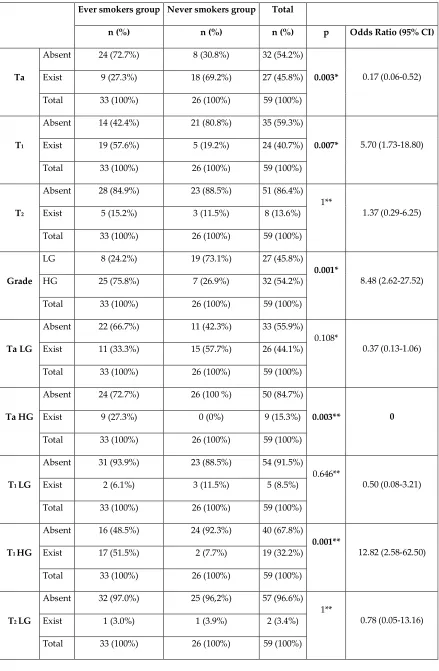
Epidemiologic and pathologic data are displayed in Tables 1 and 2.
102
Table 1. The differences between groups in terms of age values and gender frequency
103
Ever smokers group (n = 33)
Never smokers group (n = 26)
p
Age (years) 69.5 (55.8 –
75.3)
66.0 (57.0 – 73.0)
= 0.427*
Male/Female (N/N) 33/0 21/4 = 0.013**
* p value calculated by Mann-Whitney U Test ** p value calculated by Fisher’s exact test
104
The number of patients with the pathologic stage Ta was 9 (27.3%) in ever smokers group and
105
18 (69.2%) in never smokers group (p=0.003). In the never smokers group, the rate of
106
detection of the Ta tumor was significantly higher while the rate of detection of the T1 tumor
107
was significantly higher in ever smokers group (p=0.007). Pathological T2 tumor rates were
108
equally distributed in both groups (p = 1). The number of patients with a LG tumor was 8
109
(24.2%) in ever smokers group and 19 (73.1%) in never smokers group (p <0.05). The
110
number of patients with a HG tumor was 25 (75.8%) and 7 (26.9%) in ever smokers and never
111
smokers groups, respectively (p <0.05). It was found that cigarette smoking associates with a
112
higher tumor grade. When the pathological grade and stage distributions of the groups were
113
evaluated together, the number of Ta LG patients was 11 (33.3%) and 15 (57.7%) in ever
114
smokers and never smokers groups, respectively. There were 9 Ta HG patients (27.3%) in
115
ever smokers group and zero in never smokers group. Smoking was not associated with a LG
116
pathological stage (p = 0.108) and it was found to increase the risk of Ta HG (p <0.05). The
117
number of patients with T1 HG tumors were 17 (51.5%) in ever smokers group and 2 (7.69%)
118
patients in never smokers group (p <0.05). We found that smoking was associated with a HG
119
in Ta and T1 stage tumors. It was determined that the association of smoking with the tumor
120
stage and grade in muscle-invasive bladder tumors was similar to that of non-smokers group
121
(p=1) (Table 2).
6
Table 2. The relationship between the groups and the variables of the chi-square test
123
results and the odds ratios interpreted by logistic regression analysis 124
Ever smokers group Never smokers group Total
n (%) n (%) n (%) p Odds Ratio (95% CI)
Ta
Absent 24 (72.7%) 8 (30.8%) 32 (54.2%)
0.003* 0.17 (0.06-0.52)
Exist 9 (27.3%) 18 (69.2%) 27 (45.8%)
Total 33 (100%) 26 (100%) 59 (100%)
T1
Absent 14 (42.4%) 21 (80.8%) 35 (59.3%)
0.007* 5.70 (1.73-18.80)
Exist 19 (57.6%) 5 (19.2%) 24 (40.7%)
Total 33 (100%) 26 (100%) 59 (100%)
T2
Absent 28 (84.9%) 23 (88.5%) 51 (86.4%)
1**
1.37 (0.29-6.25)
Exist 5 (15.2%) 3 (11.5%) 8 (13.6%)
Total 33 (100%) 26 (100%) 59 (100%)
Grade
LG 8 (24.2%) 19 (73.1%) 27 (45.8%)
0.001*
8.48 (2.62-27.52)
HG 25 (75.8%) 7 (26.9%) 32 (54.2%)
Total 33 (100%) 26 (100%) 59 (100%)
Ta LG
Absent 22 (66.7%) 11 (42.3%) 33 (55.9%)
0.108*
0.37 (0.13-1.06)
Exist 11 (33.3%) 15 (57.7%) 26 (44.1%)
Total 33 (100%) 26 (100%) 59 (100%)
Ta HG
Absent 24 (72.7%) 26 (100 %) 50 (84.7%)
0.003** 0
Exist 9 (27.3%) 0 (0%) 9 (15.3%)
Total 33 (100%) 26 (100%) 59 (100%)
T1 LG
Absent 31 (93.9%) 23 (88.5%) 54 (91.5%)
0.646**
0.50 (0.08-3.21)
Exist 2 (6.1%) 3 (11.5%) 5 (8.5%)
Total 33 (100%) 26 (100%) 59 (100%)
T1 HG
Absent 16 (48.5%) 24 (92.3%) 40 (67.8%)
0.001**
12.82 (2.58-62.50)
Exist 17 (51.5%) 2 (7.7%) 19 (32.2%)
Total 33 (100%) 26 (100%) 59 (100%)
T2 LG
Absent 32 (97.0%) 25 (96,2%) 57 (96.6%)
1**
0.78 (0.05-13.16)
Exist 1 (3.0%) 1 (3.9%) 2 (3.4%)
7 T2 HG
Absent 29 (87,9%) 23 (88.5%) 52 (88.1%)
1**
1.04 (0.21-5.26)
Exist 4 (12.1%) 3 (11.5%) 7 (11.9%)
Total 33 (100%) 26 (100%) 59 (100%)
LG: low grade, HG: high grade, CI, confidence interval,* p value calculated by Pearson’s chi-square test,
125
** p value calculated by Fisher’s exact test.
126
127
128
129
130
131
132
133
134
135
136
137
138
139
140
141
142
143
144
145
146
147
148
149
8
4. Discussion
151
Occupational exposure to aromatic amines, polycyclic aromatic hydrocarbons, and
152
chlorinated hydrocarbons and smoking are two important risk factors for developing bladder
153
cancer. Tobacco contains more than 60 carcinogens including benzidine derivatives and
154
aromatic amines. These substances have an important role in developing bladder cancer. In
155
addition, studies have shown that high-grade bladder tumors develop more often in people
156
with high-risk occupations such as industrial plants, which process dye, paint, metals, and
157
petroleum products [8–10]. Moreover, cigarette smoking increases the risk of recurrence and
158
progression of non-muscle-invasive bladder cancer (NMIBC) [11]. The association of
159
cigarette smoking with bladder cancer has been known for 60 years and accounts for about
160
50% of cases [12].
161
Two main mutation pathways are responsible for bladder cancer development. One of these is
162
the fibroblast growth factor receptor-3 (FBFR-3) mutation, which is significantly associated
163
with lower grade tumor development [13].The other mutation is related to the p53-oncogene
164
and associated with the development of high grade tumors. Smoking is associated with the
165
development of higher grades of bladder cancer and causes this through mutations in both
166
pathways. Therefore, the prevalence of aggressive tumors in smokers is higher than in
non-167
smokers. In a study published recently, the rate of high grade tumors in smokers was 26% and
168
in non-smokers was 13%. This difference was statistically significant (p <0.05) [13]. In our
169
study, the prevelance of high grade bladder cancer was significantly higher in patients who
170
smoked than in never smokers (91% vs. 7.7%).
171
Age and gender are important risk factors for bladder cancer. Bladder cancer is detected more
172
often in men. However, in women the prognosis is worse. Women who smoke have shown an
173
increased risk of invasive bladder cancer when compared to men who smoke[14]. Bladder
9
cancer affects people of middle and advanced ages. Approximately 90% of initially diagnosed
175
bladder cancer patients are >60 years of age. Bladder cancer under 35 years of age is rare.
176
Sturgeon et al. [15] showed that cigarette smoking increased the risk of muscle-invasive
177
tumors in patients younger than 60 years. There was no statistically significant relationship
178
between smoking and the stage of the tumor in patients >60 years old or older. The average
179
age of our study was 66.4 years and 62.7 years in the ever smoker and never smoker groups,
180
respectively. We did not detect any correlation between muscle-invasive tumors and cigarette
181
smoking, which may be because there were no female patients in the smoker group and the
182
mean age was more than60 years.
183
The relationship between cigarette smoking and the stage of the tumor at the initial diagnosis
184
differs in various studies. Although some studies have reported that cigarette smoking does
185
not affect the stage and grade of the tumor, some other studies have reported that cigarette
186
smoking is associated with high grade tumors and some studies found that cigarette smoking
187
is associated with low grade tumors [14–18]. In a recent study, Jiang et al. [14] reported that
188
the incidence of advanced stage bladder tumors especially muscle-invasive bladder tumors
189
was higher in smokers. The same study also reported that, as smoking duration and smoking
190
intensity increased, high grade tumors and muscle-invasive tumors were detected at twice the
191
rate than low grade tumors. Nevertheless, Sturgeon et al. [15] investigated the relationship
192
between cigarette smoking and the grade of the bladder tumor. They found that smoking was
193
strongly associated with low-grade bladder cancer. The authors did not explain the cause of
194
this result.
195
Regarding tumor size, Fleshner et al. [16] reported that smoking did not affect the tumor
196
grade and stage and showed that smoking significantly increases the risk of detecting a tumor
197
regardless of its size. Recently, Carpenter [17] found that there was no significant difference
198
in the tumor stage and grade in smokers but reported that recurrence was significantly higher.
10
Su et al. [18] reported that tumors smaller than 3 cm tend to have a lower grade and stage than
200
tumors larger than 3 cm in size. In our study, although the tumor size in both groups was
201
smaller than 3 cm, it was found that high grade and stage tumors were more prevalent in the
202
smoker group. These findings suggest that smoking increases the stage and grade of the tumor
203
regardless of its size.
204
The risk of developing bladder cancer is directly related to the duration and intensity of
205
cigarette smoking [19]. In a study showing the relationship between smoking and bladder
206
cancer stages and grades, it was reported that active smokers have higher grades and stages of
207
bladder cancer when compared to those who have never smoked and have quit smoking.
208
Additionally, those who have quit smoking have higher stages and grades than those who
209
never smoked. The duration of smoking and quitting cigarette smoking affects the risk of
210
bladder cancer [20].
211
There are some limitations in the present study. The retrospective nature was the main
212
limitation of the study. Additionally, the duration of smoking was not investigated due to the
213
retrospective design of the study. The small number of patients and the small number of
214
enrolled women are some other limitations of this study. Although there are several
215
limitations mentioned, we believe that the findings are clinically useful.
216
5. Conclusions
217
Under the light of the data, smoking seems to be associated with worse pathological features
218
(tumor stage, tumor grade) in patients with primary, single, <3cm, non-muscle-invasive
219
bladder cancer. Despite the limitations of our study, we find this finding clinically useful.
220
11
Author Contributions: Ercan Öğreden and Ural Oğuz took part in the conception and
222
design. Orhan Yalçın provided administrative support. Ercan Öğreden, Ural Oğuz, Erhan
223
Demirelli, and Orhan Yalçın provided study material and/or patients. Ercan Öğreden and
224
Erhan Demirelli collected and assembled the data. Ercan Öğreden and Ural Oğuz analyzed
225
and interpreted the data. Ercan Öğreden wrote the manuscript. Ercan Öğreden approved the
226
final manuscript.
227
Funding: This research received no external funding
228
Conflicts of Interest: The authors declare no conflict of interest.
229
230
231
232
233
234
235
236
237
238
239
240
241
12
References
243
1. Antoni, S.; Ferlay, J.; Soerjomataram, I.; Znaor, A.; Jemal, A.; Bray, F. Bladder Cancer
244
Incidence and Mortality: A Global Overview and Recent Trends. Eur Urol. 2017, 71,
96-245
108. https://doi: 10.1016/j.eururo.2016.06.010.
246
2. Horstman, M.; Witthuhn, R.; Falk, M.; Stenzl, A. Gender-specific differences in bladder
247
cancer: a retrospective analysis. Gend Med. 2008,5, 385-394. https://doi:
248
10.1016/j.genm.2008.11.002.
249
3. vanOsch, F.H.; Jochems, S.H.; vanSchooten, F.J.; Bryan, R.T.; Zeegers, M.P. Quantified
250
relations between exposure to tobacco smoking and bladder cancer risk: a meta-analysis
251
of 89 observational studies. Int J Epidemiol. 2016, 857-870. https://doi:
252
10.1093/ije/dyw044.
253
4. Delclos, G.L.; Lerner, S.P. Occupational risk factors. Scand J UrolNephrolSuppl. 2008,
254
58-63. https://doi.org/10.1080/03008880802284423.
255
5. European Association of Urology Guideleines for Non-muscle-invasive bladder cancer
256
2018. Available at:https://uroweb.org/guideline/non-muscle-invasive-bladder-cancer/#6.
257
6. Mitra, A.P.; Cote, R.J. Molecular pathogenesis and diagnostics of bladder cancer.
258
AnnuRevPathol. 2009, 4, 251-285. https://doi.org/10.1146/annurev.
259
7. Sylvester, R.J.; van der Meijden, A.P.; Oosterlinck, W.; Witjes, J.A.; Bouffioux, C.;
260
Denis, L.; et al. Predicting recurrence and progression in individual patients with stage Ta
261
T1 bladder cancer using EORTC risk tables: a combined analysis of 2596 patients from
262
seven EORTC trials. Eur Urol. 2006, 49, 466-465; discussion 475-477.
263
https://doi.org/10.1016/j.eururo.2005.12.031.
13
8. Brooks, D.R.; Geller, A.C.; Chang, J.; Miller, D.R. Occupation, smoking, and the risk of
265
high-grade invasive bladder cancer in Missouri. Am J IndMed. 1992, 21, 699-713.
266
https://doi.org/10.1002/ajim.4700210510.
267
9. Hecht, S.S. Tobacco carcinogens, their biomarkers and tobacco-induced cancer.
268
NatRevCancer. 2003, 3, 733-744. https://doi:10.1038/nrc1190.
269
10. Hayes, R.B.; Freidell, G.H.; HoarZahm, S.; Cole, P. Are the known bladder cancer risk
270
factors associated with more advanced bladder cancer? CancerCauses Control. 1993, 4,
271
157-162. https://doi.org/10.1007/BF00053157.
272
11. Figueroa, J.D.; Middlebrooks, C.D.; Banday, A.R.; Ye, Y.; Garcia-Closas,
273
M.; Chatterjee, N.; et al. Identification of a novel susceptibility locus at 13q34 and
274
refinement of the 20p12.2 region as a multi-signal locus associated with bladder cancer
275
risk in individuals of European ancestry. HumMolGenet. 2016, 25, 1203-1214.
276
https://doi.org/10.1093/hmg/ddv492.
277
12. Chavan, S.; Bray, F.; Lortet-Tieulent, J.; Goodman, M.; Jemal, A. International variations
278
in bladder cancer incidence and mortality. EurUrol. 2014, 66, 59-73.
279
https://doi.org/10.1016/j.eururo.2013.10.001.
280
13. Pietzak, E.J.; Malkowicz, S.B. Does quantification of smoking history correlate with
281
initial bladder tumor grade and stage? CurrUrolRep. 2014, 15, 416.
282
https://doi.org/10.1007/s1193.
283
14. Jiang, X.; Castelao, J.E.; Yuan, J.M.; Stern, M.C.; Conti, D.V.; Cortessis, V.K.; et al.
284
Cigarette smoking and subtypes of bladder cancer. Int J Cancer. 2012, 130, 896-901.
285
https://doi.org/10.1002/ijc.26068.
14
15. Sturgeon, S.R.; Hartge, P.; Silverman, D.T.; Kantor, A.F.; Linehan, W.M.; Lynch, C.; et
287
al. Associations between bladder cancer risk factors and tumor stage and grade at
288
diagnosis. Epidemiology. 1994, 5, 218-225. http://www.jstor.org/stable/3702364.
289
16. Fleshner, N.; Garland, J.; Moadel, A.; Herr, H.; Ostroff, J.; Trambert, R.; et al. Influence
290
of smoking status on the disease-related outcomes of patients with tobacco-associated
291
superficial transitional cell carcinoma of the bladder. Cancer. 1999, 86, 2337-2345.
292
https://doi.org/10.1002/(SICI)1097-0142(19991201).
293
17. Carpenter, A. Clinical experience with transitional cell carcinoma of the bladder with
294
special reference to smoking. J Urol. 1989, 141, 527-528.
https://doi.org/10.1016/S0022-295
5347(17)40880-9.
296
18. Su, X.; Fang, D.; Li, X.; Xiong, G.; Zhang, L.; Hao, H.; et al. The Influence of Tumor
297
Size on Oncologic Outcomes for Patients with Upper Tract Urothelial Carcinoma after
298
Radical Nephroureterectomy. BiomedResInt. 2016, 1-8.
299
http://dx.doi.org/10.1155/2016/4368943.
300
19. Brennan, P.; Bogillot, O.; Cordier, S.; Greiser, E.; Schill, W.; Vineis, P.; et al. Cigarette
301
smoking and bladder cancer in men: a pooled analysis of 11 case-control studies. Int J
302
Cancer. 2000, 86, 289-294. https://doi.org/10.1002/(SICI)1097-0215(20000415).
303
20. vanRoekel, E.H.; Cheng, K.K.; James, N.D.; Wallace, D.M.; Billingham, L.J.; Murray,
304
P.G.; et al. Smoking is associated with lower age, higher grade, higher stage, and larger
305
size of malignant bladder tumors at diagnosis. Int J Cancer. 2013, 133, 446-454.
306
https://doi.org/10.1002/ijc.28017.
307