M o r r i s , Ka r e n a n d Wa r d , Ka t h ( 2 0 1 8 ) T h e i m pl e m e n t a ti o n of a n e w c o n c e p t u a l f r a m e w o r k fo r o c c u p a ti o n al e n g a g e m e n t in fo r e n si c s e t ti n g s : f e a si bility a n d a p p lic a tio n t o o c c u p a ti o n al t h e r a p y p r a c ti c e . M e n t al H e al t h R evi e w Jo u r n a l, 2 3 ( 4). p p . 3 0 8-3 1 9 .
Do w n l o a d e d fr o m : h t t p ://i n si g h t . c u m b r i a . a c . u k /i d/ e p ri n t/ 4 1 7 3 /
U s a g e o f a n y i t e m s f r o m t h e U n i v e r s i t y o f C u m b r i a’ s i n s t i t u t i o n a l r e p o s i t o r y ‘I n s i g h t ’ m u s t c o n f o r m t o t h e f o l l o w i n g f a i r u s a g e g u i d e l i n e s .
Any it e m a n d it s a s s o ci a t e d m e t a d a t a h el d i n t h e U niv e r si ty of C u m b r i a ’s in s ti t u ti o n al r e p o si t o r y I n si g h t ( u nl e s s s t a t e d o t h e r wi s e o n t h e m e t a d a t a r e c o r d ) m a y b e c o pi e d , di s pl ay e d o r p e rf o r m e d , a n d s t o r e d i n li n e wi t h t h e JIS C f ai r d e a li n g g ui d eli n e s ( av ail a bl e
h e r e) fo r e d u c a t i o n al a n d n o t-fo r-p r ofi t a c tiviti e s p r o v i d e d t h a t
• t h e a u t h o r s , ti tl e a n d full bi blio g r a p h i c d e t ail s of t h e it e m a r e ci t e d cl e a rly w h e n a n y p a r t
of t h e w o r k is r ef e r r e d t o v e r b a lly o r i n t h e w ri t t e n fo r m
• a h y p e rli n k/ U RL t o t h e o ri gi n al I n si g h t r e c o r d of t h a t it e m is i n cl u d e d i n a n y ci t a ti o n s of t h e w o r k
• t h e c o n t e n t is n o t c h a n g e d i n a n y w a y
• all fil e s r e q ui r e d fo r u s a g e of t h e it e m a r e k e p t t o g e t h e r wi t h t h e m a i n it e m fil e. Yo u m a y n o t
• s ell a n y p a r t of a n it e m
• r e f e r t o a n y p a r t of a n it e m wi t h o u t ci t a ti o n
• a m e n d a n y it e m o r c o n t e x t u ali s e it i n a w a y t h a t will i m p u g n t h e c r e a t o r ’s r e p u t a t i o n
• r e m ov e o r a l t e r t h e c o py ri g h t s t a t e m e n t o n a n it e m . T h e full p oli cy c a n b e fo u n d h e r e.
Alt e r n a t iv ely c o n t a c t t h e U niv e r si t y of C u m b ri a R e p o si t o ry E di t o r b y e m a ili n g
The implementation of a new conceptual framework for occupational
engagement in forensic settings: feasibility and application to occupational
therapy practice
AUTHORS
Acknowledgements: We would like to thank the occupational therapists from the two
secure units for their contributions to this research.
Funding: The project was funded by the University of Cumbria – Research and
The implementation of a new conceptual framework for occupational
engagement in forensic settings: feasibility and application to
occupational therapy practice
Abstract
Purpose
Facilitation of genuine occupational engagement rather than a more superficial level of participation that has minimal therapeutic benefit is a challenge within secure mental health settings. The purpose of this study was to develop, pilot and evaluate therapeutic tools based on a framework of occupational engagement.
Design/methodology/approach
The study used action research with occupational therapists from two secure residential units. Focus group discussions gathered participants’ views of how the occupational engagement framework could be used to inform a therapeutic tool. Following the development and piloting of the subsequent tools, focus groups were again used to review their usefulness in practice. Discussions were audio recorded and thematically analysed.
Findings
Three tools were designed and piloted. Evaluation revealed a number of benefits and different ways in which the tools could be used in practice.
Research limitations/implications
This research has indicated that the occupational engagement framework has potential for increasing understanding of the relationship between the value and consequences of participating in occupations. The limited timescale of the research restricted the opportunity to fully explore the tools’ potential effectiveness as outcome measures.
Practical implications
The clinical tools developed within this research have provided some information to the clinical teams which has contributed to their understanding of how service users
experience participating in occupations.
Originality/value
The occupational engagement framework and resulting tools have the potential to enhance understanding of occupational engagement within secure settings.
Keywords: occupational engagement; occupational therapy, secure settings,
action research, therapeutic tools
Introduction
Occupational therapists are core members of the multidisciplinary team within
forensic mental health services (Holder & Souza, 2016). Their interventions take into
account how criminal occupations impact on the lifestyle and wellbeing of their service
to the individual’s admission (Martin, 2003). Through the provision of personal
meaningful activity, occupational therapists have a key role in promoting recovery and
reducing the risk of future offending (RCOT, 2017b).
Despite their knowledge and skills, there are a number of challenges for
occupational therapists working in forensic settings. As admissions to secure units are
often lengthy (Duncan, 2011), it is important that therapeutic programmes evolve to
maintain interest and motivation over time (Farnworth et al., 2004). Wellbeing is a
subjective positive experience enhanced by participating in occupations which have
meaning for a person (RCOT, 2017b). In addition, occupational therapists should ensure
that they are able to facilitate engagement in purposeful occupation rather than just
participation in an occupation. It may be difficult to identify when an individual is
engaged (and indeed to what degree they are engaged) in an occupation.
Forensic settings have some inherent features that incite individuals to participate
in occupations that have little or no therapeutic value for them. Some service users may
participate because of the positive consequences of demonstrating ‘compliance’ with
treatment. Being seen to be doing the right thing by those in positions of authority and
power was found to influence behaviour during a study carried out by Lin et al. (2009).
Furthermore, attendance at therapy sessions might simply be prompted by the opportunity
to spend some time away from the ward environment.Craik et al. (2010) found that some
individuals attended therapy sessions merely to relieve boredom, even though they
sometimes considered them to be childish or irrelevant. Cronin-Davis et al. (2004, p173)
discuss how “occupational enrichment may be difficult to achieve due to patients’ often
distorted perceptions of meaningful occupations.” Often, preferred occupations are not
legal or socially acceptable, resulting in a clear conflict between the needs and desires of
This poses a further challenge for occupational therapists as they strive to
accomplish a careful balancing act between the needs of society, the responsibility of the
service and the preferences of the individual. The role of the occupational therapist to
promote ‘socially acceptable’ forms of occupation to replace previous ‘unacceptable’
pastimes, could be seen to conflict with the professional tenet that it is the individual who
gives meaning to the occupation. In this event, the occupational therapist is at risk of
ignoring a person’s perceptions of the value of an occupation because society believes it
to be distorted.
Measuring Occupational Engagement
A systematic review of outcome measures used in forensic mental health services
(Fitzpatrick et al., 2010) found nine measures were being used and these had largely a
medical focus. Whilst there are a few tools (e.g. Forensic OCAIRS, Forsyth et al., 2005)
which have been adjusted to the unique environmental considerations of the setting, there
are no tools available which consider both the value of an occupation and the
consequences of participating in it. The development of a clinical tool for occupational
engagement will contribute to the evidence base for occupational therapy (RCOT, 2017a).
Development of a conceptual framework for occupational engagement in forensic settings
A conceptual framework for occupational engagement in forensic settings
emerged as a product of a PhD research thesis by Morris (2012). This research used case
studies to explore occupational engagement of five men living in a regional secure unit
in England. It is based upon the notion that every occupation holds a level of personal
environments. The development of the conceptual framework is reported elsewhere
(Morris & Cox, 2017).
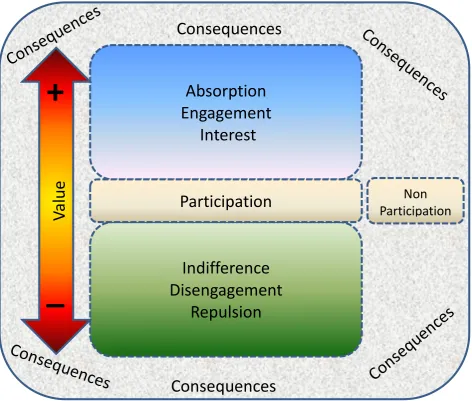
The framework is presented in two parts. Part one is illustrated in Figure 1.
Levels of ‘value’ are represented as a continuum with Participation as the anchor and
entry point. Interest, Engagement and Absorption represent graded levels of positive
value. To explain further, engaging occupations require more carry more value than those
that interest, but not as much as those that absorb the individual. At the other end of the
continuum, Indifference, Disengagement and Repulsion represent graded levels of
negative value.
INSERT FIGURE 1 HERE
It should be noted here that NonParticipation is not considered to be part of the
continuum as the definition of ‘occupation’ is active. However, it is important and must
be remembered as it serves a purpose. For example, it may be the only way that
individuals have of controlling their environment.
As well as value, the person will perceive positive or negative consequences to
participation which may change over time in response to feedback from their
environment. An occupation with positive value for the individual can have negative
consequences and vice versa.
To give an example, illicit substance use might stimulate occupational interest or
engagement (therefore positive value) but can result in deteriorating mental health and
legal action (which therefore carries negative social and personal consequences). On the
other hand, attending a drug awareness course might be accompanied by occupational
indifference (classed as negative value) but can result in overcoming problems with
substance misuse (and therefore hold positive consequence for the individual and
It is accepted that it is not possible for all occupations to have positive value and
consequences. It is therefore important to acknowledge the negative value of some
required occupations. For example, cleaning up may be disengaging but the consequence
is positive in that it is more comfortable to live in a clean environment. However, people
who lack a sense of wellbeing tend to have more occupations with negative value and
consequences. The aim of successful rehabilitation therefore is to achieve wellbeing
through minimising the number of such occupations and developing occupations with
positive value and positive consequences. The intended result is that the individual
engages in occupations that are personally fulfilling and acceptable to the community in
which they live.
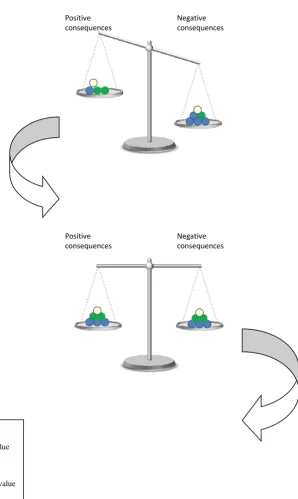
The second part of the framework is illustrated in Figure 2. The two ends of the
scales represent perceived consequences, with Positive consequences represented by the
left side and Negative consequences represented by the right side of the scales. Each
sphere on the scales represents an occupation. Blue spheres represent those with positive
value and green represent those with negative value. Additionally, white spheres
represent occupations of neutral value.
INSERT FIGURE 2 HERE
The first set of scales on Figure 2 illustrates that the individual positively values
more occupations that have negative consequences whilst more of the occupations with
positive consequences are valued negatively. The scales are therefore weighted more
towards occupations that have negative consequences. In the third set of scales the
balance has been tipped as there are now more positively valued occupations with positive
consequences. Additionally, more of the occupations with negative consequences are
now valued negatively. A greater sense of wellbeing is now achieved. This explanation
Aim
The aim of this research was to develop, pilot and evaluate a therapeutic tool based
on the Occupational Engagement Framework (Morris, 2012).
Objectives
To explore occupational therapists’ current understanding of occupational
engagement and methods of evaluating this
To design a therapeutic tool for occupational engagement for use in forensic
mental health settings
To pilot the therapeutic tool in forensic mental health settings for six months
To evaluate the usefulness of the tool for clinical practice
To review both the conceptual framework and therapeutic tool
Study Design
Method
The research was carried out in three stages:
Stage 1: Introduction to and training on the conceptual framework of occupational
engagement followed by an exploration of its potential use in a practice setting
Stage 2: Development and piloting of the new tool for six months
Stage 3: Review of the framework and therapeutic tool
The research used action research to begin to explore the potential of the
occupational engagement framework for occupational therapists working in a forensic
involves a cooperative and reflective partnership between the researcher and participants
with the aim of designing, implementing and evaluating a change in practice (Reason &
Bradbury, 2008). Action research was chosen to ensure that the clinical tool takes into
account the requirements of the occupational therapists from the earliest possible stage
and to add value to their practice with their patients. The clinical OTs were involved
throughout the whole process in developing, testing out and evaluating the tools. Ongoing
evaluation through regular meetings between the university researchers and the clinical
OT teams generated information which prompted change and development of the tools.
Ethics
NHS ethical approval for this research project was granted (reference number
12/WA/0315). In addition to NHS ethical approval, NHS Trust research governance
approval, service manager approvals and University ethical approval were granted before
commencing the project. Two Research and Scholarship Development Fund grants from
the University of Cumbria were awarded to facilitate visits to the units and some research
assistant support for the early stages of data collection.
Participation in the research was voluntary. Participant information sheets were
provided and written consent was obtained. Participants were able to withdraw from the
project at any time and without any negative consequences. The university based
researchers did not have any direct contact with patients at any stage of the research. No
identifying patient information was gathered or shared. The clinical occupational
therapists used their professional judgment about how they used the tool and this
information was included within the evaluation of the effectiveness of the tool. All
University of Cumbria. Only the named researchers had access to these files. Any paper
information was stored in a locked filing cabinet.
Participants
Following a seminar about the occupational engagement framework at a national
occupational therapy conference, two units expressed interest in the subsequent research
to explore the framework’s utility. All qualified occupational therapists from two secure
mental health units were invited to participate in the research.
Data collection and analysis
Focus group discussions were used at stages 1 and 3 of the research. First, at stage
1, to gather participants’ views of the framework and identify how it could be used to
inform a therapeutic tool. Then, following the development and piloting of a therapeutic
tool, to review its usefulness in practice. Interviews were audio recorded. Field notes of
the researchers’ reflections on the focus group discussions were also taken.
All occupational therapists at the two units were invited to attend a training session
about the occupational engagement framework, immediately prior to stage 1 of the
research. The training consisted of an exploration of the conceptual framework as
described within this article, followed by a consideration of how this concept could be
applied to their own practice. Following the training session, the occupational therapists
were then invited to participate in the first focus group discussion. The focus groups lasted
approximately one hour and explored two issues; how the teams thought the framework
could contribute to their services and the features of a useful clinical tool based on the
framework. This information was analysed and used to design new clinical tools. At site
A, this process was led by the university team in consultation with the occupational
university. Each site designed a different clinical tool to meet the needs of their own
service. When the tools were agreed by both the clinical and academic teams, they were
piloted within the services for six months. University team members were available for
support during the piloting period (stage 2).
The third and final stage of the research consisted of a second focus group
discussion at each site. As with the first ones, these lasted approximately one hour and
explored two issues; how the teams thought the tool had contributed to their services and
their views of the occupational engagement framework in practice. There was also some
reflection about the experience of participating in an action research project.
Data from the first focus group interviews were thematically coded by the
university team (DePoy & Gitlin, 2015; Silverman, 2013). These themes informed the
development of the new clinical tools. Data from the second focus group interviews,
completed after the trial period were also thematically analysed. At both these stages,
two researchers reviewed the audio recordings and discussed identified themes. The
researchers identified themes separately and then came together to discuss, refine and
agree the themes. At the end of the research, the findings from all the audio recordings
were reviewed again. Themes considering the clinical tool, the occupational engagement
framework and the action research process were identified and discussed.
The findings are presented in two parts. A summary of each stages 1 and 3 of the
research is presented.
Stage 1: Tool design
At both units all of the staff members who were in work on the specific day chose
to participate in the first focus group discussions. Staff discussed the potential uses and
disadvantages of the framework within their respective settings and proposed ideas
regarding how they would like a tool to look. Following the discussions, staff at both
units chose to focus on designing a tool aimed at a specific part of their service. The staff
involved in these teams continued to participate in the research. This comprised four
participants at site A and seven participants at site B.
Due to service users’ dislike of paper based assessments, the participants working
at Site A chose to design a very practical tool to be used in conjunction with service users.
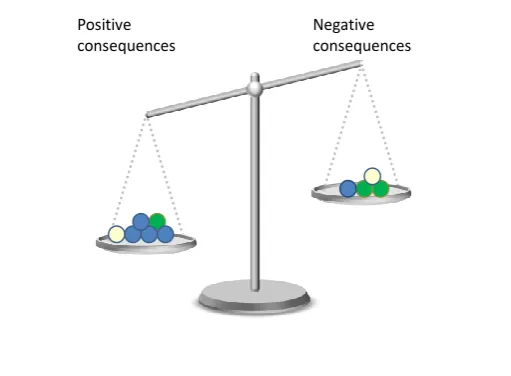
This comprised using a recording form along with an actual set of scales and mosaic tiles.
Each tile represented a specific activity and the colour chosen represented the value of
the activity. Service users were asked to choose a tile for each activity, to symbolise its
perceived value and then to put it in one side of the scales (the sides of the scales
represented positive and negative consequences of participation). In addition to notes
recording the discussion, photographs of the completed scales exercise were taken (see
Figure 3). The participants agreed that they would each pilot the tool using two service
users and that they would carry this out on at least a monthly basis.
INSERT FIGURE 3 HERE
The participants working at Site B chose not to use actual scales with service
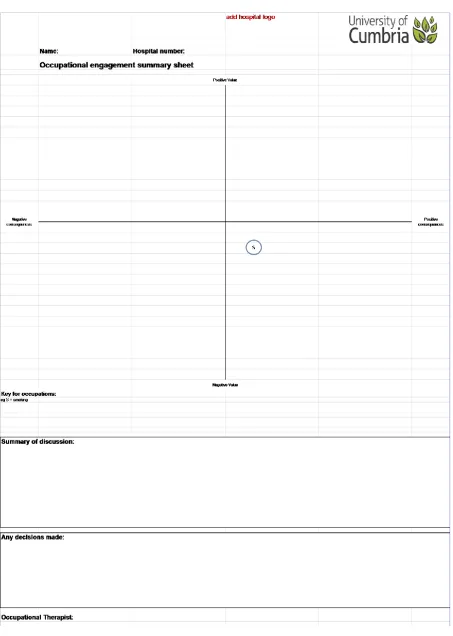
users. They designed a three phase process based on the occupational engagement
Phase 1 – Ask the service user to look at a diagram which explains and gives
examples of positive and negative consequences of participation in an activity and
different levels of participation.
Phase 2 – Ask the service user to list their daily activities.
Phase 3 – Ask the service user to plot out where they feel their activities should
be positioned on the occupational engagement summary sheet and record a
summary of the discussion (see Figure 4).
INSERT FIGURE 4 HERE
The occupational therapy teams at both units were enthusiastic about being
involved in the project to evaluate the framework’s application to practice settings. The
lack of consensus about how a tool could be used in practice may be attributed to differing
perceptions regarding the theory and purpose of a tool. However, it is in keeping with the
collaborative nature of the project to support each team in developing a tool to suit the
particular needs and demands of their own service.
Stage 3: Tool evaluation
The second focus group discussions were held approximately twelve months after
the first focus groups and aimed to review the tool which had been designed by each unit.
Both focus groups were analysed together and themes identified. Three main themes
emerged: Process issues; Tool functions and Utility of the tool. These are summarised in
Table 1.
Process issues
Participants discussed their experiences of using the tools from the perspectives
of their service users and themselves.
There was general consensus amongst participants at both units that the tools were
easy and understandable to use. It was acknowledged that some people did struggle with
the language used to describe the differential levels of engagement and therefore the use
of colours and numerical rating scales were used instead. Some participants expressed
that they found the tool difficult to explain to service users, though acknowledged that
this could have been simply because it was new to them.
An interesting point was a concern from one participant that the tool had somehow
lost the original theory. When further questioned about why he felt this he replied that it
was because it was “simple” and “useable”. This was qualified by another participant
who laughed when commenting that many people think that “it should be hard to be
useful”. They commented on how locum occupational therapists were able to understand
how to use it immediately without any need for “a big manual or a day long training
course”.
Participants appreciated the visual aspect of the tools over a more traditional
written assessment. Viewing occupations in the scales or on a grid enabled service users
to reflect on how they felt about what they were doing and encouraged deeper thinking
about the value of occupations. It was suggested that the “less formal” nature of the tool
meant that it did not feel like an assessment and consequently was better received by
service users who are too often “assessed to death”.
It was acknowledged by both units that there was a tendency for participants to
carefully select which service users the tools were used with. Neither unit used it with
hindsight that they eliminated those who would express negative views. Consequently,
there was a leaning towards more balanced or positive views towards occupations.
A similar issue was the tendency for service users to select occupations that they
valued and ignore ones that they did not. Encouraging them to consider all occupations
undertaken within a specific timeframe, for example over a single day, addressed this.
Tool functions
There was considerable discussion at both units regarding how the tool fitted into
the occupational therapy process.
Participants at Site A considered that their tool would be most useful as part of
the initial assessment in identifying what service users enjoy and therefore helping the
occupational therapists to get to know them. They felt that it would be less useful at a
later stage.
The timescale of the research meant that the participants had not had the
opportunity to really use the tools as an outcome measure. However, it was felt that they
would enable the gathering of information to review changes over time and would be
useful to implement before a case review. One participant stated that it had already
enabled them to identify issues that they wouldn’t otherwise have picked up on. There
was a sense at Site B that the tool could help to capture feelings towards future activities
and would therefore be of value in planning the transition to the community upon
discharge.
Participants at Site B also felt that the tool could have value as a supervision aid
in assisting occupational therapists to consider the assumptions that they bring to their
Utility of the tools
The participants at both units were generally positive about the contribution of the
tool to their work.
Participants at both units expressed how the tools prompted discussion about how
service users were actually feeling, at a deeper level than they were accustomed to. The
tools enabled the occupational therapists to understand what really motivates service
users and capture changes in the reason for engagement. For example, a service user who
previously engaged in an activity as a means of avoidance but now engages in the same
activity as it provides a sense of productivity and meaning.
The collaborative aspect of the tool was emphasised by all participants. One
stated “it was interesting to see what their [service users] real thoughts were about
activities that we referred them to” –perhaps suggesting that the tool prompted more
honesty than other tools. There was a strong sense that it encouraged services users to
take on increased responsibility.
There are examples of instances where the tool uncovered essential information
that otherwise would have led to clinical teams “going completely down the wrong lines
and adopting the wrong treatment strategy”. Consequently, the tool can promote accuracy
in intervention planning. One example was a service user who was reluctant to shower.
It was being assumed that this was due to his mental health and lack of motivation to
attend to self-care. On completing the tool, it emerged that the reason he did not shower
was simply because the water kept going cold.
Furthermore, participants felt that service users had been enabled to learn
something from using the tools. For some it prompted conversations about real life and
the idea that “we all have to do some things that we don’t enjoy” because of the
A service user who did not enjoy or value psychology sessions but was able to
identify the positive consequences of the sessions.
Similarly, a service user who did not value the weekly multi-disciplinary review
meeting agreed to attend after being able to identify the positive consequences of
doing so.
Conversely, a service user who highly valued playing computer games was able
to identify the negative consequences in terms of anger and frustration.
One participant stated that the tool “acknowledges the complexity of activity”
adding that “it was quite respectful and helped with the therapeutic relationship”.
Encompassing a multidisciplinary perspective, it was felt that the tool provides a
more holistic view of how service users spend their time and is not solely about
occupational therapy sessions. It helped to broaden ideas of what is meant by occupation.
Discussion
The clinical tools developed within this research have provided some information
to the clinical teams which has contributed to their understanding of how service users
experience participating in occupations. This is in line with the recommendations that
occupational therapists should recognise the specific intrinsic value of occupation and
facilitate meaningful occupational choices (RCOT, 2017a). An increased awareness of
the consequences of occupational choices is anticipated to help service users to maintain
and continue in their recovery journey and reduce reoffending (Morris, 2012). With
further development and evaluation, the tools should contribute to the evidence of the
value placed on occupations and how this changes over time within a secure environment.
Forensic mental health, and therefore occupational therapy within these settings,
are at times in conflict. The two overarching aims of treatment are the recovery from
illness and maintenance of good mental health and the instilling of an on-going desire to
participate and engage in in socially acceptable behaviours. Working within the forensic
services requires acknowledgement of the negative consequences of some required
occupations. Occupational therapists work with people to understand and minimise these
and to work with people to develop occupations with positive value and positive
consequences (occupational engagement). The concept of recovery has become
embedded within forensic services through ‘My Shared Pathway’ (NHS Networks, 2012;
Drennan & Alred, 2013). While the term recovery is becoming better understood,
individual components are less well understood. This research has increased
understanding of the concept of "occupational engagement" and, through the
development of the clinical tools, has begun to contribute to the emerging understanding
of the negative side of occupation (Aldrich & White, 2012; Twinley & Addidle, 2012;
Twinley, 2012, Twinley & Morris, 2014).
Evaluation of the action research process
The experience of participating in this piece of action research has been a valuable
experience for both the clinical and university based teams. It has enabled participants to
reflect on the occupational nature of their work and explicitly discuss the relationship
between theory and practice.
The participants from one of the units were much more involved in the process of
developing the tool that they used. From the findings it appeared that this led to a greater
sense of ownership and therefore much more of a positive impact on perceived confidence
to use the tool. It appeared that this sense of ownership seemed to lead to a greater
commitment to engage in the research process. The team admitted that if they had merely
It became apparent during the focus group interview with this team that part of
the reason for them being more involved was because the service manager who was taking
a lead in driving the project forward had been late for one of the initial meetings.
Consequently, it had been necessary for the team to take greater responsibility in the
process. The manager and the team all felt that this accidental incident had actually had
a very positive impact on the whole process and throws up an important issue relating to
the balance of support versus autonomy in the action research process. The team also
acknowledged that the process had not been easy and that “ownership” requires a certain
level of discomfort.
A key issue was the admission of participants from both units that they had been
selective about which service users they had used the tool with and therefore the leaning
towards more positively valued occupations. This potentially limited the scope for a more
comprehensive evaluation. Furthermore, the limited timescale of the research restricted
the opportunity to fully explore the tools’ potential effectiveness as outcome measures.
Conclusion
This research has indicated that the occupational engagement framework has
potential for increasing understanding of the relationship between the value and
consequences of participating in occupations. Evaluation of the tools developed over a
more extended period of time will provide information regarding therapeutic impact of
the tools which the current study was unable to determine. It is of course also essential
that the tools are evaluated from the perspectives of the service users. This would also
enable the gathering of data to inform the development of written guidance regarding how
to use the tools in practice and how to formulate and document information gathered from
References
Aldrich, R. and White, N. (2012), “Reconsidering violence: a response to Twinley and Addidle (2012) and Morris (2012)”, British Journal of Occupational Therapy, 75(11), 527-529.
Craik, C. Bryant, W, Ryan, A. Barclay, S. Brooke, N. Mason, A. and Russell, P. (2010), “A qualitative study of service user experiences of occupation in forensic mental
health”, Australian Occupational Therapy Journal, 57(5), 339-344.
Cronin-Davis, J. Lang, A. Molineux, M. (2004), “Occupational science: The forensic challenge”, in: Molineux, M. ed. Occupation for occupational therapists, Blackwell, Oxford, pp. 169–179.
DePoy, E. and Gitlin, L. (2015), Introduction to research methods: Understanding and applying multiple strategies. 5th ed. Elsevier Mosby, St Louis.
Drennan, G. and Alred, D. (Eds.) (2013), Secure recovery: Approaches to recovery in forensic mental health settings. Routledge, London.
Duncan, G. (2011) Pathways to unlocking secure mental health care. Centre for Mental Health, London.
Farnworth, L. Nikitin, L. and Fossey, E. (2004), “Being in a secure forensic psychiatric unit: every day is the same, killing time or making the most of it”, British Journal of
Occupational Therapy, 67(10), 430-438.
Fitzpatrick, R. Chambers, J. Burns, T. Doll, H. Fazel, S. Jenkinson, C. Kaur, A. Knapp, M. Sutton, L. and Yiend, J. (2010), “A systematic review of outcome measures used in forensic mental health research with consensus panel opinion”, Health Technology Assessment, 14(18), 1-94.
Holder, S. and Souza, R. (eds) (2016), Standards for forensic mental health services:
Low and medium secure care. Royal College of Psychiatrists, London.
Lin, N. Kirsh, B. Polatajko, H. and Seto, M. (2009), “The nature and meaning of occupational engagement for forensic clients living in the community”, Journal of Occupational Science, 16(2), 110-119.
Martin, M. (2003), “The foundation of good practice”, in Couldrick, L. and Alred, D. eds. Forensic occupational therapy, Whurr Publishers, London, pp. 22–29.
Morris, K. (2012), Occupational engagement in a regional secure unit. PhD. Lancaster University, Lancaster.
Morris, K. and Cox, D. (2017), “Developing a descriptive framework for “Occupational Engagement””, Journal of Occupational Science, 24(2), 152-164.
NHS Networks (2012), My shared pathway. Available at:
http://www.networks.nhs.uk/nhs-networks/my-shared-pathway (accessed 04 January 2017).
Reason, P. and Bradbury, H. (2008), Handbook of action research: participative inquiry and practice. 2nd edn. Sage, London.
Royal College of Occupational Therapists (2017b), Occupational therapists’ use of
occupation-focused practice in secure hospitals Practiceguideline. Second Edition. Royal College of Occupational Therapists, London.
Silverman, D. (2013), Doing qualitative research. 4th ed. London: Sage.
Twinley, R. (2012), “The dark side of occupation: A concept for consideration”,
Australian Occupational Therapy Journal, 60(4), 301-303.
Twinley, R. and Addidle, G. (2012), “Considering violence: the dark side of occupation”, British Journal of Occupational Therapy, 75(4), 202-204.
Figure 1: Part 1 of the conceptual framework for occupational engagement (Morris, 2012)
The lines between the occupation and consequences are dotted to represent their
interrelationship. The negative and positive occupations are represented by different
colours; these colours are also used in part 2.
Absorption
Engagement
Interest
Indifference
Disengagement
Repulsion
V
al
ue
Participation
Non
Participation
Consequences
Consequences
+
Figure 2: Part 2 of the conceptual framework for occupational engagement (Morris
2012)
Positive consequences
Negative consequences
Positive consequences
Negative consequences
Key:
Blue sphere = positive value
Green sphere = negative value
Negative consequences Positive
consequences
Table 1: Identified themes
THEME 1: PROCESS ISSUES
Patients
Easy and understandable to use
Language
Visual aspect/pictorial learning
“doing” aspect
Choice of occupations for discussion
Occupational therapists
Labour intensive/difficult to explain
Use of practical examples to explain concepts
Selection of patients
THEME 2: TOOL FUNCTIONS
OT process
Part of initial assessment
Intervention planning
Evaluation – programme review/case review
Transition/discharge planning
Professional development Supervision tool
THEME 3: UTILITY OF THE TOOL
Depth of information
Collaborative/inclusive
Promotes accuracy of intervention
Develops patient’s understanding of occupation
Enhancement of therapeutic relationships