Effect of Bead-Beating on DNA Extraction from Trichuris trichiura Positive Stool Samples: A Meta-Analysis
Divya RSJB Rana*1, Nischal Pokhrel1
1Freelancers
*Corresponding author: [email protected]
Abstract:
Polymerase chain reactions are helpful diagnostic methods to accurately quantitate the intensities of infections of various
soil-transmitted helminths, especially in the low-intensity infection samples. Method of DNA extraction hugely impacts the
outcomes of the diagnostic method. Trichuris trichiura is one of the three major helminths prevalent world-wide and
accurate estimation of their loads in stool is affected by the method of DNA extraction. We meta-analyze two studies by
dividing them into all together 6 sub-studies. The objectives of the meta-analysis required the two studies to be divided into
sub-studies as the different methods of DNA extractions could not be combined. We found that the inclusion of the
bead-beating step during DNA extraction significantly increases the sensitivity of the test.
Key words: Trichuris trichiura, polymerase chain reaction, DNA extraction, bead-beating, sensitivity
Declarations:
Funding: Not applicable
Conflicts of interest/Competing interests: None
Ethics approval: Not applicable
Consent to participate: Not applicable
Consent for publication: All authors agree for publication
Availability of data and material: All data are given in the article
Code availability: Not applicable
Authors' contributions: DRSJBR was involved in conceptualization of the study. DRSJBR and NP carried data curation. DRSJBR did formal data analysis. Both authors wrote original draft preparation and reviewing and editing..
Introduction:
Soil-transmitted helminths (STH) claim high disease burden especially in the poor parts of the world (1). The diseases,
while being treatable by common deworming medications and preventable with common hygienic standards (2), are a
major contributor of worldwide morbidity. Roundworm (Ascaris lumbricoides, ascariasis), whipworm (Trichuris trichiura,
trichuriasis) and hookworm (Ancylostoma duodenale and Necator americanus, ancylostomiasis and necatoriasis) are the
three major worms among others that claim the highest disease morbidities. Round worm and whipworm are transmitted by
faeco-oral route (3,4) while the hookworm and threadworm (Strongyloides stercoralis, strongyloidiasis) are transmitted
through penetration of larvae into the open skin (5,6). Round worm, hookworm and threadworm have tissue-dwelling stages
where their specific larval stages leave the gut and penetrate the vascular and solid tissue. Whipworm complete their life
cycles in the intestine and in their particular life stage, their heads remain embedded in the linings of the gut.
DNA-based detection of STH in stool samples have proved to be the most sensitive method (7,8). Quantitative polymerase
chain reaction (qPCR) is more consistent method compared to other copro-microscopic techniques and is less affected by
the experience of the technologists as personnel with basic knowledge of PCR are able to perform the experiments with
similar results. qPCR has various advantages from detection the presence of worms in stools and to follow-up evaluation
after various therapeutic interventions to decrease the prevalence. However, high cost of equipment and maintenance of
contamination-free conditions prevent the use of this technique in resource constraint settings. DNA-based techniques have
an additional advantage of the feasibility of carrying tests on later time points if the stool samples are preserved in a proper
manner (9).
While the extraction of DNA from stool samples containing roundworms and hookworms pose no reported difficulties, the
extraction of DNA from Trichuris eggs have been reported to require additional handling (10). More specifically, studies
have repeatedly pointed out the requirement of bead-beating step during DNA extraction for proper extraction of the
Trichuris DNAs. A meta-analysis of comparative studies was carried to search for articles which assessed the relevance of
bead-beating during DNA extraction. While many studies incorporate bead-beating into their DNA extraction methods, very
few have done comparative studies to show the efficacy of inclusion of this step.
Search strategy: Articles were searched in Pubmed by using “AND” Boolean operator to combine two search fields, “qPCR OR quantitative polymerase chain reaction OR quantitative PCR OR quantitative real-time PCR OR polymerase
chain reaction OR PCR” and “Trichuris OR Trichuriasis OR Whip worm OR Whipworm OR Trichuris Trichiura”.
Additional search was carried in Google search engine with search term “Trichuris bead beating DNA extraction”.
Additional search were carried to study the biochemical structure of helminth eggs.
Statistical Analyses: Random effects model odds ratio was estimated for the meta-analysis. Meta-analysis was carried in
MedCalc software which uses Mantel and Haenszel (1959) method for fixed effect model and DerSimonian and Laird (1986)
method for random effects modelling (11).
Results:
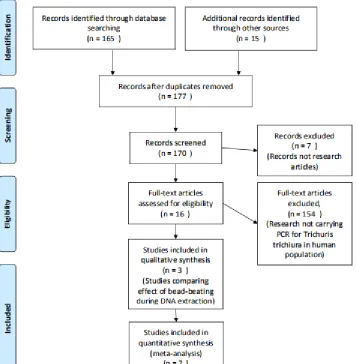
Search Results: Search through Pubmed resulted in 165 results from inception to Dec 2019 with no barrier to languages.
Search through Google resulted in a total of 15 relevant search results. After step-wise sorting (Figure 1), 2 articles from
Pubmed and 1 article from Google search were selected for further analysis. Studies that carried experiments to compare the
effect of inclusion or exclusion of bead-beating step during DNA extraction from stool on the prevalence of Trichuris
trichiura were selected. Further reading of the articles led to exclusion of one article for the meta-analysis as it carried DNA
extraction in artificially spiked stool samples and did not specifically study the effects of bead-beating in actual field
samples.
Qualitative analysis: All together three articles assessed the effect of bead-beating during DNA extraction. Anderson et al (2013) (12) artificially spiked healthy stool samples with Trichuris trichiura eggs and carried qPCR to assess the effect of
zirconium beads using NucliSENS easyMag DNA extraction system (Biomerieux, USA). They concluded (no data reported)
that zirconium beads gave best results for DNA isolation. The study found that vortexing without any beads gave
comparable results for Trichuris trichiura analytical sensitivity compared to bead beating with zirconium beads beaten for
30 secs at 7,000 oscillations. They reported that the clinical sample showed lower (better) limit of detection compared to the
artificially spiked sample hinting the presence of microscopically invisible extra-cellular DNA in clinical stool samples.
Study by Kaisar (2017) (13) also assessed the effects of five different kind of beads: 0.5 mm stainless steel, 0.5 mm
zirconium oxide, 0.7 mm garnet, 0.8 mm garnet and 0.5 mm Yttria-stabilized zirconium oxide. It was found that 0.8 mm
garnet gave the best analytical sensitivity and further experiments were carried with this bead by vortexing 3 mins at 1800
rotations per minute. Ayana (2019) (9) used 1.4 mm ceramic beads to beat the stool samples for 1 min at 3000 rotations per
minute. Just before the bead beating, the stool samples were freeze-thawed to increase the efficiency of cell disruption
Quantitative analysis: Study by Kaisar et al (2017) divided the 60 collected stool samples into two aliquots and preserved them in fridge or mixed with ethanol and stored at room temperature (13). Both sets of preserved samples underwent two
types of DNA extraction protocols, one including the bead-beating step and the other without. As the samples materials had
been altered chemically to some degree due to the preservation methods, we considered the two sets of experiments (frozen
and ethanol preserved) as two different sub-studies (Frozen_samp and Ethanol_samp) in this analysis. Both sets of
experiment used QIAamp DNA-easy kit from Qiagen, Germany. Overall, the inclusion of bead-beating gave higher
positivity rate. 51.7% (31/60) frozen stool samples were positive when bead-beating was used during DNA extraction
compared to only 40% (24/60) when bead-beating was not used (p>0.05). Similarly, the percentage of positive samples
were 55% (33/60) and 45% (27/60) respectively for ethanol-preserved samples (p>0.05). Overall, ethanol-preserved
samples performed better. Study by Ayana et al (2019) (9) used two different kits to extract DNA. QIAamp DNA Stool Mini
kit (S_K) and DNeasy Blood & Tissue kit (BaT_K), both from Qiagen, Germany, were used and the Blood and Tissue kit
was reported to perform better. Each method was further divided into one using the bead-beating and the other not. To
examine the effect of bead-beating, the tool samples, as assessed by Kato-Katz, were divided into 15 faecal egg count (FEC)
negative samples, 11 low-intensity FEC positive samples and 10 moderate to heavy intensity FEC positive samples. For the
sake of this meta-analysis, the FEC negative (zero value for egg per gram) samples were grouped as one
(Zero_FEC_BaT_K or Zero_FEC_S_K for FEC negative samples analyzed by Blood and Tissue kit and Stool Kit
respectively) and FEC low to heavy intensity positive samples (11+10) (positive value for egg per gram) as other groups
(Pos_FEC_BaT_K or Pos_FEC_S_K for FEC positive samples analyzed by Blood and Tissue kit and Stool Kit
respectively). This grouping is logical because only a small number (n=15) of actual Trichuris negative samples (81.5%,
159/195) samples were used in analysis and combination of all three groups of samples (negative, low intensity and
moderate to heavy intensity) could have hamper actual sensitivity estimation. When Blood and Tissue Kit was used 87%
(13/15) of the Kato-Katz negative samples were positive by DNA extraction method incorporating bead-beating compared
to only 73% (11/15) for method not including bead-beating (p>0.05). The positivity percentages for Kato-Katz positive
samples were 100% (21/21) and 95% (20/21) respectively. When the Stool Kit was used, the positivity percentages were 73%
(11/15) and 67% (10/15) respectively for Kato-Katz negative samples (p>0.05). For Kato-Katz positive samples, the
Random effects model was chosen compared to fixed effect model even when I2 (inconsistency) was 0.00% (95% CI: 0.00-0.00). As the methods of DNA extraction, types of beads, stool preservation methods and level of prevalence of STH were
different in the studies or within the studies, random effects model was considered more appropriate. The random effects
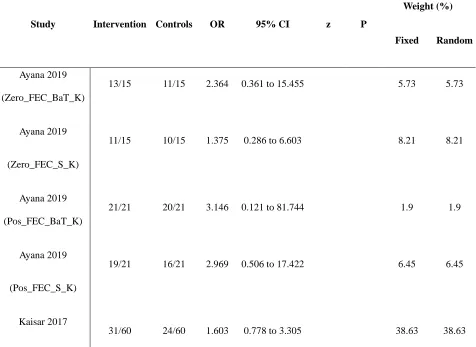
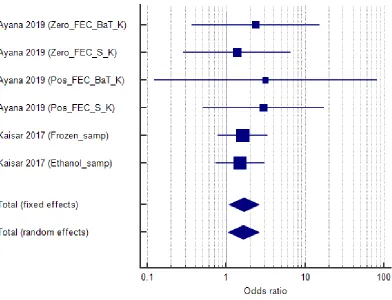
model showed a summary odd ratio of 1.66 (95% CI: 1.059 to 2.209) (Table 1, Fig. 2). None of the individual sub-studies
showed a significant effect of bead-beating while the random effects model showed a significant effect. This could be due to
small sample sizes in the individual studies. None of the small sub-studies showed a negative effect of bead-beating. Thus, it
can be safely concluded that the significant effect in the meta-analysis is due to synergistic effect all the sub-studies whose
results directed in one direction. When all the FEC zero and positive samples in Ayana et al were combined as one and
reanalyzed (sample sizes of 36 in BaT_K and S_K each) in the meta-analysis (data not shown), comparable significant
random effects model results (summary OR of 1.665) was obtained.
Table 1: Random effects model summary odds ratio
Study Intervention Controls OR 95% CI z P
Weight (%)
Fixed Random
Ayana 2019
(Zero_FEC_BaT_K)
13/15 11/15 2.364 0.361 to 15.455 5.73 5.73
Ayana 2019
(Zero_FEC_S_K)
11/15 10/15 1.375 0.286 to 6.603 8.21 8.21
Ayana 2019
(Pos_FEC_BaT_K)
21/21 20/21 3.146 0.121 to 81.744 1.9 1.9
Ayana 2019
(Pos_FEC_S_K)
19/21 16/21 2.969 0.506 to 17.422 6.45 6.45
Kaisar 2017
(Frozen_samp)
Kaisar 2017
(Ethanol_samp)
33/60 27/60 1.494 0.728 to 3.067 39.07 39.07
Total (fixed effects)
128/192 108/192 1.669 1.067 to 2.611 2.246 0.025 100 100
Total (random effects)
128/192 108/192 1.66 1.059 to 2.602 2.209 0.027 100 100
Biochemical studies of helminth eggs: The eggs of nematodes have been known to be to resist various environmental stresses and chemical. The egg of Ascaris alone has shown to remain viable against various acids, alkali and digestive
enzymes (14–16). This extreme resilience is hypothesized to be due to the eggshell, which has to be strong enough to
protect the embryo inside (17). Nematodes eggshells, including those of Hookworm, Trichuris and Ascaris, in general, are
made up of 3 layers: outer vitelline layer, middle chitinous layer and inner lipid layer. The middle chitinous layer is a
composite layer composed of chitin microfibrils surrounded by protein matrix, which is said to make the egg resistant to
mechanical damage (18–20). The inner lipid layer is impermeable to most chemical (21,22) and maybe a reason for the
difficulty in DNA extraction using chemical process. In many nematodes, including Ascaris, it consist of ascarosides esters
which could be a reason for the impermeability (23,24), and is said to be responsible for resistance against chemical actions
(25).
Increasing number of STH studies are using bead-beating steps in the DNA extraction method. While the possible need of
this step have been raised earlier (7,26), very few studies have actually reported the significance of this addition. Though
Trichuris is considered to be the only STH that require the bead-beating, Ayana et al have found that this could also be
required for hookworms (9). They also reported that the blood and tissue kit gave better result than the stool kit. It may be
because kits are usually designed for the isolation of bacterial DNA in the stools (27). The sizes of helminth eggs for
hookworm, Trichuris and Ascaris are comparable and the biochemical structures of the egg shells are similar too. While the
hookworm eggs are known to be fragile and can rupture within hours of stool collection at room temperature, the Trichuris
and Ascaris eggs remain in soil for longer durations. Present meta analysis shows that inclusion of bead beating makes
significant impact on the DNA extraction of Trichuris DNA and recommends the use of this technique.
Limitations of this study include only two studies being analyzed due to paucity of systematic comparison studies. We have
divided the two studies into total of 6 sub-studies. It was not possible to keep the sub-studies combined as the methods of
stool preserved, kits used and the cohort of patients studied, if combined, could affect the outcome concluded. Another
limitation could be non-inclusion of the cycle threshold data for the PCR which could differentiate the slight changes in the
yield of Trichuris DNA extracted using various interventions during DNA extraction. But most of the studies also do not
report the mass of the DNA template used in the PCR and only volumes of template DNA are mentioned.
Conclusion: More systematic studies assessing the effect of bead-beating on DNA extraction of Trichuris is recommended. As reported by the two studies above, preliminary optimization of the best bead types and/or sizes should also be carried so
the impact is clearly concluded.
References:
1. Jourdan PM, Lamberton PHL, Fenwick A, Addiss DG. Soil-transmitted helminth infections. Vol. 391, The Lancet.
1
Lancet Publishing Group; 2018. p. 252–65.
2
2. Campbell SJ, Nery S V., McCarthy JS, Gray DJ, Soares Magalhães RJ, Clements ACA. A Critical Appraisal of
3
Control Strategies for Soil-Transmitted Helminths. Vol. 32, Trends in Parasitology. Elsevier Ltd; 2016. p. 97–107.
4
3. CDC. CDC - Ascariasis - Biology [Internet]. 2020 [cited 2020 Apr 11]. Available from:
5
4. CDC. CDC - Trichuriasis - Biology [Internet]. 2020 [cited 2020 Apr 11]. Available from:
7
https://www.cdc.gov/parasites/whipworm/biology.html
8
5. CDC. CDC - Hookworm - Biology [Internet]. 2020 [cited 2020 Apr 11]. Available from:
9
https://www.cdc.gov/parasites/hookworm/biology.html
10
6. CDC. CDC - Strongyloides - Biology [Internet]. 2020 [cited 2020 Apr 11]. Available from:
11
https://www.cdc.gov/parasites/strongyloides/biology.html
12
7. O’Connell EM, Nutman TB. Review article: Molecular diagnostics for soil-transmitted helminths. Vol. 95,
13
American Journal of Tropical Medicine and Hygiene. American Society of Tropical Medicine and Hygiene; 2016. p.
14
508–14.
15
8. Verweij JJ, Rune Stensvold C. Molecular testing for clinical diagnosis and epidemiological investigations of
16
intestinal parasitic infections. Clin Microbiol Rev. 2014;27(2):371–418.
17
9. Ayana M, Cools P, Mekonnen Z, Biruksew A, Dana D, Rashwan N, et al. Comparison of four DNA extraction and
18
three preservation protocols for the molecular detection and quantification of soil-transmitted helminths in stool.
19
Cantacessi C, editor. PLoS Negl Trop Dis [Internet]. 2019 Oct 28 [cited 2020 Apr 11];13(10):e0007778. Available
20
from: https://dx.plos.org/10.1371/journal.pntd.0007778
21
10. Demeler J, Ramünke S, Wolken S, Ianiello D, Rinaldi L, Gahutu JB, et al. Discrimination of Gastrointestinal
22
Nematode Eggs from Crude Fecal Egg Preparations by Inhibitor-Resistant Conventional and Real-Time PCR.
23
Carlow CKS, editor. PLoS One [Internet]. 2013 Apr 19 [cited 2020 Apr 11];8(4):e61285. Available from:
24
http://dx.plos.org/10.1371/journal.pone.0061285
25
11. MEDCALC. Meta-analysis: odds ratio [Internet]. [cited 2020 Apr 11]. Available from:
26
https://www.medcalc.org/manual/meta-analysis-oddsratio.php
27
12. Andersen LOB, Röser D, Nejsum P, Nielsen HV, Stensvold CR. Is supplementary bead beating for DNA extraction
28
from nematode eggs by use of the nuclisens easymag protocol necessary. Vol. 51, Journal of Clinical Microbiology.
29
American Society for Microbiology Journals; 2013. p. 1345–7.
30
13. Kaisar MMM, Brienen EAT, Djuardi Y, Sartono E, Yazdanbakhsh M, Verweij JJ, et al. Improved diagnosis of
31
Trichuris trichiura by using a bead-beating procedure on ethanol preserved stool samples prior to DNA isolation and
32
the performance of multiplex real-Time PCR for intestinal parasites. Parasitology. 2017 Jun 1;144(7):965–74.
33
14. Yoshida S. On the resistance of Ascaris eggs. J Parasitol. 1920;6:132–9.
34
15. Martin HM. Studies on the Studies on the Ascaris lumbricoides Ascaris lumbricoides [Internet]. 1926 [cited 2020
35
Apr 11]. Available from: https://digitalcommons.unl.edu/extensionhist
36
16. Beyhan YE, Yilmaz H, Hokelek M. Effects of acetic acid on the viability of Ascaris lumbricoides eggs: Is vinegar
37
reliable enough to clean the vegetables? Saudi Med J. 2016 Mar 1;37(3):288–92.
38
17. Wharton DA. The Production and Functional Morphology of Helminth Egg-Shells. Parasitology. 1983;86(4):85–97.
39
18. Wharton DA, Jenkins T. Structure and chemistry of the egg shell of a nematode (Trichuris suis). Tissue Cell. 1978
40
Jan 1;10(3):427–40.
41
19. Slayter G. Two-Phase Materials - Scientific American [Internet]. 1962 [cited 2020 Apr 11]. Available from:
42
https://www.scientificamerican.com/article/two-phase-materials/
43
20. Neville AC. Biology of the Arthropod Cuticle. Springer Berlin Heidelberg; 1975.
44
21. Chappell LH. D. A. Wharton 1986. A functional biology of nematodes. Croom Helm, London. 192 pages. ISBN
0-45
22. Barrett J. Biochemistry of Parasitic Helminths. Biochemistry of Parasitic Helminths. Macmillan Education UK;
47
1981.
48
23. Ludewig AH, Schroeder FC. Ascaroside signaling in C. elegans. WormBook : the online review of C. elegans
49
biology. 2013. p. 1–22.
50
24. Nissen S, Al-Jubury A, Hansen TVA, Olsen A, Christensen H, Thamsborg SM, et al. Genetic analysis of Trichuris
51
suis and Trichuris trichiura recovered from humans and pigs in a sympatric setting in Uganda. Vet Parasitol. 2012
52
Aug 13;188(1–2):68–77.
53
25. Bartley JP, Bennett EA, Darben PA. Structure of the Ascarosides from Ascaris suum. J Nat Prod. 1996;
54
26. Verweij JJ, Rune Stensvold C. Molecular testing for clinical diagnosis and epidemiological investigations of
55
intestinal parasitic infections. Clin Microbiol Rev. 2014 Apr 1;27(2):371–418.
56
27. Fiedorová K, Radvanský M, Němcová E, Grombiříková H, Bosák J, Černochová M, et al. The Impact of DNA
57
Extraction Methods on Stool Bacterial and Fungal Microbiota Community Recovery. Front Microbiol [Internet]. 2019 Apr
58
17 [cited 2020 Apr 11];10:821. Available from: https://www.frontiersin.org/article/10.3389/fmicb.2019.00821/full
59