Article
Active AU Based Patch Weighting for Facial
Expression Recognition
Weicheng Xie, Linlin Shen*, Meng Yang and Zhihui Lai
SchoolofComputerScience&SoftwareEngineering,ShenzhenUniversity, Nanhai Ave 3688, Shenzhen, Guangdong 518060, China
*Correspondence: [email protected]; Tel.: +86-755-8693-5089
Abstract:Facial expression has lots of applications in human-computer interaction. Although feature extraction and selection have been well studied, the specificity of each expression variation is not fully explored in state-of-the-art works. In this work, the problem of multiclass expression recognition is converted into triplet-wise expression recognition. For each expression triplet, a new feature optimization model based on Action Unit (AU) weighting and patch weight optimization is proposed to represent the specificity of the expression triplet. Sparse representation based approach is then proposed to detect the active AUs of testing sample for better generalization. The algorithm achieved competitive accuracies of 89.67% and 94.09% for Jaffe and CK+ databases, respectively. Better cross-database performance has also been observed.
Keywords: expression recognition; expression triplet; feature optimization; AU weighting; active AU detection
1. Introduction
With the help of facial expression recognition, human-computer interaction can automatically obtain the information of human face and infer the psychologic status of the user, which can be applied to driver monitoring, face paralysis expression recognition, intelligent access control and so on.
Recognition of six basic expressions like happy (Ha), angry (An), surprise (Su), fear (Fe), disgust (Di), sad (Sa) and the neutral (Ne) expression can be categorized into 3D-based and 2D-based approaches. The 3D-based expression recognition is a current research hot topic [1], which often employs the geometry features like differential curvature [2,3] based on an aligned face mesh [4]. The 2D-based approaches are currently prevailing due to the easy accessibility of the training samples. Facial action coding system (FACS) [5] is one of the important 2D approaches, i.e., the expressions are described and tracked according to some basic action units (AUs). The FACS was defined by Ekman [6] to reflect the deformation status of the corresponding facial part, which was developed based on a set of discrete emotions and initially applied to measure some specific facial muscle movements named as AUs. While AUs were often used as an intermediate step for recognizing the basic expressions, image-based feature representation is often considered for recognizing the expression directly. Dynamic recognition based on expression images is important in face animation and multimedia analysis [7–10]. As less information about the considered expression is available, static image based recognition is more challenging.
the facial AUs are obtained by the CNN-based algorithms, the weighting and optimization of these AU alike features in these algorithms are not fully studied. Meanwhile, CNN-based algorithms require large number of training parameters and high computational complexity [16,17]. Thus, our work focuses on exploring the feature optimization and active AU detection, which can be further integrated into the CNN to further improve the encoded features.
For static image encoding, many features have been proposed and evaluated. Examples are Gabor surface feature [18], Haar-like features [19], histograms of oriented gradients (HOG), local binary patterns (LBP) [20,21], radial encoding feature [22] and key point movement feature [23]. Combination of texture and geometric features was introduced [24] to solve the problem of minor expression deformation when wrinkle feature is unavailable [25]. In this work, the Gabor surface feature (GSF) proposed in [18] is employed for the feature representation. Gabor magnitude surface can reflect the differential geometry information even when the considered face is slightly deformed. Thus, it can discriminate different wrinkle textures on the expression face.
Based on the devised features, feature selection was often conducted for not only boosting the efficiency [26], but also improving the recognition accuracy and the generalization ability [27,28]. Feature selection can be conducted on the whole image, such as independent component analysis (ICA) [29], linear discriminant analysis (LDA) [30], rotational invariant dimensionality reduction [31], maximum margin projection [32] and supervised locally linear embedding [33]. For patch and landmark point-based feature representation, salient expression regions were manually located [34]. Automatic feature selection was usually realized with AdaBoost [19,20,26,35]. For better generalization ability, some feature selection algorithms attempted to obtain a relatively sparse number of features with the incorporation of optimization algorithms. Jia et al. [36] weighted the LBP feature with sparse representation, Zafeiriou and Pitas [37] proposed the sparse feature graph for the recognition. Feature selection has also been achieved by feature reduction or transformation, such as margin maximization [38], normalized cut [28], multitask joint sparse presentation [39] and locality preserving projection (LPP) [40]. An unified classification system [41] integrating feature selection and reduction was proposed based on boosted deep belief network (BDBN).
These algorithms devised and selected the same features for all the categories of expressions (such as six basic expressions), which may leave out the feature speciality and multi-scale property. Thus, pairwise expression features were proposed to improve the recognition performance. Kyperountas et al. [42] employed a pairwise expression recognition with a class separability measure by pairwise inter-class difference maximization and intra-class difference minimization. Happy and Routray [43] extracted pairwise appearance features with LDA for the recognition. Based on different pairwise expression features, feature selections were also different. Liu et al. [44] proposed feature disentangling machine (FDM) to learn different pairwise features. Besides of the common features for all the expressions, the specific features for each expression pair were also selected with multi-task learning in [45]. When most of these algorithms extract expression features from patches, they may not fully consider the causal relation between the patches since facial expressions are often demonstrated in the scale of facial parts involving multiple patches.
However, current AU-based algorithms modeled the AU relations without considering the weights of patches contained in each AU. AU feature is suitable for encoding the macro-scale information of each expression since it integrates the large-scale information of face parts. However, they are not good for encoding the micro-scale feature since the combination space of AUs is limited when they are not carefully organized. Moreover, most of these algorithms learned the features from the training expression samples. However, the active feature implied in each testing expression sample is not fully exploited. Model learned from training samples might produce wrong classification when the testing sample is significantly different. However, only few works detect and use the active features of testing sample for recognition.
Although a lot of research works have been conducted in face expression recognition, the following problems are still to be addressed. First, current algorithms recognize the seven expressions entirely with an uniform feature weight, which may leave out the feature speciality and multi-scale property. In this work, the seven expression recognition is divided into multiple sub-problems with appropriate subsets, i.e., the expression triplet. Moreover, the weight vector w.r.t. each expression triplet are fine tuned individually to fully consider its specificity; Second, the patch-based and AU-based features are often encoded separately without considering the influence of their deficiencies. In this work, the weights of patches contained in each AU are finely optimized to represent characteristics of different expressions. In this way, the advantages of large-scale (AU-based) and small-scale (patch-wise) features are both explored; Third, few of current works make use of the specificity of each testing sample before recognition, wrong classification could occur when the testing sample is significantly different. Thus, this work exploits the active features of each testing expression.
The main novelties of this work are mainly on three aspects. First, a two-stage expression recognition using the idea of expression triplet weighting is introduced for representation of diversity among different expressions; Second, a new offline weight optimization for the patches contained in each AU is proposed to increase the discrimination abilities of both patch and AU features. Third, online detection of active AUs for each testing sample is proposed to fully exploit its specificity for feature encoding.
This paper is structured as follows. Section2gives a description about the proposed algorithm step by step. The experimental results of the proposed algorithm on public databases are presented in Section3. Finally, discussions and some conclusions are addressed in Section4.
2. The Proposed Algorithm
2.1. Framework of the Algorithm
!"#!"$"%&$'(#$'%)&&$$*+#)&,,-(.$/01&2,$3')-#2&"4 5"06&$ .&$720,,-8-90"-(.$:,-.6$5;<$35&=&.$70"&6()-&,4
>()$*09%$(8$"%&$$$$$$$$$$$$$$')-#2&", 5!
50 ?0 @5>$>&0"!)&
!"#$#%&"#'()'*)+,)-.#/0"1)2))))))3)&(4)5&"60) -.#/0"1))2)))))))3))78)+9/':#"0$);
A&-6%"&B$$5;<$720,,-8-&) C0"9%$10,&B$>&0"!)&$*+")09"-(.
#"-D-E&B$A&-6%"$;&9"(),
+6"#<.)+,)=.".6"#'()2))))))3) >8)+9/':#"0$);
**9#(.)?:&#(#(/ (9#(.)?.1"#(/
C0"9%$10,&B$>&0"!)&$*+")09"-(.
')-#2&"$F ')-#2&"$GH
@"!@")"0.)A#(&9)BC!:.11#'()D&7.9
Figure 1.The framework of the proposed algorithm.
2.2. Region Definition and Feature Extraction
2.2.1. Definition of Patch, Region, Part and AU
Face image was first aligned with reference to the feature points located using the approach presented in [50,51], and then resized to 84×68. Only the central region with size 80×64 is cropped out for the following processing. Illumination was normalized by the method proposed in [52].
To extract features representing local face variations caused by expression, the face image was divided into 10×8 patches. Based on the 80 patches, 12 regions with relatively fixed shapes (RFSs) were defined to represent the expression sensitive face parts (PT). Figure2c shows the 12 regions and Table1lists the involved landmarks for each region. When patches are used to represent local texture, regions encode the important variations correlated with expression changes. Figure3presents the involved regions used to define each of the seven face parts, i.e., eyes, brows, mouth, forehead, nose root, nasolabial regions and chin (PT1−PT7).
Figure 2. The patches and RFS regions. (a) The landmarks used for alignment; (b) The patches;
(c) The RFS regions for defining face parts; (d) The sizesd1−d9 of the RFS regions. The darker
region on the mouth part denotes the patches having nonempty intersection withR6,R8,R9in (c),
!" #$%
&" '()*
+" ,)-./ 0" 1)(%/%23
4" 5)6% 7)).
8" 526)92:;29
<" =/;>
Figure 3.The AUs of seven facial parts with the corresponding RFSs and expression labels. The first
part (eye,PT1) consists of two regionsR4,R5, which can be classified asAU1−AU3according to its
eye status. The listede1−e7are the expressions related with each defined AU, i.e., neutral, angry,
disgust, fear, happy, sad and surprise.
Table1. Feature point sequences for constructing the RFS regions in Figure 2c and the region sizes in
Figure 2d. Take R1 as an example, points {P3, P8}define the length and width d1 of R1.
R1 R2 R3 R4
{P3,P8},
d1= 12||P3−P8||2
{P1−P5},
d2=2||P1−P2||2
{P6−P10},
The same asd2
{P20−P25},
d3=2||P20−P21||2
R5 R6 R7 R8
{P26−P31},
The same asd3.
{P32−P43},
d8=4||P32−P33||2
{P12,P23,P5,P6,P26}
{P32,P33,P43},
d6=2||P32−P43||2,
d7=||P33−P43||2
R9 R10 R11 R12
{P37,P38,P39},
The same asd6,d7
{P32,P13,P20,P15},
d4=|P20x −P13x|,
d5=|P y
13−P
y 15|
{P38,P13,P29,P15},
The same asd4,d5
{P39,P43},
d9=||P43−P39||2
For encoding the face part variations related with expression [53], Action Units (AUs) have been widely used in literature. We defined 20 AUs to encode the seven expressions named as e1−e7,
i.e., neutral, angry, disgust, fear, happy, sad and surprise. Different from the AU labeling in [53], the part regions of each AU are manually labeled for training samples in this work. See Figure3 for the definition of 20 AUs and their relationship with the 12 regions and the 7 parts. For example,
AU3encodes wide opening eyes, which is usually correlated withe7, i.e., surprise. As bothAU1and AU2encode the status of the two eyes, they mainly consist of regions around eyes, i.e.,R4andR5.
Figure2d labels the involved patches of an example mouth part (AU8−AU12) with dark grey, i.e.,
each AU of a part may involve multiple patches.
2.2.2. Feature Extraction
g(x1,x2) = k
2 s
σ2exp[−
k2 s
2σ2(x
02
1 +x022)]exp(ksx10i) x01=cosαax1+sinαax2,x20 =−sinαax1+cosαax2,
ks= √π
22+s,s=1,· · ·,ns;αa=
aπ
8 ,a=1,· · ·,na.
(1)
whereσ=1.8π,ns=5,na =8,(ks,αa)define the amplitude and orientation of the central frequency. To encode the texture magnitude map, the Gabor surface feature (GSF) [18] is employed since it can depict the curvature information of the wrinkles and direction of the expression texture. To extract GSF, thens×naGabor magnitude images are first extracted, which are then encoded by local binary pattern (LBP) to reduce the feature sensitivity to misalignment. More precisely, feature GSF for thek-th patchpkis formulated as follows
p fpk =23B+22Bx+21By+20B2, (2)
where B,Bx,By,B2 are the binarizations of the Gabor magnitude image I, its first-order and
second-order gradient picturesIx,Iy,Ixx+Iyycorresponding to the patchpk. As an example, for each pixel(i,j)ofpk, its binary value is defined as
Bi,j =
(
1 ifIi,j≥ThresMedi,j
0 otherwise (3)
where the thresholdThresMedi,jis the median of the pixel values of patchpk. Thus,p fpkis the output
feature map with value ranging from 0 to 15, which is further transformed to the histogram for feature representation. For each face patch or region, the corresponding feature GSF is then vectorized as a 16×ns×nadimension vector, wherens,naare defined in Equation (1). Finally, the feature of thei-th expression sample is represented as
fi = (p fp1,· · ·,p fpn), (4)
wherenis the number of patches or regions. For convenience of the following illustration, the feature of thei-th expression sample can be also grouped as(fi(1),· · ·,fi(7))according to the seven face parts presented in Figure3.
2.3. Feature Optimization
Based on the feature representation, the weights of AU and patches for each expression triplet are optimized. First, the original AUs are weighted with conditional transition probability matrix, based on which, weight optimization is performed to weigh the patches involved in each AU in the second step. These two steps are conducted on the training samples and are offline. The third step is to select the active AUs for each testing sample. The entire procedure of the feature optimization is presented in Algorithm1.
Algorithm 1AU weighting, patch weight optimization and active AU detection.
1: Offline Training:
2: AU weighting (WAU) using the conditional probability matrix presented in Section2.3.1;
3: Patch-wise weight optimization of weight vectors ({Wi}) by multi-task sparse learning presented in Section2.3.2;
4: Online Testing:
2.3.1. AU Weighting
Motivated from the causal AU pair extraction with large transition probability by the Bayesian network (BN) [46], the representative abilities of all the AUs for each expression are weighted in this work to decrease the influence of weakly related AUs and provide a constraint for the following patch-wise weight optimization.
With the labeled AUs of all the training samples, the causal relation network between the AUs is obtained with the conditional probability matrix. The probabilitypie|jof thei-th AU conditioned on thej-th AU w.r.t. thee-th expression is defined as the product of the co-occurrence and co-absence probabilities as follows
pei|j=opei|j·apei|j, (5) where the co-occurrence probability of i,j-th AUs conditioned on j-th AU is defined as the conditional probability
opei|j =p(i∈ AUe|j∈ AUe), (6) whereAUedenotes all the action units of thee-th expression. And the co-absence probability of action unitsi,jconditioned onj∈/ AUeis defined as the probability
apei|j =p(i∈/ AUe|j∈/AUe), (7) Then the degree of causal relation of AU pair(i,j)is defined as follows
pei,j=min(pei|j,pej|i). (8) The ‘min’ function of two conditional probabilities is adopted to avoid abnormal probability resulted from the imbalance of expressions related with each AU. For example (see Figure 3),
AU2 is related to a large number of expressions, which may result in significantly larger arrival
transition probability.
For each expression, a relation probability matrix of dimension 20×20 is obtained with Equation (8). With the causal relation matrixes for all the expressions, the representative ability of AU for each expression can be found by simultaneously maximizing the representative ability for the considered expression and minimizing the representative abilities for the other expressions. That is, the representative ability of the AU pair(i,j)for thee-th expression is obtained as follows
RepAbei,j=
(
1+|{l6=1e}|(pei,j−∑l6=epli,j) if{i,j} ⊂ AUe
0 otherwise. (9)
where|{l6=e}|represents the number of elements in the set{l6=e}. Finally, the representative ability of thei-th AU for thee-th expression is obtained as follows
RAei =
( 1
|{j6=i}|∑j6=iRepAbei,j ifi∈ AUe
0 otherwise. (10)
For applying{RAei, 1 ≤ i ≤ 20, 1 ≤ e ≤ 7}for recognition, the maximum AU representative ability of each expression and face part is collected, which are denoted as RAPie and presented as follows
RAPie=max j∈I Ai
RAej (11)
Due to the number limitation of AUs and the training samples, the representation space of AU is limited when they are simply organized. In order to expand the representation space of the AUs, the contribution of the patches contained in each AU is weighted by the following weight optimization model in this work.
2.3.2. Patch Weight Optimization
Based on the weights of AUs for each expression, a weight optimization model is proposed to weigh the patches of each AU for the considered expression tripletG={e1,e2,e3}.
The objective is to minimize a loss function with the weight sparseness and regularization constraints, which is presented as follows
minwE+λ||w||1= N1 ∑ j k∈∑IDj
log(1+exp(− 1
α·g(fj,fk,w))) +λ||w||1,
s.t.||wPTi||1=RAP
G
i ||w||1,i=1,· · ·, 7;||w||2=1.
(12)
where fj,fkare the features of thej-th andk-th training samples of the tripletG, whose patch feature is defined in Equation (2) and reduced to two dimensions using PCA and LDA [30].N=∑j|IDj|and
IDjrecords all the training sample indices. Vectorwrecords the weights of all the patches,wPTirecords
the weights of the patches related with thei-th partPTi, parameterαis fixed to 1. RAPiG denotes
the normalized representative abilities w.r.t. the considered expression tripletG, which is formulated as follows
RAPiG= max
1≤j≤3RAP
ej i ,RAP
G
i ←
RAPiG ∑iRAPiG
. (13)
The loss functiong(fj,fk,w)reflects the similarity loss of the feature vectors fj,fkwith the weight vector w, which is constructed to minimize the intra-class variance and maximize the inter-class variance as follows
g(fj,fk,w) =
< fj,fk·w>−< fj,fj0·w> ifL(fk)6=L(fj) < fj,fj0·w>−< fj,fk·w> ifL(fk) =L(fj)
withj0=arg max
{t:L(ft)=L(fj)}
< fj,ft·w>
(14)
whereL(fk)is the expression label of the training feature vector fk.
For solving the optimization problem (12), the gradient of the first term of the minimization objective function in Equation (12) is formulated as follows
∂E
∂w =
α
NΣjΣk∈IDj
ej,k(w)−1
ej,k(w)
· ∂g(fj,fk,w)
∂w , (15)
whereej,k(w) =1+exp(−α·g(fj,fk,w))and∂g(f∂jw,fk,w)is computed based on Equation (14) as follows
∂g(fj,fk,w)
∂w =
(
fj·fk−fj·fj0 ifL(fk)6=L(fj)
fj·fj0 −fj· fk ifL(fk) =L(fj).
(16)
The sparseness term of model (12) adopts the L1norm, which is a special case of the L1/L2
mixed-norm employed in the work [45,55]. Thus, the optimization model (12) is solved with modified multi-task sparse learning algorithm employed in [45,55] with several differences presented as follows. The overall optimization algorithm is elaborated in Algorithm2.
• The weight of each patch is initialized as a ratio of the corresponding AU representative ability as follows
wPj,0←
RAPiG
|PTi|
,w0← ||w0
whereiis the index of part including thej-th patch,|PTi|denotes the number of patches in the part
PTi,wPj,0records the weights of thej-th patchPj. The initialization procedure is presented in
Step 3 of Algorithm2;
• The weight vectorws+1and auxiliary vectorvs+1ins+1-th iteration of Algorithm2are normalized
to satisfy the constraint defined in Equation (12) as follows
wPj,s+1←
wPj,s+1RAP
G i ||wPTi,s+1||1
,ws+1← ws+1
||ws+1||2
, (18)
whereiis the index of part including thej-th patch,wPTi denotes the weights of the partPTi.
The normalization is employed in Steps 11 and 19;
• Compared with [45], optimization model (12) is proposed by minimizing the feature similarity bias of different expression classes in Equation (14), which uses the information of mutual feature difference and contains more information than that of expression label matching in [45]. The corresponding objective function and the gradient vector are changed according to Equations (12) and (15), as revealed in Step 5.
Algorithm 2The modified multi-task sparse optimization.
1: Obtain the feature vectors of the training and testing samples.
2: Initialization: the coefficientsλ=η=1e−2,S=3e1,e=1e−10,MaxNumF=4.
3: Initialize the weight vectorw0as in Equation (17).
4: fors=0,· · ·,Sdo
5: Compute the objective valueFunVwith Equation (12) and the gradient ∂E
∂ws with Equation (15).
6: ifs≥2 ANDFunV−pFunV≥ −ethen
7: NumF←NumF+1.
8: else
9: NumF←0.
10: end if
11: Perform ws+1 = vs −η∂∂wE
s, normalize current weight vector ws+1 with Equation (18).
Renew thei-th element of the weight vectorws+1as follows. 12: if|wi,s+1| ≥ληthen
13: wi,s+1= (1−|wλη
i,s+1|)wi,s+1
14: else
15: wi,s+1=0 16: end if
17: as+1= s+23,δs+1=ws+1−ws,pFunV←FunV 18: vs+1=ws+1+1−asasas+1δs+1
19: Normalize weight vectorsws+1,vs+1with Equation (18). 20: if||δs+1||2≤eORNumF>MaxNumFthen
21: break
22: end if 23: end for
With the weight optimization model (12) and Algorithm2, the weights of the patches for each expression triplet are obtained. The number of optimized weight vectors{Wi}equals toC73=35, i.e.,
the number of expression triplets.
2.3.3. Active AU Detection
we proposed a sparse representation based approach to identify the parts where the corresponding AUs are active for each testing sample before expression recognition.
For thek-th part of thei-th testing sample in Figure3, the sparse representation is represented as follows
min c(k)
1 2||f
(k)
i −D(k)c(k)||22+λ||c(k)||1. (19)
where fi(k)is vectorized features of thei-th testing sample andD(k)= [ftr(k1),ftr(k2),· · ·,ftr(kn)]are the patch features corresponding to thek-th face part (PTk) of all the training samples of the candidate expression triplet and the neutral expression. Weight vectorc(k)records then-dimensional sparse representation coefficients, andλis the regularization parameter set as 1e−3in this work [56,57].
With the part-based sparse representation, the coefficients w.r.t. the AUs related with neutral and non-neutral expressions are obtained, where the AUs related with neutral expression (AUNE) are{AU1,AU4,AU8,AU13,AU15,AU17,AU19}and the others are the AUs related with non-neutral
expressions (AUEX) as presented in Figure3. More precisely, for thek-th part of the weight vectorc(k), the corresponding weight components w.r.t. the AUs related with neutral and non-neutral expressions are obtained as follows
(c(NEk),j,c(EXk),j) =cj(k)·(r(NEk),j,r(EXk),j). (20) wherer(NEk),j,r(EXk),jare the number ratios of thej-th feature element of the training samples w.r.t. the AUs of neutral and non-neutral expressions, respectively. That is, the weight vectorc(k)is grouped into the sub-vectorsc(NEk),c(EXk) with neutral and non-neutral expressions. Finally, the activeness ofPTkof thei-th testing sample is defined as follows
ActVi(k)= 1
n
n
∑
j=1 c(EXk),t
j−c
(k)
NE,tj (21)
wheretjis the index of the weight with the thej-th largest value in the vectorc(EXk) or c (k)
NE,n = 10 is the number of patches set to reduce the influence of abnormal weight components by sparse representation (19).
To judge whetherPTkor the corresponding AU is active or not, we treat each training sample
fiwith non-neutral label as the testing sample and obtain its activeness valueTrActVi(k)ofPTkwith Equation (21), where the part feature of fi(k) is removed from the dictionaryD(k)when obtaining the sparse coefficientsc(k)in Equation (19). Finally, the considered part of testing image is decided to be active ifActVi(k)is larger than the average of training activeness values as follows
f g(ik)=
(
1 ifActVi(k)≥ n1
tr∑
ntr
j=1TrActV (k) j
0 otherwise. (22)
wherentris the number of training samples with non-neutral labels. When the number of the selected active AUs for the i-th testing sample is less than two, which is likely to happen for the neutral expression sample, then the AUs with the top two largest activeness valuesActVi(k)presented in Equation (21) are determined to be active.
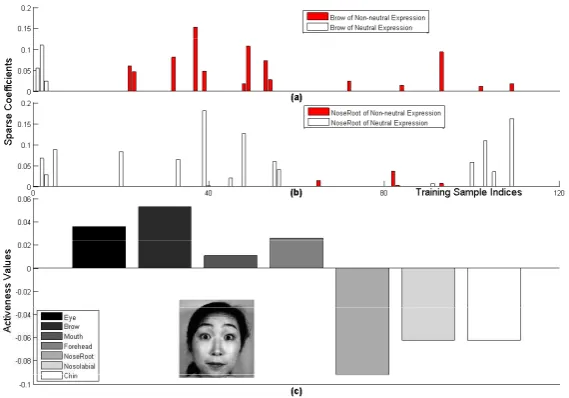
‘NoseRoot’ is the most non-active part. While ‘Brow’, ‘Eye’ and ‘Forehead’ are decided to be active and included for feature representation, non-active parts like ‘Mouth’, ‘NoseRoot’, ‘Nasolabial’ and ‘Chin’ regions will not involve in the following expression recognition.
Figure 4.The sparse coefficients and the activeness values of an example surprise expression. (a,b) show
the sparse representation coefficients of ‘Brow’ and ‘NoseRoot’; (c) presents the example surprise expression and the activeness values of its seven parts.
After the active AU detection for each testing sample, the optimized patch weights for the corresponding candidate expression triplet with Algorithm2are used to weigh the selected active AUs (AUA) and the involved patches for the following recognition.
2.4. Weighted SVM for Classification
After the feature weight optimization and AU activeness detection, support vector machine (SVM) with slightly modified kernel function is employed for the classification [58]. Rather than treat the feature weights as variables in SVM and obtain them with mutual information [59], the optimized feature weights learned in Section 2.3.2 are directly integrated with the patches involved with the detected active AUs in Section2.3.3for the recognition. That is, the new inner producthfi,fjiwof two features fi,fjwith weight vectorwis defined as follows
hfi,fjiw=hfi,w·fji. (23)
wherehx,yi=xTyis the inner product of two vectors,x·y= (x1y1,· · ·,xnyn)is the dot product of two vectors. Finally, with the new defined inner product (23) as the kernel function, SVM is used for the recognition.
3. Experimental Results
is different from person to person, to guarantee that the image really represents a specific expression, these collected expressions are labelled by two independent labellers [62]. The remaining databases were videoed in the controlled lighting condition and the faces are all frontal, the corresponding participants were instructed by an experimenter to perform a series of facial displays for each expression [61].
The Jaffe database consists of 213 expression images of 10 Japanese female models, which can be categorized to six basic and the neutral expressions, i.e., angry (An), disgust (Di), fear (Fe), happy (Ha), sad (Sa) and surprise (Su). The CK+ database consists of 593 expression sequences from 123 subjects, where 327 sequences are labeled with one of seven expressions (angry, disgust, fear, happy, sad, surprise and contempt). Each sequence contains a set of captured frames when the subject changes his expression, 1033 expression images, i.e., the neutral and three non-neutral images sampled from each expression sequence are used for testing. The database SFEW2 is derived from the sub-challenge of static expression recognition in The Third Emotion Recognition in the Wild Challenge [62], which includes 958, 436 and 372 training, validation and testing samples of seven basic expressions. As the labels of testing set are not publicly available, the validation set was used in this paper for testing. The images were videoed in the un-controlled condition with different lightings, head poses, profiles, resolutions and face colors. Five landmark points were located with [50,66] for face alignment.
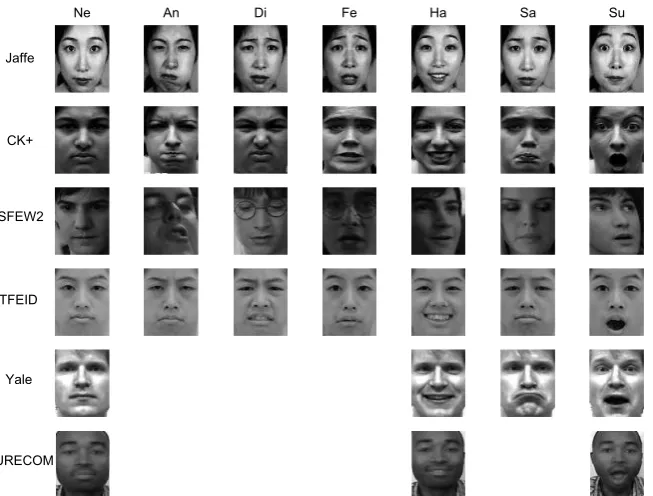
The Taiwanese Facial Expression Image Database (TFEID) database consists of 268 expression images from 40 subjects (20 females, 20 males), each of the subject presents six basic expressions and the neutral expression. The Yale expression database consists of 60 expression images from 15 subjects, each of the subject presents three basic expressions (happy, sad and surprise) and the neutral expression. The EURECOM Kinect Face Dataset (EURECOM) consists of 312 expression images from 52 subjects (14 females, 38 males), each subject presents two basic expressions (happy and surprise) and the neutral expression. The expression images are captured in two sessions at an interval of about two weeks. The six basic and the neutral examples of the six databases are demonstrated in Figure5. For the following experiment, the person-independent strategy with ten-fold setting is employed for testing and comparison. More precisely, the considered database is divided into ten groups with approximately equal number of person IDs. While nine of them were used for training, the remaining group was used for testing. The process was randomly repeated ten times and the average accuracy is recorded as the final result.
Ne An Di Fe Ha Sa Su
EURECOM Yale TFEID SFEW2
CK+ Jaffe
3.1. Number of Candidate Expressions Suggested by the First Stage Classifier
TakeJaffedatabaseasexample,someexpressionsinthedatasetarequitedifficulttodiscriminate, evenforhumaneyes.Forexample,theangryandsadexpressionsshowninFigure6aandd,fandg areverysimilar.Itwouldbemoreplausibletodevelopahierarchysystemwhichcoulddiscriminate theeasycategoriesatthefirststage,andthendifferentiatethedifficultcategoriesatthesecondstage.
(a):An (b):Di (c):Fe (d):Sa (e):Su
(f):An (g):Di (h):Fe (i):Sa (j):Su
Figure 6.Expression examples with similar appearance from Jaffe database.
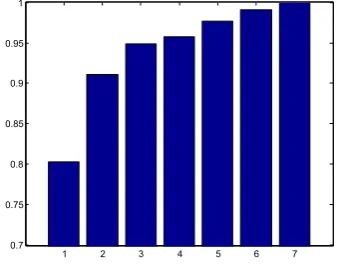
To decide the number of candidate expressions proposed by the first stage classifier, we show in Figure7the variation of accuracy with the value ofkwhen top-kstrategy is adopted for expression recognition. A classification is said to be correct if one of the top-klabels returned by the system matches the true label of the sample. The accuracy generally increases with the values of rank,
k. While the accuracy of 91.5% was achieved for k = 2, the accuracy reached 96% for k = 3. To reach a trade-off between accuracy and efficiency, we setk = 3 for the first stage classification, i.e., the top three expression labels were assigned for the testing sample at the first stage. Based on the three candidates, the final label was given by a different model trained using finer features at the second stage.
1 2 3 4 5 6 7 0.7
0.75 0.8 0.85 0.9 0.95 1
Figure 7.The variation of recognition rates with the value of ranks for Jaffe database.
3.2. Recognition Performance Analysis
Table 2.The effects of different models to the overall recognition rate (%).
Database
Seven Expression Triplet-Wise Based Two Stage Classification
Patch Feature
Patch Feature
Patch Feature+ AU Weight
Patch Feature+ AU Weight+ Patch Weight
Patch Feature+ AU Weight+ Patch Weight+
Active AU Detection
Jaffe 82.63 83.10 84.04 86.85 89.67 CK+ 89.06 89.55 91.09 93.32 94.09
SFEW2 42.2 42.2 42.66 43.81 46.1
Figure8shows the top three most representative AUs of each expression, one can observe from the figure that the most representative parts of the surprise expression (g) are the brows, eyes and mouth. The most representative regions of the laugh expression (e) are the brow, mouth and nasolabial parts.
(a): Ne (b): An (c): Di (d): Fe (e): Ha (f): Sa (g): Su
Figure 8. The top three most representative parts for each expression. The darker regions denote
the larger representative abilities.
To analyze the performance of the patch weight optimization, Figure9depicts the optimized weight vectors of five expression triplets of the Jaffe database. It can be seen from the figure that the weights of the patches of each AU are further optimized. With the proposed weight optimization, the discrimination ability of the weighted patches for expressions with small variation is increased and performance improvements on the databases Jaffe and CK+ are observed in the fifth column of Table2.
(a): Ne
(g): An
(m): Di
(b): Ne
(h): An
(n): Fe
(c): Ne
(i): An
(o): Ha
(d): Ne
(j): An
(p): Sa
(e): Ne
(k): An
(q): Su
Figure 9.The visualization of optimized patch weights for five expression triplets. The darker the patch
is, the larger is the weight. The patches with the top ten largest weights are labeled with red rectangles.
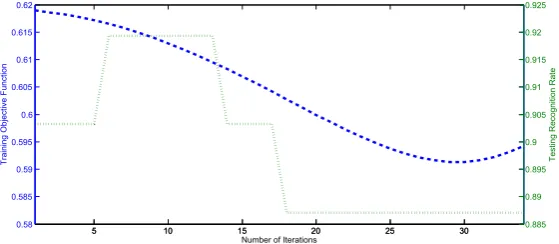
values in Equation (12) and the testing accuracy of an example expression triplet (angry, fear and sad) w.r.t. the number of iterations on the Jaffe database, when active AU detection was not applied. It can be seen that the recognition rate is not always increasing with the descendant of the objective function values due to the difference between the testing and training samples. Thus, active AUs could be detected to represent the specific features for each testing expression sample.
5 10 15 20 25 30
0.58 0.585 0.59 0.595 0.6 0.605 0.61 0.615 0.62
Training Objective Function
Number of Iterations
5 10 15 20 25 30 0.885
0.89 0.895 0.9 0.905 0.91 0.915 0.92 0.925
Testing Recognition Rate
Figure 10.The evolutions of the objective function values and the testing recognition rates of expression
triplet: fear, angry and sad w.r.t. the number of iterations.
TostudytheeffectoftheactiveAUdetectionforrecognition,Figure11presentsthetoptwoactive AUsofsixexampletestingexpressions,where(c)and(i)showthatthebrowandeyepartsaremore activethantheotherpartsfortheexpressionsamplepresentedinFigure6e.Whentheseactiveparts areusedforthefeatureencoding,theexpressionsampleswillbecorrectlyrecognized.
(g): An (a): An
(h): Sa (b): Sa
(i): Su (c): Su
(j): Ha (d): Ha
(k): Sa (e): Sa
(l): Ha (f): Ha
Figure 11.The top two active AUs of six example testing images.
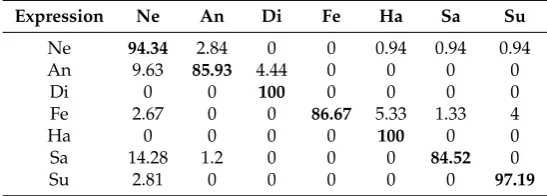
To analyze the algorithm performance in overall, the confusion matrix of the final recognition results on the databases Jaffe and CK+ are presented in Tables3and4, respectively. Both tables show that the angry, fear and sad expressions are relatively difficult to be correctly recognized. The difficulty is verified by expressions presented in Figure6, where faces present similar features, not only in the appearance but also in the face part deformation. Table4suggests that the sad expression is mostly misclassified as the neutral expression (error rate 14.28%).
Table 3.Confusion matrix (%) of the proposed recognition algorithm on Jaffe database.
Expression Ne An Di Fe Ha Sa Su
Ne 90 3.33 0 0 0 0 6.67
An 0 83.33 6.67 0 0 10 0
Di 0 3.45 93.1 0 3.45 0 0 Fe 3.13 0 0 87.5 6.25 3.12 0
Ha 0 0 0 0 100 0 0
Sa 0 6.45 3.23 6.45 6.45 77.42 0
Table 4.Confusion matrix (%) of the proposed recognition algorithm on CK+ database.
Expression Ne An Di Fe Ha Sa Su
Ne 94.34 2.84 0 0 0.94 0.94 0.94
An 9.63 85.93 4.44 0 0 0 0
Di 0 0 100 0 0 0 0
Fe 2.67 0 0 86.67 5.33 1.33 4
Ha 0 0 0 0 100 0 0
Sa 14.28 1.2 0 0 0 84.52 0
Su 2.81 0 0 0 0 0 97.19
3.3. Feature Optimization Comparison
This section mainly compare the performance of the proposed weight optimization algorithm with other related algorithms, such as Adaboost [19,20,26,35], linear discriminant analysis (LDA) [30,43], Chi square statistic (CSS) [48], multi-task salient patch selection (MTSPS) [45] and the uniform weights (UWs) setting. For the Adaboost feature selection [35], the strong classifier of the final recognition is linearly composed of a number of patch-based weak classifiers. In the expression recognition [48], only the Chi square statistic for weight assignment is employed. In the feature selection [43], the patch saliency score is related with the classification accuracy of the training expression samples, where PCA and LDA are employed to reduce the feature dimension. The salient feature selection in [45] trains a set of active common and specific expression patches. The same strategy of the triplet-mode and the GSF feature is employed for a fair comparison. The recognition rates obtained by these algorithms on the databases Jaffe and CK+ are presented in Table5.
Table 5.The recognition rates (%) of different feature selection algorithms on two databases.
Database UWs
(Uniform Weights) Adaboost [35] LDA [43] CSS [48] MTSPS [45] Ours
Jaffe 83.10 81.22 82.63 83.57 85.45 89.67
CK+ 89.55 88.58 90.71 90.22 92.45 94.09
Table5shows that the recognition rates of Adaboost, LDA are lower than that of the uniform weights UWs. CSS achieves slightly better performance than UWs on Jaffe database. In these models, the specificity of each expression and the causal relation information among AUs are not sufficiently exploited. To reduce the effects of personal ID information, the salient feature selection in [45] integrated the common and specific expression features and higher recognition rates are achieved.
Different from the other feature selection algorithms, the AU based feature optimization in the proposed algorithm weighs the AUs and the corresponding patches with conditional transient probability matrix. The discrimination information contained in both large-scale AUs and small-scale patches are considered. Moreover, active AUs of each testing expression sample are also detected for the feature encoding. The best recognition rates achieved in Table5justified the advantages of the proposed feature optimization.
3.4. Comparison with State of the Art
Table 6.Comparison of different algorithms on Jaffe database.
Algorithm Category Subjects Protocol Recognition Rate (%)
Feature and
Classifier Selection [42] Traditional 10 10-fold 85.92 Radial Feature [22] Traditional 10 10-fold 89.67 Supervised LLE [33] Traditional 10 10-fold 86.75
Ours Traditional 10 10-fold 89.67
Deep CNN [11] Deep learning-based 10 10-fold 88.6 Deep Belief Network [41] Deep learning-based 10 10-fold 91.8
Table 7.Comparison of different algorithms on CK+ database.
Algorithm Category Subjects Protocol Recognition Rate (%)
Maximum Margin
Projection [32] Traditional 100 5-fold 89.2 Feature Selection
with GMM [67] Traditional 97 10-fold 89.1
SVM (RBF) and
Boosted-LBP [20] Traditional 96 10-fold 91.4 Radial Feature [22] Traditional 94 10-fold 91.51
Ours Traditional 106 10-fold 94.09
AU Deep Network [47] Deep learning-based 118 10-fold 92.05 Deep Neural Network [68] Deep learning-based 106 5-fold 93.2
Table 8.The accuracy (%) of different algorithms on SFEW2 database.
Pyramid of Histogram of Gradients+Local Phase
Quantisation+Non-linear SVM [62]
Hierarchical Committee
CNN [12] Multiple CNN [69]
Transfer Learning
Based CNN [70] Ours
35.93 56.4 56.19 48.5 46.1
For Jaffe database, our proposed algorithm achieves competitive recognition rate among all the algorithms in Table6. The algorithm [41] using deep belief network yields the highest recognition rate of 91.8%. However, feature selection and classifier training are time-consuming and the process requires several days for each database. Rather than using a well-designed feature representation, the proposed algorithm achieves the best accuracy of 89.67% as the radial feature based algorithm [22] among the traditional algorithms. For the CK+ database, the proposed algorithm achieves the highest accuracy of 94.09%. As we are focused on seven class expression recognition, those work developed for six expressions like [21,37,41,43–45,49] are not included for comparison in this paper.
The feature and classifier adopted in the proposed algorithm are significantly different from the convolutional neural network (CNN)-based algorithms. In the following, the database (SFEW2) collected in the wild is taken to compare the overall performance between CNN and the proposed algorithms. As SFEW2 was used in Emotion Recognition in the Wild Challenge for performance evaluation, we directly take the accuracies of participants for comparison. All of the top three participants adopted CNN and their results are listed in Table8, together with that of our approach.
3.5. Cross-Database Performance Study
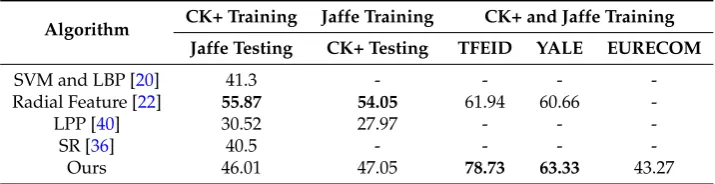
To study the generalization ability of the proposed model, cross-database experiments are conducted and the corresponding recognition rates are presented in Table9. In this testing, while one database is set as the training set, the other database is used as the testing set for evaluation.
Table 9.Comparison of cross-database recognition rates (%).
Algorithm CK+ Training Jaffe Training CK+ and Jaffe Training
Jaffe Testing CK+ Testing TFEID YALE EURECOM
SVM and LBP [20] 41.3 - - -
-Radial Feature [22] 55.87 54.05 61.94 60.66
-LPP [40] 30.52 27.97 - -
-SR [36] 40.5 - - -
-Ours 46.01 47.05 78.73 63.33 43.27
It can be seen from Table9that the radial feature encoding [22] with the probability projection achieves the highest accuracy when the databases Jaffe and CK+ are used for testing and training, respectively. The proposed algorithm achieves a competitive recognition rate of 46.01%, which is better than the recognition rate of 32.86% achieved by [22] when the employed probability projection is replaced with the Borda count strategy. When Jaffe is used as the training and CK+ is used for testing, the proposed algorithm also achieves competitive accuracy.
To further study the generalization ability of the proposed model, databases of CK+ and Jaffe are used as the training, while one of the other three databases is chosen for the testing. The accuracy is presented in the last three columns of Table9, which shows that the proposed algorithm achieves much better recognition rate than the algorithm [22] on database TFEID and a competitive recognition rate on the database YALE.
4. Discussion and Conclusions
In this work, a two-stage expression recognition model based on triplet-wise feature optimization is proposed, the novelty of the this work is concentrated on three aspects. First, overall facial expression recognition is transformed into the triplet-wise mode to sufficiently exploit the specificity of each expression. Second, AU weighting and patch weight optimization are proposed for each expression triplet. Lastly, online detection of active AUs is proposed for each testing expression sample to reduce the influence of the non-active features in recognition. Experimental results and comparison with the related state-of-the-art algorithms verify the effectiveness and competitiveness of the proposed algorithm.
Although competitive results are obtained with the proposed model, there still leaves room for further improvement. First, feature optimization of more than two stages can be explored for the performance improvement. Second, more efficient features should be devised and integrated into the feature optimization model. Third, the cross-database recognition rates are still not high enough for the real application, which will be explored in our future work. Lastly, the ideas of AU weighting, feature sparseness optimization and active AU detection can be combined with CNN-based algorithms to improve the feature encoding based on face frontalization [71].
Acknowledgments:The authors thank the anonymous reviewers for their helpful comments and suggestions.
The work was supported by Natural Science Foundation of China under grand No. 61672357, 61602315 and 61402289, the Science and Technology Innovation Commission of Shenzhen under Grant JCYJ20160422144110140, China Postdoctoral Science Foundation under grant No. 2015M572363, the Science Foundation of Guangdong Province under grant No. 2014A030313556 and 2014A030313558.
Author Contributions:Linlin Shen is the corresponding author who designed the algorithm and revised the paper.
Meng Yang and Zhihui Lai provided some suggestions and comments for the performance improvement of the recognition algorithm.
Conflicts of Interest:The authors declare no conflict of interest. The founding sponsors had no role in the design
of the study; in the collection, analyses, or interpretation of data; in the writing of the manuscript, and in the decision to publish the results.
References
1. Sandbach, G.; Zafeiriou, S.; Pantic, M.; Yin, L. Static and dynamic 3D facial expression recognition: A comprehensive survey.Image Vis. Comput.2012,30, 683–697.
2. Vezzetti, E.; Marcolin, F.; Fracastoro, G. 3D face recognition: An automatic strategy based on geometrical descriptors and landmarks.Rob. Auton. Syst.2014,62, 1768–1776.
3. Vezzetti, E.; Marcolin, F. 3D landmarking in multiexpression face analysis: A preliminary study on eyebrows and mouth.Aesthet. Plast. Surg.2014,38, 796–811.
4. Liu, J.; Zhang, Q.; Tang, C. Base mesh extraction for different 3D faces based on ellipse fitting. In Proceedings of the IEEE Advanced Information Technology, Electronic and Automation Control Conference, Chongqing, China, 19–20 December 2015; pp. 285–294.
5. Tian, Y.; Kanade, T.; Fcohn, J. Recognizing action units for facial expression analysis.IEEE Trans. Pattern Anal. Mach. Intell.2001,23, 97–115.
6. Ekman, P.; Rosenberg, E.L.What the Face Reveals: Basic and Applied Studies of Spontaneous Expression Using the Facial Action Coding System, 2nd ed.; Oxford Univ. Press: New York, NY, USA, 2005.
7. Valstar, M.; Pantic, M. Fully automatic facial action unit detection and temporal analysis. In Proceedings of the IEEE Conference on Computer Vision and Pattern Recognition Workshop, Washington, DC, USA, 17–22 June 2006; p. 149.
8. Elaiwat, S.; Bennamoun, M.; Boussaid, F. A spatio-temporal RBM-based model for facial expression recognition.Pattern Recognit.2016,49, 152–161.
9. Liu, M.; Shan, S.; Wang, R.; Chen, X. Learning expressionlets on spatio-temporal manifold for dynamic facial expression recognition. In Proceedings of the IEEE Conference on Computer Vision and Pattern Recognition, Columbus, OH, USA, 23–28 June 2014; pp. 1749–1756.
10. Rudovic, O.; Pavlovic, V.; Pantic, M. Multi-output Laplacian dynamic ordinal regression for facial expression recognition and intensity estimation. In Proceedings of the IEEE Conference on Computer Vision and Pattern Recognition, Providence, RI, USA, 16–21 June 2012; pp. 2634–2641.
11. Fasel, B. Multiscale facial expression recognition using convolutional neural networks. In Proceedings of the Third Indian Conference on Computer Vision, Graphics & Image Processing, Ahmadabad, India, 16–18 December 2002; p. 8123.
12. Kim, B.K.; Roh, J.; Dong, S.Y.; Lee, S.Y. Hierarchical committee of deep convolutional neural networks for robust facial expression recognition.J. Multimodal User Interfaces2016,10, 173–189.
13. Burkert, P.; Trier, F.; Afzal, M.Z.; Dengel, A.; Liwicki, M. DeXpression: Deep convolutional neural network for expression recognition.arXiv2016, arXiv:1509.05371.
14. Pramerdorfer, C.; Kampel, M. Facial expression recognition using convolutional neural networks: State of the art.arXiv2016, arXiv:1612.02903.
15. Khorrami, P.; Paine, T.L.; Huang, T.S. Do deep neural networks learn facial action units when doing expression recognition? In Proceedings of the IEEE International Conference on Computer Vision Workshops, Santiago, Chile, 11–12 December 2015; pp. 19–27.
16. Liu, B.; Wang, M.; Foroosh, H.; Tappen, M.; Penksy, M. Sparse convolutional neural networks. In Proceedings of the IEEE Conference on Computer Vision and Pattern Recognition, Boston, MA, USA, 7–12 June 2015; pp. 806–814.
17. Graham, B. Spatially-sparse convolutional neural networks.Comput. Sci.2014,34, 864–867.
18. Yan, K.; Chen, Y.; Zhang, D. Gabor surface feature for face recognition. In Proceedings of the First Asian Conference on Pattern Recognition, Beijing, China, 28–30 November 2011; pp. 288–292.
19. Whitehill, J.; Womlin, C. Haar features for FACS AU recognition. In Proceedings of the International Conference on Automatic Face and Gesture Recognition, Southampton, UK, 10–12 April 2006; pp. 97–101. 20. Shan, C.; Gong, S.; Wmcowan, P. Facial expression recognition based on Local Binary Patterns:
A comprehensive study.Image Vis. Comput.2009,27, 803–816.
22. Gu, W.; Xiang, C.; Vvenkatesh, Y.; Huang, D.; Lin, H. Facial expression recognition using radial encoding of local Gabor features and classifier synthesis.Pattern Recognit.2012,45, 80–91.
23. Ghimire, D.; Lee, J. Geometric feature-based facial expression recognition in image sequences using multi-class AdaBoost and support vector machines.Sensors2013,13, 7714–7734.
24. Kotsia, I.; Zafeiriou, S.; Pitas, I. Texture and shape information fusion for facial expression and facial action unit recognition.Pattern Recognit.2008,41, 833–851.
25. Xie, W.; Shen, L.; Jiang, J. A novel transient wrinkle detection algorithm and its application for expression synthesis.IEEE Trans. Multimedia2016, doi:10.1109/TMM.2016.2614429.
26. Bartlett, M.; Littlewort, G.; Bartonfrank, M.; Lainscsek, C.; Fasel, I.; Rmovellan, J. Recognizing facial expression: Machine learning and application to spontaneous behavior. In Proceedings of the IEEE Conference on Computer Vision and Pattern Recognition, San Diego, CA, USA, 20–26 June 2005; pp. 568–573. 27. Hesse, N.; Gehrig, T.; Gao, H.; Kemalekenel, H. Multi-view facial expression recognition using local appearance features. In Proceedings of the International Conference on Pattern Recognition, Tsukuba, Japan, 11–15 November 2012; pp. 3533–3536.
28. Sha, T.; Song, M.; Bu, J.; Chen, C.; Tao, D. Feature level analysis for 3D facial expression recognition.
Neurocomputing2011,74, 2135–2141.
29. Liu, C.; Wechsler, H. Independent component analysis of Gabor features for face recognition.IEEE Trans. Neural Netw.2003,14, 919–928.
30. Jlyons, M.; Budynek, J.; Akamatsu, S. Automatic classification of single facial images.IEEE Trans. Pattern Anal. Mach. Intell.1999,21, 1357–1362.
31. Lai, Z.; Yong, X.; Jian, Y.; Shen, L.; Zhang, D. Rotational invariant dimensionality reduction algorithms.
IEEE Trans. Cybern.2016, doi:10.1109/TCYB.2016.2578642.
32. Nikitidis, S.; Tefas, A.; Pitas, I. Maximum margin projection subspace learning for visual data analysis.
IEEE Trans. Image Process.2014,23, 4413–4425.
33. Liang, D.; Yang, J.; Zheng, Z.; Chang, Y. A facial expression recognition system based on supervised locally linear embedding.Pattern Recognit. Lett.2005,26, 2374–2389.
34. Zhang, Y.; Zhang, L.; Ahossain, M. Adaptive 3D facial action intensity estimation and emotion recognition.
Expert Syst. Appl.2015,42, 1446–1464.
35. Silapachote, P.; Rkaruppiah, D.; Rhanson, A. Feature selection using Adaboost for face expression recognition. In Proceedings of the the Fourth IASTED International Conference on Visualization, Imaging, and Image Processing, Marbella, Spain, 6–8 September 2004; pp. 84–89.
36. Jia, Q.; Gao, X.; Guo, H.; Luo, Z.; Wang, Y. Multi-layer sparse representation for weighted LBP-patches based facial expression recognition.Sensors2015,15, 6719–6739.
37. Zafeiriou, S.; Pitas, I. Discriminant graph structures for facial expression recognition.IEEE Trans. Multimedia 2008,10, 1528–1540.
38. Giladbachrach, R.; Navot, A.; Tishby, N. Margin based feature selection-theory and algorithms. In Proceedings of the International Conference on Machine Learning, Banff, AB, Canada, 4–8 July 2004; pp. 43–50. 39. Jia, S.; Hu, J.; Xie, Y.; Shen, L. Gabor cube selection based multitask joint sparse representation for
hyperspectral image classification.IEEE Trans. Geosci. Remote Sens.2016,54, 1–14.
40. Wang, L.; Wang, K.; Li, R. Unsupervised feature selection based on spectral regression from manifold learning for facial expression recognition.IET Comput. Vis.2015,9, 655–662.
41. Liu, P.; Han, S.; Meng, Z.; Tong, Y. Facial expression recognition via a boosted deep belief network. In Proceedings of the IEEE Conference on Computer Vision and Pattern Recognition, Columbus, OH, USA, 23–28 June 2014; pp. 1805–1812.
42. Kyperountas, M.; Tefas, A.; Pitas, I. Salient feature and reliable classifier selection for facial expression classification.Pattern Recognit.2010,43, 972–986.
43. Happy, S.L.; Routray, A. Automatic facial expression recognition using features of salient facial patches.
IEEE Trans. Affect. Comput.2015,6, 1–12.
44. Liu, P.; Tianyizhou, J.; Wtsang, I.; Meng, Z.; Han, S.; Tong, Y. Feature disentangling machine-A novel approach of feature selection and disentangling in facial expression analysis. In Proceedings of the European Conference on Computer Vision, Zurich, Switzerland, 6–12 September 2014; pp. 151–166.
45. Zhong, L.; Liu, Q.; Yang, P.; Huang, J.; Metaxas, D. Learning multiscale active facial patches for expression analysis.IEEE Trans. Cybern.2015,45, 2562–2569.
46. Tong, Y.; Liao, W.; Ji, Q. Facial action unit recognition by exploiting their dynamic and semantic relationships.
47. Liu, M.Y.; Li, S.X.; Shan, S.G.; Chen, X.L. AU-aware deep network for facial expression recognition. In Proceedings of the Tenth IEEE Int. Conf. and Workshops on Automatic Face and Gesture Recognition (FG), Shanghai, China, 22–26 April 2013; pp. 1–6.
48. Zhao, G.; Huang, X.; Taini, M.; Li, S.Z.; Pietikainen, M. Facial expression recognition from near-infrared videos.Image Vis. Comput.2011,29, 607–619.
49. Li, Y.; Wang, S.; Zhao, Y.; Ji, Q. Simultaneous facial feature tracking and facial expression recognition.
IEEE Trans. Image Process.2013,22, 2559–2573.
50. Sun, Y.; Wang, X.; Tang, X. Deep convolutional network cascade for facial point detection. In Proceedings of the IEEE Conference on Computer Vision and Pattern Recognition , Portland, OR, USA, 23–28 June 2013; pp. 3476–3483.
51. Tzimiropoulos, G. Project-out cascaded regression with an application to face alignment. In Proceedings of the IEEE Conference on Computer Vision and Pattern Recognition, Boston, MA, USA, 7–12 June 2015; pp. 3659–3667.
52. Tan, X.; Triggs, B. Enhanced local texture feature sets for face recognition under difficult lighting conditions.
IEEE Trans. Image Process.2010,19, 1635–1650.
53. Ekman, P.; Friesen, W.V.Facial Action Coding System: A Technique for the Measurement of Facial Movement; Consulting Psychologists Press: San Francisco, CA, USA, 1978.
54. Shen, L.; Bai, L. A review on Gabor wavelets for face recognition.Pattern Anal. Appl.2006,9, 273–292. 55. Chen, X.; Pan, W.; Kwok, J.T.; Carbonell, J.G. Accelerated gradient method for multi-task sparse learning
problem. In Proceedings of the IEEE International Conference on Data Mining, Miami, FL, USA, 6–9 December 2009; pp. 746–751.
56. Lee, H.; Battle, A.; Raina, R.; Ng, A.Y. Efficient sparse coding algorithms. In Proceedings of the Advances in Neural Information Processing Systems, Vancouver, British Columbia, Canada, 4–7 December 2006; pp. 801–808.
57. Yang, M.; Zhang, L.; Yang, J.; Zhang, D. Robust sparse coding for face recognition. In Proceedings of the IEEE Conference on Computer Vision and Pattern Recognition, Colorado Springs, CO, USA, 20–25 June 2011; pp. 625–632.
58. Chang, C.C.; Lin, C.J. LIBSVM: A library for support vector machines.ACM Trans. Intell. Syst. Technol.2011,
2, 389–396.
59. Xing, H.J.; Ha, M.H.; Tian, D.Z.; Hu, B.G. A novel support vector machine with its features weighted by mutual information. In Proceedings of the International Joint Conference on Neural Networks, Hong Kong, China, 1–8 June 2008; pp. 315–320.
60. Jlyons, M.; Akamatsu, S.; Kamachi, M.; Gyoba, J. Coding facial expressions with Gabor wavelets. In Proceedings of the International Conference on Automatic Face and Gesture Recognition, Nara, Japan, 14–16 April 1998; pp. 200–205.
61. Kanade, T.; Fcohn, J.; Tian, Y. Comprehensive database for facial expression analysis. In Proceedings of the International Conference on Automatic Face and Gesture Recognition, Grenoble, France, 26–30 March 2000; p. 46.
62. Dhall, A.; Ramana Murthy, O.V.; Goecke, R.; Joshi, J.; Gedeon, T. Video and image based emotion recognition challenges in the wild: EmotiW 2015. In Proceedings of the ACM International Conference on Multimodal Interaction, Seattle, WA, USA, 9–13 November 2015; pp. 423–426.
63. Chen, L.F.; Yen, Y.S. Brain Mapping Laboratory, Institute of Brain Science. Ph.D. Thesis, National Yang-Ming University, Taipei, Taiwan, 2007.
64. Nbelhumeur, P.; Phespanha, J.; Jkriegman, D. Eigenfaces vs. Fisherfaces: Recognition using class specific linear projection.IEEE Trans. Pattern Anal. Mach. Intell.1997,19, 711–720.
65. Min, R.; Kose, N.; Dugelay, J. KinectFaceDB: A Kinect database for face recognition.IEEE Trans. Syst. Man Cybern. Syst.2014,44, 1534–1548.
66. Zhang, J.; Shan, S.; Kan, M.; Chen, X. Coarse-to-fine auto-encoder networks (CFAN) for real-time face alignment. In Proceedings of the European Conference on Computer Vision, Zurich, Switzerland, 6–12 September 2014; pp. 1–16.
67. Elguebaly, T.; Bouguila, N. Simultaneous high-dimensional clustering and feature selection using asymmetric Gaussian mixture models.Image Vis. Comput.2015,34, 27–41.
69. Yu, Z.; Zhang, C. Image based static facial expression recognition with multiple deep network learning. In Proceedings of the ACM International Conference on Multimodal Interaction, Seattle, WA, USA, 9–13 November 2015; pp. 435–442.
70. Ng, H.W.; Nguyen, V.D.; Vonikakis, V.; Winkler, S. Deep learning for emotion recognition on small datasets using transfer learning. In Proceedings of the ACM International Conference on Multimodal Interaction, Seattle, WA, USA, 9–13 November 2015; pp. 443–449.
71. Hassner, T.; Harel, S.; Paz, E.; Enbar, R. Effective face frontalization in unconstrained images. In Proceedings of the IEEE Conference on Computer Vision and Pattern Recognition, Boston, MA, USA, 7–12 June 2015; pp. 4295–4304.