International Journal of Early Childhood
Intuitive and informal knowledge in preschoolers' development of probabilistic thinking
--Manuscript
Draft--Manuscript Number: IJEC93R4
Full Title: Intuitive and informal knowledge in preschoolers' development of probabilistic thinking
Article Type: Original research
Keywords: informal knowledge; intuitive thinking; probabilistic thinking; preschool education
Corresponding Author: Zoi Nikiforidou
Liverpool Hope University Liverpool , UNITED KINGDOM Corresponding Author Secondary
Information:
Corresponding Author's Institution: Liverpool Hope University Corresponding Author's Secondary
Institution:
First Author: Zoi Nikiforidou
First Author Secondary Information:
Order of Authors: Zoi Nikiforidou
Jenny Pange
Theodore Chadjipadelis Order of Authors Secondary Information:
Abstract: Preschoolers develop a wide range of mathematical informal knowledge and intuitive thinking before they enter formal, goal-oriented education. In their everyday activities young children get engaged with situations that enhance them to develop skills, concepts, strategies, representations, attitudes, constructs and operations concerning a wide range of mathematical notions. Recently there is scientific interest in linking children's informal and formal knowledge in order to provide them with opportunities to avoid biases aiming at formulating, perceiving, reflecting on and exercising probabilistic notions.
The current study investigates preschoolers' (N=90) intuitive understanding of the likelihood of events in a probabilistic task with spinners. Participants, at the age of 4 to 6, are tested on their predictions of the most probable outcome prior to and after an instructive session of reasoning. The probabilistic task, based on constructivist principles, includes methodological alterations concerning the sample space and the themes of the stimuli. Educational implications are further discussed under the general point of view that in order to link informal to formal mathematical learning in preschool classroom, the subject content and the cognitive capacity of children are important to match.
Los niños en edad preescolar desarrollan un conocimiento matemático informal y un pensamiento intuitivo antes de comenzar la educación formal, orientada a la búsqueda de objetivos. En sus actividades cotidianas, los niños pequeños
participan en situaciones que promueven el desarrollo de habilidades, percepciones, estrategias, representaciones, actitudes, construcciones y operaciones relacionadas con una amplia gama de conceptos matemáticos. Recientemente existe un interés científico por establecer una relación entre el conocimiento formal e informal de los niños, permitiéndoles así evitar sesgos en la formulación, percepción, razonamiento y/o en el ejercicio de nociones probabilísticas.
razonamiento. El juego de probabilidades, basado en los principios del
constructivismo, incluye cambios metodológicos relacionados con el espacio de muestra y el tema del estímulo. Se discuten las implicaciones educativas bajo la visión general de que, para establecer la conexión del aprendizaje matemático informal con el formal en la enseñanza preescolar, es fundamental establecer una conexión entre el contenido del tema y la capacidad cognitiva de los niños.
Les enfants d'âge préscolaire développent une vaste gamme de connaissances mathématiques informelles et de la pensée intuitive avant d'entrer à l'éducation formelle, axée sur des objectifs. Dans leurs activités quotidiennes les jeunes enfants se trouvent engagés dans des situations qui les amènent à développer des habiletés, des concepts, des représentations, des attitudes, des construits et des opérations relatives à une grande étendue de notions mathématiques. Il y a un intérêt scientifique récent à lier les connaissances formelles et informelles des enfants, afin de leur offrir des possibilités d'éviter des préconceptions visant la formulation, la perception, la réflexion et l'exercice de notions probabilistes.
La présente étude examine la compréhension intuitive de la vraisemblance d'événements dans une tâche probabiliste avec toupies chez des enfants d'âge préscolaire (N = 90).
Les participants, âgés de 4 à 6 ans, sont testés sur leurs prédictions du résultat le plus probable, avant et après une séance de raisonnement instructive. La tâche
probabiliste, fondée sur des principes constructivistes, comprend des modifications méthodologiques concernant l'échantillonnage et les thèmes du matériel. Les implications pédagogiques sont discutées du point de vue général que pour relier l'apprentissage mathématique informel à l'apprentissage mathématique formel en classe préscolaire, il est important que le contenu de la matière et la capacité cognitive des enfants correspondent.
1
Intuitive and informal knowledge in preschoolers’ development of probabilistic thinking
Zoi Nikiforidou
Liverpool Hope University, Department of Education Studies, UK
[email protected] Jenny Pange
University of Ioannina, Department of Early Childhood Education, Greece
Theodore Chadjipadelis
Aristotle University of Thessaloniki, Department of Political Sciences, Greece
Corresponding author: Zoi Nikiforidou, Department of Education Studies, Liverpool Hope University, Hope Park, L16 9JD, Liverpool, tel: +4401512917365, mail: [email protected]
1. Informal mathematical knowledge
‘Informal knowledge’, according to Baroody and Ginsburg (1986), includes the
knowledge that children develop in everyday settings before entering formal schooling. Similarly,
prior knowledge, according to Jonassen and Gabrowski (1993) is considered as the set of
knowledge background, skills or abilities that students bring to the learning process. Family life,
social interactions, playgrounds, day care, and everyday experiences provide informal
opportunities for the development of concepts, skills, attitudes and abilities; these, in turn, are
influenced contextually and culturally, morally and emotionally, cognitively and mentally,
physically and biologically, through group and/or individual engagement. During the last decades
a large body of research has revealed that children at early years express informal mathematical
knowledge associated with diverse notions and mechanisms such as enumeration and arithmetic
problem solving (Baroody 2004; Wynn 1990), spatial reasoning and geometric knowledge
(Samara and Clements 2006; Newcombe and Huttenlocher 2000).
Seo and Ginsburg (2004) studied the types of informal mathematical activities which
four- and five-year-old children express in natural settings during free play. Children demonstrated
five mathematical categories; classification activities, magnitude activities, enumeration activities,
dynamics and pattern and shape activities. According to Sarama and Clements (2009), children
construct mathematical notions as they get actively engaged in the following sorts of play:
sensorimotor or manipulative play, symbolic constructive play, symbolic dramatic play and games
with rules. So, play is a means to get children involved in problem solving situations and develop
their thinking on mathematical ideas and procedures.
Informal mathematical knowledge undergoes considerable development during the
preschool years and provides a basis for the later acquisition of formal mathematics in the school
context (Clements and Sarama 2007). In this sense, successful early childhood instruction builds
on children’s informal knowledge and supports the linkage of this prior thinking to more analytical
mathematical representations, while taking into account diversity in terms of language, culture,
needs and interests. Children possess informal knowledge of many complex mathematical ideas,
enjoy the challenges of playing with these complex ideas and, with adult or peer guidance, they
*Blinded Manuscript (Without authors names and affiliations)
can achieve greater understanding than previously expected (Ginsburg, Greenes and Balfanz
2003).
2. Educational strategies linking informal to formal knowledge
The importance of prior knowledge and informal experiences on learning and perceiving
the world has been stressed mainly by the theoretical approach of constuctivism (Bruner 1996;
Piaget 1970; Vygotsky 1986). Under this approach, learning is an active, meaningful procedure
that takes place as new constructs, concepts and knowledge get absorbed through interactions with
people, places, objects and ideas. Knowledge construction occurs as students use their prior
informal knowledge while engaging with new experiences, mental structures, socio-cultural
connections and beliefs in order to interpret the world. Young children build more advanced
knowledge from prior understandings, through play, relations, explorations, games and stimulating
activities (DeVries et al, 2002).
In instructional terms, the base of constructing on previous knowledge in order to conquer
skills, knowledge and values occurs through scaffolding and repetition. Bruner (1996) proposed a
spiral curriculum in which when teaching a subject "you begin with an intuitive account that is
well within the reach of a student, and then circle back later to a more formal or highly structured
account until the learner has mastered the topic or subject" (p. 119). By viewing learning as an
active procedure, instruction should be designed in the direction of avoiding misunderstandings
and misconceptions and acquiring deeper and longer lasting understandings (Jones and
Brader-Araje 2002). Students get introduced to diverse notions at a basic level from the early years and as
they grow older they deepen their understandings. In this direction, according to Ginsburg (2009),
educational strategies should aim to link the spontaneous and the scientific, the everyday and the
academic. For example, the child already knows, without the benefit of schooling, that while
throwing a dice she/he might throw a six. This idea should be related later on to the responsive
written computation and representation of probabilities, taught under the mathematics curriculum.
The informal approach encourages children to engage in rich mathematical experiences
which enable them to explore their environment, either through hands-on discovery, or through
computer-assisted practices, or through a combination of both. Informal knowledge encourages
cognitive skills in order to make sense of the world (Carr, Peters and Young-Loveridge 1994). In
general, preschool programs are to be planned on sequences of learning that elaborate on and
reinforce children’s knowledge; informal in the beginning and formal later on. According to
Conole (2005), these experiences should include a wide variety of activities, small-group
cooperative teaching, child-oriented tasks and opportunities that encourage children to talk about
and share their mathematical ideas and strategies in a responsive, reciprocal environment.
According to Greenes et al, (2004) the principles in guiding the design and
implementation of a comprehensive mathematics curriculum for preschool children involve:
capitalizing on children’s knowledge and interests, highlighting the mathematics in routine
classroom activities, organizing instruction and sequence activities, developing complex
mathematical ideas, emphasizing mathematical language development and promoting thinking like
a mathematician. Clements and Stephan (2004) mention that mathematizing involves “reinventing,
redescribing, reorganizing, quantifying, structuring, abstracting, and generalizing that which is
first understood on an intuitive and informal level in the context of everyday activity” (p.314).
Early mathematics instruction does not mean imposing knowledge on preschoolers, drilling them
with material and stimuli, or having them memorize arithmetic facts or categorize shapes. Children
should get opportunities in organized activities to discover patterns and relations and invent
reasoning strategies, mathematical thinking, problem solving skills and literacy (Clements and
Sarama, 2007; Copley, 2000). Young children not only know some mathematics, but they are
ready and eager to learn more of it (Greenes 1999).
3. The development of probabilistic thinking in preschoolers
Fischbein (1975) was amongst the first researchers to argue that although preschoolers
have not reached an adequate conceptual framework, they do possess an intuitive understanding of
probabilities, ratios as well as other mathematical notions. He defines intuitions as “cognitive
acquisitions derived from the experience of the individual, without the need for any systematic
instruction” (p. 117). In this sense, intuitions usually develop in informal settings and become
‘adjusted’ as children enter formal learning environments. Such environments are provided by
educational settings in a structured, organised process with specific goals and objectives or
alternatively refer to “institutionalised learning activities that are designed to lead to a learning
informal contexts, but in the case of early years in terms of time intuitive thinking is mainly
associated with informal knowledge. Under this perspective, young children are expected to
estimate odds and unpredictability and therefore make probability judgments at a certain level,
prior to formal learning.
The research on probabilistic thinking in young children is approached through two
directions: on one hand there is a focus on the theoretical implications that occur and on the other
hand there is a focus on the methodological practices and design that are considered as
developmentally appropriate within the preschool classroom. Research is in progress and young
children have been found, in terms of their cognitive and mathematical capacity, to show a
minimal understanding of randomness, to identify the most/least likely event, to compare
outcomes, to make use of random sampling and base rate information, to apply probabilistic
evidence in order to elaborate on causal relationships, to realize part-part comparisons in order to
estimate probability (Denison et al. 2006; Kushnir and Gopnik 2005; Nikiforidou and Pange 2010;
Spinillo 2002). Furthermore, the design of the activities that introduce probabilities, the use of
random generators, simulators and ICTs, the size, location and proportion of the sample space, the
kind of stimuli used, the information given as well as other methodological features are significant
in implementing probabilistic notions in the formal educational settings (Nikiforidou and Pange
2009; Pratt 2000; Skoumpourdi et al. 2009).
The aim of this study is to schematize children’s choices and prior knowledge while
interacting with a spinner task. Preschoolers were asked to infer the most likely option in a
one-shot probabilistic game which was designed based on the basic principles of constructivism: active
engagement, play, discovery, meaningful context and oral reasoning. At a first point, it is tested
whether preschoolers express informal probabilistic knowledge in estimating the probability of an
event. At a second point, after an educational goal-oriented session, it is examined whether
preschoolers can build on their prior knowledge in order to reach probabilistic conclusions and
more complex reasoning. Theoretical, instructional and methodological issues are addressed on
how the linkage of informal and formal thinking can be applied to intuitive probabilistic thinking
in early years.
The study was undertaken in 2011, in 3 Greek public kindergartens selected from
different geographical regions. 90 children, aged 4–6 years, participated in the test. They took part
in pairs, in a separate room from their classroom after their parents’ signed letter of consent. The
study was realized within 4 weeks and no previous instruction or introduction to the notion of
‘most probable’ had taken place within the classrooms.
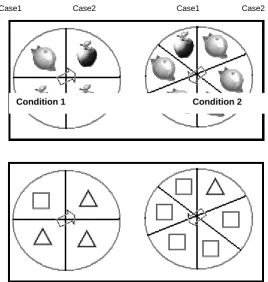
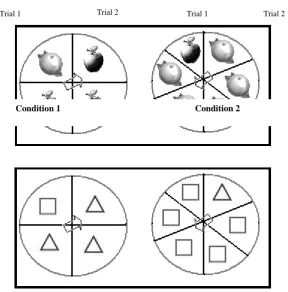
The task consisted of spinners showing fruit (oranges and apples) in Condition 1 and
shapes (squares and triangles) in Condition 2; themes relevant to early years. There were 2 cases
per Condition: in Case 1 the distribution of the sample space was 3:1 and in Case 2, the
distribution of the sample space was 5:1. In some cases apples or triangles outnumbered, whereas
in other cases oranges or squares outnumbered. The spinners were divided in equal parts, 4 in Case
1 and 6 in Case 2, with diameter 16 cm. The basis for the probabilistic game was a 40 x 40 cm
board made of cork. On there the spinners and the arrows were pinned up. Children would turn
around the disks by themselves in order to get motivated and actively engaged (Fig. 1).
Fig 1 Example of the stimulus
Case1
Condition 1 Condition 2
As long as children were seated in pairs, they were presented with the stimulus of the game.
Conditions were counterbalanced so that children would be tested either firstly on the fruit theme
and then on the shape theme or the other way round. In each condition, children were asked to
predict at which item they assumed the arrow would stop. They were provided with specially
designed sheets in order to record their inferences as well as the actual outcome of each spin. Each
case in each condition was repeated 3 times.
Between Conditions 1 and 2 an instructional session would take place, where participants
would discuss and try to explain the occurrences orally. The experimenter would assist by
intervening only with open-ended questions in order to encourage children’s critical thinking.
Children would be stimulated to argument on what were their predictions, what was the final
outcome each time and why, if any, there was difference. Apart from oral engagements children
could make use of the graphical representations in order to reach conclusions. As long as a
statement in the sense of “the x is more probable to win as xs are more” was reached, children
would move on to the following condition. Again, children’s predictions in three spins per case
were marked down and further discussed.
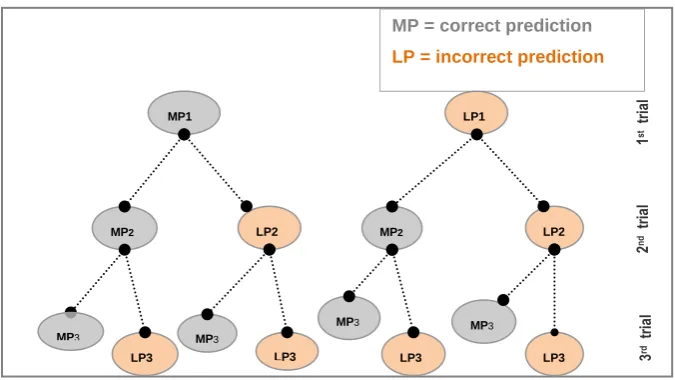
For the purposes of the current analysis two responses were recorded; the ‘MP’ (most
probable) responses which corresponded to the most probable outcome and the ‘LP’ (less
probable) responses which corresponded to the most unlikely outcome. Children’s choices were
analyzed through decision trees (Fig 2) and the theorem of Bayes.
Fig 2 The decision tree through each trial
MP1 LP1
MP2 LP2
LP3 LP3
MP3 2
MP2 LP2
MP3
LP3
MP3
LP3 MP3
MP = correct prediction
LP = incorrect prediction
2
nd t
ria
l
1
st t
ria
l
3
rd t
ria
The Bayes’ theorem relates the probability of the occurrence of an event, in our case
children’s predictions of the most probable outcome in each trial, to the occurrence or
non-occurrence of an associated event, which in our case was children’s choice (either MP or LP) that
proceeded in the previous trials. In this way, the conditional probability of predicting the most
likely outcome, each time, given children’s previous choice (MP or LP) was recorded and
calculated under the rule:
)
(
)
(
)
/
(
)
/
(
N
P
MP
P
MP
N
P
N
MP
P
.
5. Results
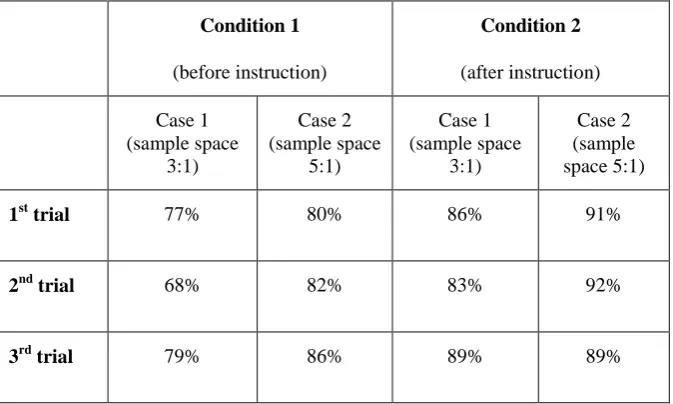
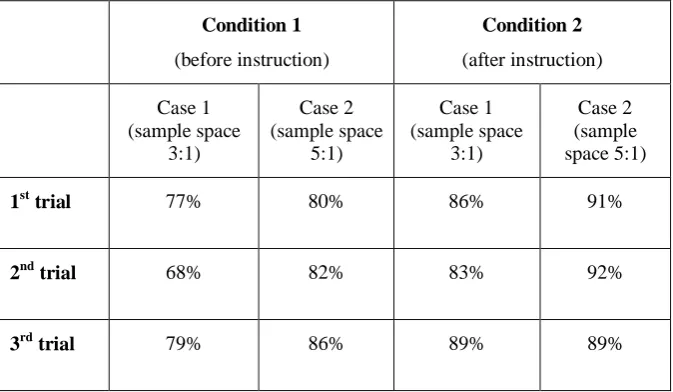
Children’s strategies and choices of MP given that they had previously selected the MP
option were traced and recorded in both Conditions and every trial and case (Table 1). By
comparing the impact of the Conditions (before and after the instruction), in Case 1, where the
sample space was 3:1, it can be seen that there is a significant difference in selecting the MP
option, t (269)= 3.59, p < 0.05. Similarly, when the sample space was 5:1, in Case 2, children gave
significantly the MP answers in Condition 2 than in Condition 1; t (269)= 3.94, p < 0.05. Such
findings entail that children at first have an intuitive understanding of predicting the most probable
outcome; but, after justification and reasoning, they obtain a better understanding and appreciation
of the likelihood of events and the notion that in problems with uneven analogies the most
probable outcome is usually the outcome that associates to the most numerous set of objects.
Table 1 Results of children’s predictions of the ‘most probable’ outcome (given that
they previously had selected the ‘most probable’ outcome)
Condition 1 (before instruction) Condition 2 (after instruction) Case 1 (sample space 3:1) Case 2 (sample space 5:1) Case 1 (sample space 3:1) Case 2 (sample space 5:1)
1st trial 77% 80% 86% 91%
2nd trial 68% 82% 83% 92%
In precise, in the 1st trial of Condition 1, case 1, the percentage of the most likely
predictions (MP1) was: P (MP 1/Ν) =70/90 = 0.77. In the 2nd trial the proportion of the correct
predictions (MP2) given that children had made a correct prediction in trial 1 (MP1) was: P
(MP2/MP1) = 48/70 = 0.68. Concerning the 3rd trial: given that children made correct predictions in
both previous trials they gave: P (MP3/MP2) = 38/48 = 0.79. In Condition 1, case 2, in the 1st trial
the percentage of the correct predictions (MP1) was: P (MP1/Ν) = 74/90 =0.82. In the 2nd trial the
percentage of the correct predictions (MP2) given that children had made a correct prediction in
trial 1 (MP1) was: P (MP2)/( MP1)= 52/74 = 0.70. Respectively in the 3rd trial given that children
made correct predictions in both previous trials they selected the most probable outcome by: P
(MP3/MP2) = 46/52 = 0.88.
Respectively, in Condition 2, in Case 1, in the 1st trial the percentage of the most probable
predictions (MP1) was: P (MP1/Ν) = 78/90 = 0.86. The 2nd time the proportion of the correct
predictions (MP2) given that children had made a most likely prediction in trial 1 (MP1) was: P
(MP2/ MP1) = 65/78 = 0.83. Concerning the 3 rd
trial: given that children made correct predictions
in both previous trials they gave: P (MP3/MP2) = 58/65 = 0.89. In Condition 2, Case 2, the first
time the proportion of the correct predictions (MP1) was: P (MP1/Ν) = 82/90 = 0.91. In the 2 nd
trial
the proportion of the most probable predictions (MP2) given that children had made a correct
prediction in trial 1 (MP1) was: P (MP2/ MP1) = 76/82 = 0.92. Concerning the 3 rd
trial, given that
children made correct predictions in both previous trials they gave: P (MP3/ MP2) = 68/76 = 0.89.
Results also show that children’s selection of the MP outcome given that they previously
had selected the most probable outcome was found to be higher when the sample space was larger;
5:1 (case 2) rather than 3:1 (case 1). This implies that the methodological design and the number
of items affect children’s responses and inferences in probabilistic games. Additionally, in terms
of sequence in the 1st trial, children started with quite high percentages of MP predictions (78.5%
for Condition 1 and 88.5% for Condition 2). In the 2nd trial they respectively gave high
percentages of MP inferences (75% in Condition 1 and 87.5% in Condition 2). Finally, the 3rd time
many children selected the most probable outcome given that they already had selected the most
probable alternative twice, by 82.5% and 89% accordingly in each Condition. Such trend implies a
learning affect, although more trials would be more revealing in this direction.
Overall, it can be seen that children at the age of 4 to 6 express stable informal
understanding of predicting an outcome as more likely. Before any justification or exploration,
children made sensible estimations about the likelihood of events; three times through both
distributions of the sample space (3:1 and 5:1) and both themes of stimuli (fruit and shapes). As in
previous studies (Jones et al 1997; Nikiforidou and Pange 2010), children at these ages seem to
possess prior intuitions concerning probabilistic concepts. Such findings support that preschoolers
have the cognitive capacity and intuitions to access basic notions of probabilities, particularly the
likelihood of events. Consequently, probabilities can be ‘mathematized’, as Clements and Stephan
(2004) would outline, as the intuitive and informal understanding of probabilities can be
re-directed and re-understood and in turn be inserted in formal educational setting from early years.
Another important conclusion that may be drawn relates to the importance of the linkage
between informal and intuitive understanding with big maths (Greenes et al 2004). Children’s
predictions before and after the didactic sequence of discussion, observation and information
processing delineated an important progress. Children gave higher responses in predicting the
most probable outcome in Condition 2 rather than in Condition 1. Personal engagement, sensory
experience with the manipulative, oral argument on what happens to the disks, motivation to win
and experimentation intervened between the two Conditions and led young children in higher
estimations about uncertain events within a contextualized problem situation.
Such constructivist aspects created a learning situation that allowed preschoolers to
realize and acknowledge the probabilistic principle that within unequal proportions the most
probable outcome is the one that is more numerous. The meaningful situation, presented as a game
and the repetition of the events stimulated their interests, experiences and realities. Children, under
the double role of ‘young scientists-players’ had the opportunity to share their opinions with their
pair and the experimenter and to express their ideas verbally in an encouraging context, as
proposed by Conole (2005). The structured and goal-oriented activity guided participants to take
advantage of their informal knowledge and organize their personal estimations in an objective and
more mathematical way.
By considering intuitions either as complementary to formal understanding (Bruner
1960), or as self-evident, subjective, holistic cognitions (Fischbein 1975), an effective educational
children already have. During the last decades there is a scientific orientation in this direction; in
enlightening what children know or understand concerning probabilistic notions, as partly
supported by the current results, and in turn how this prior knowledge and understanding may
become the starting point of instruction (Langrall and Mooney 2005).
Another methodological point to be discussed refers to the influence of the nature and the
structure of a particular task in probabilistic reasoning (Nikiforidou and Pange 2009; Pratt 2000;
Skoumpourdi et al. 2009; Spinillo 2002). Responses and participation depend on the material, the
stimuli, the design of the activity, the nature of random generators and the goal-context. In this
study, children responded to the probabilistic game composed by disks depicting fruit and shapes,
with alterations in the distribution of the sample space that didn’t exceed six items in total. They
gave higher percentages of predicting the more probable alternative in the case where the
difference in the proportion of the uneven sets was bigger. Further research could consider
modifications in the size, number and arrangement of the particular stimulus, as well as changes in
the theme or the scenario of the task. In addition, there are also broader methodological issues that
should be taken into account related to early childhood research; such future implications relate to
how and whether children’s intentions while engaging with a test could be explored accurately, or
how do children’s intentions match with the objectives set up by the experimenter, or in what
means can learning at these ages be measured and assessed, or which is the role of the
socio-cultural influences or personality traits in learning.
Under this perspective, probabilistic thinking may be enhanced in preschool settings
through what Sarama and Clements (2009) name mathematization processes: developmentally
appropriate activities and instruction programs designed in order to construct on children’s prior
knowledge by linking formal learning to personal experiences and understandings. Such informal
experiences may be guessing games, or producing narratives and predictions about the forecast or
a sports match, or elaborating on tables and graphs, or participating in board games and group
games with potential winners or getting involved in problem solving situations. Learning activities
and interactions may be based on representing and processing mathematical and statistical notions,
creating models, engaging with, and implementing relevant realities in diverse contexts.
play in all its forms, teachable moments, projects, curriculum, and intentional teaching described
by Ginsburg et al. (2008) should be taken into account too.
References
Baroody, A. J. (2004). The developmental bases for early childhood number and operations
standards. In D. H. Clements, J. Sarama, and A. M. Dibiase (Eds.), Engaging young children in
mathematics: Standards for early childhood mathematics education (pp. 173-219). Mahwah, NJ:
Lawrence Erlbaum Associates.
Baroody, A. J. and Ginsburg, H. P. (1986). The Relationship between Initial Meaningful and
Mechanical Knowledge of Arithmetic. In J. Hiebert (Ed.) Conceptual and Procedural Knowledge:
The Case of Mathematics (pp. 75-112). Hillsdale, N.J.: Lawrence Erlbaum Associates.
Bruner, J. (1996). The culture of education. Cambridge, MA: Harvard University Press.
Bruner, J. (1960). The process of education. Cambridge, MA: Harvard University Press.
Carr, M., Peters, S. & Young-Loveridge, J. (1994).Early childhood mathematics: Finding the right
level of challenge. In J. Neyland (Ed.) Mathematics Education: A handbook for teachers (pp.
271-282). Wellington: Wellington College of Education.
Clements, D.H. and Sarama, J. (2007). Effects of a preschool mathematics curriculum: summative
research on the Building Blocks project. Journal for Research in Mathematics Education, 38,
136-163.
Clements, D. H., and Stephan, M. (2004). Measurement in pre-k to grade 2 mathematics. In D. H.
Clements and J. Sarama (Eds.), Engaging young children in mathematics: Standards in early
childhood mathematics education (pp. 299-320). Mahwah, NJ: Lawrence Erlbaum.
Conole, M. (2005). Mathematics in early childhood. ACE papers, 16, 91-103
Copley, J. (2000). The young child and mathematics. Washington DC: National Association for
DeVries, R., Zan, B., Hildebrandt, C., Edmiaston, R., & Sales, C. (2002). Developing
constructivist early childhood curriculum: Practical principles and activities. New York: Teachers
College Press.
Denison, S., Konopczynski, K., Garcia, V., and Xu, F. (2006). Probabilistic reasoning in
preschoolers: random sampling and base rate. In R. Sun and N. Miyake (eds.), Proceedings of the
28th Annual Conference of the Cognitive Science Society (pp. 1216-1221).
European Commission (2006), Classification for Learning Activities – Manuals. Luxembourg:
Eurostat.
Fischbein, E. (1975). The intuitive sources of probabilistic thinking in children. Dordrecht, The
Netherlands: Reidel.
Ginsburg, H., Greenes, C., and Balfanz, R. (2003). Big math for little kids. Parsippany, NJ: Dale
Seymour Publications.
Ginsburg, H. P. (2009). The challenge of formative assessment in mathematics education:
Children’s minds, teachers’ minds. Human Development, 52, 109-128.
Ginsburg, H. P., Lee, J. S. and Boyd, J. S. (2008). Mathematics education for young children:
What it is and how to promote it. Social Policy Report of the Society for Research in Child
Development, 22, 3–23.
Greenes, C. (1999). Ready to learn: Developing young children’s mathematical powers. In J.
Copley (Ed.), Mathematics in the early years (pp. 39–47). Reston, VA: National Council of
Teachers of Mathematics.
Greenes, C., Ginsburg, H. and Balfanz, R.(2004). Big math for little kids. Early Childhood
Research Quarterly, 19, 159-166.
Jonassen, David H. and Grabowski, Barbara L. (1993). Handbook of Individual Difference,
Jones, G., Langrall, C., Thornton, C. and Mogill, T. (1997). A framework for assessing and
nurturing young children’s thinking in probability. Educational studies in Mathematics, 32,
101-125.
Jones, M. and Brader-Araje, L. (2002). The impact of constructivism on education: Language,
discourse, and meaning, American Communication Journal, 5, 1-9
Kushnir, T. and Gopnik, A. (2005). Young Children Infer Causal Strength From Probabilities and
Interventions. Psychological Science, 16(9), 678- 683.
Langrall, C.W. and Mooney, E.S. (2005): Characteristics of elementary school students’
probabilistic reasoning. In G.A. Jones (Ed.), Exploring probability in school: Challenges for
teaching and learning (pp. 95-119). Berlin: Springer,
Newcombe, N. S., and Huttenlocher, J. (2000). Making space: The development of spatial
representation and reasoning. Cambridge, MA: MIT Press.
Nikiforidou Ζ. and Pange, J. (2009). Does the nature and amount of posterior information affect
preschooler’s inferences? In V. Durand-Guerrier, S. Soury-Lavergne, and F. Arzarello (Eds.),
Proceedings of the Sixth Congress of the European Society for Research in Mathematics
Education (pp. 388 – 393). Lyon: INRP, France.
Nikiforidou, Z. and Pange, J. (2010). Τhe notions of chance and probabilities in preschoolers.
Early Childhood Education Journal, 305-311.
Piaget, J. (1970). Genetic epistemology. New York: W.W. Norton and Company.
Pratt, D. (2000). Making sense of the total of two dice. Journal for Research in Mathematics
Education, 31(5), 602- 625.
Sarama, J. & Clements, D. H. (2006). Introducing geometry to young children. Early Childhood
Today, 20(7), 12-13.
Sarama, J. and Clements, D.H. (2009). Early childhood mathematics education research: learning
Seo, K. and Ginsburg, H. (2004). What is developmentally appropriate in early childhood
mathematics education? Lessons from new research. In D. Clements, J. Sarama and A. Dibiase
(Eds.), Engaging young children in mathematics: Standards for early childhood mathematics
education (pp. 91 – 104). Hillsdale, NJ: Erlbaum.
Skoumpourdi, C., Kafoussi, S. and Tatsis, K. (2009). Designing Probabilistic Tasks for
kindergartners. Journal of Early Childhood Research, 7(2), 115-134.
Spinillo, A. G. (2002). Children’s use of part-part comparisons to estimate probability. Journal of
Mathematical Behavior, 21, 357-369.
Vygotsky, L. S. (1986). The genetic roots of thought and speech. In A. Kozulin (Trans. and Ed.),
Thought and language. Cambridge, MA: MIT Press.
Fig 1 Example of the stimulus
Fig 2 The decision tree through each trial
MP1 LP1
MP2 LP2
LP3 LP3
MP3 2
MP2 LP2
MP3
LP3
MP3
LP3 MP3
MP = correct prediction
LP = incorrect prediction
2
nd t
ria
l
1
st t
ria
l
3
rd t
ria
l
Trial 1 Trial 2 Trial 1 Trial 2
Condition 1 Condition 2 Figure
Table 1 Results of children’s predictions of the ‘most probable’ outcome (given that they
previously had selected the ‘most probable’ outcome)
Condition 1
(before instruction)
Condition 2
(after instruction)
Case 1 (sample space
3:1)
Case 2 (sample space
5:1)
Case 1 (sample space
3:1)
Case 2 (sample space 5:1)
1st trial 77% 80% 86% 91%
2nd trial 68% 82% 83% 92%
3rd trial 79% 86% 89% 89%
Table