IOS Press
Array
P
Systems and
t
−
Communication
K. G. Subramanian∗, Rosihan M. Ali School of Mathematical Sciences
Universiti Sains Malaysia, 11800 Penang, Malaysia
Atulya K. Nagar
Deanery of Business and Computer Sciences,
Liverpool Hope University,
Hope Park, Liverpool L16 9JD, UK
Maurice Margenstern
LITA, Universite Paul Verlaine-Metz,
Ile du Saulcy, 57045 Metz Cedex, France
Abstract. The two areas of grammar systems and P systems, which have provided interesting computational models in the study of formal string language theory have been in the recent past effectively linked in [4] by incorporating intoP systems, a communication mode calledt−mode of cooperating distributed grammar systems. On the other hand cooperating array grammar systems [5] and arrayP systems [1] have been developed in the context of two-dimensional picture description. In this paper, motivated by the study of [4], these two systems are studied by linking them through thet−communication mode, thus bringing out the picture description power of these systems.
Keywords: Grammar systems, P systems, Picture languages, Array grammars
1.
Introduction
The theory of grammar systems [3] has provided an effective grammatical framework for capturing several phenomena characteristic of multi-agent systems. Different kinds of grammar systems have been introduced and investigated in the literature to capture various features such as cooperation, distribution, communication, parallelism and so on. On the other hand the new computability model introduced by Pˇaun [11] inspired by the structure and functioning of living cells has proved to be a rich frame work for obtaining universality results and studying many computational problems. Although these two areas originated from different motivations and the models were formulated with different basic structures, recently these two have been linked in [4], by incorporating into rewritingP systems [11], a communication mode calledt−mode of cooperating distributed (CD) grammar systems [3]. The power of the resultingP systems is investigated in [4] by comparing them with CD grammar systems.
In theoretical studies on generation and analysis of images or pictures in the two-dimensional plane, syntactic techniques have constituted one of the main areas of study. Motivated by different applications such as character recognition, pictorial information system design, pattern recognition and so on, several types of two-dimensional picture generating systems have been proposed in the literature [13, 14, 7, 2, 25, 24] extending to two-dimensions the well-known Chomskian string grammars [16] or Lindenmayer systems [15] or Marcus contextual grammars [6, 10] and others.
The power of the mechanism of cooperation in generating pictures by array grammars is investigated in [5]. It is shown in [5] that the power of cooperating array grammar systems is strictly greater than that of context-free array grammars. In fact the generative power is increased even in the case of systems with components having regular array grammar rules which is in contrast to the string case. On the other hand in [1], array P systems are considered extending the string-objects P systems to array-objects P systems, thus bringing together the two areas of membrane computing and picture grammars considered in the form of two-dimensional (2d) array grammars. It is shown in [1] that P systems with array context-free rules are computationally universal. The array P system in [1] uses an extended alphabet which includes a terminal alphabet, has internal output with the result being obtained in a specified membrane and considers halting computations.
Motivated by the study in [4], here we incorporate into array P systems thet−mode of communica-tion of cooperating array grammar systems, and examine the power of the array P systems, thus providing a natural extension of the study in [4] to picture arrays.
2.
Basic Definitions and examples
We refer to [16] for notions of formal language theory and to [5] for array grammars and array languages. For notions pertaining to P systems, we refer to [11] and for grammar systems to [3].
An alphabet V is a finite set of symbols. A word or a stringw over V is a sequence of symbols from V. The set of all words, including the empty word λwith no symbols, is denoted by V∗ and
V+
=V∗−λ.
The pictures that we consider are arrays consisting of finitely many symbols from a given alphabet
V with the symbols placed in the points of the plane and the points not marked with elements of V
representation for 2D finite arrays indicating their non-blank pixels. Also we take into account only the relative positions of non-blank pixels in the array. For example, the T-shaped array with equal arms in Figure 1 is formally given by
{((0,4), a), ((1,4), a), (2,4), a), ((3,4), a), ((4,4), a), ((5,4), a), ((6,4), a),
((7,4), a), ((8,4), a), ((4,0), a), ((4,1), a), ((4,2), a), ((4,3), a)}
a a a a a a a a a a
a a a
Figure 1: T-shaped array with equal arms
We denote byV+2
the set of all two-dimensional non-empty finite arrays overV. The empty array is denoted byλ, and then the set of all arrays overV isV∗2
=V+2
∪ {λ}. Any subset ofV∗2
is called an array language.
The array grammars we consider here are extensions of string grammars to two dimensional pictures [5, 2, 26].
An array rewriting rulepoverV is of the formp:A −→ BwhereAandBare arrays overV. For two arraysC,DoverV and a rulepas above, we writeC=⇒pD(C=⇒ Dwhenpis understood), ifD
can be obtained by replacing a subarray ofCidentical toAwithB. The reflexive and transitive closure of the relation=⇒is denoted by=⇒∗.
An array productionp= (W,A,B)is called:
1. monotonic, if the symbol positions ofAare all contained inB; 2. #-context-free, if there is exactly one nonblank symbol inA; 3. context-free, if it is both monotonic and#-context-free.
An array grammar is a five-tupleG= (N, T,#,{((0,0), S)}, P), whereN, T are disjoint alphabets of nonterminal symbols and of terminal symbols, respectively,#∈/ N∪T is the blank symbol,S ∈N, and P is a finite set of array productions A −→ B such that at least one pixel ofAis marked with an element ofN; usually, the axiom array{((0,0), S)}will be simply written asS.
An array grammar is monotonic, #-context-free, or context-free if all its rules are of these types; clearly, in the case of #-context-free and context-free grammars, there is a unique non-blank pixel in the left hand array of each rule, marked with a nonterminal. Regular array grammar rules are of the
following forms: A # → a B, #A → B a, #
A →
B a ,
A
# →
a
The array language generated byGis
L(G) ={A ∈T∗2
| {((0,0), S)} =⇒∗ A}.
The families of array languages generated by arbitrary, monotonic,#-context-free, context-free, and regular array grammars are denoted by ARE, AM ON, A#CF, ACF, AREG respectively. The fol-lowing strict inclusions are known: AREG⊂ ACF ⊂AM ON ⊂ARE,ACF ⊂A#CF ⊂ARE. Here we deal with only the familiesACF andAREG.
The two-dimensional matrix grammars introduced in [17] and studied extensively in the literature (to quote a few [18, 8, 20, 19]) generate only rectangular arrays over terminals. We briefly recall these grammars. A 2dmatrix grammar has two components (G1, G2) where G1 is a Regular, CF orCS grammar generating in the first phase strings over a set of symbols{S1, S2,· · ·, Sk}, called
intermedi-ates;G2= (G21, G22,· · · , G2k)where eachG2iis a regular grammar corresponding toSiand has right
linear production rules of the formX →aY orX →awhereX, Y are nonterminals ofG2i andais a
terminal ofG2i.
Gis a regular, context-free, context-sensitive2dmatrix grammar ifG1 is regular, context-free, con-text sensitive respectively. Derivations are defined as follows: First a string over the intermediates ofG1 is generated horizontally using the rules ofG1. Vertical derivations then proceed in parallel using the rules ofG2i generating rectangular arrays over terminal symbols ofG2iswhen the vertical derivation
terminates.
The setL(G)consists of allm×narrays generated byG. We denote the picture language classes of regular,CF 2dMatrix grammars by2dRM L, 2dCF M L,respectively.
Now we very briefly mention the notion of cooperating array grammar system defined in [5]. The idea is analogous to string cooperating grammar system [3] except that array rewriting rules are taken in the components of the system. The family of array languages generated by cooperating array grammar systems consisting of at mostncomponents with the rules in the components either regular or CF array rewriting rules and in the t−mode of derivation, is denoted by CDn(REGA, t) and CDn(CF A, t)
according as all the components use regular rules or at least one component uses non-regular CF rules. In [5] an extensive investigation of the power of these systems is done.
We now briefly and informally recall a specific basic model of string-rewriting P systems and com-putations carried out in such systems. A comprehensive account of these systems can be found in [11] or at the web addresshttp://psystems.disco.unimib.it.
In the regions of a string-rewriting P system defined by a hierarchical arrangement of membranes, objects which are strings of symbols are processed by rewriting rules (or other string handling operations) associated with the membranes. A typical rewriting rule used in a string-objects membrane system (also called P system) is of the form X → u(tar), where X → u is a usual context-free rule, and
unchanged. All strings, from all regions, are rewritten at the same time. A sequence of such steps is called a computation; a computation provides a result only if it halts, and a configuration of the system is reached where no further rule can be applied. The result of a computation is the set of strings present in the halting configuration in a specified elementary membrane; if acceptance is defined by collecting only the strings over a specified terminal alphabet, then the system is called extended and otherwise, it is called non-extended. We have described here a specific type of rewriting P systems, namely one with internal output in which the result is obtained in a specified membrane and with halting computations and this model has proved to be very useful in the array case.
We now very briefly mention computation in the basic model of a rewriting array-objectsP system introduced in [1].
A computation in an array P system Π is defined in the same way as in the string rewriting P
system described earlier with the successful computations being the halting ones: In the compartments of a membrane structure we place arrays, which evolve by means of array rewriting rules. The result of a computation is the set of arrays collected in a specified elementary membrane in the halting configuration. The family of all array languages generated by systemsΠas above, with at mostmmembranes, with rules of typeα ∈ {REG, CF}is denoted byEAPm(α)whereREG, CF respectively refer to regular
and context-free array rewriting rules ; if non-extended systems are considered (that is, we haveV =T; in such a case we ignore the condition to have at least one nonterminal pixel in the left hand side of rules), then we writeAPm(α).
3.
Array P system with
t
mode of communication
Csuhaj-Varju et al [4] have brought out the relationsihp between coperating distributed string grammar systems and string-objects P systems by linking them through thet−derivation mode. Dassow et al [5] have incorporated the t−mode of derivation in their study of cooperating array grammar systems and have demonstrated the power of this mechanism of t−mode of derivation, besides establishing other results. Motivated by the studies in [4], we now introduce an arrayP system withtmode of communi-cation.
APsystem (of degreem≥1) with array-objects andt−communication (or in short, at−communicating arrayP system of typeα,(tEAP Sm(α, β)), α∈ {tin, tout}, β ∈ {REG, CF}is a construct
Π = (V, T,#, µ, F1, . . . , Fm, R1, . . . , Rm, io),
where:
1. V is the total alphabet,
2. T ⊆V is the terminal alphabet,
3. #is the blank symbol,
4. µis a membrane structure withmmembranes labelled in a one-to-one way with1,2, . . . , m,
6. R1, . . . , Rmare finite sets of array rewriting rules overV associated with themregions ofµ; the
array-rewriting rules are context-free of the formA → BorA → B(tar)andtar∈ {out,in}; In
a given system at most one of the target indicationsinandoutmay be present in the rules of the regions.
7. io is the label of an elementary membrane ofµ(the output membrane).
The computation starts in the usual way with the arrays, if any, ofFiinitially present in theithregion
1 ≤ i ≤ m.Each array in every membrane regioniis rewritten by any available array-rewriting rule in the region Ri; only one rule, nondeterministically chosen, is applied to each array in every region.
We now describe the manner in which the arrays are communicated or sent among the regions.If an array-rewriting rule has target indicationin, then the array to which it is applied is non-deterministically sent to one of the immediately direct inner regions and if no such region exists such a rule cannot be applied. If an array-rewriting rule has target indicationout, then the array to which it is applied is sent to its immediately direct upper region. If an array-rewriting rule has no target indication, then the array to which it is applied remains in the same region if it can be further rewritten there but if no rule can be applied to it in that region, then one of the following actions is done depending on the system is of type
tinortout.
1. At−communicating arrayP system of typetinhas array-rewriting rules in its regions with target indicationout or no target indication (and does not have rules with target indicationin). In fact when an array cannot be further rewritten in a region, it is sent to the immediately direct inner region if one such region exists. In other words the t−mode or maximal derivation performed enforces theintarget command. If the membrane is elementary, the rewritten array remains there.
2. At−communicating arrayPsystem of typetouthas array-rewriting rules in its regions with target indicationin or no target indication (and does not have rules with target indicationout). In fact when an array cannot be further rewritten in a region, it is sent to the immediately direct outer region if one such region exists. In other words the t−mode or maximal derivation performed enforces theouttarget command.
Remark 3.1. In defining correct computations, the halting condition has proved to be useful in the array case as has been noted in [1]. Here we therefore deal only witht−communicating arrayPsystem of type
tinin the rest of the study and so we writetEAP Sm(REG), tEAP Sm(CF),with the understanding
that the type of the system istin.
The set of all arrays computed or generated by a t−communicating P system Π is denoted by
tAL(Π).The family of all array languagestAL(Π)generated by such systemsΠwith at mostm mem-branes and rules of typeα∈ {REG, CF}is denoted bytEAPm(α).
Example 1. Consider thet−communicating arrayP system,tEAP S4(REG),
Π1 = ({A, B, C, A0, B0, C0, X, Y, a},{a},#,[1[2[3[4]4]3]2]1,
(
A X B C
)
,∅,∅,∅, R1, R2, R3, R4,4),
R1 ={ #A → A0a , B# → a B0 , C
# →
R2 ={ A0 → A , B0 → B , C0 → C , Y → X (out)} R3 ={ X → Y (out), X → a }
R4 ={ A → a , B → a , C → a }
Starting with the array
(
A X B C
)
initially present in region1of the system, the “horizontal” and the
“vertical” “arms” are grown once and due to the maximal mode of derivation and typetinof the system, the array is sent to the inner region2wherein the cells with labelsA0, B0, C0are respectively changed into
A, B, C.Again due to thetintype the array is sent to region3.If the rule used is X → Y , the target
indication outsends it immediately to region2wherein the rule that can be used is only Y → X
with target indication outand so the array is sent to region1.The process repeats. But if the rule used in region3is X → a , then the array enters region4, the nonterminals are changed into the terminal
aand the array generated is in the form of the letter T (Figure 1) with all three “arms” of equal length. These arrays constitute the language generated.
Example 2. Consider thet−communicating arrayP system,tEAP S4(CF),
Π2= ({A, B, C, A0, B0, C0, X, Y, a},{a},#,[1[2[3[4]4]3]2]1,
(
A C X B
)
,∅,∅,∅, R1, R2, R3, R4,4),
R1 ={ #
A →
A0
a ,
# #
C# →
A0C0
a B0 , B #→a B 0}
The rules inR2, R3, R4 are as in example 1.
Starting with the array
(
A C X B
)
initially present in region 1 of the system, the border made of the
top row and rightmost column is grown just to increase the size of the array by one in both row and column, thus maintaining the “square” shape. The rest of the computation is similar to the example 1, finally yielding solid “square” arrays (Figure 2) over the terminal symbolaand these are collected in the region 4.
a a a a a a a a a a a a a a a a a a a a a a a a a a a a a a a a a a a a
Figure 2: A Solid square ofa0s
Remark 3.2. It is known that the setSsof alln×n(n≥2)solid squares overa,can be generated [26]
the difference is that the number of rules required in the former case is very large whereas in the case of Π2,we have only 12 rules in all the 4 membranes together. It remains to be seen whether the number of rules can still be reduced.
The following results in Theorem 3.1 are immediate from the definition oft−communicating array
P system.
Theorem 3.1. 1. ForX∈ {AREG, ACF}, X ⊆tEAP1(X) 2. ForY ∈ {REG, CF}, tEAPn(Y)⊆tEAPn+1(Y), n≥1
3. tEAPn(REG)⊆tEAPn(CF), n≥1
Theorem 3.2. 1. 2dRM L⊂tEAP4(CF) 2. tEAP4(CF)−2dCF M L6=∅
Proof:
Every2dRM Lgenerated by a2dRM G Gcan be simulated by atEAP S4(CF) Π(of typetin) which is described below: We can assume that the rules in the first phase of the2dRM G Gare of the form
X → AY or X → A where X, Y are nonterminals in the first phase of G and A is a terminal symbol (also called intermediate) of the first phase of G. Π has four membranes having a structure [1[2[3[3[4]4]3]2]1. In regions 2, 3 and 4 initially there are no array-objects.
In the region 1 of Π, the start symbol of the 2dRM G is the initial array object. For every rule of the first phase of the2dRM Gof the formX → AY, whereX, Y are nonterminals of the first phase andA an intermediate, we include a ruleX# → AY in region 1. For each rule of the formX → A,
whereX is a nonterminal of the first phase andAan intermediate, we include in region 1, a rule of the formX → [A,1]where [A,1]is a new symbol and corresponds toA. Also rules of the of the forms
A
# →
a B0 ,
[A,1] # →
a
[B,1] are included in region 1, corresponding to a regular ruleA→aBin
the second phase of the 2dRM G, where [A,1],[B,1] are new symbols that respectively correspond toA, B.
Region 2 has rules of the formA0 → A whereA0 is a new symbol corresponding to the nonterminal
Aof the second phase of the2dRM G. Also rules of the forms[A,1]→[A,2],[A,3]→ [A,1](out)are included in region 2, for every such[A,1], where[A,2],[A,3]are new symbols that correspond to[A,1].
In region 3, for every such symbol [A,2] created, a rule of the form [A,2] → [A,3](out) is added. Also, ifA→ais a terminal rule in phase 2 of the2dRM G, we add a rule[A,2]→ain region 3.
It can be seen that due to the t− mode of rewriting in the regions and the type tin of the system Π,
the first phase of the2dRM Gis simulated in region 1 starting from start symbol (array)S except that in the strings generated the last symbol will be of the form [A,1]for some intermediate A.Also one step of “vertical” derivation of the second phase of the 2dRM Gis also simulated in this region. The resulting array is passed on to the region 2 wherein the nonterminals (of the second phase of2dRM G) are changed into their primed versions but the symbol of the form[A,1]is changed into[A,2]. The result is passed on to region 3 wherein if the rule[A,2]→[A,3](out)is used, the array is sent back to region 2 and an application of the only possible rule[A,3]→[A,1](out)sends it to region 1 and the process is repeated. Otherwise, an application of the rule of the form[A,2] → asends it to region 4 wherein the terminal rules of the second phase of the2dRM Gare used yielding the terminal arrays generated by the 2dRM G.This shows the inclusion in the first statement.
The proper inclusion in the first statement is due to the fact that no2dCF M Gand hence no2dRM G
can generate the setSsof solid squares over{a} as the derivations in the two phases of the2dRM G
are independent of each other. But from example 2, Ss ∈ tEAP4(CF). This also proves the second
statement. ut
Remark 3.3. In [8], a variation of 2dRM G is considered by allowing “vertical” derivations to take place with the columns “growing” either up or down in parallel. This model can also be generated by a
tEAP S4(CF) as in Theorem 3.2. The rules in the regions are to be suitably modified to take care of ‘up’ or ‘down’ rewriting in the variation [8] of the2dRM G.
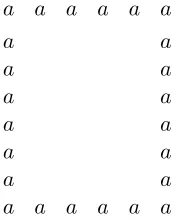
LetRhbe the set of all hollow rectangles over the symbol{a},a member of which is shown in Figure
3. LetShbe the set of all hollow squares over the symbol{a},in which all the sides are of equal length.
a a a a a a
a a
a a
a a
a a
a a
a a
a a a a a a
Figure 3: A hollow rectangle ofa0s
Theorem 3.3. 1. Rh∈tEAP2(REG)∩CD2(REG, t) 2. tEAP2(REG)−ACF 6=∅
Proof:
R1 ={ #
S →
S a ,
#
S →
X
a , X# → a A , A# → a A ,
A# → a Y , Y
# →
a B ,
B
# →
a B ,
B
# →
a Z ,
#Z → C a , #C → C a , #C → D a , #
D →
F a } R2 ={D→a}
Starting from S and using rules of region R1 a vertical line ofa0s (the leftmost column of a rectan-gle) is grown until the generation turns right on an application of the rule X# → a A to grow a
horizontal line ofa0s(the topmost row of the rectangle). The application of the rule Y # →
a B turns
the generation down to grow again a vertical line ofa0s(the rightmost column of the rectangle) until the application of the rule #Z → C a which turns the generation to the left again to grow a horizontal line ofa0s(the bottommost row of the rectangle). If the generation ends in region 1 with a correct appli-cation of the rule #C → D a (the correct application is indicated by non-applicability of the rule
#
D →
F
a ) the array is then sent to region 2 due totintype and the hollow rectangle ofa
0sis formed
by an application of the ruleD→a.
An incorrect application of the rule #C → D a will end the generation with an application of
the rule #
D →
F
a ,again sending the array to region 2 where it remains forever but not collected as a
member in the language as it has a nonterminalFin it. It is known [5] thatRh ∈CD2(REG, t).In fact the generation of a hollow rectangle ofa0sin thet−communicating array P system given here is based on the technique used in [5] except that the typetinof the arrayP system is crucial in sending the array to region 2. This proves statement (1).
The statement (2) follows from (1) by noting that the set Rh of all hollow rectangles over a symbol
ais not inACF as no CF array grammar can generate it [26]. ut
Theorem 3.4. 1. Sh ∈tEAP5(REG)∩CD3(CF A, t) 2. Sh ∈/ CDn(REGA, t), n≥1
3. tEAP5(REG)−CDn(REGA, t)6=∅, n≥1
Proof:
The setShis generated by the followingt−communicating arrayP systemtEAP S5(REG)
Π4 = ({U, R, U0, R0, X, Y, R00, U00, Z, F},{a},[1[2[3[4[5]5]4]3]2]1,
(
U X R
)
,
R1 ={ #
U →
U0
a , R# → a R
0 },
R2 ={ U0 → U , R0 → R , Y → X (out)} R3 ={ X → Y (out), X → a }
R4 ={ U# # → a a R00 , R00# → a R00 , R00 → a , # # R → U00 a a , #
U00 →
U00
a ,
#
U00 →
Z
a , #Z → F a } R5 ={ Z → a }
Starting with the initial array
(
U X R
)
each of the leftmost column and the bottommost row of the
hollow square of a0sis grown one step by the application of the rules #
U →
U0
a , R# → a R
0
and the array is passed on to the region 2 due to thetintype of the system wherein the symbolsU0, R0 are changed intoU, Rrespectively and then sent to region 3, again due to thetintype of the system. If the rule applied isX→Y(out),then the array is immediately sent back to region 2 where the only rule applicable isY →X(out)which sends it to region 1 and the process repeats.
But if the rule applied in region 3 isX →a,then the array is sent to region 4 again due to thetintype of the system. In region 4, the uppermost side and rightmost side are grown. A correct application of the rules makes the growing uppermost side and the rightmost side meet at the right position thus yielding a hollow square ofa0sexcept for the ‘northeast’ corner symbol which isZ.Thetintype of the system sends the array to region 5 where the symbol Z is changed intoathus yielding a hollow square ofa0s in the language generated. On the other hand an incorrect application of the rules in region 4 will send an array with a nonterminal F orU”to region 5 where it remains forever. This proves the statement (1). It is known [5] that Sh ∈ CD3(CF A, t).Statement (2) is due to [5]. Statement (3) follows from
statements (1) and (2). ut
Another model of grammars called Puzzle grammar has been introduced in [9] as an array generating two-dimensional grammar motivated by the problem of tiling the plane. It is known that context-free puzzle grammars (CFPG) and context-free array grammars (CFAG) coincide [9] whereas a subclass of CFPG, called Basic Puzzle grammars is known [21] to properly include the class of RAG’s.
A −→ a
B , A −→ a
B A −→ B
a , A −→ B
a
A −→a
B
, A −→ a
B
, A −→ B
a
, A −→B
a
, A −→a
A Basic Puzzle grammar consists of rules analogous to the rules of a regular array grammar but one of the symbols in the right side of the rule is circled. We give here the types of rules. (HereA, B ∈N
anda∈T.)
Derivations begin withSwritten in a unit cell in the two-dimensional plane, with all the other cells containing the blank symbol#, not inN ∪T. In a derivation step, denoted⇒, a non-terminal Ain a cell is replaced by the right-hand member of a rule whose left-hand side isA. In this replacement, the circled symbol of the right-hand side of the rule used, occupies the cell of the replaced symbol and the non-circled symbol of the right side occupies the cell to the right or the left or above or below the cell of the replaced symbol depending on the type of rule used. The replacement is possible only if the cell to be filled in by the non-circled symbol contains a blank symbol.
The set of pictures or arrays generated byG, denotedL(G), is the set of connected, digitized finite arrays overT, derivable in one or more steps from the axiom.
In [22] cooperating basic puzzle grammar systems with components having basic puzzle grammar rules and maximal mode of derivation has been considered and their picture generating power has been examined. The family of array languages generated by such systems with at most n components in the maximal derivation mode is denoted byCDn(BP G, t).On the other hand in [23] arrayP systems
with array objects and basic puzzle grammar rules in the regions of the system are considered. TheseP
systems are called as BPG arrayP systems. Here we can incorporatet−communication in these BPG arrayPsystems. We denote bytEAP Sm(BP G)such an arrayP system having at mostmmembranes
and having BPG rules and array objects in its regions and type tin. The family of array languages generated by such systems is denoted bytEAPm(BP G)
LetRhf be the set of all hollow rectangular frames over the symbol{a},a member of which is shown
in Figure 4.
a a
a a a a a a a a
a a
a a
a a a a x a a a
a a
Figure 4 : A Rectangular frame ofa0s
Theorem 3.5. 1. Rhf ∈tEAP2(BP G)∩CD2(BP G, t) 2. tEAP2(BP G)−ACF 6=∅
Proof:
The setRhf is generated by the followingt−communicating arrayP systemtEAP S2(BP G)
P1 ={S → a , S→ a , A→a B , B → C ,
S A a
C → a C , C→ D a , D→ E , E → a ,
a
F
I → J a , J →J a , J →K a , K → a ,
Z
F → a , F → I }
F
a
P2 ={K → X , X→a Y , Y → a }
a
It can be seen thatRhf is generated by thet−communicating arrayPsystemΠ5.The generation will proceed analogous to the generation of a rectangle in the proof of Theorem 3.4 except that the ‘protru-sions’ in the corners will be produced. It is known [23] thatRhf ∈CD2(REG, t).In fact the generation of a hollow rectangular frame ofa0sin thet−communicating array P system given here is based on the technique used in [23] except that the typetinof the arrayP system sends the array to an inner region. This proves statement (1).
The statement (2) follows from (1) by noting that the set Rhf of all hollow rectangular frames over
a symbolais not inACFas no CF array grammar can generate it [5]. ut
4.
Conclusion
We have examined in this paper the relationship between the two array generating models, namely ar-ray grammar systems and arar-ray P systems by extending thet−derivation mode of cooperating array grammar systems [5] to rewriting P systems [1] with array objects and array-rewriting rules. We have also compared the power of thet−communicating arrayPsystems with other array grammar models. It remains to be seen whether the number of membranes used in the examples and results could be reduced. Although thetintype of the system considered here has proved to be very useful in view of the halting condition in computations, it remains to examine the power of the other typetout.This might require a different approach in the way of defining successful computations.
Acknowledgements
in Theorem 3.2. The first two authors K.G. Subramanian and Rosihan M. Ali acknowledge support from FRGS grant and RU grant of the Universiti Sains Malaysia for this research.
References
[1] R. Ceterchi, M. Mutyam, Gh. Pˇaun and K.G. Subramanian, Array - rewriting P systems, Natural Computing,
2 (2003), 229-249.
[2] C.R. Cook, P.S.-P. Wang , A Chomsky hierarchy of isotonic array grammars and languages, Computer
Graphics and Image Processing, 8 (1978), 144-152.
[3] E. Csuhaj-Varju, J. Dassow, J.Kelemen, Gh. Pˇaun, Grammar systems: A grammatical approach to
distrib-ution and cooperation , Gordon and Breach Science Publishers, 1994.
[4] E. Csuhaj-Varju, G. Vaszil, Gh. Pˇaun, Grammar systems versus membrane computing: The case of CD grammar systems, Fundamenta Informaticae, 76 (2007), 271-292.
[5] J. Dassow, R. Freund, Gh. Pˇaun , Cooperating array grammar systems,Int. J. of Pattern Recognition and
Artificial Intelligence, 9 (1995), 1029-1053.
[6] A. Ehrenfeucht, Gh. Pˇaun, G. Rozenberg, Contextual grammars and formal languages. In: G. Rozenberg and A. Salomaa (eds.), , Handbook of Formal Languages, Springer-Verlag, Vol. 2 (1997), 237-293.
[7] D. Giammarresi, A. Restivo, Two-dimensional languages, In: G. Rozenberg and A. Salomaa (eds.), ,
Handbook of Formal Languages, Springer Verlag, Vol.3, (1997), 215 - 267.
[8] K. Krithivasan, Variations of the matrix models, Int. J. Computer Mathematics, 6 (1977), 171-190.
[9] M. Nivat, A. Saoudi, K.G. Subramanian, R. Siromoney, R. and V.R. Dare, Puzzle grammars and context-free array grammars, Int. J. Pattern Recognition and Artificial Intelligence, 5 (1991), 663-676.
[10] Gh. Pˇaun, Marcus Contextual Grammars, Kluwer Academic Publishers, Dordrecht-Boston-London, 1997.
[11] Gh. Pˇaun, Membrane Computing : An Introduction, Springer-Verlag Berlin, Heidelbrg, 2000.
[12] S.C. Reghizzi and M. Pradella, Tile rewriting grammars and picture languages, Theoretical Computer
Sci-ence, 340 (2005), 257-272.
[13] A. Rosenfeld, Picture Languages, Academic Press, Reading, MA, 1979.
[14] A. Rosenfeld, R. Siromoney, Picture Languages-A Survey, Languages of Design, 1 (1993), 229-245.
[15] G. Rozenberg and A. Salomaa, The Mathematical Theory of L systems, Academic Press, New York, 1980.
[16] A. Salomaa, Formal Languages, Academic Press, New York, 1973.
[17] G. Siromoney, R. Siromoney, K. Krithivasan, Abstract families of matrices and picture languages, Computer
Graphics and Image Processing, 1 (1972), 234-307.
[18] R. Siromoney, K.G. Subramanian, K. Rangarajan, Parallel/Sequential rectangular arrays with tables, Int.J.
Computer Mathematics, 6 (1977) 143-158.
[19] R. Stiebe, Slender Siromoney Matrix Languages, Proceedings of the1stInternational Conference on Lan-guage and Automata: Theory and Applications, Tarragona, Spain, 2007.
[21] K.G. Subramanian, R. Siromoney, V.R. Dare, and A. Saoudi, Basic Puzzle Languages, Int.J. Pattern
Recog-nition and Artificial Intelligence, 9 (1995), 763-775.
[22] K.G. Subramanian, R. Saravanan, P. Helen Chandra, Cooperating Basic Puzzle Grammars, Lecture Notes
in Computer Science, 4040 (2006), 354-360.
[23] K.G. Subramanian, R. Saravanan, M. Geethalakshmi, P. Helen Chandra, M. Margenstern, P systems with array objects and array rewriting rules, Progress in Natural science, 17 (2007) 479-485.
[24] K.G. Subramanian, D. L. Van, P. Helen Chandra, N. D. Quyen, Array Grammars with Contextual Opera-tions, Fundamenta Informaticae, 83 (2008), 411-428.
[25] P.S.P. Wang, Some new results on isotonic array grammars, Information Processing Letters, 10 (1980), 129-131.