Probabilistic Bounds on the Length of a Longest Edge in Delaunay Graphs of
Random Points in d-Dimensions
Esther M. Arkina, Antonio Fern´andez Antab, Joseph S. B. Mitchella, Miguel A. Mosteiroc,∗
aDepartment of Applied Math and Statistics, Stony Brook University, USA. bIMDEA Networks Institute, Spain.
cComputer Science Department, Kean University, USA.
Abstract
Motivated by low energy consumption in geographic routing in wireless networks, there has been recent interest in determining bounds on the length of edges in the Delaunay graph of randomly distributed points. Asymptotic results are known for random networks in planar domains. In this paper, we obtain upper and lower bounds that hold with parametric probability in any dimension, for points distributed uniformly at random in domains with and without boundary. The results obtained are asymptotically tight for all relevant values of such probability and constant number of dimensions, and show that the overhead produced by boundary nodes in the plane holds also for higher dimensions. To our knowledge, this is the first comprehensive study on the lengths of long edges in Delaunay graphs.
Keywords:
Multidimensional Delaunay Graphs, Random Geometric Graphs, Radio Networks
1. Introduction
We study the length of a longest Delaunay edge for points randomly distributed in multidimensional Euclidean spaces. In particular, we consider the Delaunay graph for a set of n points distributed uniformly at random in a d-dimensional body of unit volume. It is known that the probability that uniformly distributed random points are not in general position1is negligible and therefore it is safe to focus on generic sets of points [3], which we do
throughout the paper.
The motivation to study such settings comes from the Random Geometric Graph (RGG) model in which n nodes are distributed uniformly at random in a disk or, more generally, according to some specified density function on d-dimensional Euclidean space [4]. The problem has attracted recent interest because of its applications in energy-efficient geometric routing and flooding in wireless sensor networks (see, e.g., [5, 6, 7, 8]).
Related Work. For n random points uniformly chosen from the unit disk, Kozma, Lotker, Sharir, and Stupp [6] show that the asymptotic length of a longest Delaunay edge depends on the distances of the endpoints from the disk boundary. More specifically, letσbe the sum of these two distances; their bounds are O(p3(log n)/n) if σ ≤ ((log n)/n)2/3, O(p(log n)/n) if σ
≥ p(log n)/n, and O((log n)/(nσ)) otherwise. Kozma et al. also show, in the same setting, that the expected sum of the squares of all Delaunay edge lengths is O(1). In [9] the authors consider the Delaunay triangulation of an infinite random (Poisson) point set in d dimensional space. In particular, they study different properties of the subset of those Delaunay edges completely included in a cube [0,n1/d]
×· · ·×[0,n1/d]. For the maximum length of a Delaunay edge in this setting, they observe that in expectation
is inΘ(log1/dn).
The lengths of longest edges in geometric graphs induced by random point sets has also been studied for graphs related to the Delaunay graph, including Gabriel graphs [10] and relative neighborhood (RNG) graphs [11, 12]. In
Earlier and partial versions of this work have appeared in [1, 2].
∗Corresponding author. Kean University, Computer Science Department, 1000 Morris Avenue, Union, NJ 07083, Phone+1 (908)
737-4259.
Email addresses:[email protected](Esther M. Arkin),[email protected](Antonio Fern´andez Anta), [email protected](Joseph S. B. Mitchell),[email protected](Miguel A. Mosteiro)
1A set of d+1 points in d-dimensional Euclidean space is said to be in general position if no hyperplane contains all of them. We say that
such a set is generic, or degenerate otherwise.
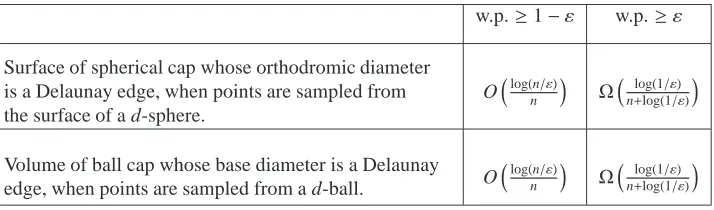
w.p.≥1−ε w.p.≥ε
Surface of spherical cap whose orthodromic diameter is a Delaunay edge, when points are sampled from the surface of a d-sphere.
Olog(nn/ε) Ωn+log(1log(1/ε/ε))
Volume of ball cap whose base diameter is a Delaunay
edge, when points are sampled from a d-ball. O
log(n/ε)
n
Ωnlog(1+log(1/ε/ε))
Table 1: Summary of results in asymptotic notation for constant d.
particular, Wan and Yi [10] show that for n points uniformly distributed in a unit-area disk, the ratio of the length of a longest Gabriel edge to √(ln n)/(πn) is asymptotically almost surely equal to 2, and the expected number of “long” Gabriel edges, of length at least 2p(ln n+ξ)/(πn), is asymptotically almost surely equal to 2e−ξ, for
any fixedξ. In [13], while studying the maximum degree of Gabriel and Yao graphs, the authors observe that the probability that the maximum edge length is greater than 3p(log n)/n tends to zero, a bound that they claim becomes O(((log n)/n)1/d) for d dimensions. An overview of related problems can be found in [14].
Interest in bounding the length of a longest Delaunay edge in two-dimensional spaces has grown out of extensive algorithmic work [15, 16, 17] aimed at reducing the energy consumption of geographically routing messages in Radio Networks. Multidimensional Delaunay graphs are well studied in computational geometry from the point of view of efficient algorithms to construct them (see [3] and references therein), but only limited results are known regarding probabilistic analysis of Delaunay graphs in higher dimensions [18].
Overview of Our Results.. We study the probabilistic length of longest Delaunay edges for points distributed uniformly in geometric domains in two and more dimensions. Since the length of the longest Delaunay edge is strongly influenced by the boundary of the enclosing region, we study the problem for two cases, which we call with boundary and without boundary.
Our results include upper and lower bounds for d-dimensional bodies with and without boundaries, that hold for a parametric error probabilityεand are computed up to the constant factors (they are tight only asymptotically). In comparison, the upper bounds presented in [6] are only asymptotic, are restricted to two dimensions (d=2), and apply to domains with boundary (disks), although results without boundary are implicitly given, since the results are parametric in the distance to the boundary.
All our bounds apply for any d>1. The asymptotic results, shown in Table 2, are tight for e−cn
≤ε≤n−c, for
any constant c>0, and d∈ O(1). As it can be seen in Table 1 where the results are denoted asymptotically for readability. To the best of our knowledge, this is the first comprehensive study of this problem.
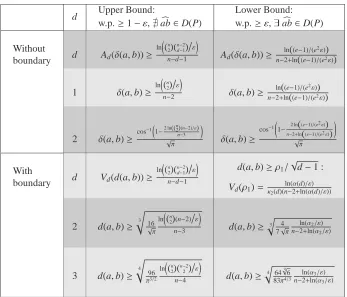
The precise results obtained are detailed in Table 2. (Refer to Section 2 for necessary notation.) In order to compare upper and lower bounds for bodies with boundary, it is crucial to notice that we bound the volume of a circular segment (2D) and the volume of a ball cap (3D), which can be approximated by polynomials of third and fourth degree, respectively, on the diameter of the base. Upper bounds are proved exploiting the fact that, thanks to the uniform density, it is very unlikely that a “large” volume is void of points. Lower bounds, on the other hand, are proved by showing that a configuration that yields a Delaunay edge of a certain length is not very unlikely.
In the following section, some necessary notation is introduced. Upper and lower bounds for enclosing bodies without boundaries are shown in Section 3, and the case with boundaries is covered in Section 4.
2. Preliminaries
The following notation will be used throughout. We will restrict attention to Euclidean (L2) spaces. A d-sphere,
S =Sr,c, of radius r is the set of all points in a (d+1)-dimensional space that are located at distance r (the radius)
from a given point c (the center). A d-ball, B=Br,c, of radius r is the set of all points in a d-dimensional space
that are located at distance at most r (the radius) from a given point c (the center). The area of a d-sphere S (in (d+1)-space) is its d-dimensional volume. The volume of a d-ball B (in d-space) is its d-dimensional volume. We refer to a unit sphere as a sphere of area 1 and a unit ball as a ball of volume 1. (This is in contrast with the definition of a “unit” ball/sphere as a unit-radius ball/sphere. In particular, notice that in our definition the unit sphere is not the boundary of a unit ball. We find it convenient to standardize the volume/area to be 1 in all dimensions.)
Let P be a set of points on a d-sphere, S . Given two points a,b∈P, letab be the arc of a great circle betweenb them. Letδ(a,b) be the length of the arcab, which is also known as the orthodromic distance between a and b onb
d Upper Bound:
w.p.≥1−ε,∄abb ∈D(P)
Lower Bound: w.p.≥ε,∃abb ∈D(P)
Without
boundary d Ad(δ(a,b))≥
ln
(n
2)(
n−2
d−1)
ε
n−d−1 Ad(δ(a,b))≥
ln((e−1)/(e2ε))
n−2+ln((e−1)/(e2ε))
1 δ(a,b)≥ln
(n
2)
ε
n−2 δ(a,b)≥
ln((e−1)/(e2ε))
n−2+ln((e−1)/(e2ε))
2 δ(a,b)≥
cos−11−2 ln((n2)(n−2)/ε)
n−3
√π δ(a,b)≥
cos−11− 2 ln((e−1)/(e2ε))
n−2+ln((e−1)/(e2ε))
!
√π
With
boundary d Vd(d(a,b))≥
ln
(n
2)(
n−2
d−1)
ε
n−d−1
d(a,b)≥ρ1/
√ d−1 : Vd(ρ1)= κ ln(α(d)/ε)
2(d)(n−2+ln(α(d)/ε))
2 d(a,b)≥ 3
r 16
√π
ln
(n
2)(n−2)
ε
n−3 d(a,b)≥
3
q 4 7√π
ln(α2/ε)
n−2+ln(α2/ε)
3 d(a,b)≥
4
r 96
π3/2
ln
(n2)(n−2 2)
ε
n−4 d(a,b)≥
4
q 64√36 83π4/3
ln(α3/ε)
n−2+ln(α3/ε)
Table 2: Summary of results.α2, α3are constants.α(d) andκ2(d) are functions of d.
the sphere S . Let the orthodromic diameter of a subset X⊆S be the greatest orthodromic distance between a pair of points in X. A spherical cap on S is the set of all points at orthodromic distance at most r from some center point c ∈ S . Let Ad(x) be the area (d-volume) of a spherical cap of orthodromic diameter x, on a d-sphere of
surface area 1. A ball cap of B is the intersection of a d-ball B with a closed halfspace, bounded by a hyperplane h, in d-space; the base of a ball cap is the (d−1)-ball that is the intersection of h with the ball B. Let Vd(x) be the
d-volume of a ball cap of base diameter x, of a d-ball of volume 1. For any pair of points a,b, let d(a,b) be the
Euclidean distance between a and b, i.e. d(a,b)=||−ab→||2. Let D(P) be the Delaunay graph of a set of points P.
The following definitions of a Delaunay graph, D(P), of a finite set P of points in a d-dimensional body follow the standard definitions of Delaunay graphs (see, e.g., Theorem 9.6 in [3]).
Definition 1. Let P be a generic set of points on a d-sphere S .
(i) A set F⊆P of d+1 points define the vertices of a Delaunay face of D(P) if and only if there is a d-dimensional spherical cap C⊂S such that F is contained in the boundary,∂C, of C and no points of P lie in the interior of C (relative to the sphere S ).
(ii) Two points a,b∈ P form a Delaunay edge, an arc of D(P), if and only if there is a d-dimensional spherical cap C such that a,b∈∂C and no points of P lie in the interior of C (relative to the sphere S ).
Definition 2. Let P be a generic set of points in a d-ball B.
(i) A set F ⊆P of d+1 points define the vertices of a Delaunay face of D(P) if and only if there is a d-ball B′ such that F is contained in the boundary,∂B′, of B′and no points of P lie in the interior of B′.
(ii) Two points a,b ∈ P form a Delaunay edge, an arc of D(P), if and only if there is a d-ball B′ such that a,b∈∂B′and no points of P lie in the interior of B′.
The following inequalities [19] are used throughout
e−x/(1−x)≤1−x≤e−x, for 0<x<1. (1)
3. Enclosing Body without Boundary
3.1. Upper Bound
Theorem 1. Consider the Delaunay graph D(P) of a set P of n points in dimension d ≥ 1, where n ≥ d+2, distributed uniformly and independently at random in a unit d-sphere, S . Then, for 0< ε <1, the probability is at least 1−εthat there is no arcabb ∈D(P), a,b∈P, such that
Ad(δ(a,b))≥
lnn2nd−−21ε
n−d−1 . (∗)
Proof. Let Eεbe the event that “there exists an arcabb ∈D(P), a,b∈P, with inequality (∗) satisfied.” Our goal is
to prove that P(Eε)≤ε.
Let us consider a fixed pair of points, a,b∈P. We let Ea,bbe the event thatabb ∈ D(P). For any subset Q⊂P
of d+1 points containing a and b, let CQdenote the spherical cap through Q and let FQdenote the event that the
interior of CQcontains no points of P (i.e., int(CQ)∩P=∅).
Thus, we can write Ea,b =SQFQas the union, over all
n−2 (d+1)−2
=nd−−21subsets Q⊂ P with|Q| =d+1 and a,b ∈Q, of the events FQ. Then, by the union bound, we know that P(Ea,b)≤PQP(FQ). Further, in order for
event FQto occur, all points of P except the d+1 points of Q must lie outside the spherical cap CQthrough Q;
thus, P(FQ)=(1−µd(CQ))n−(d+1), whereµd(CQ) denotes the d-volume of CQ.
We see that P(FQ)≤(1−Ad(δ(a,b)))n−(d+1), since, for any subset Q ⊃ {a,b}, the d-volumeµd(CQ) is at least
as large as the d-volume, Ad(δ(a,b)), of the spherical cap having orthodromic diameterδ(a,b). In other words,
Ad(δ(a,b)) is the d-volume of the smallest volume spherical cap whose boundary passes through a and b. This
property can be seen by noticing that, fixing a spherical cap, the largest arc is an orthodromic diameter. Hence, fixing the arcab, the smallest spherical cap whose boundary passes through a and b has orthodromic diameterb δ(a,b).
Altogether, we get
P(Ea,b)≤
X
Q
P(FQ)=
X
Q
(1−µd(CQ))n−(d+1)
≤ nd−2 −1
!
(1−Ad(δ(a,b)))n−(d+1).
Now, the event of interest is
Eε=
[
a,b∈P:(∗) holds
Ea,b.
The inequality (∗) is equivalent to
(n−d−1)Ad(δ(a,b))≥ln
n
2
! n
−2 d−1
!
ε
!
,
which is equivalent to
e−Ad(δ(a,b))(n−d−1)≤ ε
n
2 n−2
d−1 .
Since, by Inequality (1), e−x≥1−x, the above inequality implies that
(1−Ad(δ(a,b)))(n−d−1)≤
ε
n 2
n−2
d−1 ,
which implies that
n 2
!
n−2 d−1
!
(1−Ad(δ(a,b)))(n−d−1)≤ε.
Using the union bound, we get
P(Eε)=P
[
a,b∈P:(∗) holds
Ea,b
≤ X
a,b∈P:(∗) holds
P(Ea,b).
Since each term P(Ea,b) in the above summation is bounded above by
n−2
d−1
(1−Ad(δ(a,b)))n−(d+1), and there are at
mostn2terms in the summation, we get
P(Eε)≤
X
a,b∈P:(∗) holds
P(Ea,b)
≤ n
2
!
n−2 d−1
!
(1−Ad(δ(a,b)))(n−d−1)≤ε.
The following corollaries for d=1 and d=2 can be obtained from Theorem 1 using the corresponding surface areas.
Corollary 1. In the Delaunay graph D(P) of a set P of n>2 points distributed uniformly and independently at random on a unit circle (1-sphere), with probability at least 1−ε, for 0 < ε < 1, there is no arcabb ∈ D(P), a,b∈P, such that
δ(a,b)≥ ln
n 2
ε
n−2 .
Corollary 2. In the Delaunay graph D(P) of a set P of n>3 points distributed uniformly and independently at random on a unit sphere (2-sphere), with probability at least 1−ε, for 0 < ε < 1, there is no arcabb ∈ D(P), a,b∈P, such that
δ(a,b)≥ √1 πcos
−1 1−
2 lnn2(n−2)ε n−3
.
Proof. The radius of a unit 2-sphere is R =1/(2√π). Thus, the surface area of a spherical cap of a 2-sphere is 2πRh = √πh, where h is the height of the cap. On the other hand, the central angle of a cap with orthodromic diameterρis 2πρ/√π=2√πρ. Thus, the height is h=1/(2√π)(1−cos(√πρ)). This yields that the surface area of a spherical cap of a 2-sphere whose orthodromic diameter isρis (1−cos(√πρ))/2. Replacing in Theorem 1, the claim follows.
3.2. Lower Bound
Theorem 2. Consider the Delaunay graph D(P) of a set P of n>2 points distributed uniformly and independently at random in a unit d-sphere, S . Then, for any 0< ε <1 andρsuch that
Ad(ρ)=
ln(e−1)/(e2ε)
n−2+ln (e−1)/(e2ε),and
Ad(2ρ)≤1−1/(n−1),
the probability is at leastεthat there is an arcabb ∈D(P), a,b∈P, such that Ad(δ(a,b))≥Ad(ρ).
Proof. To see that the claim is not vacuously true, fix d and let Ad(2ρ)= f (d)Ad(ρ), for some function f (·). Then,
we want to show that Ad(2ρ)= f (d) ln((e−1)/(e2ε))/(n−2+ln((e−1)/(e2ε)))≤1−1/(n−1) for some 0< ε <1.
This is true forε≥(e−1)/(e2exp(n
−2)2/(1+(n
−1)( f (d)−1)).
In order to prove the claim, we consider a configuration given by a specific pair of points and a specific empty spherical cap circumscribing them, that would yield a Delaunay arc between those points. Then, we relate the probability of existence of such a configuration to the distance between the points. Finally, we relate this quantity to the desired parametric probability. The details follow.
For any pair of points a,b∈ P, by Definition 1, for the arcab to be in D(P), there must exist a d-dimensionalb spherical cap C such that a and b are located on the boundary of the cap base, and the cap surface of C is void of points from P. We compute the probability of such an event as follows.
Letρ′> ρbe such that Ad(2ρ′)−Ad(2ρ)=1/(n−1). Such a valueρ′exists because Ad(2ρ)≤1−1/(n−1). Consider any point a ∈ P. The probability, p1, that some other point b is located so thatρ < δ(a,b) ≤ρ′can
be computed by considering the spherical annulus centered at a withρ(resp.,ρ′) equal to the minimum (resp., maximum) orthodromic distance to a (i.e., we consider the difference between a spherical cap of orthodromic diameter 2ρ′and a spherical cap of orthodromic diameter 2ρ). Then, p1 =1−(1−1/(n−1))n−1 ≥1−1/e, by
Inequality (1).
The spherical cap with orthodromic diameterδ(a,b) is empty with probability (1−Ad(δ(a,b)))n−2. To lower
bound this probability we consider separately the spherical cap with orthodromic diameterρand the remaining annulus of the spherical cap with orthodromic diameterδ(a,b). The probability that the annulus is empty, call it p2,
is lower bounded by upper bounding the area Ad(δ(a,b))−Ad(ρ)≤Ad(ρ′)−Ad(ρ)≤Ad(2ρ′)−Ad(2ρ)=1/(n−1).
Then, p2≥(1−1/(n−1))n−2 ≥1/e, by Inequality (1).
Finally, the probability that the spherical cap with orthodromic diameterρis empty, call it p3, is, by
Inequal-ity (1),
p3 =(1−Ad(ρ))n−2≥exp −
Ad(ρ)(n−2)
1−Ad(ρ)
!
=exp −ln e−1 e2ε
!!
= e
2ε
e−1. Therefore,
Prabb ∈D(P)≥p1p2p3 ≥ 1−
1 e
!
1 e
e2ε e−1 =ε.
The following corollaries for d=1 and d=2 can be obtained from Theorem 2 using the corresponding surface areas.
Corollary 3. In the Delaunay graph D(P) of a set P of n>2 points distributed uniformly and independently at random on a unit circle (1-sphere), with probability at leastε, for any (e−1)/exp (n+4/n)≤ε <1, there is an arcabb ∈D(P), a,b∈P, such that
δ(a,b)≥ ln
(e−1)/(e2ε) n−2+ln (e−1)/(e2ε).
Proof. The lower bound onδ(a,b) can be obtained by replacing in Theorem 2 the surface of the spherical cap, which for d=1 is the length of the arc. Regarding the lower bound onε, in the proof of Theorem 2, it was shown that the conditions of the theorem can be met by imposing a lower bound onεthat depends on d. Using d=1, we obtain that f (d)=2 andε≥(e−1)/(e2exp(n
−2)2/(1+(n
−1)( f (d)−1))=(e−1)/exp (n+4/n).
Corollary 4. In the Delaunay graph D(P) of a set P of n > 2 points distributed uniformly and independently at random in a unit sphere (2-sphere), with probability at leastε, for any e−n+2√n−1−1 ≤ ε <1, there is an arc
b
ab∈D(P), a,b∈P, such that
δ(a,b)≥ √1 πcos
−1 1−
2 ln(e−1)/(e2ε)
n−2+ln (e−1)/(e2ε) .
Proof. As shown in the proof of Corollary 2, the surface area of a spherical cap of a 2-sphere whose orthodromic diameter isρis (1−cos(√πρ))/2. Replacing in Theorem 2, the claim follows.
4. Enclosing Body with Boundary
The following theorems show upper and lower bounds on the lengths of edges in the Delaunay graph in a d-ball. (Recall that we refer to a unit ball as a ball of volume 1.)
4.1. Upper Bound
Theorem 3. Consider the Delaunay graph D(P) of a set P of n > d+1 ≥ 2 points distributed uniformly and independently at random in a unit d-ball, B. Then, for 0< ε <1, the probability is at least 1−εthat there is no edge (a,b)∈D(P), a,b∈P, such that
Vd(d(a,b))≥
lnn2nd−−21ε
n−d−1 . (∗∗)
Proof. In order to prove this claim, we consider any one set of d+1 points in P. Then, we relate the probability that the ball circumscribing the set is empty, to the distance separating the points. Finally, we combine the probabilities for all possible pairs of points and sets and we relate this quantity to the desired parametric probability. The details follow.
Let Eεbe the event that “there exists an edge (ab)∈D(P), a,b∈ P, with inequality (∗∗) satisfied” Our goal is
to prove that P(Eε)≤ε.
Let us consider a fixed pair of points, a,b∈P. We let Ea,bbe the event that (ab)∈D(P). For any subset Q⊂P
of d+1 points containing a and b, let BQdenote the ball through Q and let FQdenote the event that the interior of
BQcontains no points of P (i.e., int(BQ)∩P=∅).
Thus, we can write Ea,b =SQFQas the union, over all
n−2 (d+1)−2
=nd−−21subsets Q⊂ P with|Q| =d+1 and a,b ∈ Q, of the events FQ. Then, by the union bound, we know that P(Ea,b) ≤ PQP(FQ). Further, in order
for event FQto occur, all points of P except the d+1 points of Q must lie outside the ball BQthrough Q; thus,
P(FQ)=(1−µd(BQ∩B))n−(d+1), whereµd(BQ∩B) denotes the d-volume of BQ∩B. (Recall that points lie only
inside B.)
We see that P(FQ) ≤ (1−Vd(d(a,b)))n−(d+1), since, for any subset Q ⊃ {a,b}, the d-volumeµd(BQ∩B) is
at least as large as the d-volume, Vd(d(a,b)), of the ball cap of B having base diameter d(a,b). In other words,
Vd(d(a,b)) is the d-volume of the smallest volume ball cap of B whose base boundary passes through a and b.
This property can be seen by noticing that, fixing a ball cap, the largest segment in the base is a diameter. Hence, fixing a segment (a,b), the smallest ball cap whose boundary passes through a and b has base diameter d(a,b).
Altogether, we get
P(Ea,b)≤
X
Q
P(FQ)=
X
Q
(1−µd(BQ∩B))n−(d+1)
≤ dn−2 −1
!
(1−Vd(d(a,b)))n−(d+1).
Now, the event of interest is
Eε=
[
a,b∈P:(∗∗) holds
Ea,b.
The inequality (∗∗) is equivalent to
(n−d−1)Vd(d(a,b))≥ln
n 2
!
n−2 d−1
! ε!,
which is equivalent to
e−Vd(d(a,b))(n−d−1)≤ ε
n
2 n−2
d−1 .
Since, by Inequality (1), e−x≥1−x, the above inequality implies that (1−Vd(d(a,b)))(n−d−1)≤
ε
n 2
n−2
d−1 ,
which implies that
n 2
!
n−2 d−1
!
(1−Vd(d(a,b)))(n−d−1)≤ε.
Using the union bound, we get
P(Eε)=P
[
a,b∈P:(∗∗) holds
Ea,b
≤ X
a,b∈P:(∗∗) holds
P(Ea,b).
Since each term P(Ea,b) in the above summation is bounded above by
n−2
d−1
(1−Vd(d(a,b)))n−(d+1), and there are at
mostn2terms in the summation, we get
P(Eε)≤
X
a,b∈P:(∗∗) holds
P(Ea,b)
≤ n2
!
n−2 d−1
!
(1−Vd(d(a,b)))(n−d−1)≤ε.
The following corollaries for d = 2 and d = 3 can be obtained from Theorem 3 using the corresponding volumes.
Corollary 5. In the Delaunay graph D(P) of a set P of n>3 points distributed uniformly and independently at random in a unit disk (2-ball), with probability at least 1−ε, forn2(n−2)e−√2(n−3)/π < ε <1, there is no edge
(a,b)∈D(P), a,b∈P, such that
d(a,b)≥ 3
v t
16 √π
lnn2(n−2)ε
n−3 .
Proof. Consider the intersection of the radius of the unit disk perpendicular to (a,b) with the circumference of the unit disk, call this point x. The area of the triangle△abx is a strict lower bound on V2(d(a,b)). From Theorem 3,
we have the condition
V2(d(a,b))≥
lnn2(n−2)ε
n−3 .
Thus, it is enough to show that
d(a,b) 2
√1
π−
r
1 π−
d(a,b)2
4
≥
lnn2(n−2)ε
n−3 .
Makingρ=d(a,b)√π/2, we want
q
ρ2−ρ4≤ρ−πln n
2
(n−2)ε
n−3 . (2)
If d(a,b)<2√πln2n(n−2)ε (n−3), there is nothing to prove because
2√πlnn2(n−2)ε
n−3 <
3
v t
16 lnn2(n−2)ε √π(n
−3) ,
for anyε >n2(n−2) exp−√2(n−3)/π. Otherwise, we have thatρ≥πlnn2(n−2)ε (n−3), and by squar-ing both sides of (2) we get
ρ4≥2ρπln
n 2
(n−2)ε
n−3 −
πln
n 2
(n−2)ε n−3
2
,
which is implied by
ρ3≥2πln
n 2
(n−2)ε
n−3 .
Substitutingρ=d(a,b)√π/2 into the above inequality, the claim follows.
Corollary 6. In the Delaunay graph D(P) of a set P of n>4 points distributed uniformly and independently at random in a unit ball (3-ball), with probability at least 1−ε, forn2n−22e−2(n−4)(3√π) < ε <1, there is no edge
(a,b)∈D(P), a,b∈P, such that
d(a,b)≥ 4
s
96 π3/2
lnn2n−22ε
n−4 .
Proof. Consider the intersection of the radius of the unit ball perpendicular to (a,b) with the surface of the unit ball, call this point d. The volume of the cone whose base is the disk whose diameter is (a,b) and its vertex is d is a strict lower bound on V2(d(a,b)). From Theorem 3, we have the condition
V3(d(a,b))≥
lnn2n−22ε
n−4 .
Thus, it is enough to show that
π 3
d(a,b) 2
!2 √1
π−
r
1 π−
d(a,b)2
4
≥
lnn2n−22ε
n−4 .
Makingρ=d(a,b)√π/2, we want
q
ρ4−ρ6 ≤ρ2
−3√π
lnn2n−22ε
n−4 . (3)
If d(a,b)<
q
12 lnn2n−22ε (√π(n−4)), there is nothing to prove because
v t
12 lnn2n−22ε √
π(n−4) < 4
s
96 π3/2
lnn2n−22ε
n−4 ,
for anyε > n2n−22exp−2(n−4)(3√π). Otherwise, we have thatρ2
≥ 3√πlnn2n−22ε (n−4), and by squaring both sides of (3) we get
ρ6 ≥6ρ2√π
lnn2n−22ε
n−4 −
3√π
lnn2n−22ε n−4
2
,
which is implied by
ρ4≥6√π
lnn2n−22ε
n−4 .
Substitutingρ=d(a,b)√π/2 into the above inequality, the claim follows.
4.2. Lower Bound
As in the case without boundary, we prove our lower bound by showing a configuration given by a specific pair of points and a specific empty body circumscribing them, that would yield a Delaunay edge between those points. Then, we relate the probability of existence of such configuration to the distance between the points and to the desired parametric probability.
Theorem 4. For any d>1, let
α(d)=1−e−κ1(d)/κ2(d) 1−e−κ1(d)/(2κ2(d)(2d−2))
κ1(d)=
1 d−1
d−2 X
i=0 √ d
d2−1 !i
− √
d2−1
d
κ2(d)=
1+ 2d−1 d−1
!d−1
d d−1
.
For any n>1 and 0 < ε≤α(d)/e, given the Delaunay graph D(P) of a set P of n points distributed uniformly and independently at random in a unit d-ball, with probability at leastε, there is an edge (a,b)∈D(P), a,b∈P, such that d(a,b)≥ρ1/
√
d−1, where
Vd(ρ1)=
ln (α(d)/ε) κ2(d) (n−2+ln (α(d)/ε))
.
Proof. We illustrate the proof in Figures 1 and 2. Throughout the proof, we refer to a body and its set of space points with the same name indistinctly. Let V(X) be the volume of a body (or a set of space points) X. Let the unit ball where points are sampled be called B. Consider two ball caps of B, concentric on a lineℓ, called S1and S2,
with bases B1and B2of diametersρ1andρ2, and heights h1and h2respectively (see Figure 1(a)). Inside S2\S1,
consider the following d-dimensional bodies of height h2−h1: a cylinder C with base B1; a cone K of base B2;
and a frustum F of bases B2and B1(see Figure 1(b)).
B ℓ S1
S2\S1
ρ1
ρ2
h1
h2
(a) Projection of B, S1, and S2in two dimensions.
F
K
C
(b) Projection of F, K, and C in two dimensions.
a
b
ρ1/
√ d−1
(c) Points in F\K∪C for d=3 projected in two dimensions.
Figure 1: Illustration of Theorem 4.
Consider the body F\(C∪K) evenly partitioned into 2(d−1) pieces such that two of them, call them Baand
Bb, have the following property. For any pair of points a∈ Baand b ∈Bb, the points a and b are separated by a
distance of at leastρ1/
√
d−1. To see why such a partition exists, consider a (d−1)-dimensional cube, call it C1,
inscribed in the base of S1. The maximum diagonal of C1has lengthρ1, and, hence, each side of C1has length
ρ1/
√ d−1.
Additionally, we observe that, for any pair of points a∈Baand b∈ Bb, there exists a ball cap S that contains
the points a and b in its base of diameterρsuch that Vd(ρ)≤Vd(ρ2). To see why the latter is true, consider the
following. Without loss of generality assume that the point a is closer to B2than b. Then, consider a 2-dimensional
plane h containing the lineℓand the point a and the projection of b on h. On h, the point closest to B2is located
above the projection of K (see Figure 1(c)).
If S is void of points, the configuration described implies the existence of an empty d-ball of infinite radius with a and b in its surface which proves that (a,b)∈ D(P). In the following, we show that such configuration occurs with big enough probability.
Letρ1be such that Vd(ρ1) is as defined in the statement of the theorem. Let h2be such that V(C)=dVd(ρ1)/(d−
1). Let q=ρ2/ρ1. First, we prove upper and lower bounds on q to be used later. Claim 1. d/√d2−1≤q≤(2d−1)/(d−1).
Proof. From the volume of C, we know that h2/h1=1+V(C)/(h1V(B1)). Consider a cone with the same volume
and base as S1. The height of such cone, which is bigger than h1, is dVd(ρ1)/V(B1). That is, h1<dVd(ρ1)/V(B1).
Consider also a cylinder with the same volume and base as S1. The height of such cylinder, which is smaller
than h1, is Vd(ρ1)/V(B1). That is, h1 > Vd(ρ1)/V(B1). Replacing those bounds and using that the fact that
V(C)=dVd(ρ1)/(d−1), we get
d d−1 ≤
h2
h1 ≤
2d−1
d−1 . (4)
Consider a 2-dimensional projection of the configuration described (see Figure 2(a)). Let R be the radius of B. Then, using Pythagoras’ theorem, R2=(ρ
2/2)2+(R−h2)2=(ρ1/2)2+(R−h1)2. Subtracting,
q2=1+(R−h1)
2
−(R−h2)2
(ρ1/2)2
≥1+ h2 h1 −
1
!
1− 1
2−h1/h2 !
= h2
h1(2−h1/h2)
.
ρ1/2
ρ2/2
R
R−h1
R−h2
(a) Ratio of diameters.
K1
K2
F
(b) Projection of F, K1, and K2in two dimensions.
Figure 2: Illustration of Theorem 4.
Using Inequality (4),
q2≥ d d−1 ·
1
2−(d−1)/d = d2 d2−1.
Which proves the lower bound. For the upper bound, consider the cones K1 and K2 inscribed in S1 and S2
respectively (see Figure 2(b)). It can be seen that
V(K1∪F)>V(K2). (5)
The volumes of K1and K2are
V(K1)=
h1V(B1)
d =
h1C(d−1)ρd1−1
d2d−1
V(K2)=
h2V(B2)
d =
h1C(d−1)ρd1−1
d2d−1 .
Replacing in (5), the following inequality holds,
ρd2−1 ρ2−
h2
h1
ρ1 !
< ρd1−1 ρ2−
h2
h1
ρ1 !
.
Given thatρd−1 2 > ρ
d−1
1 , it must beρ2< ρ1h2/h1. Using Inequality (4), we have q<(2d−1)/(d−1).
For any d > 1, let C(d) = πd/2/Γ(1+d/2), whereΓ(·) is the Gamma function. We compute the volume of F\(C∪K) as V(F)−V(C∪K).
V(F)=C(d−1)
Z h2−h1
0
ρ1/2+
ρ2/2−ρ1/2
h2−h1
z
!d−1
dz
=V(C)
d ·
qd
−1 q−1.
V(C∪K)=C(d−1)
(ρ1/2)d−1
Z ρ1(h2−h1)/ρ2
0
dz+
Z (h2−h1)
ρ1(h2−h1)/ρ2
rK(z)d−1dz
=C(d−1)
(ρ1/2)d−1
Z ρ1(h2−h1)/ρ2
0
dz+ ρ2/2 h2−h1
!d−1Z (h2−h1)
ρ1(h2−h1)/ρ2 zd−1dz
=V(C)1 q
1+1 d
qd−1 .
Thus,
V(F\(C∪K))=V(C) 1 d ·
qd−1 q−1 −
1 q 1+
1 d(q d −1) !! = V(C) d
qd−1 q−1 −
d+qd−1 q ! = V(C) d qd −1 q−1 −q
d−1
−d−1 q
!
= V(C) d
qd−1
−1 q−1 −
d−1 q
!
= V(C) d
d−2 X
i=0
qi−1 q
!
. (6)
Using Claim 1 and the fact that V(C)=dVd(ρ1)/(d−1) in Equation (6), V(F\(C∪K))≥κ1(d)Vd(ρ1). Given
thatε≤α(d)/e, we know that Vd(ρ1)≥1/(κ2(d)n), then V(F\(C∪K))≥κ1(d)/(κ2(d)n). Then, the probability
that F\(C∪K) contains at least one point of P is at least 1−(1−κ1(d)/(κ2(d)n))n ≥1−e−κ1(d)/κ2(d). Consider
the body F\(C∪K) evenly partitioned into 2(d−1) parts. The probability that any given one of these parts of F\(C∪K) contains at least one point of P\ {a}, for some a∈P, is at least 1−(1−κ1(d)/(κ2(d)n(2d−2)))n−1≥
1−e−κ1(d)/(2κ2(d)(2d−2)). Conditioned on the existence of two points a,b∈P located as described earlier, let S be a ball cap of base B (of diameterρ) such that B contains a and b and S ⊂S2(see Figure 1(c)). Such cap exists as
shown before. The probability that S is void of points of P is lower bounded by upper bounding its volume. We know that V(S )≤V(S2), and V(S2) can be upper bounded considering S1and S2\S1separately, which we do as
follows.
V(S2)−V(S1)≤C(d−1)(ρ2/2)d−1(h2−h1)
≤C(d−1) 2d−1 2(d−1)ρ1
!d−1
(h2−h1)
= 2d−1 d−1
!d−1
d
d−1Vd(ρ1).
Then V(S )≤κ2(d)Vd(ρ1). Thus, the probability that S is empty is at least
(1−κ2(d)Vd(ρ1))n−2 ≥exp −
κ2(d)Vd(ρ1)(n−2)
1−κ2(d)Vd(ρ1) !
.
Replacing, we get
Pr ((a,b)∈D(P))≥α(d) exp −κ2(d)Vd(ρ1)(n−2) 1−κ2(d)Vd(ρ1)
!
=ε.
Corollary 1. For any n > 1 and 0 < ε ≤ α/e, whereα = 1−e−(2−√3)/14 1−e−(2−√3)/56, given the Delau-nay graph D(P) of a set P of n points distributed uniformly and independently at random in a unit circle, with probability at leastε, there is an edge (a,b)∈D(P), a,b∈P, such that
d(a,b)≥23
s
ln (α/ε)
14√π(n−2+ln (α/ε)).
Proof. Instantiating Theorem 4 in dimension d = 2, we know that with probability at leastεthere is an edge (a,b)∈D(P), such that d(a,b)≥ρ1, where
V2(ρ1)=
ln (α/ε) 7 (n−2+ln (α/ε)).
We upper bound the area of the circular segment of chordρ1with the area of the rectangle circumscribing it.
V2(ρ1)≤ρ1
1 √π−
s
1 π−
ρ2 1
4
.
Hence,
s
ρ2 1
π − ρ4
1
4 ≤
ρ1
√π−V2(ρ1).
Given thatρ1/√π≥V2(ρ1), we can square both sides getting
ρ41≥4 2√ρ1
π−V2(ρ1)
!
V2(ρ1)
≥4√ρ1
πV2(ρ1), because V2(ρ1)≤ρ1/ √
π.
Then we getρ1/2≥
3
q
V2(ρ1)/(2√π) and replacing V2(ρ1) the claim follows.
Corollary 2. For any n > 1 and 0 < ε ≤ α/e, whereα = 1−e−κ1(3)/κ2(3) 1−e−κ1(3)/(8κ2(3)),κ
1(3) = 1/2−
7/(6√8), andκ2(3)=10+3/8, given the Delaunay graph D(P) of a set P of n points distributed uniformly and
independently at random in a unit ball inR3, with probability at leastε, there is an edge (a,b)∈D(P), a,b∈P, such that
d(a,b)≥ √24
s
3
p
48/π4ln (α/ε)
κ2(3) (n−2+ln (α/ε))
.
Proof. Instantiating Theorem 4 in d =3, we know that with probability at leastεthere is an edge (a,b)∈D(P), a,b∈P, such that d(a,b)≥ρ1/
√
2, where
V3(ρ1)=
ln (α/ε) κ2(3) (n−2+ln (α/ε))
.
We upper bound the volume of the ball cap of base diameterρ1with the volume of the cylinder circumscribing
it.
V3(ρ1)≤
πρ2 1 4 3 r 3 4π−
s
3 4π
!2/3
−ρ 2 1 4 . Hence, v t π4
3 r 3 4π 2 ρ4 1− π2 64ρ 6 1≤ πρ2 1 4 3 r 3
4π−V3(ρ1).
Given thatπρ2 1/4
3 √
3/(4π)≥V3(ρ1), we can square both sides getting
π2 64ρ 6 1≥ 2πρ
2 1 4 3 r 3
4π−V3(ρ1)
V3(ρ1)
≥ πρ 2 1 4 3 r 3
4πV3(ρ1), because V3(ρ1)≤πρ
2 1/4
3
p
3/(4π).
Then we getρ1/2≥
4
q
3
p
48/π4V
3(ρ1) and replacing V3(ρ1) the claim follows.
5. Acknowledgements
E. Arkin and J. Mitchell are partially supported by grants from the National Science Foundation (CCF-1018388) and the Binational Science Foundation (BSF 2010074). M. A. Mosteiro is partially supported by grants from the National Science Foundation (CCF 1114930, CCF 0937829) and from Kean University (UFRI grant). A. Fern´andez Anta is partially supported by grants from the Comunidad de Madrid (S2009TIC-1692), the Spanish MICINN/MINECO (TEC2011-29688-C02-01), and the National Natural Science Foundation of China (61020106002).
References
[1] E. M. Arkin, A. Fern´andez Anta, J. S. B. Mitchell, M. Mosteiro, The length of the longest edge in multi-dimensional Delaunay graphs (extended abstract), in: Proceedings of the 20th Annual Fall Workshop on Computational Geometry, 2010.
[2] E. M. Arkin, A. Fern´andez Anta, J. S. B. Mitchell, M. Mosteiro, Probabilistic bounds on the length of a longest edge in Delaunay graphs of random points in d-dimensions, in: Proceedings of the 23rd Canadian Conference on Computational Geometry, 2011, pp. 163–168. [3] M. de Berg, M. van Kreveld, M. Overmars, O. Schwarzkopf, Computational Geometry: Algorithms and Applications, 2nd Edition,
Springer-Verlag, 2000.
[4] M. Penrose, Random Geometric Graphs, Oxford University Press, 2003.
[5] P. Bose, P. Morin, Online Routing in Triangulations, in: Proc. of the 10th International Symposium on Algorithms and Computation, Springer Verlag, 1999, p. 113.
[6] G. Kozma, Z. Lotker, M. Sharir, G. Stupp, Geometrically aware communication in random wireless networks, in: Proc. 23rd Ann. ACM Symp. on Principles of Distributed Computing, 2004, pp. 310–319.
[7] E. Kranakis, H. Singh, J. Urrutia, Compass routing on geometric networks, in: Proc. of the 11th Canadian Conference on Computational Geometry, 1999.
[8] E. Lebhar, Z. Lotker, Unit disk graph and physical interference model: Putting pieces together, in: Proc. of the 23rd International Symposium on Parallel & Distributed Processing, IEEE, 2009, pp. 1–8.
[9] M. Bern, D. Eppstein, F. Yao, The expected extremes in a Delaunay triangulation, International Journal of Computational Geometry and Applications 1 (1) (1991) 79–91.
[10] P. Wan, C. Yi, On the longest edge of Gabriel graphs in wireless ad hoc networks, IEEE Transactions on Parallel and Distributed Systems (2007) 111–125.
[11] P. Wan, L. Wang, F. Yao, C. Yi, On the Longest RNG Edge of Wireless Ad Hoc Networks, in: Proc. of the 28th International Conference on Distributed Computing Systems, IEEE, 2008, pp. 329–336.
[12] C. Yi, P. Wan, L. Wang, C. Su, Sharp thresholds for relative neighborhood graphs in wireless Ad Hoc networks, IEEE Transactions on Wireless Communications 9 (2) (2010) 614–623.
[13] L. Devroye, J. Gudmundsson, M. P., On the Expected Maximum Degree of Gabriel and Yao Graphs,arXiv:0905.3584v1 [cs.CG] (May 2009).
URLhttp://arxiv.org/abs/0905.3584v1
[14] D. Aldous, S. J., Connected spatial networks over random points and a route-length statistic, Statistical Science 25 (3) (2010) 275–288. [15] P. Bose, P. Carmi, M. H. M. Smid, D. Xu, Communication-efficient construction of the plane localized Delaunay graph, in: Proc. of the
9th Latin American Theoretical Informatics Symposium, 2010, pp. 282–293.
[16] C. Avin, Fast and efficient restricted Delaunay triangulation in random geometric graphs, Internet Mathematics 5 (3) (2008) 195–210. [17] F. Ara´ujo, L. Rodrigues, Single-step creation of localized Delaunay triangulations, Wireless Networks 15 (7) (2009) 845–858. [18] C. Lemaire, J. Moreau, A probabilistic result on multi-dimensional Delaunay triangulations, and its application to the 2D case, Comput.
Geom. 17 (1-2) (2000) 69–96.
[19] D. S. Mitrinovi´c, Elementary Inequalities, P. NoordhoffLtd. - Groningen, 1964.