RVC OPEN ACCESS REPOSITORY – COPYRIGHT NOTICE
This is the author’s accepted manuscript of an article published in Laboratory Animals.
The final publication is available at SAGE Journals via http://dx.doi.org/10.1177%2F0023677215622883.
The full details of the published version of the article are as follows:
TITLE: Olfaction variation in mouse husbandry and its implications for refinement and standardization: UK survey of animal scents
AUTHORS: Noelia López-Salesansky, Nur H Mazlan, Lucy E Whitfield, Dominic J Wells, Charlotte C Burn
JOURNAL TITLE: Laboratory Animals
PUBLICATION DATE: October 2016
PUBLISHER: SAGE Publications
Olfaction variation in mouse husbandry and its implications for refinement and standardisation: UK 1
survey of animal scents 2
Short title: Survey of animal scents in mouse husbandry 3
Noelia López-Salesansky1, 2, Nur H. Mazlan3, Lucy E. Whitfield2, Dominic J. Wells3 and Charlotte C. Burn1 4
1 Animal Welfare Science and Ethics group, The Royal Veterinary College, UK; 2 Named Veterinary 5
Surgeons Department, The Royal Veterinary College, UK; 3Department of Comparative Biomedical 6
Sciences, The Royal Veterinary College, UK. 7
Corresponding author: 8
Noelia López-Salesansky, Animal Welfare Science and Ethics group, The Royal Veterinary College, Royal 9
College Street, London NW1 0TU, Telephone 07961865001, Email [email protected] 10
Abstract 11
Olfaction plays a crucial role in mouse communication, providing information about genetic identity, 12
physiological status of conspecifics and alerting mice to potential predators. Scents of animal origin can 13
trigger physiological and behavioural responses that could that could affect experimental responses and 14
impact positively or negatively on mouse welfare. Additionally, differing olfactory profiles could help 15
explain variation in results between laboratories. A survey was sent to animal research units in the UK to 16
investigate potential transfer of scents of animal origin during routine husbandry procedures, and 17
responses were obtained from animal care workers and researchers using mice in 51 institutions. The 18
results reveal great diversity between animal units regarding the relevant husbandry routines covered. 19
Most (94%) reported housing non-breeding male and female mice in the same room, with 79% reporting 20
commonly reported species housed in the same facility as mice was the rat (91%) and 41% of 22
respondents were aware that scents from rats could affect mice. Changing gloves between handling 23
mice and other species was reported by 79% of respondents. . Depending on the aspect considered, 24
between 18 and 33% of respondents believed human and non-human animal odours would strongly 25
affect mouse physiology, behaviour or standardisation, while approximately 32-54% believed these 26
effects would be weak. This indicates uncertainty regarding the significance of these factors. 27
Understanding and controlling these practices could reduce unwanted variability in experimental results 28
and maximise welfare. 29
Mice are adapted for a dangerous world. In nature they compete for resources with their own kind 31
(conspecifics) and avoid being predated by other species, relying mainly on olfaction to do so 1,2 . 32
Mice use olfactory cues in deciding whether or not to interact with the signaller, for avoiding predators 33
or seeking a mate; transfer of scents may also occur in the laboratory setting, where multiple species, or 34
both genders of mice are housed in the same building. Transfer of animal-derived scents is likely to occur 35
in shared areas and through staff members. Odours from previous animals can linger on anaesthetic, 36
behavioural and other equipment and influence animals that are subsequently exposed. 37
Scents provided by a conspecific are called pheromones 3andcan triggerphysiological reactions 38
that will depend on the identity of the signaller. For example, territory marking by urine is known to 39
provide both non-variable genomic information like species, sex and identity, and metabolic information 40
such as health, social hierarchy and nutritional and reproductive status4. Mediating these endocrine and 41
behavioural changes via non-volatile and volatile metabolites 5-8. 42
These social signals are produced by both males and females and produce effects in both 43
genders. Male urine may elicit, aggression, fleeing behaviour or submission in the recipient male 44
depending on its position in the social hierarchy 9 (but less so if the males are of the same inbred strain 45
as each other 10). In females, male urine induces changes in reproductive physiology such as the oestrus 46
synchronisation or ‘Whitten Effect’ 11-13, . Female urine can initiate fights in group housed male mice 47
14,15and suppress oestrous in other females in a phenomenon known as ‘the Lee-Boot Effect’ 16.
48
Species-specific odours called kairomones derived, for example, from the other species’ fur, 49
urine, faeces and anal gland secretions 17 , allow predators and prey to detect each other at a distance. 50
Laboratory bred mice retain the capacity to detect predators to which they have never been exposed 18. 51
flee), decrease feeding rate and hamper reproductive performance 19 and this is even used in modelling 53
human emotional disorders such as anxiety and panic 20-22. 54
Interaction with humans may also affect the mouse’s behaviour, immune response and 55
physiology, according to the nature of the contact. The identity, including gender, of the handler is 56
reported to produce different effects 23-26 and stressful situations (handling or painful procedures) 57
prompt mice to produce urine containing alarm pheromones (APs) that can be detected by other 58
individuals of both sexes 27. Exposure to APs has been linked to an inhibition of the immune system and 59
produces active behaviours (e.g. increased locomotion, air sampling) similar to those caused by 60
predators 27-32. 61
The olfactory environment specific to the experimental situation could explain some of the 62
inconsistency of laboratory results 33,34. Scents that are idiosyncratic to a particular place or person could 63
be a source of systematic error that could reduce external validity of the results. Additionally, variations 64
on the olfactory environment could increase random errors requiring larger sample sizes to find 65
significant results. With this in mind, husbandry procedures should be designed to minimize the transfer 66
of pheromones and kairomones to mice by adequate handling routine and PPE changes. 67
In summary, conspecific and allospecific odours can have behavioural and physiological effects 68
on mice, but little is known about the variability and propensity for these effects to occur across 69
laboratories. We therefore carried out a UK-wide survey of animal units to learn about routine 70
husbandry practices with the potential of transfer of animal scents. 71
Materials and methods 72
The questionnaire was emailed to individuals involved in laboratory animal work in the UK in 73
February 2012. These contacts were obtained through the professional network of the RVC Named 74
survey closed in June 2012. During the second round, the survey was distributed using specialist mailing 76
lists (Vets on Line; VOLE and Institute of Animal Technology; IAT) and it was advertised in the Laboratory 77
Animal Science (LASA) Spring Forum magazine. To safeguard anonymity no personal details were asked 78
and respondents were given the option not to disclose the name of their organisation. A cover letter 79
accompanied the questionnaire communicating the purpose of the study and providing instructions on 80
how to complete the survey. It also re-assured participants that anonymity would be observed for 81
individuals and for institutions. 82
The questionnaire was created using Survey Gizmo (www.surveygizmo.com), an on-line 83
application that allowed respondents to enter free text and to select a predetermined answer from a list. 84
Colleagues with knowledge on the field (veterinarians and animal technicians) completed a pilot run of 85
the questionnaire and their feedback was used to improve its design. 86
The survey consisted of 34 questions covering 5 main topics: glove use, cleaning products, other 87
animals, staff policies and personal opinions (Supplementary material S1). There were 23 multiple-choice 88
questions and 11 open questions. Open questions aimed at providing further details on multiple-choice 89
questions or were used to leave an opinion or a comment. The language of the questionnaire was 90
English. The questions relevant to the current study covered: 91
Demographic information: role, age and sex of the respondent, type of facility, and type of rodent 92
caging. 93
If strains or sexes were kept separately from other mice, and if so, why. 94
Whether gloves, gowns or clothes were changed, and/or hands washed between mice of opposite 95
sexes, and/or between handling other species and mice. 96
Whether anaesthesia chambers or behavioural apparatus were cleaned between individual mice 97
and at the end of the day. 98
What species were housed in the same room as mice, or elsewhere in the facility. 100
Which species the respondents believed affected mice (giving details of effects). 101
Ownership of pets by staff members. 102
Respondents’ opinions on the relative importance of odours from other mice or other species with 103
respect to standardization, mouse health and physiology, and mouse behaviour. 104
Ethical approval for the survey was granted by the RVC Ethics and Welfare Committee (URN 105
2012 0052H). 106
Statistical analysis 107
Most data were analysed using descriptive statistics. Respondent beliefs about the importance of 108
odours influences on mice were scored between 0 (odours perceived as likely to have little effect on all 109
four factors asked about) and 16 (odours perceived as definitely affecting all four factors). Respondent 110
actions were also scored by totaling the numbers of possible husbandry procedures enquired about that 111
were carried out to potentially avoid scent transfer. Spearman Rank correlations were then used to 112
investigate relationships between beliefs, actions and certain respondent demographics. 113
Results 114
Demographics 115
There were a maximum of 80 responses to any one question, with 23 respondents dropping out 116
before reaching the end of the questionnaire and 57 respondents going through all the questions but, as 117
questions were not compulsory, they did not necessarily answer them all. Only 41 respondents 118
volunteered their institution name. However, Survey Gizmo unexpectedly provided the IP addresses for 119
the respondents, which were solely used to verify the independence of responses, helping exclude 120
duplicate responses; this revealed that the 80 usable responses originated from 51 institutions (15 of 121
noticeably different responses). Most respondents (50%) were Named Animal Care and Welfare Officers, 123
followed by Unit Managers (19%), animal unit staff (13%), Named Veterinary Surgeons (11 %) and 124
scientists (7%). The highest represented type of establishment was academic research institutions (63%), 125
followed by government scientific research institutes (20%), pharmaceutical industry (14%) and contract 126
research organizations (4%). 127
Sources of conspecific odours 128
The majority (94%) of respondents indicated that non-breeding male and female mice were 129
housed in the same room as each other in their animal facility. Although 70% of respondents always 130
used gloves when handling mice, the majority (79%) did not wash hands or change gloves between 131
handling males and females. Amongst the 21% of respondents that took some precautions, 4 specified 132
that they sanitized their gloves between animals with either alcohol (1), Trigene™ (1), hand foam (1) or 133
an unspecified product (1). Although 45% and 35% of respondents reported noticing an effect of female 134
mice on male mice and vice versa respectively, there was no significant correlation between these beliefs 135
and the above practices (p > 0.05). In the free text, the main effects reported of females on males were 136
aggression or fighting (10), increased activity (1), excitement (1) and non-specific changes in behaviour 137
(1) and for males on females synchronisation of oestrus (7) or increased activity levels, (3). 138
The most common (49%) caging system was a combination of barrier cages (including IVCs, 139
Isolators and filter tops) and open cages, but 33% and 17% reported using solely barrier cages or open 140
cages respectively. When using anaesthesia or euthanasia chambers, 65% respondents used a product to 141
clean the equipment between each mouse and 21% wiped them down with water and 5% rarely cleaned 142
them. 143
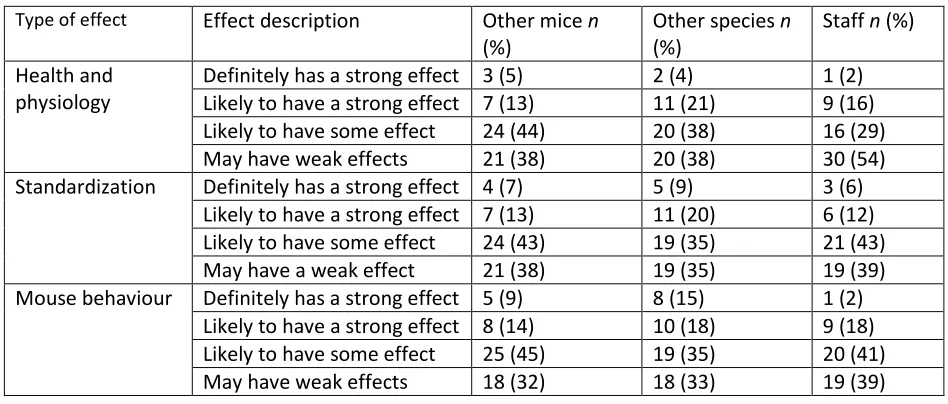
Table 1 below summarizes the opinion of respondents regarding the effect of other mice, other 144
Respondents considered conspecific odours as most likely to have a strong effect on mouse behaviour 146
(23%), but a weak effect (38%) on health and physiology and standardization. 147
Sources of allospecific odours 148
54 respondents from 40 different institutions reported housing some predatory species in the 149
same facility as mice with rats being the most common (41) followed by ferrets (9), primates (6), cats (5) 150
and dogs (3) (Figure 2). When participants were requested to provide their opinion about which species 151
in their facility could produce odours that might affect mice, 31/29 (55%) suggested rats, 5/29 (17%) 152
ferrets and 3/29 (10%) humans. Other responses were cats (1), ‘predators’ (1), other mice (3), primates 153
(1) and ‘miscellaneous smells’ (3). 154
Regarding practices that could restrict the transfer of scents between other species and mice, 155
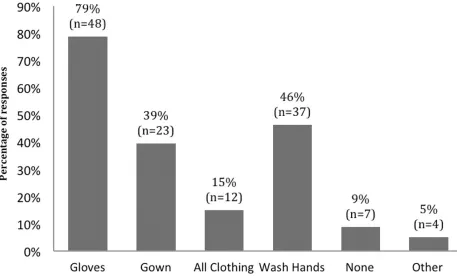
most respondents (79%) reported changing their gloves and 61% washed their hands, but it was not 156
clearly specified if this was done when handling other species followed by mice, or vice versa. Other less 157
common practices were changing gowns (38%) or changing all clothes (20%) and 11% of respondents did 158
not report taking any precautions when handling different species (Figure 3). Additionally, gowns were 159
most commonly shared between staff (63%), washed weekly (32%) and only 32% had species-specific 160
gowns. No statistically significant correlation was found between these beliefs and the practices carried 161
out to minimize inter-species scent transfer (p>0.05). 162
With respect to facility-policies, 57% of respondents indicated that their place of work had a 163
policy regulating staff pet ownership. These policies were mainly aimed at controlling the possession of 164
rodents: keeping rodents was either not allowed (10), limited (1), discouraged (1), or it required a 165
shower before entering the animal unit (2). Cats and dogs were the most common (74%) species kept as 166
companion animals. Other predatory species kept as pets were rats (16%) and ferrets (9%). 167
of other species (33%) or staff (20%). In contrast, the weakest effects were reported on health and 169
physiology (38% and 54% respectively). Interestingly, non-human odours were generally considered as 170
having less of an effect than other animal odours (Table 1). 171
Discussion 172
The results of the survey have revealed that a variety of routine husbandry procedures could allow 173
the transfer of scents of animal origin, such as odours of conspecifics of different sexes and strains, and 174
other species including mouse predators. The critical points with arguably the biggest risk of scent 175
transfer are the lack of changes of PPE and the methods of cleaning anaesthesia/euthanasia chambers 176
and behavioural apparatus between animals. The survey also provided the opportunity for those most 177
involved in the daily care of laboratory mice to raise any concerns and give their opinion regarding the 178
importance of this type of scent transfer. 179
With both sexes of mice sharing the same room in the majority (70%) of cases, pheromones of 180
conspecifics of the other sex can be transferred if gloves are not changed and hands are not washed 181
when handling both sexes, as reported by 78% of participants. The effect of pheromones on behaviour 182
and reproductive physiology been extensively studied and is widely used to manage mouse-breeding 183
programs. Although the use of barrier cages could reduce the exposure to pheromones in the home cage 184
(but not necessarily during procedures), conventional open cages were still used in many establishments. 185
Additionally, the nonvolatile nature of pheromones limits the capability of the barrier cages to prevent 186
pheromone exposure via hands or gloves, relying on adequate hand sanitising practices to prevent the 187
transfer of sexual cues. The transfer of pheromones between mouse cages could add a source of 188
physiological variation and possibly of stress or frustration. However the lack of exposure to conspecific 189
scents could be considered as a type of sensory deprivation and might have a negative impact on mouse 190
cage they are housed in, adding a source of variation to experimental results 1,2,4,35-39 192
The survey revealed that rats are commonly (91%) housed in the same animal unit as mice and 193
that a large (41%) percentage of participants believed that rat odours might affect mice. When predatory 194
and prey species are housed in the same facility, it is important to ensure that husbandry procedures 195
prevent the transfer of kairomones from the former to the latter. Kairomones present in urine and fur 196
can trigger stress-associated physiological and behavioural changes, but scents associated with the fur of 197
predators could have a particularly high impact as, in nature, they would indicate high proximity to the 198
threat 5-7,27-31,40. Changing gloves and washing hands was a moderately (79% and 61% respectively) 199
common practice when handling different species (although the direction of species change was not 200
specified) but species-specific gowns were used by only 32% of respondents. This may not be an issue if 201
repeated exposure to predatory scents leads to habituation, but strong stimuli might be resistant this 202
phenomenon and, on occasions, if the stimulus is withdrawn and later reintroduced, responses can be 203
recovered and even potentiated 3,10,41. For example, mice exposed to cat urine for 10 days failed to show 204
habituation and continued to show inhibition of sexual behaviour and over a three-fold elevation of 205
plasma corticosterone throughout this time 9,14,15,19,42. However, the effect of rat scents on mouse 206
habituation has not been studied, and further research on the onset, length and magnitude of this 207
phenomenon would be beneficial. 208
Despite the effects of cat and ferret odours on mice being well researched, and indeed these 209
odours are explicitly used as stressors in some experiments 1,2,4,43-46 , people’s awareness of their effects 210
on mice was low (cats: 3%, and ferrets: 17%). This may be a relevant concern, since 74% of respondents 211
reported the keeping of cats as pets by staff at their institutions, and 9% of institutions housed cats; 16% 212
housed ferrets. 213
laboratory animal allergens 5-7,27-31,47-49. Because allergens, like pheromones, derive from urine and other 215
animal secretions, not changing clothes or failing to cover the hair (particularly if predatory species are 216
kept as pets in the household) could introduce olfactory cues with a noticeable effect on behaviour and a 217
possible impact on mouse welfare 3,10,18,42-44,46,50-60. Indeed, respondents seemed most concerned about 218
the effects of other species’ odours on mouse behaviour, health and physiology and standardization of 219
experiments, with the highest proportion (33%) believing that these effects would be strong. However, 220
there is considerable uncertainty, because approximately 40% believed that any effects were likely to be 221
weak, so research is required to resolve the importance of these effects in an applied context. 222
Transfer of human scents to mice can occur during husbandry procedures, particularly when it 223
involves handling the animals with bare hands (30%). A recently published study 9,14,15,25,42 showed that 224
male and female mice exposed to human males or their scents (who share a similar androgen dependent 225
pheromonal make up as males of other species), displayed behaviours associated with stress (increased 226
thigmotaxis in the open field, increased defecation), signs of pain inhibition (decreased facial grimacing 227
after injection of inflammatory agents) and physiological changes indicating hypothalamic activation 228
(increased plasma corticosterol levels, hyperthermia). Additionally, rodents seem to be able to perceive 229
differences between the olfactory identity of the people that interact with them. The presence of 230
unfamiliar experimenters can cause fear like behaviours such as higher anxiety scores in the elevated 231
plus maze 16,26 or increased locomotion and place preference 8,17,61,62. These types of behavioural tasks 232
are routinely used to assess mouse models of neuropsychiatric disorders18,22,63-70; drug screening and 233
toxicology 19,67-69,71 and for phenotyping genetically modified and mutant mice 27,68,70,72-76. The effect of 234
the housing and test environment, such as the sex and familiarity with the experimenter, should be 235
considered in the experimental design of animal studies 2,32-34. 236
laboratory animals, and could add a source of variation to experimental results, they could also affect 238
reproducibility between laboratories. The survey highlights discordance between respondents as to 239
whether scents of animal origin have strong versus weak effects on mice. Further studies to investigate 240
these effects are required to enable recommendations for best practice. 241
Acknowledgements 242
We are grateful for all the respondents who participated in this survey. Noelia López-Salesansky 243
was supported by a Went Scholarship at the RVC. This research did not receive any specific grant from 244
any funding agency in the public, commercial, or not-for-profit sectors. RVC publication approval 245
reference PPH_00934. 246
Figure legend 248
249
Figure 1: Number of respondents that wash hands or change gloves between working with male and 250
female mice. The number of responses is given on the top of each bar (n = 67). 251
253
Figure 2: Responses indicating what species are housed in the same facility as mice. The number of 254
responses for species is given on top of each bar (n = 57). 255
257
Figure 3: Current practices for changes of PPE between working with mice and other species. The 258
number of responses for each practice is given on the top of each bar (n = 61). 259
Type of effect Effect description Other mice n (%)
Other species n (%)
Staff n (%) Health and
physiology
Definitely has a strong effect 3 (5) 2 (4) 1 (2) Likely to have a strong effect 7 (13) 11 (21) 9 (16) Likely to have some effect 24 (44) 20 (38) 16 (29)
May have weak effects 21 (38) 20 (38) 30 (54)
Standardization Definitely has a strong effect 4 (7) 5 (9) 3 (6) Likely to have a strong effect 7 (13) 11 (20) 6 (12) Likely to have some effect 24 (43) 19 (35) 21 (43) May have a weak effect 21 (38) 19 (35) 19 (39) Mouse behaviour Definitely has a strong effect 5 (9) 8 (15) 1 (2)
Likely to have a strong effect 8 (14) 10 (18) 9 (18) Likely to have some effect 25 (45) 19 (35) 20 (41)
May have weak effects 18 (32) 18 (33) 19 (39)
261
Table 1: Opinion of respondents regarding the effect of other mice, other species and staff on mouse 262
References 264
1. Latham N, Mason G. From house mouse to mouse house: the behavioural biology of free-living 265
Mus musculus and its implications in the laboratory. Appl Anim Behav Sc 2004; 86: 261–89. 266
2. Olsson IAS, Nevison CM, Patterson-Kane EG, Sherwin CM, Van de Weerd HA, Würbel H. 267
Understanding behaviour: the relevance of ethological approaches in laboratory animal science. 268
Appl Anim Behav Sc 2003; 81: 245–64. 269
3. Karlson P, Lüscher M. “Pheromones”: a new term for a class of biologically active substances. 270
Nature 1959; 183: 55–6. 271
4. Dulac C, Torello A. Molecular detection of pheromone signals in mammals: from genes to 272
behaviour. Nat. Rev. Neurosci 2003; 4: 551-562. 273
5. Jemiolo B, Novotny M. Inhibition of sexual maturation in juvenile female and male mice by a 274
chemosignal of female origin. Physiol Behav 1994; 55: 519–22. 275
6. Jemiolo B, Harvey S, Novotny M. Promotion of the Whitten effect in female mice by synthetic 276
analogs of male urinary constituents. P Natl Acad Sci USA 1986; 83: 4576–9. 277
7. Novotny M, Harvey S, Jemiolo B. Chemistry of male dominance in the house mouse, Mus 278
domesticus. Experientia 1990; 46: 109–13. 279
8. Schwende FJ, Wiesler D, Jorgenson JW, Carmack M, Novotny M. Urinary volatile constituents of 280
the house mouse, Mus musculus, and their endocrine dependency. J. Chem. Ecol 1986; 12: 277– 281
96. 282
9. Hurst JL. The priming effects of urine substrate marks on interactions between male house mice, 283
Mus musculus domesticus Schwarz & Schwarz. Anim Behav 1993; 45: 55-81. 284
10. Lacey JC, Beynon RJ, Hurst JL. The importance of exposure to other male scents in determining 285
competitive behaviour among inbred male mice. Appl Anim Behav Sci 2007; 104: 130–42. 286
11. Bruce HM. A block to pregnancy in the mouse caused by proximity of strange males. Reproduction 287
1960; 1: 96–103. 288
12. Whitten W. Modification of the oestrous cycle of the mouse by external stimuli associated with 289
the male.J. Endocrinol 1956; 13: 399–404. 290
13. Vanderbergh J. Effect of the Presence of a Male on the Sexual Maturation of Female Mice. 291
Endocrinology 1967; 81: 345–9. 292
14. Palmer RK, Hauser H, Gandelman R. Relationship between sexual activity and intraspecific fighting 293
in male mice. Aggr Behav 1984; 10: 317–24. 294
15. Korpela SR, Sandnabba NK. Gender-specific social experiences and the development of aggressive 295
16. Van der Lee S, Boot LM. Spontaneous pseudopregnancy in mice. Acta Physiol Pharmacol Neerl 297
1995; 4: 442--444. 298
17. Wyatt T. Pheromones and animal behaviour: communication by smell and taste. Cambridge Univ 299
Pr 2003; 391 pp. 300
18. Apfelbach R, Blanchard CD, Blanchard RJ, Hayes RA, McGregor IS. The effects of predator odors in 301
mammalian prey species: A review of field and laboratory studies. Neurosci. Biobehav. Rev 2005; 302
29: 1123-44. 303
19. Voznessenskaya VV. Influence of Cat Odor on Reproductive Behavior and Physiology in the House 304
Mouse. CRC Press 2014. 305
20. Blanchard R, Blanchard C. Antipredator defensive behaviors in a visible burrow system. J Comp 306
Psychol 1989; 103: 70–82. 307
21. Blanchard RJ, Blanchard DC. Attack and defense in rodents as ethoexperimental models for the 308
study of emotion.Prog. Neuropsychopharmacol. Biol. Psychiatry 1989; 13: S3–S14. 309
22. Blanchard C. Mouse Defensive Behaviors: Pharmacological and Behavioral Assays for Anxiety and 310
Panic. Neurosci. Biobehav. Rev 2001; 25: 205–18. 311
23. Davis H, Taylor AA, Norris C. Preference for familiar humans by rats.Psychon Bull Rev 1997 Mar; 312
4: 118–20. 313
24. Morlock GW, McCormick CE, Meyer ME. The effect of a stranger’s presence on the exploratory 314
behavior of rats. Psychon Sci 2013; 22: 3–4. 315
25. Sorge RE, Martin LJ, Isbester KA, Sotocinal SG, Rosen S, Tuttle AH, et al. Olfactory exposure to 316
males, including men, causes stress and related analgesia in rodents. Nat Meth. 2014;11: 629-32. 317
26. Driel KSV, Talling JC. Familiarity increases consistency in animal tests. Behav. Brain Res 2005; 159: 318
243–5. 319
27. Cocke R, Moynihan JA, Cohen N, Grota LJ, Ader R. Exposure to conspecific alarm chemosignals 320
alters immune responses in BALB/c mice. Brain Behav Immun 1993; 7: 36–46 . 321
28. Galef BG, Heiber L. Role of residual olfactory cues in the determination of feeding site selection 322
and exploration patterns of domestic rats. J Comp Physiol Psychol 1976; 90: 727–39. 323
29. Whittier JL, McReynolds P. Persisting odors as a biasing factor in open-field research with mice. 324
Can J Exp Psychol 1965; 19: 224–30. 325
30. Mason GJ. Murid stress odours: a review and a “low tech” method of collection. Dallaire J, Ware 326
N, editors. Universities Federation for Animal Welfare (UFAW) 2009; 18: 301–10. 327
31. Satinder KP. Effects of odour trials on open-field behavior in rat. Psychol Rep 1969; 25: 115-116 . 328
32. Zalaquett C, Thiessen D. The effects of odors from stressed mice on conspecific behavior. Physiol 329
33. Würbel H. Behavioral phenotyping enhanced–beyond (environmental) standardization. Genes 331
Brain Behav 2002; 1:3–8. 332
34. Würbel H. Behaviour and the standardization fallacy. Nature genetics. 2000; 26: 263–3. 333
35. Mineur YS, Crusio WE. Behavioral effects of ventilated micro-environment housing in three inbred 334
mouse strains. Physiol Behav 2009; 97: 334–40. 335
36. York JM, McDaniel AW, Blevins NA, Guillet RR, Allison SO, Cengel KA, et al. Individually ventilated 336
cages cause chronic low-grade hypoxia impacting mice hematologically and behaviorally. Brain 337
Behav. Immun 2012; 26: 951–8. 338
37. Burman O, Buccarello L, Redaelli V, Cervo L. The effect of two different Individually Ventilated 339
Cage systems on anxiety-related behaviour and welfare in two strains of laboratory mouse. 340
Physiol Behav 2014; 124: 92-9. 341
38. Kallnik M, Elvert R, Ehrhardt N, Kissling D, Mahabir E, Welzl G, et al. Impact of IVC housing on 342
emotionality and fear learning in male C3HeB/FeJ and C57BL/6J mice. Mamm Genome 2007; 18: 343
173–86. 344
39. Logge W, Kingham J, Karl T. Behavioural consequences of IVC cages on male and female C57BL/6J 345
mice. Neuroscience 2013; 237: 285–93. 346
40. Blanchard DC, Markham C, Yang M, Hubbard D, Madarang E, Blanchard RJ. Failure to produce 347
conditioning with low-dose trimethylthiazoline or cat feces as unconditioned stimuli. Behav 348
Neurosci 2003; 117: 360–8. 349
41. Barry RJ, Bhatnagar S, Clayton DF, Colombo J. Habituation revisited: An updated and revised 350
description of the behavioral characteristics of habituation. Neurobiology Learn Mem 2009; 351
92(2):135-8. 352
42. de Catanzaro D. Effect of predator exposure upon early pregnancy in mice. Physiol Behav 1988; 353
43: 691–6. 354
43. Adamec R, Walling S, Burton P. Long-lasting, selective, anxiogenic effects of feline predator stress 355
in mice.Physiol Behav 2004; 83(3): 401-10. 356
44. Adamec R. Lasting anxiogenic effects of feline predator stress in mice: sex differences in 357
vulnerability to stress and predicting severity of anxiogenic response from the stress experience. 358
Head D, Blundell J, Burton P, Berton O.Physiol Behav 2006 ; 88(1-2): 12-29. 359
45. Berton F, Vogel E, Belzung C. Modulation of mice anxiety in response to cat odor as a 360
consequence of predators diet. Physiol Behav 1998; 65: 247–54. 361
46. Staples LG. Predator odor avoidance as a rodent model of anxiety: learning-mediated 362
consequences beyond the initial exposure. Neurobiol Learn Mem 2010; 94: 435–45. 363
47. Damato G, Liccardi G, Russo M, Barber D, Damato M, Carreira J. Clothing is a carrier of cat 364
48. Krop EJM, Doekes G, Stone MJ, Aalberse RC, van der Zee JS. Spreading of occupational allergens: 366
laboratory animal allergens on hair-covering caps and in mattress dust of laboratory animal 367
workers. Occup. Environ. Med 2007;64: 267-72. 368
49. Liccardi G, Barber D, Russo M, D rsquo Amato M, D rsquo Amato G. Human hair: an unexpected 369
source of cat allergen exposure. Int Arch Allergy Immunol 2005; 137: 141–4. 370
50. Dielenberg RA. Defensive behavior in rats towards predatory odors: a review. McGregor IS, 371
editor. Neurosci Biobehav Rev 2001; 25: 597. 372
51. O'Boyle M. Rats and mice together: the predatory nature of the rat's mouse-killing response. 373
Psychol. Bull 1974; 81: 261–9. 374
52. Blanchard RJ. The characterization and modelling of antipredator defensive behavior. Blanchard 375
DC, Rodgers J, Weiss SM, editors. Neurosci Biobehav Rev 1990; 14(4): 463-72. 376
53. Blanchard RJ, Nikulina JN, Sakai RR, McKittrick C, McEwen B, Blanchard DC. Behavioral and 377
endocrine change following chronic predatory stress. Physiol Behav 1998; 63: 561–9. 378
54. Hebb A, Zacharko RM, Dominguez H, Laforest S, Gauthier M, Levac C, et al. Changes in brain 379
cholecystokinin and anxiety-like behavior following exposure of mice to predator odor. 380
Neuroscience 2003; 116: 539–51. 381
55. Blanchard DC, Griebel G, Blanchard RJ. Conditioning and residual emotionality effects of predator 382
stimuli: some reflections on stress and emotion. Prog. Neuropsychopharmacol. Biol. Psychiatry 383
2003; 27: 1177–85. 384
56. Calvo Torrent A, Brain PF, Martinez M. Effect of predatory stress on sucrose intake and behavior 385
on the plus-maze in male mice. Physiol Behav 1999; 67: 189–96. 386
57. Masini CV. Accessory and main olfactory systems influences on predator odor-induced behavioral 387
and endocrine stress responses in rats. Garcia RJ, Sasse SK, Nyhuis TJ, Day HEW, Campeau S, 388
editors. Behav Brain Res 2010; 207: 70-7. 389
58. Belzung C, Hage El W, Moindrot N, Griebel G. Behavioral and neurochemical changes following 390
predatory stress in mice. Neuropharmacology 2001;41: 400-8. 391
59. Takahashi LK, Nakashima BR, Hong H, Watanabe K. The smell of danger: a behavioral and neural 392
analysis of predator odor-induced fear. Neurosci Biobehav Rev 2005; 29: 1157–67. 393
60. Nakashima T, Akamatsu M, Hatanaka A, Kiyohara T. Attenuation of stress-induced elevations in 394
plasma ACTH level and body temperature in rats by green odor. Physiol Behav 2004; 80: 481–8. 395
61. Davies Vj, Bellamy D. The olfactory response of mice to urine and effects of gonadectomy. J. 396
Endocrinol 1972; 55: 11–20. 397
62. McCall RB, Lester ML, Corter CM. Caretaker effects in rats. Developmental Psychology1969; 1: 398
771. 399
21: 801–10. 401
64. Holmes, A. Targeted and gene mutation approaches to the study of anxiety-like behavior in 402
mice. Neurosci Biobehav Rev 2001; 25: 261–273. 403
65. Bourin M, Petit-Demoulière B, Nic Dhonnchadha B, Hascöet M. Animal models of anxiety in mice. 404
Fundamental & clinical pharmacology 2007; 21: 567–74. 405
66. Wall PM, Messier C. Methodological and conceptual issues in the use of the elevated plus-maze 406
as a psychological measurement instrument of animal anxiety-like behavior. Neurosci Biobehav 407
Rev 2001; 25: 275–86. 408
67. Blanchard DC, Griebel G, Blanchard RJ. The mouse defense test battery: pharmacological and 409
behavioral assays for anxiety and panic. Eur J Pharmacol 2003; 463: 97–116. 410
68. Choleris E, Thomas AW, Kavaliers M. A detailed ethological analysis of the mouse open field test: 411
effects of diazepam, chlordiazepoxide and an extremely low frequency pulsed magnetic field. 412
Neurosci Biobehav Rev. 2001; 25: 235-60. 413
69. Crawley JN, Paylor R. A proposed test battery and constellations of specific behavioral paradigms 414
to investigate the behavioral phenotypes of transgenic and knockout mice. Horm Behav 1997; 31: 415
197–211. 416
70. Bailey KR, Rustay NR, Crawley JN. Behavioral phenotyping of transgenic and knockout mice: 417
Practical concerns and potential pitfalls. ILAR J. 2006; 47: 124-31. 418
71. Treit D, Fundytus M. Thigmotaxis as a test for anxiolytic activity in rats. Pharmacol. Biochem. 419
Behav 1988; 31: 959–62. 420
72. Crawley JN. Behavioral phenotyping of rodents. Comparative medicine. J Am Assoc Lab Anim Sci 421
2003; 53: 140–6. 422
73. van der Staay FJ, Steckler T. Behavioural phenotyping of mouse mutants. Behav. Brain Res.2001; 423
125: 3–12. 424
74. Gould T. Mood and anxiety related phenotypes in mice : characterization using behavioral tests. 425
Totowa, NJ. Genes Brain Behav 2009; 9: 544. 426
75. Tanaka S, Young JW, Halberstadt AL, Masten VL, Geyer MA. Four factors underlying mouse 427
behavior in an open field.Behav. Brain Res 2012; 233: 55–61. 428
76. Koolhaas JM, Bartolomucci A, Buwalda B. Stress revisited: A critical evaluation of the stress 429
concept. Neurosci. Biobehav. Rev 2011; 35(5):1291-301.
430