EFFECT OF INCREASING DOSES OF MUSHROOM SUBSTRATE ON THE
ROOT MASS OF SELECTED LAWN MIXTURES
Beata Wiśniewska-Kadżajan1
1 Departament of Grassland and Green Areas Creation, University of Natural Sciences and Humanities in
Siedlce, B. Prusa 14, 08-110 Siedlce, e-mail: [email protected]
INTRODUCTION
In Poland, especially in the central eastern part of the country, mushroom cultivation is an important and rapidly growing sector of agricul-tural production. The production of this mush-room in recent years reached the level of 250–300
thousand tons, which gives Poland first place in
Europe and third in the world [Szudyga 2011]. We hold the same position in terms of the produc-tion of waste mushroom substrate (1.250–1.500 thousand tons).
Mushroom production provides the raw mate-rial for the processing industry and participates in the recycling of other waste organic materials such as straw and poultry manure.
Volume 14, No. 4, Oct. 2013, pp. 39–44
DOI: 10.5604/2081139X.1066231 Research Article
ABSTRACT
To fertilize both grassland and turf lawns waste materials, including the substrate after mushroom cultivation have been used recently. The aim of this study was to deter-mine the effect of the mushrooms substrate to change the amount of root mass of five turf lawns with varying precipitation of perennial ryegrass. Field experiment was established in 2004 in the agricultural station of University of Natural Science and Humanities in Siedlce. In the research, the following factors were used: 1) dose of mushroom substrate, 2) the mixtures lawns with different species composition and participation of perennial ryegrass. Within two years of research the evaluation of the amount of root mass of turf lawns were done. This assessment was made after plants’ vegetation in 2005 and 2006. The roots sampling of lawns were taken. After cleaning of the root and drying at 1050C, the mass was determined by weighing. The largest
mass of roots (average from the study years and substrate doses) was observed for the two-component mixture (M1) with 80% share of perennial ryegrass, and the smallest for five-component mixture (M5), where the share of perennial ryegrass was 40%. The average for research years of and mixtures type, indicates that most of the root mass formed the turf lawns with the largest mushroom substrate doses, but at least on the control object. The majority of the tested lawn mixtures, with the exception of mixture five (M5) produced a greater mass of roots in the second year (2006) than in the first (2005) year, despite worse weather conditions.
Keywords: lawn, dry matter of roots, mixtures, mushroom’s refuse. Received: 2013.08.15
Accepted: 2013.09.08 Published: 2013.10.10
In accordance with the Decree of the Min-ister of the Environment from 27 September 2001 substrate after mushroom production is
classified as a group of waste from agriculture,
horticulture, aquaculture, forestry, hunting and
food processing as “other wastes not specified”
[Regulation ... 2001].
This waste generates problems for mushroom producers because mushroom hall usually oper-ate in isolation from agricultural land and do not have the capacity for utilization of the waste on their own way [Rutkowska 2009].
The studies conducted showed that spent mushroom substrate (SMS) after mushroom cultivation is a good material for fertilization
Wiśniewska 2004, 2006, 2008, 2009]. According
to Szudyga [2005, 2009, 2011], properly prepared SMS should not contain pests, pathogenic fungi and weed seeds. But should be a good consis-tency and tolerated soil smell, and any residues of chemicals used prophylactic ally before mush-rooms harvest do not do any threat to the later, cultivated plants due to the short waiting period.
According to Jordan et al. [2008] mushroom substrate in 65% is an organic substance which, after introduce into the soil is converted into hu-mus. The research carried out by Kalembasa and
Wiśniewska [2001] showed that the mushroom
waste contains on average 25 to 35% of dry mat-ter, has a generally neutral reaction and narrow C: N ratio (13,8:1) very favourable in terms of fertilizer value.
Maszkiewicz [2010] reports that in the spent substrate mushroom macro elements content is (kg. T-1) amounted: N – 8.0, phosphorus – 2.5,
potassium – 9.7, magnesium – 2, 1, sulfur – 5.0, calcium – 22; Sodium – 0.8, and micronutrients (g. t-1): manganese – 118, copper – 15, zinc – 86,
boron – 12. Jordan et al. [2008] as well as Salo-mez et al. [2009] reported that in the spent
sub-strate mushroom, a significant part of the overall
macro elements, establish their absorbed forms. Physical-chemical properties and the absence of
toxic substances make the cultivation of mush -room substrate useful waste and can be effec-tively used.
So far, studies have shown that mushroom substrate is increasingly used in agriculture to fer-tilize of arable land and permanent grasslands, in
horticulture, and for the establishment and
main-tenance of green areas (Kalembasa, Wiśniewska
2004, 2006, Rak et al. 2001, Jankowski et al. 2004, Jankowski et al., 2012 a, b).
The aim of this study was to determine the effect of mushroom substrate on the amount of roots matter of turf lawns established from of the
five lawn mixtures with different species com -position.
MATERIALS AND METHODS
The field experiment was established in
2004 in the completely randomized design ob-ject Agricultural of University of Natural Sci-ences and Humanities in Siedlce (coordinates:
52.169 °N, 22.280 °E). The experiment was set
up in a split-plot design with three replications on plots with the area of 3 m2, with the
follow-ing research factors:
• organic manuring with mushroom substrate in different doses: D0-0, D1-2, D2-4, D3-6 (kg∙m-2);
• the lawn mixture (M1, M2, M3, M4 and M5),
with a varying number of components and di-verse participation of perennial ryegrass (re-spectively: 80, 60, 40, 20 and 40%) (Table 1).
The mushroom substrate used in the experi -ment contained 36.0% of dry matter and 40% of organic matter, 14.0 g . kg-1 of nitrogen, 2.0 g . kg-1,
of phosphorus and 5.0 g . kg-1 of potassium in
ac-cording to dry matter. At all experimental objects
fast-acting fertilizer Pokon was used with a
con-Mixture Grass species Quantity of species Share in mixture[%]
M1 Perennial reygrass Red fescue 2 8020
M2
Perennial reygrass Red fescue Tall fescue
3
60 30 10
M3
Perennial reygrass Red fescue Tall fescue
3
40 30 30
M4
Perennial reygrass Red fescue Sheep’s fescue Kontucky bluegrass
4
20 55 15 10
M5
Perennial reygrass Red fescue Sheep’s fescue Kentucky bluegrass Common bent
5
tent N-20%, P-5%, K-7%. The dose of mineral fertilizers was applied on the basis of nitrogen,
using 120 kg ∙ ha-1 of this component in two equal
doses in early spring and summer.
The field experiment was conducted on the
soil with a particle size of clay light sand
classi-fied as anthropogenic soils of hortisole type. Its
pH in 0.01 M CaCl2 was 6.8, the carbon content in organic compounds 13.45 g . kg-1 and 1.32 g . kg-1of total nitrogen, and C: N ratio was 10.2.
The content of available phosphorus was low (P - 39.6 mg . kg-1 of soil), and the average abundance
of potassium (K – 114.0 mg . kg-1 of soil), while
the available magnesium in the range of very high abundance ( Mg – 114.0 mg . kg-1 of soil).
In 2005 and 2006 (after the vegetation period
) from each experiment object the samples of turf
with the root system with a depth of 10 cm was
taken . The samples of root mass were purified
from the remaining soil and then were dried at 1050C to a constant weight and then the dry
mat-ter of roots samples were demat-termined.
Meteorological data from the years 2004– 2006 were obtained from the Hydrological and Meteorological Station in Siedlce.
In order to determine temporal and spatial variability of meteorological elements and to as-sess their impact on the course of plant growth
hydrothermal coefficient (K) of Sielianinow was
calculated [Bac et al. 1993] dividing the sum of monthly rainfall for one-tenth of total average daily temperature for the month (Table 2).
The results of root mass of tested grass mix -tures were determine by multifactor analysis of variance with using of random model (synthesis
from the years). For the significant sources of
variation a detailed comparison of averages by
Tukey’s test at the level of p ≤ 0.05 has made [Trętowski, Wojcik 1991].
RESULTS AND DISCUSSION
According to Harkot and Czarnecki [1999] root mass is a very important element of lawn grasses assessment and plays a very important role in the stabilization of turf areas. On the de-velopment of grass root mass can affect a variety of factors including fertilization.
The present study examined the amount of root mass from lawns which was significantly differentiated under the influence of mushroom
substrate dose (Table 3).
Average from (years and doses of the mushroom substrate) the greatest mass of roots (219.9 g . m-2 D.M.) was observed for a
quater-nary mixture (M4) with 20% of perennial rye -grass, and the smallest root mass (208.5 g . m-2
D.M.) were obtained for the five-component mixture (M5), where the proportion of peren -nial ryegrass was 40%.
With increasing doses of mushroom substrate root matter of studded lawn grasses increased. The greatest root mass (245.2 g . m-2 D.M.) formed
Table 2. Hydrotermical Sielianinow indexes (K) in individual months of vegetation seasons in 2004–2006 (K < 0.5 high drought; 0.51 – 0.69 drought; 0.70 – 0.99 poor drought; K >1 no drought)
Year Month
IV V VI VII VIII IX X
2004 1.58 2.29 0.96 0.99 1.20 0.44 1.05
2005 0.35 1.94 1.06 1.59 0.49 0.41 0.08
2006 1.18 0.97 0.46 0.24 4.21 0.45 0.74
Table 3. Roots dry matter depending on the kind of mixture and the dose of mushroom’s refuse (mean from years 2005–2006)
Dose of mushroom substrate (A)
Kind of mixture (B)
Mean
M1 M2 M3 M4 M5
D0 201.5 194.3 200.4 198.3 192.8 197.4
D1 205.7 201.3 208.3 206.3 212.9 206.9
D2 224.3 224.3 217.0 230.0 213.9 221.9
D3 227.9 238.4 227.6 245.2 214.6 230.7
Mean 214.8 214.5 213.3 219.9 208.5
quaternary compound (M4) with the lowest share of perennial ryegrass on the object fertilized with mushroom substrate at 6 kg . m-2 (D3), whereas
the least (192.8 g . m-2 D.M.) pentavalent mixture
(M5) on the control object, where the amount of perennial ryegrass was 40%.
The percentage of perennial in the tested
rye-grass mixtures did not affect the amount of root
mass produced by lawn grasses tested.
All lawn grass mixtures produced the greatest
root mass on the object with the highest content of mushroom substrate (D3 – 6 kg . m-2, which is
due to a large amount of nitrogen introduced to-gether with the dose.
The size of root mass produced by each lawn
mixtures, are confirmed in a study of Jankowski
et al. [2011] with the using of the some lawn grass
mixtures supplied with the hydrogel.
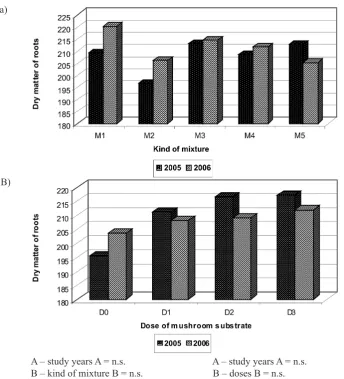
Within two study years there were no signifi
-cant differences in root mass between the first and
second year of research (Fig. 1a).
In the first study year (2005), the greatest
mass root (average for dose) was recorded for the
ternary mixture (M3) with perennial ryegrass in
the amount of 40%, and the lowest also for the
ternary mixture (M2), but with a larger share of
perennial ryegrass (60 %). The greatest root mass in the second year (2006) was recorded for the
two-component mixture with perennial ryegrass
constituating 80% (M1), but the smallest one was
for the component mixture (M5) with 40% share
of ryegrass.
The majority of the tested mixtures lawn, ex
-cept the five-component mixture (M5), produced greater root mass in the second than in the first
study year despite worse weather conditions
(ta-ble 2), because in five months (May, June, July,
September, October) drought was recorded. Böhm [1985] and Falkowski et al. [1994] suggested that the root system has a decisive
im-pact on the plant survival under water deficit con -ditions. Roots played great role in the adaptation
a)
A – study years A = n.s. A – study years A = n.s. B – kind of mixture B = n.s. B – doses B = n.s.
Fig. 1. Roots dry matter of turf lawns in depends of kind of mixture (a) and doses of mushrooms substrate (b) in the study years.
of plants to changing habitat and weather condi-tions. It has connected with differing resistance to
stress conditions which expose individual plants
and the unequal ability to run and nutrient uptake from the soil.
According to Fiala [1997] drought periods activate the root system to the intensity of the
de-velopment, especially in depth of the soil profile,
which helps plants maintain the physiological condition.
Increasing doses of the mushroom substrate had a positive effect on root mass of the tested lawns, as evidenced by the tendency to increase the root mass with increasing dose of used waste,
but this difference is not statistically significant
(Fig. 1b).
Similar results for the root mass of turf lawn
mixtures obtained in studies of Grabowski et al.
[2008] with the fact that these lawns were fed with different doses of sewage sludge.
CONCLUSIONS
1. Roots mass of lawn grasses showed significant
differences depending on the dose of mush-room substrate.
2. The highest roots mass (average from the years and doses) was observed for the four
component mixture (M4) with 20% share of
perennial ryegrass, but the smallest one was
the five component mixture (M5), where the
proportion of perennial ryegrass was 40%. 3. The average from the study years and the types
of mixtures, indicate that the highest roots was
mass produced by lawn turf grown on the highest doses of mushroom substrate and at least on the control object, where no fertilizers were used.
4. Most of the tested lawn mixtures, except of the five component mixture (M5), produced greater root mass in the second than in the first
study year, which demonstrates the viability of the lawns maintaining in good shape, even in bad weather conditions.
REFERENCES
1. Bac S., Koźmiński C., Rojek M. 1993. Agrometeo-rologia. PWN, Warszawa: 32-33.
2. Böhm W. 1985. Metody badań systemów korze-niowych. PWR i L, Warszawa, 188-191.
3. Falkowski M., Kukułka J., Kozłowski S. 1994. Właściwości biologiczne roślin łąkowych. Wyd. AR Poznań.
4. Fiala K. 1997. Underground plant biomass of grassland communities in relation to mowing in-tensity. Acta Sc. Nat. Brno 31(6), 54.
5. Grabowski K., Grzegorczyk S., Głowacka – Gil A. 2008. The effect of sludge bon initial growth and development of lawn grasses in background of dif-ferent mix types and sowing times. Pol. J. Environ. Stud. 17 : 960, 975-980.
6. Harkot W., Czarnecki Z. 1999. Przydatność pols-kich odmian traw gazonowych do zadarniania pow-ierzchni w trudnych warunkach glebowych. Folia Univ. Agric. Stetin, 197, Agriculture 75: 117-120. 7. Jankowski K, Czeluściński W, Jankowska J,
Sos-nowski J. 2012b. Wpływ zróżnicowanej dawki odpadu popieczarkowego na stopień odrostu mu-raw tmu-rawnikowych. Folia Pomeranie Universitatis Technologie Stetinensis 297 (23), 35-42 .
8. Jankowski K., Ciepiela G.A., Jodełka J., Kolczarek R. 2004. Możliwość wykorzystania kompostu pop-ieczarkowego do nawożenia użytków zielonych. Ann. UMCS, Sec E, 59 (4): 1763-1770.
9. Jankowski K., Czeluściński W, Jankowska J. 2011. Wpływ rodzaju hydrożelu i rodzaju nawozu min-eralnego na zadarnienie muraw trawnikowych o zróżnicowanym udziale życicy trwałej. Folia Pomeranae Univer. Techn. Stetin. Agricultura 286 (18): 13-32.
10. Jankowski K., Czeluściński W., JankowskaJ., Sos-nowski J. 2012a. Kolorystyka muraw trawnikowych w wyniku zastosowania zróżnicowanych dawek odpadu popieczarkowego. Łąk. Pol. 15: 77-85. 11. Jordan S.N., Mullen G.J., Murphy M.C. 2008.
Composition variability of spent mushroom compost in Ireland. Bioreosurce Technology, 99: 411-418.
12. Kalembasa D., Wiśniewska B. 2006. Zmiany składu chemicznego gleby i życicy wielokwia-towej pod wpływem stosowania podłoża popiec-zarkowego. Zesz. Probl. Post. Nauk Roln., 512: 265-276.
13. Kalembasa D., Wiśniewska B. 2004. Wykorzystan-ie podłoża popWykorzystan-ieczarkowego do rekultywacji gleb. Roczniki Gleboznawcze, 55, 2: 209-217.
14. Kalembasa D., Wiśniewska B. 2008. Wpływ nawożenia podłożem popieczarkowym na plon i zawartość wybranych makroelementów w życicy wielokwiatowej. Zesz. Probl. Post. Nauk Rol., 526: 191-198.
16. Kalembasa S., Wiśniewska B. 2001. Skład chem-iczny podłoży po produkcji pieczarek. Zesz. Probl. Post. Nauk Roln., 475, 295-300.
17. Maszkiewicz J. 2010. Zużyte podłoże popieczar-kowe jako nawóz i paliwo. W: Pieczarki. Biuletyn Producenta Pieczarek. Wyd. Hortpress, 1:59-60. 18. Rak J., Koc G., Jankowski K., 2001. Zastosowanie
kompostu popieczarkowego w regeneracji runi łąko-wej zniszczonej pożarem. Pam. Puł. 125: 401-408. 19. Rozporządzenie Ministra Środowiska z dnia 27
września 2001 r. w sprawie katalogu odpadów. Dz. U. Nr 112, poz. 1206.
20. Rutkowska B. 2009. Możliwości rolniczego wykorzystania zużytych podłoży po produkcji pieczarek. Odpady w kształtowaniu i inżynierii środowiska. Polska Akademia Nauk Wydziału
Nauk Rolniczych, Leśnych i Weterynaryjnych. Zesz. Probl. Post. Nauk Roln., 535:349-354. 21. Salomez J., De Bolle S., Sleutel S., De Neve S.,
Hofman G. 2009. Nutrient Legislation in flanders (Belgium). Procedings, More sustainability in ag-riculture: New fertilizers and fertilization manage-ment, Rome 546-51.
22. Szudyga K. 2005. Podłoża do uprawy piec-zarki. W: Uprawa piecpiec-zarki. Wyd. Hortpress, 73-74.
23. Szudyga K. 2009. Jakość. W: Pieczarki. Biuletyn Producenta Pieczarek. Wyd. Hortpress, 1: 12-13. 24. Szudyga K. 2011. Ja pieczarka. W: Pieczarki.
Biule-tyn Producenta Pieczarek. Wyd. Hortpress, 1: 8-13. 25. Trętowski J., Wójcik A. R. 1991. Metodyka