ARCHITECTURE REQUIREMENTS FOR INTERACTING WITH
THINGS USING CONSTRAINED APPLICATION PROTOCOL
*Krishna Chaitanya Sanagavarapu
System Analyst, Teknatio Inc, Philadelphia, PA.
Article Received on 25/08/2019 Article Revised on 15/09/2019 Article Accepted on 05/10/2019
ABSTRACT
Particularly, the advent of low- price as well as low-power
transceivers, along with the advancement of compact-size and open
standard stacks, have enabled Wireless Sensor Networks (WSNs),
mainly taken on for both home/office and also industrial monitoring
applications. The nowadays ambitious objective is to sample, accumulate and assess every
piece of information around us, in order to boost manufacturing efficiency and also make
sure optimum resource usage. It additionally offers a design which is called alternative as it
takes into consideration the circulation of the information from sensing units with to services
The style offers a collection of abstractions for the various kinds of sensors as well as
services.
INDEX TERMS: Wireless Sensor Networks, Cloud based IoT.
I. INTRODUCTION
In Cloud computing, the majority of the computing sources exist on the Internet on servers,
rather than client devices such as laptop computers or personal computers. Cloud computing
is typically related to Information Technology (IT) solutions, but can in theory be
encompassed ingrained software application shows. Integrating Cloud computing with
Wireless Sensor Networks (WSNs) brings the principle of Cloud-based ingrained system
shows. The Cloud-based integrated shows atmosphere has a typical benefit, namely that the
regional managers and individuals don't need to hang out with large client as well as server
machine setups, setups, or software application updates. With Cloud-based tools, the
customer can configure from anywhere that has an Internet connection. In the proposed
World Journal of Engineering Research and Technology
WJERT
www.wjert.org
SJIF Impact Factor: 5.924*Corresponding Author
Krishna Chaitanya
Sanagavarapu
Cloud-based version, the Cloud links devices such as Computers, cellular phones, ingrained
growth platforms, or host makers to Cloud-based programming tools. These tools can consist
of sales data sources, or Integrated Growth Environments (IDE), and can assemble sources
held by Cloud computing platforms such as Amazon.com, Microsoft, Google, and also
Yahoo. The Cloud-based design requires that the Web-based tools are operating systems, as
well as are client equipment- agnostic. A further benefit of the Cloud design is the
adaptability of application.
In RFID application development,[1] pointed out that the release of RFID applications
frequently remains intricate and also expensive, considering that they include the laborious
deployment and monitoring of big and heterogeneous dispersed systems. As a result, they are
just ideal for large organizations; as opposed to the minimal sources of local business
applications To resolve this issue, Dominique et al. talked about a Cloud computing solution
incorporating virtualization technologies and the style of the Internet as well as its services.
They applied the Amazon Web Solution platform and also Elastic Compute Cloud (EC2)
services. The EC2 service enables the development and also management of virtual makers
(Amazon.com Device Images, or AMIs) that can after that be released on demand onto a pool
of devices that are organized, took care of, and also configured by Amazon. The advantage of
this method is that the server-side hardware maintenance is handed over to the Cloud carrier.
Additionally it offers far better scaling abilities, as the firm making use of the Cloud AMI,
can release additional and also much more effective instances according for requests.
The Cosm solution for the Internet of Things supplies data administration infrastructure for
sensors, devices, as well as atmospheres. It is an on-line database solution that permits
programmers to attach sensor data, e.g. power as well as setting data, from challenge the
Internet, as well as to construct their very own applications based on that data. The Cosm
handles countless data factors each day from countless individuals or companies around the
world. The Cosm permits individuals to embed real time charts in websites. It evaluates and
processes historic data pulled from any public information source Cosm feeds and also sends
out real time alterations from any kind of data stream to manage scripts, devices, or their
settings.
Nimbits is an open resource data logging Cloud server built on Cloud computing architecture
that gives connectivity between the Internet of Things using data points. Customers can
Nimbits, customers can produce information points on the Cloud and also feed altering
numerical, message based, or xml values right into them. Information points can be
configured to carry out computations, generate notifies, relay data to social media networks
or can be attached to spread sheets, web sites, as well as a lot more. Nimbits uses an
information compression device, an alert administration device, and also information
estimation on the obtained sensor information, utilizing simple mathematic solutions.
ThingSpeak is another open source Internet of Things application and also API (application
shows interface) for storing and also getting data from Things which makes use of HTTP
online or using a Lan. With ThingSpeak, customers can develop sensor-logging applications,
area tracking applications, and a social network of Things with standing updates. The
ThingSpeak API allows for numeric information processing such as time scaling, averaging,
mean summing, and rounding. The ThingSpeak network feeds support JSON and XML
formats for integration right into applications.
II. INTERACT WITH THINGS USING CONSTRAINED APPLICATION
PROTOCOL (COAP)
In the CloudThings architecture, our experts make use of CoAP to engage with Things. The
CoAP is actually a concentrated Web transmission method for usage along with constricted
nodules as well as constrained (e.g. low-power, or lossy) networks. The nodes frequently
possess 8-bit microcontrollers along with small amounts of ROM and RAM, while
constricted systems such as 6LoWPAN frequently have high package inaccuracy costs as
well as a normal throughput of 10s of kbit/s. The method is actually designed for
machine-to-machine (M2M) requests including intelligent electricity and building automation. CoAP
delivers a request/response interaction style between program end-points. This assists
integrated revelation of services as well as sources, and also features essential principles of
the Internet like URIs as well as Internet media styles. CoAP simply interfaces with HTTP
for integration with the Internet, while satisfying specialized requirements like multicast
assistance, really reduced overhead, as well as ease for constricted atmospheres.
CoAP is actually based on the same client/server style as HTTP, as well as represents its own
communication style in a similar fashion. Assets are requested and also pinpointed through
URIs making use of the Representational State Transmission techniques of GET, PUT, POST
and also REMOVE. Compare to HTTP, the CoAP swaps notifications asynchronously over
telematic devices. The information is actually recognized due to the sought URI. The PUT
technique is used to change an existing resource on a sensor nodule or even a telematic unit.
Both the approaches and the asked for URI are actually carried in a confirmable message
which stands for the demand.
III. ARCHITECTURE REQUIREMENTS
The goal of our design is to simplify the development, setup as well as deployment issues to
make it possible for ubiquity of WSNs, less complicated interfacing to various other networks
as well as the easier advancement of generic and a lot more powerful applications utilizing
sensor information. To fulfill this purpose, we specify the following architecture needs:
It needs to be independent of certain node hardware, must manage a series of node useful
abilities and provide an extensible layered system able to deal with the radio network as well
as environmental factors, within the called for limits of power consumption.
It should give abstractions for the basic operations needed of a sensor node as well as the
solutions utilizing it, which map quickly to a variety of heterogeneous devices as well as
greater degree solutions.
It needs to plainly define the feasible functions of nodes as well as any methods must be
adequately straightforward for reduced ability devices to get involved. It is unreasonable to
demand that all nodes have equivalent performance, as this restricts the capacity to manage
much more powerful nodes. Nodes will, nevertheless, require a minimum level of
performance, e.g. forwarding information to a neighbor.
It must supply a regular methods to exchange sensor information independent of the
underlying modern technology and also give specific assistance for the modelling of sensor
data to allow integration into greater level systems. A sensor node ought to be able to suggest
other nodes as well as services of its noticing and also system capacities.
It should be able to take care of tiny, static networks and also enable the system to adapt as
the network grows/changes or experiences various other networks and also assistance
applications discovering as well as collaborating without a central coordination center.
The need for a much more alternative approach can be seen in a remote healthcare
wireless network. The portal is in charge of storing the data locally and publishing data to a
central health monitoring website, potentially through a main gateway/proxy as well as cloud
based solutions to analyse the information. Such options usually require sensor application
and proxy design to handle data assimilation, network assimilation and protection issues. This
lack of linked abstractions will certainly end up being much more troublesome in this
scenario as Wireless Body Location Networks are released, e.g. IEEE802.15.6 which allows
as much as 64 nodes on a body to link using a central co-ordinator node. When lots of
WSNs/BANs are released, dealing with these networks of nodes as peripheral devices and
also linking them to the Internet using proxies or sinks will certainly restrict performance and
also scalability.
IV. WSNs and Cloud computing
As soon as highlighted features and advantages of both WSNs and also cloud computing, it is
rather evident that these 2 standards can be mixed with each other to allow for easily sharing
and also assessing real-time sensor data on-the-fly.[4] Additionally, this combination likewise
permits providing sensor data or sensor occasion as a service online, to ensure that sensor
data can be conveniently evaluated not only locally, but additionally from almost everywhere
around the world. For these reasons, the terms "Noticing as a Solution" as well as "Sensor
Occasion as a Service" have actually been created. The former explains the process of
making the sensor data available to the clients throughout the cloud infrastructure; the latter,
on the other hand, is related to occasions of interests given by the cloud infrastructure.
Combining of these two modern technologies can be valuable manipulated for a largenumber
of different applications, including:
x Carry Tracking, e.g. for handling of systems for website traffic control, automated
acknowledgment of plates, toll- method monitoring, emergency automobile notification,
vibrant traffic light monitoring etc. Sensors data gathered by the cloud platform would allow
to build a global traffic picture dynamically updated by user themselves. These information
can be utilized in a multitude of applications, as automobile category, crash avoidance
systems, automated toll gates and so on.
x Army Usage; cordless sensor networks were originally designed for army applications (e.g.
response to top degree safety and security needs of these applications, demands that can not
be conveniently offered using normal Internet connection.
x Weather condition Forecasting; data collected by environmental sensing units represent an
instance of the so called "big data" concern, that can not be quickly kept using the traditional
database strategies, but can be beneficially solved by affordable huge computational power of
the cloud.
x Health Care; sensor networks are nowadays widely embraced in health care applications,
not just restricted to in hospital scenarios. Particularly, there is a boosting rate of interest in
developing individual as well as mobile gadgets for individuals's health and wellness
continuous surveillance as well as subsequently life top quality improvement. For example,
professional athletes can take advantage of such systems to get real-time warnings for a
risk-free as well as much more effective training; vital parameters of disregarded patients can be
frequently as well as from another location kept track of; and also, a lot more in general, all
individuals can get personalized guidance to maintain a healthy way of living.
Particularly, in the following section an application writers are establishing on this topic is
briefly resumed.
Radio Frequency Identification
With the IoT modern technologies such as RFID implemented in producing websites, huge
data will certainly be created. Such data are so complex, abstract, and variable that it is hard
to make full use the data that lug valuable details.[7] RFID-enabled item-level tagging, is
expected to create not just big operational as well as strategic information across the worth
chain of all markets, but also an impressive quantity of RFID data.[8]
EPCIS is an RFID occasion repository, which is among the core element of the EPCglobal
Architecture Framework. It helps store RFID event information as well as share the
information amongst supply chain partners. Digital Product Code (EPC) describes a coding
system for distinct code for the designation of physical products. RFID and also sensor
innovations are the core technologies of future IoT. RFID develops new opportunities as well
as processes such as real time supply and also item-level procedure validation. As a result, a
much larger volume of data is generated, and it is item-level data rather than transactional
result can be actually billions of additional information points. Many existing venture
systems were created to manage transaction-level information (like a P.O. or delivery) and
also not created to handle item-level information. What is required is a new type of
application designed specifically to take care of item-level RFID data, while integrating to
existing heritage systems and procedures. The brand-new systems ought to be able to:
Translate item-level information right into transaction-level information that existing systems
can soak up.
Filter and settle item-level information into meaningful organisation events, making reliable
use network transmission capacity.
Offer management-by-exception via rules-based tracking of these substantial brand-new
information circulations.
Shop item-level information in an EPICS-compliant data source, arranged in a hierarchical
manner (i.e. settling regional event data as much as greater degrees company event
information as required).
Supply organisation knowledge as well as analytic tools created specifically to take
advantage of this granular item-level data.
The RFID-enabled logistics big data typically consist of some "noise" such as incomplete,
redundant, and also imprecise documents. The significant noises in RFID-enabled logistics
information originate from repetitive records. Thus, it is necessary to identify as well as
remove the redundancy. Nonetheless, existing methods are not appropriate for getting rid of
the above noises. The understanding concealed in the RFID-enabled big data is erratic. That
suggests numerous RFID documents might develop a piece of info which indicates the
comprehensive reasoning procedures. Therefore, raw RFID information are typically of low
quality and may consist of many abnormalities due to physical gadget limitations as well as
various types of ecological noise. RFID information presents numerous obstacles for data
evaluation: (1) RFID information are inherently loud and redundant; (2) RFID data are
temporal, streaming, high quantity, and should be processed on the fly. A number of crucial
procedures are recommended: an RFID-Cuboid cleansing algorithm existed for detecting and
also removing the sound information from the logistics dataset; an RFID- Cuboid
granularity; as well as an RFID-Cuboid classification algorithm was reported for clustering
the cuboids according to the useful applications/considerations.
V. Green Machine to Machine Technology
Just recently, equipments are significantly becoming smarter as well as able to gather
information without human treatment. Artificial intelligence (AI) is the drive behind the
growth of numerous current modern technologies. Doing well the suggestion of an intelligent
device to machine (M2M) interaction is essential to be used on a considerable scale.
Machines should have great connectivity in order to enhance the contemporary computer
system devices as well as various other electronic tools for storing huge information. After
that, they can share the capability with all physical devices and any kind of various other
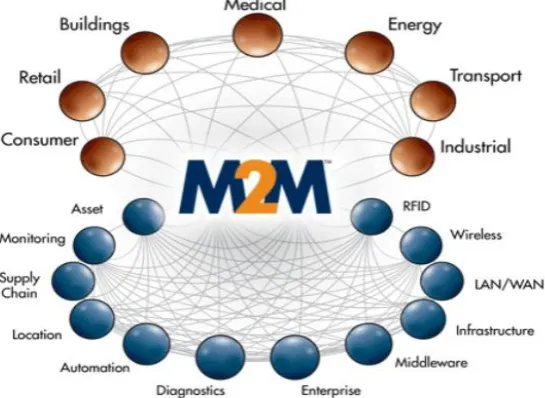
makers around. A maker represents an item which has electric, mechanical, ecological as well
as digital residential or commercial properties as received Fig. 1. The advantage of such
integrated radios interaction is to make certain that M2M communication is risk-free and
functions efficiently for all sort of jobs such as home, industrial, medical, along with service
procedures.
Fig 1: M2M communication.
The communication between devices is actually illustrated. Consequently, a substantial
number of equipments can correspond wisely, portion info as well as team up on selection
making. M2M is the development variation of IoT, where equipments correspond with one
another without individual assistance. With the aid of IoT, the billions maker can easily
have actually determined within 5-10 years, one hundred billion gadgets will certainly be
linked via the internet.
VI. CONCLUSION
Cloud computing companies and also the schedule of powerful as well as affordable wise
devices allow to improve information management, sharing size outcomes and also boosting
top quality of companies In review, this style has actually been shown to allow a holistic,
high-ranking strategy on constricted and powerful systems and allow a straightforward
integration along with Contiki and HBase to stash sensor data, calling for simply basic
notification reformats without calling for semantic adjustments or app proxies in a
commercial infrastructure of nodes and also companies.
REFERENCES
1. S. Haller, “The Things in the Internet of Things”, Internet of Things Conference 2010,
http://www.iot2010.org/
2. D.A Reed, D.D. Ganno., J.R. Larus., "Imagining the Future: Thoughts on Computing,"
Computer, Jan. 2012; 45(1): 25-30.
3. A. Zaslavsky, C. Perera, D. Georgakopoulos, “Sensing as a Service and Big Data”, Proc.
of International Conference on Advances in Cloud Computing, July 2012.
4. L. Mottola and G. P. Picco. “Programming Wireless Sensor Networks: Fundamental
Concepts and State of the Art. ACM Computing Surveys, 2010.
5. Anusha Medavaka, P. Shireesha, “Review on Secure Routing Protocols in MANETs” in “International Journal of Information Technology and Management”, May-2015; VIII:
XII, [ISSN : 2249-4510]
6. Anusha Medavaka, P. Shireesha, “Classification Techniques for Improving Efficiency and Effectiveness of Hierarchical Clustering for the Given Data Set” in “International Journal of Information Technology and Management”, May-2016; X: XV, [ISSN :
2249-4510]
7. Anusha Medavaka, P. Shireesha, “Optimal framework to Wireless Rechargeable Sensor
Network based Joint Spatial of the Mobile Node” in “Journal of Advances in Science and Technology”, May-2016; XI: XXII, [ISSN : 2230-9659]
8. Anusha Medavaka, “Enhanced Classification Framework on Social Networks” in “Journal of Advances in Science and Technology”, May-2015; IX: XIX, [ISSN :
9. Anusha Medavaka, P. Shireesha, “A Survey on TraffiCop Android Application” in “Journal of Advances in Science and Technology”, September-2017; 14: 2, [ISSN :
2230-9659]
10.Anusha Medavaka, Dr.P.Niranjan, P. Shireesha, “USER SPECIFIC SEARCH HISTORIES AND ORGANIZING PROBLEMS” in “International Journal of Advanced
Computer Technology (IJACT)”, 3: 6 [ISSN : 2319-7900]
11.Krishna Chaitanya Sanagavarapu, “PARALLEL PROCESSING ON FP-TREE BASED FREQUENT ITEM SET MINING” in “Airo International Research Journal”, Aug-2015;
VI, [ISSN : 2320-3714]
12.Krishna Chaitanya Sanagavarapu, “CLASSIFICATION OF DATA MINING SYSTEMS AND FUNCTIONALITY OF DATA MINING” in “AiroInternational Research Journal”,
July-2016; VIII, [ISSN : 2320-3714]
13.Krishna Chaitanya Sanagavarapu, “A STUDY ON SOURCES AND TYPES OF DATA TOWARDS DATA MINING” in “Airo International Research Journal”, July-2017; XII,
[ISSN : 2320-3714]
14.Krishna Chaitanya Sanagavarapu, “Advantages and Evolution of Cloud Computing” in “International Journal of Scientific Research in Science and Technology”, Apr-2017; 3: 3,
[ISSN : 2395-602X]
15.Krishna Chaitanya Sanagavarapu, “A Review on Pattern Mining Research Issues” in “International Journal of Scientific Research in Science and Technology”, June-2018; 4:
5, [ISSN : 2395-602X]
16.Krishna Chaitanya Sanagavarapu, “A Comprehensive Overview on Multidimensional Frequent Pattern Mining” in “Journal of Advances and Scholarly Researches in Allied Education”, Dec-2018; 15: 12, [ISSN : 2230-7540]
17.Krishna Chaitanya Sanagavarapu, “An Overview on the Design of Frequent Pattern Mining Algorithms” in “Journal of Advances and Scholarly Researches in Allied Education”, Jul-2016; XI: 22, [ISSN : 2230-7540]
18.Krishna Chaitanya Sanagavarapu, “Evolution of Social Networks and Social Networking Sites” in “Journal of Advances in Science and Technology”, Feb-2016; X: XXI, [ISSN :
2230-9659]
20.Anusha Medavaka, "Algorithm Feasibility on IoT Devices with Memory and
Computational Power Constraints", International Journal of Science and Research (IJSR),
May 2019; 8(5): [ISSN : 2319-7064]
21.Anusha Medavaka, "Programmable Big Data Processing Framework to Reduce On-Chip
Communications and Computations Towards Reducing Energy of the Processing" in “International Journal of Advanced Research in Computer and Communication Engineering”, April 2019; 8(4): [ISSN : 2278-1021]
22.Anusha Medavaka,“Identification of Security Threats and Proposed Security Mechanisms
for Wireless Sensor Networks” in “International Journal of Scientific Research in
Computer Science, Engineering and Information Technology”, May-2019; 5: 3, [ISSN :
2456-3307]
23.Anusha Medavaka,“A REVIEW ONDISPLAYING KNOWLEDGE INTO THE
UNLIMITED WORLDVIEW OF BIGDATA” in “International Journal of Research and
Analytical Reviews”, May-2019; 6: 2, [ISSN : 2348 –1269]
24.Anusha Medavaka, “A Comprehensive Study on Characteristics of Big Data and the Platform Used in Big Data” in “International Journal for Scientific Research & Development”, May-2019; 7: 3, [ISSN : 2321-0613]
25.Anusha Medavaka, “An Overview of Security Mechanisms Towards Different Types of
Attacks” in “International Journal of Scientific Research in Science and Technology”,
October-2018; 4: 10, [ISSN : 2395-602X]
26.Anusha Medavaka, “A study on the process of hiding protective information from the big data processing databases” in “International journal of basic and applied research”,
June-2019; 9: 6, [ISSN : 2278-0505]
27.Anusha Medavaka, “K-Means Clustering Algorithm to Search into the Documents
Containing Natural Language” in “International Journal of Scientific Research in Science and Technology”, Dec-2017; 3: 8, [ISSN : 2395-602X]
28.Anusha Medavaka, Siripuri Kiran, “Implementation of dynamic handover reduce function algorithm towards optimizing the result in reduce function” in “International Journal of Academic Research and Development”, July-2019; 4: 4, [ISSN : 2455-4197]
29.Anusha Medavaka, Siripuri Kiran, “A COMPREHENSIVE SURVEY IN INTERNET OF THINGS SMART APPLICATIONS” in “International Journal of Research”,
30.Krishna Chaitanya Sanagavarapu, “A Survey on Historical Developments of Social Network Sites” in “Journal of Advances in Science and Technology”, Sep-2017; 14: 2,