SOCIAL CHALLENGES FACING HEADS OF
SCHOOLS IN THE PROCESS OF
ENACTING THE CHILDREN’S
ACT (2001)
Julius Maiyo, Joan Owiye Masinde Muliro University of Science and Technology, Kenya E-mail: [email protected], [email protected]
Caroline R. Nandi Kenyatta University, Kenya E-mail:[email protected]
Abstract
Education has been identified as a tool for fostering the development of knowledge, skills, at-titudes, values and ideals necessary for individuals to play a productive role in any society. The signing of the various global policy frameworks such as the 1998 United Nations convention on the rights of the child (CRC), the 1990 Jomtien world conference on EFA, the 2000 world educa-tion forum (Dakar, Senegal) and the 2000 Millennium Development goals (MDGs) demonstrated the commitment by governments to the well being of children. In regard to this, Kenya fully imple-mented FPE in 2001 and also partially free secondary education in 2008.
However, there are social challenges facing the management of schools in the wake of the craze to achieve high mean scores which go against the rights of children as stipulated in the Children’s Act (2001) and in turn affect retention and participation of the children in education. Overempha-sis on the cognitive aspect of education, while overlooking the other potentials that a child has, leads to discriminatory acts that may hinder full participation of a child in education.
This study therefore sought to identify the social challenges facing heads of schools in the enact-ment of the children’s rights and also establish ways of dealing with the challenges identified. A case study methodology was used to achieve in-depth and detailed information. The study was carried out in Bungoma East District of Western Province where 10% of secondary schools were purposively sampled. The research tools employed included; questionnaires, interview schedules and focus group discussions (FGD) to collect information from students, Heads of departments (Guiding and counseling), Heads of schools and District quality assurance and standards officers (DQUASO). Data was analyzed both qualitatively and quantitatively. Descriptive analysis was used to report the results of the data.
Volume 21, 2010
110 discrimination in education. Only a small percentage (13) of the children sampled were aware of their rights yet they did not understand that acts of humiliation as regards achieving of low grades in examinations were actually acts of discrimination that goes against their rights in education. The study too found out that there is no serious follow up by the government on the implementation of the policy on repeating and the enactment of the children’s rights 2001. Parents seem to stand on the fence helplessly as their children go through acts of humiliation with regard to their grades in examinations. The study recommends the government to endeavor to implement to the fullest both the children’s act, specifically in education and the policy on repeating in schools in order to seal the gaps that allow for discriminatory acts in the school system.
Key words: social challenges, enacting, children’s act (2001).
Background to the Study
the strengthening and expansion of human rights movements led to the enactment of children’s’ rights as far back as 1921 when the league of nations adopted a general
declara-tion on the rights of children. Specifically, on November 20th 1959, the UN General Assembly
resolution 1386 XiV adopted the universal declaration of the rights of children and in 1944 established the united nations children’s’ fund (uncef) to cater for children who were
victims of World War II, this was extended to cover third world countries in 1951. In 1979 it passed a resolution 31/169 to declare 1979 the International year of the child in a bid to
further increase awareness among member states on the special needs of children and also
promote recognition of the fact that programs for children should be part and parcel of any
economic and social development plans. the un convention on children’s rights was adopted
by the UN General assembly in 1989 and came into force in September 1990. The convention defines a child as a person below the age of 18years. The Jomtien Declaration of education for All (EFA) 2000, The Millennium Development Goals (MDGs) and The Kenya Children’s Act (2001) has been a pointer towards the enhancement of education for all.
In the Bill of Rights, children are entitled to education, which should be free and com
-pulsory at primary level so as to develop the child’s culture and facilitate the development of
abilities.
Kenya being a signatory to the UN Convention on Human Rights and The African Charter on the Rights of the child, has the obligation to ensure the protection of the Rights of the child in education so as to face out any forms of discrimination in schools that hinder the full participation of the child. Kivilu (2004) maintains that schools are supposed to be social,
moral and academic organizations charged with the function of developing social
responsi-bilities in young people, training them in sound and moral precepts and equipping them with appropriate skills, knowledge and abilities for the purpose of future development. The Kenya Children’s act (2001) has seen the government take a keen interest in the child. According to section 13:1, a child shall be entitled to protection from physical and psychological abuse, neglect and any other form of exploitation. Section 5 states in part that “no child shall be subjected to discrimination on grounds of sex, religion, disability…..”(Kenya Children’s Act, 2001).
Looking back at the history of education in Kenya, it has been examinations oriented with undertones of acquisition of practical skills. The first formal schools which were set up way back in 1935 put a lot of emphasis on technical education and examinations (Bogonko, 1992). In 1938, pupils from government African schools (GAS) had to sit the Common En
111 Volume 21, 2010 was born to manage exams in Kenyan schools. All this time, emphasis was on academic per
-formance as seen in passing of exams to qualify for the next level (Bogonko, 1992; Eshiwani, 1993). According to Hickman, Henrick and Smith (2002), when excellence is pegged on only academic performance as a measure of excellence, schools engage in cream skimming; they
exclude the weak students from sitting an exam as pruning of students sets in.
The exam system has led to some acts of discrimination especially on grounds of low achievement on grades. A study carried out in Mauritius in 2004 by the Ministry of Education and Scientific Research (MOESR) found out that the issue of ranking schools was a major stumbling block to equity in education and that it also gave a lopsided education whose main focus was on examinable subjects other than examining the holistic development (Amunga, 2009). According to a study done in Kenya (Otieno, 2010), Schools burden students with as
-sessments due to high stakes placed on excelling. According to the study, the current curricu
-lum has failed to adequately capture learner related peculiarities such as aptitude, interests and regional diversities. The study also revealed that the use of parallel syllabus prepared by KNEC and K.I.E negatively affects curriculum as teachers use the KNEC curriculum as it appears more attractive to teachers than the K.I.E. As a result, students graduate with lack
of practical skills and desired attitudes and values due to over emphasis of theoretical work
geared towards “A” in exams.
Acts of discrimination in the education system have been tolerated because of societal expectations where teachers have to meet subject targets. This forces them to make every ef -fort to be seen as having children who are passing thus put in place some measures which end up discriminating some of the children. the school heads on the other hand have to protect
their positions and make a name. This coupled with pressure from the local community the politicians and the Ministry of Education, use every means to achieve high mean-scores thus
save their skin.
On the part of parents, they are not available for the child as they are busy pursuing further studies or chasing for money to meet the ever increasing societal and family expecta
-tions. The child is left alone with nobody to assist thus falls prey to the discrimination acts. Kenya was able to cater for the Free and compulsory education through an Act of Parliament in 2001 to cater for the increasing number of school dropouts at this level and also in line with the Convention of the children’s rights and the Education for All. The Ministry
of education (moe) adopted a sector wide approach to program planning (sWap) with the
aim of engaging all stakeholders in education to attain National ownership, alignment of objectives harmonization of procedures, approaches and a coherent financing arrangement. The government together with her development partners has developed the Kenya Education Support Sector program (KESSP) based on overall policy goal of achieving EFA and the MDGs. The Policy on repeating was also enacted in 2001 to safeguard the rights of a child to complete schooling and thus improve participation in education by eradicating dropouts. It had been observed that repeating of classes especially at class seven and form three was due to low achievement on grades. This had led to an increase in dropouts (Omutsani, 2008).
Research Problem
some of the most crucial current issues in educational management are related to
gov-ernance, effective schooling and performance indicators, conditions of employment of teach
-ers and in-service education such as what type of policy and operational decisions should be made by central, regional and school bodies. The apparent issues in the enactment of the chil -dren’s rights in education in schools fall under governance and effective schooling. there are
acts of discrimination in schools due to the struggle by the schools to make a name by post
Volume 21, 2010
112 with those not excelling having no way out. The system glorifies exams to the exclusion of everything else. Grades for students and mean scores for schools is the order of the day, ir
-respective of how they are achieved. Though the government has put in place some measures to protect the child against discrimination in education, such acts as repeating, expulsion for
low achievement on grades and humiliating acts on the child are so rampant. discriminating
a child due to academic ability goes against the rights of the child as seen in sections 5 and 13:1 of the Kenya children’s Act of 2001.
Objectives of the Study
1. Find out whether children, teachers and Heads of schools were aware of the Chil
-dren’s rights and the policy on repeating in schools
2. Identify areas of discrimination on children in schools and Establish reasons behind such discriminatory acts
3. Identify challenges faced by heads of schools in enacting the children’s rights in
education and non- discrimination.
Theoretical Framework
This study was based on the conflict theory which views human society as a collec
-tion of compelling interest groups/structures, each with their own motives, expecta-tions and goals. This theory originated from and was inspired by Karl Max (1818-1883), Max Webber (1864-1920), Georg Simmel (1858-1918) and Ralf Dohrendorf (1 959). It tries to explain why and how conflicts arise. When social actors struggle to attain what they consider as desirable for their well being such as power, authority, influence, wealth and higher social class, which they feel denied, a conflict may arise.
According to this theory, social institutions are constantly changing and this encour
-ages conflicts especially where the institutions are not able, unprepared or even refuse to change. Education being a major/important social institution is subjected to many social forc
-es in society. Dependence on academic achievement and examinations, end of term t-ests and even regional and national examinations as the only recognized and accepted form of assess
-ing pupils, encourages and trains pupils to compete for top grades while the Schools, teach -ers and heads compete for mean grades and mean scores but does not promote cooperation
needed to produce an all round pupil. Competition is a form of conflict. Therefore, in order to minimize the risk of engendering competitive attitudes in learners and the accompanying tendencies, other forms of assessing learners should be installed in schools, such as social and personality assessments.
Methodology of Research
In this section, the conceptualization of the research design, methodology, analysis
procedures and the entire research process is presented.
Study Design
A case study methodology was adopted so as to gather in-depth data on the subject. A case study methodology enlists in-depth comprehensive information. The research employed the qualitative paradigm in its descriptive form to discus the findings and qualitative to quan
113 Volume 21, 2010 schools fighting to out do each other thus it formed a typical case.
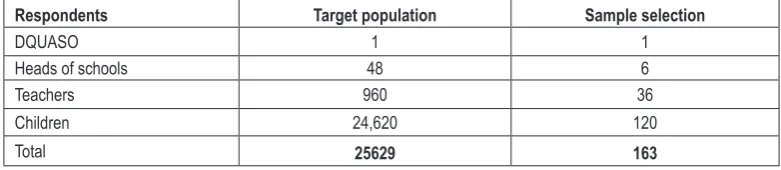
The study purposively targeted District, provincial and private secondary schools, where 10% (6 schools) were randomly selected; 2 schools from each of the three categories. The bottom-up approach was utilized where perspectives of the primary actors- the students, were first enlisted before branching out to teachers, heads of schools and DQUASO officers.
Table 1. Sampling.
Respondents Target population Sample selection
DQUASO 1 1
Heads of schools 48 6
Teachers 960 36
Children 24,620 120
Total 25629 163
Students: the research targeted forms one to form four students in the selected schools. this was to help understand the perceptions of all the students as each class had
experienced the problem under investigation. The study purposively sampled the very weak
students and those average achievers on the account that the former were the ones hardest hit
while the latter group was at the edge and could easily fall back into the targeted group of low achievers. Questionnaires were administered to seek their perceptions.
Teachers: The Guiding and counseling teachers were targeted as they were the ones
who handled students who went through the forms of discrimination in school. career
teach-ers were also targeted to discuss the implementation of the government policy on no repeating for students and the acts of discrimination adduced. Class teachers were also targeted as they
handled all cases in their classes. focus-group discussions were conducted with the teachers so as to seek their views on the policies and the implementation of the rights of the child.
Heads of schools: These acted as key informants since they are the implementers of
government policies and the children’s rights at school level.
DQUASO official: Quality assurance inspectors were interviewed. Being in charge of quality, they monitor the implementation of government policies and other Bills in schools.
Research Instruments
A variety of instruments were used to reach the informants, these included; question
-naires for Students, focus group discussions for teachers and Interview schedules conducted with Heads of schools and DQUASO officials.
Research and Data Analysis
Volume 21, 2010
114 Results of Research
This study sought to examine the implementation of the children’s rights in educa
-tion and the government policy on repeating of classes in schools and also to establish the challenges heads of schools are facing in implementing the policy and enacting the rights of
the child in education. these are discussed under the following themes: a) awareness of the
Rights of the child in education and the government Policy on repeating; b) Areas of dis
-crimination on students and the reasons for acts of dis-crimination on students; c) Challenges faced by heads of schools as they try to implement the policy on repeating and also enact the
children’ rights in education.
Awareness of Children’s rights and the Policy on Repeating
The study established that the adult respondents and 90% of the children involved in the study were aware of the rights of children against discrimination in education and the government policy on repeating classes in schools. The table below gives this analysis
Table 2. Levels of awareness on the children’s Act (2001) and the Policy on repeating.
Respondents Had no Idea Had an Idea % Knew content %
DQUASO - 1 100 1 100
Principals - 6 100 6 100
Teachers - 36 100 26 72
Children 12(10) 118 90 17 13
From the table above, it was apparent that only 10% of children were not aware of the policy and the children’s rights in education. Though 90% had an idea, from what they heard from peers and in their History lessons, a minority, 13% actually knew what was contained in the drafts. They had never even set their eyes on the drafts. This meant that the children’s bargaining power was low as they could not fight for what they did not understand.
On the part of the teachers, it was surprising to realize that 28% had not read the con
-tents, thus relied on what they heard from their colleagues. The 72% who knew the contents
could not act on it as there were other factors that hindered them. both the principals and the
DQUASO officer were well aware and had even gone through the two documents. Like the teachers, The Heads of schools agreed that the implementation of the two had been slow. The
major reason given for the slow implementation can be summarized as follows:
“The cut- throat competition in the school system had become so stiff that those not excelling were left out. The system glorifies exams to the exclusion of everything else. Grades for students and mean-scores for schools is the order of the day, irrespective of how they are achieved”
115 Volume 21, 2010 Table 3. Required scores for promotion to other classes.
School type Minimum score to proceed to next class
F1 to F2 F2 to F3 F3-F4
Provincial 650/1100 550/1100 ‘C’ mean grade
District 400/1100 350/1100 ‘C-‘ mean grade
Private 600/1100 500/1100 ‘C’ mean grade
Any child who fell short of the score in terms 1 and 2 had to be subjected to any one
or a combination of the following situations.
• Had to come to school during school holidays in the company of both parents so as to discuss the child’s performance in the exams and any other matters arising from
the low achievement. the child had to write a letter of commitment that in the event
that they failed to meet the target, then they would repeat the class.
• During the end of term closing Assembly, the children’s names were called out as they stood up. Failure to stand up earned the student another punishment
• The child had to close school before the rest and with him/her carry all their posses -sions. this was done with the hope that the child would not want to come back after
such humiliation. Those who came back after this were sent away again several times with their belongings. Some gave up on the way and either sought alternative
schools or accepted to repeat class in the same or even alternative schools.
Reasons given for such Acts
The adult respondents did not see these as acts of discrimination but ways of forcing those achieving low grades to improve. Though in some cases the policy dampened the spirits of some children, yet it had helped quite a number of them to excel. They cited cases where a child in the bottom bracket had worked their way to better grades for fear of undergoing such
situations. When asked about those who could not meet the mean mark set due to academic
incapacitation they said that such had to look for alternative schools where the cut- off mark was lower as theirs was a competitive system.
the teachers also cited improved mean-scores as a ladder to promotions either as administrators or senior heads of departments. Whenever the teacher’s service commission
(TSC) conducted interviews, subject means in the National examinations were highly recog
-nized for promotions. Teachers therefore felt that they had to present candidates who would
help improve their subject mean scores.
the head teachers on their part agreed that mean-scores were a ladder to success or
failure. Those who posted good mean-scores and were in “small” schools were promoted to head bigger schools. Those in the “big” schools had to do everything possible to remain there. Competition motivated them to use every means to achieve the end.
The Adult respondents also agreed to the fact that, though the government had stopped ranking schools in national exams, Mean- scores for schools were calculated and ranking
done behind the scenes. schools and all stake holders got to know about it. this just goes to
reinforce the cut-throat system we have in place.
The Issue of politics in schools, where the local community, to include the local politi -cians encouraged such acts of discrimination had become rampant. if a school did not post
improved mean-scores, cases of heads of schools being ejected out of schools had grown tremendously. The government seemed to be at a loss over such issues as the communities seemed to triumph over the decisions that they (community) made. Schools were left with no
Volume 21, 2010
116 Children’s perception on Education Rights and Government’s policy on Repeating
the child respondents were well aware of their rights to education but did not seem to
understand the basic contents of the document. As sighted earlier in this paper, only 30% of the child respondents had heard about their rights from peers and their History lessons, thus they lacked awareness on the fact that what they were going through due to low achievement
on grades was an act of discrimination. those interviewed felt that what was being done to the low achievers was so humiliating and unfair.
“It is not my wish to be at the bottom of the class. I try my best but it seems my best re-mains to be the worst according to the teachers. It is so embarrassing to be subjected to standing before other students, even your juniors”.
A child who had left the school earlier due to low achievement on grades was quoted
to have said:
“When a teacher asks a question in class, before I even understand the question, oth-ers have already answered it”.
Such a child may not benefit from acts of humiliation as there is resignation in the words. The children stated that they needed the teachers to be more understanding since they too were parents. Where a child was out rightly trying but could not make it above the mean mark, then help was necessary but not humiliation, psychological torture and health compli -cations.
the children also complained that it was so dehumanizing to ask the low achievers to close school before the rest and subject them to several trips back home with their
belong-ings, yet they are the ones who mostly needed attention from the teachers. Their feeling was that such children be left at school for remedial teaching so that they too can catch up with
the rest.
Some concurred that their parents also went through psychological torture when a
child appeared home with all their belongings thus harassed the children before even reading the report stating the issue at hand. cases of children going home with all their belongings
were only common where a child had been expelled for pregnancy or other serious offences. The neighbors too were an issue as they also came up with humiliating stories to explain why
the child had been sent home. this made the situations in the child’s life more traumatizing such that some developed medical conditions such as ulcers and high blood pressure at a tender age.
Challenges faced by Heads of Secondary schools in the Enactment of Children’s Rights
The study established the following as the major challenges.
• According to the heads of schools, children have varied abilities yet the present system of education does not cater for this. The society is so engrossed in quality performance that they hardly notice those with lower ability academically. When they try to stream students according to ability, parents don’t seem to take it kindly yet some students are unable to cope. There was a case in one of the schools sam -pled where a student who had come in form one could not even complete a term.
117 Volume 21, 2010 “The other students are too first for me to cope. When a teacher asks a question,
be-fore I even think, some students have already answered the very question”.
such students would be better off in their own class where a teacher can meet their
in-dividual differences. In the event that this student does not drop out, they perpetually remain at the lower end of the class. The ministry of education, parents and the entire community expect good mean scores, what then does a head do with such a child?
• Parents have abdicated their role of parenting to the school. They have no time for their children as they are busy furthering their education or looking for an extra coin to supplement the family income. They therefore hardly realize when their child’s grades begin to drop. They have even been heard to ask if holiday tuition can be extended to the December holiday. The school is therefore left with the role of parenting and providing adequate education for the child. Without the parent’s concern, it becomes difficult to follow up cases of low achievement thus heads re -sort to sending the child home so that the parent can get a chance to come to school.
Sometimes such parents even fail to go to school when invited, so, what does the head of school do with the child?
• The teacher is so overworked following the dual role they have to play on the child. Having other roles to play as parents to their own children, husbands/wives, they hardly can afford the much time needed to attend to the other needs of students at
school other than the academic function. coupled with the expectations of
achiev-ing high subject mean scores, the teachers therefore get down on academics and move with those who are able. The low achievers are left out. The head has to find ways and means of assisting such students. When asked whether the system they were using was of any help to the child, the heads answered:
Yes and no. Yes because, when a student is made to stand before teachers and fel
-low students, some have confirmed that they feel bad to have let down their best
teacher or one who is their role model. such children end up improving
tremen-dously. But there are those who actually feel bad but are unable to make any mean
-ingful improvement since they have lower abilities. These are the ones we feel for
but then the school policies must be followed.
No because, some students perform poorly because they want to hit at a teacher
or even the parent. such do not even seem to care about being humiliated but feel
heroic. One student had this to say:
“I just love to see my father come to school. He has no time for me at home. If I don’t create a situation for him to be forced to come, then he will not. So I plan to remain at the bottom so that he actually comes to see me”.
Conclusions
Though adult respondents were aware of the Government Policy on repeating and the Kenya Children’s Act 2001 on education, a desire to achieve high mean- scores, coupled with the pressure from all stakeholders in education, and had led them to discriminate children in terms of academic ability. There seems to be no serious follow up by the government on the implementation of the policy on repeating and the enactment of the children’s rights 2001,
Volume 21, 2010
118 Parents seem to stand on the fence helplessly as their children go through acts of humiliation. Either they are ignorant of the government policy on repeating or the children’s Act on education 2001 or they do not care about what happens to their children in school. There are other factors affecting the academic performance of children other than laxity on their part. Some of them have a lower ability to comprehend and recall what they are taught. Subjecting them to acts of humiliation may never help them improve, if not dampen their
spirits.
Children, though aware of their right to education, were not aware of the fact that
some practices in their schools were acts of discrimination which went against their rights even in education.
Recommendations
1. there is need for the government to endeavor to implement to the fullest both the
children’s act, specifically in education and the policy on repeating in schools in order to seal the gaps that allow for discriminatory acts in the school system. 2. The government, through the Ministry of Education, should put in place mechanisms
geared towards meeting the rights of the child and aggressively monitor the chil -dren’s welfare.
3. Schools should set up realistic and practical policies which discourage any form of discrimination but encourage the learner to participate positively.
4. The Government should seek for better ways of assessing the children’s aptitude other than using academic exams. The education system should be more focused on
knowledge and skills rather than grades.
5. There is need for a study to be carried out to ascertain the levels of awareness of par
-ents concerning the government policy on repeating and the Kenya Children’s Act (2001).
6. There is need for the government to educate children on their rights especially in education so that they can say no to acts of humiliation and discrimination that are
rampant in our schools
7. KNEC should provide only examination regulations and guidelines instead of an
-other syllabus that would conflict the one from K.I.E.
References
Amunga, J. (2009). The effects of ranking Secondary schools and Students in National examinations in Ke-nya: a Case of Kakamega South District. Unpublished M.ed Thesis, Masinde Muliro University.
Bogonko, S.N. (1992). A History of Modern Education in Kenya (1895–1991). nairobi: evans brothers.
Eshiwani, G. (1993). Education in Kenya since Independence. nairobi: east african publishers.
Evers, W. and Walberg, H. (2003). Accountability: an assessment by Kovet Task Force on K-12 education. Stanford, C.A: Hoover Institution Press.
Holdaway, E. (1990). some crucial issues in educational management. International Journal of Educational management, Vol.4, issue 2. MCB UP Ltd.
KSSHA, (2009). The Student: Quota System, why it should be scrapped off. Nairobi: Pen Media Company
119 Volume 21, 2010 Kivilu, M. (2004). Politics of National Examinations in Africa. the 22nd annual conference of the
associa-tion of pretoria: human sciences research council.
Manani, K.H. (2007). Accelerated Learning: New Approaches for Children at Risk. seminar paper: 15th-17th,
Kenya institute of Education, Addis Ababa.
Omutsani, C. R. (2008). Influences of Mother’s education and Income on Participation of their children in schooling, Luanda Division, Vihiga District. Unpublished M.Ed. Project, Kenyatta University, Kenya.
Otieno S. (2010). School Syllabus Deficient in Core Values: A report by the Ministry of Education, Kenya;
the standard 12th May 2010, pg.4 column 2&3.
Owiye, J.O. (2009). Management of resources in Early childhood Development Centers and its implication for Quality Education. A study of Bungoma East District. Unpublished M.ed Thesis, Masinde Muliro
uni-versity, Kenya.
Adviced by Naglis Švickus, SMC “Scientia Educologica”, Lithuania
Julius Maiyo M.ED, Lecturer, Masinde Muliro University of Science and Technology, Department of Education Planning and Management, P.O. Box 190 - 50100, Kakamega, Kenya.
Phone:+254 0721 223 154 E-mail:[email protected] Website: http://www.mmust.ac.ke
Joan Amwayi Owiye Lecturer, Masinde Muliro University of Science and Technology, Department of Education Planning and Management, P.O. Box 190 – 50100,
Kakamega, Kenya. Phone: +254 0724 340 620. E-mail: [email protected] Website: http://www.mmust.ac.ke
Caroline Resi Nandi Lecturer, Kenyatta University, Department of Education and Social Sciences, P.O. Box 43844 -00100, Nairobi, Kenya.