Issue 39
December 2007
Journal of the Ecclesiological Society
C
o n t e n t s
Ecclesiology
Today
Issue 39 for December 2007 published February 2008
ISSN: 1460–4213
ÓThe Ecclesiological Society 2008
All rights reserved
Society website: www.ecclsoc.org
Charity No: 210501
Journal of the
Ecclesiological Society
Front cover illustration:The monument to Denys Rolle (d. 1638) and his wife, in the mausoleum at Bicton House, Devon.
Introduction to this issue 3
125th Anniversary Essays
Between deconsecration and desecration
Timothy C. Engleman 5
Redundant churches: an antipodean perspective on the present and future
Christopher Akehurst 11
We will go into the house of the Lord
Philip Corbett 19
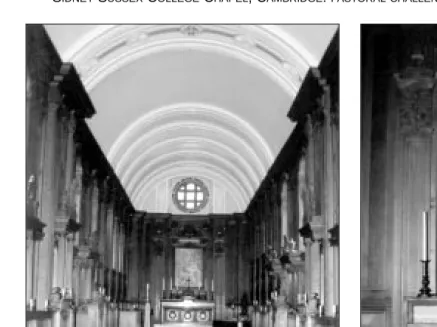
Sidney Sussex College Chapel, Cambridge: pastoral challenge and solution in design and liturgy
Megan Daffern 23
Churches no longer used for worship
All Souls, BoltonGabriella Misuriello 33
Redundant churches revived: the Friends of Friendless Churches fifty years on
Caroline Carr 45
Conference
Recording English country churches
C. B. Newham 59
Keeping our rural churches
Trevor Cooper 69
Society News
Ecclesiological Society Focus Day: the churches of
Whittlewood 79
Questionnaire on Ecclesiology Today 81
Regular Features
Chairman’s Letter 2
Book Reviews 87
Events
With this issue you should receive our programme for the year ahead. Our thanks as always to Christopher Webster for co-ordinating this, and to all those who have volunteered their time and energy to organise and lead the various events.
If you would be interested in arranging an event, anywhere in the country, do contact Chris, whose address is on the inside rear cover.
National Churches Trust
News from the wider world: as many members will know already, in mid-2007 the National Churches Trust came into existence.This is the new name and face for what was previously the Historic Churches Preservation Trust. It reflects a significant expansion in ambitions. Not least, the Trust intends to set up a major programme of national fundraising initiatives, and encourage partnership between congregations and other bodies.
Already, in partnership with the Churches Conservation Trust, the new body is working to create the Cumbrian Churches Partnership, which will act to support church buildings of all denominations in that county.
My personal view is that these changes are to be warmly welcomed.The congregations looking after church buildings will surely appreciate the increased help and support that a reinvigorated national body can bring, and the experimental new structure in Cumbria could provide important pointers for the future.
Questionnaire onEcclesiology Today
In this issue we report on the questionnaire which asked a random sample of members for their views of Ecclesiology Today. You might feel it makes fairly dry reading, but the results have been very helpful to your Council in thinking about how to take the journal forward.
We always welcome individual views about Ecclesiology Today from members, by email or letter. Please write to me in the first instance and I will forward your comments. In doing so, do bear in mind that we are only human (If you prick us, do we not bleed? if you tickle us, do we not laugh?), and that the Society is entirely staffed by volunteers working in what would otherwise have been their spare time.
The next two issues and a call for articles
The next edition of Ecclesiology Today has Richard Halsey as guest editor, and should appear in late Spring or early Summer.As his theme he has chosen ‘Second Thoughts’. From what I have seen, it looks as though the contents will be as intriguing as the title . . .
The Autumn issue for 2008, which is expected to appear at the end of the year, will be a general edition, not themed.
Offers of articles for this final edition of 2008 (or subsequent editions) are very welcome: in the first instance, contact any member of the Publications Subcommittee listed on the rear inside cover.
Trevor Cooper Chairman of Council
THE ARTICLES IN THIS ISSUE of Ecclesiology Today are unashamedly a pot-pourri – four essays, two reports from organisations looking after churches, and two talks from our recent conference.
But although no theme was imposed, one has emerged – the question of the future purpose and use of church buildings, whether or not still in use for worship.
v v v
The first four articles are essays, written to argue a point of view. Members will recall that the Society organised an essay competition during its 125th anniversary, and here we print the two winning entries (in the under-25 and general category), and two of those which were specially commended. No title was specified for the essays, but they had to reflect the interests of the Ecclesiological Society, and particular consideration was given to essays which looked forward to the future whilst relating it to the past.
Whether or not you agree with the authors’ views, we hope you find the results stimulating and thought-provoking.
The essays are followed by two articles on churches no longer in use for regular worship. Last year the Friends of Friendless Churches celebrated fifty years of looking after apparently unwanted churches, and the article tells their story and looks forward to the next fifty years.
Many of the Friends’ churches are rural and remote, tranquil places of discovery. In considerable contrast is All Saints, Bolton a textbook example of a very large Victorian church in an area of urban deprivation, closed for worship a number of years ago, now playing no part in the community, and subject to destructive vandalism.
What do you do with such a church? This article explains the plans of the Churches Conservation Trust, who care for the building.
Our recent conferencewas largely historical, looking at the location of parish churches. But there were two shorter talks, looking at rural churches today. That by Trevor Cooper looks at the pressures and opportunities they face, whilst the talk by C B Newham describes his work building up a detailed photographic archive of England’s rural churches, now at the half way point with over one quarter of a million images.
There is a then a short section on Society news, reporting on the Focus Day at Whittlewood, and giving the results of the questionnaire sent to one hundred randomly selected members asking their views of Ecclesiology Today.
IN RETROSPECT, it showed poor tactical thinking on my part. That the outcome was so happy is yet another example of God’s Grace.The occasion was an informal dinner at which we were to discuss whether a potential candidate to be pastor of our Presbyterian church might become an actual candidate. Sharing the meal were the potential candidate, the chairman of the pastor nominating committee and the writer, a member of said committee. The location was a restaurant-microbrewery occupying a deconsecrated Roman Catholic church building of Romanesque Revival style (Fig. 1). The church, located in an Eastern US city, had served what once would have been called an ethnic neighborhood.
The committee chairman, always generous, had suggested to me, ‘You pick the place, I’ll pick up the check.’ Our candidate, a new resident of the city, had no preference for a place to dine. I had enjoyed a number of meals at this restaurant and found the food good and the surroundings relaxed. Neither of my companions had been there and I was aware that finding brewing equipment in a former chancel can be a shock. To reduce the surprise, on the way to the restaurant, I told our candidate about some friends whom I had introduced to the venue.
Those friends are a married couple. She is Roman Catholic, faithfully practicing, sophisticated and possessing a good sense of humor. In addition, her ethnic and faith tradition could be described as sympathetic to the former congregation. He is a back-slidden Baptist, a medical professional, respectful of, but not sentimental about, religious sensibilities. His ethnic and faith tradition could be described as Anglo-Saxon Protestant farmer. Their individual reactions were anything but expected. She found the restaurant a delight. He admitted that the ambience had left him feeling ‘creeped out.’
The architecture, while reviving the Romanesque, is not of the broad-shouldered Richardsonian variety influenced by Normandy, Auvergne and Spain. Rather, it looks toward more intentionally colorful and reedy-proportioned precedents such as Italian Romanesque or German rundbogenstil (round arch style; Figs. 2 & 3).The long nave and ample aisles must have been every bit as practical a gathering space for the faithful as they are for the hungry. The high coffered ceiling and the polychrome of decorative accents would be as conducive to spiritual devotion as to dinnertime conversation. I must concede that a deep chancel does seem like a better home for an altar, credence table and tabernacle than for a vat, pipes and pressure gauges.
This is the winning essay in the general category.
Timothy C. Engleman, an elder at Shadyside Presbyterian Church, Pittsburgh , Pennsylvania, is employed as an engineer and lives in the village of Saxonburg .
Between deconsecration and desecration
Timothy C Engleman
Given this, I should not have been too surprised at our candidate’s visceral reaction to the space. After a good meal and a thorough conversation, with a kind smile, he said he agreed with my friend who had been ‘creeped out’.This was not some coded message about the topic of the evening. He is too straightforward for that.This was not an uninformed, emotional response. He is a spiritually mature Reformed pastor, a PhD. in church history, who thinks critically about worship and its setting. There must be something intrinsic to the architecture, even – or especially – in the new context, that still evokes worship rather than fermentation (Figs. 4 & 5).
Allow me to wrap up the candidate story. Despite my poor tactical planning, the candidate and committee discerned God’s call for him to our church. The congregation received our nomination with joy and enthusiasm. A new pastorate of great promise has begun. We worship under his leadership and under our own (Richardsonian) Romanesque lantern tower.
There was one surprise yet in store. By coincidence, I met the restaurant’s developer through his business interests in my own field – heavy industry. He and his son had planned and carried out the conversion. I complimented him on saving the structure and preserving its character. He thanked me and remarked, ‘I always liked that churchy architecture. Is that what they call Gothic?’
What are the characteristics of ‘churchy’ architecture that are so important for worship and so resilient through adaptive re-use? They evoke more than mere emotion. They produce more than an intellectual mindset.They transcend architectural style.We may find them in a dark parish church, a stark Dissenter meetinghouse, or a markedly Baroque Wren auditory.They are required alike for devotional observation of the mass and for engaged hearing of the proclaimed Word. They facilitate a post-Vatican II pilgrimage of the faithful as well as a post-Pentecost second blessing of the Spirit.
Identification of the characteristics is no less important when we are saving an old village church than when we are designing a new hall for a burgeoning seeker-sensitive assembly. In fact, the trivial example of the church-brewery may have broader implications for the success of adaptive re-use. If we do not contend with the characteristics, thereby to honor them or attenuate them, they may fight the new purpose of the structure. Perhaps the more successful a space has been for worship, the greater care we must take in designing its next use. Deconsecration is, in this sense, more than a ritual. For the optimists among us, if a church building is preserved because it is successfully re-applied, it remains available when the original purpose is once again in demand.
Fig. 2: The west window, the spokes of the rose emphasised by polychromatic brick.
I claim no Gnostic notions of these crucial characteristics. We may well start with Jesus’s pastoral admonitions to the Samaritan woman at the well. According to John’s Gospel, the Lord tells her that those who know what they worship do so ‘…in spirit and in truth.’ Worship in spirit precludes idolatry, which is worship of the created. Our church building should not attract devotion to itself or its people. The church should point beyond itself and toward God. This principle should guide decisions on budget and aesthetics.
Worship in truth means saying true things about ourselves and
about God.At a minimum, our church should not distract us from this privilege. At a maximum, it should teach or remind us of the truth. This informs architectural decisions concerning layout, symbolism and ornament.Truth demands an understanding of our theology of worship. Such understanding allows the arrangement of people and things within the church to speak honestly. If we believe, for example, that reading and preaching the Word are the center of worship, our architecture should not overwhelm us with an altar of sacrifice.
Jesus also tells the woman that no specific worship location (this mountain or Jerusalem) is intrinsically holy. This renders futile any attempt to concoct a sacred space. The best a human might do is arrange a place to seem holy – a task more appropriate to a special effects technician than an architect. What, then, of a holy encounter? Jesus implies that we do not seek it, because it is the Father who seeks. He seeks the kind of person who worships in spirit and in truth.We might then infer that the designer’s goal is a space that helps us to be open in soul and in mind to the encounter that the Father seeks. While the choice between dim,
religious Gothic light and clear, flooding Renaissance light may be a matter of aesthetics, openness to the Light of the World is not. While the size, shape and place of the communion table may be a matter of discussion, our need for the holy encounter of the sacraments is not.
Temple worship was for a specific people, in a specific location at a specific time. This calls for a precise design specification, in terms of cubits, colors, and capitals. Gospel worship is for all people, in any place at any time.This calls for an accurate functional specification, in terms of principles: Our church building should direct our worship toward God and away from ourselves and away from itself. It should help us speak honestly about ourselves, about God and about what we believe. Our worship place should not attempt to be holy but should encourage an encounter with the Holy Spirit. It should not make us seek God, but remind us that God through Jesus Christ is seeking us for salvation and sanctification. Our church building should not be sacred, but a place where the sacraments are celebrated.
A well-designed church adheres to these principles. So, the jarring impact that the church-turned-brewpub has on some folks
may be attributable to its success as an ecclesiological design. Medieval worship, for the people in the nave, was observational. The chancel was clearly set apart. In a Romanesque structure, this may be expressed architecturally by a partial barrier, elevation and narrowing of the volume. In a Romanesque revival church, this separation is still clear and appropriate to pre-Vatican II practice. Within that place set apart, our attention is directed to an altar. The architecture urges this attention, even in a society less than familiar with the theology behind it. Therefore, in the restaurant, our attention is directed to a place of honor and in it we find an object commonly considered profane.
What if a similar displacement were made in a church of different architecture? Consider a large Gothic structure. Compared to our Romanesque revival, we would find a narrower nave proportion. Likely, the roof would be higher and steeper.The walls would be more glass and less stone. The drama of the perspective lines (delineated by the column capitals, the points of the arches, the sweep of the triforium) would be accentuated. A rood screen would emphasize the ‘set apartness’ of the chancel. The diffuse light might heighten the expectation of an encounter with the holy. The actual encounter with brewing equipment would certainly be even more jarring in a Gothic environment.
What of a Christopher Wren-inspired auditorium? The worship theology here is reflected in people gathered close to the priest and to pulpit, font and table. The surroundings avoid distraction. Compared to our Romanesque example, the nave would be shorter, the proportions less oblong. A Palladian window might draw attention front and center as well as invite the worshipper forward.This invitation of the window would be less effective at the dinner hour than at morning prayer. Never the less, the galleries draw people close and offer a view from above. Those objects near the focal point of the room might seem less mystical, less set apart. Replacing them with a purely utilitarian device, even a beer-making device, may well be less traumatic in an Enlightenment setting than in the Middle Ages. One may assume, though, that the Kings George would not be amused.
We can imagine extending this light-hearted exercise to other styles of worship space and to features more subtle than plumbing in the holy of holies.The thought process may commend itself to decision-making in the adaptive re-use of disused churches. Sensitivity to the residual messages of the architecture will inform the re-design procedure. I make no attempt to prescribe solutions for problems like a brewery in the chancel. Avoidance of such a task is the privilege of a dilettante.
Presumably, as people interested in both the history and future of architecture, it is also the aspect we would most want to preserve. Other features worthy of preservation might also retain their religious identity. Stained glass is a most obvious example. Others include side chapels, confessionals, built-in pulpits, communion rails, baptismal pools, murals, organ pipes and iconostases.
While some of these may be preserved in storage or protected
in situ, good stewardship and architectural integrity encourage
sensitive adaptation. This may mean the frank, respectful acknowledgement of a feature and its presence. It may also mean finding a new use while diminishing the perceived religious significance of an item. Some adaptations are straightforward: narthex as lobby, sacristy as changing room. Some require a degree of finesse: baptismal font as water feature, pulpit as auctioneer’s desk. This course is best navigated with an understanding of the holy as well as the vernacular perception of holy.
If I properly understand the words of Jesus at Sychar, no earthly place is inherently holy. A place is holy when the people gather in truthful spirit and are encountered by a seeking God.We raise buildings when we wish to facilitate and repeat such encounters. If a building no longer functions as a church, future uses are not inherently unholy. However, we design our church buildings with an understanding of worship and to encourage true, spiritual worship. The physical manifestations of that design remain, even when the space is no longer set apart for worship. A clash between former and planned use may result. People may be ‘creeped out’. Careful attention to this dynamic allows us to deconsecrate and not desecrate.
CHURCHES HAVE become redundant as long as populations have ebbed and flowed, but in western countries, and particularly in Britain, redundancy in populated districts has been an acute problem only since the 1970s. The pastoral reorganisation measures in that decade opened the way to widespread amalgamation of parishes and declarations of redundancy. Each redundancy was preceded by elaborate procedures of ‘consultation’, but no matter how loud the protests from parishioners, architectural experts and enthusiasts or surrounding residents (who, though they never went to it, liked the church as part of their ‘streetscape’) the outcome was more often than not the same: closure followed by probable dereliction and possible demolition.The rate of redundancy has slowed since then, though periodically an architecturally important church is threatened with closure (Hove Parish Church is a recent case) and protests arise again.
Churches in Britain, and particularly England, are nevertheless better protected, statutorily and culturally, from redundancy than churches in Australia.The Church of England remains woven into the texture of English life, and even if churchgoing is not what it was, most churches can still count on at least a loyal few parishioners and a wider range of occasional users to keep them going. Christian denominations in Australia have never been as deeply rooted in the national soil as is the Anglican Church in England and are less able to withstand the winds of secularism and indifference. Their buildings too, even when comparable in architectural merit and size to important parish churches in England, have never really been looked on as to some extent belonging to the community around them. They are seen (if anyone thinks about it at all) as belonging to their denomination or congregation; and if the congregation fades away, the church can be pulled down and hardly anyone will notice. Once the site is covered by a supermarket or apartments, no one will remember it at all.
It has thus come about that one of the most familiar and easily recognisable buildings in any Australian street, the suburban church, is becoming an endangered species. Churches are closing in all Australian cities, in suburbs and countryside. There are not lacking those who think this a good thing, given the Christian Church’s alleged record of slaughter, oppression, paedophilia and all the other horrors it is regularly accused of visiting on our
This essay was specially commended in the general category.
Christopher Akehurst is a journalist and amateur ecclesiologist who has lived for long periods in London and Italy and is now editor of the magazine Coast & Country in Melbourne, Australia.
Redundant churches: an antipodean perspective
on the present and future
culture.Yet even among those concerned about architecture and ‘heritage’ the demolition of churches is seldom a priority for protest in Australia, as long as whatever replaces them is acceptable to prevailing taste. This is sad, because when a church is demolished a local landmark of greater or lesser prominence disappears – perhaps one that gave an architecturally undistinguished district its only notable building. Even if the church is spared and converted to a new use a fine interior can be dismantled and good fittings dispersed. Either way the closure is one more reminder of the gradual passing of an institution which for generations was part of the everyday experience of a large minority of Australians — the local parish with its choir and tennis club, its brides and grooms and funerals, and its accumulation of local memories enshrined in honour rolls, memorial plaques and stained-glass windows.
The decline of the suburban church in Australia is like a re-run of the fate of the suburban cinema nearly half a century ago. Until then no local high street had been without its Regal or Victory or Majestic.Then television lured the audiences away and one by one the cinemas closed their doors, to be demolished or turned into bowling alleys.
True, churches in Australia have been closing for more than a century. But up until the 1960s this was usually for a reason unconnected with any quantifiable general decline in religious observance, such as a change in the ethnic character of a district (and often the newcomers took over the church and reopened it for their own use).There was a substantial wave of closures some thirty years ago when three denominations – Methodists, Congregationalists and some Presbyterians – combined their resources to form the Uniting Church of Australia. Flushed with ecumenical hope, they took an adjectivised present participle for their new name to proclaim that for them this was but the first step towards total Christian reunion (although no one else has yet joined, and the hybrid denomination is now declining so quickly there mightn’t be much to join within a generation or two). One Uniting parish was established where formerly there were three, and usually one church at least closed and disposed of (in not a few cases not without wrangling and rancour over which one), but these closures were face-savingly attributed less to a decline in churchgoing already starting to make considerable inroads into congregations – and of which the union itself was to some extent a product – than to responsible stewardship of property. Besides, plenty of churches were still being built or extended all over Australia until well into the 1970s.
have stopped going to them. It’s where the closures are happening that is new – in predominantly Anglo-Saxon middle-class suburbs that were once the heartland of Australia’s mainstream denominations. I write from a Melbourne perspective, but the story is identical in any big city and in country towns and hamlets. In the Melbourne diocese in recent years the Anglican Church alone has closed churches in such quintessentially middle-class residential districts as Alphington, Brighton, East Brighton, Darebin, Deepdene, Middle Park, Mont Albert, Northcote, Syndal, Thornbury and Port Melbourne (where docklands redevelopment is bringing in large numbers of new residents).The names will have no meaning for most British readers (who might nonetheless detect in them a certain poetic resonance, implying to those who know these places leafiness and Edwardian brick); what is pertinent here is that few of these closures have been caused by the disappearance from the district of the socio-cultural group from which Anglicans historically were drawn and its replacement by members of other cultures and faiths. Most are indications of a wholesale abandonment of religious practice by its former most loyal practitioners, the middle class. Almost imperceptibly from one Sunday to the next, the congregations have slipped away – moved, got too busy with the garden or grandchildren, lost interest, died. Quietly, without the melancholy long withdrawing roar of Arnold’s sea of faith (census returns indicate that some 70 per cent of Australians still consider themselves religious believers) churchgoing has given way to indifference. Australian churches, like the cinemas before them, are losing their audiences.
to a smaller building, the current trend, if it continues at the same pace, will eventually render that church unviable as well and closure will loom again.
I should say that I have excluded Roman Catholic churches from the scope of this essay. Redundancy has not yet become an issue in the Roman Catholic Church in Australia, though shortage of priests has, and this has led to the amalgamation or ‘partnering’ of a considerable number of parishes, almost invariably with the retention of existing church buildings. Some Catholic churches have been closed in remote rural districts where there has been a decline in the overall – rather than the specifically churchgoing – population. Nevertheless, the possibility of wider redundancy can be discerned in falling Mass attendances and, as in other communions, the failure to attract younger attenders. The pews vacated by lapsed Australian-born Catholics are to some extent being occupied by the many devout members of Catholic immigrant groups, European and Asian, but even so, Roman Catholic churches in Australia, historically the best attended of those of any denomination, are now visibly emptier in many places.
It’s not only on Sundays that most Australians have lost the church habit. In the past even non-churchgoers usually got married in church. Few chose the bureaucratic minimalism of the register office. That was until a Labor government in the 1970s, with secularising zeal, created a new caste of civil celebrant ready to solemnise marriages in a venue of one’s choice, be it garden, beach or hot-air balloon. For funerals, most nominal protestants in Australia had long since preferred the undertaker’s chapel to the parish church (unlike in England, where church funerals are still common) but christenings in church used to be almost a middle-class norm. These have declined rapidly in number in recent decades, replaced in many families by ‘name-givings’ – ersatz baptisms conducted by a secular celebrant and one less occasion for anyone to set foot in a church.
internal character. What will happen to the others? Indeed, what is happening now? Demolitions have not so far been numerous and more often the unwanted church is adapted to a new purpose. Leaving aside use by other (usually non-anglophone) denominations, this means secular use. Dividing church buildings laterally into apartments and vertically into ‘town houses’ is popular with building developers and has happened in at least eight cases in Melbourne alone. Conversion of this sort has the advantage that from outside the church will look much as before, give or take a few skylights and a satellite dish.There’ll be no neon signs to disfigure the façade and it won’t be painted a garish colour and used as a discount warehouse.
Churches have been put to commercial use as (a random sample in Melbourne) an Irish bar, recording studios, community centres and offices. Two large Uniting churches, one with a landmark spire, are used by their own denomination for offices and archive storage. Amateur theatre companies have taken over churches and a former Methodist church is a funeral chapel. In country townships unwanted churches have become art galleries, antiques and craft shops, restaurants and pizza parlours. In such cases the church is stripped and emptied before sale and although the more valuable fittings and glass are generally moved to other churches, much is abandoned to secondhand dealers.
These churches at least remain as shells of what they were.The difficulty is that as the number of closures rises, more and more churches will have to be demolished outright, because there will be too many for the alternative uses available and the value of their sites for redevelopment will be too temptingly high. Church financial managers don’t want valuable sites encumbered with under-used ‘plant’ when the proceeds of their sale can go to building new churches in new residential districts where at least some congregations are expanding and the area is deemed fertile for ‘mission’. Besides, just as in England, there is considerable expense in keeping an unused building protected against decay and vandalism – not that any security system is proof against the really determined vandal, as the condition of any church that has been closed for a while depressingly attests.
That many suburban churches in this country would disappear was prophesied more than a decade ago by the National Trust of Australia, which stated in the introduction to its survey Victorian Churches that
So just as the Australian suburb lost its neighbourhood cinema (of which the National Trust at the time was not a notable defender, no matter how fond of Art Deco it has since become) so, in the Trust’s view, it is likely to lose more of its churches than it has already lost.And just as the cinema chains concentrated their resources on keeping a reduced number of cinemas open on strategic sites, perhaps the Churches will do the same and retreat from a parish network with a church in every suburb to a few central churches with eclectic congregation from hither and yon. But how far will the analogy go? Cinema audiences began to grow after the novelty of television wore off. Will congregations eventually start attracting back a generation bored with materialism and, if so, will closed churches be bought back and reopened for services? Or is the future to be seen in places like Melbourne’s multicultural Moreland, where the Anglican parish demolished its church in favour of a shop in a busy street?
The answer, insofar as it is within human capability to determine it, is with the ecclesial communities themselves. The Christian Church believes itself to be not merely an earthly institution like an empire or a commercial enterprise, destined to a cycle of growth and decline in response to political or market forces, but a divinely-founded body with a divine promise that it will not pass away. If this promise be taken seriously it is surely not unreasonable for Christians to look forward to an eventual revival of church life and practice in places where it is now declining or moribund. (That such a revival seems to be happening, where it is happening, in non-mainstream congregations, need not cause loss of heart in the traditional Churches. Not everyone wants unreflective clap-hands religion, and revivalist Christianity, one suspects, appeals to a particular personality-type rather than to the unchurched in general.) When (rather than if), under the stimulus of, say, a new Oxford Movement or who knows what other concatenation of events, the traditional denominations begin once more to attract members, churches will be needed – churches, not shops, since the time for temporising ground-holding measures will be past.
and maintained until needed again is daunting, but it ought not to be insuperable if confronted by the level of faith and determination a guarantee of existence until the end of time should inspire.
In practical terms – and here we return to the area of expertise of the Ecclesiological Society – churches that are solid, well-built and of architectural importance but at present under-used or unwanted, should be retained in the legal possession of their denominations by any means possible. They can be let on renewable contracts to tenants for other uses – concert halls, bingo halls, gymnasiums – anything that leaves their external and interior structure intact (division of their interiors, unless easily reversible, would thus not be appropriate). Their glass and furniture could be placed in store for the duration, or the best of it kept in another unwanted church set aside as a gallery of church art.Without their pews, some churches would be suitable for use as restaurants or reception centres (this has already been demonstrated in Australia where guests at a fund-raising dinner for the completion of Pearson’s St John’s Cathedral in Brisbane a few years ago sat at candlelit tables arranged throughout the nave). None of these solutions is claimed to be original, and a number have already been applied, particularly in England, to redundant churches. But those churches are just that: redundant. Most have been sold and are no longer and almost certainly never again will be churches. We are thinking of churches that, by being kept in ecclesiastical ownership, can in time be restored to the use for which they were built.
the nation’s architectural patrimony – itself in Australia not so replete with excellence that it can afford to lose even one good building.
The author, Christopher Akehurst, can be contacted at [email protected]
Notes
1 Victorian Churches. Their origins, their story & their architecture, Miles Lewis (ed.), National Trust of Australia (Victoria), Melbourne, 1991.
RECENTLY I WAS SHOWN a picture of a Roman Catholic church in the United States of America.As part of the re-ordering of the sanctuary the celebrant’s chair had been moved to the centre with the altar and pulpit either side of it. This seemed to me to place the priest at the centre of the church and not the Eucharist. What this showed was the importance of the ordering of our churches when it comes to educating people in the Christian faith.
For many people the only religious education they receive is within the walls of the church. They are often taught about the Christian message through the sermon or in other church-run education but more often they learn through the day-to-day practices of the church. In this it is not only the liturgy that teaches but also the very ordering of our churches. For example, by placing at the centre of the church the pulpit (say in a Congregational church) the worshipper is alerted to the centrality of the Word in the Congregationalist tradition.2 We cannot underestimate the ordering of our churches both as a method of teaching and of spreading the Christian message.
The church building as a teacher
In doing this we must be careful not to lose the Christian message in the hope of making our buildings more appealing to the modern world. But as in times past a compromise can be made. Modern churches (and indeed older churches) can both appeal to the modern worshipper and be useful tools in the teaching of the Christian message.
James White suggests that this is indeed the case:
Architecture then is a means of teaching those who enter the church what it is to be one in Christ. Liturgical architecture provides the space and tools in which the central acts of Christian life are performed in the common worship of God. The building is indeed a most important concern of the Church since it provides all the physical conditions necessary for a crucial part of our work done in God’s service, our common worship.3
Forty years on I would add the need for Christian education and for our church building to aid in that teaching, especially at a time when so many people are uneducated in the Christian faith. The buildings can be tools in the work of spreading the Christian Gospel.
This is the winning essay in the under 25s category.
At the time of writing, Philip Corbett was a post-graduate student at Keble College, Oxford. He is now preparing for ordination at Mirfield. He is a member of our Society and is on the editorial board of the Prayer Book Society Journal.
We will go into the house of the Lord
1Robert Runcie reflecting on the Shrine of Our Lady of Walsingham wrote:
There is a need for renewal and re-dedication. Such Walsingham can become, not by fearful conservation, but courageous development of its own essential nature; a place where men and women come to a living faith in the incarnate Son of God.4
This is I think a vision for all churches. If we want our places of worship to be places of evangelism and learning they must appeal to people. They must be courageous and imaginative in dealing with the theology that lies behind the building. The churches must hold onto their theology but not be afraid to develop the ways in which it is embodied in the worship space.
Baptism, Eucharist and Ministry
In the first edition of The Ecclesiologist an important question was raised about the practicality of a church:
The most important requisite in erecting a church is that it be built in such a way as the Rubrics and Canons of the Church of England may be consistently observed, and the Sacraments rubrically and decently administered….[But] how can the Minister ‘Baptize publickly at the stone font’, such font standing ‘in the ancient and usual place’, when, if it did stand so, he would be so enclosed by galleries, that most surely he would not be seen or heard?5
This sort of practical issue faces the designers both of modern churches and those who have to worship in older churches. In order for the worship to be meaningful it must be seen by all.
In many parishes a small movable font is used at the front of the church whilst the older stone font stands at the back unused. But there seems here to be a problem: whilst placing the font before the altar points to the connection between the sacraments, the font at the back seems out of place. The original font if used would be visible to everyone in church and because of its size, does make a statement about the importance of baptism in the church.The small portable font placed in the corner of the church and brought out for baptisms does not have this impact.
Church’s theology. Upon entering the church one cannot help but feel that the Eucharist is central to the theology of the people of the church. Simply by worshipping in the space the congregation, subconsciously perhaps, becomes aware of the centrality of the most sacred act of worship – the Mass – in the theology and life of All Saints.
Helpful in discussing these issues is Baptism, Eucharist and
Ministry (the ‘Lima document).6This ecumenical document was designed to bring the different practices of the church closer together, that they might share and learn from one another. In the case of Baptism, Lima suggest that ‘water should not be minimalized’7 and that adult baptism (believers baptism) should be considered.8 This seems to rise out of a concern expressed in many churches to return to the older practice of full immersion baptism. In the American Episcopal Church, for example, adult baptism is now seen as normative and thus fonts need to be suitable for adult baptism.
The Lima document is also keen to stress that baptism should be central to the worship of the church: it is the fundamental initiation rite, and should take place at the main Sunday service to emphasise this. People should where possible be reminded of their baptism every week or every time they enter the church. It is rather difficult to see the importance of this when the font is small and placed to one side of the church. If we want water as a central feature in churches then the font must be designed in order to show this. It may for example be a large pool, with running water. If a congregation wishes to keep a more traditional design of font, it might be decorated or placed in such a way to make it a focal point of the church.
The Lima document also wishes to make the Eucharist central to the life of the church. Lima suggests that the Eucharist be celebrated every Sunday and that people be taught of its significance and centrality.9This can be done in some part by the placement of the altar in the church and its design. In some churches the altar might be placed in the centre of the church, making it a focal point. In others the highly decorated high altar might be retained as it shows how important the Eucharist is, by lifting it up.The importance of the sacrament might be shown in the use of candles. In churches where the sermon is the central feature, the bringing forward of a table for communion to the centre of the people might be a way in showings its importance and the reverence with which it should be performed.
a long way to building ecumenical bridges (showing that churches are not as different in practice and theology as we might first think).
Entering the twenty-first century
The buildings in which we worship are important tools in communicating the Christian message.They teach about theology and the way in which we want to worship God.
Church buildings have been enlisted in this task for centuries. As we enter the twenty-first century, both new buildings and old ones must be allowed to do that work as well. In designing new churches the Christian message must be in mind. When the buildings fail to do this they are useless. As Betjeman points out:
In the period between the two wars church architects were too often concerned with style, and they built places of worship that vied with the local Odeon or with by-pass modern factories in trying to be contemporary. They now look dated, and will, I fear, never look beautiful. But the purpose of the church remains the same as it was at the beginning of this book, to be the place where the Faith is taught and the Sacraments administered.10
That is not say that all old churches are useful tools in teaching Christianity. We can however, learn from both the mistakes and successes in their design.We can also consider ways in which those that may seem outdated or impractical can be redesigned.
In doing this both theologians and architects must come together to see what is right for the building and the local congregation. This co-operation is important if the Church is to continue to use the worship spaces as tools for education and evangelism. In trying to be contemporary and appealing however we must not lose the Christian message from the design of our buildings: they must reflect the theology of the Church.When the two come together we can indeed enter the courts with thanksgiving and praise.
Notes
1 Psalm 122. v.1.
2 I am thinking here of the Congregationalist churches in New England where the pulpit is raised up and where the Eucharist is celebrated infrequently and the preaching of the Word/Sermon is the central act in the liturgy.
3 James F White, Protestant Worship and Church Architecture (Oregon, 1964), 201. 4 Robert Runcie, writing after preaching at the National Festival in Walsingham,
Norfolk 1980.
5 The Ecclesiologist,Vol. 1., No. 1 (November 1841), 10.
6 Baptism, Eucharist and Ministry (The World Council of Churches, 1982). 7 Baptism, Eucharist and Ministry, B18.
8 This can be seen in the fact that in the Book of Common Prayer 1979 the service for Adult Baptism takes precedence over the service for infants.
9 Baptism, Eucharist and Ministry, E30.
SIDNEY SUSSEX COLLEGE CHAPEL in Cambridge strikes the thoughtful visitor as an anomaly in several ways. It lies north-south rather than being orientated. It is ‘both architecturally unique and unique among the college chapels of Oxford and Cambridge in so unequivocally insisting on High Church attributes’.1 Given the Puritan history of the college of which Oliver Cromwell was a member, it is striking that it is such a building which holds the remains of the Lord Protector’s head. The history of the college and the present chapel structure seem to be at odds.
Furthermore, it now continues to be a place of worship and prayer for today’s very mixed community of Sidney Sussex college. As we look at the developing relationship between chapel and college, let us consider the development of the present chapel building and its worship in the context of Sidney Sussex.
The building of the new chapel
The present geography of the building was inherited from its two predecessors on the site of one of the few surviving buildings of the former Franciscan friary. Its immediate predecessor was deemed inadequate and the possibility of building a new chapel was considered from the late nineteenth century. One proposed plan, by J. L. Pearson, architect of Truro Cathedral, was to build a new chapel on a different site in the college to correct its orientation, but this was too expensive. A correction of the orientation was simply beyond the means of the college. The architect of the present chapel, T. H. Lyon, instead took the building of the existing chapel, and extended it, more than doubling the size but retaining the original site and foundations.
The building of the chapel began in 1912 and aroused considerable interest. A brief article in the Architectural Review of March 1924 marks the recent completion of the west end.2 It declines to give much detail since there is too much of beauty to describe in a short article. The college Annual charts the development of the building. In 1912, it was declared that it would be ready for use by the beginning of the Michaelmas term, but that the oak panelling and stalls were yet to be finished and fixed.The momentum continued in 1913, when the Annual boasts that ‘The chapel has excited much interest in Cambridge, and there have been many visitors to see it’.3The First World War
This essay was specially commended in the under 25s category.
At the time of writing, Megan Daffern was studying for the priesthood. Now ordained, she is a curate in Rugby.
Sidney Sussex College Chapel, Cambridge:
pastoral challenge and solution in design and liturgy
caused some delay in both funding and completing the building, but again in 1918, we are told that ‘The design of the Dean’s and Reader’s stalls is very fine, and has been admired by many visitors’.4 Clearly, striking beauty was central to the aims of the architect and college, and, whether a motivating factor or not, its power of attraction was valued.
Reformation, Puritanism, and High Church
development at Sidney
This power of attraction helps to explain how such a High Church building came to be constructed in a college which had benefited from the Reformation and had a Puritan background. From the University Tests Act of 1871, the university was becoming more secular in government. This Act declared that it was no longer necessary for all Fellows to be unmarried clergy, and all undergraduates Anglican (nominally at least). The Sidney Sussex Statutes of 1882 decreed that the Master no longer had to be in Holy Orders, and the chapel was no longer under the Governing Body but was the responsibility solely of the Dean and Chaplain. Indeed, the first lay Master of the college was in post from 1906 to 1916, in the formative period for the building of the new chapel. This therefore allowed the Dean and Chaplain considerable input into the chapel’s redevelopment. Their grandiose conception of the chapel could be put into effect, and not held up by the Protestant and Puritan history of the college.
Moreover, the increasing secularization of the University meant that from 1867 the college no longer issued fines for non-attendance at chapel. The college was one of the first in Cambridge to stop this practice.This, however, forced the college to look for ways in which to make chapel more attractive to its members. The musical tradition of the Cambridge colleges was revived to bring in a congregation, and it seems likely, as Pyke argues, that such architectural shifts as are demonstrated in the design of Sidney Sussex chapel, were a similar reaction to the changing religious needs of both University and college. It was a ‘practical and ambitious attempt to meet the challenge of pluralism and ultimately secularism’.5
(Fig. 2).The wooden surround features the instruments of Christ’s Passion, evident also in the Sanctuary windows on the liturgical north, which in addition show signs of the sacrament of the Eucharist (Fig. 3). The oak carvings facing these, over the arches leading to the Lady Chapel, symbolize the altar:6the gift of manna to the Israelites, the feeding of the multitude, the striking of the rock by Moses in Horeb, and the piercing of Christ’s side (Fig. 4). The chapel is the only one in Cambridge to have a Lady Chapel, with rich symbolism throughout. The windows, showing the imagery of the Litany of Loreto (Fig. 5), were funded by the Sanctae Trinitatis Confratemitas;7beside the altar are two panels of decorative lilies, and above it another Italianate painting of the Madonna and Child (Fig. 6). The carvings on the pillars commemorate John Wale Hicks, dean 1887–90 and later Bishop of Bloemfontein. The imagery in the Lady Chapel is echoed throughout the building, with carvings of roses in the Italian style decorating the stalls towards the liturgical west end. Powys also points out Hitch’s two wooden statues of St Francis and St George, the former between high altar and sacristy, the latter over the archway from the ante-chapel (Fig. 7).
Fig. 1: Left, view of chapel from liturgical west end.
Design and liturgy
This decoration points clearly to a new, High Church, Eucharistic approach to university college worship, and a fresh view of liturgy. This can be seen in the changing Sunday services held in the chapel during full term in this period. In 1911, the Eucharist was celebrated at 8am, the mid-morning service Morning Prayer at 10am, and the only sung service of the day was Evensong at 6pm. A similar pattern was evident in 1912, while in 1913, this changed to incorporate a second, Choral Eucharist at 10.30am. This routine persisted for four years, and although 1917 and 1918 reverted to the former emphasis on Morning and Evening Prayer, again in 1919 the Sung Eucharist was resumed, to become the established pattern.8The services to be held on Holy Days give a similar picture.
The general trend of the college’s interest in liturgy is further evident in the description of an ordination service held in the chapel in 1914. The procession is detailed at length, with particular interest given to the vestment of the Bishops; the Merbecke setting of the Mass is specified. ‘The beauty and solemnity of the service will long be remembered by those who were present’, we are told in the college Annual.9It is striking that the year of the introduction of the second Sunday celebration of the Eucharist also saw this celebration of the sacrament of Ordination in the new chapel. The attractive beauty of the new structure with its High Church style was being paralleled in contemporary liturgy. It is also notable that in 1918, an announcement in the Annual tells how the George Williams Prize for Liturgiology was awarded to a Sidney Sussex member for the third time in the last few years.10 Such details suggest that the relationship between the new, grand High Church structure, in such contrast to the rather small and dingy previous chapel, went hand in hand with this interest in attractive liturgy.
Fig. 3: Two windows on the north side of the sanctuary, showing the
The chapel and the college community
The liturgical development we see in the early years of the new chapel may be understood largely as a pastoral move. At a time when it was felt necessary to attract undergraduates to the chapel, the grandeur of the design and liturgy was considered the best way to do so. It was a pastoral, not a theological statement. Pyke writes:
Although in the 1840s and 1850s the adoption of the aesthetic of the pre-Reformation Church had been a matter of ecclesiological controversy in that ecclesiologists such as Neale encouraged a return of ‘sacramentality’ in church architecture which seemed to have Roman Catholic overtones, by the 1890s ecclesiology was more an indicator of aesthetic values than of a particular theological position within the Church of England.11
A place of beauty, in design and movement, could be an attractive place where undergraduates could come and feel at ease in their worship and prayer. Aesthetic quality was therefore a pastoral concern.
Yet the balance between aesthetics and theology remains a difficult one to maintain. While the High Church attributes may simply be at the service of the aesthetics of the building, they may nevertheless today cause a Christian undergraduate of a different tradition to feel uneasy. The pastoral challenge of the 1900s was primarily that of attracting undergraduates to chapel; today, the greatest pastoral challenge is perhaps enabling all to feel welcome and at ease in the building and in the worship. In considering how this might be achieved, I shall look at three areas where this is played out: the chapel as a Eucharistic space, the chapel as a space for prayer, and the chapel as a collegiate space.
Fig. 5: Detail of one of the windows in the Lady Chapel.The central panel is of the Annunciation.
A Eucharistic space
Despite the centrality of the high altar, celebration of the Eucharist there is now only an occasional occurrence. Its design allows only comfortably for east-facing celebration, at a distance from the congregation. With this in mind, Eucharists on Holy Days during the week are celebrated in the Lady Chapel, and the regular Sunday morning Eucharist at a movable table at the East end of the choir stalls.The high altar is used for communion only on Ash Wednesday, and occasionally by groups outside the college who value the space for concelebrated masses. The use of a movable table is clearly a challenge to the original design of the building: it was introduced for pastoral purposes, so that the small congregation do not feel overwhelmed and distanced, but personally involved and gathered together in a more intimate and familiar space.
Yet this is perhaps a natural development of the position indicated by Pyke in the 1890s. Both situations, although a century apart, have pastoral concern at their heart, becoming central in the life of a Cambridge chapel in particular, under the supervision of the Dean whose title has since become ‘Pastoral Dean’.
A prayer space
The chapel is set aside at particular points in the day for silence and prayer.The Lady Chapel is always available for private prayer. The reserved sacrament is present in the elegant tabernacle on the altar (see Fig. 6), and the rich symbolism throughout this side chapel offers much stimulus for meditation. Yet while the sacramental imagery may be used as a focus for the personal prayer life of the undergraduate, it does not have to. One who wishes could pray simply in the most unadorned ‘room’ of the chapel, the stalls at the liturgical west end. The flexibility allowed by the structure and fittings of the chapel again may be viewed as a pastoral concern, offering a variety of options for the individual.
The Lady Chapel also happens to be the part of the chapel with the most modern fittings.With carpet and individual chairs, it also allows a certain freedom of movement, and has an open and contemporary atmosphere.This enables undergraduates to escape the kind of institutional religion that wooden pews and stone floors might suggest to them. Once again, variety and flexibility are a key pastoral concern in both the individual and communal use of the chapel.
Collegiate space
The chapel at Keble College, Oxford, is one of the few college chapels where the pews face the altar. Most college chapels have the pews arranged facing each other (‘collegiate’ style). At Sidney, the pews are positioned in this way (Fig. 1).What are the strengths and weaknesses of this, and how suitable is this order for college chapel life today?
Like the quires of many cathedrals and large parish churches, this seating arrangement allows the choir stalls to be as an extension of the congregational seating, so that the sung word is intrinsically part of the worship of the whole body of
worshippers.Thus the congregation participation in the sung parts of a service is clearly expressed in the relationship of seating of choir and rest of the congregation. It allows for a closer bond between the two. This is particularly powerful in services of Evensong, for example, which forms an integral part of the worship at Sidney as at many university college chapels. Similarly, the Dean’s and Reader’s stalls are situated collegiately, and again this enables the leader of non-Eucharistic services to appear as representative of the whole priesthood of the laity in worship.The facing arrangement of seating also encourages a shared participation simply among the worshippers of the congregation. The layout is thus expressive of a communal body of worshippers united in their prayers, relating to each other as well as to God, in corporate as well as individual relationship with God.
While we might have expected the altar to be expressed as the visual focus in the seating arrangement, given the Eucharistic theology we have already seen communicated throughout the building, the collegiate seating order can again be seen as a pastoral strength. It allows for worship that is more relational, more corporate, more familiar, more intimate. This is fitting for a congregation that is drawn largely from an institution of which the chapel is a part, both physically as well as spiritually and emotionally.
At the same time, however, the ordering poses the problem that not all the seats have a good view of both Dean and Preacher at Evensong from their stalls. This could be overcome by placing a lectern towards the liturgical west end of the chapel from where readings and sermons could be delivered, to form a focal point to balance the great high altar. This too could soften the catholic overtones of the building as a whole, so that there is also a centrally positioned focus on the Word, to be more accessible to the more Protestant of undergraduates.This would further justify the collegiate seating, as all then would stand a good chance of stronger communication and relationship with the preacher and reader. Other weaknesses of the current arrangement, such as the potential for greater intrusion into an individual’s prayer life by being in the public gaze from the seats opposite, would be balanced by the strengths brought by such a change.
Pastoral solutions in design and liturgy
in architectural and liturgical aesthetics.This awareness of both the existing congregation and of others who could be drawn into the chapel is essentially a pastoral concern. The liturgical use of the design of the chapel can offer great pastoral support to the members of the college as a whole at particular times of need, at times of particular tragedy or celebration for the college as a body. Small changes, such as the provision of a lectern as outlined above, or better lighting to improve both the aesthetics and practicality of the building, could enhance the worship and all that the chapel offers to the college.
The future of the college chapel seems to lie in its pastoral expression; all changes should be checked by the criterion of pastoral concern for the institution of the college and its members.This seems to have been the case from the inception of today’s chapel, and should continue to be, so that it can offer a Christian response to both the college body and individuals in today’s secular academic context.
The author would like to express her thanks to the photographer, Andrew Mumby.
Notes
1 Pyke, ‘New chapel’, p. 235
2 Powys, ‘Sidney Sussex College’, p. 27 3 Sidney Sussex College Annual, 1913, p. 27 4 Sidney Sussex College Annual, 1918, p. 26 5 Pyke, op. cit., p. 246
6 Sidney Sussex College Chapel: A Guide for Visitors 7 Pyke op.cit., p. 243
8 For this paragraph, see Sidney Sussex College Annual, 1911, p. 17; 1912, p. 17; 1913, p. 17; 1914, p. 17; 1915, p. 18; 1916, p. 18; 1917, p. 18; 1918, p. 19; 1919, p. 20 9 Ibid, 1914, pp. 28–9
10 Ibid, 1918, p. 26 11 Pyke, op. cit., p. 236
12 Giles, Re-pitching the Tent, p. 8; quoted by Daffern, ‘Cathedral Liturgy’, p. 58
Bibliography
Royal Commission on the Historical Monuments of England: An Inventory of the Historical Monuments in the City of Cambridge (1959), p. 208
Sidney Sussex College Annual (Cambridge, 1911–1921) Sidney Sussex College Chapel. Guide for Visitors
Daffern, A., ‘Cathedral Liturgy: Changes in Emphasis’, (unpublished thesis, University of Durham, 2004)
Giles, Richard, Re-Pitching the Tent: Re-ordering the Church Building for Worship and
Mission in the New Millennium (Canterbury Press, 1996)
Powys, L. A., ‘Sidney Sussex College Cambridge: designed by T. H. Lyon’, in
The Architectural Review, vol. LV, No. 328 (March 1924), pp.100–104.
THE CHURCHES CONSERVATION TRUST (CCT) is developing the redundant church of All Souls, Bolton into the All Souls Crompton Community Centre.
Bolton is the birthplace of both Crompton and Arkwright, whose inventions in the late eighteenth century made possible the development of the cotton industry. In particular, Samuel Crompton’s Spinning Mule (1779) revolutionised the cotton industry and set the town on course to become a world centre of cotton spinning. It was in order to cater for the moral and spiritual welfare of those working in the cotton mills in the expanding town that the mill-owning brothers Nathaniel and Thomas Greenhalgh built the church of All Souls.
They were men of evangelical conviction, concerned to ensure that the moral and spiritual needs of the cotton workers were not overlooked. Nathaniel died in 1877, leaving his fortune to Thomas, who used it to establish All Souls church, built to the designs of Paley and Austin, architects of Lancaster, who were to become the finest and most prolific ecclesiastical practice in the north of England. Through its various incarnations, the practice was to span the whole Victorian period and the twentieth century up to the Second World War.
All Souls church dates from what has been described as the ‘golden age’ of Paley and Austin’s practice. In the introduction to the South Lancashire Buildings of England, Pevsner singles out ten Paley and Austin churches, including All Souls, which, in his opinion ‘are of the highest European standard of their years’. All Souls is the surviving one of two churches built by the Greenhalgh brothers. Sadly, the brothers’ other church, The Saviour, Deane Road (1882), which was also designed by Paley and Austin and had many characteristics in common with All Souls, was demolished in 1975.
Greenhalgh’s remit to his architects was for a church without obstructions, where everyone could see and hear and in which there would be no uncomfortable draughts. The result is a large aisleless nave, spanning 52 ft (16m) with a west tower, 117ft (36m) high, faced externally in red brick with Longridge stone dressings, and internally with Stourton stone (Figs. 1 & 2). The style is late medieval, the plan form and internal space somewhat early nineteenth century in character.
All Souls displays the characteristic Paley and Austin features of the wide aisleless nave (Fig. 3), towering proportions, richly
Gabriella Misuriello is Conservation Manager for the North West and West Midlands Region of the Churches Conservation Trust.
All Souls, Bolton
articulated wall surfaces, fine timber roofs and majestic west tower with an externally expressed stair turret. The articulation of wall surfaces, quality of materials and detailing and the scale and volume of the building are predominant.
Paley and Austin’s design survives more or less intact. There have been no structural additions or demolitions, and changes have been limited to the introduction of monuments and memorials, and minor reconfiguration of the chancel aisles, involving some loss of pews. While the quality of the fittings is high (particularly in the chancel (Fig. 4), where the oak furnishings are a successful blend of gothic and arts and crafts detail), they are surpassed by the quality and sheer scale of the volume that encloses them. The nave is dominated by the pews, which are pitch pine and perhaps notable above all for their sheer number. There are churchwardenss seats at the west end on the southern side. Most noteworthy are Paley and Austin’s oak furnishings in or near the chancel – altar, communion rails, choir stalls, credence table, pulpit and lectern, organ case (Figs. 5 & 6); the Clayton and Bell glass in the east windows, depicting scenes from the New Testament (Figs. 7, 8, 9); and the Burlison and Gryll glass in the east windows of the chancel aisles, depicting personifications of Faith, Hope and Charity, an offering of thanks
Fig.1: Bolton All Souls, from the south.
from the parish for the generosity of the Greenhalgh brothers (Fig. 10). The tower contains 8 bells by Taylor of Loughborough (1880) and the organ is a fine instrument by Isaac Abbott of Leeds (1880).
The second half of the twentieth century witnessed the decline of cotton manufacturing in Bolton, and demographic changes brought about by large-scale immigration from the Indian sub-continent. By 1986 it was estimated that 80% of the local population was Asian and Muslim, and the numbers attending worship at All Souls had declined significantly. The diminishing congregation found it increasingly difficult to worship in a building designed for the accommodation of 800 mill workers, and to meet the growing repair and maintenance bills. It was therefore decided that the church should close for regular worship. All Souls was vested in the Churches Conservation Trust (then Redundant Churches Fund) in 1987.
Despite the fact that the small congregation had for over fifty years maintained the church in an exemplary fashion, the fabric progressively required more than just ordinary maintenance. Damp and water penetration from the roof led to a serious infestation of dry rot. In 1987 when All Souls church was vested in the Trust, a programme was prepared to deal with the most
urgent problems, followed by another two phases of repairs in 1997 and 2001.
Over the years, however, a vast part of the Trust’s effort went towards the repairs of damage caused by vandals. In fact, All Souls church has been the object of continuous attacks, with the empty church becoming a focus for anti-social behaviour by young people, including graffiti and attempted arson.The down pipes are continually blocked, smashed or stolen, and the drains are frequently obstructed with all sorts of materials, or destroyed. In the last six months alone it has suffered four lead thefts, with associated damage from water penetration. It is also a location for substance abuse. The vicinity of the building is similarly afflicted by vandalism and a number of homes adjacent to the empty church are burnt out. All Souls Church stands unused and empty; the local community has rarely had access during the last 20 years. The building is now in urgent need of repair, particularly to the roof.
CCT has learned from experience that a building that is unused deteriorates faster, wastes a valuable historic asset,
Fig.4: Above, Bolton All Souls, the chancel looking west.
encourages vandalism and lacks a feeling of life. The Trust is therefore encouraging access and promoting greater use of its churches by and for the community, thereby increasing their cultural significance for the local people.
The project for All Souls started when local residents approached CCT with a view to developing new uses for the building to meet the education, leisure and welfare needs of their neighbourhood. A steering committee was formed by local residents, among them people who had attended the church in its time as a place of Christian worship. From the outset, the vision was to serve people of all faiths and backgrounds.
With the support of many partners, including various departments of the local council, the All Souls Crompton Community Centre Trust – now a registered charity – was formed with the aim of establishing All Souls as a community, heritage, culture, and education centre in partnership with the CCT.
All Souls Crompton Community Centre will have a heritage and culture programme for and with local people including exhibitions and events that build up social cohesion, mutual
about the history and changing story of All Souls, its neighbourhood and people, both those who have lived here their entire lives and those who are immigrants from different parts of the world.The project will give everyday access to a fine heritage building.
The adaptation of the Church will not only preserve the original fabric, detailing and character of the interior space, but will create useable space within it in a way that is much more than removing the pews and providing folding chairs.
A fragmented pod structure (Fig. 11) will be inserted rising organically through three storeys within the central nave of the church. The contrast between the twenty-first century insertion and the nineteenth-century original will be exciting in itself.The project thus has not only community and heritage benefits but is an exiting architectural scheme that will show how a series of spaces for a variety of new uses can be successfully housed in the single, large, magnificent nave space.
The activities planned will include education and training for unemployed young people, for women returning to work or preparing for college, and after school and weekend programmes for children and young people; it will provide opportunities for