Convergence rates for diffusive shallow water equations (DSW) using
higher order polynomials
H. G. Radwan 1,3 , P. Vignal 2 , N. Collier 1 , L. Dalcin 4 , M. Santillana 5 , V. M.Calo 6 1Applied Mathematics and Computational Science, King Abdullah University of Science and Technology, Thuwal, Saudi Arabia
2Materials Science and Engineering, King Abdullah University of Science and Technology, Thuwal, Saudi Arabia
3Irrigation and Hydraulic Department, Engineering Faculty, Cairo University, Egypt 4National Scientific and Technical Research Council (CONICET), Argentina
5School of Engineering and Applied Sciences, Harvard University, Cambridge, MA, USA 6Center for Numerical Porous Media, Applied Mathematics and Computational Science, and Earth Science and Engineering, King Adbullah university of Science and Technology,Thuwal, Saudi Arabia
Abstract
In this paper, we describe the diffusive shallow water equation (DSW) and discuss a numerical strategy to solve it using the generalized- method as a method for temporal discretization. This method provides a good norm estimate of the error and guarantees an optimal convergence rate for the spatial discretization. We also discuss the effect of higher polynomial orders on the convergence rates, focusing on the nonlinear DSW problem. Our numerical experiments show that optional convergence rates can be obtained for polynomial orders 1 through 4.
Keywords: shallow water, barenblatt solutions, convergence rates, DSW
1 Introduction
In this paper, we present a solution strategy for the DSW equation using the generalized- method for temporal evolution of the finite element discretization for horizontal terrain with no source or sink terms. The effect of polynomial order on the spatial discretization is dis- cussed. Our numerical experiments show that optimal convergence rates are obtained for p = 1, 2, 3, 4.
2 Diffusive shallow water equations 2.1 Introduction
The Navier-Stokes equations describe the conservation of mass and momentum for incompressible fluid [Vreugdenhil 1994]. For a free water surface, disregarding the lateral stresses, assuming the simplest possible expression for the bottom stress, and by considering vertical and horizontal scaling, the Navier-Stokes equations will simplify to the shallow water equations which can be written as follows:
2
1
( u) ( u ) ( u ) ( f ) P xx xy 0
t x y x x y
2
1
(
)
(
u
)
(
) (
f u
)
P
xy yy0
t
x
y
y
x
y
where (x, y) correspond to the coordinate system shown in Fig.1, is time , is density, is the acceleration of gravity, 2Ω is the Coriolis parameter which indicates the effect of the rotation of the earth (Ω is the angular rate of revolution, the geographic latitude), and the viscous stresses are expressed in terms of the fluid deformation rate as follows.
ij i j
j i
u
u
x
x
(1)The conservation of mass for a fluid element leads to the following mass-conservation equation:
(
u
)
(
)
f x y t
( , , )
t
x
y
(2)where f(x, y, t) is the forcing function. The shallow water equations can in turn be simplified to the diffusive shallow water equation by assuming that [Alonso et al 2008, Feng and Molz 1997, Giammarco et al 1996, Fiedler and Ramirez 2000, Hamrick 1997]:
1. The horizontal momentum is simplified through Manning’s equation. 2. The slope of the bathymetry is small.
3. The hydraulic radius can be approximated by the water depth (rectangular cross section).
1
0
1
(
)
(0, )
{
0}
(
)
(0, ]
(0, ]
f
N N
D D
H
H
z
H
f
on
T
t
C
H
H
H
on
t
H
z
H
n
B
on
T
H
H
B
on
T
(3)
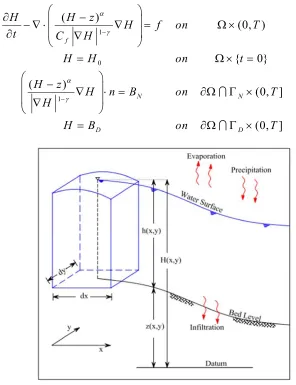
Fig. 1. Control volume for flow through a prism of wetland.
where H is the water height, is the land surface elevation, is the forcing function (precipitation acting as a source or infiltration and evaporation acting as sink) as shown in Fig. 1, is the initial water height distribution, and are the Neumann and Dirichlet conditions, respectively, and are empirical parameters present in Manning’s equation [Turner and Chanmeesri 1984], set here to be and , respectively and is the Manning roughness coefficient. We assume 1 to compare our results with a self-similar solution proposed by Barenblatt [Grundy and McLaughlin 1784].
1
(
)
( ( ,
)
))
( ,
)
f
H
H z
H
H
H
f
with
H
H
t
C
H
(4)where is the diffusion coefficient. The nonlinear character of Eq. (4) is analyzed in [Alonso et al 2008, Santillana and Dawson 2010 a, Santillana and Dawson 2010 b, Calo et al 2011]. New challenges come from the possible degeneracy of a when 0, and its nonlinear dependence with respect to [13]. The DSW equation has been studied in several publications where topographic effects are neglected 0 and zero-Dirichlet boundary conditions are assumed [Alonso et al 2008, Esteban and Vazquez 1988].
2.2 Compactly supported solution
Barenblatt made one of the first mathematical contributions to study the initial-value problem for the DSW equation. He constructed a class of self-similar solutions which have the property of finite propagation in 1D, for 0 and 0. These solutions will be extensively used later on as a paradigm for the behavior of all non-negative solutions with integrable initial data , especially when has compact support. More details can be found in [Grundy and McLaughlin 1784, Esteban and Vazquez 1988]. Barenblatt’s solution can be expressed as follows:
1 1 ( ) 1
( 1)
( , )
( , ) | |
m m
H x t
t
C k m
(5)where denotes the positive part of , 1 , C is a positive function (in this case taken to be equal to 1 [Santillana and Dawson 2010]) which depends on the initial mass M, given by: 1 1 ( 1)
( , )
1
( , )
(
1)
(
1)
m
M
H x t dx
m
k m
m
m
xt
3. Discrete approach 3.1 Space discretization
In the weak form of the DSW, the problem is to find ∈ such that ∀ ∈ ,
( , )
,
H
(
, ( ,
)
)
( , )
0.0
R w H
w
w
H
H
H
w f
t
(6)method by choosing proper sub-spaces and of V and W, respectively [Hughes 2000]. In this particular case, we chose piecewise polynomial spaces formed by B-splines which have a high degree of continuity at element interfaces.
3.2 Time discretization
When solving highly nonlinear problems, high frequency numerical dissipation has been found to improve the solution behavior [Hughes 2000]. The generalized- method is a family of time integration algorithms that possess high frequency damping, which can be controlled by the user. It achieves high frequency dissipation while minimizing unwanted low frequency dissipation [Chung and Hulbert 1993]. Due to the non-linearity of the DSW equation and the fact that it is a first order equation in time, we use the temporal discretization method described in [Chung and Hulbert 1993, Jansen et al 2000], which has been used successfully in other complex applications [Gomez et al 2008, Gomez et al2010, Bazilevs et al 2007].
The generalized- method for problems which are first order in time is stated as [Jansen et al 2000, Gomez et al 2008]: given , , find , , , , such that
R H , 0 (7)
H (8)
(9)
H 1 (10)
where R is the residual function, , , , and ̅ are parameters of the method. It is useful to combine the two parameters and and express them in terms of the spectral radius for an infinite time step. Chung and Hulbert (1993) referred to this parameter as . Unconditional stability is attained when , while second order accuracy is ensured by imposing as in [17]. The time step size selected follows
0.025√
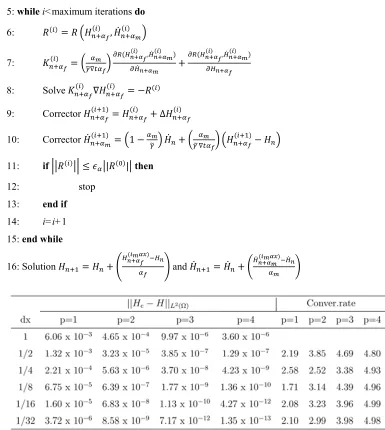
where p is the polynomial order and dx is the space step size. The algorithm that describes the generalized- method is illustrated in Alg.(1), where the consistent tangent matrix K corresponds to the derivative of the residual R with respect to the solution variables [Jansen et al 2000, Gomez et al 2008] and is selected to be 10 . All computations were performed with extended precision 80 bit floating point using PETSc libraries [Balay et al 2010, Balay et al 2008]. The algorithm implementation uses a predictor/multi-corrector scheme where the corrector steps are indicated by a superscript index inside parenthesis. The predictor used in step 1 is one of many possible choices. A time adaptive scheme using this discretization is presented in [Collier et al 2011].
Algorithm 1 Generalized- method 1: Compute predictor and
2:
4: i=0
5: while i<maximum iterations do
6: ,
7: , ,
8: Solve
9: Corrector ∆
10: Corrector 1
11: if | | then
12: stop
13: end if 14: i=i+1 15: end while
16: Solution and
Table 1: Norm estimate of errors and convergence rates for higher polynomial orders using the generalized- method (Non-degenerate case)
4 Convergence rates for higher polynomial orders
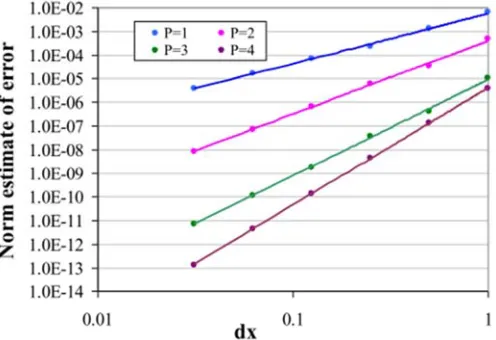
polynomial orders for the non-degenerate case. is the exact solution obtained from Eq. (5). The previous table shows that the convergence rates are of order p + 1, and these are plotted in Fig. (2). These simulation results show that optimal rates of convergence can be obtained for polynomial orders lower than four. Thus, the necessary conditions used in [Esteban and Vazquez 1988] may be relaxed to derive a more nuanced approximation theory.
Fig. 2. Convergence rates for higher polynomial orders using the generalized- method
5 Conclusions
We briefly described the derivation of the diffusive shallow water equations and presented the numerical strategy used for their approximation using the Galerkin finite element procedure for spatial discretization. We then discussed the generalized- method to be used for temporal discretization. This work shows that the convergence rates for higher order polynomials are of order p + 1.
Acknowledgments
Извод
Брзине
конвергенције
за
дифузионе
једначине
за
плитку
воду
(DSW)
коришћењем
полинома
вишег
реда
H. G. Radwan 1,3 , P. Vignal 2 , N. Collier 1 , L. Dalcin 4 , M. Santillana 5 , V. M.Calo 6 1Applied Mathematics and Computational Science, King Abdullah University of Science and Technology, Thuwal, Saudi Arabia
2Materials Science and Engineering, King Abdullah University of Science and Technology, Thuwal, Saudi Arabia
3Irrigation and Hydraulic Department, Engineering Faculty, Cairo University, Egypt 4National Scientific and Technical Research Council (CONICET), Argentina
5School of Engineering and Applied Sciences, Harvard University, Cambridge, MA, USA 6Center for Numerical Porous Media, Applied Mathematics and Computational Science, and Earth Science and Engineering, King Adbullah university of Science and Technology,Thuwal, Saudi Arabia
Резиме
У овом раду дајемо опис дифузионе једначине за плитку воду (DSW) и дискутујемо
нумеричку стратегијуда решимоову једначину користећи генералисани метод као
метод временске дискретизације. Овај метод даје добру процену норме грешке и
гарантује оптималну брзину конвергенције за временску дискретизацију. Такође
дискутујемоефекатполиномавишегреданабрзинеконвергенције, сапосебномпажњом
нанелинеарни DSW проблем. Нашинумеричкиекспериментипоказујудасеоптималне
брзинеконвергенцијемогудобитизаредполиномаод 1 до 4.
Кључнеречи: плиткавода, Баренблатоварешења, брзинеконвергенције, DSW
References
A. K. Turner, N. Chanmeesri, Shallow flow of water through non-submerged vegetation, Agricultural Water Management 8 (4) (1984) 375–385.
C. Vreugdenhil, Numerical Methods for Shallow-Water Flow (Water Science and Technology Library), Springer, 1994.
F. R. Fiedler, J. A. Ramirez, A numerical method for simulating discontinuous shallow flow over an infiltrating surface, International Journal for Numerical Methods in Fluids 32 (2) (2000) 219–239.
H. Gomez, T. J. Hughes, X. Nogueira, V. M. Calo, Isogeometric analysis of the isothermal Navier-Stokes-Korteweg equations, Computer Methods in Applied Mechanics and Engineering 199 (2528) (2010) 1828–1840.
J. Chung, G. M. Hulbert, A time integration algorithm for structural dynamics with improved numerical dissipation: The generalized-alpha method, Journal of Applied Mechanics 60 (2) (1993) 371–375.
J. R. Esteban, J. L. Vazquez, Homogeneous diffusion in R with power-like nonlinear diffusivity, Archive for Rational Mechanics and Analysis 103 (1988) 39–80.
K. Feng, F. Molz, A 2-D, diffusion-based, wetland flow model, Journal of Hydrology 196 (1-4) (1997) 230 – 250.
K. Jansen, C. Whiting, G. Hulbert, A generalized-alpha method for integrating the filtered Navier-Stokes equations with a stabilized finite element method, Computer Methods in Applied Mechanics and Engineering 190 (3) (2000) 305–319.
M. Santillana, C. Dawson, A local discontinuous Galerkin method for a doubly nonlinear diffusion equation arising in shallow water modeling, Computer Methods in Applied Mechanics and Engineering 199 (23-24) (2010) 1424 – 1436.
M. Santillana, C. Dawson, A numerical approach to study the properties of solutions of the diffusive wave approximation of the shallow water equations, Computational Geosciences 14 (2010) 31–53.
N. Collier, H. Radwan, L. Dalcin, V. M. Calo, Time adaptivity in the diffusive wave approximation to the shallow water equations, Journal of Computational Science, accepted (2011).
P. D. Giammarco, E. Todini, P. Lamberti, A conservative finite elements approach to overland flow: the control volume finite element formulation, Journal of Hydrology 175 (1-4) (1996) 267 – 291.
R. Alonso, M. Santillana, C. Dawson, On the diffusive wave approximation of the shallow water equations, European Journal of Applied Mathematics 19 (05) (2008) 575–606. R. E. Grundy, R. McLaughlin, Eigenvalues of the Barenblatt-Pattle similarity solution in
nonlinear diffusion, Proceedings of the Royal Society of London. A. Mathematical and Physical Sciences 383 (1784) (1982) 89–100.
R. H. Nochetto, C. Verdi, Approximation of degenerate parabolic problems using numerical integration, SIAM Journal on Numerical Analysis 25 (4) (1988) 784–814.
S. Balay, K. Buschelman, V. Eijkhout, W. D. Gropp, D. Kaushik, M. hew G. Knepley, L. C. McInnes, B. F. Smith, H. Zhang, PETSc users manual, Tech. Rep. ANL-95/11 - Revision 3.0.0, Argonne National Laboratory (2008).
S. Balay, K. Buschelman, W. D. Gropp, D. Kaushik, M. G. Knepley, L. C. an McInnes, B. F. Smith, H. Zhang, PETSc Web page, http://www.mcs.anl.gov/petsc (2010).
T. A. Hamrick, Analysis of the Numerical Solution of the Shallow Water Equations, Storming Media, 1997.
T. J. R. Hughes, The Finite Element Method: Linear Static and Dynamic Finite Element Analysis, Dover Publications, 2000.
V. Calo, N. Collier, M. Gehre, B. Jin, H. Radwan, A gradient-based estimation of Manning’s friction coefficient from noisy data, Journal of Computational and Applied Mathematics, submitted (2011).
V. T. Chow, D. R. Maidment, L. W. Mays, Applied Hydrology, McGraw-Hill, 1988.