S H O R T R E P O R T
Open Access
Diet and lifestyle factors associated with fish
consumption in men and women: a study of
whether gender differences can result in
gender-specific confounding
Maria Wennberg
1*, Andreas Tornevi
1, Ingegerd Johansson
2,3, Agneta Hörnell
4, Margareta Norberg
5and Ingvar A Bergdahl
1Abstract
Background:Fish consumption and intake of omega-3 fatty acids from fish are associated with a lower risk of cardiovascular disease. However, a prospective study from northern Sweden showed that high consumption of fish is associated with an increased risk of stroke in men, but not in women. The current study aimed to determine if fish consumption is differently related to lifestyle in men compared with women in northern Sweden.
Methods:Lifestyle information on 32,782 men and 34,866 women (aged 30–60 years) was collected between 1992 and 2006 within the Västerbotten Intervention Programme (a health intervention in northern Sweden). Spearman correlations coefficients (Rs) were calculated between self-reported consumption of fish and other food items. Lifestyle variables were compared between fish consumption categories.
Results:Fish consumption was positively associated with other foods considered healthy (e.g., root vegetables, lettuce/cabbage/spinach/broccoli, chicken, and berries; Rs= 0.21-0.30), as well as with other healthy lifestyle factors (e.g., exercise and not smoking) and a higher educational level, in both men and women. The only gender difference found, concerned the association between fish consumption and alcohol consumption. Men who were high consumers of fish had a higher intake of all types of alcohol compared with low to moderate fish consumers. For women, this was true only for wine.
Conclusions:Except for alcohol, the association between fish consumption and healthy lifestyle did not differ between men and women in northern Sweden. It is important to adjust for other lifestyle variables and socioeconomic variables in studies concerning the effect of fish consumption on disease outcome.
Keywords:Fish consumption, Lifestyle, Gender, Confounding factors
Background
The beneficial role of fish consumption or omega-3 fatty acids from fish on the risk of cardiovascular disease has been extensively studied. Most studies have concluded that fish consumption is associated with decreased risk of cardiovascular disease [1-3], although there is more evidence for myocardial infarction than for stroke [4]. However, fish consumption is associated with a healthy
lifestyle in several populations and it can be argued that this protective association may be influenced by a healthy lifestyle. Most previous findings on fish con-sumption and lifestyle are from epidemiological studies that investigated the effect of fish consumption on dis-ease outcome. The associations between fish consump-tion and other lifestyle variables have been described as baseline characteristics in these previous studies [5-8]. However, few studies have investigated the association between fish consumption and other lifestyle variables as the main aim of the study [9-11], and even fewer studies have reported if confounding by a healthy lifestyle differs
* Correspondence:[email protected] 1
Department of Public Health and Clinical Medicine, Occupational Medicine, Umeå University, Umeå 901 87, Sweden
Full list of author information is available at the end of the article
between men and women [10]. We have previously observed results that raise concern for the possibility of gender differences in the northern Swedish population. In our prospective case–control study on the risk of stroke and fish consumption in northern Sweden, an increased risk of stroke was found in men reporting that they consumed fish more than three times a week [12]. In women, the tendency was the opposite, although this was not statistically significant. Therefore we hypothesize that male fish consumers in northern Sweden differ from female fish consumers with regard to confounding be-tween dietary and other lifestyle factors, and that high fish consumption is a marker of otherwise unhealthy life-style in men in this population. We also speculate that lifestyle factors were not properly controlled for in our previous stroke study [12]. The relationship between fish consumption and lifestyle has not been thoroughly inves-tigated in the population from northern Sweden.
The current study aimed to determine if there are gen-der differences in the association between fish consump-tion and other lifestyle variables in northern Sweden.
Associations between fish consumption and
self-reported intake of other foods and lifestyle variables were studied, in men and women separately.
Methods
The Västerbotten Intervention Program (VIP)
Health examinations of the population in the county of Västerbotten in northern Sweden have been continuously conducted since 1985 within the VIP [13], which is an intervention concerning risk factors for cardiovascular dis-ease and diabetes. All citizens in Västerbotten are invited to participate in a health examination at their healthcare center when they turn 40, 50 and 60 years (also at 30 years until 1995). The participants fill out an extensive question-naire on lifestyle, including a food frequency questionquestion-naire (FFQ), a medical examination is carried out, and partici-pants are asked to give blood samples for future research. The participation rates have increased from approximately 55% in the early 1990s to 65% from 2004–2006. Dropout analyses, on data from 1992–1993, indicated only small dif-ferences between participants and non-participants regard-ing social and health factors, indicatregard-ing that the selection bias was small [14]. In total, 32,782 unique men and 34,866 unique women participating in the VIP between 1992 and 2006 were enrolled in this study, after exclusion of individuals with a food intake level (FIL = reported cal-oric intake/basal metabolic rate) below the 5thor above the 97.5thpercentile [15].
The FFQ
Changes have been made to the VIP FFQ over time, and to simplify data handling, only individuals filling out the optically readable 64-66-item FFQ used since 1992 were
included in this study. An 84 item version of the FFQ has been described by Johansson et al. [16]. The FFQ has been validated against 10 24-hour dietary recalls [16] and the questions on fish consumption were validated against erythrocyte levels of eicosapentaenoic acid (EPA) and doc-osahexaenoic acid (DHA) [17]. Fair correlations (Rs=
0.42-0.51, p≤0.005) were found between the intake of EPA and DHA according to the FFQ and levels of erythrocytes. In the 64–66 item FFQ, some foods in the 84 item version were combined into groups to obtain a shorter FFQ. The FFQ has 9 answer alternatives ranging from“never”to“4 times a day or more often” [16]. The answers were trans-formed to the number of intake/day or intake/week.
The questions asked regarding fish consumption in the present study were as follows;“How often do you eat lean fish (e.g., perch and cod)?”and“How often do you eat fatty fish (e.g., herring, lavaret, and salmon)?” The intake fre-quencies of lean and fatty fish were calculated as times/ week of total fish. These questions on fish consumption were consistent in the different versions of the FFQ.
The questions asked on fruit and berries (apple/pear/ peach/citrus fruit, bananas, and berries) were combined into total intake/week. Likewise, a vegetable variable was created by combining root vegetables, lettuce/cabbage/ spinach/broccoli, and frozen vegetables. Because of dif-ferences over time in the FFQ concerning questions on fruit and vegetables, there were fewer observations for these variables. An alcohol variable was created by com-bining the intake frequencies of strong beer (beer with more than 3.5% of alcohol), wine and spirits to intake/ week, but these items were also considered separately.
Lifestyle and socioeconomic variables
Smoking habits, educational level and physical activity were included in the questionnaire. Smoking was categor-ized as non-smokers (including ex-smokers and occasional smokers) or current smokers. Educational level was cate-gorized as academic education (e.g., completed a university degree) or no academic education. Those subjects who reported that they never exercised or took a walk less than twice a week were categorized as physically inactive.
Statistical analysis
considered as the reference group in each gender. Com-parisons of mean levels of dietary and lifestyle variables were also performed with fish consumption in the follow-ing categories: < once a week, 1–3 times/week, and > 3 times/week. Spearman correlation coefficients were calcu-lated between the frequency of fish consumption and other food items, in men and women separately. Spearman cor-relation coefficients were also calculated for age groups (<40, 40–49, 50–59 and ≥60 years) and time periods (1992–1996, 1997–2002 and 2003–2006) to determine if the results were consistent.
Ethics
All participants gave informed consent and the study was approved by the Regional Ethical Review Board in Umeå.
Results
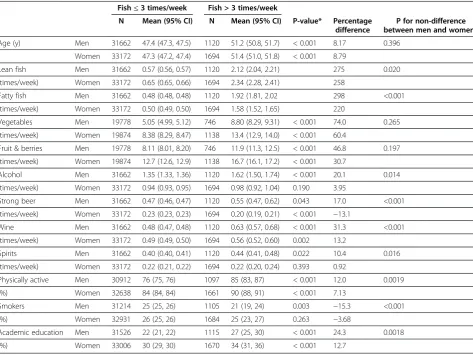
For both men and women, high consumers of fish were older, had a higher reported consumption of vegetables, fruit and berries, a higher level of physical activity, and a
higher educational level than low to moderate consumers (Table 1). Men who consumed a lot of fish smoked less than low to moderate consumers. Male and female high consumers of fish had a higher consumption of wine. There were gender differences for consumption of strong beer and spirits, with a higher consumption in male high consumers of fish than in low to moderate consumers, while women who consumed a lot of fish reported a lower consumption of strong beer than female low to moderate consumers. Differences between high consumers of fish and low to moderate consumers were larger for men com-pared with women concerning the reported consumption of fish and alcohol (all varieties) and the proportion of physically active subjects, smokers, and the proportion of subjects with an academic education.
When fish consumption was classified into 3 categories (< once a week, 1–3 times/week, and > 3 times/week), fish consumption was generally associated with a healthier be-havior. Also when comparing the medium consumption category (1–3 times/week) with the low consumption
Table 1 Lifestyle characteristics for the population in the Västerbotten Intervention Program, by fish consumption level
Fish≤3 times/week Fish > 3 times/week
N Mean (95% CI) N Mean (95% CI) P-value* Percentage
difference
P for non-difference between men and women†
Age (y) Men 31662 47.4 (47.3, 47.5) 1120 51.2 (50.8, 51.7) < 0.001 8.17 0.396 Women 33172 47.3 (47.2, 47.4) 1694 51.4 (51.0, 51.8) < 0.001 8.79
Lean fish Men 31662 0.57 (0.56, 0.57) 1120 2.12 (2.04, 2.21) 275 0.020 (times/week) Women 33172 0.65 (0.65, 0.66) 1694 2.34 (2.28, 2.41) 258
Fatty fish Men 31662 0.48 (0.48, 0.48) 1120 1.92 (1.81, 2.02 298 <0.001 (times/week) Women 33172 0.50 (0.49, 0.50) 1694 1.58 (1.52, 1.65) 220
Vegetables Men 19778 5.05 (4.99, 5.12) 746 8.80 (8.29, 9.31) < 0.001 74.0 0.265 (times/week) Women 19874 8.38 (8.29, 8.47) 1138 13.4 (12.9, 14.0) < 0.001 60.4
Fruit & berries Men 19778 8.11 (8.01, 8.20) 746 11.9 (11.3, 12.5) < 0.001 46.8 0.197 (times/week) Women 19874 12.7 (12.6, 12.9) 1138 16.7 (16.1, 17.2) < 0.001 30.7
Alcohol Men 31662 1.35 (1.33, 1.36) 1120 1.62 (1.50, 1.74) < 0.001 20.1 0.014 (times/week) Women 33172 0.94 (0.93, 0.95) 1694 0.98 (0.92, 1.04) 0.190 3.95
Strong beer Men 31662 0.47 (0.46, 0.47) 1120 0.55 (0.47, 0.62) 0.043 17.0 <0.001 (times/week) Women 33172 0.23 (0.23, 0.23) 1694 0.20 (0.19, 0.21) < 0.001 −13.1
Wine Men 31662 0.48 (0.47, 0.48) 1120 0.63 (0.57, 0.68) < 0.001 31.3 <0.001 (times/week) Women 33172 0.49 (0.49, 0.50) 1694 0.56 (0.52, 0.60) 0.002 13.2
Spirits Men 31662 0.40 (0.40, 0.41) 1120 0.44 (0.41, 0.48) 0.022 10.4 0.016 (times/week) Women 33172 0.22 (0.21, 0.22) 1694 0.22 (0.20, 0.24) 0.393 0.92
Physically active Men 30912 76 (75, 76) 1097 85 (83, 87) < 0.001 12.0 0.0019 (%) Women 32638 84 (84, 84) 1661 90 (88, 91) < 0.001 7.13
Smokers Men 31214 25 (25, 26) 1105 21 (19, 24) 0.003 −15.3 <0.001 (%) Women 32931 26 (25, 26) 1684 25 (23, 27) 0.263 −3.68
Academic education Men 31526 22 (21, 22) 1115 27 (25, 30) < 0.001 24.3 0.0018 (%) Women 33006 30 (29, 30) 1670 34 (31, 36) < 0.001 12.7
*P-value for non-difference between low to moderate and high fish consumers within gender.
category (< once a week), higher fish consumption was associated with healthier behavior for both men and women. Low fish consumption was associated with a higher proportion of smokers also in women (Figure 1).
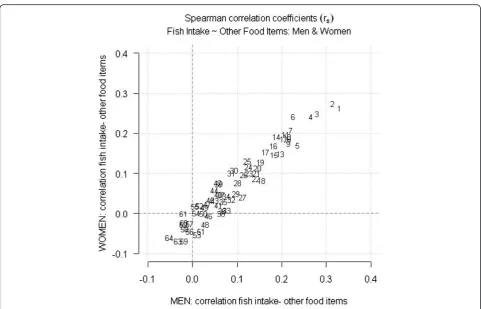
When Spearman correlation coefficients were calculated for total intake of fish and other dietary variables, we found that the associations between fish consumption and the in-take of other foods were similar in men and women (Fig-ure 2). Reported fish consumption was positively correlated with other foods considered healthy (e.g., root vegetables, chicken, berries, and lettuce/cabbage/spin-ach/broccoli) and was poorly correlated with many foods considered unhealthy (e.g., crisps/snacks, white bread, fried potatoes, pizza/hamburger, and soda). The same plots restricted by age group or time period showed similar correlations (data not shown).
Because alcohol consumption was the only factor that was differently associated with fish consumption in men and women but was not accounted for in the statistical analysis in our previous study of stroke and fish con-sumption [12], we made a new analysis of those data,
now including alcohol in the multivariate model. This did not change the point estimate for the stroke risk in relation to fish consumption (without alcohol: OR: 1.24 [95% CI: 1.01, 1.51]; with alcohol: OR: 1.23 [95% CI: 1.00, 1.52] for intake of fish, meals/week, in men).
Discussion
The current study found that fish consumption was posi-tively associated with a healthy lifestyle in both men and women in a large study of the adult population in the county of Västerbotten in northern Sweden. This is in agreement with previous studies [8,10]. We did not find any indication of gender differences, except for alcohol.
There are limitations concerning the dietary measure-ment method used in this study. FFQs are designed to rank participants according to their dietary intake, not to measure the whole diet. Therefore, we only reported correlations between intake frequencies in this study, not absolute food consumption. The fish consumption questions used in the FFQ have been validated using erythrocyte levels of EPA and DHA, which is a strength
of the current study. Spearman correlation coefficients between estimated intake of these fatty acids accord-ing to the FFQ and erythrocyte levels were satisfactory (Rs= 0.42-0.51) [17].
A problem in dietary surveys is that people often report a more healthy behavior than what is actually true [18]. It is well known in the population of northern Swe-den that fish is a healthy food. This might increase the positive association between fish consumption and other foods considered healthy and other healthy behaviors. In addition, underreporting is a problem in dietary surveys. In a previous study, no gender difference in the preva-lence of underreporting in the northern Swedish popula-tion was found [19], but it is unknown if there is a difference in what men and women underreport, which is a limitation. In the current study, people below the 5th and above the 97.5thpercentile of food intake level were
excluded, to avoid an effect from the most evident under- and overreporters.
Our finding of higher consumption of alcohol in male high consumers of fish is interesting when considering our previous finding of a higher risk of stroke in male high consumers of fish in northern Sweden [12]. High blood pressure is the dominant risk factor for stroke and high consumption of alcohol is positively associated with hypertension. However, light to moderate alcohol con-sumption may be protective against ischemic stroke [20]. Hypertension, but not alcohol consumption, was adjusted for in our previous stroke study [12].
The finding of a positive association between alcohol and fish consumption in men, in this larger study performed in the same population as our previous stroke study [12], called upon additional analysis in our previous stroke study. Therefore, we requested complementary information on
Figure 2Gender-specific correlations between consumption of fish and other foods according to the northern Sweden food frequency questionnaire.The horizontal axis shows correlations between fish consumption and other foods in men. The vertical axis shows the
alcohol consumption (frequency of strong beer, wine and spirits consumed) in our previous stroke study. However, addition of alcohol in the statistical model did not change the point estimate for the stroke risk in relation to fish con-sumption. Therefore, the finding of a higher risk of stroke in men reporting high fish consumption could not be explained by a higher intake of alcohol. The hypothesis that high fish consumption is a marker of unhealthy lifestyle in men in this population must be rejected. As regards the fac-tors measured in this study, there are no gender-specific confounding factors in the association between fish con-sumption and the risk of stroke in northern Sweden. Add-itional studies are warranted to clarify the finding of an increased risk of stroke in men reporting high consumption of fish in northern Sweden.
Conclusions
Fish consumption is positively associated with other healthy lifestyle factors (consumption of vegetables and fruit, exercise, and not smoking) and a higher educational level in both men and women in northern Sweden. It is important to adjust for other lifestyle variables and socioe-conomic variables in studies concerning health effects of fish consumption.
Competing interests
The authors declare that they have no competing interests.
Authors' contributions
MW participated in the design of the study, the acquisition of data, interpretation of data, and drafted the manuscript. AT participated in the design of the study, performed the statistical analysis, and participated in interpretation of data. IJ participated in the acquisition of data and interpretation of data. AH participated in the design of the study and interpretation of data. MN participated in the acquisition of data and interpretation of data. IAB participated in the design of the study and interpretation of data. All authors read and approved the final manuscript.
Disclaimer
The paper reflects only the authors0views: the European Union is not liable for any use that may be made of the information.
Acknowledgements
This work was supported by the Swedish Research Council Formas and the European Union (Sixth Framework Program: PHIME; FOOD-CT-2006-016253).
Author details
1Department of Public Health and Clinical Medicine, Occupational Medicine,
Umeå University, Umeå 901 87, Sweden.2Department of Nutritional
Research, Umeå University, Umeå, Sweden.3Department of Odontology,
Umeå University, Umeå, Sweden.4Department of Food and Nutrition, Umeå
University, Umeå, Sweden.5Department of Public Health and Clinical
Medicine, Epidemiology and Global Health, Umeå University, Umeå, Sweden.
Received: 14 May 2012 Accepted: 20 November 2012 Published: 4 December 2012
References
1. He K:Fish, long-chain omega-3 polyunsaturated fatty acids and prevention of cardiovascular disease--eat fish or take fish oil supplement?Prog Cardiovasc Dis2009,52(2):95–114.
2. Konig A, Bouzan C, Cohen JT, Connor WE, Kris-Etherton PM, Gray GM, Lawrence RS, Savitz DA, Teutsch SM:A quantitative analysis of fish
consumption and coronary heart disease mortality.Am J Prev Med 2005,29(4):335–346.
3. Larsson SC, Orsini N:Fish consumption and the risk of stroke: a dose- response meta-analysis.Stroke2011,42(12):3621–3623. 4. Park K, Mozaffarian D:Omega-3 fatty acids, mercury, and selenium in
fish and the risk of cardiovascular diseases.Curr Atheroscler Rep2010, 12(6):414–422.
5. Panagiotakos DB, Pitsavos C, Zampelas A, Chrysohoou C, Griffin BA, Stefanadis C, Toutouzas P:Fish consumption and the risk of developing acute coronary syndromes: the CARDIO2000 study.Int J Cardiol2005,102(3):403–409. 6. Anderson JS, Nettleton JA, Herrington DM, Johnson WC, Tsai MY,
Siscovick D:Relation of omega-3 fatty acid and dietary fish intake with brachial artery flow-mediated vasodilation in the multi-ethnic study of atherosclerosis.Am J Clin Nutr2010,92(5):1204–1213.
7. Chavarro JE, Stampfer MJ, Hall MN, Sesso HD, Ma J:A 22-y prospective study of fish intake in relation to prostate cancer incidence and mortality.Am J Clin Nutr2008,88(5):1297–1303.
8. Yamagishi K, Iso H, Date C, Fukui M, Wakai K, Kikuchi S, Inaba Y, Tanabe N, Tamakoshi A:Fish, omega-3 polyunsaturated fatty acids, and mortality from cardiovascular diseases in a nationwide community-based cohort of Japanese men and women the JACC (Japan collaborative cohort study for evaluation of cancer risk) study.J Am Coll Cardiol2008, 52(12):988–996.
9. Cundiff DK, Lanou AJ, Nigg CR:Relation of omega-3 fatty acid intake to other dietary factors known to reduce coronary heart disease risk. Am J Cardiol2007,99(9):1230–1233.
10. Turunen AW, Mannisto S, Suominen AL, Tiittanen P, Verkasalo PK:Fish consumption in relation to other foods in the diet.Br J Nutr2011, 106(10):1570–1580.
11. Barberger-Gateau P, Jutand MA, Letenneur L, Larrieu S, Tavernier B, Berr C: Correlates of regular fish consumption in french elderly community dwellers: data from the three-city study.Eur J Clin Nutr2005,59(7):817–825. 12. Wennberg M, Bergdahl IA, Stegmayr B, Hallmans G, Lundh T, Skerfving S, Stromberg U, Vessby B, Jansson JH:Fish intake, mercury, long-chain n-3 polyunsaturated fatty acids and risk of stroke in northern Sweden. Br J Nutr2007,98(5):1038–1045.
13. Norberg M, Wall S, Boman K, Weinehall L:The västerbotten intervention programme: background, design and implications.Glob Health Action 2010,3:4643–doi:10.3402/gha.v3i0.4643. www.ncbi.nlm.nih.gov/pmc/ articles/PMC2844807/pdf/GHA-3-4643.pdf.
14. Weinehall L, Hallgren CG, Westman G, Janlert U, Wall S:Reduction of selection bias in primary prevention of cardiovascular disease through involvement of primary health care.Scand J Prim Health Care1998,16(3):171–176.
15. Winkvist A, Hornell A, Hallmans G, Lindahl B, Weinehall L, Johansson I:More distinct food intake patterns among women than men in northern Sweden: a population-based survey.Nutr J2009,8:12.
16. Johansson I, Hallmans G, Wikman A, Biessy C, Riboli E, Kaaks R:Validation and calibration of food-frequency questionnaire measurements in the Northern Sweden health and disease cohort.Public Health Nutr2002, 5(3):487–496.
17. Wennberg M, Vessby B, Johansson I:Evaluation of relative intake of fatty acids according to the Northern Sweden FFQ with fatty acid levels in erythrocyte membranes as biomarkers.Public Health Nutr2009, 12(9):1477–1484.
18. Lafay L, Mennen L, Basdevant A, Charles MA, Borys JM, Eschwege E, Romon M:Does energy intake underreporting involve all kinds of food or only specific food items? Results from the Fleurbaix Laventie Ville Sante (FLVS) study.Int J Obes Relat Metab Disord2000,24(11):1500–1506. 19. Johansson G, Wikman A, Ahren AM, Hallmans G, Johansson I:Underreporting of energy intake in repeated 24-hour recalls related to gender, age, weight status, day of interview, educational level, reported food intake, smoking habits and area of living.Public Health Nutr2001,4(4):919–927.
20. Patra J, Taylor B, Irving H, Roerecke M, Baliunas D, Mohapatra S, Rehm J:Alcohol consumption and the risk of morbidity and mortality for different stroke types–a systematic review and meta-analysis.BMC Publ Health2010,10:258.
doi:10.1186/1475-2891-11-101
Cite this article as:Wennberget al.:Diet and lifestyle factors associated with fish consumption in men and women: a study of whether gender differences can result in gender-specific confounding.Nutrition Journal