Submitted in: July 2011 Accepted in: November 2011 Published in: January 2012
Recommended citation
RAMÍREZ, José Luis; JUÁREZ, Manuel; REMESAL, Ana (2012). “Activity Theory and e-Course Design: An Experience in Discrete Mathematics for Computer Science”. In: “Mathematical e-learning” [online dossier]. Universities and Knowledge Society Journal (RUSC). Vol. 9, No 1. pp. 320-339UOC. [Accessed: dd/mm/yy].
<http://rusc.uoc.edu/ojs/index.php/rusc/article/view/v9n1-ramirez-juarez-remesal/v9n1-ramirez-juarez-remesal-eng>
ISSN 1698-580X
Activity Th
eory
and e-Course Design:
An Experience in Discrete
Mathematics for Computer
Science
article
José Luis Ramírez
[email protected] CENIDET (México)Manuel
Juárez
[email protected] CENIDET (México)Ana
Remesal
[email protected] Universidad de BarcelonaAbstract
The aim of this article is to present a distance e-learning experience of mathematics in higher education. The course is offered as a remedial program for master’s degree students of Computer Science. It was designed to meet the particular needs of the students entering the master’s degree program, as a response to the lack of understanding of logical language which was identified in several previous cohorts of students at CENIDET. The course addresses mathematical abilities of comprehensive functional use of logical language as a basic ability to be developed for later successful participation in the Master of Computer Science and also for later use in professional contexts of Computer Engineering. Eighteen students distributed throughout Mexico volunteered to participate under the guidance of one instructor. The techno-pedagogical design of the course is grounded on two theoretical approaches. Content-related instructional decisions are supported by different concepts of the second generation of Activity Theory. The concept of Orienting Basis of an Action was particularly useful to define the skills the students were expected to develop. Instructional decisions related to the participants’ interaction are underpinned by Slavin’s Team Accelerated Instruction model. We present the course structure in detail and provide some student interaction excerpts in order to illustrate their learning progress.
Keywords
e-learning, instructional design, higher education, discrete mathematics, activity theory, mathemati-cal abilities
Teoría de la actividad y diseño de cursos virtuales:
la enseñanza de matemáticas discretas en Ciencias de la Computación
Resumen
El objetivo de este estudio es presentar una experiencia de aprendizaje virtual a distancia en el ámbito de la enseñanza de las matemáticas en educación superior. El curso se ofrece como programa de apoyo para alumnos de un máster de Ciencias de la Computación y está específicamente diseñado para satisfacer las necesidades de los estudiantes que iniciaban dicho programa, particularmente la falta de comprensión del lenguaje lógico detectada en varias promociones anteriores de los alumnos del CENIDET. El curso tiene como objetivo el desarrollo de la habilidad de uso del lenguaje lógico, la cual es básica para cursar con éxito el máster de Ciencias de la Computación, así como para su posterior aplicación en contextos profesio-nales relacionados con la Ingeniería computacional. Dieciocho estudiantes distribuidos por todo México participaron voluntariamente en el estudio bajo la dirección de un tutor. El diseño tecnopedagógico del curso se basa en dos premisas teóricas. Las decisiones didácticas relacionadas con el contenido se funda-mentan en varios conceptos derivados de la segunda generación de la Teoría de la Actividad (TA). El con-cepto de «base de orientación para la acción» ha sido particularmente útil para definir las habilidades que se esperaba que desarrollaran los estudiantes. Las decisiones didácticas relacionadas con la interacción de los participantes se basan en el modelo de enseñanza acelerada en equipo de Slavin. A continuación se expone detalladamente la estructura del curso y se presentan algunos extractos de la interacción de los estudiantes para ilustrar su proceso de aprendizaje.
Palabras clave
1. Introduction
Working with formalized or semi-formalized statements is often a challenge for many students of
mathematics. A typical coping strategy is to read the statements informally, avoiding mathematical
formalism. Unfortunately, an important loss of mathematical knowledge happens by using this strategy.
Various researchers have linked these difficulties with: i) the negation of mathematical statements
(Antonini, 2001; Durand-Guerrier, 2004); ii) the translation (formalization) of natural-language statements
into the formal language of First Order Logic (FOL) (Barker-Plummer, Cox, Dale & Etchemendy, 2008);
and iii) the identification of the logical structure of mathematical statements (Selden & Selden, 1996).
In the field of Computer Science (CS), there have been recent proposals to include Formal Methods
in the curriculum. Students are now expected to develop skills to read and write formal specifications
for professional practice (Boca, Bowen & Duce, 2006). However, although many of them first encounter
formalized or semi-formalized mathematics in Discrete Mathematics (DM) courses, their instructors
often expect them to master FOL already. Hence, the students face difficulties in understanding
and communicating new and complex concepts in their discipline with semi-formalized texts.
Consequently, they need specific help to develop the skills to read mathematical texts in different
settings. A good presentation of content does not suffice; therefore, remedial courses in higher
education must work towards the explicit development of this ability (Merisotis & Phipps, 2000).
This paper describes the use of some elements of the second generation of Activity Theory (AT) to
design an online remedial course. Particularly, the concept of Orienting Basis of an Action (OBA) was
helpful to provide master’s degree students with the necessary support in their learning processes.
The online remedial course covers DM Preliminary Concepts (Logic, Set, Relations and Functions) for
students entering a Master of CS in Mexico. In the following sections, we shall present the contextual
background in detail, the theoretical assumptions and the consequences for instructional design. Some
excerpts of the interactions occurring during the course will illustrate the students’ learning progress.
2. The institutional context: mathematics teaching
in Computer Science
Most DM courses offered to CS students follow a traditional model of mathematics teaching, such
as: (1) concept definition; (2) theorem presentation; (3) demonstration; and (4) exercising (see Meyer,
2005, for example). Alternative courses are still the exception. Furthermore, they usually lack the
theoretical underpinning of mathematical education (see, for example, Sutner, 2005).
Whether traditional or problem-based, all of these instructional proposals emphasize the
accuracy of mathematical definitions. They all establish the definitions of content by means of
logical language. In contrast, previous evaluation of the Mexican context (Ramírez, 1996; 2005) has
repeatedly pointed to two comprehension lacunae among CS students: (a) translating mathematical language into natural language (and vice versa); and (b) analysing mathematical definitions. Hence,
latter topic in particular, students need to connect different representations of one concept, such as
natural language, logical language, mathematical language and pictographic language.
3. Theoretical background: Activity Theory
AT allows mathematics educators to address all the above-mentioned deficiencies and requirements
in DM online courses. Currently, there are three generations of AT (Engeström, 2000). The concepts
defined by the first generation of AT – mediation, internalization and zone of proximal development
(Vygotsky, 1988) – and those proposed by the third generation – learning by expanding, shared zone
of proximal development (Engeström, 1987) and situated learning (Lave & Wenger, 1991) – are well
established. In contrast, the development and applications of the second generation of AT are less
recognised. Our instructional experience specifically draws on the second generation of AT. One of
the basic elements of this approach is the accurate definition of the activity structure, through actions
and operations (Leontiev, 1984). These concepts enable the study of human activity by facilitating
the characterization of the notion of ability,which is a key element in our instructional proposal, both
for the design of activities and learning materials, and for the analysis of advancements in learning.
In the following subsections, we shall address the instructional decisions step by step, as guided by
this theoretical framework.
3.1. The second generation of AT and mathematics teaching
in higher education
Leontiev’s concept of activity was used by Tallizina (1988), and later by Hernandez (1989) and
Valverde (1990), among others, to describe mathematical abilities. For Leontiev, the activity appears
as a refinement of the internalization concept and is a constituent element of the psychological
subject in both its cognitive (awareness) and its affective and motivational aspects (personality). The
activity orients the subject in the objective reality, transforming it into a form of subjectivity. That is,
an activity is not just a reaction or a series of reactions; it is a system with structure, development,
transitions and internal changes. An activity system produces actions and is, in turn, realized through
actions. However, the activity is irreducible to particular actions. Each activity is always linked to a
motive (either material or abstract), which responds to a need. The components of human activities
are the actions performed by the individuals. The action has an operational aspect (how, by what
means can we achieve the objective?), defined by the objective conditions required to achieve the
goal of the activity. Activities, actions and operations are dynamic: they can change their ‘level’ within
the macrostructure of the activity under certain conditions.
The design of a learning process departs from the psychological characterization of the activity in
terms of its structural components: actions and operations. The educational interpretation of these
components is expressed in terms of skills, and requires the mastery of a complex system of actions
the actions they comprise. In turn, this process requires a conscious execution by the subject. The
successful execution of the actions indicates the degree of skill development to perform the task.
Hence, the subject must master the system of actions in order to fully develop the skill. In other
words, we could argue that, for the teaching of mathematical text comprehension, it is essential to
characterise the ability and identify the skills it comprises.
3.2. Designing the Orienting Bases of Action
The development of higher mental functions has a social origin (Vygotsky, 1988). This development
happens in two separated stages: interpsychological and intrapsychological. Thus, development
results from internalized actions. Galperin’s Theory of the Stage-by-Stage Formation of Mental
Activity (Galperin, 1969) is grounded on Vygotsky’s premises and applies them to the instructional
context. First, there is the stage of material activity, in which the learner needs to manipulate real
objects, and embodied activity, in which the individual can handle models, diagrams and drawings,
depending on the learner’s age. Second, there is verbalization, when the student needs to repeat the
sequence of operations aloud. By rewording, the action moves from the outside to the inside. Finally,
the activity can take place at a wholly inner level, which implies thinking.
These evolutionary events can be tailored through the performance of certain guided actions.
It is precisely that set of actions which will allow the student and the instructor to monitor and, if
necessary, to correct each stage of assimilation. Galperin introduced the term ‘orienting basis of an
action’ (OBA) to refer to the whole set of orienting elements by which the student is guided towards
the successful execution of an action (also conceptualized as ‘scaffolding’ (Samaras & Gismondi, 1998).
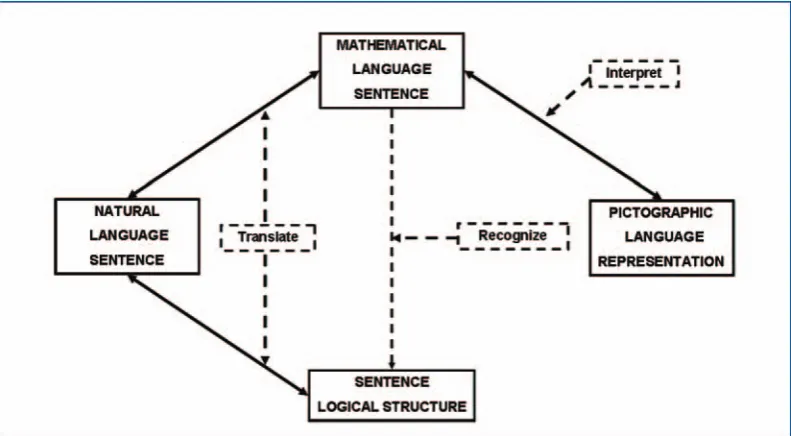
In our study, we assume that the ability to read and understand mathematical texts comprises the
following actions: (a) the translation of a mathematical statement into natural language, or vice versa;
(b) the translation of the statement into the FOL language in order to reveal its structure; and (c) the
representation of the statement in graphical language. To proceed with these steps and correctly
interpret the mathematical statements, the students need to master both codes. This identification
and characterization of the necessary skills for reading and comprehending mathematical texts
provides a basis for designing and implementing online instructional processes (see Figure 1).
4. Addressing the challenges of instructional design
In line with AT, we took three axis elements for the instructional design: course objectives, contents
and the scaffolds for the students (OBAs). We shall address each of these elements one by one further
below. We shall then explain how these elements were implemented in a Learning Management
System (LMS).
4.1. Course objectives
As a result of the problems identified in previous courses, we wanted the students to develop skills
to identify and analyze the formal language (logical language and mathematical language itself ) and
thus represent mathematical concepts and their definitions. This main goal was divided into three
objectives:
Students should...
a) Analyze and identify the FOL language in natural language.
b) Identify the mathematical language that is expressed through logical language, and the
mathematical entities to which it relates.
c) Interpret definitions in mathematical language, both in formal and pictographic codes.
4.2. Content focus
The basic contents of DM traditional courses in higher education are Propositional Logic, Predicate Logic, Sets, Relations and Functions. Logic is usually taught on the basis of a deductive model of content presentation, aiming at demonstration, and using its own rules. In contrast, our course
focused on the handling of FOL language and emphasized the process of translation of
natural-language statements into logical and mathematical natural-languages. The topic Reading Mathematical
Texts was introduced after the Logic unit. For the translation from natural to mathematical language,
students received a specific OBA.
The topics Sets, Relations and Functions had the following structure: first, the instructor presented a brief reading of the disciplinary area, where target mathematical concepts appeared in their usual
contexts. After that, he presented the mathematical subject with standard texts. Thirdly, the students
performed the exercise system for each topic, which included two main activities: (a) the analysis of
definitions and (b) the use of the corresponding OBAs. Finally, the students received other additional
4.3. Orienting Bases of Action
We defined OBAs to help the students in their problem-solving processes. In this course, there were
OBAs to translate statements: (a) from natural to propositional-logic language; (b) from natural to
predicate language; (c) from natural to mathematical language, and vice versa. Finally, we proposed one
OBA for (d) reading mathematical texts and for (e) analyzing the definition of mathematical concepts.
We offered the OBAs throughout the course, along with the material used by the students,
introducing them by examples. In the unit Logic, OBAs were characterised and provided in order to
develop the translation ability from natural language into FOL language. For the units Sets, Relations and Functions, an OBA was provided for the analysis of definitions. The following is an example of a partial implementation of an OBA for the analysis of definitions.
4.3.1. Example of an OBA
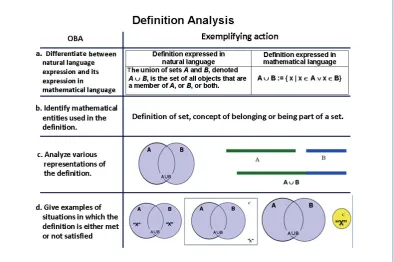
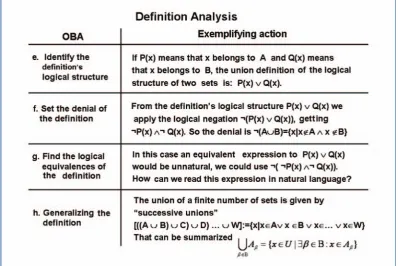
Initially, we offered the students step-by-step examples, performing the eight actions of the analysis:
(1) differentiating between the expression of the definition in natural language and its expression
in mathematical language; (2) identifying the mathematical entities in it; (3) giving examples of
objects that both meet and do not meet the definition; (4) finding different ways to represent it; (5)
identifying the underlying logical structure; (6) setting its negation; (7) finding the logical equivalence
of the definition; and finally, (8) generalizing it.
The process presented to students as a model for using the OBA is outlined in Figures 2 and 3. In
these Figures, the actions are listed in the left-hand column and possible responses are illustrated in
the right-hand column.
Figure 3: Actions #5 to #8 presented to students as an example for the analysis of a definition.
This OBA assumes the partial development of the skills to translate statements from mathematical,
pictorial and natural languages into each of the three codes. Performing the analysis of definitions
provides students with fertile ground for developing the ability to read mathematical texts.
4.4. Techno-pedagogical design of the e-course
In e-learning, many drop-outs are caused by a lack of motivation (Juan, Huertas, Steegmann, Corcoles
& Serrat, 2008); therefore, the instructional design of the courses is a key issue in the context of adult
education. The term techno-pedagogical design refers to the instructional characteristics of a course
as supported by technological devices (Mauri, Colomina & De Gispert, 2009). Indeed, the design of
e-learning courses cannot be reduced to the traditional elements of the curriculum, i.e., objectives,
content and learning activities and assessment. On the contrary, it must include a reasoned selection
and planning of the technological tools that will be used throughout the course, together with a plan
for the actual use of these tools and spaces by all participants. Hence, the techno-pedagogical design
must include a careful planning of the interactions (instructor-students and among peers) that will
be pursued throughout the course.
4.4.1. The LMS
For this course, we used Moodle (V.1.5.8) as the LMS. Moodle presents a flexible structure and leaves
many choices open to the course designers and instructors. For example, it is possible to manage
different spaces for diverse, flexible groups within the same course. This feature was particularly
private spaces. The course administrator/instructor takes these decisions, according to the
techno-pedagogical design. Furthermore, it allows the management of the course content in individual
modules. In this course, we presented each of the five topics separately, in ‘week-mode’, all of which
had the same recursive structure to help the students assume the participation norms.
4.4.2. Interaction design
For the selection and planning of technological tools, it is necessary to determine the interaction
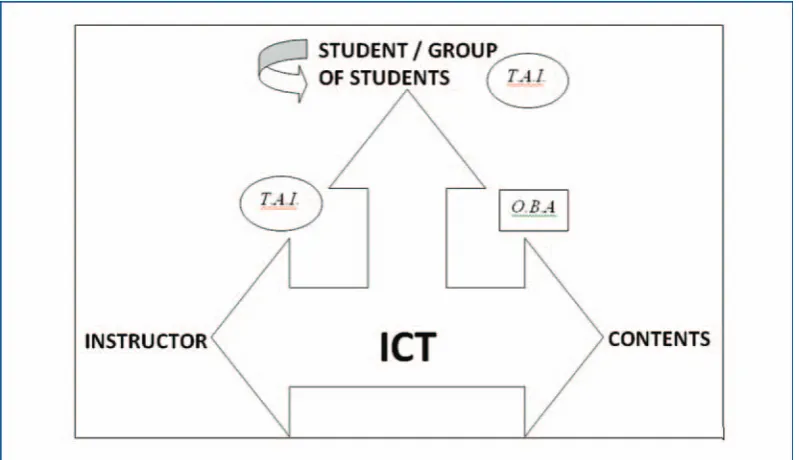
among students, and between students and instructor. We adapted the collaborative technique
called Team Accelerated Instruction (TAI) (Slavin, 1994) to the Virtual Learning Environment (VLE). In
keeping with this technique, the students have to perform three kinds of activities. First, the students
must work independently with the learning materials. They are expected to read the course materials
and solve the exercises and problems. The second step is for them to work in pairs in order to share
and discuss solutions and difficulties with exercises and problems. For this purpose, the students have
access to both a synchronous (chat) and an asynchronous (forum) private room on the online platform.
The third interaction level covers the whole group. Again, both chat and forum tools support group
interaction. The use of each of these spaces and tools is regulated by means of specific participation
norms. Figure 4 shows a scheme for the organization of participants and content-learning materials.
Figure 4: Techno-pedagogical course design.
Student-content interaction. Earlier editions of the course presented a technical difficulty while using chat and forum tools. The participants faced troubles when writing in logical and mathematical
language. These problems had been reported previously in similar studies (Smith, Ferguson & Gupta,
2004). Thus, to facilitate mathematical communication, we added an HTML editor with a mathematical
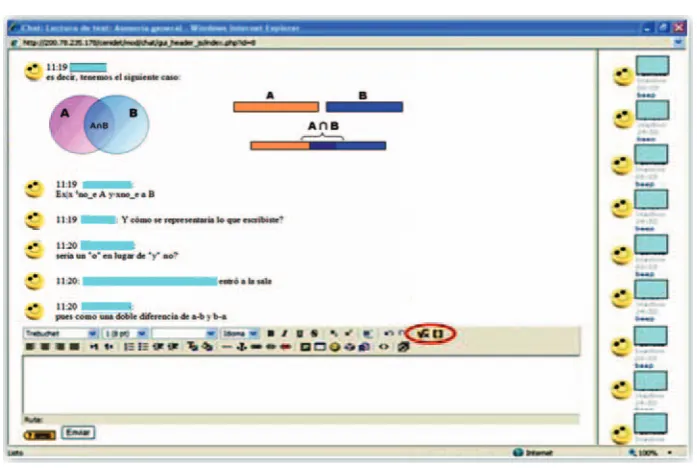
equation editor (WIRIS, V.2.1.26) to the chat device (Juárez & Ramírez, 2010). Figures 5 and 6 show the
Student-instructor interaction. The main area of the course had three communication spaces. First, there was a forum for small-group discussion. This forum provided an asynchronous space to
facilitate continuity of discussions and feedback to students by the instructor. Second, there were
two chat rooms for synchronous interaction, serving two purposes: there was a fi rst chat room for
organized whole-class discussion to resolve doubts under the instructor’s guidance, and a second
one for technical support.
Figure 5: Example of the equation editor and its use in synchronous interaction.
Student-student interaction. Student-student interaction was designed to occur in pairs and was facilitated by means of different tools. First, there was a chat room for synchronous interaction;
second, a wiki for joint resolution of mathematical problems; and third, a database to share results
and reflections. Each pair of students could freely decide which tool to use. The group spaces were
private to each pair of students; only the instructor could access all the small-group spaces. Hence,
he was able to check or participate in the students’ interaction, as would be the case in face-to-face
TAI situations.
4.4.3. Course structure
The course lasted five weeks, from July to August 2008. A group of 18 students voluntarily accepted
to enrol on the master’s degree course in CS at CENIDET. The students were CS Engineers from
several states across Mexico. The instructor had experience in conventional courses on the subject;
in addition, he was familiar with basic technological tools and had participated in the course design.
The course included five units (Logic and Mathematical Language, Sets, Relations, Functions and Applications), one per week. The students worked together in pairs, following the TAI model previously presented. If doubts remained after peer interaction, they were brought to the whole-class forum or
the whole-class chat.
After each week, the students carried out a self-assessment using a feedback sheet provided
by the instructor as a model of resolution. The students had to compare the model with their own
resolution in order to identify deviations, strengths and weaknesses. This self-assessment was not
graded. The instructor conducted weekly sessions of two hours to offer guidance and clarify doubts.
He gave feedback and interacted with the students both synchronously (whole-class chat room)
and asynchronously (whole-class forum). Strict turn-taking was established in order to facilitate
synchronous interaction in the whole-class chat room. Each student pair had a particular interaction
turn with the instructor for 20 minutes. The other participants attended the chat session as observers;
they had the chance to ‘listen’ until the change of turn. This instructional design is presented in more
detail in an earlier publication (Remesal, Juárez & Ramírez, 2011).
5. Results: evidence of ability development through the use
of Orienting Bases of Action
In order to assess the development of the students’ abilities, we performed an interpretive analysis of
the following discursive aspects (Lacity & Janson, 1994; Willig, 2004):
1. The students’ answers to the exercises.
2. The questions asked in the forum and chat.
3. The comments made in student-student interaction.
We shall now go on to present the specific results of the analysis of data sources #1 to #3, with the
purpose of illustrating rather than providing an exhaustive account.
In the following sequence, we can observe an example of a student’s development of abilities,
that is, of her internalization process (translated from the original language, participants are quoted
by pseudonyms). First, we can see how Lois begins the analysis of the definition by indicating what
definition she used for inverse functions; then she indicates her doubts regarding its logical structure.
She finally tells Mary how she interprets the mathematical definition in natural language. Her
explanations and doubts show the acquisition of a skill to organize definitions according to the model
shown in the OBA. In this asynchronous interaction, Mary’s answer shows how she partially performs
the definition analysis. She starts with the definition in natural language and then in mathematical
language. Mary provides more elements about what she understands as the logical structure of the
definition. She concludes by commenting on the types of properties that a function must satisfy in
order to have an inverse function. Despite her analysis, she is unsure about the correctness of the
logical structure she proposes:
[Small-group forum. Author Lois. 08/02 08:59]
“Hello Mary,
What definition in mathematical language did you use for an inverse function? I
used the following one, but I’m not sure what its logical structure is:
f-1:B[A | x = f -1 (y),
which in natural language is: a function is inverse is any rule or correspondence that
allows us to get the values of
x ∈A from the values of y ∈B
Do you have any other idea?”
[Small-group forum. Author Mary. 08/02 11:27]
“Hello Lois! Good morning,
Well, let’s see if I can help you, OK? Look, my definition of natural language came
out like this....
Be A in B and B in A an inverse function, if and only if the function is bijective, that is,
a one to one correspondence and above the co-domain.
f ⇔ f -1
It’s an inverse or invertible function.
f = f -1 If,
f: A → B and f -1 : B → A if,
f: A → B ( ∀x ∃y ∧∀y ∃x)
and in its logical structure, I’m not quite sure, but look at what I got…
P(x) ----> Q(x) and Q(x) ----> P(x)
Well, that’s what I think, look, because reading the defi nition, it says that in order for
a function to be inverse, you fi rst need to know that it’s a function, secondly, check
if it has the properties of injective and surjective in order to say that f: A → B and
f -1 : B → A.
Well, girl, I hope this was helpful,... if it wasn’t, tell me and we can talk, I may be
wrong and that way we can clear things up, OK?”
Through peer interaction, by sharing doubts and eff orts to grasp the OBA in order to handle
mathematical content in the multiple communication spaces of the course, the students proved
to be progressively internalizing these abilities. In the last units of this course, most students
formed defi nitions according to the OBA through the following actions: fi rst, negating the
function; second, translating the function from mathematical language to natural language and
vice versa; third, representing the diff erent forms of the function; and fi nally, representing the
logical structure.
Figure 7: Example of fi rst steps of OBA use in a chat session.
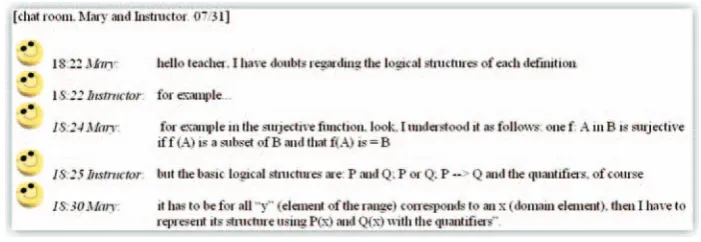
For instance, the following intervention by Cinthya (Figure 7) shows how she explicitly states the
fi rst step for the OBA: “First is the analysis of the defi nitions. Please, tell me if I’m doing OK.” At certain
times, the instructor intervened actively to remind the students of the actions that structured the
OBAs and guided them to establish a link to the learning content. In the following sequence, for
the instructor intervenes to remind her of one of the scaffolding actions related to the translation of
statements and the recognition of their logical structure.
After the instructor’s indications on basic logical structures, Mary remembers the need to use
the predicates and quantifiers. Feedback and scaffolding for solving exercises was not only provided
by the instructor; at times, other students who participated in chat sessions also contributed to this
assistance intervention.
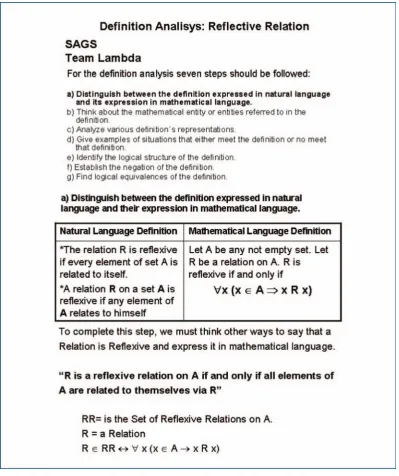
In addition to the chat and forum interaction, the weekly quizzes that the students performed
for each unit also informed on the skills development by means of the OBAs, For example, Figure 8
shows part of a student’s answer to the first question the third weekly quiz. In this quiz, the student
begins rewriting the entire OBA for definition analysis. Then he solves the exercise one step at a time.
The student’s response shows the first step of the definition analysis, expressed in both natural
language and mathematical language. The student began his analysis by writing the expressions
in both languages in a table. He concluded this step by proposing a different way of expressing
the definition in natural language and its corresponding formalization in mathematical language.
The student was able to propose his own way of describing the reflexive relationship concept and
formalizing it in mathematical language. These actions show how the student used the OBA, and
hence, they bear witness to his mastery of the targeted skill to translate a sentence expressed in
natural language into mathematical language.
6. Conclusions: assessment of the course design
The need for remedial courses to promote Mexican students’ successful participation in the CEDINET
master’s degree program has been confirmed in recent decades (Ramírez, 1996; 2005). In face-to-face
educational situations, the development of mathematical skills is a complex teaching and learning
task. Consequently, re-locating it in the virtual context is a risky business in its own right. Particularly,
the instructional design and its implementation in an LMS constitute a fundamental challenge to
higher education instructors. In this course, the techno-pedagogical design allowed the participants’
interaction within the system to be anticipated by promoting student-student synchronous and
asynchronous interaction followed by whole-class student-instructor highly structured synchronous
interaction. On the one hand, this was pedagogically enabled by the TAI model. On the other, it was
technologically facilitated by the flexibility of the LMS and the incorporation of the WIRIS application.
However, and most importantly, the online instructional design presented in this article strongly
suggests that the second generation of AT provides useful theoretical elements for promoting the
development of the pursued abilities by means of virtual tools. Based on AT, it was possible to define
the course objectives in terms of skills, knowledge and application conditions. This in turn allowed
the focus to be placed on skills development, using mathematical content as a means, in contrast to
traditional approaches of teaching mathematics in higher education, which often focus on content
presentation.
In earlier works, we reported the positive assessment that all the participants made of the course
(Remesal, 2008). After analyzing the participants’ interactions on the virtual platform with regard to
undertaking the translation exercises following the OBAs provided, we evaluate the course design
positively with respect to three important teaching aspects. First, regarding the content sequence,
starting with logical-language proficiency and moving towards an understanding of semi-formalized
mathematical texts appeared to be a highly appropriate strategy to facilitate the development of the
target abilities. Second, the interaction structure and norms had three positive effects: (1) they allowed
the resolution of exercises; (2) they fostered the appropriation of content and the development of
abilities; and (3) they encouraged social interaction between pairs of students at a distance. And
third, the incorporation of specific software (WIRIS) helped the participants to overcome difficulties
Nevertheless, the insufficient duration of the course poses a clear limitation for the full development
of the intended abilities, since the development of skills requires gradual practice; indeed, five weeks
is too short a time span. In future editions of this course, a longer term (up to eight weeks) should
be considered. In addition, we are looking at three possible directions for the next research and
instructional steps. First, a longitudinal study is needed to identify how students use the OBA for the
analysis of definitions on the Master of CS after the remedial course. This longitudinal project would
facilitate the assessment of the remedial course. Second, we intend to expand the remedial course to
other related content, such as Modal Logic and Dynamic Logic of the master’s degree program. Finally, audio and videoconferencing tools will be added to upcoming editions in order to establish whether
interaction is enhanced through their use.
Acknowledgments
This project was funded by the CUDI/CONACYT grant I0101/131/07 C-229-07.
Dr Ana Remesal is a member of the “Development, Interaction and Communication in Educational
Contexts” Consolidated Research Group. This group has been supported and financed by the
Government of Catalonia since 1995 (2009 SGR 933).
References
ANTONINI, S. (2001). “Negation in mathematics: obstacles emerging from an exploratory study”.
Proceedings of the 25th PME Conference. University of Utrecht. Pages 49-56.
BARKER-PLUMMER, D.; COX, R.; DALE, R.; ETCHEMENDY, J. (2008). “An empirical study of errors in
translating natural language into logic”. Proceedings of the 30th Annual Meeting of the Cognitive
Science Society/CogSci. Pages 505-510.
BOCA, P.; BOWEN, J. P.; DUCE, A. (eds) (2006). Teaching Formal Methods: Practice and Experience. Electronic Workshops in Computing (eWiC) series. London: BCS London Office.
DURAND-GUERRIER, V. (2003). “Which notion of implication is the right one? From logical
considerations to a didactic perspective”. Educational Studies in Mathematics. Vol.53, pages 5-34. DURAND-GUERRIER, V.; BEN-KILANI, I. (2004). “Négation grammaticale versus négation logique dans
l’apprentissage des mathématiques. Exemple dans l’enseignement secondaire Tunisien”. Les Cahiers du Français Contemporain.Vol. 9, pages 29-55.
ENGESTRÖM, Y. (1987). Learning by expanding: An activity-theoretical approach to developmental research. Helsinki: Orienta-Konsultit Oy.
ENGESTRÖM, Y. (2000). “Activity theory and the social construction of knowledge: A story of four
umpires”. Organization. Vol. 7, No 2, pages 301-310.
JUAN, A. A.; HUERTAS, A.; STEEGMANN, C.; CORCOLES, C.; SERRAT, C. (2008). “Mathematical e-learning:
state of the art and experiences at the Open University of Catalonia”. International Journal of Mathematical Education in Science and Technology. Vol. 39, No 4, pages 455-471.
JUÁREZ, M.; RAMÍREZ, J. L. (2010). “Colaborar para aprender y enseñar matemáticas online”. Didac. Nos 56-57, pages 71-75.
JUNGK, W. (1981). Conferencias sobre la enseñanza de la matemática. Havana: Ministerio de Educación. LAVE, J. & WENGER, E. (1991). Situated Learning: legitimate peripheral participation. Cambridge:
Cambridge University Press.
LACITY, M. C.; JANSON, M. A. (1994). “Understanding qualitative data. A framework for text analysis
methods”. Journal of Management Information Systems. Vol. 11, No 2, pages 137-155. LEONTIEV, A. N. (1984). Actividad, Conciencia y Personalidad. Mexico: Cartago.
MAURI, T.; COLOMINA, R.; DE GISPERT, I. (2009). “Diseño de propuestas docentes con TIC en la enseñanza
superior: nuevos retos y principios de calidad desde una perspectiva socioconstructivista”. Revista de Educación. Vol. 348, pages 377-399.
MERISOTIS, J. P.; PHIPPS, R. A. (2000). “Remedial education in colleges and universities. What’s really
going on?” The Review of Higher Education. Vol. 4, No 1, pages 67-85.
MEYER, A.; RUBINFELD, R. (2005). Mathematics for computer science [course notes]. MITOPENCOURSEWARE. Massachusetts Institute of Technology.
<http://ocw.mit.edu/OcwWeb/Electrical-Engineering-and-Computer-Science/6-042JFall-2005/
CourseHome/index.htm>
RAMÍREZ, J. L. (1996). Reporte del proyecto: “Estructuración de una metodología para la enseñanza de las matemáticas discretas para la maestría en ciencias de la computación en el CENIDET” [internal report, course notes]. CENIDET. Departamento de Desarrollo Académico.
RAMÍREZ, J. L. (2005). Reporte del proyecto: “Identificación de dificultades en los cursos de matemáticas de los programas de maestría del CENIDET” [internal report]. CENIDET. Departamento de Desarrollo Académico.
REMESAL, A. (2008). Lectura de textos semi-formalizados de matemáticas para computación. Informe técnico de evaluación [internal report]. CENIDET/Universidad de Barcelona.
REMESAL, A.; JUÁREZ, M.; RAMÍREZ, J. L. (2011). “Technopedagogical design versus reality in an
interinstitutional online remedial course” [paper]. EARLI 2011 Education for a Global Networked Society.
<http://aremor.wordpress.com/publications-2/>
SAMARAS, A. P.; GISMONDI, S. (1998). “Scaffolds in the field: Vygotskian interpretation in a teacher
education program”. Teaching and Teacher Education. Vol. 14, No 7, pages 715-733.
SELDEN, A.; SELDEN, J. (1996). “The role of logic in the validation of mathematical proofs”.
Proceedings of The DIMACS Symposium on Teaching Logic and Reasoning in an Illogical World. Rutgers University.
SLAVIN, R. E. (1994). Cooperative Learning. Theory, Research, and Practice. Boston: Allyn and Bacon. SMITH, G. G.; FERGUSON, D.; GUPTA, S. (2004). “Diagrams and math notation in e-learning: Growing
SUTNER, K. (2005). CDM:Teaching discrete mathematics to computer science majors. Carnegie Mellon University.
<http://www.cs.cmu.edu/%7Esutner/papers/jeric.pdf>
TALLIZINA, N. F. (1988). Los fundamentos de la educación superior. Mexico: UAM-Ángeles Editores. VALVERDE, L. (1990). Un método para contribuir a desarrollar la habilidad fundamentar-demostrar una
proposición matemática. [Unpublished doctoral thesis]. Universidad de la Habana. VYGOTSKY, L. S. (1988). El desarrollo de los procesos psicológicos superiores. Barcelona: Grijalbo.
WILLIG, C. (2004). Introducing qualitative research in psychology. Adventures in theory and method. Philadelphia: Open University Press.
About the Authors
José Luis Ramírez [email protected] CENIDET (México)
José Luis Ramírez Alcántara holds a degree in Educational Mathematics awarded by the Autonomous University of Guerrero, Mexico. He obtained his master’s degree in Mathematics at CINVESTAV, Mexico, and is currently doing his doctoral studies in Mathematics Teaching at the Autonomous University of Barcelona, Spain. For 15 years, he has taught mathematics, educational research and mathematics teaching methodology courses on undergraduate degree and master’s degree programmes. At CENIDET, he has collaborated with the Department of Computational Sciences, teaching Discrete Mathematics (DM) and Theory of Computation. His current line of research is mathematics teaching and learning processes in higher education in Virtual Learning Environments:e-learning and blended learning.
Centro Nacional de Investigación y Desarrollo Tecnológico (CENIDET) Interior Internado Palmira S/N
Col. Palmira Cuernavaca, Morelos. D.R. C.P. 62490
Manuel Juárez
[email protected] CENIDET (México)
Manuel Juárez holds a degree in Psychology, a master’s degree in Computation and a doctorate in Education Sciences awarded by the Department of Educational Research at CINVESTAV - National Polytechnic Institute, Mexico. His doctoral thesis was about the use of Computer-Supported Collaborative Learning in the processes of teaching science at a distance. At CENIDET, he has undertaken projects connected with online mathematics teaching on refresher programmes for teaching staff , in the area of mathematics and in the use of ICTs for engineering teaching. He is a member of the CONACYT ICT Network and his current line of research is mathematics teaching and learning processes in higher education in Virtual Learning Environments:e-learning and blended learning.
Centro Nacional de Investigación y Desarrollo Tecnológico (CENIDET) Interior Internado Palmira S/N
Col. Palmira Cuernavaca, Morelos. D.R. C.P. 62490
Mexico
Ana Remesal [email protected] University of Barcelona
Ana Remesal holds a degree in Psychopedagogy and a doctorate in Psychology of Education awarded by the University of Barcelona, Spain. Her doctoral thesis was about the assessment of mathematics learning in compulsory educational stages. She is a member of the GRINTIE group led by Dr César Coll. Within that group, she has taken part in various teaching research and innovation projects connected with new technologies in general and with Virtual Collaborative Learning in particular. She has collaborated on various CENIDET courses as an auditor-consultant. She now teaches in the Faculty of Teacher Education at the University of Barcelona.
Universidad de Barcelona
Facultad de F ormación del Profesorado Passeig de la Vall d’Hebron, 17
08035 Barcelona Spain