R E S E A R C H
Open Access
Redocumenting APIs with crowd
knowledge: a coverage analysis based on
question types
Fernanda Madeiral Delfim
1*, Klérisson V. R. Paixão
1, Damien Cassou
2and Marcelo de Almeida Maia
1Abstract
Background: Software libraries and frameworks play an important role in software system development. The appropriate usage of their functionalities/components through their APIs, however, is a challenge for developers. Usually, API documentation, when it exists, is insufficient to assist them in their programming tasks. There are few API documentation writers for the many potential readers, resulting in the lack of explanations and examples concerning different scenarios and perspectives. The interaction of developers on the Web, on the other hand, generates content concerning APIs from different perspectives, which can be used to document APIs, also known as crowd documentation. Methods: In this paper, we present a study regarding the knowledge generated by the crowd on the Stack Overflow question-and-answer website. Our main goal is to understand how the crowd can contribute for API documentation on two programming tasks: how to implement a scenario using an API (how-to-do-it), and how to fix
domain-independent bugs in an existing code where there was a misunderstanding regarding the usage of an API (debug-corrective). We classified questions available on Stack Overflow by the main concerns of askers, and we used those classified ashow-to-do-itanddebug-correctiveto analyze the coverage of API elements on the discussions related to such questions. Our cases included the well-known and popular Swing and Android APIs.
Results: Our main findings showed that the crowd provides more content fordebug-correctivetasks than for how-to-do-ittasks, regardless of the API. Android API elements are more discussed by the crowd compared to Swing. Moreover, we observed that some API elements are frequently mentioned together in discussions, and that there is a strong association between API coverage on Stack Overflow and its usage in real software systems.
Conclusions: Crowd documentation may not be a complete substitute for official documentation because of its partial coverage, especially forhow-to-do-ittasks. However, it can still significantly enhance the existent
documentation, especially for the most commonly used API elements, providing code samples and explanations on a large variety of usage nuances. Finally, taking advantage of the high coverage fordebug-correctivetasks, a new kind of debugging assistant may be conceived.
Keywords: API documentation, Crowd knowledge, Stack Overflow, Question classification, Coverage analysis
Introduction
New development platforms are being deployed at an unprecedented pace. Software developers are required to deeply learn their respective APIs (application pro-gramming interface) to take maximum advantage of the underlying innovations, while avoiding misuses that could
*Correspondence: [email protected]
1Faculty of Computing, LASCAM-FACOM, Federal University of Uberlândia, Uberlândia, Brazil
Full list of author information is available at the end of the article
decrease the final product quality. Meanwhile, develop-ers have reported that inadequate or absent resources for learning APIs, e.g., documentation, is a major obstacle for adequate learning [1, 2].
The social interaction of developers in blogs, forums, and question-and-answer (Q&A) websites generates a partially structured content. This can be considered one of the thriving forms of software documentation avail-able nowadays [3]. Different to the traditional software documentation, which is produced mostly by a central
authority, this phenomenon allows anyone to produce and share relevant content for documentation. The con-tent available in such repositories is also known ascrowd knowledge[4, 5].
An example of the channels that support developer social interaction is Stack Overflow [6], a question-and-answer website where developers collaborate with each other in order to solve issues related to software devel-opment. In the Stack Overflow, developers postquestions related to a programming topic, e.g., an API, while other developers can provideanswersto help solve their issues [7]. In the context of Stack Overflow, aquestionis an entry consisting of a title, tags and text body, and an answer is an entry consisting of a text body (which may include code samples) where a solution, a clarification and/or a in-depth discussion are provided concerning the question. Stack Overflow has been studied to help researchers to understand the knowledge/mechanisms available on it and how that can be used to assist software development. To investigate the feasibility of using crowd knowledge on Stack Overflow for API documentation, Parnin et al. [8] carried out a study on how content related to a set of APIs is being produced on Stack Overflow. They ana-lyzed the coverage of API elements overthreads, which is the composition of a question with no or with a collec-tion of answers. However, they did not analyze the nature of threads, which can impact significantly on how suitable threads are for documentation purposes.
The nature of threads can be distinguished by the main concerns of the askers. These concerns are being used in the literature for the definition ofquestion types [7, 9, 10]. Examples of question types are how-to-do-it – providing a scenario and asking how to imple-ment it—debug-corrective—dealing with problems in code already written —seeking-something—looking for some-thing objective (e.g., tutorial, tool, library) or subjective (e.g., an opinion, a suggestion, a recommendation)—and conceptual—regarding conceptual questions on a particu-lar topic (e.g., definition of concepts, best practices for a given technology). The definition itself of the how-to-do-it question type reveals that this type is more adherent to the purpose of documenting how to use API ele-ments. Nonetheless, questions of type debug-corrective are still useful as complementary documentation on how to fix frequent problems related to the usage of API elements, while the other types seems to be marginally useful.
In our previous work [11], we conducted a study on the coverage of API elements on Stack Overflow for API documentation, introducing the idea that the coverage analysis should take into account the API documentation purpose. We reported the coverage of Swing API elements by threads with how-to-do-it question type in order to measure how much elements are covered in discussions
that provide code samples on how to implement a specific task by using the API elements.
In this paper, we extend the previous study, providing coverage analysis of the Swing and Android APIs on threads containing how-to-do-it and debug-corrective question types. Our main goal is to measure the coverage of API elements to understand how the crowd can contribute for (1) API documentation on how to useAPI elements through code samples to accomplish a specific task given a scenario (coverage on threads containing how-to-do-it questions) and (2) API documentation on how to fix domain-independent bugs in an existing code where there was a misunderstanding regarding the usage of an API (coverage on threads containingdebug-correctivequestions). Our overall contribution consists of the intersection of the Parnin et al.’s coverage analysis [8] with two ques-tion types defined by Nasehi et al. [9]. Our specific contributions are threefold. First, we developed a clas-sifier by using supervised machine learning algorithms to automatically classify Stack Overflow questions, in order to select threads containinghow-to-do-itand debug-correctivequestion types. Second, we proposed a method-ology for analyzing API coverage on Stack Overflow based on question types, and consequently improving the knowledge for using Stack Overflow content for API doc-umentation. Third, we analyzed the co-occurrence of API elements on threads, i.e., how threads discuss multiple API elements. As complementary analyzes, we investi-gated (i) the growth of the coverage of API elements as compared to the growth in the number of threads on Stack Overflow related to the same API and (ii) the association between API coverage and its respective usage in a large code base repository.
The remainder of this paper is organized as follows. In the “API coverage by Stack Overflow” section, we posi-tioned our work regarding the work of Parnin et al.. In the “Automatic classification of questions” section, we explain how we classified Stack Overflow questions. And in the “Linking Stack Overflow threads with API elements” section, we explain how we identified API elements on threads. Our methods and experimental setup regarding coverage analysis are presented in the “Methods” section. We present and discuss the obtained results in the “Results and discussion” section, as well as the threats to validity, limitations, and practical implications of the work. In the “Related work” section, we present the related work on (re)documenting APIs, Stack Overflow, and linking doc-uments with code elements. Finally, our conclusions and future work are presented in the “Conclusions” section.
API coverage by Stack Overflow
possible for acompleteAPI documentation. The complete-nessof the crowd knowledge for an API can be measured by analyzing how many elements of the API are discussed by the crowd, i.e., bycoverage analysis.
A study on API coverage analysis by the crowd on Stack Overflow was conducted by Parnin et al. [8], which is the work most related to ours. They claimed that a high cov-erage would suggest that it is feasible to use the crowd knowledge for API documentation as a comprehensive source of knowledge concerning an API.
To analyze API coverage, they built a traceability model between API classes and Stack Overflow threads where these classes are mentioned. Then, they calculated the percentage of API classes linked with at least one thread, resulting in the coverage of API classes. They found that 87.2, 77.3, and 54.3% of the Android, Java, and GWT classes, respectively, are covered by the crowd. They also concluded that despite the potential of a documentation by the crowd to provide many examples and explanations on API elements, the crowd is not reliable for providing content over an entire API.
Their analysis, however, is still too general. They ana-lyzed coverage of API classes with no criterion or filter on Stack Overflow threads regarding the type of API documentation that they target. The type of API docu-mentation can be characterized by the type of content that the documentation should include, which is defined by the intentions from the point of view of the API users, i.e., what they wish to accomplish through its use or knowl-edge concerning a given API. For example, an intention type can be how to implement specific tasks using an API [5]. Hence, without considering types of API documentation, an understanding of how the API elements are covered by the crowd and how the crowd knowledge can be used for generating API documentation was not possible.
In our work, on the other hand, we have introduced the notion that coverage analysis must be conducted accord-ing to the intended type of API documentation. With that in mind, we performed a coverage analysis considering types of Stack Overflow questions related to the main con-cerns of askers, and thus, subsidizing the choice of threads for different types of API documentation. We took into account the how-to-do-it and debug-corrective question types:
• How-to-do-it: the asker describes a scenario and asks how to implement it (sometimes with a given technology or API) [7, 9]. Figure 1 shows an example of ahow-to-do-it question.
• Debug-corrective: the asker describes or presents problems in the code under development, such as run-time errors, notifications, and unexpected behavior [7, 9]. Figure 2 shows an example of a debug-corrective question.
Therefore, the main difference between our work and that of Parnin et al.’s work is that we analyzed the coverage of API elements by the crowd on Stack Overflow consider-ing types of questions for different types of API documen-tation. We can also point out the following differences:
• We presented an analysis of co-occurrence of API elements on threads, i.e., how threads discuss multiple API elements;
• Instead of analyzing the speed of the crowd at covering API elements over time, as Parnin et al. did, we analyzed the growth of coverage of API elements comparing to the growth in the number of threads on Stack Overflow related to the same API;
• We also analyzed the coverage of API elements with their actual usage, as Parnin et al. did; however, we collected API usage from a large code base repository instead of Google Code Search API (which is no longer available), and we searched for usage in any type of statement instead of searching only in import statements as they did.
• We evaluated our implementation of the linking approach (the identification of API elements in the content of threads), which is based on Parnin et al.’s linking approach and other works [12, 13]. However, as they did not carry out the same evaluation, we cannot judge the reliability of their linking implementation or perform comparisons.
• The Parnin et al.’s coverage analysis relies on API classes, while our coverage analysis relies on three types of API intermediate elements: classes, interfaces, and enumerations.
Additionally, we replicated Parnin et al.’s coverage anal-ysis to quantify the difference of coverage considering threads with specific question types (how-to-do-it and debug-corrective), i.e., our coverage, regarding coverage considering all threads, i.e., their coverage.
Automatic classification of questions
The selection of Stack Overflow threads by specific ques-tion types can be characterized as a text classification problem. A classification problem consists of mapping a data sample(in our case, text) for an appropriateclass(or label) that is previously known.
Therefore, we rely on supervised machine learning algo-rithms to classify questions for selecting threads with how-to-do-it and debug-corrective question types. We could not reuse the classifier built by Souza et al. [7] and Campos et al. [14], as this classifier does not address debug-corrective questions. Also the classifier built by Campos and Maia [15] does not focus only on how-to-do-itanddebug-corrective.
Fig. 1Example of ahow-to-do-itquestion
than seeking-something and conceptual, the latter are considered as belonging to theothersclass, and so we have a ternary classification problem.
In the remainder of this section, we present the used classification algorithms and tools, the training set con-struction, the generation of input data for classification, and finally, the evaluation and selection of classification algorithms.
Classification algorithms and tools
There does not exist any classification algorithm that per-forms better than others for all application domains. For this reason, to select an appropriate algorithm for the clas-sification of Stack Overflow questions, we evaluated and compared the performance of different algorithms, which are listed as follows:
• IBk° (nearest neighbor method) [16]
• J48° (decision tree) [17]
• C45•(decision tree) [18]
• NaiveBayes°•(Bayesian approach) [19]
• BayesNet° (Bayesian approach) [20]
• DecisionTable° (rule-based method) [21]
• MultilayerPerceptron° (neural network) [22]
• SMO° (support vector machine) [23]
• RandomForest° (random forest) [24]
• SimpleLogistic° (linear logistic regression) [25]
• Logistic° (multinomial logistic regression) [26]
• MaxEnt•(maximum entropy) [27]
• MaxEntL1•(multinomial logistic regression with L1 regularization) [27]
These algorithms belong to different types of classi-fiers. For instance, J48 and C45 are decision tree-based algorithms, while NaiveBayes and BayesNet are Bayesian approaches and SimpleLogistic, Logistic, MaxEnt and MaxEntL1 are logistic regression models. We chose these algorithms because (1) we want to evaluate algorithms from different types of classifiers, (2) they are well-known algorithms, and (3) their implementations are available.
Our evaluation was conducted using Weka [28] and Mallet [29], two open source tools containing a collection of machine learning algorithms, including classification algorithms and support for their evaluation. The differ-ence between these tools is that Mallet is specialized in machine learning applications to text, such as information extraction and document classification, while Weka is for
general machine learning and data mining tasks. In the above list of the algorithms selected for evaluation, ° and• flag algorithms from Weka and Mallet, respectively.
Training set construction
Classification algorithms fall within the category of super-vised machine learning algorithms. It means that they must be trained with a set of labeled samples (training data) to be able to distinguish unlabeled samples (test data) between a set of classes.
Since we are interested in the selection of Android and Swing threads, we randomly selected 400 questions related to each API from the Stack Overflow database to construct the training sets. We consider that a question is related to an API if some of its tags contain the name of the API (“android” or “swing”). We decided to use non-exact word matching on tags, i.e., to not accept only those which match the exact “android” and “swing” keywords, as we observed that there are Android- and Swing-related ques-tions tagged with packages of the API. For example, the question 951121 has been tagged with “android-widget”.
The 800 questions were manually and independently classified by two of the four authors to obtain reliable training sets. At the end of the classification process, we calculate the Kappa statistic [30] for assessing the agreement between the two manual classifications. The observed agreement and the Kappa value for each train-ing set and for both together are presented in Table 1. The observed agreement for Swing (84.75%) was higher than that for Android (78.75%), as the Kappa value as well. For both Android and Swing, individually or together, the strength of the agreements based on Kappa value is considered substantial [30].
Then, the same two authors analyzed only the disagree-ments to reach a consensus on the correct classification for each question. Table 2 presents the number of mistakes of each author by training set. Interestingly, we observed that some questions were classified differently, but we can accept either of the two classifications, i.e., both classifi-cations are right. In fact, according to Nasehi et al. [9], questions might belong to more than one question type (overlapping).
After the disagreement analysis, we built the final train-ing sets with the correct classifications. We also applied
Table 1Kappa statistic on the training sets built by manual classification
Observed
Kappa Strength agreement (%)
Android 78.75 0.675 Substantial
Swing 84.75 0.750 Substantial
Both 81.75 0.712 Substantial
Table 2Disagreement analysis of the manual classification
# Author 1’s # Author 2’s # Both are
mistakes mistakes right
Android 14 37 34
Swing 10 23 28
Total 24 60 62
two filters on the training questions. First, we removed the questions where types of question are overlapped. Since the classification maps only one class to a question, we would need to decide which class to assign to questions of overlapped types. Our decision was to discard these, as the training data should be as discriminative as possible. We are not claiming that our training sets are free of ques-tions of overlapped types because they would still exist even if authors 1 and 2 agreed upon a single classification for these. Second, we removed the unanswered questions. Unanswered questions are not useful, and could introduce some sort of misunderstanding into the classifier.
Table 3 presents the numbers of the initial training sets, the numbers of questions of overlapped types and those unanswered (removed), and the numbers of the final training sets. The final training set for Android contains 315 questions, and for Swing 359, totaling 674 questions. Additionally, Table 4 presents the number of questions classified in each of the three classes.
Input data for the tools
The data source used to extract the input data for the tools consists of both the content of questions and the con-tent of one of their answers (the selection of the answer is described in the next paragraph). We used the content of answers since Souza et al. [7] classified Q&A pairs and reported that the answer body provides relevant infor-mation to make decision of the Q&A pair class, even considering that the classification applies to questions.
In addition, we used the content of exactly one answer for each question to acquire greater uniformity across the dataset since a question with ten answers has more content than a question with one answer. So, for each question, we selected one of its answers by passing them through a conditional selection sequence: (1) if the ques-tion has an accepted answer, select it; otherwise, (2) if there is only one answer with the highest score, select it;
Table 3Filtering of the training sets
# Questions
Initial Overlap. typ. Unanswered Final
Android 400 34 51 315
Swing 400 28 13 359
Table 4Distribution of the training sets’ questions in the classes
# Questions
Class Android Swing Total
How-to-do-it 112 157 269
Debug-corrective 118 156 274
Others 85 46 131
Total 315 359 674
otherwise, (3) if there is only one answer with the largest code (in bytes), select it; otherwise, (4) the answer with the largest body (in bytes) is selected.
The classification process in Weka uses attribute values extracted from the source data (question plus answer) and in Mallet their textual content is used.
In the case of Weka, we relied on the Souza et al. [7]’s definition of attributes. They defined attributes related to the frequency of predefined terms and expressions ( key-words) in the content of questions and answers. Each one of these attributes is related to a type of question (how-to-do-it, seeking-something, conceptual and debug-corrective), and each keyword has a weight (1 = less important or 5 = more important).
We adopted their keywords of the how-to-do-it and debug-correctiveclasses, adding some extra missing key-words. For the others class, we used the keywords of the seeking-something and conceptual classes. Table 5 presents the keywords by class, and those highlighted in bold have weight 5.
We adjusted the keyword weighting method where key-words found in the question title have their weights dou-bled. This was performed as we observed, during the
construction of the training sets, that the asker tends to summarize his main concern in the title of the question.
Moreover, Souza et al. [7] defined one attribute for the frequency of the question mark (“?”), and four boolean attributes for the presence or absence of code or link in the question and answer bodies. We also reused these attributes, and defined four more for the body and code sizes of questions and answers. Table 6 presents those nine attributes used in the construction of the input data for Weka algorithms. The attributes flagged with “*” are the ones reused from Souza et al. [7].
Algorithms evaluation and selection
The classification algorithms were evaluated on three training sets: one built for Android, another one built for Swing, and both together with the aim of choosing which alternative has the best performance.
For Weka algorithms, we defined three different settings for entering the keyword frequencies for the algorithms as follows:
1. The frequencies of the keywords are grouped by class (how-to-do-it, debug-corrective and others). For example, the frequencies of the keywords defined to characterizehow-to-do-it question type are grouped together. So, we obtain three attributes related to frequencies of the keywords.
2. The frequencies of the keywords are used separately, independent of the class that the keywords were defined as belonging to. The frequencies of the keywords are grouped with the frequencies of their variants instead. For example, the keyword “solve” has the variant “resolve”, then their frequencies are grouped into a single attribute.
Table 5Keywords defined for the three classes
Keywords forhow-to-do-itclass:
how to/do/does/can/i/we,accomplish,achieve,implement,way(s),anyway,(re)solve, solution(s), step(s), approach(es), function(s), algorithm(s), pseudocode, script(s), manner, mode, workaround, idea(s), suggest, suggestion(s), thought(s), no error(s), no problem(s), is working, work(s/ing) fine/well/ok
Keywords fordebug-correctiveclass:
how [...] fix,not working,does not/doesn’t/doesnt work,did not/didn’t/didnt work,does not/doesn’t/doesnt seem to work,nothing works/happens,no effect(s),fix,bug(s),error(s),exception(s),wrong,incorrect, problem(s), issue(s), mistake(s), missing, trouble(s), debug(ging), fault, fail(ed), unexpected, warning, notice, notification, denied, breakpoint, unhandled, tracker(s), permission(s), weird, strange, crash(es/ed),
struggle(ing), does not/doesn’t/doesnt
Keywords forothersclass (seeking+conceptualkeywords):
looking/searching for/forward/at/around,tutorial(s),manual(s),book(s),tool(s), package(s), client(s), plugin(s), plug-in, app, application(s), lib(s), library(ies), framework(s), ide(s), article(s), system(s), software, repository(ies), platform(s), video(s), resource(s), technique(s), editor(s), blog(s), debugger(s), interpreter(s), compiler(s), profiler(s), generator(s), guide(s), guidance, guideline(s), orientation(s), direction(s), recommend(ation), suggest, suggestion(s), advice(s), opinion(s), hint(s), point(ers), alternative(s), choice(s), idea(s), thought(s), option(s), clue(s), experience(s), experienced, search(ing), research(ing), google(ing), look(ed), seek(ing), scan(ing), learning, getting, migrate(ing), migration(s), upgrade(ing), convert(ing), conversion, porting, freeware, strategy, started, tips, tricks, caveats, insight(s), light, share, provide, find, material, available, beginner, possibilities,concept(ual), explain,explanation,explanatory,clarify,clarification,explicate,elucidate,illuminate,expound,practice(s),best practice(s),difference(s) between, mean(ing), significance, signification, possible, level, metrics, statistics, reason(s), motive(s), cause(s), justification(s), potential, distinction(s), consensus, lesson(s), understand, purpose(s), how much, how many
Table 6Attributes for question types characterization
Attribute name Description
QUESTION_MARK* Frequency of the question mark (“?”) in the question and answer.
QUESTION_HAS_CODE* Boolean value indicating whether existssource code in the question.
ANSWER_HAS_CODE* Boolean value indicating whether existssource code in the answer.
QUESTION_HAS_LINK* Boolean value indicating whether exists linkin the question.
ANSWER_HAS_LINK* Boolean value indicating whether exists linkin the answer.
QUESTION_BODY_SIZE Bytes value of the question size.
ANSWER_BODY_SIZE Bytes value of the answer size.
QUESTION_CODE_SIZE Bytes value of the question code size.
ANSWER_CODE_SIZE Bytes value of the answer code size.
The attributes flagged with “*” were reused from Souza et al. [7]
3. The frequencies of the keywords are grouped by class as in setting number 1, but taking into account only keywords considered relevant (by the method described below).
Furthermore, Weka algorithms were evaluated twice for each one of those settings: (A) with no attribute selec-tion filter on the training sets and (B) with attribute selection filter. We evaluated the algorithms with a fil-ter of attribute selection for two reasons. First, with a limited amount of training samples, excessive attributes may cause the classifier to overfit the training data, i.e., the learning mechanism fits to peculiarities in the training data and decreases the generalization perfor-mance for classifying new samples [31]. Second, irrelevant or redundant attributes may confuse the classification algorithm [32].
We used the information gain method to select the relevant attributes. In this method, each attribute is inde-pendently evaluated and a score is assigned to it. Then, the selected attributes are the ones with the score higher than a threshold. In our work, we removed the attributes with score zero. See Appendix “Attribute selection based on the information gain method” for information on the num-bers of selected attributes and the attributes with highest information gain value.
Table 7 summarizes the settings of the evaluations on Weka algorithms. For future reference, “1A”, for example, refers to a test where the frequencies of the keywords were grouped by class and no attribute selection filter was applied to the attributes.
The evaluation of each algorithm was performed using 10-fold cross-validation, where the training data is split in k equal parts (folds), and for each kth iteration, the
Table 7Settings of the evaluations on Weka algorithms
Attribute selection
No Yes
Frequencies of keywords
grouped by class 1A 1B
Frequencies of keywords grouped
with the frequencies of their variants 2A 2B
Frequencies of keywords with information
gain grouped by class 3A 3B
classification algorithm is trained with k − 1-folds and tested with the remaining one [33]. At the end of the process, fold accuracies (correct classification rates) are aggregated by average calculation.
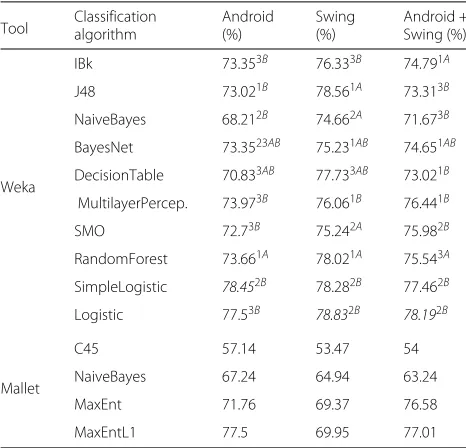
Table 8 presents, by tool (Weka and Mallet), the classi-fication algorithms and their respective evaluation results (overall accuracy) on the three training sets. The highest accuracy obtained for each training set is highlighted in bold. For presentation reasons, we do not present all accu-racies obtained by Weka algorithms with the six different settings. Only the highest accuracy of each algorithm on each training set is presented, flagged by the setting in which it was obtained (see Table 7 for the meaning of the flags).
For the Android training set, the best algorithm was SimpleLogistic with an overall accuracy of 78.45%, and for the Swing training set it was Logistic with 78.83%. The best accuracy for both Android and Swing together was 78.19%, obtained with the Logistic algorithm. Due to the
Table 8Evaluation of the classification algorithms: overall accuracies based on 10-fold cross-validation on the training sets of the Android and Swing
Tool Classificationalgorithm Android(%) Swing(%) Android +Swing (%)
Weka
IBk 73.353B 76.333B 74.791A
J48 73.021B 78.561A 73.313B
NaiveBayes 68.212B 74.662A 71.673B
BayesNet 73.3523AB 75.231AB 74.651AB
DecisionTable 70.833AB 77.733AB 73.021B
MultilayerPercep. 73.973B 76.061B 76.441B
SMO 72.73B 75.242A 75.982B
RandomForest 73.661A 78.021A 75.543A
SimpleLogistic 78.452B 78.282B 77.462B
Logistic 77.53B 78.832B 78.192B
Mallet
C45 57.14 53.47 54
NaiveBayes 67.24 64.94 63.24
MaxEnt 71.76 69.37 76.58
fact that there is no advantage gained using both training sets together, we chose to select the best algorithm for each API in order to classify its questions.
We also observed that some algorithms have similar per-formance, in terms of accuracy, with the SimpleLogistic algorithm for Android and with the Logistic algorithm for Swing. For example, for Android, the SimpleLogis-tic algorithm had an overall accuracy of 78.45% and the Logistic and MaxEntL1 algorithms had 77.5% of accu-racy. To check if the performance of these algorithms are significantly different, we used McNemar’s test [34, 35]. This test employs the z score equation, which uses the number of samples where one of the algorithms failed and the other succeeded, i.e., the performance discrepancies.
We calculated the z score for each API considering the algorithm with the highest accuracy and the algo-rithms with accuracy 1% lower than the highest rank-ing algorithm. When the z score value is equal to 0, the two algorithms are said to show similar perfor-mance, and when the z score diverges from 0 in positive direction, this indicates that their performance differs significantly [35].
We concluded that, for Android, the performance of the SimpleLogistic algorithm differs significantly from the performance of the Logistic (z score = 0.38) and MaxEntL1 (z score = 0.23) algorithms, thus we chose to use SimpleLogistic to classify Android questions. For Swing, the performance of the Logistic algorithm differs significantly from the performance of the SimpleLogis-tic (z score = 0.2) and RandomForest (z score = 0.26) algorithms, but it is similar to the performance of the J48 algorithm (z score = 0). It means that we could choose any of the two algorithms (Logistic or J48) to clas-sify Swing questions, and so we opted for the Logistic algorithm.
In addition, Tables 9 and 10 present the performance of the selected algorithms (SimpleLogistic and Logistic, respectively) for the APIs (Android and Swing, respec-tively) by class. Noted here through an analysis of the f-measure is that for both APIs, the selected algorithm performs better at classifyingdebug-correctivequestions but shows an inferior performance when classifyingothers questions.
Linking Stack Overflow threads with API elements The coverage analysis of API elements by the crowd on Stack Overflow requires the creation of links between Stack Overflow threads and API elements. Our linking approach style relies on three works [8, 12, 13]: from a list of elements of a given API, the names of these elements are searched for within content of given threads (related to the API), and when a match is found, a link is created between the thread and the API element. At the end of the
Table 9Performance of the SimpleLogistic algorithm for Android by class
Class Precision Recall F-measure
How-to-do-it 0.824 0.821 0.822
Debug-corrective 0.804 0.864 0.833
Others 0.733 0.625 0.675
process, each API element has a list of threads where its name is mentioned.
The search for API elements is performed by their short names, i.e., their names without their respective package names. The short name of a top-level element is its non-qualified name, i.e., the single name of the element. For instance, the short name of the element javax.swing.JFrameisJFrame. The short name of an inner element, on the other hand, is its non-qualified name preceded by the non-qualified name of its top-level element plus a dot. For instance, the short name of the
ele-ment javax.swing.JFrame.AccessibleJFrame
isJFrame.AccessibleJFrame.
In the remainder of this section, we present the link types considered for linking threads with API elements, the preprocessing of threads, the identification of API ele-ments in Stack Overflow posts strategy, and finally, the evaluation of the linking approach.
Link types
There are different types of textual content on Stack Over-flow posts in which the name of API elements can be mentioned [8, 12, 13], calledlink types. We adopted the four link types from Parnin et al. [8], with some minor modifications on how the name of API elements may match in the content of some link types. The link types are described as follows:
Code sample link: A match for an API element name occurring in the text inside<code></code>tags;
Code markup link: A match for an API element name partially enclosed by<code></code>tags;
Href markup link: A match for an API element name occurring in the text inside<a></a>tags;
Word link: A match for an API element name occurring in the text outside of <code></code> and <a></a> tags.
Table 10Performance of the Logistic algorithm for Swing by class
Class Precision Recall F-measure
How-to-do-it 0.788 0.795 0.791
Debug-corrective 0.832 0.885 0.858
Threads preprocessing
Before performing the linkage of threads with API ele-ments, we preprocessed the content of threads. This pre-processing consists of separating the content of each post of threads (question and answer) according to the link types. We used Jericho HTML Parser [36] to perform this task.
Given a post, for code sample and code markup links, we first collect all<code>elements existing in the post. Then, we verify if there exists white-space between strings in the content of each <code>element. In those cases where it does not occur, we consider the content of the <code>element as code markup. Otherwise, that content is separated for code sample link.
For href markup link, we just collect all<a>elements existing in the post. For word link, we removed the con-tent of <code> and <a> elements from a copy of the whole post body.
We also removed comments and natural language texts contained in the code samples (content separated for code sample link). We used the regular expressions numbers 1 and 2 presented in Table 11 for finding comments and texts.
Identification of API elements in Stack Overflow posts
For creating links between Stack Overflow threads and API elements, it is necessary to identify mentions of the API elements in the (preprocessed) content of thread posts. So, for each thread, the mention of API element short names (names without package names) are searched for within the content of its posts by regular expressions (regex) based onword boundary matching.
A word boundary can be defined as a position where a word character (normally letter or digit) is followed or preceded by a non-word character (such as white-space). For instance, the regex (search) matches the “search” word, but also matches the “research” and “searcher” words. For finding only exact matches for the “search” word, word boundaries must be used in the regex, which are specified by \b((\bsearch\b)).
We used word boundaries for finding matches of API element short names in Stack Overflow posts to ensure that these names occur at the beginning and the end of a sequence of characters. We used the regex number 3 presented in Table 11 for performing this task.
Moreover, there are three situations where threads can be mistakenly linked with API elements. These situations, and how we handled these to avoid false positives, are presented as follows.
First, since we search for API elements by their short names, we could acquire false positives by linking threads with API elements that share the same short name. For
Table 11Regular expressions used in the process of linking Stack Overflow threads with API elements
1) ((?s)(/.*?/))|(//.*)
Regex for matching comments inside “/* */” or preceded by “//”
2) ((?s)(¨.*?¨))
Regex for matching natural language text inside “”
3) (\bElementShortName\b)
Regex for API element short name boundary matching. For example: theregex (\bJCheckBox\b)matchesJCheckBoxbut does not matchJCheckBoxMenuItem
4) (\bElementShortName\b)(?!.PartialShortNames)
Regex for API element short name boundary
matching with negative look-ahead. For example: the regex
(\bDefaultTableCellRenderer\b)(?!.UIResource)
matchesDefaultTableCellRendererbut does not match
DefaultTableCellRenderer.UIResource
5) (?<!PartialShortNames.)(\bElementShortName\b)
Regex for API element short name boundary matching with negative look-behind. For example: the regex(?<!ScrollPaneLayout.
|BasicComboBoxEditor.) (\bUIResource\b)
matchesUIResourcebut does not match neither
ScrollPaneLayout.UIResourcenor
BasicComboBoxEditor.UIResource
6) (\b([A-Z_]+[a-z_0-9]+)2,\b)| (\b([A-Z_])2, [a-z_0-9]+\b)| ([
¯A-Z_]+[a-z_0-9]+[A-Z_]+\b)
Regex for matching multi-word API element short name
(camel case). For example: the regex matchesSwingUtilities,
JFrame,HTMLDocumentandTextUI, but does not match
ViewandHTML
such elements, we check if their package names appear in the threads where their short names matched. If the pack-age name of an API element is found, the thread is linked with that API element. Otherwise, i.e., if no package of those API elements is found, the thread is not linked with any of those API elements.
Second, the existence of inner elements in the API raises a problem of matching API elements using word boundaries, as the dot character is considered a non-word character. This problem occurs in two forms. Form A: the name of outer elements also matches the name of their inner elements. For example, at searching the DefaultTableCellRenderer element name by using the regex number 3, the
DefaultTableCellRenderer.UIResource name
will also be a match. Form B: the name of (inner or non-inner) elements can also match with the name of inner elements. For example, when searching theUIResource element name, theScrollPaneLayout.UIResource
and BasicComboBoxEditor.UIResource element
names will also be matches.
that the pattern of interest is not immediately fol-lowed or preceded by another pattern, respectively. In our case, regarding theDefaultTableCellRenderer element name, we used negative look-ahead (regex number 4 in Table 11) for ensuring that the name is not followed by .UIResource. In a similar way, we used negative look-behind (regex number 5 in Table 11) in order to ensure that the UIResource name is not preceded by ScrollPaneLayout. and
BasicComboBoxEditor..
Third, one-word API element short names, likeView, can be confused with English words in natural language texts. To avoid false positives regarding this issue, we only search for multi-word API element short names in the content of word and href markup links. The regex 6 was used to check if an API element short name consists of a multi-word name.
Linking approach evaluation
We evaluated the implementation of our linking algorithm for Stack Overflow threads with API elements to obtain an indicator on how reliable it is. We randomly selected 50 threads, 25 related to each API.
First, we manually analyzed each thread and identified the API elements that are mentioned on it. We found 129 Swing and 134 Android element occurrences in these 50 threads by the manual analysis, totaling 263 API elements occurrences. Second, we executed the linking algorithm on these threads.
Then, for each thread, we verified if the API ele-ments linked with respective threads are the same API elements identified manually. The overall precision was 99.20% and recall was 94.68%. We observed that our linking algorithm is not able to identify occurrences of API elements when an API element is not men-tioned exactly by its short name. For instance, in the thread containing the question 9785173, the Android element android.widget.BaseAdapterwas men-tioned as “Base Adapter”. This type of occurrence of API element is missed by the linking approach, and consequently the thread is not linked with the API element.
Analysis of actual semantic links
One characteristic of our linking approach used for cov-erage analysis is that we do not deepen on the type of occurrenceof an API element in a Stack Overflow post. Our coverage results (which are presented in the “Results and discussion” section) are based on the analysis of any type of occurrence of API elements in the content of threads. In other words, those threads may be poten-tiallyuseful to document those API elements based on their nature:how-to-do-it or debug-corrective. However,
the occurrence of an API element in the content of a thread does not necessarily mean that such discussion, or part of it, is in fact useful for documenting that ele-ment. There would be different types of API element occurrences that would require a semantic analysis of the post content to define the respective type of API element occurrences.
Due to the fact that our linking approach does not work at a semantic level, we cannot assure with certainty the exact number of API elements that are actually semanti-cally covered for either how-to-do-it or debug-corrective posts. Nonetheless, in this section we perform a manual and qualitative study in order to understand a possible decrease in our coverage results when the semantics of Stack Overflow posts is taken into account.
The challenge of discovering if the content (or part of it) of an informal documentation, as Stack Overflow posts, is pertinent to API elements was addressed in the works of Rigby and Robillard [37] and Petrosyan et al. [38]. Rigby and Robillard proposed a classification-based solution to detect which code elements in a document are salient to the topic of the Stack Overflow post—“a code element is salient, if it is central to an example code fragment or if there is some discussion defining its function or describ-ing its use” [37]. Petrosyan et al. [38], on the other hand, proposed a classification-based solution to discover tuto-rial sections that explain a given API type (classes and interfaces), i.e., relevant tutorial sections to API types. They considered that a tutorial section is relevant to an API type if it would help a reader unfamiliar with the cor-responding API to decide when or how to use the API type to complete a programming task.
In the context of our work, however, the concepts of salient code element [37] and relevant tutorial sections to API types[38] are not exactly adequate. By these def-initions, even if an API element mentioned in a Stack Overflow post is not salient, or even if a tutorial section (a thread, in our case) is not relevant to an API element, it does not mean that there is no useful content there for documenting the element.
In this sense, we define what is relevant for docu-menting: a thread is relevant for documenting an API element if it contains any relevant content for a spe-cific type of documentationof that API element. Since we are interested in two types of documentation, i.e., doc-umentation containinghow-to-do-itanddebug-corrective content, and the nature of threads containing these two types of discussions are different, we defined that a thread is relevant for documenting an API element as follows:
demonstrating the use of the element, even when it is not the central point of the thread;
• a thread ofdebug-corrective nature, or a part of it, is considered relevant for documenting an API element if the element is part of the central point of the bug reported by the asker (where the asker thought that the bug had occurred) or the central point of the bug fixing (where the bug actually occurred).
Then, to quantify a potential decrease in our cover-age results when the semantics of Stack Overflow posts is taken into account, we manually analyzed a sample of threads to investigate in how many cases there exists con-tent for documenting API elements in how-to-do-it and debug-correctivediscussions. We randomly selected 200 threads for each API, where 100 were classified as how-to-do-it and the other 100 asdebug-corrective, totaling 400 threads.
Each of those 100 threads were not sampled completely randomly—we noted the need of selecting threads that mention API elements of different ways, so we decided to perform a stratified random sampling based on previous data analysis. First, we decided to select 30% out of those 100 threads to compose group 1 of samples:
Group 1: threads that are unique for API elements, i.e., threads that mention API elements covered only by one thread.
It is important that threads contained in group 1 to be part of our sample as we need to be sure that we also assess if that only one thread citing a given API element is relevant for its documentation. Second, we decided sampling the remaining 70% of threads by the amount of API elements that they cover, composing groups 2 and 3:
Group 2: threads that cover only one element of the API under analysis.
Group 3: threads that cover multiple elements of the API under analysis.
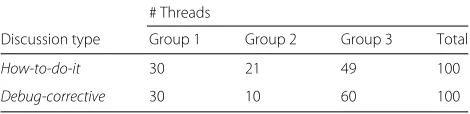
Threads that cover only one element of the API under analysis do not necessarily concern that API. For instance, a thread that covers only one Android element can be, actually, about another API. Therefore, we selected these threads to investigate how many of these were tagged as being on Android and Swing but are actually not on those APIs. As we noted, from Table 23, there are a small percentage of threads that cover only one ele-ment of the API under analysis. Based on the Table, for how-to-do-itanddebug-correctivethreads, we decided to select 70 and 85% of them, respectively, as threads that cover multiple API elements. Table 12 presents a sum-mary of the numbers of threads and Table 13 presents a summary of the numbers of occurrences of API ele-ments (in those threads) contained in the groups of samples.
The samples were manually and independently ana-lyzed by two of the four authors to obtain more reli-able results. At the end of the analysis process, we cal-culate the Kappa statistic [30] for assessing the agree-ment between the two manual analyses. The observed agreement and the Kappa value for each type of dis-cussion are presented in Table 14. The strength of the agreements based on the Kappa value is considered substantial for debug-corrective and slight for how-to-do-it [30]. The observed agreement, however, for both debug-corrective(91.32%) andhow-to-do-it(88.73%), were high.
The same two authors analyzed only the disagreements to reach a consensus on the correct answer for each occur-rence of API element in the threads, i.e., if a given thread contains any relevant content for a type of documentation of a given API element or not. In this analysis, we observed that the task of finding relevant content for documenting specific API elements is not trivial: sometimes it can be subjective. For example, we found a reason for why the strength of the agreements concerninghow-to-do-it was slight: one of the authors did not consider XML code as an example code fragment in an answer that demonstrates the use of an API element. As an example, the thread con-taining the question #15751365, entitled “android how to code dialog layout”, contains an answer that demonstrates the use of the android.widget.RelativeLayout element in an XML code, but one author marked that thread as not being relevant for documenting that ele-ment. In the discussion of the disagreements, the two authors decided to consider XML code as an example of code fragment. Concerning debug-corrective related threads, the two authors also have some difficulties to reach a consensus. One of those cases was to understand which are the actual API elements that the asker thinks that the bug/problem is. For instance, in the analysis of the thread containing the question #7549887, enti-tled “Can’t figure out how to overlap images in java”, one author marked that javax.swing.JPanel ele-ment was involved in the problem reported by the asker, and the other author marked javax.swing.JFrame element. In the disagreement analysis, the authors agreed that both elements were involved.
After the agreement analysis, we obtained the final results of the manual analysis with the correct answers.
Table 12Summary of the numbers of threads contained in the groups of samples, for each APIs, for both types of discussion
# Threads
Discussion type Group 1 Group 2 Group 3 Total
How-to-do-it 30 21 49 100
Table 13Summary of the numbers of occurrences of API elements contained in the groups of samples, for both APIs and both types of discussion
# Occurrences analyzed
API Discussion type Group 1 Group 2 Group 3 Total
Swing how-to-do-it 36 21 244 301
debug-corrective 30 10 353 393
Android how-to-do-it 33 21 204 258
debug-corrective 32 10 452 494
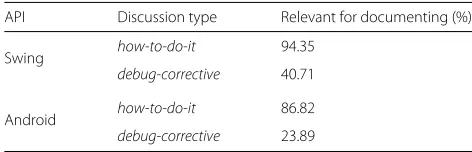
Table 15 presents the results regarding the proportion of occurrence of API element that the analyzed threads are relevant for documenting such. For both APIs, there exists relevant how-to-do-it content for documenting a high number of occurrence of API elements—the total percentages of occurrences that threads are actually rel-evant for are 94.35% for Swing and 86.82% for Android. Debug-correctivecontent, on the other hand, is not rele-vant for documenting a high number of occurrence of API elements—there exists relevant debug-correctivecontent for only 40.71 and 23.89% of the occurrences of Swing and Android elements, respectively.
However, concerning coverage of API elements, those proportions are not exactly adequate to quantify how much coverage can potentially be decreased from our cov-erage based on our non-semantic linking approach. Those proportions are based on the occurrences of API ele-ments, which means that a given API element can occur in more than one thread. So, even if a given thread were not considered relevant for documenting that element, it does not mean that there is no other thread relevant for such element.
To perform that quantification, for each API element mentioned in the threads of our sample, we searched for at least one occurrence in a thread that was considered relevant for documenting it. Then, we calculated the per-centage of API elements that we found relevant content for documenting them. Table 16 presents the numbers of API elements contained in the sample and the overall percentage of API elements actually contained in relevant content.
Based on the sample estimate results, we can note that the percentages of API elements mentioned in how-do-to-it related threads and that are actually contained in relevant content for their documentation are high—there exists content in the sampled threads for almost 90%
Table 14Kappa statistic on the manual analysis
Observed agreement (%) Kappa Strength
How-to-do-it 88.73 0.119 Slight
Debug-corrective 91.32 0.796 Substantial
Table 15Proportion of occurrence of API element which threads are relevant for documenting such, for both APIs and both types of discussion
API Discussion type Relevant for documenting (%)
Swing how-to-do-it 94.35
debug-corrective 40.71
Android how-to-do-it 86.82
debug-corrective 23.89
of the Swing and Android elements. Regarding debug-correctivecontent, on the other hand, the decrease from the amount of API elements mentioned in the threads to the amount of API elements contained in relevant content of such threads is higher—there exists content in the sampled threads for only 50% of the Swing ele-ments and for only 43.3% of the Android eleele-ments. Although these numbers show that there is a higher decrease on the coverage fordebug-corrective documen-tation than for how-to-do-it, the numbers should not be used absolutely to infer the increase in the nomi-nal coverage results we will show for RQ #1 and RQ #2, as the decrease tends to be lower as we enlarge the sample.
Methods
Our main goal is to analyze Stack Overflow discussions for the purpose of understanding how the crowd can con-tribute to document APIs, with respect to coverage of API elements in threads forhow-to-do-itanddebug-corrective tasks. To achieve our goal, we formulated five research questions:
RQ #1. To what extent does Stack Overflow cover API elements of Swing and Android APIs with threads containing how-to-do-it question? This research ques-tion aims at providing an indicator on how well API elements are covered by threads that can be potentially useful to document these elements regardinghow-to-do-it tasks.
RQ #2.To what extent does Stack Overflow cover API elements of Swing and Android APIs with threads con-tainingdebug-correctivequestion? This research question
Table 16Results on API elements actually contained in relevant content of the sampled threads, for both APIs and both types of discussion
API Discussion type # Elements Relevant for documenting (%)
Swing how-to-do-it 115 89.57
debug-corrective 118 50
Android how-to-do-it 144 89.58
aims at the same as RQ #1, but regardingdebug-corrective tasks.
RQ #3.How often do threads cover multiple API ele-ments? This research question aims at providing an indi-cator on how many threads are dedicated for only one spe-cific API element, and how many threads cover multiple API elements. Moreover, it aims at providing indicators on API elements that are frequently mentioned together. This analysis can provide insights on API elements that must be documented together.
RQ #4.How does Stack Overflow cover API elements over time? This research question aims at investigating the growth of coverage of API elements compared to the growth of threads related to the API over time. This analy-sis can provide an indicator of the maximum coverage that the crowd can reach for an API whether Stack Overflow reaches saturation when covering API elements.
RQ #5. Is there an association between coverage of API elements onhow-to-do-it anddebug-corrective dis-cussions by the crowd and actual usage of these elements in software systems? This research question aims at veri-fying whether API elements covered by a high number of threads are used in a high number of projects, and API ele-ments covered by a low number of threads, or not covered, are used in a low number of projects, or not used at all. This analysis can provide an explanation for API elements that are not discussed by the crowd.
Data collection
The necessary data for answering the research questions are (1) the Stack Overflow threads on Swing and Android, (2) a list of classes, interfaces and enumerations existing in Swing and Android, and (3) usage references of Swing and Android elements in source code of real software projects.
1) We downloaded the Stack Overflow threads from the Stack Exchange Data Dump [39], release of January 2014 of the Stack Overflow public data dump, and we imported these into a relational database to facilitate queries. Spe-cific threads for Swing and Android were selected in the same way as shown in one of the previous sections, i.e., by searching for threads where their questions have a tag containing the name of the API (“android” or “swing”).
2) We obtained the lists of Swing and Android inter-mediate elements from javadoc jar files. For Swing, we obtained the jar file from the Java official documentation [40], containing 923 Swing intermediate elements: 823 classes, 90 interfaces and 10 enumerations, distributed in 18 packages. For Android, we obtained the jar file from The Central Repository [41], containing 1678 Android intermediate elements: 1259 classes, 361 interfaces and 58 enumerations, distributed in 66 packages. It is worth mentioning that these numbers of API elements include
top-level and inner elements. A top-level element is a direct member of a package, while an inner element is defined as a member inside another element. Since inner elements are public, they are also part of the API of a library or framework, so we consider them in the cover-age analysis. Also, we selected only elements in packcover-ages that begin with “javax.swing” and “android”, for Swing and Android, respectively, although thosejar files contained other utilities.
3) We obtained the usage of Swing and Android ele-ments from the Boa infrastructure [42], which pro-vides the metadata for almost 8,000,000 GitHub projects. Projects identified as Java projects also include repository history and source code. The source code of a Java file is stored as abstract syntax tree (AST). Boa provides a syntax inspired by the object-oriented visitor pattern to analyze projects and their ASTs using depth-first search traver-sal strategy. In a visit function, visit clauses are defined to visit AST node types, and when the visitor visits any node matching the specified node type, the body of the clause is executed.
We coded a visit function for collecting Swing and Android usage, which traverses the ASTs of full develop-ment histories of Java projects. The types of AST node of interest are Project, ASTRoot and Type ones. We col-lected the name of the projects in a visit clause defined for Project node. API usage information is obtained in the visit clauses defined for the ASTRoot and Type nodes. In ASTRoot nodes, we searched imports (generic or not) of the APIs. In Type nodes, we searched (i) fully-qualified name of types (classes, interfaces and enumerations) used in statements and (ii) any other types used in statements of an AST where an import of the API was found. For find-ing imports and fully qualified name of types, we check if their names start with “javax.swing” and “android”, for Swing and Android, respectively. We post processed the non-qualified types found in ASTs where an import of the API was also found. We check whether these types belong to any package found as a generic import in the same AST. Types not found in any these packages are discarded.
Thread selection based on question types
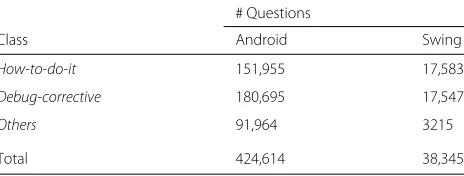
(Android files for SimpleLogistic and Swing files for Logis-tic). Table 17 presents the number of questions for each API by class according to the produced classification.
Noted here is that the difference of proportions between Swing and Android in the distribution of the classified questions in the classes is mainly caused by the fact that a larger fraction of questions from Android API was clas-sified as others. Moreover, we note that there are more questions classified asdebug-correctivethanhow-to-do-it for Android. Differently, the proportions of questions clas-sified asdebug-correctiveandhow-to-do-itare pretty close for Swing.
It is worth mentioning that the thread selection based on question types for coverage analysis consider those questions classified and presented in Table 17, along with those in the training sets. For example, for Android cover-age analysis that only considers threads withhow-to-do-it questions, the input threads for coverage analysis consist of 151,843 (see Table 17) plus 112 (see Table 4), total-ing 151,955 threads. Table 18 presents the total number of questions by class, which were selected for coverage analysis.
API coverage analysis
For coverage analysis, we propose some filters on the Stack Overflow threads. First, threads are filtered on their respective type of analysis (how-to-do-it or debug-corrective). Moreover, for how-to-do-it questions, we defined that for an API element to be considered as covered, it should necessarily be mentioned at least once in a code sampleof an answer of a thread. We defined these two filters based on the nature of thehow-to-do-it question type, in which the questioner provides a sce-nario and asks about how to implement it. For the specific documentation purpose of explaining how to use API ele-ments, we argue that API elements should necessarily be mentioned incode samples ofanswersto be considered covered as follows. If an API element is mentioned in the question but is not mentioned in an example (code sam-ples) in the answer, the element is not part of the solution of the scenario provided. Then, that thread seems to have little relevance forhow-to-do-itdocumentation [5], so the API element should not be considered covered by the thread.
Table 17Distribution of the classified questions in the classes
# Questions
Class Android Swing
How-to-do-it 151,843 (35.79%) 17,426 (45.87%)
Debug-corrective 180,577 (42.56%) 17,391 (45.78%)
Others 91,879 (21.65%) 3169 (8.34%)
Total 424,299 37,986
Table 18Distribution of all questions in the classes
# Questions
Class Android Swing
How-to-do-it 151,955 17,583
Debug-corrective 180,695 17,547
Others 91,964 3215
Total 424,614 38,345
Figure 3 provides an overview of the coverage analy-sis process. The input is a list of Stack Overflow threads and a list of API elements. After the filters are applied on threads, we linked the threads with the API elements by using the approach detailed in the “Linking Stack Overflow threads with API elements” section.
Observe that there are three entries for coverage anal-ysis regarding Stack Overflow threads. The dotted flow indicates the preprocessing of the threads for coverage analysis onhow-to-do-itquestions, i.e., thethread filterto select threads withhow-to-do-itquestion, thepost filterto discard the questions from the threads, and thecontent fil-terto select the code samples of the answers. The dashed flow indicates the preprocessing of the threads for cover-age analysis ondebug-correctivequestions, i.e., thethread filter to select threads with debug-corrective questions. Finally, the dashed and dotted flow illustrates Parnin et al.’s coverage analysis approach [8], where no preprocessing on threads is performed.
Results and discussion
In this section, we present the results for the posed research questions.
How-to-do-itcoverage of API elements
To answer RQ #1, we performed coverage analysis on the threads containing questions classified as how-to-do-it: 17,583 threads related to Swing and 151,995 threads related to Android. Only code samples in answers of these threads were analyzed. Table 19 presents the coverage results. Noteworthy here is that almost half of the threads of both APIs was linked with some API element: 47.77% of the Swing threads and 46.28% of the Android threads.
Fig. 3Overview of the coverage analysis process
further support or that it is barely used by developers in general.
Moreover, we observed that among all the Swing classes, 43.38% are inner classes. Only 14.29% of these are cov-ered, and 62.83% of the uncovered classes are inner ones. Considering only top (non-inner) classes, the coverage is 20% higher (61.16%). Although there are less interfaces and enumerations than classes, the coverage for inner ele-ments of those eleele-ments is also low. Only 25% of the inner interfaces are covered, and 60% of the uncovered inter-faces are inner. For enumerations, the three uncovered ones are inner enumerations.
For Android, we observed that there is at least one answer containing code sample to a how-to-do-it ques-tion for 71.17% of the classes, 64.27% of the interfaces, and 58.62% of the enumerations, totaling 69.25% of the Android elements. These coverage values indicate that classes are better covered than interfaces and enumera-tions in Android.
Regarding the inner elements, among all the Android classes, 27.96% are inner classes and 58.52% are covered. Moreover, 40.22% of the uncovered classes are inner ones. Considering only top classes for Android, we observed that the coverage is higher (76.07%), but it is not much higher than the overall class coverage. In regards to interfaces, among all the Android interfaces, 74.52% are inner and 58.74% are covered. Moreover, 86.05% of the
uncovered interfaces are inner. For enumerations, all the uncovered ones are inner enumerations.
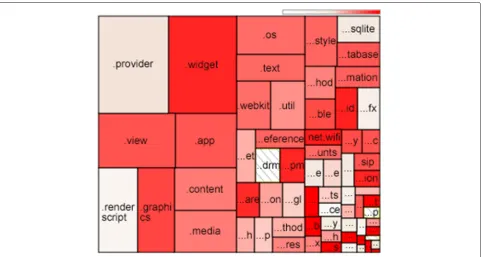
We also analyzed the coverage of elements intra-package. The results for Swing are pre-sented with different perspectives in Fig. 4 and Table 20, column “Coverage/How-to-do-it”. We observed that two packages (out of 18) are
com-pletely covered: javax.swing.filechooser
and javax.swing.text.rtf, which are also
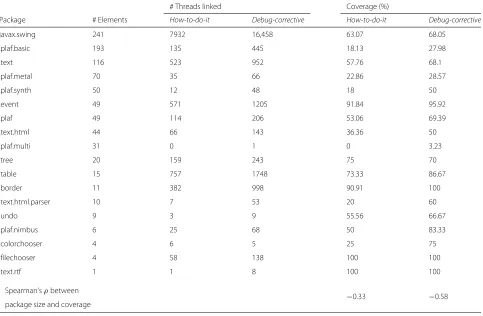
the smallest. Considering the two largest packages, javax.swing has an average coverage (63.07%), and javax.swing.plaf.basic is poorly covered (18.13%). Moreover, there is one package completely uncovered (javax.swing.plaf.multi), which is represented by the scratched rectangle.
To verify whether the size of package influences cov-erage, we calculated Spearman’s rank correlation coeffi-cient (ρ) between package size and coverage. Correlation coefficients measure the extent to which two variables tend to change together. In the case ofρ, a positive value indicates that coverage tends to increase when package size increases, and a negative value indicates that cover-age tends to decrease when packcover-age size increases. For the sizes and thehow-to-do-itcoverage of the Swing packages, we foundρ = −0.33, which means a weak negative cor-relation, i.e., the coverage tends to decrease when package size increases.
Table 19Coverage results on Swing- and Android-related threads containinghow-to-do-itquestion type
API # Threads # Threads Coverage considering all elements Coverage considering only non-inner elements analyzed linked Classes Interfaces Enums Total Classes Interfaces Enums Total
Swing 17,583 8400 40.83% 83.33% 70% 45.29% 61.16% 92.31% 100% 65.75%
336 75 7 418 285 72 2 359
Android 151,955 70,325 71.17% 64.27% 58.62% 69.25% 76.07% 80.43% 100% 76.52%
Fig. 4Swing intra-package coverage forhow-to-do-ittasks considering the three API element types. The color scale represents percentage values of coverage of the elements—whiterepresents the lowest value>0% andredrepresents 100%.Scratched rectanglerepresents 0%. Thesizeof each rectangle is proportional to the number of existing elements in the package
Table 20Swing intra-package coverage considering the three API element types
# Threads linked Coverage (%)
Package # Elements How-to-do-it Debug-corrective How-to-do-it Debug-corrective
javax.swing 241 7932 16,458 63.07 68.05
.plaf.basic 193 135 445 18.13 27.98
.text 116 523 952 57.76 68.1
.plaf.metal 70 35 66 22.86 28.57
.plaf.synth 50 12 48 18 50
.event 49 571 1205 91.84 95.92
.plaf 49 114 206 53.06 69.39
.text.html 44 66 143 36.36 50
.plaf.multi 31 0 1 0 3.23
.tree 20 159 243 75 70
.table 15 757 1748 73.33 86.67
.border 11 382 998 90.91 100
.text.html.parser 10 7 53 20 60
.undo 9 3 9 55.56 66.67
.plaf.nimbus 6 25 68 50 83.33
.colorchooser 4 6 5 25 75
.filechooser 4 58 138 100 100
.text.rtf 1 1 8 100 100
Spearman’sρbetween
−0.33 −0.58