A non‑parametric maximum for number
of selected features: objective optima for FDR
and significance threshold with application
to ordinal survey analysis
Amir Hassan Ghaseminejad Tafreshi
1,2,3*Introduction
High-dimensionality is one of the attributes of big data in many fields. As stated by Dutheil and Hobolth [7], the shift from genetics to genomics brings to new challenges in data analysis. For example, when tests are performed, the global false discovery rate (FDR) has to be properly controlled for (p. 310). According to Kim and Halabi [12], a vital step in model building is dimension reduction. For example, in clinical studies, it is assumed that there are several variables that are associated with the outcome in the large dimensional data. The main purpose of the variable selection is to identify only
Abstract
This paper identifies a criterion for choosing an optimum set of selected features, or rejected null hypotheses, in high-dimensional data analysis. The method is designed for dimension reduction with multiple hypothesis testing used in filtering process of big data, and in exploratory research, to identify significant associations among many predictor variables and few outcomes. The novelty of the proposed method is that the selected p-value threshold will be insensitive to dependency within features, and between features and outcome. The method neither requires predetermined thresh-olds for level of significance, nor uses presumed threshthresh-olds for false discovery rate. Using the presented method, the optimum p-value for powerful yet parsimonious model is chosen, then for every set of rejected hypotheses, the researcher can also report traditional measures of statistical accuracy such as the expected number of false positives, and false discovery rate. The upper limit for number of rejected hypotheses (or selected features) is determined by finding the maximum difference between expected true hypotheses and expected false hypotheses among all possible sets of rejected hypotheses. Then, many methods of choosing an optimum number of selected features such as piecewise regression are used to form a parsimonious model. The paper reports the results of implementation of proposed methods in a novel example of non-parametric analysis of high-dimensional ordinal survey data.
Keywords: High-dimensional data analysis, Dimension reduction, Feature selection, Multiple hypothesis testing, False discovery rate, Optimum significance threshold, Maximum for reasonable number of rejected hypotheses, Big data analysis
Open Access
© The Author(s) 2018. This article is distributed under the terms of the Creative Commons Attribution 4.0 International License (http://creat iveco mmons .org/licen ses/by/4.0/), which permits unrestricted use, distribution, and reproduction in any medium, provided you give appropriate credit to the original author(s) and the source, provide a link to the Creative Commons license, and indicate if changes were made.
METHODOLOGY
*Correspondence: [email protected]
3 School of Business, Capilano
University, 2055 Purcell Way, North Vancouver, BC V7J 3H5, Canada
those variables which are related to the response. They have identified two steps in vari-able selection: screening and model building. The screening step is to reduce the number of variables while maintaining most of the variables relevant to the response, and the model building step is to develop a best model (p. 1).
Fan et al. [8] argue that the complexity of big data often makes dimension reduction techniques necessary before conducting statistical inference. Principal component anal-ysis (PCA), the goal of which is to find a lower dimensional subspace that captures most of the variation in the dataset, has become an essential tool for multivariate data analy-sis and unsupervised dimension reduction (p. 1). But Kim et al. [13] have argued that although PCA and partial least squares (PLS) methods have been widely used for feature selection in nuclear magnetic resonance (NMR) spectra, extracting meaningful features from the reduced dimensions obtained through PCA or PLS is complicated because, in both PCA and PLS, reduced dimensions are linear combinations of a large number of the original features. The authors show that successful implementation of feature selec-tion, based on their proposed multiple testing procedure of controlling FDR, is an effi-cient method for feature selection in NMR spectra that improves classification ability and simplifies the entire modeling process; thus, reduces computational and analytical efforts (p. 1).
Miao and Niu [14] define feature selection, as a dimensionality reduction technique which aims to “choosing a small subset of the relevant features from the original features by removing irrelevant, redundant or noisy features.” They also point out that, consider-ing the increase in both number of samples and dimensionality of data used in many machine learning applications such as text mining, computer vision and biomedical, fea-ture selection can lead to better learning performance, higher learning accuracy, lower computational cost, and better model interpretability (p. 919). According to Bolón-Canedo et al. [6], due to the appearance of datasets containing hundreds of thousands of variables, feature selection has been one of the high activity research areas (p. ix). For example, contemporary biological technologies produce extremely high-dimensional data sets with limited samples which demands feature selection in classifier design [10]. Fiori et al. [9] consider feature selection as one of the popular and recent data mining techniques applied to microarray data (p. 29).
Shmueli et al. [20] define a predictor is a variable, used as an input into a predictive model, also called a feature, input variable, independent variable, or from a database per-spective, a field (p. 10). The general research question is how many predictors, should be included in the model being constructed.
In high-dimensional data analysis, multiple simultaneous hypothesis testing arises because we need to identify which null hypotheses, among many, should be reasonably rejected [15]. A significant finding (discovery) is a hypothesis that is rejected based on statistical evidence. Rejecting a null hypothesis, about the relevance of a predictor to an outcome, is in fact selecting the predictor as a feature that will be included in the model.
positives at this p-value threshold. E-values are not very meaningful when millions of positives are obtained, and a relatively larger number of false positives might be toler-ated. FDR, however, is an appealing alternative approach (p. 2–3).
When performing multiple hypothesis testing, as the number of hypotheses being tested (m) gets bigger and bigger, using a p-value threshold (alpha), such as 0.05, for rejecting hypothesis based on p-values becomes problematic. p-value is a measure of the probability of a rejected hypothesis to be a false positive. When number of hypothesis being tested is big, for example 1000, the expected number of false positives is (m*alpha). If alpha is 0.05 this means that the expected number of false-positives among significant findings is less than or equal to 50.
It is anticipated that, when there are no expected true discoveries, the frequency dis-tribution of p-values to be uniform. Which means that the proportion of tests resulting a p-value in any class should be the same.
Iterson et al. [11] argue that thresholds for significance yielded by multiple testing methods decrease as the number of hypotheses tested increases (p. 2). The hypoth-eses with very low p-values are the hypothhypoth-eses that we might be inclined to declare as rejected null hypotheses, selected features, or significant discoveries; however, if we sim-ply choose hypotheses with (for example) p-value < 0.05, the expected number of false positives in this subset can be very high. In other words, many of rejected hypothesis may be true nulls. Therefore, we reduce our p-value threshold for rejection so fewer, but more significant, hypotheses are rejected. Reduction of alpha, decreases the chance of false positives in our discovery set and thus leads to a smaller chance of false discoveries. Unfortunately, this may increase the false negatives. By decreasing significance threshold (alpha), we are accepting to have more false negatives or in other words more hypoth-eses which should be rejected but are not.
By choosing a rejection threshold much lower than alpha, that is less than or equal to alpha/N, the probability of making one or more false discoveries will be less than or equal to alpha [22].
Dealing with N p-values, applying Bonferroni correction limits the false positive rate to less than or equal to alpha
If
Bonferroni corrected threshold ≤ ∝N is used
Then
Bonferroni correction guaranties a family-wise error rate (FWER) less than or equal to alpha; but this conservative measure can result in many false negatives. When the number of significant hypotheses is few, this measure is appropriate; because even expectation of one false positive in the result set is damaging. In many studies, where number of significant findings are many, the researcher may be able to afford a few more false-positives, if that will prevent many false negatives. Not detecting many important associations may be more harmful than probability of a few false-negative among many significant findings.
Benjamini and Hochberg [5] suggested that, instead of classical approach of using the FWER in the strong sense, we can control the FDR. FDR is defined as expected number of false discoveries (false positives among rejected hypotheses) divided by total number of rejected hypotheses [15]. They proved that their way of determining p-value threshold controls the FDR at a certain level when the p-values correspond-ing to true null hypotheses are independent and identically distributed with a uni-form distribution [23]. As emphasised by Storey and Tibshirani [22], the false positive rate and FDR are different. “Given a rule for calling features significant, the false posi-tive rate is the rate that truly null features are called significant. The FDR is the rate that significant features are truly null.”
In many situations, a p-value of 0.05 may lead to a big FDR. Several algorithms have been proposed to consider FDR in the process of selecting significant findings. Holms has proposed a sequential step-down algorithm which is shown to be “uniformly more powerful than Bonferroni’s simple procedure.” Also, Hochberg has suggested a step-up procedure which is very similar to Holm’s proposed method [1].
Iterson et al. [11] explain that statistical analysis of high dimensional data, occurs when the number of parameters is much larger than the number of samples. It often involves testing of multiple hypotheses in which p-values must be corrected. The larger the number of hypotheses tested, the stronger the correction for multi-ple testing must be in order to keep the error rate acceptably low. To decrease this penalty, and improve power, some studies select some features prior to the data anal-ysis. But this selecting procedure, called “filtering process” can leave some features out of the analysis. Also, inevitably some non-features may be selected by these fil-ters. In absence of proper filtering out of the entire range of p-values the result will be a biased multiple testing correction (p. 1). They conclude that: to avoid filtering-induced FDR-bias, Alternatives, for any generic filter and test, should adapt the mul-tiple testing correction methods that relax the assumption of uniform distribution for the null features in a way that filtering-induced bias is avoided (p. 10).
Many adaptive hypothesis testing procedures rely on estimates of the proportion of true null hypotheses in the initial pool using plugins, a single step, in multiple steps, or asymptotically [4]. Plug-in procedures use an estimate of the proportion of true null hypotheses [15]. Thresholding-based multiple testing procedures, reject hypoth-eses with p-values less than a threshold [15]. Storey and Tibshirani [22] have pro-posed a strategy that assigns each hypothesis an individual measure of significance in terms of expected FDR called q-value. Most q-value based strategies rely on some estimate of the proportion of true null hypotheses.
Norris and Kahn [16] have proposed balanced probability analysis (BPA) based on three variables: (i) the total number of true positives (TTP); (ii) the aggregate chance that any gene listed is truly not changing and is, thus, on the list by statistical accident (iii) the number of hypothesis that should truly be rejected but are missing from the sig-nificance list divided by the total number of hypothesis that should truly be rejected. They believe other definitions of type 2 error rates, such as the false non-discovery rate (the ratio of hypotheses that should truly be rejected but are not discovered to the num-ber of un-rejected hypothesis) are difficult to understand for those who are not expert statisticians. They calculate the FNR, by using resampling to estimate the null and alter-nate distributions, directly from the data. Their procedure a model-dependent step to optimize a single parameter.
As Norris and Kahn [16] have argued, the true FDR can be accurately determined only when the TTP is known. They used an adaptation of the algorithm by Storey and Tib-shirani [22] they estimate the TTPs. They estimated FDR and then they estimated FNR based on their estimates of FDR and TTP. In his dissertation, Benditkis [2] has shown that for some classes of step-down procedures the expected number of false rejections is controlled under martingale dependence. Benditkis et al. [3] have presented a rapid approach to the step up and step-down tests.
According to Park and Mori [18] the FDR method is perhaps the most popularly used multiple comparison procedures (MCP) in microarrays. Kim and Halabi [12] have pro-posed the use of FDR as a screening method to reduce the high dimension to a lower dimension as well as controlling the FDR with other variable selection methods such as least absolute shrinkage and selection operator (LASSO), and smoothly clipped absolute deviation (SCAD) (p. 1). In our example, which is in the context of high dimensional ordinal analysis of survey data, we will compare the results of our proposed method with FDR results.
One of the difficulties with targeting an FDR such as 0.05 is that when predictors, or features, are dependent to each other and to the outcome, the p-values of null hypoth-eses tested about their association with outcome will be similarly small. These p-values will inflate the FDR while their selection does not contribute to the number of differen-tiable constructs in the model. The method that will be proposed is insensitive to the number of highly correlated features that are selected. Thus, it can improve the feature selection power.
Methods
A non‑parametric maximum for reasonable number of rejected hypotheses or number of selected features
This article, is concerned about choosing an appropriate significance threshold after we have ordered the hypotheses based on their p-values without knowing or estimating the total number of true positives or total number of true negatives.
expected FDR. Although setting a subjective threshold for FDR (such as 0.05) can relax the extremely conservative suggestion by Bonferroni, it can be a limitation which may unnecessarily limit the number of reasonable findings a researcher should report. For some researchers, who accept an FDR of 5%; it might be also reasonable to accept and report a model that includes features in which the FDR is 6%, specially if this increase will add a group of items to selected features, or rejected nulls, that are mostly true discoveries.
In many situations, “it is reasonable to assume that larger p-values are more likely to correspond to true null hypotheses than smaller ones” [15], which means smaller p-val-ues are less likely to correspond to true null hypotheses (if rejected, they are more likely to be true discoveries). With no objective reason to accept 5% FDR and not 6% FDR, in some situations, grounded on observed data we can identify an objective upper bound for “level of significance and FDR” that is reasonable for the researcher to report, beyond which the resulting model is not parsimonious. To find such maximum, we tabulate the p-values resulted from hypotheses testing into sorted classes (from smallest to largest p-value). Then, we choose the smallest p-value; we count the number of hypotheses that have the same p-value and we put them in set 1. Then we choose the next small-est p-value; we count the number of hypotheses that have the same p-value and we put them in set 2. We continue to the biggest p-value. We will have the frequency of each observed p-value. But, we have a special interest in the set of smallest p-values; thus, the first class is the most valuable class for us. All the p-values with a value closest to zero (or zero if such hypotheses exist) are in set S1 in which will have f1 members (f1≥ 1).
The next smallest p-value will be p2. Set 2, will contain all the hypotheses with a value
of p2. S2 will have f2 members (f2≥ 1). For each one of k observed p-values there will be
corresponding frequency and a set of hypotheses.
In the equation above, fi is the frequency of hypotheses in set Si.
If we set the alpha (rejection threshold) at p1. We will have fa rejected hypotheses, of
which p1×N are expected to be false discoveries (EFD1).
Therefore, from the first set we expect to have:
ETD1 is expected true discoveries if we reject hypotheses with p-value less than or
equal to p1. We may be interested in including the set of f2 hypothesis S2 in our
dis-coveries, but the p-value of these hypotheses is p2 and the expected false discoveries in
rejected set S1 and S2 will be p2*N. R2 is the set total discoveries including all the features
selected so far.
Total number of hypotheses tested=N =
k
i=1
fi
EFD1=p1∗N
ETD1=f1−p1∗N
p2∗N is always bigger than p1∗N.p2∗N will be the cumulative expected false discov-eries (CEFD) in R2:
Therefore, from the first two sets we expect to have cumulative expected false discov-eries (CETD) in R2 as:
Therefore, cumulative expected true discoveries CETD2 from S1 and S2, will be
big-ger than ETD1. The series of cumulative expected false discoveries: CEFD1, CEFD2,
CEFD3, … is usually increasing because the p-values are getting bigger. And the series of
cumulative expected true discoveries is each set: CETD1, CETD2, CETD3, …. is usually
increasing in the first sets. But because p-values are increasing and by adding each set to rejected set we are in fact increasing our alpha, the proportion of false discoveries added by set Sj (j > i) to Rj is more than the contribution of false discoveries in set Si to Ri and
contribution of true discoveries in from Sj to Rj is more than the contribution of true
dis-coveries by Si to Ri. When i goes toward N (which means selecting all possible features),
pi goes toward 1 (which means selecting features that have no significance).
If we define delta:
The δ1 is always positive, and δN is always negative. At some point δi must start to
decrease and must have a maximum. The maximum number of rejected hypotheses hap-pens at set Smax after which adding the hypotheses in the next set Smax+1 (setting alpha at
pmax+1) will contribute more to false discoveries than to true discoveries.
Rmax is the largest set of rejected hypothesis that is reasonable to be reported. The larg-est alpha that is reasonable to be the threshold for rejecting hypotheses is Pmax. FDRmax
is the biggest reasonable FDR to be reported.
That is the point at which we have no incentive to add the set Smax+1 to our discover-ies. If we add set Smax+1 to our set of rejected hypotheses, the difference between CETD and CEFD (δ) will start to decline. δmax is an objective upper bound for the number of
CEFD2=p2∗N
CETD2 = (f1 + f2)−(p2∗N)
lim
i→Npi =1
lim
i→NCEFDi =ilim→NN∗pi =N
lim
i→NCETDi=i→Nlim(Ri−CEFDi)=0
δi = CETDi−CEFDi
Rmax=S1∪S2∪S3∪. . .∪Smax
FDRmax=
CEFDmax
m
1 fi
hypothesis we reject. If maximum δmax happens when we add Smax to set of rejected
hypotheses, we have decided that the threshold alpha for rejecting null hypotheses is pmax, we will reject hypothesis with p-value ≤ pmax.
With k observed p-values {p1≤p2≤p3≤ · · · ≤pk} related to sets of tested hypoth-eses {S1, S2, S3, …, Sk}, δmax happens when we add set Smax to our rejected hypotheses.
The number of rejected hypotheses, at significance level pmax , and the biggest reason-able set of rejected hypotheses Rmax will be:
Maximum ECTD can be calculated based on the following formula:
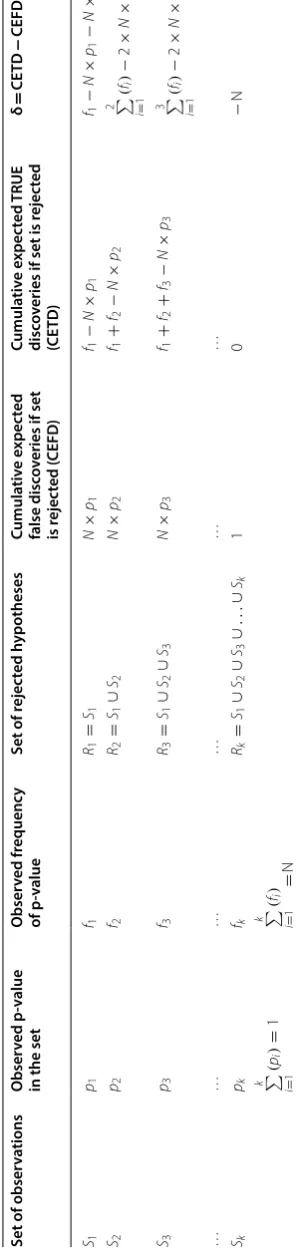
Table 1, summarizes what we discussed above. Notice that the upper limit for num-ber of rejected hypotheses is determined based on maximization of difference between cumulative expected true hypotheses and cumulative expected false hypotheses. The significance threshold is reported (not assumed) and is not subjectively selected. The sig-nificance threshold and resulting FDR are dictated by data. If the researcher decides to add more sets to discoveries, he/she is accepting the cost of adding more false discover-ies than true discoverdiscover-ies to the set of rejected hypotheses.
Objective optima for false discovery rate and significance threshold
Making the set of rejected hypotheses beyond Rmax may increase CETD, but it will increase the CEFD even more; it will decrease the quality of discovery measured as δ. At Rmax however, we may have a smooth decrease of δ. The value of “CETDi− CEFDi”
sometimes changes relatives slowly around Rmax . Then, we have a peak and a slow rever-sal in trend for δ. Thus, the researcher can use different ways of piecewise regression to identify an optimum number of rejected hypotheses much less than Rmax but much more than RFDR=0.05.
For example, piecewise regression of the p-values of hypotheses in sets S1 to Smax, and
number of observations in R1 to Rmax, with one breakpoint can model the observations
with two line-segments. The breakpoint, where the slope of the two lines changes, is were the efficiency of adding more hypotheses to R changes. It is an objective thresh-old at which rejected hypotheses are less than Rmax, while number of CETD is close to
true discoveries at Rmax, resulting in a better FDR with little loss of CETD. Therefore, the
number of rejected hypotheses at the break point, Rbp, is an optimal number of
hypoth-eses. It does not decrease the quality of our discovery, measured by δ, very much. A more computationally intensive piecewise regression of the p-values of hypotheses in sets S1 to Smax+ε can be conducted such that the second segment is a horizontal line
close to the point ( Rmax , pmax) . The horizontal line can also be the one that passes the
Rmax=
m
1
fi
δmax=Max(CETDi−CEFDi)
δmax=Max
k
i=1
fi−CEFDi
− k
i=1
CEFDi
Table
1
T
he f
orma
t of a table tha
t will b
e used t
o analyz e p -v alues and δ Set of obser va tions Obser ved p ‑v alue in the set Obser ved fr equenc y of p ‑v alue Set of r ejec ted h ypotheses Cumula tiv e e xpec ted false disc ov eries if set is r ejec ted ( CEFD ) Cumula tiv e expec ted TR UE disc ov
eries if set is r
point ( Rmax , pmax). In some situations, the resulting set of discoveries is not very sensi-tive to the selection of piecewise regression method.
Results and discussion
As an example, we will use the dataset resulted from multiple hypotheses testing that was performed analyzing a survey regarding variables that influence citizen engagement in mediated democracies. The example included 1045 ordinal Likert scale questions. The answers to a question were cross tabulated with all the other 1044 questions. The null hypothesis was that the observed association in each pairwise cross tabulation is accidental. To choose the significant associations, Fisher’s exact test was performed and the p-values for each test was recorded. Sommer’s D was used to measure the extent of association.
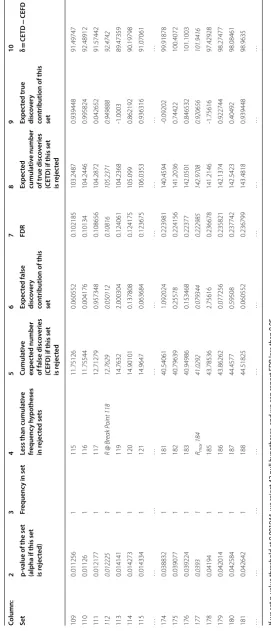
Table 2 shows the sorted p-values and associated δs. The first column is the set num-ber. The second column is an ascending sorted list of all p-vales observed. The third col-umn is the frequency of hypotheses with the p-value. The forth colcol-umn is the cumulative frequency. The fifth column is the cumulative expected number of false discoveries. If we decide that the set in a row is the last set of rejected hypotheses, the cumulative expected number of false discoveries is the resulting expected number of false positives. In other words, if the p-value of the set in a row is considered as the rejection thresh-old, the cumulative expected number of false discoveries in the fifth column of that row is the resulting expected number of false discoveries. For example, we observe that if we reject 111 hypotheses, sets S1 to S105, the expected number of false positives will be
11.4485 leading to an FDR of 0.10314. Chosen p-value threshold is 0.010966 and FDR will provide a measure of statistical accuracy for the choice we make for our rejection threshold.
The sixth column is the difference between rows in the fifth column, in other words it is the contribution of each row to expected number of false discoveries. Column seven is the FDR if we consider the p-value of the row as rejection threshold. Column eight is the expected cumulative number of true discoveries if this set is rejected; it is calculated by subtracting expected number of false discoveries from cumulative number of rejected hypotheses. Column nine is the difference between rows in column nine. The last col-umn is δ.
If we rely on 0.05 rule of thumb for rejection threshold, too many hypotheses will be falsely rejected. If we rely on 0.05 rule of thumb for FDR, many potentially significant findings, may falsely remain un-rejected. We have seven hypotheses with p-value of 0 in set S1 which will be obviously rejected. If we decide to reject the hypothesis in the second
set, at p-value = 0.000001, we will add 1 hypothesis to the set of rejected hypotheses. The single hypothesis that can be rejected contributes 0.998956 to the total expected true discoveries. Cumulative expected false discoveries will be 1044*0.000001 = 0.001044.
Rejecting the hypotheses in sets S1 and S2, we are in fact declaring the rejection
thresh-old is 0.000001, cumulative expected false discoveries will be 0.001044, FDR will be 0.000131 (0.001044/8).
Table 2 S or ted p -v alues and asso cia ted δ s
, Rmax
and br eak poin ts Column: 2 3 4 5 6 7 8 9 10 Set p‑ value of the set
(alpha if this set is rejec
ted) Fr equenc y in set Less than cumula tiv e fr equenc y h ypotheses in r ejec ted sets Cumula tiv e expec ted number of false disc ov eries (CEFD
) if this set
is r ejec ted Expec ted false disc ov er y con tribution of this set FDR Expec ted cumula tiv e number of true disc ov eries (CE TD
) if this set
is r ejec ted Expec ted true disc ov er y con tribution of this set δ = CE TD − CEFD 1 0 7 7 0 0 0 7 7 7 2 0.000001 1 8 0.001044 0.001044 0.000131 7.998956 0.998956 7.997912 3 0.000005 1 9 0.00522 0.004176 0.00058 8.99478 0.995824 8.98956 4 0.000008 1 10 0.008352 0.003132 0.000835 9.991648 0.996868 9.983296 5 0.000009 1 11 0.009396 0.001044 0.000854 10.9906 0.998956 10.98121 6 0.000015 1 12 0.01566 0.006264 0.001305 11.98434 0.993736 11.96868 7 0.000021 1 13 0.021924 0.006264 0.001686 12.97808 0.993736 12.95615 8 0.000022 1 14 0.022968 0.001044 0.001641 13.97703 0.998956 13.95406 9 0.000034 1 15 0.035496 0.012528 0.002366 14.9645 0.987472 14.92901 10 0.000037 1 16 0.038628 0.003132 0.002414 15.96137 0.996868 15.92274 11 0.0001 1 17 0.1044 0.065772 0.006141 16.8956 0.934228 16.7912 … … … … … … … … … … 34 0.00183 1 40 1.91052 0.061596 0.047763 38.08948 0.938404 36.17896 35 0.001841 1 41 1.922004 0.011484 0.046878 39.078 0.988516 37.15599 36 0.001944 1
R @ FDR 0.05 42
2.029536 0.107532 0.048322 39.97046 0.892468 37.94093 37 0.002081 1 43 2.172564 0.143028 0.050525 40.82744 0.856972 38.65487 38 0.00213 1 44 2.22372 0.051156 0.050539 41.77628 0.948844 39.55256 39 0.002369 1 45 2.473236 0.249516 0.054961 42.52676 0.750484 40.05353 … … … … … … … … … … 104 0.010835 1 110 11.31174 0.363312 0.102834 98.68826 0.636688 87.37652 105 0.010966 1
R @ Br
Table 2 (c on tinued) Column: 2 3 4 5 6 7 8 9 10 Set p‑ value of the set
(alpha if this set is rejec
ted) Fr equenc y in set Less than cumula tiv e fr equenc y h ypotheses in r ejec ted sets Cumula tiv e expec ted number of false disc ov eries (CEFD
) if this set
is r ejec ted Expec ted false disc ov er y con tribution of this set FDR Expec ted cumula tiv e number of true disc ov eries (CE TD
) if this set
is r ejec ted Expec ted true disc ov er y con tribution of this set δ = CE TD − CEFD 109 0.011256 1 115 11.75126 0.060552 0.102185 103.2487 0.939448 91.49747 110 0.01126 1 116 11.75544 0.004176 0.10134 104.2446 0.995824 92.48912 111 0.012177 1 117 12.71279 0.957348 0.108656 104.2872 0.042652 91.57442 112 0.012225 1
R @ Br
eak P oint 118 12.7629 0.050112 0.10816 105.2371 0.949888 92.4742 113 0.014141 1 119 14.7632 2.000304 0.124061 104.2368 -1.0003 89.47359 114 0.014273 1 120 14.90101 0.137808 0.124175 105.099 0.862192 90.19798 115 0.014334 1 121 14.9647 0.063684 0.123675 106.0353 0.936316 91.07061 … … … … … … … … … … 174 0.038832 1 181 40.54061 1.092024 0.223981 140.4594 -0.09202 99.91878 175 0.039077 1 182 40.79639 0.25578 0.224156 141.2036 0.74422 100.4072 176 0.039224 1 183 40.94986 0.153468 0.22377 142.0501 0.846532 101.1003 177 0.0393 1 Rmax 184 41.0292 0.079344 0.222985 142.9708 0.920656 101.9416 178 0.04194 1 185 43.78536 2.75616 0.236678 141.2146 -1.75616 97.42928 179 0.042014 1 186 43.86262 0.077256 0.235821 142.1374 0.922744 98.27477 180 0.042584 1 187 44.4577 0.59508 0.237742 142.5423 0.40492 98.08461 181 0.042642 1 188 44.51825 0.060552 0.236799 143.4818 0.939448 98.9635 … … … … … … … … … … If w
e set p
‑v
alue thr
eshold a
t 0.001944, w
e r
ejec
t 42 null h
ypotheses
, and w
e can r
epor
t FDR less than 0.05
If w
e set p
‑v
alue thr
eshold a
t 0.010966, w
e r
ejec
t 111 null h
ypotheses
, and w
e can r
epor
t FDR less than 0.11
If w
e set p
‑v
alue thr
eshold a
t 0.012225, w
e r
ejec
t 118 null h
ypotheses
, and w
e can r
epor
t FDR less than 0.11
If w
e set p
‑v
alue thr
eshold a
t 0.0393, w
e r
ejec
t 184 null h
ypotheses
, and w
e can r
epor
rejected hypotheses R36 and FDR will be 0.048322. Like many researchers who will not
reject set S37, we can define our p-values threshold of rejection to be 0.001944. This is
more powerful than Bonferroni’s correction. But we expect 2.029536 of 42 discoveries to be false. Our set S177 has the 184th p-value at 0.0393. The resulting set of rejected
hypotheses from S1 to S177 is expected to have 41.0292 to be false discoveries and
142.9708 true discoveries. The expected FDR as the result of increasing alpha to 0.0393 will be 0.222985.
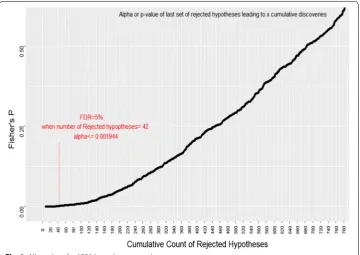
The p-value of each set can be observed in second column of Fig. 1. Since we have sorted our hypotheses based on their p-values, as we include more sets of hypotheses to our rejected set, the reasonable alpha (threshold p-value) increases. Depicted in red, we see that at FDR of 0.05 we can select 42 features, or we can reject 42 null hypotheses.
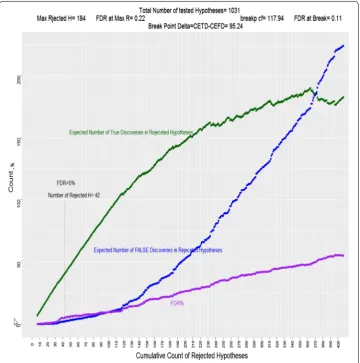
Figure 2, focuses on the first 400 lowest p-value hypotheses. The blue line is depicting the cumulative expected number of false discoveries among rejected hypotheses (false positives). Since CEFD is alpha*N, and alpha is the monotonic p-value of the last class rejected chosen as threshold, CEFD is an increasing entity. The purple curve, FDR in percentage form, is also generally increasing even though one may find local fluctuations in its values.
lim
i→NCEFDi =ilim→NN×pi=N
lim
i→NFDRi=pilim→1FDRpi=1
The green line depicts the CETD. The p-value of first sets is usually very low, and these hypotheses are most likely to be true rejections, when we reject the first sets of hypoth-eses, CETD is growing very fast. Even when we pass the threshold of FDR = 0.05 the p-values of next sets are very low which keep FDRs close to 0.05. For example, in the study presented above, the hypothesis in set 37 has a p-values of 0.0001 and FDR37 is
0.050525. If we add S37 to our rejected set R, our CETD will grow and CEFD will also
grow, but the growth of CETD is much faster. This trend however does not last forever. As p-values get bigger, CEFD will grow faster and CETD will grow slower. If we continue rejecting hypotheses with big p-values CEFD will accelerate and will surpass CETD. CETD will start to decline when p-values included in rejection set get closer to 1. If we look at the difference CETD − CEFD shown in the last column of Table 2, we see that it has a maximum at set 177 above which rejecting a set of hypotheses will contribute more to CEFD than CETD and the difference will start to decline.
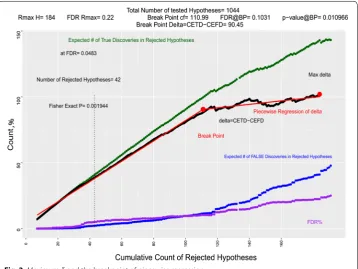
In Fig. 3, δ, the difference between the expected true discoveries and expected false discoveries among rejected hypotheses, is depicted as a black line. As expected, it has several local minima and maxima; but, it has a global maximum. Let us name the rejected number of hypotheses at this point as Rmax . FDR is always growing. By every
new rejected hypothesis, we are increasing the proportion of false discoveries in the rejected set of hypotheses. Rejecting more hypotheses after we have reached Rmax, will
weaken the quality of our model with more contribution to expected false discover-ies than expected true discoverdiscover-ies. Table 2 shows that the p-values of set S177 is 0.0393.
Rejecting hypothesis beyond Rmax , for example rejecting set S178 which contains hypoth-esis 185, may increase the quantity CETD but it will increase the quantity of CEFD even more; it will decrease the quality of discovery because delta will go from 101.9416 to 97.42928.
Rmax is the maximum number of rejected hypotheses (features included in the model) which our data can justify. It will dictate a maximum for acceptable signifi-cance level alpha considering the data we have. In this example, Rmax does not appear at a sharp peak at which we have a turn, it is a peak around which the trend has an slow reversal; therefore, we can use many methods that suggest a reasonable number of rejected hypotheses much lower than Rmax leading to more parsimonious models
If we use piecewise regression to identify two regression line-segments, that will mimic the data up to Rmax, the breakpoint is found at set S105 . If we reject set S105, or reject 111 hypotheses with lowest p-value, we will have a δ105= 88.10299
vs δmax=101.9416 at Rmax . Our FDR will be FDRS105= 0.10314; about half of FDRmax=0.222985 . As shown in Table 2, the p-value of set S105 is p105= 0.010966,
about three times less than the p-value for pmax= 0.0393. At breakpoint, we select
69 (111–42) more features of which 9.418964 (11.4485–2.029536) are expected to be false discoveries. The selection process based on p-value threshold of 0.010966 with 111 selected features is more powerful than the model with 42 features based on FDR = 0.05. At the same time, it is more parsimonious than a model with 184 features
suggested by maximum delta, with 72 (184–111) more variables including 29.5807 (41.0292–11.4485) more false discoveries.
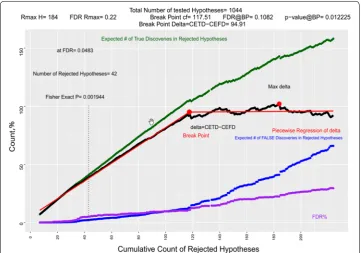
Figure 4 shows a slightly different strategy. If we use iterative piecewise regression to identify two line-segments, one of which being a horizontal line that ends a few p-val-ues after pmax. The breakpoint is at p118 . If we reject set S112, or reject 118 hypotheses,
we will have a δ112= 92.4742 close to δmax=101.9416 at Rmax , with an FDR112= 0.10816
about half of FDRmax=0.222985 . As shown in Table 2, the p-value of set S112 is p112= 0.012225, about three times less than the p-value for pmax= 0.0393.
Using segmented regression is just one of many ways the researcher can include the information about Rmax. The researcher can devise a more objective strategy to select the
set of rejected hypothesis without relying on 0.05 or any other presumed thresholds for alpha or FDR; and, should report the resulting alpha and FDR instead of assuming them.
In the example shown above, the optimum (breakpoint of piecewise regression) is not very sensitive to the method of conducting regression or identification of breakpoint. Either way, it suggests a threshold that corresponds to an FDR between 10 and 11%. At this neighborhood of FDR, 111 or 118 hypotheses could be rejected (111, or 118 features could be selected); while based on FDR = 0.05 criterion, 42 hypotheses could be rejected (42 features could be selected); nevertheless, the proposed method increases the power of selection process. Resulting model is much more parsimonious than selecting 184 fea-tures suggested by Rmax (absolute maximum reasonable number of rejected hypotheses).
It important to notice that if a number of predictors, or features, which are depend-ent to each other and associated with the outcome exist, the p-values of null hypoth-eses tested about their association with outcome will be similarly small. These p-values will inflate the FDR and may exclude some eligible features from the model, but their
contribution to ECTD and ECFD will be similar and will not affect the delta; therefore, maximum delta and the delta at breakpoint are not affected by the number of features in each set with similar p-values and the proposed method of selecting p-value threshold is insensitive to the number highly correlated features that my be selected.
In many exploratory researches the goal is to identify a set of significant associa-tions. Many times, the extent of association (like slopes in linear regression) are more important for understanding the phenomena, or modeling the system, than the differ-ences of FDRs associated with each p-value among significantly accepted alternatives. To test the quality of resulting set of rejected hypotheses, the non-parametric Som-mer’s D statistics for the extent of association for each comparison was calculated. It was observed that near all the rejected hypothesis (selected features) had a level of association whose confidence intervals for the extent of association were on one side of zero.
Conclusion
In exploratory research, or when a few more possible false positives among many truly rejected hypotheses or selected features is not a sensitive issue, relying on pre-determined threshold of 0.05 for FDR may be too limiting. But accepting larger and larger FDRs is not also a reasonable approach. The presented method is a proposal for an objective threshold for level of significance, largest p-value and consequently number of selected features or rejected null hypothesis for parsimonious yet powerful model grounded on data.
The following steps present the algorithm to identify the biggest reasonable set of features, that data can afford:
1. Choose the test method for example t-test or Fisher’s exact test depending on the data;
2. Obtain p-values by performing the chosen test on all hypotheses; 3. Sort p-values from smallest to largest;
4. Find the smallest p-value;
5. Count the number of hypotheses with the p-value found in step 4 and put them in a set;
6. Continue steps 4 and 5 until the hypotheses with biggest p-values are in the last set; 7. Tabulate the hypotheses to classes of observed p-values;
8. Reject the set of hypotheses with the least p-value (the first set is called S1);
9. Calculate cumulative expected false discoveries for all the rejected hypotheses (Pi× N);
10. Calculate 1 − CEFD for all the rejected hypotheses; 11. Calculate δ = CETD − CEFD;
12. Record the results;
13. Repeat steps 2–7 for all the sets.
15. The biggest reasonable set of rejected hypotheses Rmax will be
16. The p-value for set Sm is pm which is the alpha that should be reported; 17. The FDR that should be reported for Rmax is:
18. When there is a slow reversal in trend for δ. The researcher can use different meth-ods of piecewise regression on δ vs number selected features to identify an optimum number of rejected hypotheses, or selected features, which may be much less than
Rmax but much more than what would be dictated by a 0.05 FDR;
19. The break point of piecewise regression on δ vs number of selected features identi-fies the optimum number of selected features.
The process explained in this paper neither requires predetermined thresholds for level of significance, nor uses presumed thresholds for FDR. We observed a naturally occurring metric (for the quality of the set of rejected hypothesis), which has an upper bound. The researcher can rely on this maximum and devise methods to find an opti-mum that remains acceptable in terms of quality of model. Once the set of rejected hypotheses is determined a related significance level and FDR should be reported.
The paper presented methods that could identify an objective optimum reasonable number of rejected hypotheses. The found optimum is in the range between most conservative selection criteria, such as what has been used in Bonferroni’s procedure, and this identified upper bound. The criterion and methods can be used in many fields of inquiry dealing with high-dimensional data, including genomics and survey analysis. The results of using the criterion in the pairwise cross tabulation analysis of an ordinal outcome variable with 1044 potential ordinal predictors in a large survey, regarding variables that influence citizen engagement, was used as a novel example of application of the method in social sciences.
Authors’ contributions
There is a single author for the whole study and paper. The author read and approved the final manuscript.
Author details
1 School of Communication, Simon Fraser University, Burnaby, BC, Canada. 2 Institute for Canadian Urban Research
Studies, Simon Fraser University, Burnaby, BC, Canada. 3 School of Business, Capilano University, 2055 Purcell Way, North
Vancouver, BC V7J 3H5, Canada.
Acknowledgements
No other one than author has contributed to the study.
Competing interests
The author declares no competing interests.
Availability of data and materials
The data used as an example is attached and is available at Simon Fraser University institutional repository (Additional
file 1).
Rmax
the biggest reasonable set of selected features
=S1∪S2∪S3∪. . .∪Smax;
FDRmax=
pmax×N
m
1 fi
Additional file
Consent for publication Hereby I declare my consent.
Ethics approval and consent to participate
The data used in hypothesis testing example has been collected with the approval of Office of Research Ethics at Simon Fraser University (Study Number: 2014s0383), and all the participants have consented to the approved consent form before participation.
Funding
This study was not funded.
Publisher’s Note
Springer Nature remains neutral with regard to jurisdictional claims in published maps and institutional affiliations.
Received: 27 November 2017 Accepted: 19 May 2018
References
1. Austin SR, Dialsingh I, Altman N. Multiple hypothesis testing: a review. J Indian Soc Agric Stat. 2014;68:303–14. 2. Benditkis J. Martingale methods for control of false discovery rate and expected number of false rejections.
Dis-sertation. Heinrich Heine University Duesseldorf. 2015. http://docse rv.uni-duess eldor f.de/servl ets/Docum entSe rvlet
?id=35438 .
3. Benditkis J, Heesen P, Janssen A. The false discovery rate (FDR) of multiple tests in a class room lecture. 2015. arXiv
preprint arXiv :1511.07050 .
4. Blanchard G, Roquain E. Adaptive false discovery rate control under independence and dependence. J Mach Learn Res. 2009;10:2837–71.
5. Benjamini Y, Hochberg Y. Controlling the false discovery rate: a practical and powerful approach to multiple testing. J R Stat Soc B. 1995;57(1):289–300.
6. Bolón-Canedo V, Sánchez-Maroño N, Alonso-Betanzos A. Feature selection for high-dimensional data. 1st ed. Berlin: Springer; 2015.
7. Dutheil JY, Hobolth A. Ancestral population genomics. Methods Mol Biol (Clifton, N.J.). 2012;856:293–313. https ://
doi.org/10.1007/978-1-61779 -585-5_12.
8. Fan J, Sun O, Zhou W, Zhu Z. Principal component analysis for big data. 2018. arXiv :1801.01602 .
9. Fiori A, Grand A, Bruno G, Brundu FG, Schioppa D, Bertotti A. Information extraction from microarray data: a survey
of data mining techniques. J Database Manag (JDM). 2014;25(1):29–58. https ://doi.org/10.4018/jdm.20140 10102 .
10. Hua J, Tembe W, Dougherty ER. Feature selection in the classification of high-dimension data. In: 2008 IEEE
international workshop on genomic signal processing and statistics; 2008. p. 1–2. https ://doi.org/10.1109/gensi
ps.2008.45556 65.
11. Iterson M, Boer JM, Menezes RX. Filtering, FDR and power. BMC Bioinform. 2010;11(September):450. https ://doi.
org/10.1186/1471-2105-11-450.
12. Kim S, Halabi S. High dimensional variable selection with error control. Biomed Res Int. 2016. https ://doi.
org/10.1155/2016/82094 53.
13. Kim SB, Chen VCP, Park Y, Ziegler TR, Jones DP. Controlling the false discovery rate for feature selection in
high-reso-lution NMR spectra. Stat Anal Data Mining. 2008;1(2):57–66. https ://doi.org/10.1002/sam.10005 .
14. Miao J, Niu L. A survey on feature selection. Procedia computer science, promoting business analytics and quan-titative management of technology: 4th international conference on information technology and quanquan-titative
management (ITQM 2016). 2016; 91(January): 919–26. https ://doi.org/10.1016/j.procs .2016.07.111.
15. Neuvial P. Asymptotic results on adaptive false discovery rate controlling procedures based on kernel estimators. JMLR. 2013;14:1423–59.
16. Norris AW, Kahn CR. Analysis of gene expression in pathophysiological states: balancing false discovery and false negative rates. Proc Natl Acad Sci USA. 2006;103:649–53.
17. Ochoa A, Storey JD, Llinás M, Singh M. Beyond the E-value: stratified statistics for protein domain prediction. PLoS
Comput Biol. 2015;11(11):e1004509. https ://doi.org/10.1371/journ al.pcbi.10045 09.
18. Park BS, Mori M. Balancing false discovery and false negative rates in selection of differentially expressed genes in
microarrays. Open Access Bioinformatics. 2010;2:1–9. https ://doi.org/10.2147/OAB.S7181 .
19. Shaffer J. Multiple hypothesis testing. Annu Rev Psychol. 1995;46:561–84.
20. Shmueli G, Bruce PC, Yahav I, Patel NR, Lichtendahl KC Jr. Data mining for business analytics: concepts, techniques, and applications in R. New York: Wiley; 2017.
21. Storey JD. The optimal discovery procedure: a new approach to simultaneous significance testing. J R Stat Soc Ser B Stat Methodol. 2007;69(3):347–68.
22. Storey JD, Tibshirani R. Statistical significance for genomewide studies. Proc Natl Acad Sci. 2003;100:9440–5. 23. Storey JD. False discovery rate. In: Lovric M, editor. International encyclopedia of statistical science. Heidelberg: