O R I G I N A L A R T I C L E
Open Access
Facial expression recognition using
three-stage support vector machines
Issam Dagher
*, Elio Dahdah and Morshed Al Shakik
Abstract
Herein, a three-stage support vector machine (SVM) for facial expression recognition is proposed. The first stage comprises 21 SVMs, which are all the binary combinations of seven expressions. If one expression is dominant, then the first stage will suffice; if two are dominant, then the second stage is used; and, if three are dominant, the third stage is used. These multilevel stages help reduce the possibility of experiencing an error as much as possible. Different image preprocessing stages are used to ensure that the features attained from the face detected have a meaningful and proper contribution to the classification stage. Facial expressions are created as a result of muscle movements on the face. These subtle movements are detected by the histogram-oriented gradient feature, because it is sensitive to the shapes of objects. The features attained are then used to train the three-stage SVM. Two different validation methods were used: the leave-one-out and K-fold tests. Experimental results on three databases (Japanese Female Facial Expression, Extended Cohn-Kanade Dataset, and Radboud Faces Database) show that the proposed system is competitive and has better performance compared with other works.
Keywords:Facial expression recognition, Support vector machine, Histogram of oriented gradients, Viola–Jones, Validation
Introduction
Artificial intelligence has created higher standards for innovation and has introduced new possibilities for hu-man–computer interaction. The goal of achieving com-munication between computers and humans is now a possibility; however, 55%–94% of human communication is nonverbal [1]. Thus, there is a need to develop an ac-curate facial expression recognition (FER) system that can establish efficient communication between humans and computers. The development of such a system can also be useful in several areas, such as lie detectors, sur-veillance, smart computing, visual development, com-puter gaming, and augmented reality [2].
For efficient communication to occur between two people, seven expressions are globally identified and ana-lyzed to make communication smooth and reliable. Translating this idea into a computer system, the FER system can improve the way computers interact with humans and lead to further advancements in this field.
Many researchers have tried developing the optimal FER system. Generally, the main approaches were to do it via machine learning or deep learning. The majority of studies used the machine-learning approach, because deep learning is a recent trend. Also, deep learning re-quires a massive amount of computation time, speed, and memory, whereas machine learning does not have all these requirements. The possible combinations are endless, because any or all of the following can be chan-ged: face detection, feature extraction, and classification. Some studies in which the method of feature extraction was changed, whereas the detection and classification were kept the same, are as follows. Shan et al. [3] intro-duced an FER system that can detect facial expressions using a boosted version of local binary patterns (LBPs) and classified it using support vector machines (SVMs). Shih et al. [4] used linear discriminant analysis (LDA) and SVM. Khan performed a LBP-pyramid with SVM classification [1]. Jaffar [1] performed LBP with a Gabor filter. All these methods are based on machine learning, where the face was detected as a whole, and then each model was implemented. Some researchers decided to segment the face rather than take it as a whole and
© The Author(s). 2019Open AccessThis article is distributed under the terms of the Creative Commons Attribution 4.0 International License (http://creativecommons.org/licenses/by/4.0/), which permits unrestricted use, distribution, and reproduction in any medium, provided you give appropriate credit to the original author(s) and the source, provide a link to the Creative Commons license, and indicate if changes were made.
speed up the computation time. Liu et al. [6] combined LBP and HOG methods for feature extraction; then, they performed principal component analysis (PCA) to minimize the time and speed needed for computation, and, finally, they used SVM classification. However, some decided to implement deep learning rather than continuing to use machine learning. Mollahosseini et al. [7] used a deep-neural-network system. The number of combinations is endless, as can be seen above; however, their accuracies are fairly competitive. Thus, many re-searchers have decided to modify images by using vari-ous preprocessing techniques — spatial orientation, histogram equalization, color conversion, resolution en-hancement, and many others.
The technique applied in this study generally revolves around the preprocessing of the image before extracting its features and the stages of classification. The classifi-cation is split into three individual stages composed of binary comparisons where the system enters each stage depending on the necessity and the case.
Related work
In a previous study [8], the authors of that work used histograms of gradients as a feature extraction method. Three-dimensional FER was analyzed in other research [9]. A dictionary-based approach for FER was used [10]. Gabor wavelets and learning vector quantization were used [11]. FER using contourlet transform was done [12]. Exploring shape deformation is done [13]. In other work [14], SVM was used in FER. A convolutional neural network (CNN) was used [15]. In another study [16], the authors of that report used pairwise feature se-lection in classification. Multiple CNNs were used in other research [17]. Prototype-based modeling for facial expression analysis was implemented [18]. Curvelet transform was used in FER [19]. A guide to recognizing emotions from facial clues was presented [20]. Analysis of FER with occlusions was done in other work [21]. An-other study [22] emphasized the line-based caricatures in FER. FER using extended LBP (ELBP) based on co-variance matrix transform in Karhunen–Loeve transform was utilized in ref. [23]. Other researchers [24] used 3-D facial feature distances. Automatic FER using features of salient facial patches was demonstrated [25]. Fisher dis-criminant analysis was evaluated [26]. Other researchers [27] employed segmentation of face regions in FER. In other work [28], a deep fusion CNN was used in FER.
of 21 SVMs, which are all the binary combinations of the seven expressions. If one expression is dominant, then the first stage suffices. If two are dominant, the second stage is needed. If three are dominant, the third stage is used.
An image preprocessing stage is used to ensure that the features attained from the face detected have a meaningful and proper contribution to the classification stage.
Experimental results on three databases, Japanese Female Facial Expression (JAFFE), Extended Cohn-Kanade Dataset (CK+), and Radboud Faces Database (RaFD), show that the proposed system is competi-tive and has better performance compared with other systems.
General model and mathematical computation The skeletal structure of the model is shown in Fig. 1. The images of the datasets are divided into the training set and testing set. The number of images in each set varies depending on what type of validation method is implemented. The images of each set undergo some pre-processing techniques, followed by facial detection and feature extraction. The features are then classified using SVM classification. Once the system is trained, the set to be tested undergoes a similar process to the trained set; however, ultimately, the features extracted from the image are compared with the SVM classifiers, and the result is then obtained.
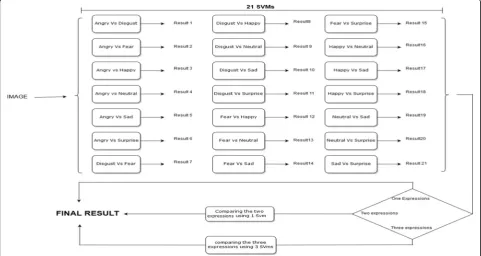
Two-part model SVM classifiers are designed in such a way that they are made up of three stages (Fig.2). Each stage represents a unique function to reach the final re-sult. The first stage consists of a network of 21 SVMs. Because there are seven main expressions, each expres-sion is compared with another expresexpres-sion, thus making a unique binary SVM. The total number of possible combinations resulting from this binary comparison is shown in Eq. (1), where selecting two expressions from the total number of expressions makes it possible to de-termine all possible binary outcomes.
C7 2¼
7!
2!5!¼21 ð1Þ
(Combination 2 out of 7 expressions)
counts the occurrences of the expression at the output of the 21 SVMs. After the occurrences have been calcu-lated, the counters are compared with each other, and the result follows one of the following conditions.
If one expression occurs the most at the outputs, then the final result definitely represents this expression.
If two expressions equally occur at the outputs, the two expressions go into another stage, called“Stage 2”. Stage 2 has one SVM that is trained with these two expressions only and compared one last time to get a final result. The result of the SVM in Stage 2 represents the final result.
If three expressions occur equally at the outputs, the three expressions enter another stage, called“Stage 3”. Similar to Stage 2, Stage 3 has three SVMs that represent all the possible combinations among the three expressions. The same concept of the 21 SVMs is applied, and the occurrences are counted. Then, the final result is determined from the output of this stage.
Datasets and image preprocessing
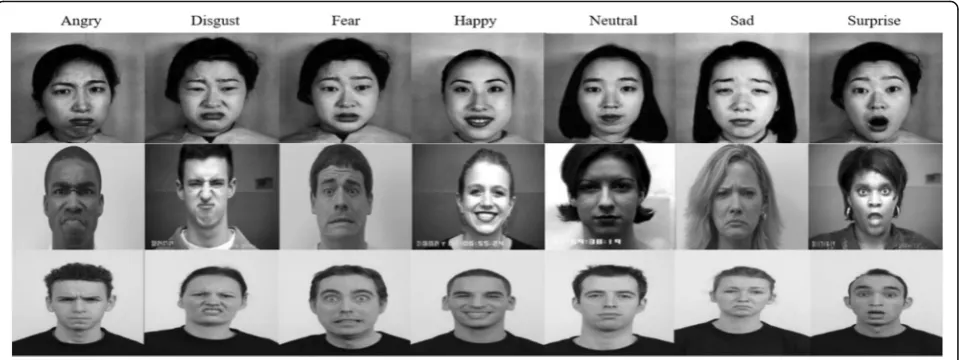
To evaluate the performance of the proposed approach, the system was tested on three commonly adopted datasets (Fig.3): the JAFFE database [31], CK+ [32], and RaFD [33]. Fig. 1General skeletal structure: dividing the dataset into training and testing sets
JAFFE database
The dataset was taken from the Psychology Department at Kyushu University. This database consists of the seven primary expressions that were posed by 10 Japanese fe-male models. The database consists of a total of 213 im-ages, where 30 images are angry, 29 images are disgust, 32 images are fear, 31 images are happy, 30 images are neutral, 31 images are sad, and 30 images are surprise. Each model provided approximately three images for each facial expression. Each image was saved in grayscale with a resolution of 256 × 256 [31].
CK+ database
This dataset consists of eight expressions (seven primary expressions plus contempt) that were posed by more than 200 adults ranging from 18 to 50 years of age. It generally consisted of Euro-American and Afro-American individuals. The images were taken in time frames where the initial frame was neutral, which was then transitioned into the expression that was desired at the end frame (the peak frame). These images were saved, some in grayscale and some in color, in 640 × 490 or 640 × 480 pixels. The database consists of 123 neutral images and 327 peak images (images with a certain ex-pression). These 327 images consist of 45 images that are angry, 18 images that are contempt, 59 images that are disgust, 25 images that are fear, 69 images that are happy, 28 images that are sad, and 83 images that are surprise. The contempt expression images are excluded in this work [32].
RaFD database
This dataset consists of 67 models: 20 male adults, 19 fe-male adults, 4 fe-male children, 6 fefe-male children, and 18 Moroccan male adults. Each model is pictured at a
different gaze direction (left, frontal, and right) and at five different camera angles simultaneously. The dataset con-sists of eight expressions (seven primary expressions + contempt) and 1608 images that are distributed into 201 angry images, 201 contempt images, 201 disgust images, 201 fear images, 201 happy images, 201 neutral images, 201 sad images, and 201 surprise images with a resolution of 640 × 1024 pixels each. The frontal facing images (im-ages at an angle of 90°) were worked on, and the contempt expression was excluded from this work [33].
Image preprocessing
The datasets have different properties, such as resolution, size, and color. To unify the system to work on all data-sets, standard image properties had to be developed.
As shown in Fig.4, to reach the standard image input, the following steps were implemented:
Gray scaling and resizing
Viola–Jones detection
Border adjustment
Cropping
Additional resizing
Gray scaling and resizing
to provide a standard input size. Fig. 5shows the image after performing the grayscale conversion and the resiz-ing. The resolution was not affected, and this not only unified the input size and color but also removed any color lamination that the image may have had.
Viola–Jones detection and border adjustment
The Viola–Jones algorithm was implemented to detect the face from the image. Some modifications were per-formed to detect only one face from the image that is the clearest face. This was done by comparing the sizes of the “supposed” faces detected and then selecting the face with the largest dimensions. The Viola–Jones algo-rithm could capture the majority of the faces of the data-sets accurately; however, it experienced some problems detecting faces displaying the surprise expression. The nature of the surprise expression is for the mouth to be wide open with raised eyebrows. As can be seen in Fig.6 (left), the mouth is cropped, which leads to false classifi-cation in the system. Also, extra components were de-tected at the edges of the face, which also leads to false classifications.
Border adjustment
Border adjustment was a reasonable solution to these problems. Fig. 6 (right) displays the possible three bor-ders that must be varied to give proper results. To optimize the input image, Border 3 must cover the whole mouth only, whereas Borders 1 and 2 must cover the face region only, without the ears. The optimal value
for the extension of Border 3 is 8 pixels downward. Values smaller than this did not solve the problem of the cropped mouth, whereas values larger than this began to cover the chin and neck of the person, which introduced new unnecessary features that increase the chance of false classification. Regarding Borders 1 and 2, the borders had to be moved inward to remove any un-necessary details that can cause confusion to the system. The optimal values for Borders 1 and 3 were 20 and 20 pixels, respectively. A value lower than this is futile, be-cause the ears are still covered within the borders, whereas a value higher than this is very bad, because the borders crop parts of the eyes.
Cropping
One border was left unmodified: the top border. The op-tions here were either to crop the image, including the forehead of the face, or to crop it without the forehead. This choice had to be determined by testing, because the forehead was a point of confusion, and it was not clear whether the forehead contributes to the expression or is just unnecessary.
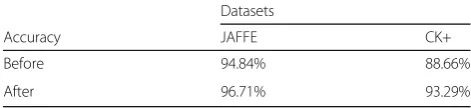
The system was tested once with the forehead and an-other time after cropping the forehead from the face. The test was repeated on two datasets: JAFFE and CK+.
Table 1shows that the forehead is an essential part of the expression and must be included in the face to de-termine the correct expression. The forehead played an important role in determining expressions such as sad and angry.
Fig. 5Grayscale and resizing to 256 × 256
Additional resizing
The last step was to resize the images with the detected face and the adjusted borders. This was done to ensure that the images with the detected faces were all equal in size, because the Viola–Jones algorithm detects faces with different border sizes due to the nature and size of the face and because of the border adjustment step. Therefore, the resizing had to be reimplemented to reach for standard image input.
After applying the border modification to the image, the size of the output image was recorded, and the mini-mum was noticed. The smallest size that was recorded was 112 × 92; therefore, all the images in all the datasets had to be of this size to ensure consistency and ensure the same number of features for all images. Table1 dis-plays how crucial image preprocessing is, because there was approximately a 2% and 5% increase in the accuracy of the Jaffe and CK+ datasets, respectively.
Experimental results and discussion
Regarding FER, the two most famous and used valid-ation methods to determine accuracy are the leave-one-out validation method and the K-fold validation method.
Leave-one-out validation test
The leave-one-out validation test is used to determine the accuracy of the system by dividing the dataset into
two categories: the testing set and the training set. The testing set contains one image, whereas the training set contains the rest of the dataset. The experiment is then repeated until all the images go through the system at least once, thus determining exactly what images are de-tected incorrectly out of the whole set [34].
For the datasets used, the number of experiments was 213 for JAFFE, 432 for CK+, and 1407 for the RaFD dataset. The results of the leave-one-out validation test on the three datasets are shown in Table2.
The accuracy of the JAFFE and RaFD datasets was higher than that of the CK+ one, because the numbers of images in each expression in those two datasets are equal, thus causing a fair training, whereas the CK+ dataset has a varying number of images for each expres-sion. Also, the RaFD dataset showed the highest accur-acy, because the training sample was extremely large compared with the other two datasets.
K-fold validation test
The K-fold validation test is one form of the leave-one-out validation test that has several modifications applied to it. In the K-fold validation test, the dataset that has N images is divided into K sets. In each run, one of the K sets is used for testing, and the remaining sets are used for training. The process is repeated until all sets go through the system once. The only difference between the leave-one-out and K-fold validation tests is that the testing sample is larger for the K-fold one, thus decreas-ing the traindecreas-ing set. Also, the randomness of the images being testing is larger, providing more-realistic results.
To validate the results as much as possible, several types of K-fold test were performed. The first test was the 10-fold validation test. In this test, the dataset was divided into 10 sets, and 10 iterations were applied to the system. The second test was the fivefold validation Fig. 6Viola–Jones face detection with mouth missing (left): Border 3 must cover the whole mouth only, whereas Borders 1 and 2 must cover the face region (right)
Table 1Increase of proposed accuracy method using image preprocessing techniques
Datasets
Accuracy JAFFE CK+
Before 94.84% 88.66%
test, in which the dataset was divided into five sets of images. The sets in the fivefold validation test were lar-ger than those in the 10-fold one. The last test was the twofold validation test, in which the dataset was divided into two halves: one for testing and the other for train-ing. The results of the three discussed K-fold tests when applied to the three datasets are shown in Table3.
The results of the 10-fold test were higher than those of the other two tests, because the training set was larger than that of the five fold and two fold tests. The CK+ ac-curacy was lower than those of the JAFFE and Radboud datasets, because CK+ is the only dataset that has a dif-ferent number of images for each expression; therefore, the randomness in this dataset plays a large part in the accuracy achieved. The twofold test had the lowest ac-curacy of all the K-fold tests, because the system is not being trained enough, thus decreasing accuracy.
Result overview
The overall results of performing the above-mentioned tests are summarized in Table4. Table4shows that the model used has a high accuracy, more than 90%, under any test used and using any dataset. The results show that, if the proposed model is trained enough, the accur-acy rises, as can be seen from the leave-one-out valid-ation test. The CK+ dataset had the lowest accuracy among the datasets, because images in the CK+ dataset are not well distributed and vary in number.
Comparison
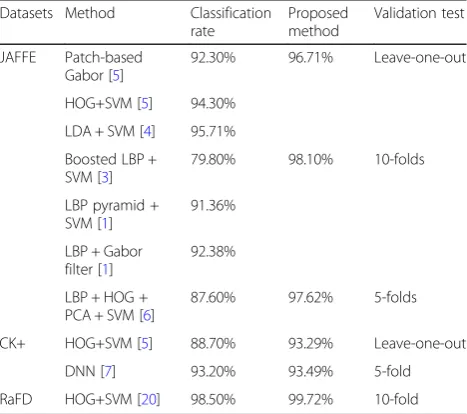
The last step is to compare the results obtained with re-sults reported in previous work. Table 5 shows the re-sults obtained by several researchers who developed FER systems. Each decided to implement a certain type of validation test different from the rest. In the last column of Table5, the type of validation test performed is given. Regarding the JAFFE database, the leave-one-out test result obtained surpassed the LDA + SVM [4] model by
1%, whereas the model that uses the same extraction and classification techniques with HOG and SVM [5] produced results that were less than those of the pro-posed model by 2.41%. The results of the K-fold tests also surpassed those of the previous models, especially the 10-fold model that had a huge accuracy difference of 5.70%.
The CK+ dataset also surpassed the previous models that used the same extraction and classification tech-nique and could compete and surpass the performance of a deep neutral network [7], which is considered opti-mal in comparison with machine learning.
Regarding the RaFD dataset, although it is not very popular in the machine-learning domain, it was possible to compare it with a work that used the 10-fold test and was able to surpass it by more than 1%.
Conclusions
An effective method of addressing the FER problem was proposed. Several steps were performed at the image preprocessing stage to ensure that the features attained from the face detected have a meaningful and proper contribution to the classification stage. The extra fea-tures at the side of the face (around the ears) and the ones at the bottom of the mouth (around the chin and
Table 3Proposed accuracy method using K-fold method
Folds
Datasets 10 5 2
JAFFE 98.10% 97.62% 90.10%
CK+ 94.42% 93.49% 90.00%
RaFD 95.14% 95.10% 94.88%
Table 4Proposed accuracy methods using different folds
Datasets Methods
Leave-one-out 10 folds 5 folds 2 folds
JAFFE 96.71% 98.10% 97.62% 90.10%
CK+ 93.29% 94.42% 93.49% 90.00%
RaFD 99.72% 95.14% 95.10% 94.88%
Table 2Proposed accuracy method using leave-one-out on the three datasets
Datasets Leave-one-out
JAFFE 96.71%
CK+ 93.29%
RaFD 99.72%
Table 5Proposed accuracy method compared with other techniques
Datasets Method Classification rate
Proposed method
Validation test
JAFFE Patch-based Gabor [5]
92.30% 96.71% Leave-one-out
HOG+SVM [5] 94.30%
LDA + SVM [4] 95.71%
Boosted LBP + SVM [3]
79.80% 98.10% 10-folds
LBP pyramid + SVM [1]
91.36%
LBP + Gabor filter [1]
92.38%
LBP + HOG + PCA + SVM [6]
87.60% 97.62% 5-folds
CK+ HOG+SVM [5] 88.70% 93.29% Leave-one-out
DNN [7] 93.20% 93.49% 5-fold
to the shape of objects. The features attained are then used to train a network of binary linear SVMs. This net-work consists of three stages where the primary and first stage is made up of 21 SVMs that are all the binary com-binations of the seven expressions. If one expression is dominant, then the first stage suffices. If two are domin-ant, then the second stage is used, and, if three are dom-inant, then the third stage is used. These multilevel stages reduce, as much as possible, the possibility of ex-periencing an error. Experimental results on three data-bases — JAFFE, CK+, and RaFD — show that the proposed system is competitive and has better perform-ance compared with previous research results. Two dif-ferent validation methods were used: the leave-one-out and K-fold tests. The percentages obtained from the leave-one-out test were 96.71%, 93.29%, and 99.72% for the JAFFE, CK+, and RaFD datasets, respectively. How-ever, the percentages obtained from the 10-fold test (the most common fold test) were 98.10%, 94.42%, and 95.14%, respectively.
Abbreviations
CK+:The Extended Cohn-Kanade Dataset; FER: Facial Expression Recognition; HOG: Histogram of Oriented Gradients; JAFFE: Japanese Female Facial Expressions; LBP: Local Binary Patterns; RaFD: Radboud Facial dataset; SVMs: Support Vector Machines
Acknowledgements We thank our intelligent team.
Authors’contributions
Results show that our proposed system is very competitive and has better performance in relation to other works. All authors read and approved the final manuscript.
Authors’information
Issam Dagher finished his MS in electrical engineering degree in 1994 from Florida International University, Miami, USA. He finished his PhD in 1997 from Univesity of Central Florida, Orlando, USA. He is now an associate professor at the University of Balamand, Lebanon. His area of interests are pattern recognition, neural networks, artificial intelligence, computer vision. He published many papers on these topics.
Elio Dahdah and Morshed Elshakik finished their MS in computer engineering in 2017 from the University of Balamand. Their area of interests are machine learning and artificial intelligence.
Funding No.
Availability of data and materials Upon request.
Ethics approval and consent to participate I consent.
References
1. Jaffar MA (2017) Facial expression recognition using hybrid texture features based ensemble classifier. Int J Adv Comput Sci Appl 8(6).https://doi.org/ 10.14569/IJACSA.2017.080660
2. Poria S, Mondal A, Mukhopadhyay P (2015) Evaluation of the intricacies of emotional facial expression of psychiatric patients using computational models. In: Mandal MK, Awasthi A (eds) Understanding facial expressions in communication. Springer, New Delhi, pp 199–226.https://doi.org/10.1007/ 978-81-322-1934-7_10
3. Shan CF, Gong SG, McOwan PW (2009) Facial expression recognition based on local binary patterns: a comprehensive study. Image Vis Comput 27(6): 803–816.https://doi.org/10.1016/j.imavis.2008.08.005
4. Shih FY, Chuang CF, Wang PSP (2008) Performance comparisons of facial expression recognition in JAFFE database. Int J Pattern Recognit Artif Intell 22(3):445–459.https://doi.org/10.1142/S0218001408006284
5. Chen JK, Chen ZH, Chi ZR, Fu H (2014) Facial expression recognition based on facial components detection and hog features. In: Abstracts of scientific cooperations international workshops on electrical and computer engineering subfields, Koc University, Istanbul, Turkey, 22-23 August 2014, pp 64–69
6. Liu YP, Li YB, Ma X, Song R (2017) Facial expression recognition with fusion features extracted from salient facial areas. Sensors 17(4):712
7. Mollahosseini A, Chan D, Mahoor MH (2016) Going deeper in facial expression recognition using deep neural networks. In: Abstracts proceedings of 2016 IEEE winter conference on applications of computer vision. IEEE, Lake Placid, 7-10 March 2016, pp 1–10.https://doi.org/10.1109/WACV.2016.7477450
8. Carcagnì P, Del Coco M, Leo M, Distante C (2015) Facial expression recognition and histograms of oriented gradients: a comprehensive study. SpringerPlus 4:645.https://doi.org/10.1186/s40064-015-1427-3
9. Savran A, Sankur B (2017) Non-rigid registration based model-free 3D facial expression recognition. Comput Vis Image Underst 162:146–165.https://doi. org/10.1016/j.cviu.2017.07.005
10. Sharma K, Rameshan R (2017) Dictionary based approach for facial expression recognition from static images. In: Mukherjee S, Mukherjee S, Mukherjee DP, Sivaswamy J, Awate S, Setlur S et al (eds) Computer vision, graphics, and image processing. ICVGIP 2016 satellite workshops, December 2016. Lecture notes in computer science (Lecture notes in artificial intelligence), vol 10484. Springer, Cham, pp 39–49.https://doi.org/10.1007/ 978-3-319-68124-5_4
11. Bashyal S, Venayagamoorthy GK (2008) Recognition of facial expressions using Gabor wavelets and learning vector quantization. Eng Appl Artif Intell 21(7):1056–1064.https://doi.org/10.1016/j.engappai.2007.11.010
12. Biswas S, Sil J (2015) An efficient expression recognition method using contourlet transform. In: Abstracts of the 2nd international conference on perception and machine intelligence. ACM, Kolkata, West Bengal, 26–27 February, 2015, pp 167–174.https://doi.org/10.1145/2708463.2709036 13. Gong BQ, Wang YM, Liu JZ, Tang XO (2009) Automatic facial expression
recognition on a single 3D face by exploring shape deformation. In: Abstracts of the 17th ACM international conference on multimedia. ACM, Beijing, 19-24 October 2009, pp 569–572
14. Tsai HH, Chang YC (2018) Facial expression recognition using a combination of multiple facial features and support vector machine. Soft Comput 22(13):4389–4405.https://doi.org/10.1007/s00500-017-2634-3 15. Clawson K, Delicato LS, Bowerman C (2018) Human centric facial expression
recognition. In: Abstracts of the 32nd international BCS human computer interaction conference, electronic workshops in computing, Belfast, UK, 4-6 July 2018, pp 1–12.https://doi.org/10.14236/ewic/HCI2018.44
17. Cui RX, Liu MY, Liu MH (2016) Facial expression recognition based on ensemble of mulitple CNNs. In: You ZS, Zhou J, Wang YH, Sun ZN, Shan SG, Zheng WS et al (eds) Biometric recognition. 11th Chinese conference, CCBR 2016, October 2016. Lecture notes in computer science (Lecture notes in artificial intelligence), vol 9967. Springer, Cham, pp 511–518.https://doi.org/10.1007/978-3-319-46654-5_56 18. Dahmane M, Meunier J (2014) Prototype-based modeling for facial
expression analysis. IEEE Trans Multimed 16(6):1574–1584.https://doi.org/10. 1109/TMM.2014.2321113
19. Uçar A, Demir Y, GüzelişC (2014) A new facial expression recognition based on curvelet transform and online sequential extreme learning machine initialized with spherical clustering. Neural Comput Appl 27(1):131–142. https://doi.org/10.1007/s00521-014-1569-1
20. Ekman P, Friesen WV (2003) Unmasking the face: a guide to recognizing emotions from facial clues. Malor Books, Cambridge
21. Vezzetti E, Marcolin F, Tornincasa S, Ulrich L, Dagnes N (2017) 3D geometry-based automatic landmark localization in presence of facial occlusions. Multimed Tools Appl 77(11):14177–14205.https://doi.org/10.1007/s11042-017-5025-y 22. Gao YS, Leung MKH, Hui SC, Tananda MW (2003) Facial expression
recognition from line-based caricatures. IEEE Trans Syst Man Cybern A Syst Hum 33(3):407–412.https://doi.org/10.1109/TSMCA.2003.817057 23. Guo M, Hou XH, Ma YT, Wu XJ (2017) Facial expression recognition using
ELBP based on covariance matrix transform in KLT. Multimed Tools Appl 76(2):2995–3010.https://doi.org/10.1007/s11042-016-3282-9
24. Soyel H, Demirel H (2007) Facial expression recognition using 3D facial feature distances. In: Kamel M, Campilho A (eds) Image analysis and recognition. 4th international conference, august 2007. Lecture notes in computer science (lecture notes in artificial intelligence), vol 4633. Springer, Heidelberg, pp 831–838.https://doi.org/10.1007/978-3-540-74260-9_74 25. Happy SL, Routray A (2015) Automatic facial expression recognition using
features of salient facial patches. IEEE Trans Affect Comput 6(1):1–12.https:// doi.org/10.1109/TAFFC.2014.2386334
26. Hegde GP, Seetha M, Hegde N (2016) Kernel locality preserving symmetrical weighted fisher discriminant analysis based subspace approach for expression recognition. Eng Sci Technol Int J 19(3):1321–1333.https://doi. org/10.1016/j.jestch.2016.03.005
27. Hernandez-matamoros A, Bonarini A, Escamilla-Hernandez E, Nakano-Miyatake M, Perez-Meana H (2015) A facial expression recognition with automatic segmentation of face regions. In: Fujita H, Guizzi G (eds) Intelligent software methodologies, tools and techniques. 14th international conference, September 2015. Lecture notes in computer science (Lecture notes in artificial intelligence), vol 532. Springer, Cham, pp 529–540.https:// doi.org/10.1016/j.knosys.2016.07.011
28. Li HB, Sun J, Xu ZB, Chen LM (2017) Multimodal 2D + 3D facial expression recognition with deep fusion convolutional neural network. IEEE Trans Multimed 19(12):2816–2831.https://doi.org/10.1109/TMM.2017.2713408 29. Islam DI, SRN A, Datta A (2018) Facial expression recognition using 2DPCA
on segmented images. In: Bhattacharyya S, Chaki N, Konar D, Chakraborty U, Singh CT (eds) Advanced computational and communication paradigms. Proceedings of international conference on ICACCP 2017. Advances in intelligent systems and computing, vol 706. Springer, Singapore, pp 289– 297.https://doi.org/10.1007/978-981-10-8237-5_28
30. Jain S, Durgesh M, Ramesh T (2016) Facial expression recognition using variants of LBP and classifier fusion. In: Satapathy SC, Joshi A, Modi N, Pathak N (eds) Proceedings of international conference on ICT for sustainable development. Advances in intelligent systems and computing, vol 42. Springer, Heidelberg, pp 725–732.https://doi.org/10.1007/978-981-10-0129-1_75
31. Lyons M, Kamachi M, Gyoba J (1998) The Japanese female facial expression (Jaffe) database.https://zenodo.org/record/3451524#.XbvRmfk6s7M. Accessed: 19 April 2019
32. Lucey P, Cohn JF, Kanade T, Saragih J, Ambadar Z, Matthews I (2010) The extended cohn-kanade dataset (CK+): a complete dataset for action unit and emotion-specified expression. In: Abstracts of 2010 IEEE computer society conference on computer vision and pattern recognition-workshops. IEEE, San Francisco, 13-18 June 2010, pp 94–101.https://doi.org/10.1109/CVPRW.2010.5543262
33. Langner O, Dotsch R, Bijlstra G, Wigboldus DHJ, Hawk ST, van Knippenberg A (2010) Presentation and validation of the Radboud faces database. Cognit Emot 24(8):1377–1388.https://doi.org/10.1080/02699930903485076 34. Kumar A (2018) Machine learning: validation techniques.https://dzone.com/
articles/machine-learning-validation-techniques. . Accessed: 19 April 2019
Publisher’s Note