R E S E A R C H A R T I C L E
Open Access
Pharmaceutical information systems and possible
implementations of informed consent - developing
an heuristic
Thomas Ploug
1*and Søren Holm
2,3Abstract
Background:Denmark has implemented a comprehensive, nationwide pharmaceutical information system, and
this system has been evaluated by the Danish Council of Ethics. The system can be seen as an exemplar of a comprehensive health information system for clinical use.
Analysis:The paper analyses 1) how informed consent can be implemented in the system and how different implementations create different impacts on autonomy and control of information, and 2) arguments directed towards justifying not seeking informed consent in this context.
Results and Conclusion:Based on the analysis a heuristic is provided which enables a ranking and estimation of the impact on autonomy and control of information of different options for consent to entry of data into the system and use of data from the system.
The danger of routinisation of consent is identified.
The Danish pharmaceutical information system raises issues in relation to autonomy and control of information, issues that will also occur in relation to other similar comprehensive health information systems. Some of these issues are well understood and their impact can be judged using the heuristic which is provided. More research is, however needed in relation to routinisation of consent.
Keywords:Autonomy, Control, Health information, Health information systems, Informed consent, Routinisation
Background
Information systems
Information systems holding data on all patients in a given health care system are being developed worldwide. The most ambitious plans envisage a system holding the complete patient record with all attendant data (lab results, imaging data, genetic data etc.) within the sys-tem, but such a system has not yet been implemented in any large scale health care system. Such information sys-tems raise many ethical and legal issues. In the present paper we analyse some of these issues, especially issues concerning informed consent. The starting point is a na-tionwide pharmaceutical information system that has already been implemented in Denmark. By focusing on a
concrete, already existing system we hope to be able to provide an analysis based more in clinical and adminis-trative reality than in speculation about the future.
There is a substantial literature on the use of routinely collected patient data for research purposes, but the lit-erature on the ethical issues raised by the collection and use of comprehensive patient data for treatment and diagnostic purposes is more limited. The so far unsuc-cessful efforts of the English National Health Service to share patient information electronically across all ser-vices has generated some ethical debate, [1-4] as has similar initiatives in other countries [5]. In this paper we hope to deepen this debate by showing that issues of consent in this context may be considerably more com-plicated than they may initially appear. There are many differences between the research context and the clinical context and many of them are relevant in relation to the kind of information systems we analyse here. Although the information in these systems is very useful for * Correspondence:[email protected]
1Centre for Applied Ethics and Philosophy of Science, Department of Communication, Aalborg University Copenhagen, A. C. Meyers Vænge, 2450 København SV, Denmark
Full list of author information is available at the end of the article
research purposes, the primary stated aim of implement-ing the systems is not to provide knowledge, or to pro-vide general public benefit, but to propro-vide direct benefit to individual patients. These systems involve people’s health related interests much more directly than most research databases do. Another very important differ-ence is that the main purpose of implementing the sys-tem necessarily involves using the information it contains, and the inferences that can be drawn from this information in a person-identifiable way. Anonymity is not an option and privacy interests can therefore not be protected by anonymising. This entails that some of the analyses provided in the literature on research databases may not be transferable to the present, clinical context.
The paper falls in 3 sections. We first briefly describe the comprehensive Danish pharmaceutical system and the reasons given for implementing it. In the second part we analyse issues of autonomy and informed consent raised by the introduction of the system and provide a heuristic for classifying these issues in a three dimensional space of relevant considerations. In this second part of the paper we also discuss some arguments raised by the Danish Council of Ethics and show how they can be encompassed by our heuristic. The final part of the paper then considers whether the tension between respect for autonomy and the reasons for introducing the system generate a true ethical dilemma, and discuss further problems created by a possible routinisation of informed consent.
The paper provides a heuristic for analysing these issues which is of value for anyone who thinks that autonomy is important, because the heuristic ranks possible models for informed consent in relation to their impact on autonomy. We do not purport to‘solve’the ethical issues since that would require a determination of exactly how important personal autonomy is in relation to all other relevant eth-ical considerations and values. Such a determination is outside the scope of this paper. Our heuristic is never the less of value, since it provides a detailed account of the ef-fect of different consent arrangements on one side of the balancing between autonomy and other considerations. This should allow decision-makers to have a clearer view of what they are sacrificing in choosing consent arrange-ments that do not fully protect autonomy.
The shared medicine profile
Since the passing of the law on personal, electronic, medi-cine profiles in 2003, the Danish Medimedi-cines Agency –an agency under the Ministry of Interior and Health – has registered the personal “use” of prescription medicine among Danes on the basis of reports from all Danish phar-macies (see below for a discussion of “use”) [6,7]. The resulting database feeds information into two separate personal records, the Medicine Profile and the Shared Medicine Profile.
The Medicine Profile is an electronic record contain-ing information about the medicine prescribed for and bought by an individual within the last two years. Medi-cine prescribed or given during in-patient stays is also registered. The registration is automatic and compul-sory. When the law was passed in 2003, pharmacists, doctors and their assistants, the patient and the Danish Medicine Agency were granted access to the records. The Medicine Profile was introduced with the primary purpose of providing doctors, patients and pharmacies with an overview of the medication prescribed for or given to an individual thereby enabling an improved and consistent use of medication leading to benefit for the individual and a reduction in public spending [6,8]. The Medicine Profile was implemented in 2004.
the access to the Shared Medicine Profile may also in the future be extended to other persons directly involved in distributing medications to individuals in their homes. The Shared Medicine Profile was introduced with the explicit purpose of sharing information about a patient’s medication between hitherto separated information sys-tems and between health care personnel in different set-tings. And the aim is to achieve better coordination of medication within and across sectors, faster correction of medication errors,early identification and consider-ation of potential drug interactions, and a more effective use of health care resources through reducing multiple, identical entries in multiple parallel information systems [7]. The Shared Medicine Profile will be fully implemen-ted by the end of 2012.
Analysis–The shared medicine profile and informed consent
The ethical challenge–beneficence, justice and autonomy
The Shared Medicine Profile poses an ethical challenge– perhaps even a dilemma. On the one hand, principles of beneficence and non-maleficence may be taken to imply the moral goodness of actions aimed at the prevention of harm to others [9]. In this case the harms caused by medi-cation errors and drug interactions. Similarly a principle of justice may support actions aimed at distributing health care resources without waste [9]. In this case by reducing unnecessary prescribing and duplication of work by health care personnel. On the other hand, the principle of respect for autonomy is typically understood to imply a require-ment to obtain informed consent before intervening in a patient’s life (cf below) [9]. The Shared Medicine Profile represents an intervention in the patient’s life. It involves the collecting and storing of personal health information, and the distribution of the information to a very large group of people. The ethical challenge faced in considering the implementation of a comprehensive health information system such as the Shared Medicine Profile is therefore to balance efforts to effectively gather and disseminate infor-mation in order to prevent harm to the individual and pro-mote a just distribution of health care resources against proper respect for the patient’s autonomy.
Personal autonomy, respect and informed consent Personal autonomy is associated with the ability to rule or govern oneself, i.e. self-rule and self-government [10]. For present purposes, we shall assume that personal au-tonomy involves two basic abilities: [11] 1) the ability to exercise one’s cognitive capabilities in a rational forma-tion of and identificaforma-tion with specific goals, values, aims, desires and plans etc., [12-14] and 2) the ability to pursue or implement these goals, values, aims, desires and plans in action without the choice of action being
restrained by forces alien to oneself [15,16]. In short, personal autonomy involves the ability to rationally form one’s own goals, values, plans etc., and to pursue these without being restrained in various ways.
Furthermore, we shall assume that protecting personal autonomy implies a requirement for a person to take steps to ascertain that a given intervention into another per-sons’s life does not alienate the person from his or her goals, values and plans, and a requirement not to restrain the person in his or her pursuit of these goals, values and plans. That is, we take it that protecting personal auton-omy requires that informed consent is obtained before an intervention into another person’s life. Finally, we shall as-sume that promoting personal autonomy is a matter of empowering a person to rationally form and pursue goals, values and plans unrestrained. Promoting personal auton-omy is a matter of providing a person with the power and the opportunity to control his or her life in formation and pursuit of goals, values and plans. Note, very importantly, that although the protection of personal autonomy may be claimed to be in principle acquired through obtaining informed consent, the specific way in which the require-ment is implerequire-mented may promote personal autonomy to a varying degree.
In the following we will show that the content and presentationof a particular request for informed consent may provide a person with control over his or her life to very different degrees. The implicit claim is that the pro-tection of personal autonomy through informed consent cannot be separated from the degree to which the per-sonal autonomy is promoted through the content and presentation of the informed consent. Consequently, in considering possible models of informed consent in rela-tion to the implementarela-tion of the Shared Medicine Pro-file we will speak of ’respect for personal autonomy’as being expressed through the requirement of informed consent, and that therefore– because informed consent both protects and promotes personal autonomy – the
’respect for autonomy’expressed in the different models of informed consent may vary in degree. In effect we will speak of models of informed consent as expressing a weaker or stronger ’respect for’ or, in this wider sense,
’protection of’personal autonomy.
The shared medicine profile and models of informed consent–developing an heuristic
provided without undue influence. We believe that this is a rather minimal set of requirements. There are a number of features and aspects of the implementation and use of the Shared Medicine Profile that may be included in the con-tent of an informed consent. Let us call these features and aspects‘variables’and the options for each variable‘values’. The listing of ‘values’for each‘variable’is not intended to be exhaustive but identifies major options:
1. Theregistrationof personal information about medication, e.g. consent to:
a. The registration of every prescribed medication b. The registration of every type of prescribed
medication
c. The registration of all prescribed medication
2. Theuseof personal information about medication, e.g. consent to:
a. The possible use of every single piece of medication information
b. The possible use of every type of medication information
c. The possible use of all medication information
3. Theaccessto personal information about medication, e.g. consent to:
a. The access to medication information for every individual member of the health personnel (e.g. an individual doctor)
b. The access to medication information for groups of health personnel (e.g. doctors)
c. The access to medication information for all health personnel (and potentially others)
4. Theexchangeof personal medication information between medical information systems, e.g. consent to:
a. Every exchange of health information between medical information systems
b. Exchange of health information between medical information systems within the same sector c. Exchange of health information between all health
information systems
5. Theauthorityto extend access to personal medication information to new groups of health personnel, e.g. consent to:
a. The authority to extend access to one person (e.g. Minister of Health)
b. The authority to extend access to a specific group of persons (e.g. medical doctors)
c. The authority to extend access to several groups and individuals.
The above variables of informed consent are all variables relating to the content of the informed consent. They con-cern what the patient is‘consenting to’. The different pos-sible values of these variables provide the patient with more or less control over the intervention in the patient’s life caused by the implementation of the Shared Medicine Profile. Assuming that respecting personal autonomy involves providing the patient with control over interven-tions, it follows that the inclusion of specific values for each of these variables in the informed consent process may either, relatively speaking, strengthen or weaken the protection of personal autonomy. For example, if the pa-tient consents to the access to medication information for all health personnel then he or she will in the future not be able to control the access to the information as effect-ively, as if he or she had restricted the availability to only some groups. This means that the patient will not, for in-stance, be able to restrict access to sensitive information only to health care personnel that he or she trusts. This clearly weakens the protection of personal autonomy. It is important to note that we are not claiming that increased control over information is necessarily welfare maximis-ing. A person may clearly use this control contrary to his or her own interests. What we are claiming is that increased control over personal information increases per-sonal autonomy. This is, we submit, close to an analytical truth.
In the following we will reduce these five variables to two, ‘registration’ and ‘use’. The reasons for this are primarily: 1) That ‘access’, ‘exchange’ and ‘authority to change’can be seen as aspects of ‘use’of information, e. g. that a restriction to a particular group of health care personnel is a restriction of a specific use of the medica-tion informamedica-tion, and 2) that in the Danish context the Shared Medicine Profile operates within a predomin-antly public health care system with clear lines of polit-ical accountability. Issues concerning ‘exchange’ and
‘authority to change’are thus less prominent.
on the patient having been adequately informed and having understood this information. The likelihood of this being attained depends on a large number of factors including an appropriate amount of information being given, the information being of high quality and rele-vance, and the information being delivered in a way that maximises the possibility that the patient will under-stand the information [17-20]. Information about the Shared Medicine Profile may be disseminated in various ways, and we will assume that the likelihood of adequate understanding increases if the information is delivered in a personal interaction. And we will assume, that very general information campaigns are likely to be the least effective. We thus have a composite variable reflecting the likelihood of good understanding of the information provided (we assume that the information provided is in all circumstances adequate and of high quality):
6. The adequacy of the information process, e.g.
a. The information is provided personally by health personnel as part of the informed consent process b. The information is provided through leaflets
distributed by health personnel
c. The information is provided through general information campaigns
Personal interaction increases the possibility that a health care professional may exert undue influence on a patient’s choice. We will in the following assume that this risk can be mitigated by professional regulation, and that it is overall more likely that a valid informed con-sent takes place when there is personal interaction as part of the informed consent process.
This list of variables and their possible values is not exhaustive. They represent an attempt to capture some of the features and aspects of the Shared Medicine Pro-file important for the informed consent process. Other variables could have been taken into account. Thus there is a longstanding discussion of the exact informational requirements for valid informed consent [21-26]. This is not unimportant but we are here focusing on how the more specific features and aspects of the Shared Medi-cine Profile are relevant to informed consent.
We have so far identified three fundamental variables–
‘registration’,‘use’and‘adequacy of information’ –relevant for the implementation of comprehensive health informa-tion systems such as the Shared Medicine Profile. Al-though the list of variables and their possible values may not be exhaustive, there is a particular reason for the in-clusion of these variables and these values. Thus it seems to hold that the degree of protection of personal auton-omy provided by choosing certain variables and certain values logically dominates the protection provided by
certain other sets of variables and values, where one model of informed consent, sayA, logically dominates an-other, sayB, if and only if the protection of personal au-tonomy entailed by B is fully included in A, i.e. if A provides a protection of personal autonomy which is greater than B. In other words, the patient’s control over interventions into his or her informational domain based on agreeing to some of these variables and values through informed consent dominates the control over such inter-ventions based on choosing another set of these variables and values. This is easily seen. Thus the control gained if the patient has to give informed consent to every registra-tion (1.a) and every use of informaregistra-tion (2.a), clearly domi-nates the control gained by only having to give a general consent to registration (1.c) and use (2.c) of information. In fact, it seems as if the combination of requiring consent to both the registration (1.a) and use (2.a) of every piece of medication information provides a degree of control over personal medication information that dominates the con-trol gained by having to negotiate an informed consent based on any of the remaining variables and values (1.b-c, 2.b-c, 3.a-5.c). This account of domination entails that whereas there are combinations of values that dominate other combinations of values, there are also combinations of values where one set does not clearly dominate another set (cf below); or more formally that the ranking of value 3-tuples is not complete.
The protection of autonomy gained by requiring informed consent based on the last variable and it’s pos-sible values (6.a-b) is not implied by the combined re-quirement of informed consent (1.a and 2.a). This is hardly surprising since this variable does not concern what the patient is consenting to, but rather the way in which the patient is being informed about the workings of the Shared Medicine Profile.
An attempt at an ethical heuristic
The three variables identified above are fundamental in the sense that if given particular values and incorporated into a requirement of informed consent, they will ex-press the strongest possible protection of personal au-tonomy. Since these variables may take different values, the many possible constructions of informed consent constituted by different values of the variables may be expressed by letting each of the variables be constituted by an axis in a three-dimensional space (Figure 1).
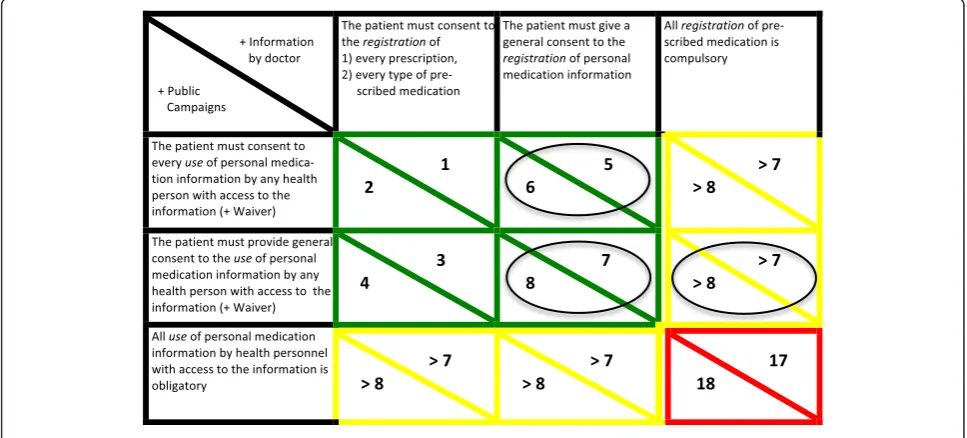
Instead of a generalized consideration of the relative strength of the protection of personal autonomy at these points in the space of values, it seems more interesting in terms of policy considerations to consider more defined points on each of the axes. To illustrate such well-defined points we shall here reconstruct the positions taken by the members of the Danish Council of Ethics in the Council’s report on the Shared Medicine Profile. In the matrix below three well-defined points on both the registration- and use-axes have been picked out together with two points on theinformation-axis (Figure 2).
The matrix contains 18 fields. The circled fields mark the recommendations of members in the Danish Council of Ethics. (The Danish Council of Ethics is not required to reach consensus among its members before making recommendations). The coordinates on the use-axis all state that consent is to the use ‘by any personnel with access to the information’. This amendment is intended to express the view, taken by all members of the Danish Council of Ethics, that only certain groups of health care personnel should have access to the medication informa-tion. In itself the limitation does not strengthen the
P
R
Figure 1The three-dimensional space of informed consent.
protection of personal autonomy. If the patient is to pro-vide consent to any use of medication information, then logically speaking it does not matter if the group of people covered by the consent is given is limited or not. The amendment could be said, however, to strengthen the protection of personal autonomy when considering waivers to the requirement of obtaining consent before use of personal medication information. All members of the Danish Council of Ethics agree that there are situa-tions in which the requirement of obtaining informed consent before use of personal medication information is trumped by other ethical concerns [8]. In those situa-tions, limitations on the groups of people with access to the information could be said to limit or reduce the loss of control over access to the information, and in this sense the limitation implies a strengthening of the pro-tection of personal autonomy as compared to having no limitations.
The Danish Council of Ethics makes three recommen-dations concerning the registration and use of informa-tion. The Council takes two different views on the registration of personal medication information [8]. One group recommends that the patient is given the right to refuse the registration of personal medication informa-tion, i.e. that one-off informed consent must be provided before the registration of personal medication informa-tion. Another group recommends that the registration should be compulsory. On the use of the information the Council members also takes two different views [8]. One group recommends that the patient is to provide consent on every occasion of personal medication infor-mation being retrieved and used. Another group recom-mends that a one-off informed consent is provided to the use of personal medication information to health care personnel other than the patient’s own general practitioner and The National Board of Health. Given the different views on the registration and use we thus end up with the three recommendations of the Council marked by circles in the matrix.
Of special importance is the ranking of each of the fields. The fields are ranked according to the degree of protection of personal autonomy provided. The ranking is marked by both numbers and colouring. The numbers mark the ranking of the relevant field such that the higher the number the weaker the protection of personal auton-omy. The reasoning behind this ranking is key to fully understanding the matrix and it’s implications – and, as we shall see, the reasoning also on a more general level deepens our understanding of how personal autonomy may be interpreted and protected when implementing in-formation systems such as the Shared Medicine Profile.
The weakest protection of personal autonomy–arguably no protection of personal autonomy at all–occurs when both the registration and use of personal medication
information is compulsory and takes place merely on the basis of general, impersonal information about the Shared Medicine Profile. The ranking as 18 is thus straightforward. The ranking as 17 is less evident. However, it seems rea-sonable to claim that the relevant ways in which a patient is informed about the Shared Medicine Profile is less im-portant to the protection of autonomy than being offered the choice of consenting to the registration or to the use of personal medication information as long as the informa-tion about the Shared Medicine Profile is available to the patient, i.e. as long as it is possible to make an informed choice. The choice of giving or refusing consent allows the patient to control the intervention of others into the life of the patient, whereas the relevant ways in which informa-tion about the Shared Medicine Profile is provided affects the degree to which the patient is able to make an informed choice. From these considerations it follows more generally that the difference between informing the patient through public campaigns and through personal encoun-ters with health care professionals in itself implies a differ-ence in ranking of only one place. This explains the difference in ranking between 1 and 2, 3 and 4, and so on– and therefore also in turn the difference between 17 and 18. (Note that in the special cases of the fields 17 and 18 the difference in ranking is also partly explained by the fact that the very act of informing a patient about compulsory registration provides the patient with an opportunity to avoid doctors or to avoid prescriptions. Hence the informa-tion provides a patient with an opportunity to exercise a very limited kind of control).
This line of reasoning could be questioned on various grounds. It may be argued that the way in which infor-mation is provided carries different weight depending on the variant of informed consent, i.e. field, under consid-eration. Thus one could claim that the fields currently ranked <1, 2, 3, 4> should be ranked <1, 3, 2, 4> with the other rankings remaining the same. However, we shall maintain the current ranking–not least because it seems that valid consent before the registration or use of personal information in practice simply cannot be obtained without providing considerable information about the Shared Medicine Profile. Thus the theoretical difference between a health care professional personally informing a patient and information only being provided by public campaigns seems to be reduced significantly when considering the practical circumstances of having to obtain consent.
plans but also, more generally, extend the available courses of action is preferable. The possible models of informed consent found in the matrix provide different degrees of control and possibilities for pursuing the ben-efits associated with the Shared Medicine Profile. Those found in the fields <1,2>, <3,4>, <5,6> and <7,8>−here paired on the basis of the same coordinates on the registration- and use-axes and referred to by their rank-ing–all provide the patient with some control over the registration and use of information while at the same time making it possible for the patient to achieve the po-tential benefits of the implementation of the Shared Medicine Profile, i.e. a better coordination of medication within and across sectors, a faster correction of medica-tion errors and an earlier identificamedica-tion of potential drug interactions.
In the model of informed consent found in the fields <1,2> the patient is given control over the registration of every piece or type of personal medication information. By controlling every piece or type of medication information the patient is given very flexible control over the informa-tion available for use by health personnel, but also and more importantly, the patient is given flexible control over the information potentially abused by health personnel or otherwise lost to third parties. The abuse may happen through people acquiring unauthorized access to the in-formation, but also through health personnel acquiring ac-cess by falsely or unjustifiably claiming a situation to be among the waivers where concurrent patient consent is not necessary. (The Danish Medicines Agency has at this point in the implementation process reported on five cases of unauthorized access to the Shared Medicine Profile [8]). In the fields <1,2> the patient is also given control over the use of personal medication information by a par-ticular health person in a parpar-ticular situation. Again, the control over the use of information by a particular health person in a particular situation makes it a very flexible control. The patient is able to control whom to entrust with personal medication information and when. In total the construction of informed consent found in the fields <1,2> represents a very flexible protection of the patient’s personal autonomy in that it allows the patient to act upon his or her own balancing of the potential benefits and harms from having a specific piece of information regis-tered, and from allowing a specific person to access per-sonal medication information on a particular occasion.
In the model of informed consent found in the fields <3,4> there is a slight weakening of the flexibility in the patient’s control over personal medication information. The patient retains the possibility of weighing benefits and harms associated with having a specific, single piece or type of personal medication information registered, but cannot flexibly control what information a particular person may access on a particular occasion.
In the model of informed consent found in the fields <5,6>, there is also a weakening of the flexibility in the patient’s control. Thus the patient cannot both realise the benefits from registering personal medication infor-mation, and at the same time retain control over what information that is registered. It is simply all or nothing. Control over the pool of information that may be used and abused is, in these fields incompatible with the real-isation of the benefits from registering personal medica-tion informamedica-tion. However, the patient is given control over the use of personal medication information by a particular person on a particular occasion. The reason for ranking these fields, <5,6>, lower than the previous fields, <3,4> and <1,2> , is simply that the combination of values makes it impossible to both gain benefits from registering personal medication information while at the same time retaining a degree of control over the regis-tration and use of personal medication information. Thus <1,2> and <3,4> provides a stronger protection of personal autonomy than <5,6> in virtue of providing flexible control over information in combination with the additional possibility of realising at least some of the benefits associated with the implementation of the Shared Medicine Profile. This argument in favour of the current ranking of the relevant fields obviously presup-poses that it is possible to realise some of the benefits claimed to be associated with the Shared Medicine Pro-file without having to register all of one’s personal medi-cation information. It seems, however, that better coordination of medication within and across sectors, faster correction of medication errors and earlier identi-fication of potential drug interacttions are benefits that may to some degree be achieved without the registration of all personal medication information (cf. below).
The model of informed consent found in the fields <7,8> implies a further weakening of the control over the use of personal medication information as compared to <5,6>. All other constructions of informed consent found in the matrix involve a weakening of the patient’s control over personal medication information by making either the registration or use of personal medication in-formation compulsory. The ranking of these fields will consequently be above 8 and below 17 – the specific ranking may be worked out on the basis of the consid-erations found above.
Discussion
Limits to the requirement of informed consent
previous section in effect leaves us with the question of what reasons there are for implementing any model but the one that provides the patient with the strongest pro-tection of his or her personal autonomy, i.e. <1>. As already mentioned, there are possible reasons for imple-menting a weaker model of informed consent, and it is to the analysis of these we now turn.
Generally speaking any requirement of obtaining informed consent, before the intervention in a patient’s life may be weakened or no longer apply, if one or more of the following is the case:
1) There are insurmountable practical difficulties associated with obtaining consent
2) The patient lacks the competence required to provide consent,
3) There are other ethical concerns trumping the principle of respect for autonomy,
4) The practice of obtaining informed consent in itself undermines the protection of personal autonomy.
It is, for instance, a combination of these considera-tions that is usually taken to justify the common practice of sharing information without consent within the im-mediate group of health care personnel involved in the patient’s care. However, the information sharing in rela-tion to the Shared Medicine Profile is much wider and requires separate analysis and justification.
The practical difficulties associated with the imple-mentation of informed consent clearly hinges on the specific model of informed consent. The models provid-ing the strongest protection of personal autonomy re-quire that consent is obtained on many occasions, whereas the models providing the weakest protection only require a single valid consent. The practical difficul-ties will also depend on the character of the informed consent process. If it is handled as other consent pro-cesses in clinical practice then the health care profes-sional must–on the basis of having informed about the Shared Medicine Profile–direct a request to the patient to provide consent to the registration and use of the patient’s personal medication information. This request could alternatively be put to the patient electronically. The Shared Medicine Profile provides the patient with web access to the entries in his or her profile. An elec-tronic request of consent could be transmitted via the Shared Medicine Profile – and in case the consent is given the transfer of information to the profile and be-tween information systems could be automatically initiated. Whichever way the requirement of informed consent is implemented it seems unreasonable to char-acterise the practical difficulties as insurmountable. Sig-nificant, but surmountable practical difficulties cannot as such rule out any implementation of informed
consent, although they may be relevant to further ethical considerations of whether or not to prioritise the imple-mentation of a given model of informed consent.
In the opinion of some members of the Danish Coun-cil of Ethics the registration and use of personal medica-tion informamedica-tion must be made compulsory for the simple reason“that many patients will find it difficult to grasp the advantages and disadvantages of not being included in the Shared Medicine Profile. In particular this would hold in relation to the group of patients (. . .) undergoing treatment with a variety of medicines (. . .).” [8] In the first general part of this statement the opinion seems to be that people in general do not satisfy stand-ard criteria of decisional competence [27-30] in that they are considered unable to comprehend the consequences for them of being included in the Shared Medicine Pro-file. Unfortunately there is no further elaboration on what particular features of the Shared Medicine Profile that patients are supposedly, unable to grasp. There seems to be little difference between the nature of the intervention into a patient’s life constituted by the im-plementation of the Shared Medicine Profile and other medical interventions for which informed consent is required.
As we briefly discussed above, there are strong ethical reasons for implementing the Shared Medicine Profile. SMP improves conditions for providing medical care in situations of emergency, and more generally leads to bet-ter coordination of medication within and across sectors, faster correction of medication errors,earlier identifica-tion of potential interacidentifica-tions, and reduced waste of resources in the Health Sector. The question remains, however, if the satisfaction of the principles of benefi-cence and justice in the case of the Shared Medicine Profile are inconsistent with respecting and protecting personal autonomy through the implementation of a re-quirement of informed consent, i.e. if we are here faced with a true dilemma.
benefits that may be achieved without full access to the patient’s information. It seems that partial access will– at least to some extent–allow for better coordination of medication within and across sectors, faster correction of medication errors, earlier identification of potential interactions, and also lead to reduced waste of the resources going into the parallel development and main-tenance of separate information systems in the health care sector. Partial access to personal medication infor-mation may be a problem in terms of discovering poten-tial drug interactions solely on the basis of studying medication records in the SMP, but some cases of inter-actions may be detected on the basis of access to less than complete personal medication information.
The second empirical prerequisite of a true dilemma concerns the patient’s actual behaviour in terms of provid-ing consent. If the implementation of the Shared Medicine Profile is to pose a true dilemma, then we must be able to rule out the possibility that adequately informed patients voluntarily choose to consent to the registration and use of their personal medication information. However, there seems to be little evidence of widespread refusal of con-sent– at least in a Danish context. On the one hand, it does seem reasonable to expect that some consent pro-cesses may result in the withholding of consent. On the other hand, it does not seem as if patients generally exhibit a restrictive behaviour in other consent processes in the health sector. The extent to which consent will be refused is thus hard to predict. The point still applies, however, that if we cannot rule out the possibility that people vol-untarily choose to provide consent, then the implementa-tion of the Shared Medicine Profile with a requirement of obtaining informed consent does not necessarily pose a true dilemma.
Although the above considerations of the empirical preconditions of a true dilemma raise some important questions, they also point to a different sense in which the Shared Medicine Profile poses a dilemma. The im-plementation of the Shared Medicine Profile along with a requirement of informed consent isde facto incompat-ible with the maximal satisfaction of the targets of bet-ter coordination of medication, fasbet-ter correction of medication errors,earlier identification of potential drug interactions, and reduced waste of health care resources. In so far as the principles of beneficence and of justice are taken to be requirements of maximal beneficence and justice, then the complete satisfaction of these prin-ciples is incompatible with the satisfaction of the re-quirement of informed consent. If the satisfaction of the principles of beneficence and justice may be gradual or partial, then it clearly is the case that the implementa-tion of the Shared Medicine Profile with a requirement of informed consent is compatible with beneficence and justice.
One might here take the position that both of the empir-ical conditions arede factosatisfied: 1) the benefits of the implementation of the Shared Medicine Profile can only be realised on condition of full access to the personal medication information and patients would generally choose to withhold consent; and 2) that the principles of beneficence and justice are to be the sole principles guid-ing action. Consequently, the Shared Medicine Profile must be implemented with a requirement of compulsory registration and full access to the use of personal medica-tion informamedica-tion. However attractive this posimedica-tion may seem, it conflicts with the strong tradition in the health care sector of giving priority to the protection of personal autonomy in situations that exhibit a significant similarity with this one. Thus it is common practice to accept a patient’s refusal of therapy that medically is considered to be appropriate, and instead provide therapy that is consid-ered to be less adequate, but in accordance with the goals, plans and values of the patient–even in cases where this may lead to increased public costs. This leaves a propon-ent of the position sketched above with two options. Either the ethically relevant difference between clinical practice and the implementation of the Shared Medicine Profile has to be pointed out, or one must argue in favour of restricting the protection of personal autonomy through informed consent in all of these situations.
use. Second, the high frequency with which consent is to be provided. Third the strong desire to acquire the functional-ities constituted by the software. Fourth, the expectation that the conditions of use are not unreasonable. The second factor is highly relevant when considering the possible im-plementation of informed consent discussed previously. If informed consent is required for every registration and use of personal medication information, then a significant num-ber of people will be asked to provide consent rather often. If this model of consent is implemented such that the con-sent is to be provided to health personnel in the course of treatment, then the third and fourth factor are also relevant. The provision of consent may thus be influenced by a de-sire to start or focus upon treatment, and it seems likely that many people will expect the actions suggested by the health personnel–access to the patient’s personal medica-tion informamedica-tion–to be in their best interest. The general conclusion therefore seems to be that at least some of the suggested models of informed consent may lead to the rou-tinisation of the provision of informed consent, and hence to the undermining of the ability of the informed consent to protect personal autonomy. It has to be noted, however, that this argument needs further substantiation. Routinisa-tion ultimately refers to an empirical condiRoutinisa-tion, and there-fore has to be vindicated as such. Note also, that although the argument from routinisation undermines extensive and repeated use of informed consent in the implementation of the Shared Medicine Profile, it is wholly consistent with the assertion of the principle of respect for personal autonomy. Thus one may hold that it exactly is because personal au-tonomy is worthy of protection, that routinisation poses a problem.
Conclusion
In this article we have argued that the implementation of a comprehensive health information system such as the comprehensive, nationwide Danish pharmaceutical infor-mation system known as the Shared Medicine Profile poses an ethical challenge, namely the challenge of balan-cing efforts to effectively gather and disseminate informa-tion in order to prevent harm to the individual and promote a just distribution of health care resources while at the same time respecting the patient’s autonomy.
In the face of this challenge we have considered possible ways of implementing a requirement of informed consent in the running of an information system such as the the Shared Medicine Profile. To clarify the way in which dif-ferent options impact on the protection of personal auton-omywe have developed a general, ethical heuristic for:
1) Constructing possible models of informed consent, and
2) Evaluating these models with respect to their impact on personal autonomy
Finally, we have considered four possible strategies for denying a requirement of informed consent in relation to the implementation of pharmaceutical information systems such as the Shared Medicine Profile. In relation to these four strategies we have argued:
1) That there are no insurmountable practical difficulties involved in implementing a requirement of informed consent
2) That it seems unlikely that patients should lack the competence required to provide consent in relation to the registering and use of personal medicine information
3) That the implementation of pharmaceutical information systems do not necessarily poses a
‘strong’ethical dilemma, and
4) That the implementation of a model of informed consent requiring the patient to provide frequent consent may lead to the routinisation of informed consent
With respect to any future research agenda, the fourth conclusion is of special importance. As argued above the routinisation of informed consent undermines the very ability of informed consent to protect personal auton-omy, and it seems as if routinisation poses a serious threat to a significant sub-set of the models of informed consent considered in this article. As far as we know the notion has not received any attention in the literature on medical ethics as well as within the broader frame-work of ethics and moral philosophy.
Competing interests
The authors declare that they have no competing interests.
Authors’contributions
TP drafted the first version which was then substantially revised with input from SH. Both authors contributed to the writing of the final version, and both approve the final version.
Author details
1
Centre for Applied Ethics and Philosophy of Science, Department of Communication, Aalborg University Copenhagen, A. C. Meyers Vænge, 2450 København SV, Denmark.2University of Manchester, Centre for Social Ethics and Policy, School of Law, Manchester M13 9PL, United Kingdom.3Center for Medical Ethics, Faculty of Medicine, University of Oslo, Oslo, Norway.
Received: 26 April 2012 Accepted: 17 October 2012 Published: 16 November 2012
References
1. Cross M:England sets up task force to hasten use of electronic records. BMJ2006,332(7556):1467.
2. Watson N:Patients should have to opt out of national electronic care records - For.BMJ2006,333(7557):39–42.
3. Halamka JD:Patients should have to opt out of national electronic care records–Against.BMJ2006,333(7557):39–42.
5. Halford S, Obstfelder A, Lotherington AT:Beyond implementation and resistance: hot the delivery of ICT policy is reshaping healthcare. Policy & Politics2009,37(1):113–128.
6. Ministry of Health:Lov om ændring af lov om offentlig sygesikring (Law on changing the law on National Health Service). Copenhagen; 2003. https:// www.retsinformation.dk/Forms/R0710.aspx?id=9727.
7. Ministry of Health:Sundhedsloven (The Health Law). Copenhagen; 2010. https://www.retsinformation.dk/Forms/R0710.aspx?id=130455&exp=1. 8. The Danish Council of Ethics:Det fælles medicinkort. Copenhagen: The
Shared Medicine Profile; 2010.
9. Beauchamp TL, Childress JF:Principles of Biomedical Ethics. Oxford: Oxford University Press; 2001.
10. Feinberg J:Autonomy. InThe Inner Citadel–Essays in Individual Autonomy. Edited by Christman J. Oxford: Oxford University Press; 1989:27–53. 11. Ploug T:The Ethical Significance of Expectations and the Case of Microsoft
Office Accounting.Studies in Ethics, Law, and Technology2010,4(2). 12. Berofsky B:Liberation From Self: A Theory of Personal Autonomy. Cambridge:
Cambridge University Press; 1995.
13. Dworkin G:The Concept of Autonomy. InThe Inner Citadel–Essays in Individual Autonomy. Edited by Christman J. Oxford: Oxford University Press; 1989:54–62.
14. Frankfurt H:Freedom of the Will and the Concept of a Person. InThe Inner Citadel–Essays in Individual Autonomy. Edited by Christman J. Oxford: Oxford University Press; 1989:63–76.
15. Kant I:Groundwork of the Metaphysics of Morals. Cambridge: Cambridge University Press; 1997.
16. Hill TE:The Kantian Conception of Autonomy. InThe Inner Citadel–Essays in Individual Autonomy. Edited by Christman J. Oxford: Oxford University Press; 1989:91–108.
17. Ong LML, De Haes JCJM, Hoos AM, Lammes FB:Doctor-Patient
Communication: A Review of the Literature.Soc Sci Med1995,40(7):903–918. 18. Kreuter MW, Bull FC, Clark EM, Oswald DL:Understanding how people
process health information: A comparison of tailored and non-tailored weight-loss material.Health Psychol1999,18(5):487–494.
19. Koo MM, Krass I, Aslani P:Factors Influencing Consumer Use of Written Drug Information.Ann Pharmacother2003,37:259–267.
20. Zarcadoolas C, Pleasant A, Greer DS:Understanding health literacy: an expanded model.Health Promot Int2005,20(2):195–203.
21. Holm S, Madsen SM:Informed consent in medical research–A procedure stretched beyond breaking point. InThe Limits of Consent. Edited by Corrigan O, McMillan J, Liddell K, Richards M, Weijer C. Oxford: Oxford University Press; 2009:11–24.
22. Appelbaum PS, Roth LH, Lidz CW, Benson P, Winslade W:False hopes and best data: consent to research and the therapeutic misconception. Hastings Cent Rep1987,17:20–24.
23. Elbourne D, Snowdon C, Garcia J:Informed consent Subjects may not understand concept of clinical trials.Br Med J1997,315:248–249. 24. Faden RR, Beauchamp T:A history and Theory of Informed Consent. Oxford:
Oxford University Press; 1986.
25. Featherstone K, Donovan JL:Random allocation or allocation at random? Patients' perspectives of participation in a randomised controlled trial. Br Med J1998,317:1177–1180.
26. Featherstone K, Donovan JL:Why don't they just tell me straight, why allocate it?" The struggle to make sense of participating in a randomised controlled trial.Soc Sci Med2002,55:709–719.
27. Buchanan E, Brock DW:Deciding for Others–The Ethics of Surrogate Decision Making. Cambridge: Cambridge University Press; 1990.
28. Brock DW:Decisionmaking Competence and Risk.Bioethics1991,5:105–112. 29. Buchanan A:Mental capacity, legal competence and consent to
treatment.J R Soc Med2004,97:415–420.
30. Freedman B:Competence, Marginal and Otherwise–Concepts and Ethics.Int J Law Psychiatry1981,4:53–72.
doi:10.1186/1472-6939-13-30
Cite this article as:Ploug and Holm:Pharmaceutical information systems and possible implementations of informed consent -developing an heuristic.BMC Medical Ethics201213:30.
Submit your next manuscript to BioMed Central and take full advantage of:
• Convenient online submission • Thorough peer review
• No space constraints or color figure charges • Immediate publication on acceptance
• Inclusion in PubMed, CAS, Scopus and Google Scholar
• Research which is freely available for redistribution