Context‑aware rule learning
from smartphone data: survey, challenges
and future directions
Iqbal H. Sarker
1,2*Introduction
In recent days, smartphones have become an essential part of our daily life and con-sidered as highly personal devices of individuals. These devices are also known as one of the most important IoT (Internet of Things) devices, because of their capabilities
to interconnect their users with the Internet, and corresponding data processing [1].
Smartphones are also considered as “next generation, multifunctional cell phones that facilitates data processing as well as enhanced wireless connectivity” [2]. The cellular net-work coverage has reached 96.8% of the world population, and this number even reaches
100% of the population in the developed countries [3]. In recent statistics, according to
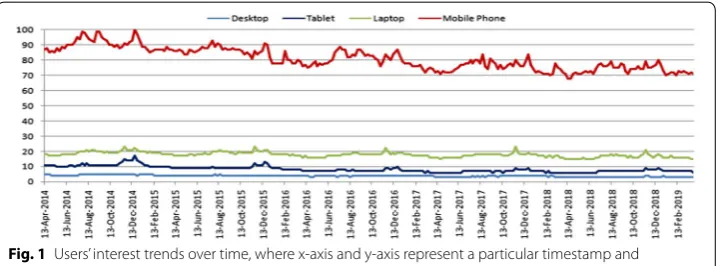
Google Trends [4] we have shown in Fig. 1, that users’ interest on “Mobile Phones” is
more and more than other platforms like “Desktop Computer”, “Laptop Computer” or
Abstract
Smartphones are considered as one of the most essential and highly personal devices of individuals in our current world. Due to the popularity of context-aware technol-ogy and recent developments in smartphones, these devices can collect and process raw contextual data about users’ surrounding environment and their corresponding behavioral activities with their phones. Thus, smartphone data analytics and building data-driven context-aware systems have gained wide attention from both academia and industry in recent days. In order to build intelligent context-aware applications on smartphones, effectively learning a set of context-aware rules from smartphone data is the key. This requires advanced data analytical techniques with high precision and intelligent decision making strategies based on contexts. In comparison to traditional approaches, machine learning based techniques provide more effective and efficient results for smartphone data analytics and corresponding context-aware rule learning. Thus, this article first makes a survey on previous work in the area of contextual smart-phone data analytics and then presents a discussion of challenges and future directions for effectively learning context-aware rules from smartphone data, in order to build rule-based automated and intelligent systems.
Keywords: Smartphone data, Machine learning, Data science, Clustering,
Classification, Association, Rule learning, Personalization, Time-series, User behavior modeling, Predictive analytics, Context-aware computing, Mobile and IoT services, Intelligent systems
Open Access
© The Author(s) 2019. This article is distributed under the terms of the Creative Commons Attribution 4.0 International License (http://creat iveco mmons .org/licen ses/by/4.0/), which permits unrestricted use, distribution, and reproduction in any medium, provided you give appropriate credit to the original author(s) and the source, provide a link to the Creative Commons license, and indicate if changes were made.
SURVEY PAPER
*Correspondence: [email protected] 1 Swinburne University of Technology, Melbourne VIC-3122, Australia
“Tablet Computer” for the last 5 years from 2014 to 2019. Figure 1 represents timestamp information in terms of particular date in x-axis and corresponding search interests in the range of 0 to 100 in terms of popularity relative to the highest point on the chart in y-axis. For instance, a value of 100 (maximum) in y-axis represents the peak popularity for a particular term, while 0 (minimum) means the term was lowest in terms of popu-larity [4].
Due to the advanced features and recent developments in smartphones, these devices can collect raw contextual data about users’ surrounding environment and their
corre-sponding behavioral activities with their phones in a daily basis [5]. As a result,
smart-phone data becomes a great source to understand users’ behavioral activity patterns in different contexts, and to derive useful information, i.e., context-aware rules, for the pur-pose of building rule-based intelligent context-aware systems. A context-aware rule has
two parts, which follows “IF-THEN” logical structure to formulate [6]. The antecedent
part represents users’ surrounding contextual information, e.g., temporal context, spa-tial context, social contexts, or others relevant contextual information and the conse-quent part represents their corresponding behavioral activities or usage. Let’s consider an example of a context-aware mobile notification management system for a smart-phone user Alice. A context-aware rule for such system could be “The user typically dismisses mobile notifications while at work; however, accepts the notifications in the evening from her family members, even though she is in work”. A set of such context-aware behavioral rules including general and specific exceptions, may vary from user-to-user according to their preferences. In addition to the personalized services mentioned above, the relevant context-aware rules in different surrounding contexts could be appli-cable to other broad application areas, like context-aware software and IoT services, intelligent eHealth services, and context-aware smart city services, intelligent cybersecu-rity services etc. utilizing the relevant contextual data of that particular domain. Overall, this study is typically for those data science and machine learning researchers, and prac-titioners who particularly want to work on data-driven intelligent context-aware systems and services based on machine learning rules.
Effectively learning context-aware rules from smartphone data is challenging because of many reasons, ranging from understanding raw data to applications. A number of
research [7–9] has been done on mining context-aware rules from smartphone data for
various purposes. However, to effectively learn such rules for the purpose of building Fig. 1 Users’ interest trends over time, where x-axis and y-axis represent a particular timestamp and
intelligent context-aware systems, a deeper analysis in contextual data patterns and learning according to individuals’ usage is needed. Thus, advanced data analysis based on machine learning techniques, can be used to make effective and efficient decision-making capabilities in different context-aware test cases for smartphones. Several machine learning and data mining techniques, such as contextual data clustering, fea-ture optimization and selection, rule-based classification and association analysis, incre-mental learning for dynamic updating and management, and corresponding rule-based prediction model can be designed to provide smartphone data analytic solutions. The reason is that such machine learning techniques can be more accurate, and more precise for analyzing huge amount of contextual data. The aim of these advanced analytic tech-niques is to discover information, hidden patterns, and unknown correlations among the contexts and eventually generate context-aware rules. For instance, a detailed analysis of time-series data and corresponding data clustering based on similar behavioral pat-terns, could lead to capture the diverse behaviors of an individual’s activities, thereby enabling more optimal time-based context-aware rules than the traditional approaches
[10]. Thus, intelligent data-driven decisions using machine learning techniques can
profit better decision making capability over the traditional approaches while consider-ing the multi-dimensional contexts.
Based on our survey and analysis on existing research, little work has been done in terms of how machine learning techniques significantly impact on contextual smart-phone data and to learn corresponding context-aware rules. To address this
short-coming, this article first makes a survey on previous work in the area of contextual
smartphone data analytics in several perspectives involved in context-aware rules, such as time-series modeling that is also known as a discretization of temporal context, rule discovery techniques, and incremental learning and rule updation techniques, which has been highlighted in our earlier work [6]. After that this article presents a brief discussion on challenges and future directions to overcome these issues. Based on our discussion,
finally we suggest a machine learning based context-aware rule learning framework for
the purpose of effectively learning context-aware rules from smartphone data, in order to build rule-based automated and intelligent systems.
The contributions of this paper are summarized as follows.
• We first make a brief survey on previous work in the area of smartphone data analyt-ics in several perspectives related to context-aware rule learning and summarize the shortcomings of these research.
• We then present a brief discussion on the challenges and future directions to over-come the issues to learn context-aware rules from smartphone data.
• Finally, we suggest a machine learning based context-aware rule learning framework and briefly discuss the role of various layers associated with the framework, for the purpose of building rule-based intelligent context-aware systems.
To the best of our knowledge, this is the first article surveying context-aware rule learn-ing strategies from smrtphone data. The remainder of the paper is organized as follows. “Background: contexts and smartphone data” section presents background information
section surveys previous work in various perspectives related to context-aware rule
learning. “Challenges and future directions” section briefly discusses the challenges and
future directions of research regarding context-aware rule learning from smartphone
data. In “Suggested machine learning based framework” section we suggest a machine
learning based context-aware rule learning framework and discuss various layers with
their roles while learning rules. Context-aware rule based applications
section summa-rizes a number of real world applications based on context-aware rules. Finally, “
Conclu-sion” section concludes this paper.
Background: contexts and smartphone data
This section reviews background information on the main characteristics of contexts and contextual smartphone data that address learning context-aware rules for the pur-pose of building rule-based intelligent systems.
Characteristics of contexts
The term context can be used with a variety of different meanings in different purposes. The notion of context has been used in numerous areas, including Pervasive and Ubiq-uitous Computing, Human Computer Interaction, Computer-Supported Collaborative
Work, and Ambient Intelligence [11]. In this section, first we briefly review what is
con-text in the area of mobile and concon-text-aware computing. In Ubiquitous and Pervasive Computing area, early works on context-awareness referred to context as primarily
the location of people and objects [12]. In recent works, context has been extended to
include a broader collection of factors, such as physical and social aspects of an entity,
as well as the activities of users [11]. Having examined the definitions and categories of
context given by the pervasive and ubiquitous computing community, this section seeks to define our view of context within the scope of smartphone data analytics. As the defi-nitions of context to pervasive and ubiquitous computing area are also broad, this dis-cussion is intended to be illustrative rather than exhaustive.
Several studies have attempted to define and represent the context from different perspectives. For instance, the user’s location information, the surrounding people and objects around the user, and the changes to those objects are considered as contexts by Schilit et al. [12]. Brown et al. [13] also define contexts as user’s locational information, temporal information, the surrounding people around the user, temperature, etc. Simi-larly, the user’s locational information, environmental information, temporal
informa-tion, user’s identity, are also taken into account as contexts by Ryan et al. [14]. Other
definitions of context have simply provided synonyms for context such as context as the environment or social situation. A number of researchers are taken into account the
context as the environmental information of the user. For instance, in [15], the
environ-mental information that the user’s computer knows about are taken into account as con-text by Brown et al., whereas the social situation of the user is considered as a concon-text
in Franklin et al. [16]. On the other hand, a number of other researchers consider it to
be the environment related to the applications. For instance, Ward et al. [17] consider
the state of the surrounding information of the applications as contexts. Hull et al. [18]
environment. The settings of applications are also treated as context in Rodden et al. [19].
According to Schilit et al. [20] the important aspects of context are: (i) where you
are, (ii) whom you are with, and (iii) what resources are nearby. The information of the changing environment is taken into account as context in their definition. In addition to the user environment (e.g., user location, nearby people around the user, and the cur-rent social situation of the user), they also include the computing environment and the physical environment. For instance, connectivity, available processors, user input and display, network capacity, and costs of computing can be the examples of the computing environment, while the noise level, temperature, the lighting level, can be the examples
of the physical environment. Dey et al. [21] present a survey of alternative view of
con-text, which are largely imprecise and indirect, typically defining context by synonym or example. Finally, they offer the following definition of context, which is perhaps now the
most widely accepted. According to Dey et al. [21] “Context is any information that can
be used to characterize the situation of an entity. An entity is person, place or object that is considered relevant to the interaction between a user and an application, includ-ing the user and the application themselves”. Thus, based on the definition of Dey et al.
[21], we can define context in the scope of this work as “Context is any information that
can be used to characterize users’ day-to-day situations that have an influence on their smartphone usage”. An example of relevant contexts could be temporal context, spatial context, or social context etc. that might have an influence to make individuals’ diverse decisions on smartphone usage in their daily life activities.
Contextual smartphone data
We live in the age of data [22], where everything that surrounds us is linked to a data
source and everything in our lives is captured digitally. Mobile or cellular phones have become increasingly ubiquitous and powerful to log user diverse activities for under-standing their preferences and phone usage behavior. For instance, smart mobile phones have the ability to log various types of context data related to a user’s phone call activities about when the user makes outgoing calls, or accepts, rejects, and misses the incoming
calls [23–26]. In addition to such call related meta data, other dimensions of
contex-tual information such as user location [27], user’s day-to-day situation [28], the social
relationship between the caller an callee identified by the individual’s unique phone
contact number [29] are also recorded by the smart mobile phones. Thus, call log data
collected by the smart mobile phone can be used as a context source to modeling indi-vidual mobile phone user behavior in smart context-aware mobile communication
sys-tems [30]. In addition to voice communication, short message service (SMS) is known
as text communication service allows the exchange of short text messages of individual mobile phone users, using standardized communications rules or protocols. According
to the International Telecommunication Union [31], short messages have become a
mas-sive commercial industry, worth over 81 billion dollars globally. The numerous growth in the number of mobile phone users in the world has lead to a dramatic increasing of
spam messages [32]. The SMS log contains all the message including the spam and
non-spam text messages [32, 33], which can be used in the task of automatic spam filtering
With the rapid development of smartphones, people use these devices for using
vari-ous categories of apps such as Multimedia, Facebook, Gmail, Youtube, Skype, Game [9,
34]. Thus, smartphone apps log contains these usage with relevant contextual
informa-tion [8, 9, 35–37]. Such logs can be used for mining the contextual behavioral patterns of individual mobile phone users that is, which app is preferred by a particular user under a certain context to provide personalized context-aware recommendation. In the real world, a variety of smart mobile applications use notifications in order to inform the users about various kinds of events, news or just to send them reminders or alerts. For instance, the notifications of inviting games on social networks, social or promotional emails, or a number of predictive suggestions by various smart phone applications,
e.g., Twitter, Facebook, LinkedIN, WhatsApp, Viver, Skype, Youtube [7]. The extracted
contextual patterns from smartphone notification logs can be used to build intelligent mobile notification management systems according to their preferences.
User navigation in the web in another major activities of individual users. Thus, web log contains the information about user mobile web navigation, web searching, e-mail, entertainment, chat, misc, news, TV, netting, travel, sport, banking, and related
contex-tual information [38–40]. Mining contextual usage patterns from such log data, can be
used to make accurate context-aware predictions about user navigation and to adapt the portal structure according to the needs of users. Similarly, game log contains the infor-mation about playing various types such games such as action, adventure, casual, puzzle, RPG, strategy, sports etc. of individual mobile phone users, and related contextual
infor-mation [41]. The extracted contextual patterns from such logs data, can be used to build
personalized mobile game recommendation system for individual mobile phone users according to their own preferences.
The ubiquity of smart mobile phones and their computing capabilities for various real life purposes provide an opportunity of using these devices as a life-logging device, i.e.,
personal e-memories [42]. In a more technical sense, life-logs sense and store
individ-ual’s contextual information from their surrounding environment through a variety of sensors available in their smart mobile phones, which are the core components of life-logs such as user phone calls, SMS headers (no content), App use (e.g., Skype, What-sapp, Youtube etc.), physical activities form Google play API, and related contextual information such as WiFi and Bluetooth devices in user’s proximity, geographical
loca-tion, temporal information [42]. The extracted contextual patterns or behavioral rules of
individual mobile phone users utilizing such life log data, can be used to improve user experience in their daily life. In addition to these personalized log data, smartphones are
also capable for collecting and processing IoT data [1]. Based on such smartphone data
having contextual information, in this paper, we briefly review the existing rule learn-ing strategies and discuss the open challenges and opportunities by highlightlearn-ing future directions for context-aware rule learning.
Context‑aware rule learning strategies
discovery by taking into account multi-dimensional contexts, such as temporal, spatial or social contexts, and incremental learning to dynamic updating of rules.
Modeling time‑series smartphone data
Time is the most important context that impacts on mobile user behavior for making
decisions [38]. Individual’s behaviors vary over time in the real world and the mobile
phones record the exact time of all diverse activities of the users with their mobile
phones. A time series is a sequence of data points ordered in time [43]. However, to use
such time-series data into behavioral rules, an effective modeling of temporal context is needed. Thus, time-series segmentation becomes one of the research focuses in this study as exact time in mobile phone data is not very informative to mine behavioral rules
of individual mobile phone users. According to [44], time-based behavior modeling is an
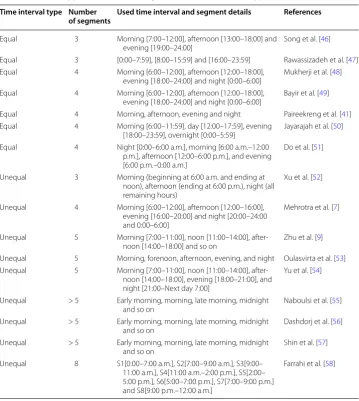
open problem. Hence, we summarize the existing time-series segmentation approaches Table 1 Various types of static time segments used in different applications
Time interval type Number
of segments Used time interval and segment details References
Equal 3 Morning [7:00–12:00], afternoon [13:00–18:00] and
evening [19:00–24:00] Song et al. [46] Equal 3 [0:00–7:59], [8:00–15:59] and [16:00–23:59] Rawassizadeh et al. [47] Equal 4 Morning [6:00–12:00], afternoon [12:00–18:00],
evening [18:00–24:00] and night [0:00–6:00] Mukherji et al. [48] Equal 4 Morning [6:00–12:00], afternoon [12:00–18:00],
evening [18:00–24:00] and night [0:00–6:00] Bayir et al. [49] Equal 4 Morning, afternoon, evening and night Paireekreng et al. [41] Equal 4 Morning [6:00–11:59], day [12:00–17:59], evening
[18:00–23:59], overnight [0:00–5:59] Jayarajah et al. [50] Equal 4 Night [0:00–6:00 a.m.], morning [6:00 a.m.–12:00
p.m.], afternoon [12:00–6:00 p.m.], and evening [6:00 p.m.–0:00 a.m.]
Do et al. [51]
Unequal 3 Morning (beginning at 6:00 a.m. and ending at noon), afternoon (ending at 6:00 p.m.), night (all remaining hours)
Xu et al. [52]
Unequal 4 Morning [6:00–12:00], afternoon [12:00–16:00], evening [16:00–20:00] and night [20:00–24:00 and 0:00–6:00]
Mehrotra et al. [7]
Unequal 5 Morning [7:00–11:00], noon [11:00–14:00],
after-noon [14:00–18:00] and so on Zhu et al. [9] Unequal 5 Morning, forenoon, afternoon, evening, and night Oulasvirta et al. [53] Unequal 5 Morning [7:00–11:00], noon [11:00–14:00],
after-noon [14:00–18:00], evening [18:00–21:00], and night [21:00–Next day 7:00]
Yu et al. [54]
Unequal > 5 Early morning, morning, late morning, midnight
and so on Naboulsi et al. [55] Unequal > 5 Early morning, morning, late morning, midnight
and so on Dashdorj et al. [56] Unequal > 5 Early morning, morning, late morning, midnight
and so on Shin et al. [57] Unequal 8 S1[0:00–7:00 a.m.], S2[7:00–9:00 a.m.], S3[9:00–
11:00 a.m.], S4[11:00 a.m.–2:00 p.m.], S5[2:00– 5:00 p.m.], S6[5:00–7:00 p.m.], S7[7:00–9:00 p.m.] and S8[9:00 p.m.–12:00 a.m.]
into two broad categories; (i) static segmentation, and (ii) dynamic segmentation, that are used in various mobile applications.
Static segmentation
A static segmentation is easy to understand and can be useful to analyze population
behavior comparing across the mobile phone users. In order to generate segments,
recently, most of the researchers (shown in Table 1) take into account only the temporal
coverage (24-h-a-day) and statically segment time into arbitrary categories (e.g., morn-ing) or periods (e.g., 1 h). Such static segmentation of time mainly focuses on time
inter-vals. According to [45], there are mainly two types of time intervals: one is equal and
another one is unequal. For instance, four different time segments, i.e., morning [6:00–
12:00], afternoon [12:00–18:00], evening [18:00–24:00] and night [0:00–6:00] can be an example of equal interval based segmentation because of their same interval length. On the other hand, another four time slots such as morning [6:00–12:00], afternoon [12:00– 16:00], evening [16:00–20:00] and night [20:00–24:00 and 0:00–6:00] can be an example of unequal interval based segmentation. For this example, different lengths of time
inter-val are used to do the segmentation. In Table 1, we have summarized a number of works
that use static segmentation considering either equal or unequal time interval in various purposes.
Although, various time intervals and corresponding segmentation summarized in
Table 1 are used in different purposes, these approaches take into account a fixed
num-ber of segments for all users. However, while performing such segmentation users’ behav-ioral evidence that differs from user-to-user over time in the real world, is not taken into account. Thus, these static generation of segments may not suitable for producing high
confidence temporal rules for individual smartphone users. For instance, N1 number
of segments might give meaningful results for one case, while N2 number of segments
could give better results for another case, where N1 =N2 . Therefore, a dynamic
segmen-tation of time rather than statically generation could be able to reflect individuals’ behav-ioral evidence over time and can play a role to produce high confidence rules according to their usage records.
Dynamic segmentation
As discussed above, a segmentation technique that generates variable number of seg-ments would be more meaningful to model users’ behavior. Thus, dynamic segmenta-tion technique rather than static segmentasegmenta-tion can be used in order to achieve the goal. In a dynamic segmentation, the number of segments are not fixed and predefined; may change depending on their behavioral characteristics, patterns or preferences. Several dynamic segmentation techniques in terms of generating variable number of segments exist for modeling users’ behavioral activities in temporal contexts. A number of authors simply take into account a single parameter, e.g., interval length or base period, to
gener-ate the segments. The number of time segments varies according to this period. If Tmax
represents the whole time period of 24-h-a-day and BP is a base period, then the
num-ber of segments will be Tmax/BP [10]. If the base period increases, the number of time
base period, e.g., 5 min, is assumed as the finest granularity to distinguish day-to-day activities of an individual. If the base period incremented to 15 min, then the number of segments decreases, where 15 min can be assumed as the finest granularity. Thus the number of segments varies based on the base time period. Similarly, individuals’ calen-dar schedules and corresponding time bouncalen-daries can also be used to determine var-iable length of time segments, in order to model users’ behavior in temporal context,
which may vary according to users’ preferences [59]. For instance, one user may have a
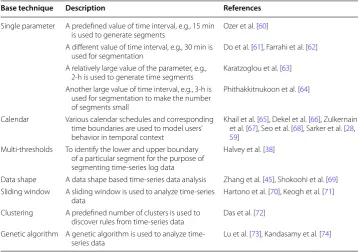
particular event between 1 and 2 p.m., while another may have in another time bound-ary between 1:30 and 2:30 p.m.. Thus, the time segmentation varies according to their daily life activities scheduled in their personal calendars. Similarly, multiple thresholds, sliding window, data shape based approaches are used in several applications, shown
in Table 2. In addition to these approaches, a number of authors use machine learning
techniques such as clustering, genetic algorithm etc. In Table 2, we have summarized
a number of works that use such type of dynamic segmentation techniques in various purposes.
Clustering highlighted in Table 2 is one of the important machine learning
tech-niques in forming large time segments where certain user behavior patterns are taken into account. Usually, clustering algorithms are designed with certain assumptions and favor certain type of problems. In this sense, it is not accurate to say ‘best’ in the
con-text of clustering algorithms; it depends on specific application [75]. Among the
cluster-ing algorithms the K-means algorithm is the best-known squared error-based clustercluster-ing
algorithm [76]. However, this algorithm needs to specify the initial partitions and fixed
number of clusters K. The convergence centroids also vary with different initial points. Sometimes this algorithm is influenced by outliers because of mean value calculation. Table 2 Various types of dynamic time segments used in different applications
Base technique Description References
Single parameter A predefined value of time interval, e.g., 15 min
is used to generate segments Ozer et al. [60] A different value of time interval, e.g., 30 min is
used for segmentation Do et al. [61], Farrahi et al. [62] A relatively large value of the parameter, e.g.,
2-h is used to generate time segments Karatzoglou et al. [63] Another large value of time interval, e.g., 3-h is
used for segmentation to make the number of segments small
Phithakkitnukoon et al. [64]
Calendar Various calendar schedules and corresponding time boundaries are used to model users’ behavior in temporal context
Khail et al. [65], Dekel et al. [66], Zulkernain et al. [67], Seo et al. [68], Sarker et al. [28,
59] Multi-thresholds To identify the lower and upper boundary
of a particular segment for the purpose of segmenting time-series log data
Halvey et al. [38]
Data shape A data shape based time-series data analysis Zhang et al. [45], Shokoohi et al. [69] Sliding window A sliding window is used to analyze time-series
data Hartono et al. [70], Keogh et al. [71] Clustering A predefined number of clusters is used to
discover rules from time-series data Das et al. [72] Genetic algorithm A genetic algorithm is used to analyze
More importantly, the characteristic of this algorithm might not be directly applicable for the purpose of learning context-aware rules. The reason is that users’ behave dif-ferently in different contexts, which also may vary from user-to-user in the real world. Thus, it’s difficult to assume a number of clusters K to capture their diverse behaviors
effectively. Another similar K-medoids method [77] is more robust than K-means
algo-rithm in the presence of outliers because a medoid is less influenced by outliers than a mean. Though it minimizes the outlier problem but the other characteristic mismatches exist between K-means and the problem of time-series modeling.
As the size and number of time segments depend on the user’s behavior and it differs from user-to-user, a bottom-up hierarchical data processing can help to make behavioral clusters. Existing hierarchical algorithms are mainly classified as agglomerative methods and device methods. However, the device clustering method is not commonly used in
practice [75]. The simplest and most popular agglomerative clustering is single linkage
[78] and complete linkage [79]. Another method, nearest neighbor [75], is also similar to the single linkage agglomerative clustering algorithm. All these hierarchical algorithms use a proximity matrix which is generated by computing the distance between a new cluster and other clusters. Then according to the matrix value these algorithms succes-sively merge the clusters until the desired cluster structure is obtained. However, it is not possible to predict the level at which the merging is best according to a proximity matrix because of the variations in users’ behavior. Thus applying such clustering tech-niques could generate the segments according to users’ behavioral patterns available in
time-series. Similarly, genetic algorithm based approaches shown in Table 2 also
pro-duce dynamic segments.
In a summary, we can conclude that time-series modeling in terms of both static seg-mentation and dynamic segseg-mentation approaches discussed above, are able to generate various time segments that can be used in different purposes. However, the above time-series modeling approaches do not necessarily map to the patterns of individuals’ usage according to their preferences, which is based on users’ diverse behaviors over time-of-the-week and may vary from user to user. A machine learning based behavior-oriented dynamic time-series modeling technique by taking into account such patterns, could be significant in order to effectively use temporal context as the basis for discovering rules capturing smartphone usage behavior.
Rule discovery
Another major issue focus in this study is discovering useful behavioral rules of individ-ual mobile phone users based on multi-dimensional contexts, such as temporal, spatial, or social contexts, utilizing their smartphone data. In the area of machine learning both
association rule learning [80] and classification rule learning [81] are the most common
Association rules
Association rule learning algorithm discovers association rules that satisfy the
prede-fined minimum support and confidence constraints from a given dataset [80]. Many
association rule learning algorithms have been proposed in the data mining literature, such as logic based [82], frequent pattern based [80, 83, 84], tree-based [85] etc. Asso-ciation rule learning technique is well defined in terms of rule’s performance, e.g.,
accu-racy, and flexibility as it has the own parameter support and confidence [86]. A number
of researchers [7–9] have used association rule learning technique (e.g., Apriori) [80]
to mine rules capturing mobile phone users’ behavior. However, the existing associa-tion rule learning techniques might not be suitable for discovering users’ behavioral rules because of several reasons. In the following, we summarize the drawbacks of asso-ciation rules for discovering the behavioral rules of individual mobile phone users by taking into account multi-dimensional contexts.
Lacking in understanding the impact of contexts Different contexts in mobile phone data, such as temporal, spatial or social context, may have different impact or influence on the behavioral rules of individual mobile phone users. For instance, incoming phone calls from a significant person, e.g., mother, is always answered by an individual, even though she is in a meeting because of her family priority. In this case, the importance
of social relationship between individuals ( social relationship→mother ) in making
behavioral decision, is higher than other relevant contexts such as time period, weekday or holiday, location, accompany with etc. However, the typical association rule learn-ing technique implicitly assumes all the contexts in the datasets have the similar nature, and/or impact while discovering rules based on multi-dimensional contexts.
Redundancy Association rule learning technique, e.g., Apriori, discovers all the con-textual associations in a given dataset, if it satisfies the user preference, specified as minimum support value and minimum confidence value. As a result, association rule learning technique produces a huge number of redundant rules as it does not take into account the usefulness of a particular context or corresponding patterns while produc-ing the associations. For instance, it produces up to 83% redundant rules for a given
dataset that makes the rule-set unnecessarily large [87]. Therefore, it is very difficult to
determine the most interesting ones among the huge amount of rules generated. As a result, it makes the rule-based decision making process ineffective and more complex,
which is not effective to build a context-aware intelligent system [88].
Computational complexity and high training time In order to produce rules, associ-ation rule learning technique takes huge amount of training time. For instance, in an experimental study in mobile phone domain, the authors observe a high running time spanning several hours when the association rule learning algorithm is used to discover
user behavioral rules [8]. The main reason for taking high training time is that typical
association techniques compute all the possible associations among contexts and are unable to filter the interesting rules that can be used to make effective decisions. As a result the unnecessary generation of patterns increases the computational complexity and training time.
techniques may not suitable to produce users’ behavioral rules in multi-dimensional contexts, for the purpose of building intelligent context-aware systems.
Classification rules
Classification is another technique to discover user behavioral rules from the datasets.
Several classification algorithms exist with the ability of rule generation like ZeroR [89],
OneR [90], RIDOR [89], RIPPER [91], PART [92], DTNB [93], Decision Trees [81, 94] etc. Among these techniques, decision tree is one of the most popular rule-based clas-sification algorithms as it has several advantages, such as easier to interpret; the ability to handle high dimensional data; simplicity and speed; good accuracy; and the ability to
generate human understandable classification rules [95, 96]. In particular, a number of
authors [67, 97–100] have used decision tree classification technique to discover rules
capturing mobile phone users’ behavior for various purposes. However, the exisitng rule-based classification techniques might not be suitable to model users’ behavior because of several reasons. In the following, we summarize the drawbacks of rule-based classifica-tion techniques for discovering the behavioral rules of individual mobile phone users in multi-dimensional contexts.
Low reliability In general, reliability refers the quality of being trustworthy or of per-forming consistently well. A pattern or rule is called reliable, if the relationship described by the pattern occurs in a high percentage of applicable cases. According to Geng et al.
[101], a classification rule will be reliable, if it gives high prediction accuracy, and an
association rule will be reliable, if it has high confidence that is associated to the accu-racy. However, the classification rules discovered by the typical rule-based
classifica-tion techniques, e.g., decision trees, mostly have low reliability in many cases [7, 102].
According to Freitas et al. [86], a classification rule may not ensure a high accuracy in
predictions. The reason is that it may has over-fitting problem and inductive bias, which decrease the prediction accuracy of a machine learning based model.
Lacking in flexibility Traditional rule-based classification techniques, e.g., decision trees, have no flexibility to set users’ preferences and consequently it makes rigid decision
for a particular test case [81]. However, rigid decision in modeling user behavior might
not be meaningful by considering real-world cases. The reason is that individuals’
pref-erences are not static in the real word; may vary from user-to-user [103]. For instance,
one individual may want the phone call agent to decline the incoming calls where she did not answer the calls more than, say, 80% of the time in the past. For another person, this preference could be 95% of the time according to her preference. Thus considering flexibility in users’ preferences while modeling their behavior could be another issue for making meaningful decisions in various context-aware test cases.
Lacking in generalization Typically, generality measures the comprehensiveness of a pattern or rule, that is, the fraction of all the relevant records in the dataset that matches
the pattern. According to Geng et al. [101], if a pattern characterizes more
informa-tion in the relevant dataset, it tends to be more useful and interesting. Tradiinforma-tional clas-sification techniques consider data-driven generalization while producing clasclas-sification rules. Besides this, users’ behavior-oriented generalization might be interested for learn-ing context-aware rules. For instance, users’ behavior might be similar for a collection
generalization could give more precise results for modeling their usage behavior. The generalization not only simplifies the resultant machine learning based model but also minimizes the over-fitting problem and improves the prediction accuracy.
In a summary, by taking into account the reliability, flexibility, and generalization dis-cussed above, typical classification rule learning techniques may not be suitable to pro-duce users’ behavioral rules in multi-dimensional contexts, for the purpose of building intelligent context-aware systems.
Incremental learning and updating
In the area of data mining, a number of updating techniques, known as incremental rule mining, have been proposed for discovering rules in a dynamic database. These tech-niques use existing discovered rules and the incremental part of the dataset to get a
com-plete updated set of rules. For instance, FUP algorithm proposed by Cheung et al. [104]
is the first incremental updating technique for maintaining association rules when new
data are inserted to database. The FUP algorithm is based on Apriori [80] algorithm and
is used to discover the new frequent itemsets in a dynamic database. In [105], Cheung
et al. propose a new algorithm FUP2 which is an extension of FUP algorithm. Another
incremental association rule mining algorithm is proposed by Xu et al. [106]. They
pro-pose an IFP-tree technique which is an extension of FP-tree [85]. Thomas et al. [107]
propose an algorithm based on the concept of negative border which maintains both frequent itemsets and border itemsets.
A few number of algorithms [108, 109] are proposed based on three-way decision that
is an extension of the commonly used binary-decision model with an added third option. A theory of three-way decision is constructed based on the notions of acceptance,
rejec-tion and no commitment proposed by Yao et al. [110]. In [111], Amornchewin et al.
pro-pose a probability-based incremental association rule discovery algorithm. Thusaranon
et al. [112] propose another probability-based incremental association rule discovery
algorithm that is an extension work of the algorithm introduced by Amornchewin and Kreesuradej [111].
The above incremental mining techniques mainly take into account the faster process-ing, e.g., efficiency, of overall mining process. While processprocess-ing, these techniques reduce the scanning on the given datasets by mining the incremental part separately, instead of processing the merged dataset that includes the initial dataset and the incremental part. Thus, the overall mining process of such traditional updating techniques reflects on the processing time to discover a complete set of updated rules. However, to model users’ behavior the freshness of rules, e.g., rules based on recent patterns are significant, which has not been taken into account in these techniques. The reason is that users’ behav-ior are not static in the real world; may change over time. Thus, the updation in terms of freshness in users’ behavior while producing rules are needed to effectively modeling smartphone users’ behavior in relevant multi-dimensional contexts.
In order to produce rules according to the current behavior of an individual, a number of researchers use the behavioral patterns of recent mobile phone log data to predict the future behavior than the patterns derived from the entire historical logs. However, they use a static period of recent historical data that might not meaningful for
phone users’ calling patterns and design a call recommendation algorithm for an adap-tive speed-call list using a recent call list data. In their approach, they extract call logs for previous three months to achieve their goal. In order to predict the outgoing calls,
Barzaiq et al. [114] propose an approach that analyzes mobile phone historical data from
a period of two years and observe relatively additional computational load which seems
to be unnecessary. Phithakkitnukoon et al. [115], conduct their study on reality
min-ing datasets that were collected over the period of nine months and observe that only a recent portion of communication history is more significant. In another work,
Phith-akkitnukoon et al. [116] present a model for predicting phone calls for the next twenty
four hours based on the users’ past communication history. In their approach, they have shown that the recent trend of the user’s calling pattern is more significant than the order one and has higher correlation to the future pattern than the pattern derived from the entire historical data. As such, the latest sixty days call records in the call logs are assumed to be the future observed call activities in order to get better prediction
accuracy [116]. However, such static period of time consideration may not be suitable to
reflect one’ current behavior, as users’ behaviors are not consistent in the real world; may vary from user-to-user over time.
Besides these approaches, a number of authors [117, 118] deal with the problem of
managing personal information, such as individual’s contact lists in their mobile phone, more specifically, the task of searching the desirable contact number when making an
outgoing call. According to Bergman et al. [117], a number of contacts in mobile phones
are never actually used albeit the contact lists become increasingly bigger. Their experi-mental results show that 47% of the contacts of the users had not been used for over
six months or had never been used at all. To predict future behavior, Stefanis et al. [118],
have used window based model for managing and searching of personal information on mobile phones. In their experiment, they have shown that the training window for predicting individual’s mobile phone usages behavior should be long enough to provide sufficient data. However, at the same time, a training window of more than two weeks would likely fail to capture the dynamic changes in the behavioral patterns for making phone calls. In Addition, a training window of less than seven days would fail to capture the behavioral changes for all the days-of-the-week including a change of social circum-stances in the weekends.
In a summary, by taking into account the freshness in rules reflecting users’ current behavior and their dynamic updation, typical updating techniques discussed above may not be suitable to produce a complete set of users’ behavioral rules in multi-dimensional contexts, for the purpose of building intelligent context-aware systems, in order to pro-vide relevant services to the end smartphone users.
Challenges and future directions
section examines the impact of learning context-aware rules on several perspectives dis-cussed in this paper, in the broad area of smartphone data analytics. In the following, the challenges and corresponding future directions are discussed briefly.
In the area of context aware computing, a number of approaches exist in order to handle the continuous contextual features like time-series and to develop time-based context-aware systems. They are mostly designed by taking into account several categor-ical time periods with a particular interval either equal or unequal, and corresponding temporal rule based system. Although, a static modeling of temporal context is easy to understand and can be useful to analyze population behavior comparing across users, a machine learning based data-driven solution could be an effective way. The reason is that we are now in the age of data science and have available real world contextual data-sets in time order due to the rapid growing of IoT and smartphones. Thus, time-series modeling becomes an open problem for building a context-aware system. Although, a few number of learning techniques are employed to create data-driven temporal seg-ments, they can be improved with advanced data analysis like observing variations in temporal patterns, relation with individuals and population behavior, data sparseness in time-series, synchronizing temporal context with multiple data sources etc. Improved machine learning techniques or hybrid methods could give better results for modeling such continuous contextual data. For instance, a dynamic behavior-oriented aggregation
algorithm [10], could produce better time-series segmentation results for the purpose of
modeling time-based user behavior. New machine learning solutions by considering the above mentioned perspectives can be designed and developed to process and analyze real-world time-series data, in order to build an intelligent time-based context-aware system.
In addition to temporal context, additional dimensions of contexts might have the impact on context-aware system. Although, association analysis and rule-based classi-fication analysis are the well known approaches in machine learning to discover rules, still there are some issues to learn context-aware rules using these techniques. For instance, an association learning technique produces a large amount of redundant rules that makes the context-aware system complex and ineffective. On the otherhand, clas-sification techniques produce rules for rigid decision making that becomes non-reliable in many context-aware cases. Thus, effectively learning rules based on multi-dimen-sional contexts becomes another challenge. Although, both the classification and asso-ciation analysis are well established methods in the area of machine learning, improved machine learning techniques or hybrid methods could give better results for learning effective rules based on multi-dimensional contexts. For instance, the problem of redun-dancy while generating the association rules can be minimized by taking into account
the precedence of contexts [119]. Thus, advanced functionality and their combinations
In recent days, rule-based context-aware systems become popular due to the rapid growing of IoT and smartphones. Some of them are static rule based system particularly designed and developed according to the current needs. A number of such rule based context-aware systems are designed by taking into account rules discovered from data using association learning or classification learning techniques. Although, these rule-based systems are capable to provide the relevant services, still there is a lack of system effectiveness in terms of prediction accuracy in a human-centric system. In that case, a machine learning based data-driven solution by taking into account incremental data and corresponding learning could be an effective way. The reason is that human behavior changes over time and the most recent pattern is likely to be more significant than older ones, which can be found from incremental data. Thus, recent patterns based modeling becomes another challenge for building a context-aware system. Although, a number of updating techniques are employed in the area of incremental data mining, they can be improved by taking into account the freshness in behavioral analytics for a
particu-lar context. For instance, a very recent work RecencyMiner [120], could produce
bet-ter prediction results by taking into account recency-based updation for the purpose of modeling user behavior. Thus, new machine learning technique or hybrid learning based solutions by considering advanced functionalities like analyzing dynamic log, behav-ioral patterns changing, context-aware incremental learning, freshness in rules, can be designed and developed to build a human-centric intelligent context-aware system that takes into account their recent activities.
The most important work for intelligent context-aware system is to develop an effec-tive framework that supports for learning context-aware rules. Thus, in such a frame-work, we need to consider advanced data analysis based on contexts using machine learning techniques, so that the rule learning framework is capble to resolve these issues. Thus, a well designed context-aware rule learning framework for contextual smart-phone data and the experimental evaluation is a very important direction and a big challenge as well. In a summary, this paper has uncovered several future directions in
the field of smartphone data analytics and context-aware rule learning. First, additional
study must be performed on the characteristics of smartphone data in terms of asso-ciated and relevant contexts, as the context-aware rules depend on surrounding
differ-ent contexts. Second, the scalability and efficacy of existing analytics techniques being
applied to smartphone data must be empirically examined. Third, new techniques and
algorithms or potential hybrid methods are needed to be designed while learning con-text-aware rules, particularly, in terms of time-series modeling, effective rule discovery based on multi-dimensional contexts, and recency-based incremental learning for
intel-ligent decision making utilizing enormous amounts of smartphone data. Fourth, a range
of empirical evaluation is necessary to measure the effectiveness and efficiency of these
machine learning techniques while comparing with existing techniques. Fifth, more
Suggested machine learning based framework
According to the survey of contextual smartphone data and corresponding rule learn-ing strategies, in this section, we suggest a context-aware rule learnlearn-ing framework based
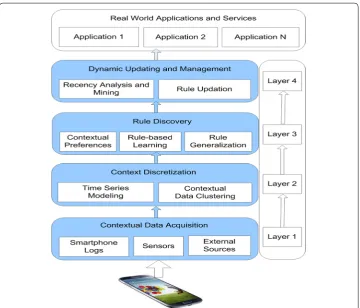
on machine learning techniques. Figure 2 shows an overview of the suggested
context-aware rule learning framework highlighting various components starting from the bot-tom raw contextual data to real world applications and services. The framework typically consists of four processing layers such as contextual data acquisition layer, context dis-cretization layer, rule discovery layer, and finally dynamic updating and management
layer, shown in Fig. 2. In the following, we briefly discuss about these layers and their
roles in learning context-aware rules from smartphone data. These are:
Contextual data acquisition This represents the first layer of our context-aware rule learning framework as collecting relevant data is the first step to build a data-driven sys-tem. Thus, this layer is responsible to collect individual’s smartphone data that includes their daily life activities with their phones and corresponding associated contextual information such as temporal context, spatial context, social context or others relevant to the particular usage. Such contextual data can be collected from various sources like smartphone logs, sensors or external sources relevant to the application. Smartphone data collected from these sources usually contains raw contexts that characterize indi-viduals’ daily life behavioral activities with their phones, and need to process effectively to use as the basis for learning context-aware rules.
Context discretization Machine learning based context discretization represents the second layer in our context-aware rule learning framework. Once we have available con-textual raw data collected from the data acquisition layer, discretization of contexts is needed to understand the actual meaning of data, which is also known as contextual data
clustering, highlighted in Fig. 2. In other words, contextual data with similar
character-istics are grouped in one cluster and dissimilar charactercharacter-istics are grouped in another cluster. For instance, real-world smartphone data contains continuous raw contextual information like time-series data that represents individual’s diverse activities in differ-ent data points in time order. Such particular data points separately may not represdiffer-ent a meaningful behavior of users. A data-driven time-series segmentation using machine learning techniques could give an effective discretization results according to the data patterns available in the source. Thus, the main purpose of this layer is to create contex-tual data clusters, e.g., segments or contexcontex-tual groups according to similar data charac-teristics. The processed data in this layer helps to find the hidden patterns that are used as the basis of learning context-aware rules.
Rule discovery Machine learning based contextual rule discovery represents the third
layer in our context-aware rule learning framework, shown in Fig. 2. As different
con-texts might have different impacts on individuals’ usage behavior in the real world, the precedence analysis of contexts can play a role to discover a set of effective rules,
high-lighted in Fig. 2. Based on the precedence of contexts, this layer is responsible to
gen-erate a set of users’ behavioral rules by taking into account relevant multi-dimensional contexts such as temporal context, spatial context, social context or others relevant. The generated behavioral rules are effective and efficient in terms of reliability that repre-sents higher decision making accuracy, conciseness by taking into account the generali-zation and non-redundancy, context importance by taking into account the precedence of contexts, and lower training time by considering the computing resources in individu-als’ devices. Thus, this layer is responsible to generate a set of contextual rules based on relevant multi-dimensional contexts by taking into account these aspects. After discov-ering rules, this layer is also responsible to rank these rules according to their relevancy in terms of contexts and rule’s strength.
Dynamic updating and management layer Machine learning based dynamic updat-ing and management of the discovered rules represents the final layer in our
con-text-aware rule learning framework, shown in Fig. 2. As individuals’ usage behavior
are not static in the real world, may change over time, the recency analysis and min-ing, and corresponding rule updation can play a role to dynamically update the
dis-covered rules over time, highlighted in Fig. 2. Based on the recent behavioral patters
of individuals’ behavior, this layer outputs a set of users’ behavioral rules by taking into account the relevant contexts. The main benefit of this layer is that it takes into account the most recent pattern that represents the freshness in individuals’ behav-ior in a particular context, which is likely to be more significant than older ones for predicting their future usage. Thus, this layer is one of the significant layers that is responsible to identify the behavioral changing patterns over time, and to update and manage the rules dynamically according to their changes in behavioral activities.
multi-dimensional contexts utilizing their smartphone data. The extracted context-aware rules can be used to build various rule-based intelligent systems, in order to not only provide them the target personalized services that may vary from user to user but also the population services in the relevant application areas.
Context‑aware rule based applications
A context-aware rule based smartphone application represents knowledge in terms of a set of IF-THEN rules, (i.e., if contexts then user behavioral activities or preferences)
that tells what to do or what to conclude in different situations [121] and can act as
a software agent. According to [98], software agent is a new paradigm for developing
software applications in which an agent is capable of performing autonomous actions in a certain environment to achieve it’s goal. The target applications of this research are those context-aware personalized applications that have been studied widely in the past few years. For instance, intelligent mobile interruptions management sys-tem in one of them. The most popular IoT device, smartphones, are considered to be ‘always on, always connected’ device and they are always with their users; however the users are not always able to response with the incoming communications because
of their various day-to-day situations [122]. For this reason, sometimes people are
often interrupted by incoming phone calls in a working environment [123].
Accord-ing to the Basex BusinessEdge report [124], the mobile interruptions consume 28%
of the knowledge worker’s day. It leads to a loss of $700 billion according to Bureau
of Labor Statistics [125]. In order to manage such interruptions, a number of authors
[24, 65–67, 126] have studied on static rule based systems. However, the machine
learning based context-aware rules can be used to make such system automated and intelligent.
Smartphone apps management could be another useful applications for individual users. According to the statistics in Google search, in March 2017, there were 2.8 mil-lion apps available at Google Play Store, and 2.2 milmil-lion apps in the Apple’s App Store. Thus, its very important to manage such kind of huge amount of available applications. Machine learning based context-aware rules can be used to manage these apps accord-ing to individual’s preferences. Besides apps management, several notifications from
dif-ferent apps are potentially annoying to the users and causes disruptions [7, 127, 128].
The reason is that the users might get irritated for such uninterested phone notifications
[129, 130]. Thus, machine learning based context-aware rules can also be applicable to
manage such notifications intelligently.
Smartphone recommendation system is one of the most important needs for the
users. According to [131], the most important feature of a recommender system is its
ability to “guess” a user’s preferences and interests according to their past usage. In gen-eral, the traditional recommender systems mainly focus on recommending the most relevant items to users among a huge number of items without considering contextual
impact [57, 132]. However, the contextual information is needed to recommend
accord-ing to users’ needs [133–135]. For instance, a travel recommender system in the
sum-mer can be well different from the winter for a particular user, which depends on the temporal context. Similarly another context, e.g., location information, might have the
recommendation is important for tourists who travel outside their usual environment
[138]. As traditional information centers for tourists are not accessible any time
any-where [139], a context-aware web service based tourism information system is needed
[140]. Thus, machine learning based context-aware rules can be used to make such
rec-ommendation system more intelligent.
In general, predictive modeling based applications are most important in the area
of machine learning and smartphone data analytics [141]. Thus, the machine learning
based context-aware rules could be more effective to predict user preferences, such as predicting calls [116, 118, 142, 143], predicting apps usage [35, 37, 144, 145], predicting
smartphone notification [129, 130] etc. The context-aware rules can also play a role to
build a self smartphone configuration management system that includes device volume settings, WiFi turn on or off, GPS turn on or off etc. that reduce battery consumption. Overall, the machine learning based context-aware rules extracted from smartphone data can help application developers to build the target intelligent system. In addition to the personalized services discussed above, such context-aware rules in different sur-rounding contexts could be applicable to other broad application areas, like IoT services, eHealth services, transportation services, city governance, industry, e-commerce, con-text-aware cybersecurity intelligence, and smart city services according to the associ-ated contexts for the purpose of providing intelligent services in relevant context-aware applications.
Conclusion
Acknowlegements
The author would like to thank all the reviewers for their rigorous review and comments. The reviews are detailed and helpful to finalize the manuscript. The author is highly grateful to them. The author also would like to thank the admin-istration of Swinburne University of Technology, Melbourne, Australia, for providing the required facilities to do research work and survey in their post-graduate research lab. Finally, the author would like to thank Prof. Jun Han and Dr. Alan Colman, Swinburne University of Technology, Australia, for their helpful guidance.
Authors’ contributions
This article reviews previous work in the area of smartphone data analytics and presents a discussion of open challenges and future directions for context-aware rule learning from smartphone data. The first and corresponding author IHS car-ried out the conception, survey, analysis and design, and prepare this manuscript as well. The author read and approved the final manuscript.
Funding Not applicable.
Availability of data and materials Not applicable.
Competing interests
The author declare that he has no competing interests. Author details
1 Swinburne University of Technology, Melbourne VIC-3122, Australia. 2 Chittagong University of Engineering and Tech-nology, Chittagong, Bangladesh.
Received: 12 July 2019 Accepted: 10 October 2019
References
1. El Khaddar MA, Boulmalf M. Smartphone: the ultimate iot and ioe device. In: Smartphones from an applied research perspective, 2017, p. 137.
2. Zheng P, Ni LM. Spotlight: the rise of the smart phone. IEEE Distrib Syst Online. 2006;7(3):3.
3. International telecommunication union. Measuring the information society. Technical report; 2015. http://www. itu.int/en/itu-d/stati stics /docum ents/publi catio ns/misr2 015/misr2 015-w5.pdf.
4. Google trends. In: https ://trend s.googl e.com/trend s/. 2019.
5. Sarker IH. Mobile data science: towards understanding data-driven intelligent mobile applications. EAI endorsed transactions on scalable information systems, EAI; 2018.
6. Sarker IH. Behavminer: mining user behaviors from mobile phone data for personalized services. In: Proceedings of the 2018 IEEE international conference on pervasive computing and communications (PerCom 2018), Athens, Greece: IEEE; 2018.
7. Mehrotra A, et al. M. Prefminer: mining user’s preferences for intelligent mobile notification management. In: UbiComp, ACM; 2016.
8. Srinivasan VEA. Mobileminer: mining your frequent patterns on your phone. In: UbiComp, ACM; 2014. p. 389–400. 9. Zhu HEA. Mining mobile user preferences for personalized context-aware recommendation. ACM Trans Intell Syst
Technol. 2014;5(4):58.
10. Sarker IH, Colman A, Kabir MA, Han J. Individualized time-series segmentation for mining mobile phone user behavior. Comput J. 2017;61:349–68.
11. Dourish P. What we talk about when we talk about context. Pers Ubiquitous Comput. 2004;8(1):19–30. 12. Schilit BN, Theimer MM. Disseminating active map information to mobile hosts. IEEE Netw. 1994;8(5):22–32. 13. Brown PJ, Bovey JD, Chen X. Context-aware applications: from the laboratory to the marketplace. IEEE Pers
Com-mun. 1997;4(5):58–64.
14. Ryan N, Pascoe J, Morse D. Enhanced reality fieldwork: the context aware archaeological assistant. Bar Int Ser. 1999;750:269–74.
15. Brown PJ. The stick-e document: a framework for creating context-aware applications. Electron Publ. 1995;8:259–72.
16. Franklin D, Flaschbart J. All gadget and no representation makes jack a dull environment. In: Proceedings of the AAAI 1998 spring symposium on intelligent environments, 1998. p. 155–60.
17. Ward A, Jones A, Hopper A. A new location technique for the active office. IEEE Pers Commun. 1997;4(5):42–7. 18. Hull R, Neaves P, Bedford-Roberts J. Towards situated computing. In: Wearable computers, 1997. Digest of papers.,
first international symposium On, IEEE; 1997. p. 146–53.
19. Rodden T, Cheverst K, Davies K, Dix A. Exploiting context in hci design for mobile systems. In: Workshop on Human Computer Interaction with Mobile Devices, Glasgow; 1998. p. 21–2.
20. Schilit B, Adams N, Want R. Context-aware computing applications. In: Mobile computing systems and applica-tions, 1994. WMCSA 1994. First workshop On, IEEE; 1994. p. 85–90.
21. Dey AK. Understanding and using context. Pers Ubiquitous Comput. 2001;5(1):4–7. 22. Cao L. Data science: a comprehensive overview. ACM Comput Surv. 2017;50(3):43.