The Influence Of Attitude, Social Norms On
Adaptation Practices Of Oil Palm Smallholders,
And Mediation Role Of Intention Towards Climate
Change Impact In Malaysia
Norsida Man, Nabara Isah Shehu, Nitty Hirawaty Kamarulzamanand Zulkefly Sulaiman
Abstract: The study examines the influence of attitude, social norms on adaptation practices of oil palm smallholders and mediation role of intention towards climate impact in Malaysia. Using a multistage cluster sampling technique, a total of 397 respondents were chosen. For data collection, a structured questionnaire was used and analyzed using SPSS and AMOS graphics. The study has shown the relationships between the variables using the theory of reasoning Action (TRA). It however, revealed attitude (r = 0.167, P < 0.004), social norms (r = 0.389, P < 0.000), intention (r = 0.163, P < 0.005) and adaptation practice. However, it revealed the contribution of attitude (β= 0.124, p < 0.014), social norms (β = 0.203, p < .000), intention (β = 0.292, p < 000) and adaptation practice. Similarly, the study revealed the mediation role of intention in the relationship between attitude (β = 0.036, LB = 0.007 and UB = 0.086, P = 0.016), social norms (β = 0.059, LB = 0.021 and UB = 0.124, P = 0.059), and adaptation practices at 95% bootstrapped confidence intervals. The study also revealed R2 value 0.45 indicating 45% of the variance explained in adaptation practice. On the other hand, the R2 value for intention 0.32 indicating 32%, of the variance explained in intention. The research concludes that the adaptation techniques of smallholder farmers in Malaysia are promoted socially and psychologically at various levels due to the attitude, social norms and intentions of the smallholder in the adaptation practice. The research, therefore, suggested that the Malaysian Palm Oil Board (MPOB) develop a training model to motivate all interested oil palm farmers with good farming practices (GAP) and weather reporting expertise so that Malaysian oil palm smallholder farmers can enhance their adaptation practices.
Keywords: adaptation, attitude, climate change, oil palm, social norms, smallholder’s theory of reasoning action.
————————————————————
1. Introduction
Climate change is increasing significantly as a critical global development issue that impacts many areas of the globe and is seen as a major issue for sustainable development [1]. Universally, exceptional greenhouse emission increases have resulted in enhanced effects on climate change. After energy consumption and chlorofluorocarbon manufacturing, it has been shown that agricultural activities contribute colossally to climate change. However, discharges are thought to account for about 15 percent of today's ozone-depleting from agricultural sources Changes in land use, often adding another 8% [2].
1.2 Agricultural Adaptation
Adaptation to climate change includes taking the correct procedures by creating suitable modifications and adjustments to decrease the adverse effects of climate change (or abusing the encouraging ones). The [3] relates to adaptation as modifications in natural structures in reaction to real or anticipated climate effects that control threats or take advantage of advantageous possibilities.
It also relates to activities taken by individuals, nations and social rules to adapt to the climate change that has happened. Adaptation has three conceivable goals: to reduce exposure to the risk of harm; to create the capacity to deal with inevitable harm and to take advantage of fresh possibilities. Besides, current Information, attitudes, past conduct and social pressure could be obstacles to adaptation actions as well. Regardless of several adaptation methods to lessen the effect of climate in 2016, FFB and CPO production dropped by 12.2% to 86.33 respectively, the target of 20 million ton of CPO and other palm oil product remain uncertain [4]. The theory of reasoned action is one of the psychological theories of behavioral change to achieve this goal that has been attracted by late consideration and support [5]. TRA allows intentions and behaviors to be predicted and has usually been used in associated sustainability studies [6]. Not many studies, however, address the psychological key drivers of behavioral change in relation to adaptation to climatic threats in particular [7]. Research on the behavioral change assurance of TRA deals primarily with Western societies. In South-East Asia, very few studies have obviously tested the TRA proposals in any region up to this stage. This study addresses, adaptation practices of smallholder towards climate change impacts at the farmer level, which is the essential focal point of this paper. Using the Potential adaptations practices such as mulching, cover crop plant, use of organic matter, soil and water conservation, and crop management practice. In this manner it is fundamental to address adaptation practice consequently, it's transforming into a significant need do to huge increases in the negative impacts of climate change which is feasible in Malaysia. _____________________________
Norsida Man. Department of Agriculture Technology, Faculty of Agriculture, Universiti Putra Malaysia, 43400 UPM Serdang, Selangor, Malaysia. [email protected]
Nabara Isah Shehu. Department of Agriculture Technology, Faculty of Agriculture, Universiti Putra Malaysia, 43400 UPM Serdang, Selangor, Malaysia. [email protected]
Nitty Hirawaty Kamarulzaman. Department of Agribusiness and Bioresource Economics, Faculty of Agriculture, Universiti Putra Malaysia, 43400 UPM Serdang, Selangor, Malaysia. [email protected]
2. Theoretical Framework and Hypotheses
Development.
The theory of reasoned action (TRA) was initially put onward by [8]. Contained by the TRA framework, behavioral intention, which basically decides real behavior, is an additive role of two variables: attitudes (favourable or un favourable assessment of performing a behavior), and subjective norms (perceived impacts that others may have) [9]. An increase in attitude and subjective norms results in a strong intention to accomplish behavior. Attitude is the favorable or unfavorable feeling of a person to conduct accurate behavior. These convictions are called behavioral beliefs. A person will expect to exercise particular behavior when the person in question decides to evaluate it. Attitudes are controlled by a person's conviction about the results of playing out the conduct (behavioral beliefs), weighted by his / her assessment of these effects (evaluations of results). Hence, attitude is the remarkable belief of an individual as to whether the effect of his or her behavior is certain or opposite [9], [10]. Subjective norms are assumed to be a component of the belief that individuals support or are subject to behavior. Beliefs that motivate subjective norms are normative beliefs. Normative social impact is described as encouraging others to imitate us to be appreciated and believed by them [11]. Even though an action may perhaps not be acknowledged by an individual, normative social influence places pressure on one to act in accordance with the social norms. Normative social effect has been displayed to transmit out a high convincing power on individuals. Consequently, the following hypothesis were depicted: There is a significant association between attitude, social norms, intention and adaptation practice: There is significant influence of attitude, social norms, and intentions on adaptation practice. Intention mediates the relationship between attitudes, social norms in a relationship with adaptation practice.
2.1. Research Framework
This study is based on the proposed framework (Figure 1). The framework considers the effect of attitude, social norms and intention on adaptation practice of smallholder farmers. The framework also considers the influence of attitude, social norms and intention on adaptation practices. The mediating effect of attitude and social norms on adaptation practice through intention is also considered.
3. Materials and Methods
3.1 Study Area
The study area is situated 1°North and 6°North in the northern latitude and between 100°E to 103°E longitude. Its nearness to the equator. Malaysia is a multi-racial in nation,
its economic activities range from agricultural and fishing activities up to highly practical industrialized engagement. Regardless of the fact that the industry and services sector take over the country’s economy, about one-third of the inhabitants hang on the agriculture sector for their basis of livelihood and this makeup approximately 3.6% of the country’s GNP (Abas et al., & Halim, 2017).
3.2 Sampling and Data Collection
Multi-stage cluster sampling using a stratified procedure to select the sample was used. A cluster sample normally calls for even more observations than simple random sampling but is regularly more logistically practicable. A stratified random sample essentially necessitates a lesser sample size than simple random sampling, so its plan influence is more promising, for the reason that the impression is to cluster your sample and population such that the inconsistency within each stratum is abridged. In the first step, Malaysia peninsula was grouped into four zones namely East, West and, south North, Then, Kedah, Johor, Perak, and Pahang, were randomly chosen from the zones. However, two districts were randomly selected from each of the selected states which represented the cluster where the smallholder farmers were randomly selected proportionately.
3.3 Variable Measurements
A survey questionnaire was considered to collect primary information for the study. The study’s constructs were adopted from the existing literature. For this study the target population is made up of smallholder oil palm growers in Malaysia. Attitude, social norm, intention and adaptation practice are the variable for the study. The model of structural equation (SEM) has been used to assess the interrelations between three factors. The following sections present the measurement of all variables using a Likert scale. The attitude, social norms, intention, and adaptation practices were all evaluated in this research on 5-point Likert scales (1 = highly disagree with 5 = highly agreed). First, an assessment of confirmatory factor (CFA) was performed. The acceptable levels of construct validity goodness-of-fit (GOF) are the two criteria for validity assessment [13]. Even though diverse studies testified various goodness of fit indices [14], there are quite a lot of goodness-of-fit indices normally used, including normed fit index (NFI), goodness-of-fit index (GFI), root mean square error of approximation (RMSEA), normed Chi-square (X2/df) and, comparative fit index (CFI) [15]. In addition to the importance of construct validity, three indicators must be regarded as standardized factor loadings, average extracted variance (AVE) and construct reliability (CR) [15].
4. Results
4.1 The Measurement Model
significance is usually predictable [13]. The good fit level of CFI, GFI and NFI is generally at 0.95 and, 0.90, in that order [16]. RMSEA can be supported between 0.03 and 0.08 and normed Chi-square equal to or less than 3 is a better fit [13]. The goodness-of-fit indices show a good fit, so it can be proved that the model and the sampled information have a rationally excellent fit. For the model, more indexes, factor loadings, CR and AVE are also needed. The standardized factor loadings should be at least 0.5, however, statistically significant. They help calculate the validity of the constructs. [13]. All standardized factor loadings are statistically important in our model, and most of them are above 0.5 as shown in Table 1. CR and AVE are two indicators of the model's converging validity. CR at 0.6 or higher indicates excellent reliability and an AVE of 0.5 or higher indicates suitable convergence [13]. In our model, the CR values are higher than 0.6 for all constructs and therefore these findings suggest fit reliability.
4.1.1 Hypotheses Testing
The df = 2.304, CFI = 0.922, GFI = 0.927, NFI = 0.971, RMSEA = 0.59 and normed = 0.971) goodness-of-fit indices promote the structural model's suitability. Table 1 shows standardized coefficients of the path resulting from testing the structural model proposed. Most of the structural path coefficients were significant (the eight hypothesized paths were supported) and the indications of the structural path coefficients with the hypothesized associations were constant. The R2 for adaptation practice (ADP) was 45%, which means that all factors studied contributed to about 45% of the variance described in ADP. The R2 for intention INT, on the other side, was 32 percent, which means that all factors contributed to about 32 percent of the variance described in INT.
4.1.2 Relationships between Attitude Social Norms, Intention and Adaptation Practices
Table 2 demonstrates the relationship between adaptation practice and attitude was positive with r = 0.167. The effect size of the relationship is small. Likewise, the squared correlation coefficient is 0.0729 implying over 7.3% of the shared variation. The relationship was found to be significant (p < 0.004). Hypothesis H1 is supported. The relationship between adaptation practice and social norms was significant at P < 0.000). Nonetheless, the effect size is moderate. The relationship is significant at 95% confidence level. Also, the R2 of 0.1521 shows about 15% shared variance between the variables. Hypothesis H2 is supported. Lastly, the relationship between adaptation practice and intention r = 0.163. The effect size is small with the squared correlation coefficient of 0.0841 implying over 8.4% of the shared variation and found to be significant at (P < 0.005) therefore H3 was supported.
4.1.3 Factors Contributing to Adaptation Practices Table 3 displays the three variables contributed positively and significantly to adaptation practice. It reveals that attitude on adaptation practice (β= 0.124, p<0.014), social norms on adaptation practice (β=0.203, p<.000), intention on adaptation practice (β=0.292, p<000), therefore hypotheses H4, H5, and H6 were all supported
4.1.4 Comparison of Mediation Model to Establish the Presence of Mediation
Table 4 shows the presence of mediation. Next is to determine the best model to use. If the χ2 < α, the full mediation model is superior, that is, the IVs has both direct and indirect relationship on the DV. Therefore, we go on to test for mediation if the χ2 > α, direct model is better (Kline,
2010).
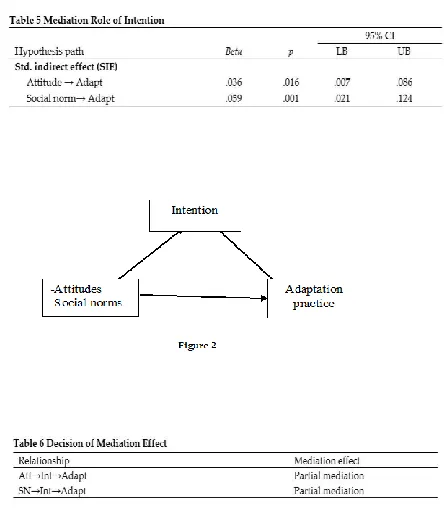
Thus, direct model DF=5, CMIN=163.375, P= 000. Meanwhile the χ2 < α, we head to test for mediation effect of intention on the association between attitude, and social norms on adaptation practice. Lastly, the output offers the bootstrapped confidence intervals (99 and 95 percentiles are considered but we preferred to look at the 95%).
4.1.4 The Mediation Role of Intention
Table 5 Mediation Role of Intention
4.2 Discussion
The result indicates that attitude had a positive and significant influence on adaptation practice, which showed that farmers’ attitudes favored adaptation practices in Malaysia. In particular, it was obvious that it needs a favorable approach from the farming community for the conservation of the environment and specifically for sustainable agriculture [17]. The attitudes of ' declared farmers ' seem to be significant as a predictor of support for adaptation practices. A likely clarification for this could be such adaptation practices require little know-how to implement based on information and training received by the smallholders. This finding was in line with the argument that skills that are observed to be stress-free and that are considered convenient had a higher likelihood of acceptance and use by impending users [18]. [19], find smallholders prior beliefs appear to determine how they process climate change adaptation measures. According to [20], this adverse effect of climate change could improve the impression of being influenced, leading to a change in attitudes. [21], recognized that adaptation methods are subject to the willingness of farmers to adopt innovative practices. This entails that the more favorable attitudes of smallholder farmer towards adaptation practice the better the oil palm output in Malaysia. Similarly, the result revealed that social norms had shown to have a significant influence on adaptation practices. This implies that Social norms have shown to be important among the smallholder farmers, particularly on the use of adaptation practices in Malaysia. However, Social norm was identified as an important predictor of adaptation practices in. This was supported by [22], that social norms had displayed to be vital among farmers, principally in adaptation practices and technologies, therefore it would make sense that they would influence farmers’ adaptation behaviors mostly on the ground and perceptible by neighbors. Further supported by
[23], farmers have disclosed that friends, neighbors or other farmers are their main source of climate impact knowledge towards adaptation practices. Attitudes and social norms are statistically significant predictors that influence farmers' adaptation practices Likewise intention had influence on adaptation practice. This findings was supported by [24] who posits that intentions can influence actual behavior of individuals and groups which in this case adaptation practice of the smallholders. [15], supported the findings as they found positive relationship with intention in farmer’s responses to address adaptation to climate impacts. This findings revealed that smallholder farmers who had the intention towards adaptation practice are more likely to had good oil palm outputs in their plantation than their counterparts. Likewise, when oil palm farmers think that there is a greater probability of climate effect that threatens their production of oil palms, they look for better services to be able to cope, and therefore, they are more likely to adopt adaptation practices. Adaptation practice for farmers also improves when they perceive higher efficiency of adaptation measures and higher capacity for adaptation practice. However, these results also stated that by establishing more networks among smallholder farmers in Malaysia, adaptive capacity can be efficiently facilitated among farmers.
5. Conclusions and Policy Implications
Acknowledgements
The authors would like to recognize Transdicipline Research Grant Scheme for supporting the research. Unambiguously, we want to spread out our thanks to the Malaysian palm oil board (MPOB) as well as Universiti Putra Malaysia (UPM) in providing relevant information for this study.
Reference
[1] World Bank, ―Cities and Climate Change: An Urban Agenda,‖ 2010.
[2] N. Ozor, N. Ozor, and N. Cynthia, ―The role of extension in agricultural adaptation to climate change in Enugu State , Nigeria The role of extension in agricultural adaptation to climate change in Enugu State , Nigeria,‖ no. April, pp. 41– 50, 2015.
[3] IPCC, Summary for Policymakers. 2014.
[4] Sangeetha Amarthalingam, ―MPOB sceptical about 2020 palm oil yield target | The Edge Markets,‖ The Edge Financial Daily, 2017. [Online]. Available: https://www.theedgemarkets.com/article/mpob-sceptical-about-2020-palm-oil-yield-target. [Accessed: 26-Mar-2019].
[5] D. Albarracín and B. T. Johnson, ―Theories of Reasoned Action and Planned Behavior as Models of Condom Use: A Meta-Analysis,‖ Psychol Bull, vol. 127, no. 1, pp. 142–161, 2016.
[6] C. Hackman and A. Knowlden, ―Theory of reasoned action and theory of planned behavior-based dietary interventions in adolescents and young adults: a systematic review,‖ Adolesc. Health. Med. Ther., vol. 5, p. 101, Jun. 2014.
[7] H. Le Dang, E. Li, I. Nuberg, and J. Bruwer, ―Farmers’ assessments of private adaptive measures to climate change and influential factors: A study in the Mekong Delta, Vietnam,‖ Nat. Hazards, vol. 71, no. 1, pp. 385–401, 2014.
[8] T. J. Madden, P. S. Ellen, and I. Ajzen, ―A Comparison of the Theory of Planned Behavior and the Theory of Reasoned Action,‖ Personal. Soc. Psychol. Bull., vol. 18, no. 1, pp. 3–9, Feb. 1992. [9] M. Fishbein and I. Ajzen, Predicting and changing
behavior : the reasoned action approach. 2010. [10] I. Ajzen, ―Martin fishbein’s legacy: The reasoned
action approach,‖ Ann. Am. Acad. Pol. Soc. Sci., vol. 640, no. 1, pp. 11–27, 2012.
[11] E. Aronson, T. D. Wilson, and R. M. Akert, Social psychology. Prentice Hall, 2010.
[12] N. Abas, Z. M. Daud, N. Mohamed, and S. A. Halim, ―Climate change impact on coastal communities in Malaysia,‖ J. Adv. Res. Des. J. Adv. Res. Des. J., vol. 33, no. 1, pp. 1–7, 2017.
[13] S. Cangur, ―Comparison of Model Fit Indices Used in Structural Equation Modeling Under Multivariate Normality,‖ vol. 14, no. 1, 2015.
[14] R. van der Veen and H. Song, ―Impact of the Perceived Image of Celebrity Endorsers on Tourists’ Intentions to Visit,‖ J. Travel Res., vol. 53, no. 2, pp. 211–224, 2014.
[15] J. G. Arbuckle et al., ―Climate change beliefs, concerns, and attitudes toward adaptation and mitigation among farmers in the Midwestern United
States,‖ Clim. Change, vol. 117, no. 4, pp. 943–950, 2013.
[16] J. G. Arbuckle, L. W. Morton, and J. Hobbs, ―Farmer beliefs and concerns about climate change and attitudes toward adaptation and mitigation: Evidence from Iowa,‖ Clim. Change, vol. 118, no. 3– 4, pp. 551–563, 2013.
[17] D’Silva, Jeffrey Lawrence, Bahaman Abu Samah, Hayrol Azril Mohamed Shaffril, and Norsida Man, ―Preservation of the Environment through Sustainable Agriculture Practices : A Case Study on the Attitude of Crop Farmers Jeffrey Lawrence D ’ Silva , Bahaman Abu Samah , Hayrol Azril Mohamed Shaffril and Norsida Man Laboratory of Sustainable Development a,‖ Am. J. Environ. Sci., vol. 7, no. 3, pp. 195–199, 2011.
[18] W. Zeweld, G. Van Huylenbroeck, G. Tesfay, and S. Speelman, ―Smallholder farmers’ behavioural intentions towards sustainable agricultural practices,‖ J. Environ. Manage., vol. 187, pp. 71–81, 2017.
[19] R. A. Howell, S. Capstick, and L. Whitmarsh, ―Impacts of adaptation and responsibility framings on attitudes towards climate change mitigation,‖ Clim. Change, vol. 136, no. 3–4, pp. 445–461, 2016.
[20] M. M. Masud, M. S. Rahman, A. Q. Al-Amin, F. Kari, and W. L. Filho, ―Impact of climate change: An empirical investigation of Malaysian rice production,‖ Mitig. Adapt. Strateg. Glob. Chang., vol. 19, no. 4, pp. 431–444, 2014.
[21] L. Berrang-Ford, J. D. Ford, A. Lesnikowski, C. Poutiainen, M. Barrera, and S. J. Heymann, ―What drives national adaptation? A global assessment,‖ Clim. Change, vol. 124, no. 1–2, pp. 441–450, 2014.
[22] A. S. Mase, B. M. Gramig, and L. S. Prokopy, ―Climate change beliefs, risk perceptions, and adaptation behavior among Midwestern U.S. crop farmers,‖ Clim. Risk Manag., vol. 15, pp. 8–17, 2017.
[23] A. Tripathi and A. K. Mishra, ―Knowledge and passive adaptation to climate change: An example from Indian farmers,‖ Clim. Risk Manag., vol. 16, pp. 195–207, 2017.
[24] I. Ajzen, ―Theory of planned behavior Theory of planned behavior,‖ Soc. Psychol. Ⅰ Soc. Cogn. Soc. Percept., vol. 211, pp. 1–8, 1991.