Study Of The Mechanical Behavior Of Textile
Protective Materials
Lotfi Harrabi, Tarek Abboud, Toan Vu-Khanh, Patricia Dolez, Jaime Lara
Abstract: The aim of this paper is to study the mechanical behavior of knitted fabrics, which are used in protection gloves, at large deformation and different strain rates in terms of extension/recovery cycling. The non linear viscoelastic model, proposed here, is based on the standard solid model. It contains three nonlinear spring and damper elements. The idea is to consider that, by analogy with elastomers, the mechanical behavior of the fabric in terms of hysteresis loop is due to the contribution of two parts: the first one represents the equilibrium state of the fabric and the second one is due to the deviation from this equilibrium. Then, the stress-strain behavior of the fabric at different strain rates can be computed using the same parameters determined at one value of strain rate. A good agreement has been obtained between the experimental and theoretical results.
Index Terms: knitted fabric, protection gloves, hysteresis loop, large deformation, variable strain rate. ————————————————————
1
I
NTRODUCTIONThe application of textile fabrics in engineering design is a very interesting development. For example various knitted, woven and non woven fabrics have been more and more used for technical protective gloves recently. When they are used as reinforcement, the obtained composite materials present various advantages, for example in terms of increased resistance to mechanical risks such as cutting and puncture [1]. Various investigations of the tensile properties of fibrous fabrics can be found in the literature. However, the mechanical behavior of these materials in terms of hystheresis loop at large deformation and at different strain rates has rarely been studied. In 1937, Pierce [2] developed a model in which the constituent yarns were assumed to be sufficiently flexible and the cross sections of yarns to be circular. This model was used to study the mechanical behavior of various woven fabrics [3-7]. As an alternative method, De Jong and Postle [8, 9] developed a mechanistic model based on energy analysis. The first step of this method consists of identifying and formulating all the individual terms of the energy contribution to an elastic system. The energy minimum is determined by means of the optimal control theory, providing the mechanical equilibrium of the system under general conditions of external loads. This model has been used to study several kinds of knitted fabrics [10-13] as well as plain weave structures [14, 15]. Other researchers [16-20] have proposed various models in order to predict the deformation behavior of knitted fabrics. They are generally based on micro-mechanical analyses of a knitted loop in the plain weft-knitted structure where the unit cell is often a single loop. The tensile properties of knitted fabrics are derived from the loop configuration and the yarn properties. However, these analyses are mostly limited to the case of knitted fabrics subjected to biaxial stresses. In addition, most of these models are difficult to apply in practice, due to their complexity.
Kawabata [21, 22] proposed the linearizing method to predict mechanical anisotropy and non linearity in fabrics and knits. This method is based on the assumption that logarithmic plots of stress versus logarithmic values of strain display a linear relationship up to the large strain region close to 100%. The linearizing method is essentially a modification of the linear elastic theory at very small strain. However, most fabrics do not behave linearly, and the slope of the curve in the large strain region is generally steeper than that in the small strain region, with two or three breaking points. To cope with this complicated behavior, Kawabata et al. [21, 22] tried to linearize the stress-strain relationship within two strain zones. They pointed out that double-zone linearization attempts to improve the accuracy of prediction and to expand the validity of this method over a wider range of strains. However, as pointed out by Yamada et al [23] two such clear zone have never been observed for knitted fabrics. More recently, the Finite Element Method was used to study the stress-strain behavior of textile fabrics [24-26]. However, this technique requires long computation times. Finally, taking into account the viscoelastic nature of textiles, rheological models have been used to describe their mechanical behavior. In particular, the 4-element Burger’s model, which is composed of a Maxwell and a Kevin-Voigt model in series, was applied by Webster [27] to the study of stitched seams under longitudinal loading subjected to extension/recovery cycling at a constant rate of extension. Matsuo [28] have used that same model to analyze the stress relaxation behavior of knitted fabrics under uniaxial and strip biaxial excitation. However, the implementation of the Burger’s model for textile applications is rather complicate. In this paper, we propose to apply a non linear and rate-dependant description based on Zener’s rheological model to the study of the mechanical behavior of knitted fabrics in terms of hysteresis loop at large deformation and at different strain rates. This model was initially developed for elastomers deformed in compression by Bergström and Boyce [29]. It is based on the concept that their behavior is controlled by two contributions, the first one corresponding to the equilibrium state and the second one to a non-linear rate-dependant deviation from the equilibrium state. This description was later simplified for the unidirectional treatment of elastomer tensile deformation [30].
_____________________________
Lotfi Harrabi, Tarek Abboud, Toan Vu-Khanh, Patricia
Dolez, Jaime Lara
École de Technologie Supérieure (ÉTS), 1100,
Notre-Dame West, Montréal (Québec) H3C 1K3; Dr Lotfi Harrabi is the corresponding author for this paper : [email protected]
Institut de recherche Robert-Sauvé en santé et en
154
2
E
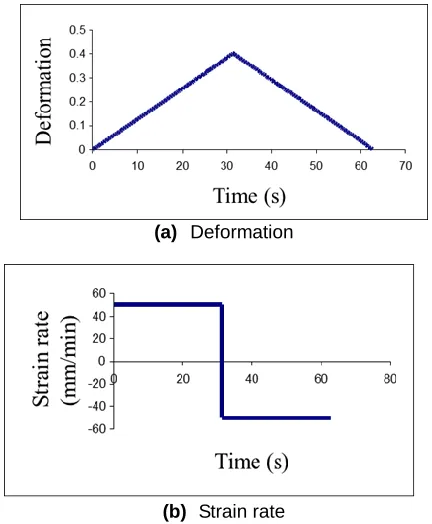
XPERIMENTAL METHODA cotton knit used as support for protective gloves was investigated in this study. Samples were cut in the uncoated liner of Best 4000 P gloves manufactured by the Best Company. Specimens had the shape of 1 x 10 cm rectangular strips. The uniaxial tensile tests at various strain rates were carried out using a MTS mechanical test frame, model Alliance RF/200. Figure 1 displays the time variation of the deformation and strain rate during a 50 mm/min test.
(a) Deformation
(b) Strain rate
Figure 1: Loading-unloading test (strain rate 50 mm/min)
3
T
HEORETICAL MODELThe non-linear viscoelastic model is based on Zener’s standard solid model (see Figure 2). Both springs are non-linear and the time dependence is provided by the damper. It is based on the concept that the hysteresis mechanical behavior of the material can be attributed to the contribution of two parts: the first one represents the equilibrium state and is provided by the spring R1 while the second one is due to the deviation from this equilibrium and is described by the spring R2 and the damper in series.
Figure 2: Schematic representation of the Zener viscoelastic
model
The differential equation corresponding to Zener’s three-element model is provided by Equation (1).
2
1 2
1 2
( )
( ) ( )
( ) ( )
( )
R
R R
R R
E
E E
E E
(1)
Where (R1)
E is the modulus of spring R1, (R2)
E is the modulus
of spring R2 and is the viscosity of the damper, σ is the
stress,
.
is the variation of the stress with time, ε is the strain and is the strain rate. Equation (2) represents the solution of Equation (1) in terms of time variation of the stress for a loading-unloading cycle.
(2) 1
(2) 1 / 2 1
( )
( )
( )
1 / 2 1 / 2
( )
2 ( ) ( )
R
R
E t R
E t R
E t e
t
E t e H t
(2)
With t is the time, is the strain rate,
1 / 2 is the half cycle time and H is the Heaviside function defined by Equation (3).(3)
3.1 Representation of the equilibrium state
The equilibrium state relative to the loading-unloading cycle is provided by the theoretical path laying between the sample loading and unloading curve as shown in Figure 3. It is represented by the mechanical behavior of the part A of the model, i.e. of the spring R1.
Figure 3: Location of the theoretical equilibrium path relatively
to the loading and unloading curves
This equilibrium path can be satisfactorily fitted by the exponential function shown in equation (4).
1 / 2 1 / 2
1 / 2 1 / 2
( ) 0
( ) 1
H t p o u r t
H t p o u r t
R2
1
R
A
B
)
exp( 1
1 )
( 1
R A B
(4)
As a result, the modulus function of the spring R1 used in
equation (2) can be expressed by:
)
exp( 1
1 )
( 1
B A
E R
(5)
3.2. Representation of the deviation from the equilibrium state
The deviation from the equilibrium state is represented by the behavior of the part B of the model, i.e. the spring R2 in series with the damper. In the same way as for the spring R1, the modulus of the spring R2 is described by an exponential function (see equation 6).
)
exp( 2 ( )
2 )
(R2 R2
B A
E (6)
For its part, the damper viscosity can be expressed using the relationship that was established for the case of elastomers [29]. It is based on the application of the Doi and Edoirds reptation motion theory to the network chain segments [29].
2
1 / 2
2
1
3 2
( 1) 1
3 1
m
C C
(7)
Where m , C1 and C2 are three parameters which can be
determined by iteration.
4.
R
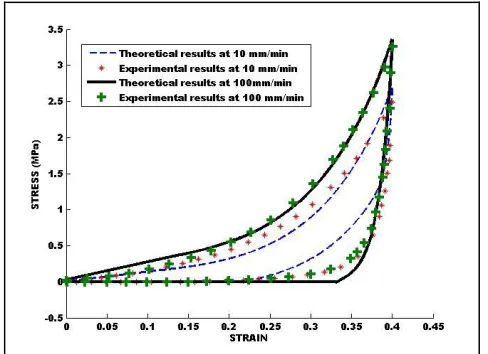
ESULTS AND DISCUSSIONSThe experimental results represented in Figure 4 illustrate the non linear mechanical behavior displayed by the studied knit. They also demonstrate the effect of the strain rate on the hysteresis loop, especially for the loading part of the cycle.
Figure 4: Stress-strain behavior of the knit samples at
different strain rates (10 and 100 mm/min)
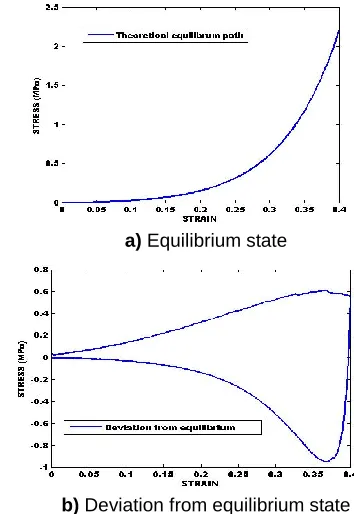
For a given strain rate, we can decompose the hysteresis loop into two curves as shown in the Figure 5. The first one (5.a) represents the equilibrium state of the fabric and is associated with the behavior of the spring R1. The second curve (5.b)
corresponds to the deviation from the equilibrium state and is described by the part B of the model (spring R2 and damper in
series).
a) Equilibrium state
b) Deviation from equilibrium state
Figure 5: Graphic decomposition of the stress-strain behavior
of the knit sample;
The model parameters corresponding to the two springs and the damper are obtained from a loading-unloading test performed at 50 mm/min. They are displayed in Table 1.
Table 1: Model constants provided by a loading-unloading
test performed at 50 mm/min
A good agreement between the experimental data points taken at 50 mm/min and the theoretical description provided by the non-linear viscoelastic model using the constants displayed in Table 1 can be observed in Figure 6.
Figure 6: Comparison of the experimental data points and the
156 The constants displayed in Table 1 and obtained from
measurements performed at 50 mm/min were used to compute the hysteresis loop of the sample knit at others strain rates (10, 25, 75 and 100 mm/min). As shown in Figure 7 for strain rates of 10 and 100 mm/min, a good agreement with the corresponding experimental data points is obtained. This model thus a mean for predicting the hysteresis behavior of knit fabrics over a range of strain rate using a single test performed at an intermediate value.
Figure 7: Comparison of the experimental data points and the
theoretical description computed with Table 1 model constants for the hysteresis loop at 10 and 100 mm/min
5
C
ONCLUSIONIn this paper, we have proposed a non-linear viscoelastic model to predict the stress-strain behavior of knitted textile fabrics at large deformations and different strain rates using the data computed from a single test performed at an intermediate strain rate. The time dependence was satisfactorily described by a spring in series with a damper within Zener’s rheological model. The non-linearity of the knit mechanical behavior is provided by using an exponential function for the two spring modulus of the model. This description corresponds to the concept initially developed for elastomers that the hystheresis behaviour is controlled by two contributions, the first one corresponding to the equilibrium state and the second one to a non-linear rate-dependent deviation from that equilibrium state. This concept was satisfactorily applied here to the case of knitted fabrics with a good agreement obtained between experimental and theoretical results at different strain rates. This model thus provides a simple tool for predicting the hysteresis loop of knitted fabrics at various strain rates from the results of one test carried out at an intermediate strain rate. This approach may eventually also be applied to other kinds of textile fabrics such as woven as well as non woven fabrics.
A
CKNOWLEDGMENTThis research has been supported by the Institut de recherche Robert-Sauvé en santé et sécurité du travail (IRSST). The authors would like to thank Professor Michel Beaudin for his mathematical advices.
R
EFERENCES[1]. Vu-Khanh, T., et al., Gants de protection : étude sur la résistance des gants aux agresseurs mécaniques multiples, in Études et recherches / Rapport R-424. 2005, IRSST: Montréal. p. 86 pages.
[2]. Pierce, F.T., Cloth geometry. Journal of Textile Institute, 1937. 28: p. T45-T112.
[3]. Buisson, Y.L., et al., Qualitative and Quantitative Evaluation of Cotton Fabric Damage by Tumble Drying. Textile Research Journal, 2000. 70(8): p. 739-743.
[4]. Chen, Y., D.W. Loyd, and S.C. Harlock, Mechanical characterestics of coated fabrics. Journal of Textile Institute, 1995. 86: p. 690-700.
[5]. Boong Soo, J., C. So Yeon, and H. Cheol Jae, Structural and Mechanical Properties of Woven Fabrics Employing Peirce's Model. Textile Research Journal, 2003. 73(10): p. 929-933.
[6]. Olofsson, B., A general model of a fabric as a geometric mechanical structure. Journal of Textile Institute, 1964. 55: p. T541-T557.
[7]. Sinoimeri, A. and J.Y. Dréan, Mechanical behavior of the plain weave structure using energy methods: fabric uniaxial extension. Textile Research Journal, 1997. 67(5): p. 370-378.
[8]. De Jong, S. and R. Postle, An introduction to the study of fabric mechanics using energy methods. Textile Inst. Ind, 1977. 15: p. 376-379.
[9]. De Jong, S. and R. Postle, A General Energy Analysis of Fabric Mechanics Using Optimal Control Theory. Textile Research Journal, 1978. 48(3): p. 127-135.
[10]. De Jong, S. and R. Postle, An energy analysis of the mechanics of weft-knitted fabrics by means of optimal control theory, Part I: The nature of the loop-inter-locking in the plain-knitted structure. Journal of Textile Institute, 1977. 68: p. 307-315.
[11]. De Jong, S. and R. Postle, An energy analysis of the mechanics of weft-knitted fabrics by means of optimal control theory, Part II: Relaxed-fabric Dimensions and tensile properties of the plain-knitted structure. Journal of Textile Institute, 1977. 68: p. 316-323.
[12]. De Jong, S. and R. Postle, An energy analysis of the mechanics of weft-knitted fabrics by means of optimal control theory, Part III: The 1 X 1 rib-knitted structure. Journal of Textile Institute, 1977. 68: p. 324-329.
[14]. De Jong, S. and R. Postle, An energy analysis of woven fabric mechanics by means of optimal-control theory, Part I: Tensile properties. Journal of textile Institute, 1977. 68: p. 350-361.
[15]. De Jong, S. and R. Postle, An energy analysis of woven fabric mechanics by means of optimal-control theory, Part II: Pure bending properties. Journal of Textile Institute, 1977. 68: p. 362-369.
[16]. Wei-Liang, W., H. Hiroyuki, and M. Zen-ichiro, Computer simulation of the deformation of weft-knitted fabrics for composite materials. Journal of Textile Institute, 1994. 85(2): p. 198-214.
[17]. Shanahan, W.J. and R. Postle, A Theoretical Analysis of the Plain-Knitted Structure. Textile Research Journal, 1970. 40(7): p. 656-665.
[18]. Whitney, J.M. and J.L.J. Epting, Three-Dimensional Analysis of a Plain Knitted Fabric Subjected to Biaxial Stresses1. Textile Research Journal, 1966. 36(2): p. 143-147.
[19]. MacRory, B.M. and A.B. McNamara, Knitted Fabrics Subjected to Biaxial Stress--An Experimental Study. Textile Research Journal, 1967. 37(10): p. 908-a-911.
[20]. Popper, P., The Theoretical Behavior of a Knitted Fabric Subjected to Biaxial Stresses. Textile Research Journal, 1966. 36(2): p. 148-157.
[21]. Kageyama, M., S. Kawabata, and M. Niwa, The validity of a ‘’linearizing method’’for prediction the biaxial-extension properties of fabrics. Journal of Textile Institute, 1988. 79(543).
[22]. Kawabata, S., et al. Validity of the ''Linearizing Method'' for describing the biaxial stress-strain relationship of textiles. in Proc. UMIST Int. Conf., Textiles, Engineered for Performance,. 1998. Manchester, U.K.
[23]. Yamada, T., N. Ito, and M. Matsuo, Mechanical Properties of Knitted Fabrics Under Uniaxial and Strip Biaxial Extension as Estimated by a Linearizing Method. Textile Research Journal, 2003. 73(11): p. 985-997.
[24]. Boisse, P., et al., Meso/macro-mechanical behaviour of textile reinforcements for thin composites. Composites Science and Technology, 2001. 61(3): p. 395-401.
[25]. Tarfaoui, M., J.Y. Drean, and S. Akesbi, Predicting the stress-strain behavior of woven fabrics using the finite element method. Textile Research Journal, 2001. 71(9): p. 790-795.
[26]. Gasser, A., P. Boisse, and S. Hanklar, Mechanical behaviour of dry fabric reinforcements. 3D simulations versus biaxial tests. Computational Materials Science, 2000. 17(1): p. 7-20.
[27]. Webster, J., R.M. Laing, and R.L. Enlow, Effects of Repeated Extension and Recovery on Selected Physical Properties of ISO-301 Stitched Seams: Part II: Theoretical Model. Textile Research Journal, 1998. 68(12): p. 881-888.
[28]. Matsuo, M., T. Yamada, and N. Ito, Stress Relaxation Behavior of Knitted Fabrics under Uniaxial and Strip Biaxial Excitation as Estimated by Corresponding Principle between Elastic and Visco-Elastic Bodies. Textile Research Journal, 2006. 76(6): p. 465-477.
[29]. Bergstrom, J.S. and M.C. Boyce, Constitutive modeling of the large strain time-dependent behavior of elastomers. Journal of the Mechanics and Physics of Solids, 1998. 46(5): p. 931-954.