1963
Exploration Of Technique Involved In Image
Retrieval Through Local Binary Pattern
Aman Dureja, Ajay Dureja, Salil Abrol
Abstract— The performance of Image Based Image Recovery Systems (CBIR) is based on efficient extraction of features and accurate retrieval of
similar images. Crime prevention, medical imaging, weather forecasting, surveillance, historical research and remote sensing are the few areas where CBIR technology is used. Here, content refers to the visual information of an image such as texture, shape and color. Image content is richer in information used for effective retrieval as compared to text-based image retrieval. In this document, we suggest a method of content-based integration and retrieval based on content to extract color properties and texture properties. To extract the color properties, the color moments (CM) are used in the color image, and the texture properties are extracted and a local binary pattern (LBP) is created in the grayscale image. Then, the color and texture properties in the image combine to form a single vector of features. Finally, the similarities are compared through Euclidean distance, and the feature vectors are compared to the database image with the query image. LBP can be used to identify the face. However, using LBP as a natural image is impressive. This integrated approach provides an accurate, efficient and less complex search system.
Index Terms— CBIR, feature extraction, color moment, local binary pattern.
————————————————————
1
I
NTRODUCTIONUsually two techniques are used to search and retrieve images. First one is text information based on manual completion. This is called concept-based or text-based image indexing. Humans describe and evaluate images based on their content, titles, or background information. However, rendering images using text is labor intensive and can be expensive, cumbersome and time consuming. To overcome the cons of text-based methods, content based image retrieval (CBIR) technology is used. The CBIR system automatically indexes images by visualizing valuable features such as color, texture, and shape. These features are extracted automatically from the image. In this paper, we present an interactive similar image retrieval system and evaluate most effective color or texture feature in expressing the similarity of color images. Our preliminary results show that the color histogram descriptor is not a valid feature as it does not consider the spatial information of the image pixels. Therefore, different images can have similar color distributions. In addition, our results show that the characteristics of the symbiosis matrix get more relevant images than those of other colors and textures. In addition, color-based image search should be used in the CBIR system to improve accuracy. In content-based image retrieval systems, color and texture features are extracted and clustered to group similar feature vectors, and sample images are extracted from each image set. In CBIR, each image stored in the database extracts its characteristics and compares them to the characteristics of the query image. Below mentioned are the main steps to perform:
Feature extraction is the process of extracting image features into distinguishable ranges.
Second step is Matching which involves matching these features to get visually similar results.
2 LITERATURE REVIEW
The performance evaluation of the research image retrieval method and the proposed method was performed using parameters such as sensitivity, specificity, search score, error rate, and accuracy [1]. In this image retrieval system, the extraction is based on an averaging method of image clustering, and the averaging algorithm is modified to reduce the extraction complexity and efficiency [2]. The Gabor wavelet transform is primarily a combination of image features, and the
1964 Zeng et al. [19] propose a fuzzy rough set method for hybrid
information system (HIS) incremental feature selection for storing information in dynamic and mixed environments and can handle different kinds of data We proposed a new Hamming distance. And it applies to the Gaussian core. The FRS updates features as new features are added and old features are removed. In order to provide valuable knowledge in these areas, clustering has been successfully applied to the analysis of data sets from multiple areas such as image processing, pattern recognition, microarray data analysis in bioinformatics. Kultur et al. [20]. One of the most widely used fuzzy clustering methods is the fuzzy C-means (FCM) algorithm [21]. Several parallelization processes have been performed in the FCM algorithm literature to process large data sets. In [22], a clustering method called fuzzy minimum has been redefined to enhance the classification of large data sets. They found parallel fuzzy minimum (PFM) has linear acceleration as compared to its serial counterpart and maintains very good classification quality. Havens [23] extended the FCM cluster to very large data. They compared methods based on sampling, and then compared non-iterative expansion and incremental techniques. This provided a sample-based approximation of the continuous subset of data and the core version of FCM, including three proposed algorithms. In addition, a series of recommendations for using various large-scale FCM clustering solutions were presented. Kwok [24] propose an algorithm called Parallel Fuzzy C-Means (PFCM) used to run on a Message Passing Interface (MPI) and a mandatory single program multiple data (SPMD) model type parallel computer. did. PFCM clusters large data sets and evaluates parallelization capabilities and quantifiability. In [25], a PFCM algorithm for image segmentation is proposed, the sequential algorithm is evaluated by minimizing the need for processor-to-processor segmentation calculations and access to external storage, and the image segmentation task is enhanced There is. Performance and Effectiveness [26] proposes an effective way to cluster all image data points at once. Grayscale histograms are used in the FCM algorithm to minimize segmentation time and space requirements. Then a parallel approach is applied to further reduce the computation time.
2.1 Research Gap
As find from the study of the above survey papers. The CBIR achieved from the various technique like C-Mean, Gabor Wavelet Transform, Message Passing Interface (MPI), Mandatory Single Program Multiple Data (SPMD) etc. They all performed well to retrieval of image. A perfection of retrieval capacity must be improve. Retrieval from various images also need some easy tools for user need.
3 M
ETHODOLOGYIn this paper, we introduce an image feature extraction method using content-based image retrieval. To detect the content of images, like color textures and images is the main goal, but in most cases, content-based image search methods are slow in searching images and produce noise. Thus, in connection with this, a new method has been proposed which eventually will result in the proper extraction of the image features (i.e. colors, textures and shapes). There are two types of image retrieval techniques based on texture-based image retrieval, and content-based image retrieval techniques based on
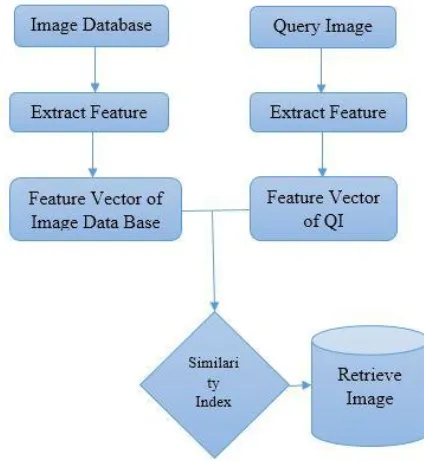
parameters whose color, texture and shape simply describe the image. CBIR requires multiple features to be used, as many images need to be described with a large number of features to include visual patterns, surface attributes of color images, and complete descriptions of texture scene images. A simple flow chart of the proposed system is shown below. The basic concepts of content-based search are divided into three parts: feature extraction, feature matching, and search system design. It is also necessary to organize the large number of images generated by CBIR properly.
Figure 1. Block Diagram of CBIR system
The basic concepts of content-based search are divided into three parts: feature extraction, feature matching, and search system design. It is also necessary to properly organize the large number of images generated by CBIR.
Flow of design
The CBIR technology has the following steps are given below:
Create a Database
Create or save several image databases to prepare your own database as a test or embedded database.
Query Image
The query or save multiple image databases and prepare your own as a test database or embedded database.
Features Extraction
Extract important functions such as colors, textures and shapes from query images and database images.
Feature Matching
The contents of the question image and the database image are measured, and the corresponding image is retrieved from the database based on the checked content and the features closed in the input image.
Retrieve Image
1965 3.1 Image retrieval Based on color Features
Color is the most important content of color images and the most extensive visual content. In this type of feature, the proportion of pixels of a particular color in the image is identified. It is a three-dimensional vector. Color images are usually RGB, Y-Cb-Cr, HSV, HSI, etc., based on color coherence vectors, color histograms, color moments, and various color descriptors of the color correlation map.
Segmentation
The feature extraction from the captured image can be performed using many techniques available. In this article, we use super pixel segmentation to make the system more robust.
3.2 Image retrieval Based on Texture Features
The texture is an important feature in images for pattern recognition. Texture similarity can be used to create differences between image areas having similar colors. Textures are like sky, leaves, and the sea. Textures fall into two categories: statistics and structures. Local texture descriptors are Gabor Transform and Tamura.
3.3 Image retrieval Based on Shape Features
The shape is simply that the edges of the edges in the image represent a sudden change in the pixel density of the image. There are various types of edge detection techniques, such as canny, sobel, prewitt and Robert edge detection techniques.
4 ALGORITHM
Set ID for Image Create Data base DBConvert the image into binary source Convt = Bin (Images I ˅ N);
Apply FE [] = ( Image ID) ˅ N; Img [m,n]= FE [];
Sim [] = Min { Img[m,n], QI [m,n] }; If
Sim[] <= min []; Show the Retrival ID
5 I
MPLEMENTATIONAs described in previous section, many techniques have been introduced to reduce the semantic gap and obtain similar images. However, there is still room for improvement. Get irrelevant images and related images. It is difficult to implement techniques to zero out irrelevant image searches. However, you can reduce this possibility and try to design techniques using the most relevant image search. To achieve this goal, we merge with the technology described below. The proposed technology constructed through MATLAB-2013 is as follows.[23]
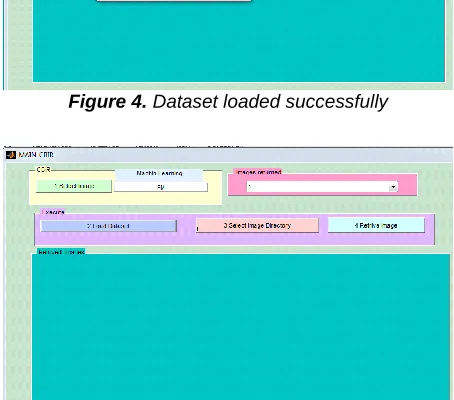
Figure 2. Basic GUI
Figure 3. Select image then load dataset of images
Figure 4. Dataset loaded successfully
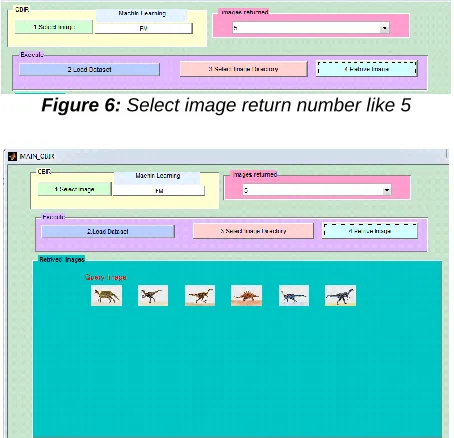
1966 Figure 6: Select image return number like 5
Figure 7. After retrieve image get five images from dataset similar to query image
This figure describes the step wise execution for the image retrieval solution using the CBIR methodology.
5 CONCLUSION
In this paper, we propose a method for content-based image retrieval. This is an integrated way to extract color and texture features from an image. A single function may not produce the accurate result. Thus, multi-feature extraction is more beneficial for performing image retrieval. In order to extract color features, higher-order color moments, i.e. color descriptors, are used. LBP is used to extract a texture, which is a texture descriptor. Local binary mode is mainly used for face recognition. This reuses LBP on natural images to extract textures.
REFERENCES
[1] Manpreetkaur, Neelofarsohi “A Novel Technique For Content Based Image Retrieval Using Color, Texture and Edge Features”, international conference on Communication and electronics system (ICCES), IEEE, 2017
[2] K.B.A.B. Chathurika, P.K.S.C. Jayasinghe, “A Revised Averaging Algorithm For An Effective Feature Extraction In Component-Based Image Retrieval System”, International Advance Computing Conference (IACC). IEEE, 2015.
[3] AnushaYalavarthi, K. veeraswamy, K. AnithaSheela, “Content Based Image Retrieval Using Enhanced Babor Wavelet Transform”, International Conference On Computer, Communications And Elelctronics. IEEE, 2017 [4] Ms. Sandhya R. Shinde, Ms. SonaliSabale, Mr. Siddhant
Kulkarni, Ms. Deepti Bhatia, “Experiments On Content Based Image Classification Using Color Feature Extraction”, International Conference On Communication, Information And Computing Technology (ICCICT), Jan. 16-17, IEEE, 2015.
[5] Marouane Ben Haj Ayech, Hamid Amiri, "Content Based Image Retrieval In The Topic Space Using SOM And LDA“3rd, International Conference On Content
Engineering And Information Technology (CEIT), 2015 [6] Jensen, R. & Shen, Q. (2004). Fuzzy-rough attribute
reduction with application to web categorization. Fuzzy Sets and Systems, 14, 469– 485.
[7] Bhatt, R. B. & Gopal, M. (2005). On fuzzy-rough sets approach to feature selection. Pattern Recognition. Letters, 26, 965–975.
[8] Hu, Q. H., Yu, D. R., Xie, Z. X., & Liu, J. F. (2006). Fuzzy probabilistic approximations spaces and their information measures. IEEETransactions on Fuzzy Systems, 14, 191– 201.
[9] Hu, Q. H., Yu, D. R., & Xie, Z. X. (2006). Information-preserving hybrid data reduction based on fuzzy-rough techniques. Pattern Recognition Letters, 27, 414–423. [10]Aboul Ella Hassanien (2007). Fuzzy rough sets hybrid
scheme for breast cancer detection. Image and Vision Computing, 25, 172–183.
[11]Chen, D. G., Hu, Q. H., & Yang, Y.-P. (2011). Parameterized attribute reduction with Gaussian kernel based fuzzy rough sets. Information Sciences, 181, 5169–5179.
[12]Cornelis, C., Jensen, R., Hurtado, G., & Ślȩzak, D. (2010). Attribute selection with fuzzy decision reducts. Inf. Sci., 180, 209–224.
[13]Zhao, S. Y., Tsang, E. C. C., & Chen, D. G. (2009). The model of fuzzy variable precision rough sets. IEEE Transactions on Fuzzy Systems, 17, 451–467.
[14]Qian, Y. H., Wang, Q., Cheng, H. H., Liang, J. Y., & Dang, C. Y. (2015). Fuzzy-rough feature selection accelerator. Fuzzy Sets and Systems, 258, 61–78..
[15]Zeng, A. P., Li, T. R., Liu, D., Zhang, J. B., & Chen, H. M. (2015). A fuzzy rough set approach for incremental feature selection on hybrid information systems. Fuzzy Sets and Systems, 258, 39–60.
[16]Yiğit Kültür, Mehmet Ufuk Çağlayan, “A Novel Cardholder Behavior Model for Detecting Credit Card Fraud,” 9th International Conference on Application of Information and Communication Technologies, 14-16 October 2015, Rostov-on-Don, Russia, pp 148–154. (DOI:10.1109/ICAICT.2015.7338535)
[17]Bezdek, J. C. (1981). Pattern Recognition with Fuzzy Objective Function Algorithm. New York, NY: Plenum Press.
[18]Timón, Isabel, Soto, Jesús, Pérez-Sánchez, Horacio, & Cecilia, José M. (2016). Parallel implementation of fuzzy minimals clustering algorithm. Expert Systems with Applications, 48(15), 35–41.
[19]Havens, T. C., Bezdek, J. C., Leckie, C., Hall, L. O., & Palaniswami, M. (2012). Fuzzy c-means algorithms for very large data. IEEE Transactions on Fuzzy Systems, 20, 1130–1146.
1967 [21]Rahimi S, Zargham M, Thakre A, and Chhillar D. (2004).
“A parallel fuzzy c-mean algorithm for image segmentation”, In Proceedings of the IEEE annual meeting of the fuzzy information, Processing NAFIPS’04, pp. 234– 237.
[22]Ravi A, Suvarna A, DSouza A, Reddy, G. R. M, et al. (2012). “A parallel fuzzy c means algorithm for brain tumor segmentation on multiple MRI images”, In Proceedings of international conference on advances in computing, Springer India, pp. 787–794.
[23]Sonika, Dureja, A. (2019). Enhancing the CBIR Technique for Image Analysis through Machine Learning Algorithm. Journal of Emerging Technologies and Innovative Research (JETIR), 6(5), 157-160.
AUTHOR’S PROFILE
AMAN DUREJA PURSUING PH.D. FROM GGSIPU, DWARKA, NEW DELHI. HE PURSUED MASTER OF TECHNOLOGY FROM PDM COLLEGE OF ENGINEERING, MDU UNIVERSITY IN YEAR 2010. HE PURSED BACHELOR OF TECHNOLOGY FROM BHIWANI INSTITUTE OF TECHNOLOGY & SCIENCES, MDU IN YEAR 2007. HE IS CURRENTLY WORKING AS ASSISTANT PROFESSOR IN DEPARTMENT OF COMPUTER SCIENCE & ENGINEERING, PDM UNIVERSITY SINCE 2010. HE HAS PUBLISHED MORE THAN 20 RESEARCH PAPERS IN REPUTED INTERNATIONAL JOURNALS INCLUDING SCOPUS INDEXED AND CONFERENCES INCLUDING IEEE AND IT’S ALSO AVAILABLE ONLINE. HIS MAIN RESEARCH WORK FOCUSED ON MACHINE LEARNING & DEEP LEARNING . HE HAS 9 YEARS OF TEACHING EXPERIENCE AND 5 YEARS OF RESEARCH EXPERIENCE.
AJAY DUREJA PURSUING PH.D. FROM DCRUST, MURTHAL, SONEPAT. HE PURSUED MASTER OF TECHNOLOGY FROM PDM COLLEGE OF ENGINEERING, MDU UNIVERSITY IN YEAR 2010. HE PURSED BACHELOR OF TECHNOLOGY FROM BHIWANI INSTITUTE OF TECHNOLOGY & SCIENCES, MDU IN YEAR 2007. HE IS CURRENTLY WORKING AS ASSISTANT PROFESSOR IN DEPARTMENT OF COMPUTER SCIENCE & ENGINEERING, PDM UNIVERSITY SINCE 2010. HE HAS PUBLISHED MORE THAN 20 RESEARCH PAPERS IN REPUTED INTERNATIONAL JOURNALS INCLUDING SCOPUS INDEXED AND CONFERENCES INCLUDING IEEE AND IT’S ALSO AVAILABLE ONLINE. HIS MAIN RESEARCH WORK FOCUSED ON INTERNET OF VEHICLES, MANET AND IMAGE PROCESSING. HE HAS 9 YEARS OF TEACHING EXPERIENCE AND 4 YEARS OF RESEARCH EXPERIENCE.
SALIL ABROL PURSUED MASTER OF TECHNOLOGY FROM PDM UNIVERSITY IN YEAR 2019. HE PURSUED HIS BACHELOR OF TECHNOLOGY FROM PDM COLLEGE OF ENGINEERING, MAHARISHI DAYANAND UNIVERSITY, ROHTAK IN YEAR 2017. HE IS CURRENTLY WORKING AS ASSISTANT PROFESSOR IN DEPARTMENT OF COMPUTER SCIENCE AND ENGINEERING, MERI COLLEGE OF ENGINEERING AND TECHNOLOGY, MAHARISHI DAYANAND UNIVERSITY, ROHTAK. HE HAS PUBLISHED 1 RESEARCH PAPER IN REPUTED INTERNATIONAL JOURNAL WHICH IS AVAILABLE ONLINE. HIS