© 2017 IJSRST | Volume 3 | Issue 1 | Print ISSN: 2395-6011 | Online ISSN: 2395-602X Themed Section: Science and Technology
Comparative Study of RCC and Composite Structures with Soft Storey using
ETABS
G. Dilip Kumar,
A. B. S. Dadapeer
Department of Civil Engineering, CRIT Engineering College, Ananthapuramu, Andhra Pradesh, India
ABSTRACT
Steel-concrete-composite buildings are formed by connecting the steel beams with concrete slab or profiled deck slab with the help of mechanical shear connectors so that slab and beam act as a single unit. In India, this new concept is under the verge of popularity and also most of the building structures were built as low rise buildings. Composite construction combines dynamic properties of steel and concrete at its maximum extent to provide appreciably a greater strength and stability for the framed structures.
In the present work, options of construction of (G+15storey) commercial building, with steel-concrete-composite and RCC are studied and compared with each other. Equivalent linear Static Method of Analysis explained in ETABS version 13software is used and results are compared for different parameters. Comparative parameter includes roof deflections, base shear, storey drifts, for the building and axial forces and bending moments for column’s and beams at different level. It is observed that steel-concrete-composite building is found to be more safe and economical and better option.
A commercial package ETABS 2013 has been utilized for analyzing high – rise building of Two structures G+15, one made of composite steel concrete material and other one is made up of RCC, situated in the earth quake zone III, having a medium soil were investigated analytically. The result has been compared using tables & graph to find out the most optimized solution. Concluding remark has been made on the basis of this analysis & comparison tables. Keywords : Steel-concrete-composite buildings, profiled deck slab , construction of (G+15storey) commercial building , ETABS version 13software.
I.
INTRODUCTION
1. GeneralComposite members are made up of two different materials such as steel and concrete are used for beams and columns. The steel and concrete structures are wide applications in multistory commercial buildings and factories as well as bridges. The two materials steel and concrete have almost the same thermal expansion, concrete is efficient in taking compression loads and steel is subjected to tensile loads. Concrete act as corrosion protection and also thermal insulation, composite construction widely preferred because to get optimum benefits from both materials. India use of steel in construction industries is very low compared with other countries. Exploring steel as an alternative material for construction industries and not using it where it is
economical heavy loss for the country. By using steel as an alternative material it would be cost and time saving for the country. In composite construction initial construction loads will be carried out by steel frame sections including the self-weight during construction and then concrete is cast around the section or concrete is poured inside the tubular section. In composite column both steel and concrete materials are utilized effectively. The steel has higher strength to weight ratio hence the use of smaller steel sections are used therefore lighter foundation are constructed. Vertical spread is common in during construction of high rise structures they can constructed in efficient manner with the use of composite column, beam and composite deck.
weak beam construction because during earth quake beam yield before column collapse before yielding of beams due to the soft storey effect. Soft storey is the sudden change of stiffness or strength within the structures, it may cause earth quake forces are distributed in undesirable way. Due to soft storey overall forces are concentrated at one or few points of the building it causes fail of walls, beams and columns for this collapse of building occurs unless adequate design is provided in such location.
2. Composite Structures
Composite structures will be consists of two materials one is structural steel and another one is concrete. There are different type of section and shapes of composite structures. First one is steel sections are encased in concrete and second one is concrete is filled in tubular steel section. In steel encasement section concrete will take care of steel section from fire and in tubular sections steel will takes care the buckling.
3. Earth Quake Resistant Structures
An earth quake may be defined as a generation of vibrations or oscillations or motion of waves on earth surface. The vibrations are generated because large amount of energy released in the earth crust. The reasons for release of energy in earth crust are due to moments of tectonic plates or volcanic eruption or exploration below the ground. The earth quake can be quantified in two forms magnitude and intensity. Magnitude will indicates the amount of energy released and intensity will shows the damage of structures and loss of life.
4. ETABS
ETABS (Extended Three Dimensional Analysis of Building Systems) is a software by Computer and Structures (CSI), founded in the year 1975, by Berkeley, a California based engineering software company.
EATBS is used for the analysis and design for civil engineering structures. World’s tallest building, BurjKhalifa in Dubai was designed using ETABS. This software can also be used in the design of earthquake resistance structures.
In ETABS we can model beam, column, slab section, deck section, bracings, walls, claddings, stairs etc. In ETABS various construction materials are used like masonry, concrete, and structural steel and reinforcing steel. It consists of three different unit systems they are U.S unit system, SI unit system and MKS unit system. In ETABS model can be modeled with respect to three global axis directions, global x and global y axes indicates plan (top view) and global z is elevated axis (up word direction). Self weight, resultant and gravity loads are generated automatically in ETABS. Analysis and design of Reinforced concrete frame structures, steel frame structures and composite frame structures can be carried out under both static and dynamic characteristics. Static analysis consists of gravity loading and dynamic analysis consists of Earth quake, wind and P- delta effects. ETABS also provide us the analysis, design and detailing of elements or sections and documentation of the model.
II.
METHODS AND MATERIAL
COMPOSITE STRUCTURES
2.1 Important Definition
Composite member
A composite member is structural member consists of concrete and structural steel which are connected with the help of shear connectors.
Shear connection
Shear connectors are interconnected between the concrete and structural steel and they give the sufficient strength and stiffness to the composite member.
Composite beam
A composite beam is a steel beam or partially encased beam which is mainly subjected to bending and it supports the composite deck slab.
Composite column
Composite slab
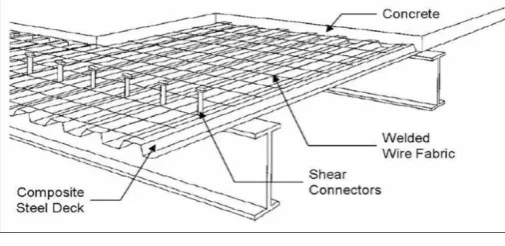
A composite slab in which steel sheets are connected to the composite beam with the help of shear connectors, initially steel sheets act as permanent shuttering and also act as bottom reinforcement for steel deck slab and later it is combined with hardened concrete.
Composite frame
In composite frame some of the elements are made up of composite members and some other made up of steel members.
Composite joint
A composite joint is joint between composite member and another is composite or steel or RCC member.
2.2 Materials in Composite Structures 1. Concrete
2. Reinforcing steel 3. Structural steel
2.3 Components of Composite Structures
1. Composite slab 2. Shear connectors
3. Composite beam
4. Composite column
Connecting devices
1. Fasteners and welding 2. Headed stud shear connector
2.2.1 Composite Slab
Figure 2.1: Composite Slab
Deck Slab without Concrete Infill
Figure 2.2 : Unfilled Deck Slab
Deck Slab with Concrete Fill
Figure 2.3: Filed Deck Slab
Solid deck slab without metal deck
Figure 2.4: Solid Deck Slab
t- Total depth of composite slab (>=80mm) tc – depth of concrete fill above deck slab hr - Depth of metal deck
wrt – For filled and unfilled deck type: Width of ribs in the top portion of the metal deck. wrb – For filled and unfilled deck type: Width ribs in the bottom portion of the metal deck. sr – total width of rib
hs – The height of shear stud after weld. Fu –The tensile strength of shear studs.
2.2.2 Shear Connectors
Shear connectors are those which are capable of preventing the separation of concrete with the steel deck element. There are different models of composite slab for the interaction (composite behavior) between the concrete and steel deck is
1. Mechanical interlock 2. Frictional interlock 3. Welded studs
4. Ribs deformation at the end of the sheeting.
Figure 2.5 : Different Types of Shear Connectors
Headed stud connectors
The diameter of the shank in the headed studs ranges from 16mm to 25mm and it length should be greater than 4 times the diameter of the shank. The number of connector’s ranges from 1 to 2 per rib, shear connectors is distributed between points of maximum sagging bending moment or hogging bending moment.
2.2.3 Composite Beam
Composite beams are those which are steel sections or partially encased sections which are connected to the composite slab with the help of shear connectors welded to the steel section. These two components act independently and if there is no connection between them a relative slip occurs at the interface under loading. Concrete is strong in compression and steel is strong in tension both of them act as composite and it as
advantage i.e. reduces the self weight and carry higher bending moments and high ductility. Composite beams have lesser values of deflection than the steel beams owing to its larger value of stiffness. Moreover, steel beam sections are also used in buildings prone to fire as they increase resistance to fire and corrosion.
1 . Steel beam encased in concrete
Figure 2.7 : Steel Beam Encased in Concrete
2. Steel beam acting composite with concrete slab using shear connectors
Figure 2.8 : Steel Beam Connected to Solid Deck Slab
3. Partially Encased Steel Beam
Figure 2.9. Partially Encased Steel Beam
Composite columns are a composite compression members or bending and compression members with steel encased sections partially or fully and concrete filled tubes.
Figure 2.10 : Typical Cross Sections of Composite Columns
Plastic resistance of a composite column of a cross section will be determined by following equation.For concrete encased and partially concrete encased sections.
PPC = Aa*fyd+ 0.85Ac*fcd + As*fsd Eq-1
For concrete filled sections
PPC = Aa*fyd+ Ac*fcd + As*fsd Eq-2
Where
Aa – cross sectional area of structural steel Ac – cross sectional area of concrete
As – cross sectional area of reinforcing steel
fyd – design value of yield strength of structural steel fcd – design value of yield strength of cylindrical compressive strength of concrete
fsd– design value of yield strength of reinforcing steel
Flexural stiffness of a composite column will be determined by
(EI )eff = Ea.Ia + Es.Is+ Kc.Ecm.Ic Eq-3
where:
Kc- is a correction factor 0.6.
Ia – second moment area of the structural steel section Ic – second moment area of the un cracked concrete section
Is – second moment area of the reinforcing steel Ea – modulus of elasticity of structural steel Es – modulus of elasticity of reinforcing steel Ecm – modulus of elasticity of concrete section (EI)eff – effective flexural stiffness
Figure 2.11 : Composite Columns with Shear Studs
III. RESULTS AND DISCUSSION
MODELING AND ANALYSIS
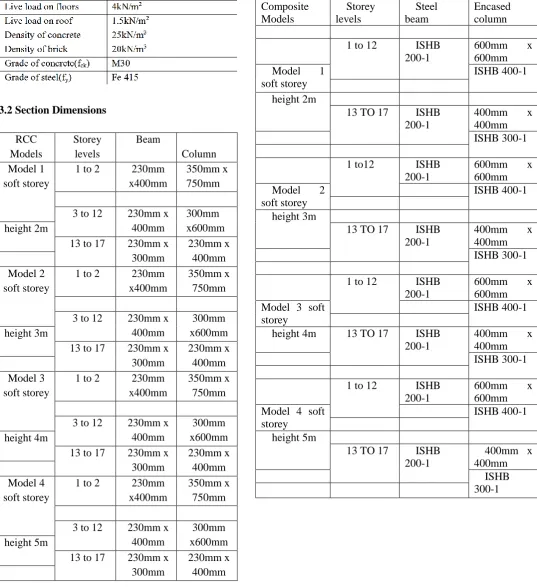
In this chapter discuss about the modeling details of building, section dimensions considered for the analysis of RCC and composite building, time period for the different models and load combinations considered for the analysis.
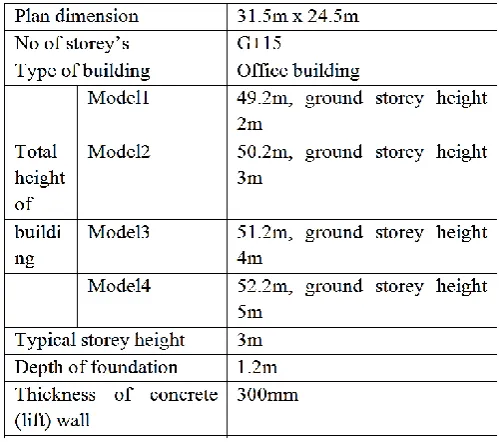
3.1 : Building Data
3.2 Section Dimensions RCC Models Storey levels Beam Column Model 1 soft storey
1 to 2 230mm
x400mm
350mm x 750mm
3 to 12 230mm x
400mm
300mm x600mm height 2m
13 to 17 230mm x
300mm
230mm x 400mm Model 2
soft storey
1 to 2 230mm
x400mm
350mm x 750mm
3 to 12 230mm x
400mm
300mm x600mm height 3m
13 to 17 230mm x
300mm
230mm x 400mm Model 3
soft storey
1 to 2 230mm
x400mm
350mm x 750mm
3 to 12 230mm x
400mm
300mm x600mm height 4m
13 to 17 230mm x
300mm
230mm x 400mm Model 4
soft storey
1 to 2 230mm
x400mm
350mm x 750mm
3 to 12 230mm x
400mm
300mm x600mm height 5m
13 to 17 230mm x
300mm
230mm x 400mm
3.3 Natural time Period
Ta = 0.09∗h √ (d
Table 3.3 : Beam and Column Dimensions of Composite Models Composite Models Storey levels Steel beam Encased column
1 to 12 ISHB
200-1
600mm x
600mm
Model 1
soft storey
ISHB 400-1
height 2m
13 TO 17 ISHB
200-1
400mm x
400mm ISHB 300-1
1 to12 ISHB
200-1
600mm x
600mm
Model 2
soft storey
ISHB 400-1
height 3m
13 TO 17 ISHB
200-1
400mm x
400mm ISHB 300-1
1 to 12 ISHB
200-1
600mm x
600mm Model 3 soft
storey
ISHB 400-1
height 4m 13 TO 17 ISHB
200-1
400mm x
400mm ISHB 300-1
1 to 12 ISHB
200-1
600mm x
600mm Model 4 soft
storey
ISHB 400-1
height 5m
13 TO 17 ISHB
200-1
400mm x 400mm
Table 3.4 : Natural Time Period for RCC and Composite Models
Soft Storey Height
Models Time
Period In X
Time Period In
Y Direction Direction
Soft Storey Height
RCC 0.773 0.876
2m Compos
ite Soft
Storey Height
RCC 0.788 0.895
3m Compos
ite Soft
Storey Height
RCC 0.805 0.913
4m Compos
ite Soft
Storey Height
RCC 0.821 0.931
5m Compos
ite
3.4 Load Combinations
1.5(DL+LL)
1.5(DL+LL+EQX)
1.5(DL+LL+EQY)
1.5(DL+LL+SPX)
1.5(DL+LL+SPY)
1.2(DL+LL+EQX)
1.2(DL+LL+EQY)
1.2(DL+LL+SPX)
1.2(DL+LL+SPX
3.5 Building Plan and Elevation View
Figure 3.1 : Building Plan View
Figure 3.2 : Building Elevation View
RESULTS
height. The analytical results are obtained for the both equivalent static and response spectrum analysis using software ETABS. The following parameters are considered for the comparative study of RCC and steel concrete composite structures.
Storey Displacements
Storey Drift
Base shear
Bending Moments
Shear Forces
Self-Weight
Time Period
7.1 Storey displacements (in mm)
Table 7.1 : Storey Displacement for Soft Storey of Height 2m in X Direction.
Models RC
C Model 1
Composite Model 1
Load Combina tions
1.5( DL+E QX)
1.5( DL+S PX)
1.5( DL+E QX)
1.5( DL+S PX)
Story17 1.5 1.3 1 0.9
Story16 1.4 1.3 1 0.9
Story15 1.4 1.2 1 0.9
Story14 1.3 1.2 1 0.9
Story13 1.3 1.1 0.9 0.9
Story12 1.2 1.1 0.9 0.8
Story11 1.2 1.1 0.9 0.8
Story10 1.1 1 0.8 0.8
Story9 1.1 1 0.8 0.8
Story8 1 0.9 0.8 0.8
Story7 1 0.9 0.7 0.7
Story6 0.9 0.9 0.7 0.7
Story5 0.9 0.8 0.7 0.7
Story4 0.8 0.8 0.7 0.7
Story3 0.7 0.8 0.6 0.6
Story2 0.7 0.7 0.6 0.6
Story1 0 0 0 0
Base 0 0 0 0
7.2 Base Shear (in kN)
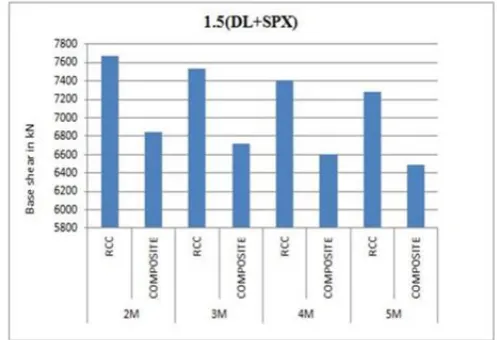
Figure 3.3. Base Shear for RCC and Composite Models for a Load Combination of 1.5(DL+SPX)
Figure 3.5. Base Shear for RCC and Composite Models for a Load Combination of 1.2(DL+LL+SPX)
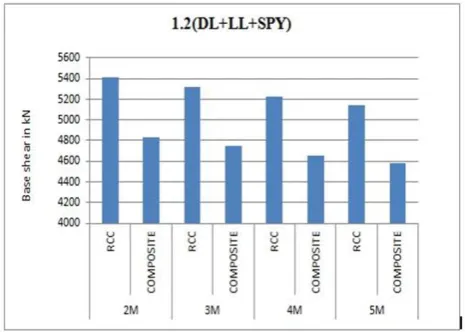
Figure 3.6. Base Shear for RCC and Composite Models for a Load Combination of 1.2(DL+LL+SPY)
Figure 3.7 : Corner Column Moments In X Direction 1.5(DL+SPX)
Figure 3.8 : Corner Column Moments In X Direction 1.2(DL+LL+SPX)
Figure 3.9 : Shear Force In X Direction
IV. CONCLUSION
About the Present Study
Two structures G+15, one made of composite steel concrete material and other one is made up of RCC, situated in the earth quake zone III, having a medium soil were investigated analytically for their performance using ETABS software. Following are the broad conclusions
By increasing the storey height at ground floor, maximum storey displacements are also increased. And it is observed that increase in storey displacements are less in composite structures compared to RCC.
Storey drift reduces in composite structures as compared to RCC, because composite structures have higher stiffness than that of RCC. In both RCC and composite structures, storey drift is within permissible limit, i.e., 0.004 times the height of storey.
Storey drift is different in both X and Y direction because of the difference in moment of inertia in the column sections.
By providing shear walls or lateral load resisting systems or bracings or providing the stiffer columns will able to restrict the drift in soft storey columns.
The beams and columns in the soft storey are designed 2.5 times of obtained bending moments and shear forces. And shear walls are designed by a factor of 1.5 times the storey shear.
Self-weight of composite structures reduces as compared to RCC which in turn reduces the foundation cost. Due to the reduction of self-weight of composite structures, it induces fewer amounts of lateral forces.
Time period is reduced for composite structures as compared to RCC structures because of composite structure has more stiffness than RCC structures.
Bending moments and shear forces in columns for composite structures are less as compared with RCC structures in X direction, but in Y direction RCC have more bending moments Composite structures are more ductile than RCC therefore composite structures are better than RCC for resist lateral forces.
Time and cost of construction is reduced for composite structures as compared to RCC. In high rise buildings composite construction shows better performance than RCC.
Scope of Further Study
Study can be carried out for the push over and time history analysis
Study can be carried out for the mass irregularity and vertical geometric irregularity.
Study can be carried out for the horizontal irregularity.
Study can be carried out the P-Delta analysis.
V.
REFERENCES
[1]. D.R Panchal and P.M. Marthe (December, 2011) "Comparative Study of RCC, Steel and Composite (G+30) Storey Building" Institute Of Technology, Nirma University, Ahmedabad – 382 481, pp 1-6
[2]. Mahesh Suresh Kumawat And L.G.Kalurkar (May
2014) "Analysis And Design Of Multistory
Building Using Composite Structure"
International Journal Of Structural And Civil Engineering Research Vol. 3, No. 2 pp 126-137. [3]. Nitin M Wared and P.J.Salunke December, 2013
"Comparative Study On Analysis And Design Of Composite Structure" International Journal Of Advance Research In Science And Engineering Vol. No.2, Issue No.12, pp 41-50.
[4]. Ketan Patel And Sanal Thakkar(2013) Entitled "Analysis Of CFT, RCC And Steel Building Subjected To Lateral Loading" Chemical, Civil And Mechanical Engineering Tracks Of The 3rd Nirma University International Conference On Engineering pp 259-265.
[5]. Manjunath M Birje(2014) "Comparative Study On Structural Parameter Of R.C.C And Composite" Civil And Environmental Research, ISSN 2224-5790 (Paper) ISSN2225-0514 (Online)Vol.6, No.6. pp 98-109
[7]. Shweta A. Wagh and Dr. U. P. Waghe (April 2014) "Comparative Study Of R.C.C And Steel Concrete Composite Structures" Journal Of
Engineering Research And Applications
Www.Ijera.Com ISSN: 2248-9622, Vol. 4, Issue 4(Version 1), pp 369-376
[8]. Hiten L. Kheni and Anuj K. Chandiwala (April 2014) "Seismic Response of RC Building with Soft Stories" International Journal of Engineering Trends and Technology (IJEET) – Volume 10 Number 12 pp 565-568
[9]. S. Zubair Ahmed K.V.Ramana and Ramnachandra
Pradeep Kumar (September 2014)"Seismic Response Of RC Frame Structure With Soft Storey" IJEET: International Journal Of Research In Engineering And Technology Volume: 03 Issue: 09 pp 180-186SuchitaHirde and Ganga Tepugade(2014) "Seismic Performance Of Multistory Building With Soft Storey At Different Level With RC Shear Wall" International Journal Of Current Engineering And Technology E-ISSN 2277 – 4106, P-ISSN 2347– 5161 Vol.4, No.3 pp 2019-2023.
[10]. P.B.Lamb And DrR.S.Londhe(December 2012) "Seismic Behavior Of Soft First Storey" Iosr Journal Of Mechanical And Civil Engineering ISSN: 2278-1684 Volume 4, Issue 5 pp 28-33. [11]. Mehmet Inel and Hayri B Ozmen(October 2008)
"Effect Of Infill Walls On Soft Story Behavior In Mid-Rise RC Buildings" The 14th World Conference On Earthquake Engineering ,Beijing, China.
[12]. Amish N. Shah 1, Dr. P.S. Pajgade(March -April 2013) " ComparisonOf R.C.C. And Composite Multistoried Buildings" International Journal of Engineering Research and Applications (IJERA) ISSN: 2248-9622 Vol. 3, Issue 2, pp.534-539. [13]. "Euro code 4" Design of Composite Steel and
Concrete Structures - Part 1-1: General Rules and Rules for Buildings Bs En 1994-1-1:2004En 1994-1-1:2004"IS 1893(Part 1): 2002"Criteria for Earthquake Resistant Design Of Structures Part 1
General Provisions and Buildings(Fifth
Revision)Bureau of Indian Standards New Delhi. [14]. IS : 875 (Part 1) – 1987 ( Incorporating Is :
1911-1967 ) (Reaffirmed 1997) Edition 3.1(1997-12) Code Of Practice ForDesign Loads (Other Than Earthquake)For Buildings And Structures Part 1
Dead Loads — Unit Weights Of Building Materials And Stored Materials ( Second Revision )
[15]. IS: 875 (Part 2) – 1987 (Reaffirmed 1997) Code of
Practice ForDesign Loads (Other Than
Earthquake) For Buildings and Structures Part 2 Imposed Loads(Second Revision) Sixth Reprint June 1998.
[16]. IS: 11384- 1985 Indian StandardCode of Practice forComposite Construction In Structural Steel and Concrete.
[17]. IS 456-2000 Indian Standard Plain and Reinforced Concrete - Code of Practice (Fourth Revision) Bureau of Indian Standards New Delhi Dr. VinodHosur "Earth Quake Resistant Design of Building Structures" Wiley India Pvt. Ltd. Publications, first edition 2013 Dr. Ashok K Jain "Reinforced Concrete Limit State Design" Published by: Nem Chand & Bros., Roorkee Page No: 876 (Vol 6th Ed) year: 2006 Design of Steel Structures by Limit State Method as Per Is 800-2007 by S. S. Bhavikatti Department of Civil Engineering BVBCET Hubli.