How Does Reporting Technology Affect Firm
Value?
Monica Rahardian Ary Helmina, Imam Ghozali, Jaka Isgiyarta, Ibnu Sutomo
Abstract: This study is to investigate the effects of corporate information reporting technology. Namely Integrated reporting. Technology enables the creation of information architectures that support management and investor decision making. Such architecture is needed because of the modern business landscape raises a series of new challenges: telling stories about how an organization creates value over time, and in a lot of capital beyond just finance, needing to be connected, change quickly information flows to management reporting, analysis and decision making. Data that supports value creation stories needs to be collected, integrated and processed inside the right way. Framework, including financial and non-financial reporting on company value. That absence of integrated reporting in disclosure of reports on the Indonesia Stock Exchange because disclosure of financial and nonfinancial information is used to describe phenomenon. This study provides insight to explain the importance of integration reporting as a financial report replaces two separate reports.
Index Terms: Stakeholder, Sustainability Reporting, Integrated Reporting, Value Creation of Integrated Reporting, financial statements, non-financial reporting, firm value
————————————————————
1
I
NTRODUCTIONThe needs of financial and non-financial information is related to the development of agency theory in which corporation does not only follow to the relation of agent - principal, but also consider other stakeholders, including employees, customers, communities and the government. Conventional company reports mostly emphasis on the failure of financial indicators in creating a clear relation between financial, social, environmental information and ethical issues. Moreover, nowadays, stakeholders question the relevance, reliability, and capability of financial statement to provide a sufficient understanding of the companies’ ability to operate sustainably in the future. It is associated with the rapidly changing world, including the environmental disasters, the extreme weather, the emergence of new disease, and the human rights violations. The world issues have become a serious threat to the operational continuity of the company (Adams & Simnett, 2011). The facts show that the financial reporting is considered failed in providing complete information regarding the company performance, especially the risk of the company. Sustainability reporting is intended to fill the gap. However, this report is also considered ineffective since the. provided information often has problems with credibility, punctuality, and audit. The target of financial reporting is mostly investors, whereas the sustainability reporting is other stakeholders (Ecless & Serafeim, 2014). In addition, the lack of relevance and punctuality in a financial statement instigate an idea to integrate all financial statements and other information into a report. International Integrated Reporting Council (IIRC) has a vision that the integrated reporting will be applied in the main business practices facilitated by integrated reporting as the norm of company reporting. In general, integrated reporting contains information about company strategies, corporate
governance, company performance and prospects, commercial representation, social and environmental context of the company. Thus, the report describes how the company operates and how the company creates and maintains value (International Integrated Reporting Committee, IIRC, 2011). Heretofore, there has been no official instruction on integrated reporting. At the end of 2013, the International Integrated Reporting Council (IIRC) established integrated reporting framework (IR framework) containing a method for a company in providing information for investors and the stakeholders regarding a holistic view of the company performance with the insight ability to create value over time. Conceptually, integrated reporting is a combination of financial and non-financial information, including environmental, social, and governance (ESG), intended to provide extensive information for the annual reports and sustainability reporting. Traditionally, financial statement and sustainability reporting have been published separately, with a slight relation one to another. Moreover, separate financial statement in which financial information disclosed in advance and non-financial information reported in later is considered providing the phenomenon of heuristic anchoring-adjustment (Tversky & Kahneman, 1974). The initial financial performance is regarded as an anchor for assessors in evaluating the provided non-financial information reported in the upcoming sustainability reporting. Therefore, the final assessment might be systematically biased toward the initial assessment, solely based on financial data (Arnold, et al., 2012).
This study aims to investigate the effect of the integrated reporting framework including financial and non-financial information on the company value. The absence of integrated reporting in the report disclosure in the Indonesia Stock Exchange causes the financial and non-financial information disclosure to be used to describe the phenomenon. This study provides insights in explaining the importance of integrated reporting as a form of financialstatement substituting the two separate reports.
2
L
ITERATUR REVIEW AND HYPOTESIS2.1 Stakeholder Theory
Stakeholder theory is related to the theory of legitimacy. The legitimacy theory focuses on the legitimacy of the social contract and the communication of information with the public, ————————————————
Monica Rahardian Ary Helmina1 Student PhD at Faculty of Economics and Business, Diponegoro University, 50241, Semarang Indonesia and Lecture at Faculty of Economics and Business, Universitas Lambung Mangkurat,70123,Banjarmasin Indonesia. Tel.+62 085225030008 E-mail [email protected]
Imam Ghozali2 Faculty of Economics and Business, Diponegoro University, 50241,Semarang Indonesia
Jaka Isgiyarta3 Faculty of Economics and Business, Diponegoro University, 50241,Semarang Indonesia
while the stakeholder theory focuses more on the communication of the company with different groups of stakeholder. Stakeholder theory explains that a society consists of diverse groups of stakeholder. The power of stakeholder influence is not the same in the company activities. There are two categories of stakeholders, including primary stakeholders and secondary stakeholders. Primary stakeholders are parties with the direct power to the company, including customers, employees, suppliers, shareholders, and the government. Secondary stakeholders are parties with indirect relation with the company, but they have a beneficial effect compared to the interested parties, for example, academician, media, and environmental community. The two theories are closely related, not contradictory, and complementary (Deegan, 2002). Intrinsic motivation of stakeholders’ commitment in performing the right action does not have a significant effect. The main purpose of the stakeholder involvement in the company is related to the continuation rate called profitability (Burgwal, 2014). Stakeholder theory emphasizes a comprehensive view of financial performance in terms of a long-term managerial orientation. Capitalization and intangible assets are the areas in which long-term orientation and financial performance focus on creating superior profits for shareholders (Simpson, Fischer, & Rhode, 2013).
2.2 Sustainability Reporting
Ecless (2012) finds that the high disclosure of non-financial information on US companies is related to better stakeholder interests in the stock market value and accounting performance. Ecless and Serafeim (2014) find that sustainability reporting is able to improve a long-term profitability and enables a company to differentiate from competitors. Other studies provide evidence that a company can benefit from publishing sustainability reporting since the capital cost will decrease if they provide better ESG performance (Dhaliwal et al., 2011). Similarly, in the event study, it is shown that the stock price changes occur as a reaction to the news about the environmental performance (Karpoff et al., 2005). However, Goss and Robert (2011) find that ESG performance leads to higher costs. By using a slightly different concept, Sarvaes and Tamayo (2012) find that the CSR disclosure has a positive effect on the company value. In contrast, Crisostomo (2011) finds a negative effect of CSR on the company value. The inconsistency in the research finding regarding the effects of integrated reporting aspects of the company assessment results in two different views. The first view reveals that if the IR provides benefits for the shareholders, the company valuation will have a positive relationship with the IR. The proponents of the IR state that IR is able to improve the quality of available information for investors for more efficient and productive calculation of capital allocation. For example, IR aims to provide a better articulation of the relationship between company strategies, business model and value creation by the company. The better quality disclosure below IR is considered to be able to reduce the cost of processing information by investors and to increase the speed and the number of specific information inserted into the asset (Healy & Palepu, 2001). In contrast, the second view argues that IR is able to precisely harm the shareholders. The theory of exclusive fee disclosure explains that as the available information is worthy (e.g. information on competitors in the market, labor unions, or the regulator), the company will
important and prioritized, the assessment of the companies’ financial performance will be regarded as an obtained anchor for the information users in assessing the provided ESG information in the sustainability reporting. Since individuals are likely to be committed in previous assessment (Staw, 1981), they are less likely to adjust the assessment after assessing ESG information in the sustainability reporting solely based on financial data. Thus, the final value of the assessment might be systematically biased toward the initial assessment, solely based on financial data. They incline to search for the information consistent with the provided external anchors (Epley & Gilovich, 2005). Based on the rationale of the anchoring and adjustment heuristic, financial and non-financial information with different distribution time do not make the financial information as an anchor. Thus, the financial and non-financial information reported in the adjacent time are expected that the financial information becoming the anchor and the non-financial information is relevant to the company value. In this study, the time gap of financial and non-financial information reporting is used to represent the phenomenon of the anchoring and adjusment heuristic as in the experimental study of Arnolds et al. (2012). In addition, this study also used ROA information as the measurement of financial performance and ESG disclosures contained in the annual report and sustainability reporting as non-financial information.
2.3 Integrated Reporting
Integrated reporting refers to a concept to articulate broader steps contributing to long-term value and organizational role in the society. The core of this proposition is to create better value of additional factors, including the dependence on the environment, social reputation, skills of human resources, and so forth. (Ernst & Young, 2013). IIRC distinguishes the current report from the integrated reporting in eight elements. The elements should be presented in integrated reporting including an overview of the organization and external environment, management, business model, risks and opportunities, strategies and resource allocation, performance, outlook, and basis of preparation and presentation. For the stakeholders, integrated reporting provides benefits, especially for long-term investors. Information from the integrated reporting originating from any value is created as a result of sustainable strategy of tangible and intangible assets to be interpreted in the form of performance affecting the market value of the company.
2.4 Value Creation of Integrated Reporting
The value created by an organization from time to time is manifested in the capital increase or decrease because of the organization business activities. Company value is generally viewed from two perspectives, including the value created for the organization and the value created for other parties (Ernst & Young, 2014). Since financial capital providers are interested in the value created by the company, the company value is able to be created from the effects of other factors on the ability of the company to create the value for the company. It is also included in the extent of the effects on the externalized capital, for example, the cost is not borne by the company). Material activities, interactions, and relationships affecting the ability of the company to create value from time to time (including externality) should be included in integrated reporting. All companies depend on a variety of capital. Capital is the stock value with continuous increase, decrease or
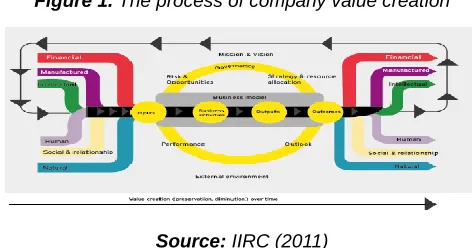
modified through the company activities and outputs. Integrated reporting framework defines six types of capital, including financial capital, manufactured capital, intellectual capital, human capital, social and relationship capital, and natural capital. Regardless of how a company categorizes capital for its own purpose, the category defined in the IR Framework as a guideline to ensure that the company does not neglect the capital or influential users. In addition, not all capitals are same, relevant, or applicable for all companies. The connection of the six types of capital in creating value for the company is described below.
Figure 1. The process of company value creation
Source: IIRC (2011)
.
3
PHENOMENON
OF
ANCHORING
AND AJUSMENTSbased on prospect theory (Kahneman & Tversky, 1979), non-financial information might be extremely large in case the poor non-financial performance accompanies good financial performance. This assumption is consistent with particular relevance of good news for market participants (Soroka, 2006).
3.1 HYPOTHESIS
Integrated reporting refers to a combination of information about available capital sources in the company. The value creating of the company by integrated reporting is able to be derived from the value creating from financial and non-financial information reported separately or independently. For example, Cheng, Ioannou and Serafeim (2014) find that companies with better sustainability disclosure have lower capital constraints and better access to finance. Dhaliwal et al. (2011) finds that companies show a decrease in the equity cost after issuing a sustainability reporting. Yu, Du and Bhattacharya (2014) find that the sustainability data disclosure has an economical effect in which abnormal stock price reactions occur. Wang (2015) finds that financial information has a positive effect on company value, environmental disclosure has a positive relationship with the company value, and CGG has a positive moderating effect on the relevance value of environmental disclosure. The results support the relevance value of environmental information disclosure. Companies with GCG characteristic have a positive correlation with the relevance value of environmental information disclosure. Zuraida et al. (2012) investigates the effect of financial and non-financial information in the form of environmental, social, and governance disclosure (ESG) on the market value. The study finds the support of the relevance value of ESG disclosure in the form of aggregate and for individuals. The findings support the disclosure theory, stating that the relevant information disclosure (ESG) has a positive effect on the company value. Wang (2015), Vafaei, Taylor and Ahmed (2011), Zuraida et al. (2012) find that the disclosure of non-financial aspects increases the company value directly or as a moderating variable. This means that the more non-financial disclosures will set higher company value.
H1: Wider ESG non-financial information provides higher stock valuation.
H2: In good financial information, wider non-financial information provides higher stock valuation.
Tversky & Kahneman, (1974) find that the separately reported information would generate anchor and adjustment phenomenon. In this phenomenon, the assessment of the financial performance is frequently considered as an anchor in assessing the company performance from the non-financial aspect contained in the annual report and separately presented after the financial information. The anchoring theory states that individuals are likely to be committed to the previous decision (Staw, 1981). Individuals will adjust the valuation lower after assessing the non-financial information in a sustainability reporting. Therefore, the final assessment might be systematically biased toward the initial assessment, solely based on financial data since the previous estimation becomes a strong anchor for further estimation (Arnold et al., 2012; Parwati,et. Al., 2017).
H3: Non-financial information in closer reporting time with financial information provides higher stock valuation.
4
R
ESEARCH METHODThis study used the companies listed on the Indonesia Stock Exchange in 2012 to 2014. The sample was 224 companies among 1053 population. Since the study used a variable of multidimensional GCG and CSR, the selected sample was required to have information regarding the audit fee as one of the GCG measurements. The dependent variable of this study was the company value measured by stock valuation in the annual report. As in the study of Reddy and Gordon (2010), the interdependent and control variable are in table 1.
Table 1. Variable measurement
This study used three models for the testing. Hypothesis 1 was tested by examining the effect of ESG on company stock valuation. In this study, ESG was represented in two variables, including CSR and GCG presented in the annual report.
CAR = bo + b1 GCG +b2 CSR + b3 LEV + b4 SIZE + b5 LISTING + b6 OPERAT+ b7 CARF + e (1)
Hypothesis 2 was tested by adding financial performance in the form of ROA as the moderating variable to test the effect of ESG on the company stock valuation. ESG was also presented in the variables of CSR and GCG.
CAR = bo + b1 GCG +b2 CSR + b3 ROA + b4 GCG*ROA + b5 CSR*ROA+ b6 LEV + b7 SIZE + b8 LISTING + b9 OPERAT + b10 CARF + e (2)
Lastly, hypothesis 3 was tested by adding annual report-financial report lag in the form of the report lag in the period between the submission of the annual report and the company financial report. This method also used ROA ratio as the moderating variable to test the effect of ESG on the company stock valuation. ESG was also presented in the variables of CSR and GCG.
5
R
ESULT AND DISCUSSIONThe sample of this study had provided the required assumptions for the analysis of descriptive statistical presentation. The analysis aimed to provide a description of the data by considering the number of sample, minimum value, maximum value, average value, and standard deviation of each variable.
The correlation analysis between variables showed that therewere not many variables with a significant correlation.
The Effect of ESG Non-financial Information on company stock value
The testing results of the GCG disclosure of cumulative abnormal return in model 1 show the significance value <0.05
to a positive coefficient. On the other hand, CSR information shows the significance value <0.05 to a negative coefficient. This means that ESG information, including CSR and GCG information seems not to be equally responded by the investor. The results indicate that CSR activities are able to increase the stock value for the company with high trust of the societyshowed by the intensity of the advertisement produced by the company in creating the trust of the society. According to Serafeim (2010), if the CSR strategy is able to create the company value, it will be reflected in the valuation. Previous studies have reported that the analysts’ perception has changed from time to time regarding the effect of CSR on the creation of the company value. In the early years of the samples, CSR strategy is considered to reduce the company value and to have a negative impact on the investment recommendations. However, in the recent years of the samples, Ioannou and Serafeim (2010) report that CSR strategy is regarded as a positive aspect in increasing the value related to the investment recommendations. The empirical results of this study showed the negative effects of CSR on the Indonesian company value. The results are consistent with the study of Crisotomo et al, (2011) in Brazil. There is a negative effect arising from the company social action on the relationships with the employees and the environment. The two social activities are the focusof CSR in Indonesia. Considering the relationship of CSR with the company value in Indonesia and in Brazil, it is indicated that the growing market views that the CSR strategy performed by the company is regarded as the additional financial burden by investors. In this case, it seems that the CSR strategy has not been considered as an activity combined with the company strategy to increase the trust of the society. On the other hand, the GCG disclosure is positively related to the company value. The result is in line with the study of Black et al. (2002) in South Korea. Thus, companies with high ESG are able to provide performance benefits of a higher market valuation. This is in line with Derwall (2007). The positive relationship is explained by the investors’ belief that companies with a high ESG have less risk towards lower discount rate, and thus, they benefit from a higher valuation (Derwall, 2007). These findings imply that not all strong ESG performance is positively related to the company value because of the different direction of the effect of CSR and GCG on the company value. Therefore, the findings are sufficient to support the argument of the studies stating that good ESG has a positive effect on the operating performance through different channels by increasing revenue through the benefits of reputation, through competitive advantage (Porter & Kramer, 2011), and through the reduction of cost and risk ( Koelher & Hespenheide 2013). These findings have significant implications for regulators and the investment communities. The investor is able to gain additional benefits from the ESG disclosure as the input for the important investment decisions. Although the results of this study have an inconsistent direction between GCG and CSR, this study is consistent with the results of recent studies stating that social and environmental governance information is crucial in improving the company value and as a reference for investors' decision making.
The Effect of the Interaction between Financial and Non-financial Information on Company Value
the company value as in model 2. It is shown that the interaction of GCG * ROA on cumulative abnormal return has the significance value <0.05 with a negative coefficient, while the interaction of CSR * ROA has the significance value <0.01 with a positive coefficient. This means that better financial information is likely to decline CSR and GCG non-financial effects on company value. The findings show that the effect of ESG non-financial information is likely lower on the company value of companies with higher financial performance compared to the companies with lower performance. This indicates that the ESG of companies with higher financial performance is likely to have smaller role in creating the company value. In other words, the priority of information regarding the financial condition is more important and beneficial for investors in creating the company value. This is because several combinations of ESG components frequently appear as a relative complement. For example, human resources and entrepreneurs towards customers and suppliers show a mutual benefit and a decline in the conflict among stakeholders. On the other hand, the environmental and behavioral aspects on customers and suppliers frequently appear as a relative substitution, and thus, indicating more conflicts or over-investment between stakeholders (Cavaco & Crifo, 2013).
The Effect of the Interaction between Annual Lag Report and Non-financial Information on Company Value
The study tested the effect of financial information on the company value using lag report of non-financial disclosure of submission period as in model 3. The results show that the interaction of GCG * LAG on cumulative abnormal return has the significance value > 0.05, and the interaction of CSR * LAG show has the significance value > 0.05. It means that the earlier delivery time lag of non-financial information is unable to moderate the effect of CSR and GCG non-financial information on the company value. The results explain that ESG non-financial information has similar effect on the value of the company with quicker annual report than to the one with slower annual report. In addition, the anchor effect is absent in the annual or sustainability reporting issued by the company after the financial statements are disclosed. This condition is probably caused by the incapable lag period in revealing the existence of the anchor phenomenon in the financial statement as the initial information for non-financial reporting. Investors possibly consider that even merely one day the time difference of reporting the financial statement and annual report (non-financial) disclosure, it has a similar effect in which the financial statement is considered as an anchor information, and non-financial information is considered as a separate information (Arnold et al., 2012). In other words, integrated reporting should be reported simultaneously to eliminate the anchor effect, since, although the financial and non financial information are reported in a short period, the effect is likely to occur. This study also used the variable of company size, leverage ratio, listing tenure, operational tenure and company stock valuation at the submission time of financial statement on the company valuation in the annual report in which the non-financial reporting were submitted. The results of this study find that only the control variable of company size and listing tenure have a negative and significant effect on company valuation, while other control variables have no significant effect.
5.2CONCLUSIONS
The findings show that non-financial information has a significant effect on the company value in varied directions. The GCG information has a positive effect, while CSR information has a negative effect. If the financial and non-financial information are used simultaneously, the non-financial information is likely to decrease the effect of non-financial information. In addition, the obtained annual report lag is unable to increase the effect of financial information on the company value. This study has several limitations. First, this study used a relatively small sample. Second, the study period is relatively short. Therefore, future studies should specifically develop research models with different variables. For academicians, integrated reporting should be further investigated regarding the relationship between financial and non-financial information, and the punctuality of the reporting. In addition, the effect of separate disclosure of financial statement and annual report results in different company valuation should be examined. The absence of real integrated reporting causes a problem for the study using the approach of financial – non-financial reporting and lag period. This is because financialreporting has a provision deadline for submission, while non-financial reporting does not. Therefore, the approach using experimental design is recommended for future studies.
R
EFERENCES[1] Adams, S. and Simnett, R, 2011, Integrated Reporting: An Opportunity for Australia's Not-for-Profit Sector. Australian Accounting Review, 21(3): 292-301. [2] Afify, H.A.E. Determinants of audit report lag Does implementing corporate governance have any impact? Empirical evidence from Egypt,2009, Journal of Applied Accounting Research, Vol. 10 No. 1
[3] Alfaraih, Mishari M dan Alanezi, Faisal S, 2011, Does Voluntary Disclosure Level Affect The Value Relevance Of Accounting Information?Accounting & Taxation Volume 3 Number 2
[4] Amir, Eli and Baruch Lev, 1996, ―Value-relevance of nonfinancial information: The wireless communications industry.‖ Journal of Accounting and Economics 22, no. 1–3: 3–30.
[5] Arnold, Markus; Bassen, Alexander dan Frank, Ralf, 2012, Integrating Sustainability Reports into Financial Statements:An Experimental Study, Paper
[6] Arya, A., Frimor, H., Mittendorf, B. G., 2010, Discretionary Disclosure of Proprietary Information in a Multi-Segment Firm. Management Science 56(4), 645-658.
[7] Barth, M.E., Beaver, W.H., Landsman, W., 2001. The relevance of value relevance research. Journal of Accounting and Economics 31, 77–104
[8] Bhuiyan, MB Uddin, Roudaki, Jamal and Clark, Murray, 2013, Corporate Governance Compliance and Discretionary Accruals: New Zealand Evidence, Australasian Accounting, Business and Finance Journal, Volume 7 . Issue 2
[9] Black, Bernard S. Jang, Hasung, Kim, Woochan, 2002, Does Corporate Governance Affect Firm Value? Evidence from Korea, SSRN.
361–376, Published online 21 November 2012 in Wiley Online Library
[11] Crisóstomo Vicente Lima, Fátima de Souza
Freire, Felipe Cortes de Vasconcellos, 2011,
Corporate social responsibility, firm value and financial performance in Brazil, Social Responsibility Journal, Vol. 7 Iss: 2, pp.295 – 309.
[12] Deegan, C. 2002. The Legitimizing Effect Of Social And Environmental Disclosures: A Theoretical Foundation. Accounting, Auditing and Accountability Journal, Vol. 15, Page 282-311.
[13] Derwall, J., K. Koedijk, Ter Horst, J., 2011. A tale of values-driven and profit-seeking social investors. Journal of Banking and Finance 35, 2137–2147. [14] Available:
https://eepi.ubib.eur.nl/bitstream/1765/8986/1/ESP200 7101F%26A9058921328D ERWALL.pdf
[14] Dhaliwal, Dan, Oliver Zhen Li, Albert Tsang, and Yong George Yang. 2011. ―Voluntary Nonfinancial Disclosure and the Cost of Equity Capital: The Initiation of Corporate Social Responsibility Reporting.‖ The Accounting Review 86 no. 1: 59-100. [15] Eccles, RG, Ioannou, I, and Serafeim, George, 2012
The Impact Of Corporate Sustainability On Organizational Processes And Performance, Nber Working Paper Series, National Bureau Of Economic Research
[16] Eccles, Robert G dan Serafeim, George, 2014, Corporate and Integrated Reporting: A unctional Perspective, Working Paper Harvard Business School.
[17] Eccles, Robert, and Michael Krzus. 2010. One Report: Integrated Reporting for a Sustainable Strategy. New York: John Wiley and Sons, Inc
[18] Eccles, Robert, George Serafeim, and Phillip Andrews. 2011. "Mandatory Environmental, Social, and Governance Disclosure in the European Union". Harvard Business School Case 111-120.
[19] Eccles Robert G. & Saltzman, Daniela, 2011, Achieving Sustainability Through Integrated Reporting, Stanford Social Innovation Review Summer 2011
[20] Edmans, Alex, 2011, Does the stock market fully value intangibles? Employee satisfaction and equityprices, Journal of Financial Economics, 101 (2011) 621–640 [21] Epley, N., Gilovich, T., 2001. Putting adjustment back
in the anchoring and adjustment heuristic: differential processing of self-generated and experimenter-provided anchors. Psychological Science 12, 391– 396.
[22] Ernest & Young, 2013, Integrated reporting Elevating value
[23] Goss, A dan Roberts, 2011, The impact of corporate social responsibility on the cost of bank loans, EconPaper
[24] Healy M Paul& Palepu, 2001, Information Asymmetry, Corporate Disclosure, And The Capital Markets: A Review Of The Empirical Disclosure Literature . Journal Of Accounting And Economics. Vol 31
[25] International Integrated Reporting Committee, IIRC, 2011, Towards Integrated Reporting Communicating Value In The 21st Century
[26] Ioannou, Ioannis, and George Serafeim. 2014. ―The Impact of Corporate Social Responsibility on
Investment Recommendations: Analyst Perceptions and Shifting Institutional Logics.‖ Strategic Management Journal, forthcoming
[27] Kahneman, D., Slovic, P., Tversky, A., 1982. Judgment under Uncertainty: Heuristics and Biases.Cambridge University Press, Cambridge. [28] Karpoff, J. M., Lott, J. E. Jr., Wehrly, E. W., 2005. The
Reputational Penalties For Environmental Violations: Empirical Evidence. Journal of Law and Economics 48, 653-675.
[29] Kempf, A., Osthoff, P., 2007. The Effect of Socially Responsible Investing on Financial Performance. European Financial Management 13, 908-922. [30] KPMG, 2011, Integrated Reporting Performance
insight through Better Business Reporting. KPMG International Cooperative (―KPMG International‖), a Swiss entity.
[31] Kruger, Tony, et;al, 2009, Effective and Sustainable University-School PartnershipsBeyond determined efforts by inspired individuals, Teaching Australia - Australian Institute for Teaching and School Leadership Limited and the authors
[32] Lee, KW dan Yeo, GHH, 2015, The Association between Integrated Reporting and Firm Valuation, Review of Quantitative Finance and Accounting, Forthcoming
[33] Mussweiler, T., Strack, F., 1999. Hypothesis-consistent testing and semantic priming in the anchoring paradigm: a selective accessibility model. Journal of Experimental Social Psychology 35, 136–164.
[34] Reddy, K & Gordon, L.W. (2010). The effect of sustainability reporting on financial performance: An empirical study using listed companies. Journal of Asia Entrepreneurship and Sustainability, 6(2), 19-42. [35] Serafeim, George, 2014, Integrated Reporting and
Investor Clientele. Harvard Business School
[36] Servaes, Henri & Tamayo, Ane. 2012. ―The Impact Of Corporate Social Responsibility On Firm Value, The Role Of Customer Awareness‖. Management Scients. Vol 59, No 5, pp 1045-1061
[37] Shefrin, Hersh, 2000. Beyond Greed and Fear: Understanding Behavioral Finance and the Psychology of Investing. Financial Management Association Survey and Synthesis Series. Boston, MA: Harvard Business School Press.
[38] Simpson, S., Fischer, B. D., & Rhode, M, 2013. The conscious capitalism philosophy pay off: A qualitative and financial analysis of conscious capitalism corporations. Journal of Leadership, Accountability & Ethics, 10(4), 19–29
[39] Smith, Sean Stein, 2014, Integrated Reporting, Corporate Governance, and the Future of the Accounting Function, International Journal of Business and Social Science Vol. 5, No. 10; September 2014
[40] Staw, B. M. 1981, The Escalation of Commitment to a Course of Action, Academy of Management Review , 6_, 577-587.
[42] Stubbs, Wendy and Higgins, Colin, 2012, Sustainability and Integrated Reporting: A Study of the Inhibitors and Enablers of Integrated Reporting. The Institute of Chartered Accountants Australia
[43] Parwati, Ni Made. et. al 2017, The Effect of Self Assesment System and Fraud Detection Possibility Toward Tax Evasion Behavior, International Journal of Mechanical Engineering and Technology, 8(8), 615-622.
[44] Stubbs, Wendy and Higgins, Colin, 2012, Sustainability and Integrated Reporting: A Study of the Inhibitors and Enablers of Integrated Reporting. The Institute of Chartered Accountants Australia
[45] Vafaei, A, Taylor, D dan Ahmed, K, 2011,The value relevance of intellectual capital disclosures, Journal of Intellectual CapitalVol. 12 No. 3, 2011 pp. 407-429 [46] Verrecchia, Robert E, 1990, Information quality and
discretionary disclosure, Journal of Accounting and Economics, 1990, vol. 12, issue 4, pages 365-380 [47] Yu. Kun, Shuili Du, and C.B. Bhattacharya. 2014.
―Everybody’s Talking But is Anybody Listening? Stock Market Reactions to Corporate Social Responsibility Communications.‖ Working paper.