THE BASIS OF A COMMUNICATIVE METHODOLOGY IN LANGUAGE TEACHING
Christopher Brumfit
Thesis submitted for the Degree of Doctor of Philosophy of the University of London
1983
ABSTRACT : THE BASIS OF A COMMUNICATIVE METHODOLOGY
IN LANGUAGE TEACHING - Christopher Brumfit
This thesis is an argument about the nature of language teaching methodology, relating general educational principles to current theories of language acquisition and use.
Chapter I discusses what constitutes appropriate knowledge about language teaching methodology. It argues for a Popperian epistemological model, providing that methodological innovation
is seen as analogous to social policy-making.
Chapter II outlines current views of the nature of language, its use and acquisition, and argues that the creation of meaning through interaction and negotiation with other language users is a central feature.
Chapter III examines a number of possible polarisations of the process of language acquisition into strategies for acquiring the tokens of the language and strategies for turning them into a negotiable and value-laden system of use. Criticisms are offered of some of these, particularly Krashen's, and a pedagogically orientated distinction between accuracy and fluency is presented.
•
Chapter IV examines the methodological implications of making this distinction, and particularly the need to establish a 'natural' setting. Group work is seen as central to this.
Chapter V explores the role of meaning in language teaching and briefly considers some curriculum design proposals. It is argued that the organisation of a syllabus is less important than the methodology used, and that a syllabus should have educational content.
Chapter VI draws'on the argument so far to outline a model of teaching methodology which emphasises substantive as well as linguistic content, and depends upon interactive methods.
The final chapter returns to the general model of methodological enquiry and argues that successful development of the practice of
teaching depends heavily on a combination of administrative channels for effective innovation and feedback with a constant process of analysis of theoretical concepts in terms which have direct
In what sense, we may well ask, do men 'make' their
history ? Conscious effort, deliberate attempts to explain the world to oneself, to discover oneself in it, to obtain from it what one needs and wants, to adapt means to ends, to express one's vision or describe what one sees or feels or thinks, individually or collectively - understanding, communication, creation - all these could be described as kinds of doing and making. But this omits too much: unconscious and irrational 'drives',.which even the most developed and trained psychological methods cannot guarantee to lay bare; the unintended and unforeseen consequences of our acts, which we cannot be said to have 'made' if making entails intention; the play of accident; the entire natural world by interaction with which we live and function, which remains opaque inasmuch as it is not, ex hypothesi, the work of our hands or minds; since we do not 'make' this, how can anything it possesses be
grasped as verum ? How can there be a scienza of such an amalgam ? Isaiah Berlin - Vico's Concept of Kiowledge
CONTENTS
Pape_
Abstract 2
.Tables, Diagrams and Figures 6
Acknowledgements 7
Introduction 8
Chapter I Research Methodology, Teaching
Methodology and Educational Values 12
Science, human science, and non-science
Social science and the methodology of teaching Educational research and language teaching
12 23
methodology 32
Chapter II Language and Language
Acquisition : A Contemporary View 41
The nature of human language 42
Language acquisition 53
Second language acquisition 58
Chapter III Fluency before Accuracy as - a Basis
67 for Second and Foreign Language Learning
The case for a polarity 71
Accuracy and fluency 83
Learning and teaching 95
An interim model of the language teaching process
100
Chapter IV The Bases for Fluency Activity : Small Group Wbrk and a 'Natural' Linguistic
Environment 111
Groupwork activity in education 114
Group work in foreign and second language
learning 122
Fluency in comprehension 133
Fluency in writing 138
Chapter V The 'Content' of Language Teaching :
142
Language and Meaning
Process and product 142
Proposals for 'communicative' content 148
The Bangalore project 163
Meaning and the language syllabus 176 Chapter VI Language Learning as an Integrated
Process 181
The role of a product-based syllabus 187
Integration of the model 193
Chapter VII A Fluency-Based Model of Language
Learning : Problems and Implications 202
Fluency distinguished from accuracy 207
Fluency and serious content 216
Notes : 222
Chapter I 222
Chapter II 225
Chapter III 228
Chapter IV 233
Chapter V 236
Chapter VI 238
Chapter VII 240
Appendix A (examples of unsatisfactory writing
exercises) 241
Appendix B (Bangalore material)
Bibliography 245
1. 2. 3.
TABLES, DIAGRAMS AND FIGURES
Page Variables in Language Teaching
Learning and Acquisition-type Distinctions Learner, Language and Use
33-34 64 68
4. Monitor Model (Krashen) 77
5. 'The Teacher Taught the Student English' (Halliday) 95-96 6. Differences Between Teaching and Learning 98 7. Model of Language Teaching - four phase :
I Basic Teaching 104
II Conventional Testing 105
III Language Use 105
IV Accuracy and Fluency 106
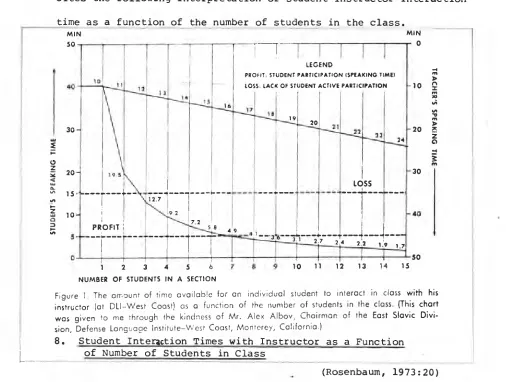
8. Student Interaction Times with Instructor as a
Function of Number of Students in.Class (Rosenbaum) 121 9. Group and Pair Work and Accuracy : Examples 127-128
10. Fluency WDrk : Examples 129-130
11. Types of Content Specification 153-154
12. Class Time Spent on Accuracy/Fluency 192
13. Learner ACtivity on a Project 195
14. Model for Language Teaching Methodology 199-200 15. Properties of Three Types of Reduced Languages
ACKNOWLEDGEMENTS
The arguments on which this study is based have been conducted over a long period with many people, who may well not recognise their own contributions, let alone agree with the final position adopted.
Selection of those to mention is always invidious, especially when colleagues and students have been so generous with their time. I am conscious, however, of particular debts in the argument offered here to the following : Dick Allwright, Roy Boardman, Ken Cripwell, Patrick Early, Rod Ellis, Roger Hawkey, Keith Johnson, Josie Levine, Alan Maley, John Munby, John Norrish, Ken Reeder, Harold Rosen, Richard Rossner, Earl Stevick, and Monica Vincent.
4
I am also grateful to Rosangela Barone and members of the research team at Bari for permission to examine some of their
material, and to N.S. Prabhu for permission to make use of Bangalore material, as well as for much stimulating discussion.
The Modern Language Centre of Ontario Institute for Studies in Education gave me facilities while I was writing this up, and I benefited greatly from their library and support services, and from discussions with, among others, Patrick Allen, Michael Candle, Maria Froatich and Merrill Swain. I was especially grateful for the time and generous consideration offered by David Stern.
Finally, I have simultaneous personal and professional
INTRODUCTION
This study is an investigation of ideas in an area which
is unclearly defined as a field for research : teaching methodology. Administratively it is classed as a sub-branch of education, but it is clear that educational disciplines alone cannot provide an
adequate base for the examination of principles in the teaching of a particular subject. Nor, it is argued here, can the linguistic sciences alone provide a basis for the teaching of languages, for• the interaction of language with on the one hand personal needs of language users and on the other institutional constraints of the users' setting will make an autonomous, linguistic theory of
performance impossible. The researcher in this area thus has two choices available. One is to reject this argument, limit the
field, and idealise the data, so that it becomes manageable in terms of criteria appropriate to one of the agreed disciplines, linguistics, or psychology, or sociology. The other is to remain in the same position as the practicing teacher, but to try to examine that position as critically- as possible. This choice entails accepting three conditions, all of which make discussion in methodology
particularly difficult :
i) generalisations and principles must be capable of being related directly to existing teaching conditions, including teachers as they actually are, institutions as they actually are, and resources as they actually are:,
ii) information, principles, metaphors and (to use the vogue term) 'insights' will be drawn from a whole range of different
which is directly translatable into classroom behaviour; iii) perceptions must reflect the position of the teacher in the
classroom - that is to say that they must refer, in the last resort, to the process of intervening in the lives of others in order to assist desirable changes of behaviour.
We expect all teachers, implicitly through the ways we train them, to accept these conditions in their professional
self-consciousness; but most research in education imitates research in other disciplines, differing only in the context or subject matter of the study. In this study, however, we are attempting to perform exactly the same kind of conceptualising task that we demand of language teachers, but at a higher level of abstraction. This inevitably creates certain problems.
The desire to remain closely in touch with conditions as they actually are leads to caution and perhaps a lack of speculative excitement. But at the same time, we cannot allow all discussion of teaching to ignore the rules that are imposed on teachers by the nature of their positions as teachers. Without denying the value of idealised constructs and divergent thinking unconstrained by the fetters of immediate responsibility, we need also to
demonstrate and practise the art of assessing the value for teaching of the work in areas that are less constrained.
The process of drawing upon research findings, theoretical
the interdisciplinary exercise is being performed. Synthesis may be seen simply as a derivative activity, unsuitable for serious research pretentions, and the difficulties arising from attempting to be interdisciplinary may be seen as resulting from a refusal to focus sharply on clearly identifiable problems. Yet we cannot afford to leave all questions of how to synthesise research conclusions to teachers actually working in classrooms, for - more often than not - they lack experience, training and above all time for such activity. Furthermore, the frequently desired integration of theory and practice requires illustrations of the process of doing this at all levels. It is no service to the profession if all those who are theoretically minded address themselves exclusively to questions that can be answered within the frameworks of existing disciplines. Particularly, in departments of teaching methods, it is essential that we attempt to examine precisely the kinds of
questions we expect our students to examine. If we do not do this, however badly, we shall be leaving the most difficult problems to those who have least time, facilities or inclination to explore them.
Working from the position of the teacher means that there is an inevitable antagonism between many research approaches and that which we have adopted here. This is partly because research is often descriptive, either looking at the teacher from outside (a position inappropriate for teachers attempting to improve their own performance) or looking at learners, or language, or classrooms with non-interventionist intentions. This does not prevent the
teacher from making use of such data, of course, but it does mean that insofar as teachers appear in research studies they are often
teacher's function may be peripheral to the main object of the
study, or because researchers have little fully committed experience of teaching and misconstrue its nature and its function. But again, this is all the more reason why we should not refuse to address
ourselves to research from the teacher's perspective.
Ultimately, this is a study based on systematised and idealised experience of teaching. From that experience, theory, observation, speculation and practice have been examined in order to attempt to clarify the principles underlying the experience. The first chapter tries to explore the status of such principles and the nature of our
understanding of teaching. The difficulty lies in the tension between our recognition of teaching as primarily a product of the relationship between human beings, and the view, tacitly supported by the structure of the educational hierarchy and the design of teacher training, that it is some kind of applied science. It will be argued in this study that there is no necessary antagonism between these two positions, but a research tradition that emphasises the latter at the expense of the former will only exacerbate the tension.
This is a study,-then, that attempts to be interdisciplinary and integrative, even 'if that means that it cannot operate within the work of any single discipline. It concerns itself with the needs of normal state educational systems, even when these may limit the possibilities of educational innovation. And it examines
I. RESEARCH METHODOLOGY, TEACHING METHODOLOGY AND EDUCATIONAL VALUES
This study is an investigation of appropriate teaching procedures for language teaching to non-native speakers. Since, • however, its approach departs from that of much literature on
language teaching, some preliminary discussion of the nature of (1) *
teaching methodology appears necessary. It would clearly be inappropriate to explore in enormous detail the vast literature on scientific procedure and epistemology, but a brief reference to key issues in such discussion will clarify and contextualise the
dissatisfaction with many contemporary approaches to language
teaching methodology expressed later in the text. This introductory chapter, then, consists of three parts. • In the first, some key problems in the exploration of human behaviour are discussed. In the second, these problems are related explicitly to issues in the analysis of teaching methodology. In the third, the discussion is related specifically to language teaching.
SCIENCE, HUMAN SCIENCE, AND NON-SCIENCE
Teaching is an activity which is performed, directly or
indirectly, by human beings on human beings. Consequently everyone who writes about it is a potential teacher or pupil. For this reason alone there will be influences on our assessments of what we observe in teaching which will be quite different from those on our observations of non-human activities. Furthermore, in practice
those who write on teaching are more likely to bring to bear 'personal knowledge' (Polanyi, 1958) of a fairly direct kind than those who write on some other aspects of human behaviour - for example anthropologists working in a culture different from their own.
One of the most important problems that this poses is that of establishing the status of the various different ways of knowing about something. One major distinction was much discussed in the late nineteenth century when the social sciences were being
established as legitimate areas of study, though it has been ignored in more recent behaviouralist approaches to social sciences. In work leading up to his 'Ideas about a Descriptive and Analytical Psychology' in 1894, Dilthey developed a distinction between
4 verstehen (to understand) and erleben (to experience) which is crucial in any discussion of academic work on teaching methodology. He was primarily concerned with differentiating between the natural and social sciences, but what he has to say has a direct bearing on the experience of teachers who have become teacher trainers, or methodologists.
We do not show ourselves genuine disciples of the great scientific thinkers simply by transferring their methods to our sphere; we must adjust our knowledge to the nature of our subject-matter and thus treat it as the scientists treat theirs. We conquer nature by submitting to it. The human studies differ from the sciences because the
latter deal with facts which present themselves to consciousness as external and separate phenomena, while the former deal with the living connections of reality experienced in the mind. It follows that the sciences arrive at connections within nature . through inferences by means of a combination of hypotheses while the human sciences are based on directly given mental
connections. We explain nature but we understand mental life ... The experience of the whole context comes first; only later do we understand its individual parts.
Although much recent thinking on the interaction between perception and understanding (e.g. Popper and Eccles, 1977) would question the account of scientific understanding given here, the
distinction as made by Dilthey does emphasise the unique character of an investigation of human activity carried out by another human being.
One way of accepting the role of experience is to see it as authenticating the object of study. Winch claims
that a historian or sociologist of religion must himself have some religious feeling if he is to make sense of the religious movement he is studying and understand the
considerations which govern the lives of its participants. A historian of art must have some aesthetic sense if he is to understand the problems confronting the artists of his period;• and without this he will have left out of his account precisely what would have made it a history of art, as opposed to a rather puzzling external account of certain motions which certain people have been perceived to go through.
(Winch, 1958:88) It may be objected, though, that part of the process of ' understanding art or religion depends on our being able to see them from the outside as 'certain motions'; indeed this is the principle of 'making strange' identified by Soviet formalist literary critics as one source of literary understanding, (Bayley, 1966:103-4;
Hawkes, 1977:62-66). There is no reason to produce an analysis fdr someone who already has understanding, so the process of analysing must demand some ability to stand outside the object; but an analysis which shows no sign of understanding the experience risks mistaking the function of the experience and therefore misinterpreting its characteristics.
to what he perceived as the excessively cognitive emphasis of Descartes. Berlin characterises this as follows :
It is a knowing founded on memory or imagination ... This is the sort of knowing which participants in an activity claim to possess as against mere observers; the knowledge of the actors, as against that of the audience, of the 'inside' story as opposed to that obtained from some
'outside' vantage point; knowledge by 'direct acquaintance' with my 'inner' states or by sympathetic insight into those of others, which may be obtained by a high degree of
imaginative power; the knowledge that is involved when a work of the imagination or of social diagnosis or a work of criticism or scholarship or history is described not as correct or incorrect, skilful or inept, a success or a
failure, but as profound or shallow, realistic or unrealistic, perceptive or stupid, alive or dead. What this capacity is, the part that it plays in the understanding of the simplest communication addressed by one sentient creature to another, and a fortiori in the creation of adequate vehicles of
expression, of criticism, above all in the recovery of the past not as a collection of factual beads strung on a
chronicler's string (or of 'ideas', arguments, works of art, similarly treated by the taxonomists and antiquaries of the humanities), but as a possible world, a society which could have had such characteristics whether it had precisely these or not - the nature of this kind of knowing is Vico's central topic.
(Berlin, 1980:117)
And to claim that this paragraph demonstrates a commitment on the part of Berlin in excess of that required by the need to describe Vico's position is to make a claim, as a reader, to precisely the kind of knowledge being referred to. The validity of this claim depends on readers of this text agreeing with the writer's assessment of Berlin's involvement with Vico's ideas. (2) We are thus talking about a kind of understanding which is fundamental to the process of human communication, and which will be considered in more detail in Chapter II. •
and 2. knowledge how to ...
but 3. knowledge of what it is to ... as well.
'Knowledge of what it is to be a language teacher' has a legitimate claim to be considered in methodological discussion, as it is
expressed through the accumulated professional wisdom, and folly, of the profession. Language teaching tradition, by the mere fact of its existence as tradition, has to be seen in part as knowledge about language teaching. To claim this is not to argue for an .uncritical acceptance of tradition, nor that traditions are not
shaped in part by laziness or outmoded assumptions; it is to recognise that we cannot understand teaching methodology by simply considering language and the processes of teaching from the outside.
But a claim that we should take account of understanding
through experience does not resolve the problem of relations between natural and human sciences. The most attractive early solution of this problem was to claim that in principle human behaviour could eventually be converted to natural science, rather as Mill, in the classic statement of the inductive approach to scientific method, refers to the problems of tides, or of meteorology.
Take, for instance, the most familiar class of meteorological phenomena, those of rain and sunshine. Scientific inquiry has not yet succeeded in ascertaining the order of .antecedence and consequence among these phenomena, so as to be able, at least in our regions of the earth, to predict them with certainty or even with any high degree of probability. Yet no one doubts that the phenomena depend on laws, and that these must be derivative laws resulting from known ultimate laws, those of heat, electricity, vaporisation, and elastic fluids.
(Mill, 1843:552) And Mill later claims :
Astronomy; but there is no reason that it should not be as much a science as
Tidology is ...
(Mill, 1843:553)
Such a view leads directly to attempts to set up a model of language behaviour in which the language can in principle be predicted by a precise specification of the conditions leading to its use (Skinner, 1957), or to quantify the complexities of human soci
a
l behaviour(Simon, 1957).
But, as several commentators have pointed out (e.g. Medawar, 1967:145-6) Mill confuses the process of discovery with the process of proof, (3) although at least one philosopher (Whewell, 1840) had clearly distinguished the two processes before the publication of Mill's A System of Logic. Consequently even his account of discovery in natural sciences can be questioned, while the logical,status of generalisations from evidence has been severely undercut by Popper, to whose work we shall now turn.
Popper's work is of particular relevance to educational research, because it substitutes for the notion of acquiring firm. knowledge by inductive reasoning one of the temptirary solution of problems by
formulating appropriate falsifiable statements. Such statements have only provisional status because, in Popper's view, there can be no proof of a scientific statement: such statements can be, falsified by one piece of counter evidence, but we shall not be able to predict
in Vienna in 1919-20. Compared with Marxism, which - because it made predictions - was refutable and, indeed, refuted by subsequent events, or Einstein, who made predictions which were not refuted, psycho-analytic theories posed a different problem.
They were simply non-testable, irrefutable. There was no conceivable human behaviour which could contradict them. This does not mean that Freud and Adler were not seeing certain things correctly: I personally do not doubt that much of what they say is of considerable importance, and may well play its part one day in a psychological science which is testable. But it does mean that those 'clinical observations' which analysts naively believe confirm their theory cannot do this any more than the daily confirmation which astrologers find in their practice.
(Popper, 1963:37-8)
Many casual claims in education are similarly irrefutable. For example, it is frequently maintained that teaching will be effective so long as the relationship between class and teacher is satisfactory. While such a comment may be helpful to a trainee teacher (as Popper indicates, non-falsifiable statements are not necessarily useless), it cannot as it stands be used as a basis for a serious analysis of classroom behaviour.
Nonetheless Popper does give us the basis for a consideration of human sciences on the same principles as natural sciences, for by - emphasising problem solving he is able to introduce the principle of
appropriate toleration of uncertainty. A statement should be precise enough to enable it to be falsified in terms of the problem it is devised to solve. 'How many inches high must a little sand- hill be in order to be called "sand-dune" ? How quickly must the air move in order to be called "wind" ?' he asks (Popper, 1945, Vol. 2:19). This is part of an argument against the demand for
in relation to a particular problem which needs solving. The prime task of a scientist, then, is that of stating problems
clearly enough for them to be tested, so that the problem statements thus lay themselves open to falsification. All this is in the context of a fundamental attack on traditional epistemology insofar as it claims to relate to scientific knowledge. The whole point about scientific knowledge,'Popper claims, is that it is not a series of 'facts' but a series of provisional statements, publicly available for testing and principled modification (Popper, 1972:108). The precise methodology of testing, and the criteria for falsification, will vary according to the nature of the problem being addressed. Hence, even issues which involve the making of value judgements, such as'decisions over social policy, including education, may be treated as hypotheses, to be adjusted according to publicly
acknowledged criteria of success or- failure - providing they have been precisely formulated in testable terms. The extent to which • issues in teaching methodology can be addressed thus is a topic that we shall return to later in this chapter.
Before we leave Popper's work, however, it is worth referring to one characteristic which has not been greatly emphasised. That . is the similarity between the research process, as he describes it,
and normal linguistic behaviour. His view of science is essentially a social view in which the new researcher is instructed to 'study the problem situation of the day' (Popper, 1963:129) and to develop constructs by interaction with others who are interested in the same areas. Furthermore, the scientific knowledge of the.time, or
they are necessarily negOtiable because each time a proposed
solution fails any new proposal may become a candidate for further refinement and testing. The procedure rests on an assumption of free creativity modified by conventional adjustments in the process of human interaction. (4) Aswe shall see in Chapter II this corresponds closely with current views on the nature of linguistic behaviour.
We have, then, a view of science which both allows a place for human action, and which can incorporate the instinct or experiential understanding of the practitioner, as described by Berlin (1980) and Winch (1958) (pp.14-15 above). The issue of the source of the understanding becomes unimportant, so long as the understanding is publicly formulated and explicitly turned into testable statements. In this view, substantive errors - false
hypotheses - are forgivable (even, if they prove useful, commendable); but the heinous offence is a refusal to come out and fight in the open. Medawar, reviewing Koestler's The Act of Creation (Koestler, 1964) defines it thus :
But certain rules of scientific manners must be observed no matter what form the account of a scientific theory may take. One must mention (if only to dismiss with contempt) other, alternative explanations of the matters one is dealing with; and one must discuss (if only to prove them groundless) some of the objections that are likely to be raised against one's theories by the ignorant or ill- disposed. (Medawar, 1967:91)
I see no grounds for accepting that being rational in any sphere is a matter of adherence to a set of principles
that are of their character invariant, nor do I see why formal systems of relations of a mathematical kind should be
regarded as providing any necessary ideal of rationality against which all other forms must be assessed. Being rational I see rather as a way of developing conceptual schemes by means of public language in which words are related to our form of life, so that we make objective judgements in relation to some aspect of that form of life. The precise character of those schemes is a matter of
investigation, not something that can be laid down in advance, • in terms of some ideal, no matter how successful or
attractive one particular scheme may
be.
How far such schemes do as a matter of fact have an invariant structure, is a question for research. Intelligibility in public language and objectivity of judgement would seem to be the demands of reason.(Hirst, 1974:92-3)
But intelligibility in public language does presuppose some consensus on appropriate frames of reference for particular fields of discourse, and this implies the establishment of more or less coherent
descriptive systems. As long as these are regarded as useful conventions, they pose little problem, but if they are stabilised as some form of 'truth' they become non-negotiable and hence irrefutable and non-:scientific. It is important, though, to distinguish this kind of objection to rigid systems from the objections of such commentators as Ions (1977). He discusses at length the deficiencies of a behaviouralistic and quantitative
tt
approach to human activity, using arguments that have already been used here, but ends up by rejecting the notion of order or patterning altogether. Discussing LAri-Strauss, he remarks, 'The natural
Whatever its claims, Structuralism is an attempt to impose order on apparent chaos. It is the opium of
the polymath, and the religion of the rationalist sceptic; an attempt to impose a design without the argument from design, or any particular ontology.
(Ions, 1977:138)
But, from the point of view both of scientific understanding and of communication, we have to express our perceptions in patterned form. Only thus can we create systems of relationships between symbols by which we can express our perceptions for others to evaluate, and only thus can we conserve meaning from one moment to the next. We can accept the argument that quantification and
model making should not be ends in themselves, without refusing to generalise altogether. Pp'refuse to generalise would be to refuse to compare and contrast, for such activities are dependent on
classifications of phenomena into like and unlike. To refuse to compare and contrast would be to refuse to perceive.
We may conclude this section, then, by isolating four points central to our argument :
1. understanding, whether of the natural or human world, may be tentatively arrived at through any kind of experience or intuition;
2. such understanding can be claimed as scientific only in relation to specific problems to be solved;
3. the clear specification of the problem should lead to tentative solutions which need to be expressed precisely enough. to be testable;
The last two points will be examined more closely in the next section, and in the rest of this chapter we shall be considering the extent to which investigation and discussion of teaching methodology can fit into this framework.
SOCIAL SCIENCE AND THE METHODOLOGY OF TEACHING
The kinds of problem that Popper had in mind early in his career were clearly intellectual problems. The kinds of problem that teachers are habitually confronted with are far more practical, and are usually expressed in terms which are too vague to be
immediately testable. Typical examples might be :
a) what will be the effect on my class if I use textbook X rather than textbook Y ?
b) what are the best procedures for correcting mistakes ? c) what is the optimal size of class ?
None of these problems can be addressed until a situation is
specified much more closely because all of them involve generalisations which are so broad as to demand answers at the level of maxims ('If you wish your class to thrive, don't go over twenty-five') rather than of analysis.
Since Popper moved more and more towards a problem solving procedure of widet application, it is worth asking what kinds of answer would be appropriate in principle for questions involving human relations. Some scholars (e.g. Hempel, 1962; Easton, 1965) have argued for a continuity between pure and applied science which goes back more to the inductive tradition of Mill than to that of Appper. Hempel, particularly, has argued that the modes of
explanation in natural science and in history (seen as an example of a human science) are essentially the same, except that the human sciences, while empirically based, are concerned with
probability rather than with certainty (Hempel, in Colodny, 1962, chapter 1). It is certainly unlikely that even a more precise definition of the teaching problems listed above would be capable of a•solution in any except crudely probabilistic terms.
But a discussion of probabilities raises crucial questions .of the relationship between experimental or observed data and the
situations to which the results will be applied. It may be true, as Hempel's discussion of a text on Luther and indulgences shows, that historians use notions of probability for explanatory
purposes, but this has not led them to make the kind of predictions
4
demanded by Popper of a scientific theory. The difficult question, in social situations, is : When are two situations examples of the same phenomenon ? This question arises whenever we try to
generalise from specific experimental data. In the field of social psychology - reasonably close to that of classroom inter- action - there are frequent problems of this kind. Hinde (1 979: 254-5) refers, for example, to attempts to measure the amount of conflict in a relationship. Several studies investigated, different aspects of the problem, but we shall take one as an example. Ravioli' and Wyden (1 974) claim to detect a pattern of behaviour in a game in which married couples operate a train and a gate each on a pattern of electric train tracks. The trains may collide or avoid each other at the gates, and imaginary
pattern of behaviour, in terms of relations like
dominant-submissive, co-operative, competitive, and combinations of these, and 60% of couples fall into one of the three major categories. Clearly such studies do shed light on the processes of co-operation and conflict in the performance of given (and, we should note, laboratory-based) tasks. But we cannot usefully claim that the principles involved will extrapolate to the particularities of even these subjects' relationships, which must be dependent on conditions of their lives together, memories of their past experiences of each other, and the humdrum characteristics of contingent life. The translation from laboratory interaction to marital interaction - or, even more, to generalisations about interpersonal interaction as a social phenomenon - seems misconceived. (5)
We may want to argue, on the basis of this and similar
experimental evidence, combined with arguments about the limits of historical prediction (see Popper, 1957, for a fully worked out attack on historicism), that explanation in social terms is only possible with hindsight. However, we cannot avoid a responsibility for acting according to predictions about the effects of our actions, even if we wish to. This is not the place to argue a fully-fledged political philosophy, but it must be recognised that the result of refusing to take responsibility for the future, either on the grounds that it is predetermined or that it cannot be affected by planning, to hand over to those who are less scrupulous. We have to act as if we can take principled decisions, but we have to insist on sensitive feedback mechanisms to enable us to adjust to
Such a view will lead us to be cautious about the
predictive value of the behaviouralist tradition, as seen, for example, in Easton's arguments. He summarises the main features of the tradition under eight major headings :
1. regularities in behaviour;
2. verification of generalisations;
3. • techniques for acquiring and interpreting data needing to be refined and constantly analysed;
4. quantification of data where appropriate;
5. values to be separated from 'empirical explanation'; 6. systematisation of research;
7. pure science preceding application;
8. integration of various disciplines inevitable when dealing with the human situation.
(Easton, 1965:7)
Such an approach has many attractions as a basis for description with a close relationship to the procedures of the natural sciences. But there is no way in which these procedures can in themselves make the jump from description to prediction without coming into conflict with the features of the human mind outlined in the discussion of Vico at the beginning of this chapter. Such an argument, like that commonly used against the scientific standing of opinion polls and psephology (Ions, 1977, chapter VII), prevents us accepting any human science as crudely predictive. (6)
'explanations of human behaviour in terms of intentions, will, hopes, beliefs, etc.' He argues that 'the concepts, logical structure and truth criteria of propositions of this latter kind are ... different from, and not reducible to, those of the former kind'. The consequence of this is that he would regard history and the social sciences as hybrid subjects, concerned with forms of knowledge of logically different kinds within the same subject. This distinction does not help our argument here, though it may reinforce despair, but it does perhaps indicate one of the problems in translating from the laboratory or the empirical data base to prediction. It is difficult to imagine a classroom, or any other social or political setting, in which human intentions, will, hopes and beliefs were not important factors in what happened, but such factors cannot appear in a behaviouralist description.
So far we have assumed that an investigation of the methodology of teaching must be undertaken as part of a 'human science'. It is time now, though, to look more closely at the concept of teaching,
in order to relate it both to our earlier discussion of the investigation of human behaviour and to the characteristics of
language activity which will be analysed later. There is of course a massive literature on this topic, and it is unnecessary for our purposes to try to be exhaustive, but there are nonetheless a number of important points of clarification which need to be made.
any behaviour. The only useful way of defining it, he concludes, is in terms of its purpose, to cause learning (p.105), though he points out that it is sometimes used with an implication of
success as well as purpose, as in 'He taught me to ride a bicycle'. Langford makes similar points in emphasising that 'teaching is not the name of a method of doing anything' (Langford, 1968:124), and rather earlier Scheffler (1'960:76) had drawn up a convenient paradigm on the basis of three distinctions :
A. X tells Y that ... C. X tells Y to ... B. X teaches Y that ... D. X teaches Y to ...
E. X tells Y how to ... F. X teaches Y how to ...
As we shall see when we look more closely at language teaching these three distinctions do not exhaust the possible relationships between teachers and pupils, but they do illustrate the three most discussed aspects of teaching : knowledge (B), attitude (D), and • skill (F) - a division which corresponds to that used in the
influential Bloom taxonomy (Bloom, 1956). In addition the 'tell/ teach' distinction is convenient in its illustration of the
emphasis for the teacher on the reaction of the learner.
If teaching is an attempt to cause somebody else to change, then a clear specification of the desired change, and some notion of possible ways of causing it become essential if it is to be carried on in a principled manner. This immediately raises the issues of content, objectives and methods, concerns which Hirst
it is the most sophisticated discussion available, it is necessary for us to consider the extent to which it can be related to
language teaching concerns. Having argued for the necessity of a planned curriculum, Hirst distinguishes between content and methods.
Bat if a curriculum is a plan of activities aimed at achieving objectives, it is a plan involving two other elements, a content to be used and methods to be employed to bring about learning. By content is usually meant the particular plays of Shakespeare that are studied, the particular elements of history considered - say, the foreign policy of Great Britain in 1914 - the particular social or moral problems that are discussed, and the like. And by methods, we usually mean the types of activities pursued by teachers and pupils together in discussions, group work, surveys, demonstrations, film and TV viewing, and so on.
(Hirst, 1974:3)
Two points might be made in comment here. The first.is that 'content' as Hirst defines it raises problems even in terms of
his own arguments, for the content will have a varying relationship to the objectives of teaching, depending on why it has been chosen. Content in practice gives a context for the development of certain abilities, but - except when we view learning as simply the
teaching have come to be called 'techniques' (Anthony, 1963). Doubts about these two categories are reinforced by Hirst's later
remark (p.5) : 'Maybe many of the teaching methods used are
excellent, but if the statement of content is taken as setting out what is to be learnt, there is a strong temptation to assume that traditional chalk and talk is pretty well all that is needed'.
In subsequent discussion Hirst's position is refined somewhat, . and it turns out that he is more concerned with underlying concepts than with surface facts in spite of the identification of 'content' with 'what is to be learnt'. This leads him to ask the important question 'how are syllabuses and methods determined by the
characteristics of what is to be taught and how are they to he
determined by our empirical knowledge of teaching methods ?' (p.116). The paper ('The logical and psychological aspects of teaching a
subject') does not answer that question, but it does explore problems in determining the characteristics of what is to be taught, though again with an emphasis on content subjects. The process of
learning is complicated, but to facilitate it different forms of thought must be distinguished, and this can only be done 'by
reference to the particular set of terms and relations, which each of the distinct forms of thought employs' (p.118). These forms of thought need to be taught by means of a logical sequence, but it is not necessary to claim that there is only one logical sequence for each subject. Examples of different forms of thought are science and history.
subjects are to be seen as providing a basis for developing
certain kinds of conceptual relations, certain ways of seeing the world, and operating with categories derived from these perceptions, then the process of acquisition of a new culture appears similar to that demanded of language learners. Hirst does indeed relate this issue to language in school, and this point will be taken up again in the final section of this chapter.
One further clarification of the issues may be taken from Hirst's work before we turn to language teaching specifically. In an influential paper he has analysed three concepts much referred to in educational literature as possible objectives in education : 'growth', 'needs' and 'interests' ('The nature and structure of curriculum objectives', Hirst, 1974:16-29). All three of these he finds lacking as specifications of objectives on the grounds that all three obscure rather than clarify the nature of objectives. If we do not specify a direction for 'growth' we risk claiming that developing skills in burglary is a legitimate objective; 'saying what children need is only a cloaked way of saying what we judge they,ought to have' (p.17); and, similarly, interests can and will be socially moulded or created, so we should admit that we have a . controlling influence over these too. Such discussion has relevance
to recent work on language syllabuses. (7)
categories in an attempt to classify, and perhaps explain
retrospectively the behaviour of teachers and pupils in direct, or indirect, interaction. Thus far, the approaches of both philosophers like Hirst and of social scientists like Easton may have a role to play. But it is important to note that Hirst's work is, in an important sense, preliminary to teaching, and a social scientist approach is subsequent to teaching. Neither of them can make predictions about the teaching process itself in terms of particular classes and particular teachers. Even if the social sciences are able to make probability statements, no class, let alone any individual student or teacher, is going to provide a . large enough, population for us to be able to say that this particular
group is going to behave in a particular way. In terms of the four points with which we concluded our first section, then, we may observe :
1. that empirical evidence can, in principle, be available to inform our experience and intuitions about teaching;
2. that teachers do perceive that there are problems to be solved, though
3. such problems will need careful logical discussion in order to arrive at testable solutions;
4. but we have not yet established whether or not serious public testing of proposed solutions is possible in relation to teaching methodology, though the predictive power of observations based on the social sciences has been doubted.
This final, crucial question will be discussed in relation to the specific problems in language teaching.
EDUCATIONAL RESEARCH AND LANGUAGE TEACHING METHODOLOGY
of the total process of language teaching.and learning in relation to existing institutions and practices, then we shall be forced to look upon it as an inter-disciplinary study. Yet, for reasons which have been clarified by our examination of problems with traditional behaviourist models, we cannot reasonably ignore the complex situations in which people teach and learn. Perhaps it may help to clarify this point, with reference to the specific
issue, by considering the major reason for a lack of transfer between one situation and others.
In a typical classroom there is likely to be at least'one teacher and somewhere in excess, in normal school systems, of thirty students. Even without attempting to specify the subtle and
indefinable relationship between language use and personal experience and context, there are still obviously a vast number of variables to respond to if we are to make valid predictions. Here is a crude attempt at classification of types of variable.
1.
At the most general level the situation will be constrained by national variables. These will directly affect the teaching-learning situation and will be major indirectinfluences on the personal characteristics of both teachers and pupils. The major factors relevant to language
teaching will be :
a) national educational aims (in general)
b) national educational aims for language teaching c) the nature of the social situation which causes
particular languages to be taught.
It
should be noted that it is perfectly possible for a, b, and c all to conflict with one another.2. These general factors will significantly affect local situational variables. These will be affected
(i) through official policy decisions, or lack of decision, in relation to
a) size of class
c) quantity and intensity of instruction allowed d) amount of administrative support offered to the
teacher (in the form of syllabuses, booklists, etc.) e) physical resources available, both general
(classroom space, desks, etc.) and pedagogical (visual aids, textbooks, etc.)
(ii) through the unofficial climate of opinion in relation to f) control, class relationships and discipline
g) degree of interference tolerated (classes suddenly cancelled, electric drilling allowed in classrooms during lessons, etc.)
h) freedom of manoeuvre allowed to the teacher (the extent to which textbooks and official syllabuses can be criticised and changed, etc.)
3. Pupil variables, including a) aptitude for language b) attitudinal factors c) motivation
d) age
e) nature of previous experience of learning, and of . language learning.
All these will combine with other factors to form the individual pupil's standard, and the combination and interaction of
individual standards will form the class standard. 4. Teacher variables, including
a) aptitude b) attitude c) motivation d) age
e) previous experience f) training.
,All of these will- be in relation to language, and to teaching
. Variables in Language Teaching
It should be noted that none of these factors yet takes into account the specific choices of methodology, resources, and
techniques that teachers make; nor do they specify the delicate interactional factors which will result from ai teacher's past
A claim that we can predict closely what will happen in a situation as complex as this can only be based on either a view that human beings are more mechanical in their learning responses than any recent discussion would allow, or the notion that we can measure and predict the quantities and qualities of all these factors. Ntither of these seems to be a sensible point of view to take.
But this does not mean that we cannot usefully talk about methodology at all; it simply entitles us to view with suspicion claims about the measurement of teaching effectiveness and overall generalisations about teaching processes, regardless of cultural and individual context. There seem to be two different basic reasons for our inability to transfer observations from one context to another. One is the sensitivity and fluid nature of the
situation. The whole process of personal interaction is one of
choose. In both cases there is an inevitable process of
improvisation because decisions in each case depend on a constant reassessment of student reactions. Either way, there is an important role to be played by interpretations and assessments of experiences in other, similar situations. Such interpretations and assessments are the proper activities of methodologists. But the experiences in other situations can only inform, they cannot predict.
In practice this means that the role of the methodologist is to describe and explore the range of possible options available to teachers in as principled a way as possible. This may involve such activities as assessment of theory and research relating to the subject being studied, in this case language, for its relevance to teaching; consideration of research in education, or in any of the disciplines which have a direct or indirect relationship to
education, such as sociology or psychology or political science; or discussion of any philosophical issues which emerge from general educational debate. The main point is that, as with scientific work, the origin of the idea is unimportant - it may come from fiction, or anecdote - so long as it can be argued convincingly as
a source of ideas for teachers. Where it will differ from scientific work is in the validation process. No-one is going to prove, even provisionally, that a particular language teaching procedure is better than another. Indeed, the major attempts to look globally at language teaching methods have been shown to be deficient in a number of ways (Keating, 1963; Scherer and Wertheimer, 1964; Smith, 1970, for example, discussed by, among others, Freedman,
(8)
feedback is maintained between the teaching profession in the classroom and those who write for and about it, the Popperian
conditions will be met at a level appropriate to the problems being examined. Whether a more detailed and specific account of classroom activity will ever be possible remains, like all other questions, an open one. But methodologists must continue to worry about their problems as best they can given the present state of our knowledge. They will perform no service to the profession if they imply a false rigour in which scientific procedures are used to falsify claims where both the data and the falsification is dependent on procedures, far from genuine classrooms. .But if the administrative means for
feedback are created, encouraged and preserved, appropriate falsification will emerge at the level of generality at which statements can
appropriately be made. That is to say that ranges of possible options will be proposed and explored. Teachers, on the basis of their experience and understanding of classrooms, will take up what looks possible, or what appears to answer the problems that are most immediately worrying. They will try it out, and accept or reject it in the context for which it is intended. A strong sense of an activist profession will create the conditions for such public 'falsification' of new and revised ideas, but such a sense: needs to be created and fostered by the structure of teacher education, professional associations and professional advancement within.a particular educational system. Nonetheless, the basis for such discussion exists. Methodology thus becomes a form of discussion analogous to the formation of political and social policy, rather
levels, within the classroom and without, but the search for easy answers has to be seen as inappropriate, just as it is inappropriate in determining broad social policies. (9)
In language teaching there have been a number of different responses to doubts about methodology as science, as expressed above. It is probably not unfair to claim that many of them
represent little more than an instinctive reaction. Taylor (1977) might be taken as representative of these, in a paper which is really
no more than a pessimistic plea, calling on Mill, St. Augustine and others, for a less behaviourist approach to language teaching, and finally calling for a language sensitization programme as part of the . foreign language curriculum. More serious have been attempts, such
as Widdowson, 1980, to link the procedures of science.and literature by pointing out the role of metaphor, or of images of the world, as bases for scientific enquiry, functioning in a way similar to those of novels or other works of art. These are examples, though, of people working in the same general direction as the argument that has been made here. One alternative approach has been to relate foreign language methodology explicitly to the social sciences, or at least to their descriptive apparatus. Strauss (1982) for - example regards foreign language methodology as a 'special branch of the social sciences' (p.2), but the attempt to define it within such a framework simply results in a specification of the interests of foreign language methodologists, related in an ad hoc way to linguistic, psychological, philosophical and pedagogic issues.
'methods' and 'rules' are equated, at another everything is' subsumed under 'methods', while they are still all treated as realisations of 'principles'. Nonetheless, it is useful to accept his relation between principles and methods; and the definition given, together with the reminder about the source of influence on the classroom, is important for the argument of this chapter.
Methods are considered to be intellectually formed prescriptions of future actions and as real forms of moving the subject-matter of fltl (foreign language teaching & learning - CJB) alike. Principles alone cannot alter the substance in fltl, only methods can. This is achieved by means of techniques, rules, exercises, and objective means (= teaching aids).
(Strauss, 1982:5)
However, for all the pretention, this seems to be no more than a rephrasing of Anthony's (1963) distinction between approach, method and technique. It is unclear that there has been any explicit gain from the alleged relationship with social sciences.
More valuable, perhaps, would be an attempt to link language pedagogy to the general development which schools try to promote. It has already been indicated (p.31)that Hirst sees the development of concepts as closely allied to the 'symbols of our common languages' (Hirst, 1974:83). He appears, in fact, to be arguing that the
development must be closely tied to effectively the playing of
language games, that is operating with conventional rules of language which vary according to the appropriate mode of discourse. If this point of view is accepted - and acceptance or not must depend on the discussion of the nature of language which we shall address in the next chapter - we seem to have a possible means of linking language
We have seen, then; that it makes little sense to treat
language teaching, or indeed any teaching, as if it can be prescribed as a result of experimentation or predictive hypothesising at a
specific level. Nonetheless, it is possible to operate institutionally within a Popperian model of public accountability and feedback. As with any attempt to intervene in human action, the procedure must be more than simply a technology, for the process of understanding cannot be separated from the process of continuous intervention. The
II LANGUAGE AND LANGUAGE ACQUISITION : A CONTEMPORARY VIEW
We have argued in Chapter I that methodology in teaching is an attempt both to understand and to intervene in the process of language learning. Although the argument developed there may be applicable to the methodology of teaching any subject, we are
concerned particularly with its implications for work with language, and consequently we need to examine the nature of language and
.language acquisition. In later chapters we shall explore some of the problems of relating linguistic and psychological ideas to the practice of language teaching, but in this chapter a basic statement will be presented of the contemporary consensus in these fields. For the purposes of our argument, it is not necessary for this statement to be too detailed, for we are concerned with the kind of overall picture of language available to teachers, not with specific evaluation of the various competing theories within linguistics or psycholinguistics. Thus we shall present a fairly succinct account of current views, though not one which is intended to be contentious. In fact, the general trend of contemporary work has, as we shall see, enabled commentators to present a much more socially sensitive view of language than was possible even fifteen years ago, and, this has some significance for the attitude we shall take to teaching procedures and syllabuses. .
THE NATURE OF HUMAN LANGUAGE
The kind of consensus on language which is normally available to teachers may be typified by a book such as Lyons (1981). In this book, he quotes and criticises a number of twentieth century definitions of language. Only Chomsky's, of the definitions given, does not view language primarily as a conventional symbol system concerned with communication or
co-operation between people, and Lyons himself sees language as one among a number of other semiotic systems (Lyons, 1981:3-11). This emphasis follows the lead of Saussure (1916:33) in a concern to see language.in the context of other communication frameworks. •
Chomsky, however, produces a much more formal definition : 'From now on I will consider a language to be a set (finite or infinite) of sentences, each finite in length and constructed out of a finite set of elements' (Chomsky, 1957:13). This is clearly a definition in terms of structure rather than function, and need not conflict with functional definitions - indeed most linguists, insofar as they idealise their date, act as if this definition is
valid, whether or not they are explicit about it. But the relationship between structure and function, if any, is a central issue in
precision, performance seems to include not merely the lapses in performance which occur when knowledge is interfered with by
fatigue or inattention, but also stylistic variation (Chomsky, 1965:127) and acceptability (Chomsky, 1965:10-15). Performance thus seems to embrace both the failure to achieve competence which is found in the traditional psychological distinction between what is known and what is actually done, and also certain other kinds of knowledge which allow us to produce utterances which are appropriate as well as grammatical.
There have been three main responses to this distinction. One has been to accept it as a useful basis for the consideration of the grammar of the language which must necessarily be idealised, and to concentrate on studies of competence, for reasons outlined in Lyons 1972:56-61. This has been the tradition of transformationally orientated linguistics. A second has been to deny the usefulness of the concepts or the distinction. This has been Halliday's minority position :
Such a dichotomy runs the risk of being either unnecessary or misleading: unnecessary if it is just another name for the distinction between what we have been able to
describe in the grammar and what we have not, and
misleading in any other interpretation. The study of . language in relation to the situations in which it.is used ... is a theoretical pursuit, no less interesting and central to linguistics than psycholinguistic
investigations relating the structure of language to the (1) structure of the human brain. (Halliday, 1970:145)
view has led to the concept of communicative competence, discussed by a range of scholars including Jakobovits (1970), Habermas (1970), Hymes (1971) and Savignon (1972), and implied earlier by Wales and Marshall (1966) and R.L. Cooper (1968) among others. (2) The literature on communicative competence has been surveyed by various
writers with varying emphases (Le Page, 1975; Munby, 1978, chapter 1; Canale and Swain, 1980), but there is general agreement among applied linguists that it is necessary to specify as clearly as possible not only the formal features of linguistic systems but the ways in which these formal features may be legitimately operated. How this should be done will depend, as Halliday has argued (Halliday, 1969), on the. purpose for which a description is being devised. For language teachers there have been attempts to define the dimensions of language use from a number of different directions. These attempts, based on various language-related disciplines, 'serve to emphasise the complexity of language behaviour, though the extent to which an awareness of such complexity should affect language teaching remains a contentious issue. It must be recognised, of course, that attempts to explore the nature of language use, originating as they do in the preoccupations of different disciplines and traditions, cannot necessarily be expected to fit together as component parts in a single coherent theory of language. Nonetheless, the similarity of concern of the past decade or so cannot fail to produce results
that are suggestive for applied linguists.
There are three important strands from the social sciences
which have clarified our understanding of language, from anthropology, sociolinguistics and social psychology. Throughout the 1960s,
be defined as appropriate to specific social contexts. The
components of particular 'speech events' (1967) are analysed to show how such factors as participants, setting, scene, form of message, topic, purpose, choice of code interact. with each other. This ethnographic approach leads to a consideration of communicative competence, in direct and deliberate opposition to Chomsky's
linguistic competence, in which the crucial questions are the extent to which something is formally possible, feasible, appropriate and actually performed (Hymes, 1971:18-19). Communicative competence, thus formulated, will include formal competence, but will extend that to embrace knowledge of the 'rules of use without which the rules of grammar would be useless' (Hymes, 1971:15). This
formulation enables Hymes to address questions which are obscured by the insistence of formal linguistics on idealisation, for while a grammar is socially neutral, competence in rules of use reflects ability to interact with social environment, and a possibility of differential competence emerges. However, the extent to which such rules of use are formalisable is a matter of debate; indeed there is little agreement onyhat form such rules could take. What Hymes has done conveniently, though, is to provide a broad framework, even if often no more than metaphorical, for subsequent discussion of language as a system which is performed as well as known. At the same time, though, •we are dependent on other areas of social science for empirical observations of what people actually do'do when they perform with language, and Hymes' categories provide a useful
One possible way of investigating what people actually do is to look at the language variations, formally measured, that occur in contextualised speech, and Labov, particularly, has
examined relations between sociolinguistic and formal patterns of language to produce rules based on probability (Labov, 1972). Other researchers (e.g. Trudgill, 1974) have produced similar findings,
but their direct value to language teaching will be limited unless convincing motivation can be found for the kinds of variation observed. Questions of this kind have been addressed by social psychologists, from a number of standpoints. Berger (1979) for example has considered ways in which language strategies are used to develop mutual understanding, Bourhis, Giles, Leyens and Tajfel (1979) have shown how in Belgium Flemish was more readily adopted in response to a Francophone speaker using the neutral language English when the speaker was perceived as threatening, and Bourhis and Giles (1977) have shown how in similar circumstances between Welsh and English speakers the Welsh accent is intensified. Day (1982) has shown how language attitudes and perceptions develop early, so that majority and minority group speakers already have strong in- and out- group perceptions, on the basis of language, by the age of three. Thus perceptions of linguistic distinctions, and the manipulation of such distinctions for communicative or
non-communicative purposes are factors to be taken into account both in language acquisition and language use. Such detailed examination of the role 'of language can also be interpreted within the broader and more speculative frameworks. of Goffman (1959, 1961, 1967) in which strategies for human interaction are related to the nature of self-presentation and self-protection.
has emerged from various traditions in philosophy. Most
influential have been on the one hand speech-act theory, deriving from Austin (1962) via Searle (1969), and the co-operative principle of Grice (1975). This is not the place for a detailed description of the value of these principles (see Schmidt and Richards, 1980), and their relevance to language teaching will be discussed later. But it is important to note that Searle valuably conceives of
language as a series of acts in the world rather than as a collection
.of sentences, as TG appears to. This is a point which has been
taken up extensively by Widdowson (1978a) in relation to language teaching. The Gricean co-operative principle provides, through a series of maxims (be as informative as required, truthful, relevant, brief and orderly - Grice, 1975:45ff), a list of presuppositions about the nature of conversation which will enable partiCipants to make sense of each other's contributions - at least for discussion and argument. Attempts to codify the ways in which we make sense have fed into ethnomethodological approaches to language, and into more formal attempts to describe the features of discourse. Thus there have been attempts to analyse telephone conversations (Schegloff, 1968), story telling (Sacks, 1972), and turn-taking (Sacks, Schegloff and Jefferson, 1974), to give three typical examples, while all these approaches have contributed to the attempts of Birmingham linguists to structure spoken discourse in terms of hierarchical categories (Sinclair and Coulthard, 1975; Coulthard, 1977).