EFFICIENT IMAGE COMPRESSION
TECHNIQUE USING SELF ORGANIZING
FEATURE MAPS
G. MOHIUDDIN BHAT*, ASIFA BABA**, EKRAM KHAN***
*University Science Instrumentaion Center,University Of Kashmir, India, 190006,[email protected]
**Islamic University of Science and Technology Awantipora, Pulwawa, India
Deptt .of Electronics Engg., AMU, Aligarh e_mail: [email protected]
Abstract:
Due to the widespread use of Multimedia applications, the need for image compression is increasing day-by-day. The image compression schemes are aimed to reduce the transmission rates for still images without sacrificing much of the image quality. In this paper, an Artificial Neural Network (ANN) approach for image compression is presented. The Codebook for Linear Vector Quantization (LVQ) is designed using Self Organized Feature Maps (SOFM). Arithmetic Coding is then used to remove redundancies between indexes of vectors corresponding to the neighboring blocks in the original image, which then leads to further compression. The simulation results demonstrate the improved coding efficiency of the proposed method, when compared with JPEG. The proposed scheme allows achieving a compression ratio upto approximately 40:1 with reasonable image quality. Further, the simulation results demonstrate that an additional bit-rate reduction of upto approximately 30-50% can be achieved using Arithmetic Coding, without any further degradation of the image quality. When compared with JPEG, the proposed coder results reconstructed images having 0.1-0.25 dB better quality in terms of PSNR than that of JPEG coder.
Keywords: Image Compression, JPEG, Artificial Neural Networks, SOFM
1. Introduction:
represented by a prototype vector. Using a set of prototype vectors often referred to as a codebook, the image data is replaced by the prototype vectors in the codebook by finding the minimum Euclidean distance. Instead of transmitting the image data, indexes of the prototype vectors are transmitted to reduce the number of transmitted bits [4, 9]. Various available coding techniques can be used to code the indexes before transmission in order to reduce the redundancy further [10].
In this paper we present a compression scheme where the input image data is splitted into 4x4 non-overlapping blocks and each block serves as input to the Kohonen’s Neural Network. The Kohonen’s Self Organizing Feature map learns to categorize their inputs into various classes. The algorithm also learns both the topology and distribution of their inputs [11]. The centroids of these clusters are finally Arithmetic coded resulting in an output bit stream which is transmitted. The simulation results on the compression scheme have been are provided together with and without arithmetic coding. The results are also compared with the JPEG technique of compression.
Rest of the paper is organized as follows. In Section 2, below, we present the proposed compression scheme based on the Vector Quantization by Kohonen’s Self Organizing Feature Map and the Entropy Coding of the indexes obtained after SOFM algorithm. Section 3 summarizes individual components of the proposed image compression technique. Self Organizing Feature Maps and Entropy Coding have been discussed in this section. Experimental results are presented in Section 4 to illustrate the performance of the proposed scheme. A comparison of the proposed scheme with that of the JPEG is presented in Section 5. Finally the conclusion and the discussion of the results are presented in Section 6.
2. Proposed Image Compression Scheme:
The proposed image compression scheme is described in Fig. 1. The image is first decomposed into 4×4 non-overlapping blocks and each block is transformed into vectors of 16 elements. These vectors serve as inputs to the Kohonen layer in the SOFM algorithm. Then a supervised algorithm LVQ is used to modify the codebook in a labeled training data. Since the consecutive blocks of an image are often similar, the topology preserving SOFM based LVQ will then quantize to some nearest codeword, hence removes redundancy. Arithmetic Coding is then used to code the indexes of the codeword The use of Arithmetic Coding is done in order to exploit the occurrence of similar codebook indexes corresponding to neighboring blocks, which then leads to further compression .The decompression scheme performs the inverse operation to regenerate the original image.
Fig.1 Block Diagram of Proposed Image Encoder
3. Self Organizing Feature Maps (SOFM):
For each vector X in the training set 1. Classify X according to
| | … … 1
2. Update weights according to:
Wj t+1 = Wj t +lr X-Wj t 2
if Cj N Ci,t
Wj t if Cj N Ci,t
…… 2
Where W is the feature vector, lr is the learning parameter in the range of 0-1 and N (Ci, t) is the set of classes, which are in the neighborhood of the winning class Ci at time t. The subscript ‘j’ represents the index of all vectors in the neighborhood of the ith feature vector. Typically the learning rate parameter is initialized to some value and then decreases monotonically with each iteration to ensure a good convergence of the algorithm. After a suitable number of iterations, the codebook converges and training is terminated. When an input pattern is presented, the SOFM learning Algorithm updates the winner node and also nodes in its topological vicinity,. As a result of application of SOFM algorithm, nodes eventually become ordered and neighboring nodes in the topology become associated with weight vectors that are near each other in the input space. Initially the output nodes are also randomly distributed in the input space, but the nodes are expected to align themselves at the end of the training process.
3.1 Binary Arithmetic Coding:
In Arithmetic coding (AC) Scheme, a one to one correspondence between source symbols and codewords does not exist; instead, an entire sequence of source symbols (or message) is assigned a single arithmetic codeword. As the number of symbols in the message increases, the interval used to represent it becomes smaller and the number of information bits required to represent the interval becomes larger [13]. Each symbol of the message reduces the size of the interval in accordance with its probability of occurrence. The Binary Arithmetic Coder is used for encoding any set of events, whatever the original form, by breaking the events down for encoding into a succession of binary events and delivers successive bits of the code string.
4. Simulation Results:
The proposed Algorithm based on SOFM and Arithmetic Coding has been implemented using MATLAB-7.02 and the proposed algorithm has been simulated on various grayscale images of size 256x256 with 8 bits per pixel over a PC with Intel Pentium IV, 2.9 GHz and 256 RAM under Windows-XP operating system. The ‘Lena’ and ‘Woman’ images are used for training the initial set and codebook design. The performance of the proposed technique is tested for images ‘Einstein’ and ‘couple’, which are outside the training sequence, as well as for image ‘Lena’ and ‘Woman’. The performance is measured for various codebook sizes of 2n where n is an integer varying from 5 to 8, and then compression efficiency is measured in terms of compression ratio (CR) which is defined as:
. 4 4 .
. … … … 3
16 8
. … … 4
The quality of the decoded image is measured in terms of Peak-Signal-to-Noise-Ratio (PSNR) which is defined as:
10 log 255
1 ∑ ∑ , , . … … 5
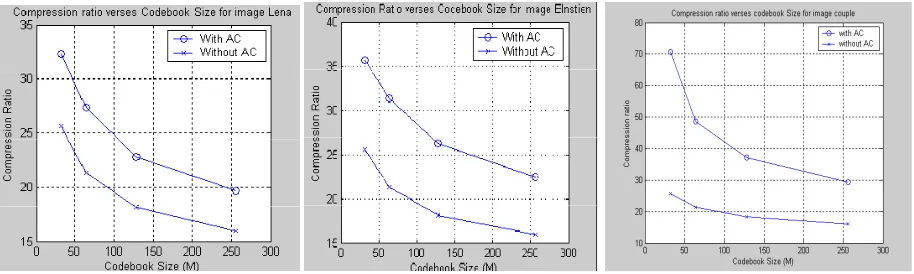
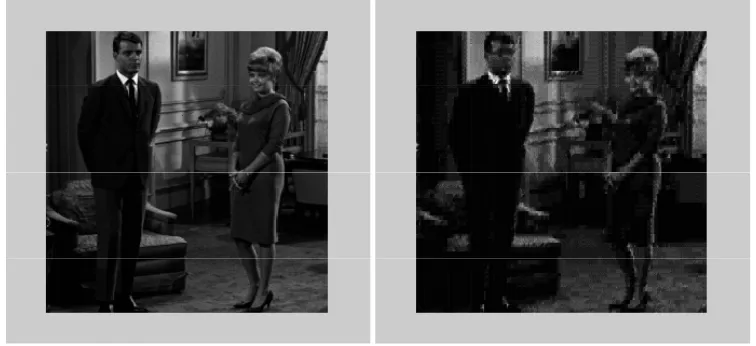
(which is one of the test images in the present investigation) the compression ratio varies from 29.38 to 74.68 for various codebook sizes. The high compression ratio for this image can be explained by observing its histogram, shown in Fig.3 (a). It is clear that there are lesser number of grey levels and larger number of black pixels in the image. This can also be ascribed from the fact that the mean and the variance of image ‘couple’ (0.1505 and 38.38 respectively) are less than the mean and variance of Lena and Einstein (Fig. 3), thus resulting in an increased Compression ratio. The variation of Peak Signal to Noise Ratio with the size is shown in Fig. 4 for all test images under consideration. It can be observed that as the codebook size increases, the objective quality of images increases, however, the compression ratio decreases. It has also been observed that PSNR value is the highest for the ‘couple’ image. Further, it is seen that the efficiency of compression increases by the use of Arithmetic Coding. Moreover, the subjective qualities of some of the representative reconstructed images are shown in Figs. 5, 6 and 7. The graph of PSNR verses compression ratio with and without Arithmetic Coding for the same test images are shown in Fig. 8.
Fig. 2 Variation of the Compression ratio with respect to Codebook size with and without Arithmetic Coding for (a) Lena (b) Einstein and (c) Couple
Fig.3 Histograms of Images used (a) Couple, (b) Lena and (c) Einstein
Fig. 5 Lena Image compression (a) Original Image (b)Compressed by proposed technique (CR=19.75, PSNR= 27.7dB)
Fig. 6 Einstein Image compression (a) Original Image (b) Compressed by proposed technique (CR=22.63, PSNR= 26.0dB)
Fig. 8 Variation of PSNR with respect to Compression Ratio with and without Arithmetic Coding (AC) for images (a) Lena (b) Einstein and (c) Couple
5. Comparison with JPEG:
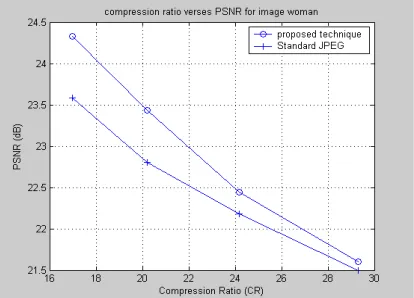
For a comparison, the performance of the proposed technique is compared with the standard JPEG for image ‘woman’ as shown in Fig. 9. For the JPEG compression 8x8 default quantization matrixes is used. It can be observed from this figure that for ‘woman’ image, the proposed method outperforms the DCT based JPEG by up to 1 dB.
Fig. 9 Performance comparison of the proposed method with JPEG for image woman
6. Conclusion:
In this paper, a neural network based compression scheme is presented. The SOFM algorithm is used to classify the similar blocks of an image, and then an arithmetic coding is employed for further decrease in redundancy. The proposed scheme allows achieving a compression ratio of approximately 40:1 with reasonable image quality. The simulation results demonstrated an additional bitrate reduction of up to approximately 30% to 50% as a result of using Arithmetic coding, without sacrificing the image quality. Further, the proposed technique has superior performance than that of JPEG and other ANN based approaches.
References:
[1] W. A Pearlman, A. Islam, N. Nagaraj and A. Said, “ Efficient low complexity image coding with set partitioning block coder”, IEEE Transactions on circuits and systems for video technology, vol. 14, pp.1219–1235, Nov. 2004.
[2] G. K. Wallace, “The JPEG still picture compression standard,” IEEE Transactions on Consumer Electronics, vol. 38, no. 1,Feb. 1992. [3] Karlik, Bekir, “Medical image compression by using Vector quantization Neural Networks”, Neural Network world. Jan 1, 2006. [4] A. Gersho and Robert M. Gray, Vector Quantization and Signal Compression. London: Kluwer, 1992.
[5] Adnan Khashman and Kamil Dimililer, “Image Compression using Neural Networks and Haar Wavelet”, Vol.4, issue 5, pp. 330-339, May 2008.
[7] A. Namphol,S. Chin,M. Arozullah, “Image compression with a hierarchical neural network”, IEEE Trans. Aerospace Electronic Systems,Vol.32, No.1, pp.326-337, Jan. 1996.
[8] Dihong Tian; Pi Sheng Chang; Chen, W.H, “Hybrid Variable Length Coding in Video Compression using Variable Breakpoint”, IEEE International Conference on Image Processing, ICIP 2007,Vol. 3, 16 Sept. - 19 Oct, 2007 pp. 413 – 416.
[9] Karen L. and Robert M. Gray, “Combining image compression and classification using vector quantization”, IEEE Trans. on Pattern Analysis and Machine Intelligence, vol. 17, No.5, pp 461-473, May 1995.
[10] Shaw-Min Lei and Ming-Ting Sun, “An entropy coding system for digital HDTV applications,” IEEE Trans. Circuits Syst. Video Technol., vol. 1, pp. 147–155, March 1991.
[11] Teuvo Kohonen, “Self-Organizing Maps”, Springer, Berlin, Heidelberg, Third Extended Edition, 2001. [12] Simon Haykin, “Neural Networks: A Comprehensive Foundation”, Second Edition, Pearson Education, 2001.