Abstract— In this experimental work, performance, and emission parameters of Nerium - water emulsion (5%water), Nerium - water emulsion (10%water), Nerium - water emulsion (15%water), Nerium - water emulsion (5%water + 1%DEE), Nerium - water emulsion (10%water + 1%DEE), Nerium - water emulsion (15%water + 1%DEE) has tested in a direct injection (DI) diesel engine. The fuel additive is di-ethyl ether (DEE). A single - cylinder, air cooled diesel engine has used as an experimental apparatus. During this test, brake thermal efficiency, specific fuel consumption, and pollutant toxic emissions of nitrogen oxide, hydrocarbon, carbon monoxide, carbon-di-oxide and smoke are measured. Nerium-water emulsion (5%water + 1%DEE) gives the higher brake thermal efficiency of 4.94%, lower specific fuel consumption of 2.31%, and brings down the discharge characteristics of carbon monoxide, hydrocarbon, carbon-di-oxide, nitrogen oxide and smoke when compared to the diesel.
Index Terms— Biodiesel, Engine,Nerium, Performance.
1) INTRODUCTION
Products from oil help us do many things. We use them to fuel our logistics. Even though, it makes life easier – finding, producing, moving, and using can cause problems to our environment. Of late, rising petroleum costs and fears over the environmental impacts of petroleum use, have prompted research into alternative fuels. Biodiesel is one such type, which act as an alternate for conventional diesel. Biodiesel is caused from the resources vegetable oils, animal fats, seeds and other oils. All vegetable oils and fatty tissues are cleared up of triglycerides, which chemically react with alcohol in the bearing of a catalyst to produce chemical compound known as fatty acids and esters (bio diesel). Biodiesel is an alternate fuel that requires no engine changes and provides power similar to conventional diesel fuel. Biodiesel is an ecologically friendly fuel and it contains no sulphur. (0.001%). Biodiesel considerably decreases soot emissions. (up to 50%) and contains no benzole or other carcinogenic
Manuscript received June, 2017.
Paul James Thadhani J, Master of Engineering-CAD, Department of Mechanical Engineering, Anna University, Tirunelveni,India.
Joshua SC Isaac J Lalvani, Department of Mechanical Engineering,
AMIT, Arba Minch University, Arba Minch, Ethiopia.
Habtewolde Ababu, Department of Mechanical Engineering, AMIT,
Arba Minch University, Arba Minch, Ethiopia.
polyaromatic components. Biodiesel easily decomposes biologically and hence no greenhouse effect and global heating. Many researchers suggested that fuels if derived from vegetable oils can be practiced successfully a substitute for diesel.
Yeo et al they stated that spent vegetable oil can be successfully employed as a substitute fuel. The performance of this fuel derived from spending vegetable oil is better than conventional diesel and the emissions of this fuel are much lesser than conventional diesel. A.G. Phadatare et al stated that fuels can be prepared by esterification of oils. Also, the fuels prepared from this process have lesser emissions than that of conventional diesel. S. Saka et al stated that the transesterification process can be done successfully by methanol. Also, methanol can be utilized as a successful substitute for ethanol. Surgical spirit can also be utilized as a transesterification agent successfully. Subba Reddi K describes us a portion of information related to the emissions when an IC Engine was fuelled by alcohol. It stated that the emissions were under control when an engine was fueled by alcohol. Desai k. pet al gave us the details that methyl and ethyl alcohols can be successfully used as an alternate fuel. Alcohols are good solvents for gums and carbon residues that arise due to engine operation. Hence, it is proved that alcohol blended fuels are cleaner than ordinary petroleum products. J. Sarangan, stated that bio-diesel has properties better than diesel, which can substantiate it to give better performance than diesel. Performance tests conducted on diesel and bio-diesel proved that the characteristics of bio-diesel were far better than conventional diesel. Also, the review stated that the emissions were much lower than diesel. Hence, in this study, we carried out using Nerium oil as a substitute fuel for diesel engine. Initially, Nerium oil was taken out from the Nerium seeds by using sox let apparatus. Then the Nerium oil is transesterified into biodiesel and is applied in a diesel engine. Rapid depletion of conventional energy sources, along with increasing demand for energy is an affair of grave worry. To solve both the energy concern and environmental concern, the renewable energies with lower environmental pollution impact should be necessary. Biodiesel is renewable and atmospheric, friendly substitution diesel fuel for diesel engine. It can be produced by transesterification process. Transesterification is a chemical reaction in which vegetable oils and animal fats react with alcohol in the presence of a catalyst.
Experimentation on Performance and Emission
Characteristics of Nerium - Water Emulsion with
Fuel Additive in DI Engine
2) EXPERIMENTAL MATERIALS
A) Preparation of biodiesel by transesterification The best method for the production of biodiesel is the transesterification of vegetable oils with an alcohol. Vegetable oils are converted into biodiesel by the process of transesterification so as to overcome the properties of pure vegetable oils such as high viscosity and low volatility. The reaction is based on one mole of triglyceride (vegetable oil) reacting with three moles of methanol or ethanol to produce three moles methyl or ethyl esters (biodiesel) and one mole glycerol. The transesterification of Nerium biodiesel was performed as follows; Nerium oil was first taken in a three way flask. NaOH pellets, which are used as the catalyst, are mixed with methanol in a beaker. The resultant solution was known as the meth oxide solution. This meth oxide solution was then added to the Nerium oil in the three way flask and stirred well. Again, this mixture was heated up to 70 o C with continued stirring for one hour. The solution obtained was then poured into a beaker and allowed to settle down for nearly 24 hours. The glycerol was settled down at the bottom and methyl esters (biodiesel) were formed at the top. Methyl esters of Nerium oil were separated and heated above 100 o C to remove any untreated methanol. The cleaned biodiesel obtained was the methyl esters of Nerium oil, simply called as Nerium biodiesel. The apparatus required in preparation of the bio-diesel are reaction vessel with water bath, washing cum settling tank, beaker, stirrer, a heating mandrel and the integrities required for preparation of bio-diesel are Nerium oil, methanol and 5 to 7 grams of sodium hydroxide which acts as a catalyst.
The following steps are involved in the preparation of bio-diesel, namely reaction process, separation process, washing with de-mineralized water and moisture removal process.
The main reaction for converting oil to bio-diesel is called transesterification. Transesterification is the process of reacting a triglyceride molecule with an excess of alcohol in the presence of a strong base catalyst such as KOH, NaOH, NaOCH 3 etc. to produce fatty ester and glycerol. In this reaction process the methanol and catalyst are added to the oil to produce methyl ester with glycerin as the by-product. At the start, pour the oil in the flask, then heat it for 65 degree Celsius and stir continuously for 20 minutes. Mix the methanol with sodium hydroxide in a separate beaker to form sodium meth oxide. After 20 minutes, add the sodium ethnocide mixture with oil in the flask and stir it for 20 minutes at uniform temperature. Pour this mixture in settling tank. After the completion of reaction process, the methyl ester is separated from the glycerin naturally, which is due to density differences
Allow glycerin to settle at the bottom and bio-diesel at the top. After settling process, the impurities such as free glycerin and catalyst remaining in the methyl ester are removed using clean water and it is continued till all the impurities removed completely. After washing with de mineralized water the next step is the moisture removal. Methyl ester is separated from waste cleaning water using the density difference. Then, moisture remaining in the methyl ester is removed by heating the bio diesel for 110 degree celsius which is shown Contaminants in the refined methyl ester are filtered to remove as many impurities (up to 10 microns)
bio-diesel fuel, is stored in an air tight stainless steel tank. This bio-diesel has been used to run the diesel engine to execute the performance testing.
3) EXPERIMENTAL SETUP
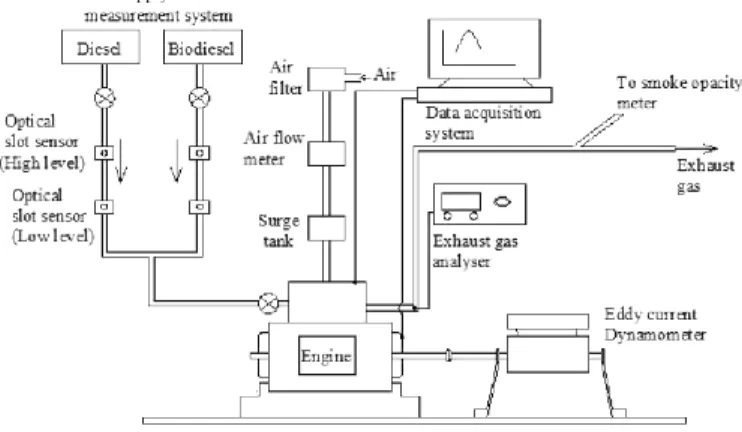
The engine Kirloskar TAF 1 was used in the experiment and its specification is shown The layout of the experimental setup is shown in Figure. An eddy current dynamometer was connected with the engine and used to measure engine power. An exhaust gas analyser DI GAS 444 (five gas analyser) was employed to measure NOx, HC, CO, O2 andCO2 emission online. To ensure the measured values were high, the gas analyser was calibrated before each measurement using reference gases. The AVL smoke meter was used to measure the smoke density. The smoke meter was also allowed to adjust its zero point before each measurement.
A) Engine test procedure
The experiments were carried out by using diesel as the baseline fuel (B0), NWE (5% WATER + 1% DEE) (Nerium biodiesel), NWE (5% water, 10% water, 15% water, 5% water + 1%DEE, 10% water + 1% DEE, 15% water + 1% water)
Figure 1 Layout of experimental setup
Table 1 Engine Specification
Before running the engine to a new fuel, it was allowed to run for sufficient time to consume the remaining fuel of the previous experiment. To evaluate the performance parameters, the important operating parameters such as engine speed, power output, fuel consumption, exhaust emissions and cylinder pressure were measured. Significant engine performance parameters such as brake specific fuel
Make and model Kirloskar TAF 1
Type Four stroke compression ignition, air cooled, direct injection. Bore stroke 87.5 mm * 110 mm Compression ratio 17.5:1
Swept volume 661 cm 3 Connecting rod length 220 mm Rated power 4.4 kW Rated speed 1500 rpm Start of injection 23 o BTDC Injection pressure 200 bar Orifice Diameter 29.6 mm
consumption (BSFC) and brake thermal efficiency (BTE) for biodiesel and its blends were calculated.
4) RESULT AND DISCUSSION
A) Performance characteristics
Brake thermal efficiency: methyl and ethyl esters of Nerium oil (biodiesel) were used separately as the fuel for compression ignition engine without any engine
modifications. The performance and emissions
characteristics of the engine with diesel, biodiesel and biodiesel water emulsion blends. The brake power is defined as the usable energy that is available at the crankshaft. It is the power after the losses due to friction. For an applied load, the brake power is similar for both diesel and biodiesel. But, biodiesel has a very slight advantage over diesel. There is an increase of 12% of brake power when Biodiesel was used. This proves that Biodiesel provides better brake power than conventional diesel.
(i) Brake thermal efficiency
Figure 2 Brake thermal Efficiency with brake power The brake thermal efficiency plots in fig 2 showed an increase in brake thermal efficiency, with an increase in the engine load as the amount of bio-diesel in the blend increases. Even a small quantity of biodiesel in the blend improves the performance of the engine. The brake thermal efficiency of the NWE (5% WATER + 1% DEE) is better than other blends, which is very close to diesel. This is due to reduction in viscosity and micro-explosion which leads to improved atomization, vaporization and combustion. Due to a faster burning of biodiesel in the blend (NWE (5% WATER + 1% DEE)), the thermal efficiency improved due to the cetane number of DEE.
(ii) Specific Fuel Consumption
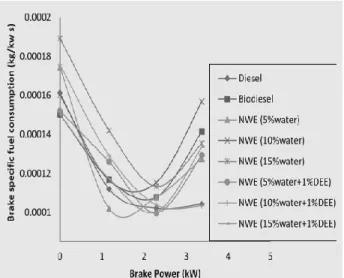
Specific Fuel Consumption is the amount of fuel consumed per brake power per second of work. It is desirable that the specific fuel consumption must be as low as possible. The SFC value was decreased when biodiesel was used at no load. This is desired as the amount of fuel consumed per brake power would be lower and this would increase the mileage of an engine.
Figure 3 Variation of BSFC, with brake power. B) Emission characteristics:
(i) Nitrogen Oxides
Figure 4 Variation of oxides of nitrogen with brake power As the load increases the deficiency for oxygen increases to burn the fuel and NOx emissions decreases The reduction in the peak combustion temperature due to the addition of the DEE which in turn reduces the calorific value of the fuel blend helps in reducing the NOx emissions. The higher cetane number and reduced ignition delay period help in reducing the NOx emission. It shows that NOx emission slightly decreased with DEE because the combustion duration of the blend is shortened. This reduced ignition delay lowers the mass of the fuel accumulated before combustion and lowers the initial combustion rates, hence decreasing the peak temperature thus reducing the NOx formation.
(ii) Hydrocarbon
With the addition of DEE the hydrocarbon emission increases, this may be due to the fact that DEE has a higher cetane number(>125) but when blended with diesel its cetane number decreases raising the ignition delay period, the higher the ignition delay period more the hydrocarbon emissions. The reduction in peak cylinder pressure may also contribute to the increase in hydrocarbon emission.
Figure 5 Variation of hydrocarbon with brake power (iii) Carbon Monoxide
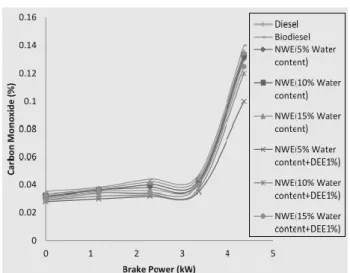
Figure 6 Variation of carbon monoxide with brake power CO emissions are higher at both lower and higher brake power, but it is at its minimum of intermediate power. This is typical with all internal combustion engines since at low loads the air fuel ratio is too low and air fuel ratio decreases with increase in load. With the blending of DEE the CO emissions increases slightly this is due to the incomplete combustion of the fuel due to over leaning of the mixture this happens both at lower and higher engine loads.
Figure 7 Variation of carbon-di-oxide with brake power
(iv) Smoke Opacity:
The smoke opacity remains the same at both high and low power situations and it decreases at intermediate power modes. The increase in smoke opacity is due to the incomplete combustion of the fuel hydrocarbon. The increase of DEE composition in diesel increases the Smoke opacity; this may be due to the phase separation of the blend.
Figure 8 Variation of smoke density with brake power
(v) CONCLUSION
In the present investigation, the performance and emission characteristics of Nerium - water emulsion (5%water), Nerium - water emulsion (10%water), Nerium - water emulsion (15%water), Nerium - water emulsion (5%water + 1%DEE), Nerium - water emulsion (10%water + 1%DEE), Nerium - water emulsion (15%water + 1%DEE) have been analyzed and compared with diesel fuel. The biodiesel is produced from Nerium oil by a method of transesterification. The tests for properties of Nerium - water emulsion demonstrate that almost all the important properties are in close agreement with the diesel fuel. Thus the diesel engine can perform satisfactorily on Nerium – water emulsion with DEE. The results of the present work are summarized as follows:
1. The BSFC decreases with increase in percentage of Nerium biodiesel water content in the emulsion due to the lower heating value of blends.
2. The BTE of Nerium - water (5% WATER + 1% DEE) is closer to diesel at part loads.
3. At part load, the emission of CO for NWE (5%water + 1%DEE) is lower, whereas for pure biodiesel it is 20% higher than diesel.
4. It is observed that there is a significant reduction of HC for biodiesel and its blends at all engine loads.
5. The emission of NO x is higher than diesel for biodiesel and its blends, but for NWE (5% WATER + 1% DEE) slight increased.
6. Reduction in smoke emission for biodiesel and its blends at high loads whereas, for NWE (5% WATER + 1% DEE) decreased at full load.
From this study, it is concluded that optimized blend is NWE (5% WATER + 1% DEE) with respect to performance, and emission characteristics at all loads compared with diesel and it could be used as available alternative fuel in a single cylinder direct injection diesel engine without any modifications.
REFERENCES
1) Andres V Ku, Quiambao B & Yeo B, 2002 ―Utilization of Spent Vegetable Oil as Diesel Fuel Additive‖, proceedings of the 6th Asia-Pacific International Conference, at Kuala Lumpur, Malaysia. . 2) Raheman. H, Phadatare. A. G., October 2004 ― Diesel engine
emissions and performance from blends of karanja methyl ester and diesel‖ Biomass and Bioenergy, Volume 27, Issue 4, pp 393–397. 3) Kusdiana. D and Saka. S, April 2001 ―Kinetics of transesterification in
rapeseed oil to biodiesel fuel as treated in supercritical methanol‖ Fuel, Volume 80, Issue 5, Pages 693-698.
4) Subba Reddi. K, 1989 ―Instrumentation for exhaust emission studies on a methanol fuelled spark ignition engine‖ Proceedings of the XI National Conference on I.C. Engines and Combustion, at Indian Institute of Technology, Madras, India.
5) Desai KP, Channaiwala SA 1989 ―performance characteristics of alcohol fueled two stroke SI. Engine‖ Proceedings of the XI national conference on IC engines and Combustion, at Indian Institute of Technology, Madras.
6) Sarangan J, 2001 ―Critical Review on Bio Diesel Substitute Fuel for Diesel Engines‖ Proceedings of 17th National Conference on IC Engines and uistions, at Karnataka Regional Engineering College Surathkal
7) Kumar C, Babu MKG and Das LM (2006) Experimental investigations on a Karanja oil methyl ester fueled DI diesel engine. SAE; 2006-01-0238
8) Lalvani, J. Isaac JoshuaRamesh, M. Parthasarathy, and K. Annamalai. "Performance and emission characteristics of a diesel engine fueled with blend of vegetable oil esters." International Journal of Science, Engineering and Technology Research 1.2 (2012): pp-6.
9) Jhon B Heywood (1988) Internal combustion engine fundamentals. McGraw – Hill, International Eds., Automotive technology series. 10) Ganesan V (2009) Internal combustion engines. Tata McGraw –Hill
publishing company limited.
11) Lalvani, J. Isaac JoshuaRamesh, et al. "Performance characteristics and emission analysis of a single cylinder diesel engine operated on blends of diesel and waste cooking oil." Energy Efficient Technologies for Sustainability (ICEETS), 2013 International Conference on. IEEE, 2013.
12) Lalvani, J.I.J., Parthasarathy, M., Dhinesh, B. et al. J Mech Sci Technol (2015) 29: 4519. doi:10.1007/s12206-015-0951-y
13) Yaliwal V S (2010) Production and utilization of renewable liquid fuel in a single cylinder four stroke direct injection compression ignition engine. Int. J.Engg. Sci. Technol. 2(10), 5938-5948
14) Murugasen A Experimental and theoretical investigation of using biodiesel in diesel engines. Ph.D., Thesis. Anna University, Chennai. 15) Parthasarathy, M., J. Isaac JoshuaRamesh Lalvani, B. Dhinesh, and K.
Annamalai. "Effect of hydrogen on ethanol–biodiesel blend on performance and emission characteristics of a direct injection diesel engine." Ecotoxicology and environmental safety 134 (2016): 433-439.
16) Isaac JoshuaRamesh Lalvani J, Parthasarathy M, Dhinesh
Balasubramaninan, Annamalai K; " Experimental Investigation on D.I Diesel Engine with Renewable Biodiesel - Adelfa Blend Journal of Chemical and Pharmaceutical Sciences" Special Issue-4, Pages 240-242, 2014
17) Balusamy T and Marappan R (2010) Effect of injection time and injection pressure on CI engine fuelled with methyl ester of Thevetia peruviana seed oil. Int. J. Green Energy, vol. 7, 397-409.
18) Abayeh O J, Omuoha EC and Ugah IA (2007) Transesterified Thevita nerifolia oil as a bio-diesel. Global J. Environ. Res. 1(3), pp 124-127. 19) Parthasarathy, M., J. Isaac Joshua Ramesh Lalvani, B. Parthiban
K.Annamalai, "Comparison of Performance and Emission Characteristic of Tamanu, Mahua and Pongamia Biodiesel in a Di Diesel Engine." Advanced Materials Research. Vol. 768. Trans Tech Publications, 2013.
20) Rosca R, Rakosi E and Manolache G (2005) Fuel and injection characteristics for a biodiesel type fuel from waste cooking oil. SAE Int. 01-3674
21) J. U. Duncombe, ―Infrared navigation—Part I: An assessment of feasibility,‖ IEEE Trans. Electron Devices, vol. ED-11, pp. 34-39, Jan. 1959.
22) C. Y. Lin, M. Wu, J. A. Bloom, I. J. Cox, and M. Miller, ―Rotation, scale, and translation resilient public watermarking for images,‖ IEEE Trans. Image Process., vol. 10, no. 5, pp. 767-782, May 2001.
J.Paul James Thadhani has finished his Master’s degree in CAD in Anna University Regional Center, Tirunelvelli and his Bachelor’s degree in mechanical engineering in PET engineering college valioor. Since 2012 soon after his completion of a Master’s he was pursuing his excellent career in teaching various design oriented subjects with a very good academic record and has published many national and international journals in reputed journals. His current area of research is to work on automobile design with composite materials.
J. Isaac JoshuaRamesh Lalvani has been working as Assistant Professor in Mechanical Engineering Department of Arba Minch University (Ethiopia) since 2016. He did his research in the Department of Automobile Engineering, Madras Institute of Technology Campus (MIT), Anna University, Chennai (India). He has done his Post Graduation in Automobile Engineering, Madras Institute of Technology, Anna University, Chennai - 600044 (India) and he did his Under Graduation in Einstien College of Engineering, Anna University, Tirunelveli - 627012 (India). He has published several research articles in National and International Journals of repute. He is also the serving as a reviewer for Journal of oil and palm research, Hindawi publications and Clean Technologies and Environmental Policies, Springer. His current field of research is combustion improvement in internal combustion engines fuelled with biofuels.
.
Habtewolde Ababu has been working as instructor in Mechanical Engineering Department of Arba Minch University since 2008. Presently, he is head of the department. He studied a Bachelor’s degree in mechanical engineering at Arba Minch University until 2007 and he pursued a Master’s degree in Energy Technology in Mekelle University. His current areas of research are renewable energies such as solar- thermal, wind, hydropower, biofuels and energy storages.