April
,
196
4
4 WAYS TO IMPROVE COMPUTER TAPE
Exercise greater quality control.
The Memorex-designed Vibrating-Sample Magnetom-eter (VSM) tests basic characteristics of oxide raw material and precise concentration of oxide particles in the tape coating_ Extra tests of this kind guaran-tee the improved performance and reel-to-reel uni-formity of Memorex computer tape.
Use a superior production facility.
A conspicuous aspect of the Memorex plant is the complex system of air filtration, humidification, dehumidification, heating and cooling. The unusual high-purity'·system, equal to that used in pharma-ceutical processing, provides a contaminant-free environment..:.... prerequisite to production of ini-proved error-free tape.
Memorex tape is premium tape. No need to pre-check it. You can place Memorex computer tape directly in service-reel after service-reel.
Memorex certification means what it says: Memorex com-puter tape ~ error-free. Extra care, extra steps and scrupu-lous attention to everydetail make it that way. We know the importance to you of having a tape you can depend on.
Circle No. 5 on Readers Service Card
Employ advanced production techniques.
Specially constructed equipment - used to slit
Memorex computer tape from jumbo rolls -
pro-auces tape with clean, straight edges free from rip-ples and ridges. A new slitting technique is but one of seventeen manufacturing improvements made to insure superior performance of Memorex tape.
Apply research in depth.
Research in oxide, coating materials, and tape-making processes has equipped Memorex with a fund of new technology. Combined with manufac-turing competence, this fundamental knowledge is manifest in Memorex computer tape by freedom from dropouts, longer life, and improved uniformity and reliability of performance.
Are you on our mailing list to receive the Memorex Monograph Series of informative technical literature? Write 1176 Shulman Road, Santa Clara, California.
MEMOREX
PRECISION MAGNETIC TAPE,
Bell System
DATA-PHONEservice can tie your
organization together efficiently and economically
with a communications system that's thousands
of times faster than the mail-and 16 times faster
than people can talk.
It makes possible business machine' 'talk" over
regular telephone lines-at regular telephone rates.
You can transmit anything that can be punched
THE
FASTEST
OUTBOX
IN THE
WORLD
on cards or tape at speeds up to two million words
in 24 hours.
Your people can have all of the information
they need-when they need it. No costly delays.
No postponed decisions.
To get all the details, just call your Bell
Tele-phone Business Office and ask for the services of
a Communications Consultant.
BELL TELEPHONE SYSTEM
Serving you
improved
h
b
4m
•
I
If.
n
t
•
•
t
•
I
(+)
COMPUTRON INC.
" l 122 CALVARY STREET. WALTHAM. MASSACHUSETTS
...
l
Circle No. 7 on Readers Service CardOur front cover shows a command post orientation being given on a computer-generated battle map at the new System Design Laboratory
0/
the Air Force's Electronic Systems Dizlisioll at Hanscom Field, Mass. For more details, see story 011 page 44.©@[fLFUCQ)(1~[~~[f~~
m[j~©J m(1~'~©U-LtUm\00©[jLl
APRIL, 1964 Vol. XIII, No.4
editor and publisher
EDMUND C. BERKELEY
assistant editors
MOSES M. BERLIN NEIL D. MACDONALD LINDA LADD LOVETT
contributing editors
ANDREW D. BOOTH NED CHAPIN JOHN W. CARR, III ALSTON S. HOUSEHOLDER PETER KUGEL advisory committee T. E. CHEATHAM, JR. GEORGE E. FORSYTHE RICHARD W. HAMMING ALSTON S. HOUSEHOLDER HERBERT F. MITCHELL, JR. associate publisher PATRICK J. MCGOVERN production manager ANN B. BAKER art director RAY W. HASS circulation manager
VIRGINIA A. NELSON, 815 Washington St. Newtonville, Mass. 02160, DEcatur 2-5453
advertising representatives
New York 18, BERNARD LANE 37 West 39 St., BRyant 9-7281 Chicago 11, COLE, MASON AND DEMING 737 N. Michigan Ave., SU 7-6558 Los Angeles 5, WENTWORTH F. GREEN 300 S. Kenmore Ave., DUnkirk 7-8135 San Francisco 5, A. S. BABCOCK 605 Market St., YUkon 2-3954 Elsewhere, THE PUBLISHER 815 Washington St., DEcatur 2-5453 Newtonville, Mass. 02160
computers and data processors: the design, applicatiollS, and implications
0/
in/ormation processing systems.
111
This Issue
14 DECISION TABLES AND THEIR APPLICATION
by Paul Dixon
20
27
STANDARDS FOR COMPUTER PROGRAMMING (PART 1)
by Dick H. Brandon and Frederick Kirch
THE PUBLIC IMAGE OF COMPUTING
by Harold J. Bergstein
111
Every Issue
across the editor's desk
39 COMPUTING AND DATA PROCESSING NEWSLETTER
7 11 11 12 8 8 9 34 35 52 54 55 56 27 58 editorial
Computers and Skills
edito}"s sC}'tltcbj)([d
Computer Swapping Competition Grows
Something New Via Something Used from Burroughs Updating the Computer Count in Europe
readers' ([IuZ editor's forum
1964 Fall Joint Computer Conference - Call for Papers Science, Privacy, and Freedom
Automation and Unemployment, by Helen Solem Calendar of Coming Events
capitol report
reference information
Monthly Computer Census '64 SJCC Preview
Books and Other Publications, by Moses M. Berlin New Patents, by Raymond R. Skolnick
index of JJotices
statement of Ownership and Management Advertising Index
COMPUTERS AND AUTOMATION IS PUBLISHED MONTHLY AT 815 WASHINGTON ST., NEWTONVILLE 60, MASS., BY BERKELEY ENTERPRISES, INC. PRINTED IN U.S.A. SUBSCRIPTION RATES: UNITED STATES, $15.00 FOR 1 YEAR, $29.00 FOR 2 YEARS, INCLUDING THE JUNE DIRECTORY ISSUE; CANADA, ADD SOc A YEAR FOR POSTAGE; FOREIGN, ADD $1.50 A YEAR FOR POSTAGE. ADDRESS ALL EDITORIAL AND SUBSCRIPTION MAIL TO BERKELEY ENTERPRISES, INC., 815 WASHINGTON ST., NEWTONVILLE, MASS., 02160. SECOND CLASS POSTAGE PAID AT BOSTON, MASS.
POSTMASTER: PLEASE SEND ALL FORMS 3579 TO BERKELEY ENTERPRISES, INC., 815 WASHINGTON ST., NEWTONVILLE, MASS., 02160. ©COPYRIGHT, 1964, BY BERKELEY ENTERPRISES, INC. CHANGE OF ADDRESS: IF YOUR ADDRESS CHANGES, PLEASE SEND US BOTH YOUR NEW ADDRESS AND YOUR OLD ADDRESS (AS IT APPEARS ON THE MAGAZINE ADDRESS IMPRINT), AND ALLOW THREE WEEKS FOR THE CHANGE TO BE MADE.
6
P D P - 5
FOR ECONOMICAL SYSTEMS CONTROL-THE GENERAL
PURPOSE PDP-5 DIGITAL COMPUTER AT ONLY $24,000.
Installation by installation, DIGITAL's Programmed Data Processor-5 is del iveri ng more value per dollar in con-trol applications than any other general purpose com-puter on the market. It can receive signals from or gen-erate commands to as many as 64 external devices di-rectly connected to its input-output buss. It has a fast, 6-microsecond memory cycle time which permits real-time data compilation and proc-essing or recording. And it comes with a complete soft-ware package based on sim-plified instructions for ease of programming.
Among the many other PDP-5 features:
a 55,555 additions- per-second computation rate
• 2-megacycle bit input via built-in data channel e 24-bit arithmetic
• 1024- or 4096-word, random access, mag-netic core memory • Analog-to-digital
con-verter wired into basic mach i ne (conve rte r modules optional at slight additional cost) • Software package
in-cludes FORTRAN, as-sembler, double- preci-sion, floating point, and maintenance routines
Computer with 1024-word memory, printer-keyboard, and paper tape reader and punch is only $24,000; 4096-word memory option, $3000 additional.
EQUIPMENT
CORPORATION
MAYNARD,MASSACHUSETTS
los Angeles • Palo Alto • Park Ridge, III. • Washington, D.C. • Parsippany, N.J. • Monroeville, Pa. • Ottawa, Canada • Munich, Germany • Sydney, Australia
Circle No.8 on Readers Service Card
Computers
"New Tool, New World" is the title of a "Special Re-port" on computers in "Business Week" for February 29, 1964, pp. 70-90, published by McGraw-Hill, Inc., New York, N.Y. This report contains much interesting informa-tion and some important ideas:
"As more and more human abilities are transferred to the computer through . . . programming, and thereby become part of a new kind of library of skills, . . . the effect may be equal in kind to the change that occurred when written language appeared.
"Writing freed mankind from total dependence on memory and permitted the accumulation and selection of effective knowledge. The computer program in turn accumulates and preserves skills. There are enormous implications in this for business, education, training, and future employment. There is not much point in having someone spend a great deal of time in mastering the kind of skill that a computer can learn in a few seconds by having a program fed into it."
It is a striking statement: "the computer program ac-cumulates and preserves skills." - And there are many situ-ations in which this statement applies correctly. The way in which 1000 stock items should be manufactured by 15 plants and stored in 26 warehouses under various condi-tions such as sale prices, production costS, etc., can be figured Out once and for all and stored in a computer pro-gram. The way to design and machine 700 different engine turbine blades can be figured out and stored in a computer program. Production formulas, such as the precise way to make a Stradivarius violin, or the Roman cement that lasts 2000 years, will no longer be lost. Such formulas can be stored in computer programs, which placed on appropriate equipment will again produce the identical product.
We need to point out however some limitations affect-ing the accumulation and preservation of skills by computer programs, and the matter of human beings mastering skills that are being programmed on computers.
First, the skills that are needed by society change. Ac-cordingly, many of the programs that preserve the skills of 1960 may not be too useful by the year 1970. This implies the alteration of computer programs recording skills. Al-though one can conceive of programming computers to alter their own programs, there seems to be in the real world a race between the complexity of programs and the capacity of human beings to understand and alter the pro-grams when needed. Often the departure of an experienced programmer who understands the program which he has
and
Skills
c&a
EDITORIAL
created and put into a computer, leaves the organization almost unable to change the program intelligently. The documentation of the program is often insufficient to un-derstand the detailed relations between the parts of the program and the parts of the skill. In fact it seems to be a theorem: a really good programmer can think so fast that he hates to write, and so he resists to the utmost writing an adequate explanation of what he has programmed on the computer. The computer field may be encountering here a serious and lasting obstacle to the progress of computer programming - the increasing inability of people other than the high priests to understand the sacred writing in all its varieties.
Second, if a human skill involves perception of a complex environment and responding to it appropriately with a wide variety of actions, it is likely to be many years and perhaps many decades before the computerized machine c::an take over. For example, take the work of a good motor car re-pairman. He listens to the symptoms reported by his cus-tomer; he listens to the sounds of the engine and the car; he makes some tests, decides what is needed, looks up the part numbers in a
big
catalogue like a telephone book, orders them by phone, sends one of his helpers to fetch them from the local supplier, removes the old parts, installs the new parts, and finally checks the car to be sure it isonce more operating correctly. The human skill of a motor car repairman is likely to endure for years and years in competition with the computerized machine.
Finally, there is the divergence between the way in which you program a computer to use skill, and the way in which you program a human being to use skill. The computer is an "idiot monster": if you substitute one hyphen for one space in a computer program 5000 instructions long, your satellite may miss its rendezvous completely. The computer may have high intellectual capacity but it
often seems to have no common sense. If you try to tell a computer "This is about the way in which you should do such and such - now use your judgment," the computer nearly always replies by its actions that it has no judgment whatever.
Not all the accumulation and preservation of skills can be accomplished by the computer program. A great many skills will be left for human beings to learn, master, apply, and teach to computers.
~~c.:::~~
1964 FALL JOINT COMPUTER CONFERENCE - CALL FOR PAPERS
The technical program committee for the 1964 Fall Joint Computer Conference has issued a call for papers to be considered for presentation October 27-29 at the San Fran-cisco Civic Center.
The scope of the program is planned to be the entire in-formation processing field. There is special interest in: Analog and hybrid computers, artificial intelligence, busi-ness data processing, components and circuits, display, edu-cation and computers, information storage and retrieval, input-output devices, logical design, mathematical tech-niques, multiprocessors, process control, programming, standards for hardware or software, storage, and systems.
Drafts of complete papers (up to 10,000 words) in quintuplicate and 150-word abstracts are required by May 1. Submissions and inquiries should go to David R. Brown, chairman of the 1964 JCC Technical Program, Stanford Research Institute, Menlo Park, Calif. Authors need to provide any needed company and security clearances at the time of the submission of the paper.
SCIENCE, PRIVACY, AND FREEDOM
1. From Professor Alan F. Westin Special Committee on Science and Law The Association of the Bar of the City of New York
320 Park Ave. New York, N.Y. 10022
For almost two years, this Committee, working under a grant from the Carnegie Corporation, has been exploring the impact of science and technology on the conditions of privacy in America. Our survey has ranged from the latest electronic eavesdropping devices to new restraint-removing drugs, and from brain-wave research to subliminal sugges-tion. Our approach has been to acquire precise scientific data on each development, to measure its present impact on privacy, and to think through the implications on our institutions.
From the start of our work, one of the areas that has seemed to us most significant has been the relation of automatic data processing to privacy. Apart from the socially beneficial uses of computers, and those dictated by national security interests, how is the spread of the com-puter into increasing areas of private and government life going to affect informational areas that the individual (and various business and civic groups) has traditionally been able to keep private in America? As we have tried to ap-proach the problem, there are several facets to this issue:
8
c&a
READERS'
&
EDITOR'S FORUM
1. the question of acquiring and storing more and more information from individuals and groups;
2. the question of making such information freely ex-changeable with other information-acquiring and processing systems;
3.
the uses made of such stored information by govern-ment and private agencies;4. the costs to essential areas of privacy resulting from such acquisition and uses, looking at costs such as vastly increased efficiency and information for govern-ment, and its effect on the balance of power between government and the private sectors in the United States; and
5. possible safeguards for crucial areas of privacy, either through arrangements possible in computer applica-tions themselves, or through laws protecting confi-dentiality of information,' or through public opinion affecting decisions as to expanding the computer into various new areas.
We have been aware that a few persons especially inter-ested in the computer field - such as Bernard Benson, of Benson-Lehner Corporation, Dr. Richard W. Hamming, of Bell Laboratories, and Edmund C. Berkeley, of Computers and Automation} among others - have specifically com-mented on the need to be aware of the potential pressure of the computer on American privacy.
To gain more detailed information and further ideas, we are now inquiring particularly in regard to the following questions:
1. Is the shrinking of privacy through computer-processed data already a serious problem, or one coming in the near future, or still quite far away, or is it not a serious concern now and not likely to become such in the foreseeable future?
2. What, if any, scientific developments looming ahead promise to make this issue more acute? When may such developments be expected and what will be the specific nature of their impact?
3. Is this a problem that should be of active concern to "computer people", or is it primarily a problem for the users of computers, such as business firms, schools, law enforcement agencies, etc.?
4. Do you have any suggestions as to the most de-sirable way for state and/or federal legislatures, regula-tory agencies and/or the courts to respond to this issue?
We would be glad to have any ideas that may be offered us on this problem, not only in relation to the statement and questions posed in this letter, but in any other aspect of the issue that we have not mentioned but which may be
im-portant and relevant to our work. We plan to publish the results of our study in a book aimed at the thoughtful general reader, which will be put out later this year by Atheneum Press under the tentative title Science} Privacy and Freedom.
II. From the Editor
A rather fearful increase in the invasion of privacy can be expected from the spreading of computer and data proc-essing activities throughout government. A governmental intelligence agency will be able to correlate enormously more activities, protests, letters to congressmen,. e~c., of .non-conforming persons; the harmfulness of blackl1stmg wlll be.:
multiplied when it is comp~teri~ed. . .
The subject of computenzed mvaSIOn of pflvacy should be one of concern to computer people. The readers ~f "Computers and Automation" are invited to express theIr views on this subject.
Here is one comment: it may be that the harm from the invasion of privacy will not be as great as the harm from the invasion of the mind, which is accomplished by control over the great media of expression - television.' radio, newspapers, and advertising - su~h a~ is found m most societies at many times. In such a situation the government and the establishment effectively (if not apparently) con-trol nearly everything that most people read. For example, how many Americans know that about 1~% (or. 40,000 men) of the forces of the South Viet Nam dICtatorshIp went over to the other side (the National Liberation Front or Viet Cong, whose platform is independence, democr~cy,
neutrality, and peace), during 1963, most of ~hem tak.mg their weapons with them? (S?urce: a Canadlar: publIca-tion. ) And how many Ameflcans are able qUIckly and automatically to translate "strategic hamlet" into ":oncen-tration camp"? One of the big advantages of readI~g. the press from other countries is the ligh.t shed by t~e vaflatlOnS in the informational intake within dIfferent natIons.
AUTOMATION AND UNEMPLOYMENT
Helen Solem Hillsboro, Oregon
"To oppose automation is to oppose progress. The time has come for us to squarely face the problem of job dis-placement. If American econo~y is n~t to suffer, some-thing must be done soon about thIS growmg segm~nt of our population." The keynot
7
speak.er. at the conv~ntIOn of the American Manufacturers ASSOCIatIon brought mto the day-light a festering social probl~m. . . .While the AMA was publIcly recognIzmg thIS problem, .the following letter was delivered to a new member of that growing population, the unemployed:
"The purpose of this letter
is.
to ~onfir~ and put in writing our agreement as of Apfll 1 I? whICh you woul? be given until June 1 to find a new Job. Although t.hIS was a longer time than I had originally intended, I thInk this amount of time is warranted because of your 20 years service and our concern for you personally."As I pointed out, and as we discussed, the reasons for this decision to terminate your employment were based upon the fact that you seemingly could not adjust t? changes created by automation. I. sincerely regret thts action, but as you are aware the tens ton generated by your attitude toward the changes of duties brought about by new methods . . ."
Heartless? or realistic? Couldn't a person with 20 years satisfactory service be trained for some other position? Or are there just too many untrained people for the avatlabl.e jobs? Whatever the foregoing situation can be termed, It
is by no means an isolated instance.
Looking at the other side of the picture, industry also has a problem. One doesn't stay in business long at today's productive pace with horse and buggy methods.
Taking a look at the statistics 1 of unemployment, one
finds that there are pronounced shortages as well as ove:-supply. Skilled, educated p~ople are as scarce .as ever. Thts is difficult to understand wtth all the emphasts and money being spent on American education, not only today,. but ~or a generation or longer. If West Germany and RUSSIa enJoy full employment for every person able and willing to work, why can't we?
Taking another look at the graphs and charts put out. by the Bureau of the Census, it seems true that older, long-tIme employees arc hardest hit by chan~e. New, inexperie.nced, job seekers also have trouble findmg wor~. IncreasIngly, middle managers have to return to producuon work - tf
they can find a spot. These are the types of people who form the "hard core of unemployed," the ones who resist the change automation brings with all their strength, by o:gan-izing, by strikes and by legislation. These are not baSICally constructive approaches toward solving the problem, but retaliatory, defensive measures.
Congress passed the Manpower Development and Train-ing Act in 1962. It is a matching funds federal-state pro-gram originally authorized for three years. There are many obstacles to such a retraining program, not the least of which is the outlook of the unemployed themselves. The ones most needing the retraining and help, arc often reluc-tant to participate. In a Massachusetts!'! attempt at re-training letters were sent to 3,500 people who were felt to be candidates for clerical-sales training. Only 233 re-sponded to the letter. 35 actually took the course.
Contrary to appearances these people were not indifferent or apathetic to their plight. But many refused to face the fact they needed help, saying the situation was only tem-porary, a seasonal layoff. Many feared trying som~thing new and different. Going away (r.om home, a posstble move, prevented many from accepting retraining .. Many felt even a small tuition was an insurmountable obstacle. There were a great many who are p~rplexed and ?ot capable of evalu-ating their own potenual and formIng a new plan for gainful employment. And last, but not least, th~re were far too many who lacked even the fundamental skills of read-ing, writing and arithmetic. .
In another attack on the problem in Massachuset~s, wht.ch was far more successful, implemented in connectIOn WIth unemployment compensation, the retraining was largel~ .a matter of individual choice. Here 1,300 persons parttCI-pated. 90 % successfully finished their course a?d 35% increased their yearly income by $1,000. AnalYSIS o~ the follow-up questionnaire showed this group 'to be lughly motivated and less typical of the hard-to-place unemploye?
An experience in Maine:l with an elementary course In sewing was highly successful. After tl~is 3-week .course the Employment Service was able to fill Jobs for sutc.hers f~r which these same women previously could not qualtfy. ThIS would have seemed a basic knowledge for women and there-fore training unnecessary, but ex:perience .proved otherwise. Food-handling, another occupatIon seem.Ingly so com.mon that no training would ever be needed, mIght be as fruitful. Good personal grooming and hints for meeting and mak-ing friends with the public might be as necessary.
Thoughtful people across America are taking the issue to heart. Fortunately the majority of willing and able persons are gainfully employed. Our Gross National Produce has never been greater - 550 billions of dollars. Average income for the ten year period from 1950 .to 1960 al~ost doubled for approximately half our workmg p~pu!atton.
Farmers the unskilled and managers however dtdn t fare as well. 'Table 1 shows who is producing this tremendous GNP.4
10
~i
":n
.O!
....
~---NOTIC[Or • L PAYMENT DUE ·:1·~i
.~'
• I 0 ,•
AGENCY COpy OF PREMIUM NOTICE J[NHlClllLlfEIHS"UHtECOM'.II" •
•
•
•
•
•
•
,...
' I S~~f~A~~~~~.~~A~E COMPANYCOpy OF UNPAID PREMIUM REMINDER.
I.".~",.,,, 1
i
•
~c=J 1 .... ,,.,,.
II
'Ii"!i "IUMB!!;
i'd!
it
-B~CI~l~.!~;~~.~E~P~N-;--
•I ~< .. - . I .. ··_···_· .... · .. ···_·· .. ··,,··_· ..
--r·"
1 "''' r ':""1'" 1 rENT'S COPY Dr UNPAID PREMIUM REMINDER.I _." " ... , ~. .._ .• _
FoliiiiSCARD
is the.
best
POliCY
lor
BenefiCial
Lile
Insurance
Co.
• Like all life insurers. Beneficial Life Insurance Co., of Salt Lake City, Utah, uses many different forms to remind policyholders of premiums due and past due, to announce dividends, for internal accounting, etc. In many cases, local agents must be informed when such notices are sent to policyholders. Meeting these diverse needs was easy, thanks to the unmatched flexibility of FORMSCARDS. Continuous tab cards were designed with provision for agency-copy vouchers . . . and high speed processing on Beneficial's computers. To insure your firm's efficiency, follow Beneficial's policy . . . investigate the unique advantages of FORMSCARDS! • Operate efficiently on any printer ... any speed • Easily separated manually or on any burster • Available pre-punched and with vouchers of any
size at top, side or bottom • Can be part of multiple-part sets
F
O:,:ii.iii,Si,C~A:RD®
the only continuous tabulating card with NO medial waste strips
call, write or wire
7i!l!'G~ov!~~
Phone: Oldfield 9-4000/Area Code 215Manufacturers of Line Hole Continuous Business Forms
Call or write for the name and address of our Sales Representative in your area Circle No. 9 on Readers Service Card
COMPUTER SWAPPING COMPETITION GROWS
As mentioned in last month's SCRATCHPAD, one of the most significant things about the success of the Honeywell 200 computer in captur-ing orders from current users of IBM 1400 series machines, is that it encourages other manufac-turers to enter more deliberately the 1401 re-placement market. This effect has not been long in coming, as recent announcements from Bur-roughs and General Electric reveal.
Moving quickly, Burroughs announced last month the availability of a program translator which converts 1400 series programs into B200 series programs. Burroughs claims that the translated programs from a card system run 50-to-100% faster on the B200's, and tape programs run 25% faster on the B200's •. As Burroughs DP sales manager V. J. Ford likes to put it, the "avail-ability of this translator removes the time and cost barriers to conversion to more productive systems."
General Electric has just officially taken the wraps off its 415 computer which extends its compatible 400 series down to the $5000 to $9000 per month range. Basically a slowed-down 425 (memory cycle time of 2.3 usec. per character versus 1.28 usec. for the 425), the 415 offers the same software and peripherals as the 425. A minimum configuration of the 415 with a 4K memory, card reader and punch, and printer goes for $4770 per month. A 32K memory, four tape 415 system with a card reader and punch, and printer, would be about $8500 per month, rather than the $5000 per month reported mistakenly in last month's SCRATCHPAD.
For the current 1400 series user who would like to convert to the 415, GE is offering three months of free use of a CAPACITRIX (Capacitive Matrix) memory, a special permanent store memory unit, which enables the 415 to simulate the operations of the 1401. This special memory is offered to keep the current 1400 series user "on the air" while he is reprogramming his jobs in 415 instructions. To encourage the user to reprogram expeditiously, GE nudges the price of the CAPACITRIX up to $300 per month for the fOl1rt:r.. thru sixth month, $600 per month for tho seventh thru ninth month, and $900 per month thereafter. GE is also offering a 1401 simula-tor program with its 415 for those users who would rather not reprogram, but are willing to go the cost of the extra core memory needed to 'store it.
EDITOR'S
SCRATCHPAD
GE has been promoting the 415 to prospec-tive customers for about a month before its of-ficial announcement, and current estimates are that GE already has about 45 orders for the sys-tem outside of GE. One New England user we talked to said he is planning to replace two 1401's with a 415 in the fall of this year.
GE can be expected to move into the IBM 7000 series market with an official announcement of its 600 series computers this month. GE, as one of the largest current users of IBM equip-ment, has already struck at the 7000 series from within when it recently decided to replace eight 7090's used internally with their own 625 com-puter this year.
Of course, one of the big and as yet un-answered questions, is what IBM will offer in the small to medium class computer range when it makes its upcoming new computer series announce-ment this month. We conducted an informal sur-vey among some current major users of IBM equip-ment, and found to our surprise that many of them had already been briefed by IBM personnel on the new series. Most of these people ex-pressed an "about time" attitude toward the new IBM equipment, noting that at last IBM is plan-ning to offer the type of computing power per dollar that their competitors have been touting for a year or two. As one data processing manager, who has four 1401's in operation, and a 1440 and two H-200's on order, mentioned to C&A,
"I have been up to Poughkeepsie Imd have been given the story on the expected capabilities of the new IBM computer series. Unless the compu-ting cost of the smaller machines comes in ma-terially lower than I currently anticipate, I will be sticking by my H-200 orders. My company sees a definite advantage to dealing with two vendors."
At the time you are reading this issue, several of these questions will probably be answered by IBM's new computer series anpounce-ment currently scheduled for April 7.
SOMETHING NEW VIA SOMETHING USED FROM BURROUGHS Burroughs has come up with a bright new way of handling one of the effects of the growing computer replacement activity. It is taking its Model 0 B200 processors which have been returned
by users who heve been up-graded to the B263, 273, 283 or other systems and surrounding them with some low-cost peripheral equipment. This Burroughs is calling its new BIOO computer ser-ies.
The BIOO series includes a B160, the B170, and B180. The B160 is a punched card system which rents for about $2000 per month. The B170 can use card, magnetic tape or MICR and rents for about $2800. The B180 with six magnetic tapes will rent for just over $4000 per month. The peripheral equipment for the series includes a 400 cards per minute reader, 475 lines per minute printer, 250 lines per minute multiple lister, and a 1200 check per minute sorter read-er. Magnetic tape units have a 24 kc transfer rate.
According to a Burroughs spokesman, the com-puter is immediately available for delivery, and several have already been sold, although the first official announcement of the series is not expected until the beginning of April.
COMPUTERS INSTALLED VALUE
UPDATING THE COMPUTER COUNT IN EUROPE
Many of our readers may remember reading the report on "The Development of the Computer Market in Europe" which appeared in the Septem-ber and OctoSeptem-ber, 1963, issues of C&A. This re-port, prepared by the Netherlands Automatic In-formation Processing Research Center, gave 8
detailed description of the growth of the market for computers in the countries of Western Europe up to the end of 1961.
Computer Consultants Limited of Enfield, Middlesex, England, one of the leading British consulting firms in the computer field, has just completed a detailed study of the use of compu-ters in Western Europe which serves to bring the information in the Netherlands-based report up to date. CCL's report, called "A Special Survey of European Computer User Systems," is stated to be accurate up to the end of 1963.
The table below gives a comparison of the computer census figures in the recent report from CCL with those in the original Netherlands Center study.
COMPUTERS ON ORDER
VALUE NUMBER NUMBER (END OF 1963) NUMBER NUMBER (END OF 1963) COUNTRY {END OF 1261} {END OF 126]} {~MILLIONS} {END OF 1261} {END OF 1263} {~MILLIONS}
Austria 25 66 16.1 20 50 12.3 Belgium 65 142 36.2 50 105 29.7 Denmark 10 74 17.2 25 30 10.5 Finland 19 4.1 35 9.5 France 260 791 136.0 300 406 69.6 Germany 390 993 131.2 385 455 58.1 Gr. Britain 340 626 81.1 260 381 57.2 Greece 50 15.1 20 5.4 Irish Rep. 10 2.3 39 6.3 Italy 200 592 159.1 165 339 63.9 Netherlands 70 156 42.3 50 134 44.2 Norway 10 54 14.8 20 71 14.7 Portugal 16 5.9 29 8.5 Sp8in 23 5.9 19 5.2 Sweden 70 147 42.0 80 121 31.7 Switzerland
--1!l
160 56.7 ~ 101 39.8 TOTALS 1,510 3,919 766.0 1,420 2,335 466.7When you think
EDP, now think NCR. They did.
18~ Houdln 1.201 40~ Houd ,r 2.25 4SV2 Hous. F 1.50 17 H~us F J1 .. 42 Hou5flP .72 39~ HowJohn .lIt 20 HIW Ttl .70 • ~ How. Sd .40 • 7~ Hud I.y 31 26V. HuntFdl .50b "',4 HuntF ,,04 5 "V2 HuntF ptl 5 6V2 HUH Cp .31t ~O':2 31 Insplral 1 20h ~2'/2 30~ Interch I ~o 27h 23'/2 Interlak 1.60 567 384'1. IntBusMch' 5 63V. ~9'h IntlHarv 2 ~O 175 157\/. InliHarv pl7 71 ¥. ~QI/. InMiner' 1.80. 11'1. 7 Int Mnl .301 74'1. 56~ IntNick 2.201 20:v. 12¥. Int Pick I 36'1. 26\1a IntPap 1.05b 35'1. 20~ InlPlpeCer IIW~ 101 Inl PIpe 1lf5
10~ 6 Inl Recllf 29:jt 16 I nlResls .~O.
89 71 Int 5111 4
28V. 24 I nliShot 1.20
~2:v. 34 InlSllv 1.20b
S7:v. ~I:v. Int T&T I I09'h 101 InlT&T pIC .. 109'h HXlV2 InlT&T plo.c 25~ 20 InlUIII .80 52 42\/2 Int Uti I pf 2 52:j4 28'1. I nterOg' .70b 27'12 20~ IntMolFrl .80 28'1. 2J¥. InterPw LOS 3J7~ 27~ towaEILP I 58¥. ~9 lowallt GE 2 34\/2 19:j4 tslCrkCI 1.50 20¥. 13¥. ITE Ckt .15; 14 30',4 3Q:jt lOVe 30~ + If. 4 4S 4S 45 4S + 'I, 13 51~ 52'h 51~ 51¥.+ ~ zlO" fI ., " + 1 II 41l,4 41~ ~7l,4 ~7:j4-1M 12 SIV. 51'/. 51 51 .... 12 21~. 217" 21 ~ 213.4- ':. I 10l,4 10l,4 10~ IO~-Va
:s
¥:¢.
~7V. ~~ ~:~~ ~ l2G 100 100 100 100 - 'h zlO 100 100 100 10 + 1 33 Hi 7l,4 7~ 724+ V. 22 39 39h 38:j4 38:v.-1~ 29 ~3'~ 43'12 ~2:v. ~3 + lh 13 27:jt 27:jt 27'1. 27:jt+ V. 93 558 559 553 553 -2'h 2960 60Va 59:v. 60 -,~ 180 165 165:v. 165 16S'~+ It. III 71:v. 71¥. 71 ]1\/.-~ 5 7:v. 8 7:j4 8 + ~ 69 72 7J 71:v. 72~-\') 16 IS~ IS¥. IS:jt 15~ =II xl03 31'h 32 3J1/. 32 + \') .. 22'.4 22'.4 22',4 22'.4 + YI 2 104 104 104 104 ... 30 6~ 6Ji 6~ 6li-YI 23 16'.4 16~ 16Va 16'h ... I 88'h 88\') 1I'h 88'h- \') 26 25~ 26'/~ 257,oi 26't.+ =II 14 ~I=II ~I~ 40:v. 41\7- \') 178 55 SS:v. 55 5S'h + =II z19 108'.4 1081f~ 108',4 108'.4 ... 2230 107:v. 108'h 107l,4 108\')+ \')IS 22 22Va 22 22Va + =II I 4Hi ~4:jt 44=11 44:jt+ Va 35 44 4S'h 43'h 45'h + IV2 17 21~ 217,oi 21'h 21~ ... 9 26'/2 26~ 26'.4 26~ =II 1 28'h 28'h 28'12 28'/2+ =II 1 59'/~ 59\1~ 59'/~ 59'~ + =II 18 33 33 32:v. 32:v. ... 2.. 20=11 20:j4 2OV. 2OV.- '.4
13:v. 10 JlegerM .60 17 llVa II¥. llV. 11¥.+:j4 Japan Fd 1n .331 1 8:jt 1=11' 8~ 8:jt ... JapanFd .18. 8 8~ I~ 8\/2 8'h" ..
12 Jeff Lak S 38 18'1. 19 IB'I~ 18:v.+ %
841~ JerCPL pI .. z30 86'h 86'h 86\1. 86'1.- \')
~7~ Jewel T 1.60 26 53 53~ 52 52 - ~ ~2 JohnsManv 2 60 5S~ 56 SS~ Ss:v.+ 1,4
JohnJ II 16112 112 III 111'h-~
JonLogan .70 19~ 19=1i 187,oi IS¥.- \') Jones&L 2.50 68'1. 68V~ 67~ 67:j4- '.4 Jones&L pIS 105 105 105 Jorgens .80 15~ HXl'~ 90 Kais pI 4.12 I 9Ov~ 90'/~ 901/. 52'1. SO Kais ncpf2.37 1 51 51 51 ~4\/2 37'12 KanCPL 1 32- 10 44 ~4 ~3:j4 48~ 38'1. KCSol n 250g 9 ~3 43\/. ~3 21 ~ 19% KC Sou pI I 3 20'1. 20'12 20'1. 35'12 27:v. Kan GE I 04 13 33:v. 33:j4 33'/2 55 ~7'/2 KanPL I 60 21 54'1. 54'1. 53'12 24~ 16'12 KaysrR .40a 25 22 22'1. 2Jl4 ~4 ~ 36 Kellogg .SOa ] 42'/~ 42~ 42'1. 42 33 Kelseyljay 2 6 38 38\/. 37~ ~7 30 Kendall 1.20 II 45'1. 45~ ~4:v. 80~ 66\1. Kennecott 4 111 80 80\1z 79~ Ky Ulil I 35 31~ 32 31Ya 78:v. 60:j4 KernCL VO 22 63'/~ 63'\W 63'1. ~2-14 34¥. KerrMeG 1 24 ~7 37\/. 36\/z 72:j4 52:jt KlmbClarle 2 9 6H. 65 64'.4 50 32\/. KingS 1.60 58 42~ 42:j4 42'1~ 2S 15\/, KlrkNat .40 77 20¥. :10¥. 20'/4 KLM Alrl fn 8 18'1, 18~ 18Va 43 ¥. :)91,~ Koppers:1 17 40 40V2 40 93 84'12 Koppers pt.c zlO OO~ 9O:j4 90:j4
~O'h 2S Korvelt. 48 32¥. 33V. 32~ 30 21 V2 Kresg. 1.20 27 28¥. 29'1. 28:j4 20 13'4 Kroehler .20, 67 19¥. 2J11. 19¥. 31=1i 23:v. Kroger 1.10 42 27 27¥. 27 34:v. 27~ KVPSu 1.40. S 30~ 30:j4 3OV2 90'1 •... 51 ... 43~ . 43\/.+ =II 20'/]+ ,~ 33\/2-.If. 53'/,-~ 21-14-'I • 42\/.+ V • J7:j4-'I. 45 - ~ SO -
v.
31 Ya . 63V.+ V. 36'12-'h 64\/2-v. ~2~ Va 20'1.-41 18~ ... 40\/.+ V. 9024-~ 32:v. ... 29Va+ 1,4 2O¥.+IV. 27¥.+ v~ 30'h ... IS¥. 6~' lab Electron35:jt 25 lacGas 1.05b 29:jt 22\/2 Lane Bry 1 17~ 15% Lanv Ritz 18:j4 13'1, LearS .~Ob 24 13¥. Lee Rubber ~~'I. 21 Leesona .50 20'1. 14'4 Leh Port 1 I:v. 1\/. Leh Val Ind
61'. 7+~ 25\/. 25V2 .... : 25~ 25~-'.4 IS¥. 16 - V. 13'/~ 13'1l + % 23'1. 23'12 .... 37\/2 37'12-~ 15'1. 15'1.+ 'Ie 23 21 lVlnd pll.SO 32 263~ Lehman 1.34. 39V2 27\/2 Lehn&Finle I 12'/2 9:jt LeonardR .60 56¥. 50¥. LOFGls 260 17¥. 12\/. Lib MeN .161 83~ 66\/2 Liggett&M 5 159'h 150 lIgg&My pf7 47\/. 33',4 lily Tulip I 20'.4 I ling TV .12, 59 linkSI 24'h l~ 1%- \/, 2J1!. 23'1.+ =II 29 29'1,- V. 28¥. 28¥.-~ 10'12 10~+ \/. 53:jt 5J:v.+ V. 16¥. 16~'1. 34'12 + If. 18:jt 8 - V.
5~7,oi 40Va lorillard 2.50 103 ~4Y. 45 44V. 45 + l'. 154 142:v. lorillard pl7 %100 149 149 149 149 + ~
39 32 LouisGE .98 2 36\12 36V2 36\1, 36'1.-;0, 94:j4 59~ Lou Nash 31 a 85 85 85 85 + '12 13¥. 9'l1 Lowenstein 15 12l'a 12¥. t2V2 12'h- \/.
22'1, 19~ LuckySt .80b 4 19'14 20 19~ 19l'e+ If.
~9'l1 38 LukensSt 1.40 5 ~1'/2 ~I~ 41'12 41V2+ V.
23 15V2 Lykes SS .80 .. 19'14 19~. 19% 19~ ...
NCR may not be the first name that comes to mind as a maker of elec-tronic data processing systems. Yet why have the U.S. government and so many leading companies through-out America invested in NCR sys-tems? Like the U.S. Air Force who uses 174 NCR 390's. Like Lockheed. Like Kaiser Jeep. Or R. H. Macy's. The answer, we feel, lies in NCR's unique position as a long·time man· ufacturer of the input side of EDP. We've been making cash registers and other business equipment for
~u ~4 Mi~. I.DB
41
WI
n,11*'1 ii'n
n
d
80? 56 MaeyRH 2.20 13 77'17 7B'/a 771* 7S¥.+2Y.
j~2
H2
In
1J
Ii
Il
lYe l~ ,.It! A
9~ 8 MadSG pf.60 4 8 8 8 8 ... 38:j4 2S MagmaC .25. 10 37 37 36~ 37 -:v.~8'1. 35'h Magnavx .90 _ 226 39'1. 39¥, 38 38 -1\/.
33'1. 28:v. Mallory 1.20 21 3O\Ia 30'12 30 3O~+ =Ii
33'1z 21 MnShirt .70b 6 22'/2 22\/z 22 22 - If.
27:jt 21 Vz Manning 1.40 12 27'12 27\/z 27'1. 27Va-V.
9:jt 5~ Marac Oil 2 9'1. 91, 91, 9\/ ... 59Ya 4J\11 Marathon 2b 3J SHiI 58Ya 58\'. 58'1.-¥.
35 19:V. Maremont 1 IJ 24'1. 24'h 24\'. 24\1,- V.
3W. 2H. MarMid 1.15 67 3tl'a 32'1. 3tll 31¥.- \/a
36'1. 24:jt MarlRk 1.40 58 35V. 35'1. 35 35\/.-V.
15Ya 9\/z MarQuar .2~e J 9:j4 934 H. 9~ . . .
40~ 30'1. Marq C 1.80 20 34¥. 34¥a 34\/8 34Ys+ %
~O~ 32 MarshFd 1.60 11 38\/2 39¥a 38\/1 39¥a+ I 'I.
22~ 18 Martin M I 83 20 20 19l'a 20 + \/s
~8¥a 36',4 Masonil 1.20b 18· ~7:j4 48~ 4]3,. 4S'/s+ '12
61 35V2 MatteI .40 74 39 40'1. 39 40'/8+1¥. 75 53 MayOSt 2.20 27 73 73'/2 72~ 73\/2 + V2 19Ya 14¥. MaysJW .80 II'. 15~ 15:j4 15% 15% . 39¥. 29\/2 May tag 1.401 11 35\1s 35\/z 34l'. 35'12 + '12 68'14 ~8 MCA Inc 188 56'1. 56'h 56'1~ 56',4 ... 39'1. 34',4 MCA pll.SO 3 35% 35~ 35\/2 35\/2- \/. 23¥. 21 \/2 McCall .~O 4 23:jt 23:jt 23'1. 23'1.-'4 23¥. 20~ McCord 1.20 6 22'12 22\/2 22'12 22'12 + V. 17:v. 9¥. McCrory .80 ~6 II¥. 11\/2 11¥. 11'12+ V.
89 70V. McCro pfJ.SO z50 72 72\/2 71\1z 71Y2+ '12
73~ 52~ MeCro p14.SO zl90 6O:v. 61:v. 6O:v. 6124 + 'I.
94 77 McCro 6pl6 zl20 ~'1. 14:v. ~'I. ~24+1'1. 31'12 'II V, McDerm .801 55 2224 23¥. 22~ 2HH %
60'1. 47 MCOonAir Ib 15 5S~ 55¥. 55~ 55%+ V. 40~ 34'12 McGEd 1.401 38 3624 36¥. 36'/2 3634
33~ 23¥. McGHill .601 46 33'12 34 33'/2 34 + %
18¥. 15V2 McGreg A 1 I 15:j4 15:j4 I HI. 15~+ 'I.
53'h 40 Mclnlyr 1.60 2 51¥. 51¥. 51'1. 51'1.- V2 19 10¥. McKee 1 4 18¥. 18¥. 18\/, 18~+ v.
51 ¥. 39'1. Me Kess 1.50 7 4~~ ~~~ 4~ ~~ _ 'I.
12 9¥. McLean .40il 12 10:v. 11 10:j4 11 + V.
56 46 McLouth 1.40 19 50 SO~ 49:v. 4924- \/.
29~ 20~ MeNeilM Ib II 2t¥a 'II¥. 21~ 21~- ~ 23~ 19'h McQuay 1. 5 20¥. 20~ 20'12 20~ 'I.
47=1i 37Va MudCp 1.713 10 43~ ~4'.4 43~ 44 + '1~
·27¥a 16'1. MelvShot.80 26 16~ 17 16~ 17 + v.
27~ 20'1. Merc 51 1 1.'J 26Ya 26~ 261i 26~+ V.
120V2 77V2 Mercle 21 9 115~ 116'.4 1I5'/~ 115'.4-1=1i
13~ 11'12 MerrCh .30; 30 11~ 12 11~ 12 ... 15li IJ1,4 MesabI .14, 16 14~ 14~ 14~ 14-14-YI
37¥. 27 MestaM I 6 32 32 31:v. 31:v. ...
37'.4 26'12 MGM 1.50 I. 29'12 29:v. 29 29 _ ~
38=11 15 Metrom .40. 21 30 30',4 29'12 29V2-=Ii
89 ~'h MetEd pfJ.U z1l0 15'12 16 IS'h 86 + 1
41\1J 34~ Mid SU 1.16 ~ 40 "0'.4 40 40',4-V. 72 49~ MidlRoss 3.20 6 70 70'.4 69~ 69~+ Va 80'1. 60'.4 MidOll I.S0b 2 70',4 70~ 70V~ 70:j4+ '4 3J:j4 24'.4 Miles .701 3 32V. 32Y, 32 32 - Va 24~ 18:Jt. MlritrCh .70 20 19~ 20 19Ys 20 + \/. 150'l~ 84'12 Mpl Hon 2 x34 133~ 135 133'1. 134'l1+ 1'l1 96 79:j4 Mpl Hon p13 3 94:v. 94~ 94'1. 94'1 •... 73'4 52'12 MinnlllngM 1 x147 69 70 69 69~+1'III
80 years. We have a practical, busi-nessman's point of view and an outstanding ability to create a total system. We have 7500 highly trained servicemen in the field. We've been able to put NCR EDP installations into effect with a speed that others would find hard to equal. For detailed information on how NCR equipment can be applied to your firm's operations, call your local NCR representative or write today to: The National Cash Register Com-pany, Dayton 9, Ohio.
BE SURE TO VISIT THE NCR PAVILION AT THE N. Y. WORLD'S FAIR THE NATIONAL CASH REGISTER COMPANY ®
DECISION TABLES
AND THEIR APPLICATION
Paul Dixon
Auerbach Corporation Philadelphia) Pa.
Introduction
The purpose of this article is to describe the
funda-~ental principles of decision tables and give some indica-tIOn of the power and applicability of this technique as an analytical and programming tool. Although the, literature on d.ecis.ion-~able development and potential directions of apphcatIOn IS extensive, relatively little use has been made of decision-table .techniques, particularly when compared to the programmIng. tool of flowcharting.
One reason given for this situation is that the decision-table technique is generally considered as being an "ad-vanced" tool. To a certain·Gxtcnt this is true. As a systems analysis and programming tool, relating to the use of com-puter equipment to perform decision-making functions, de-cision tables are of relatively recent origin. The tabular form of recording, however, has been known and used for many. years. as a ~e.ans of summarizing facts and previous eXperiellCe 111 statistIcal tables ~llld accounting reports.
To lllallY people, the designation "advanced" also im-plies complex. In this particular case, the inference is erroneous. The. basic principles of decision tables are
~luite simple, and onc of the major advantages of the tables
IS that they provide a powerful means for expressing
com-plex problems in a gre,atly simplified form, which makes possible more effective analysis. They enable the analyst or prog~ammer to partition a complex decision-making process Into a set of small interconnected tables in which the proces~ is shown in a series of easily digestible, parallel steps. ThIS format shows the decision logic much more clearly than the se.quential format of a flowchart and is much easier to revise and expand. The latter advantage
This article is based on a special report published in Auerbach
Standard EDP Reports and is used with permission. Copyright
1963 by Auerbach/Info, Inc., Philadelphia, Pa. All rights re-served.
14
makes decision tables particularly helpful in situations where the .de.cisio~ process is subject to frequent changes over a penod of time. Far from being complex, decision-table documentation is considerably more effective than flowcharts as a means for e,xpressing complex problems to non-specialists, such as top management. What's more, the clarity of their format is such that they provide a very effective means of checking the completeness of a problem description.
Another re.a~on given f?r the relatively sparse use being made of declSlon tables IS that their utility is limited to only very complex problems. This belief is valid only if you de~ne a complex problem as one composed of
nu-n~erous I~ter:relat~d cond~tions, actions, and decision points.
CO~I,>lexity of thIS type IS not, of course, a very severe re-stnctio.n of decision-table utility. The truth is, a majority of b~sIness problems are complex enough in this sense to reqUire a more effective me.ans of expression than the flowchart.
The utility of decision tables is further broadened by the ~ase with which they can be adapted to computer op-eratIOn. The ~ables can ?e prepared in either a symbolic language or In a restncted form of English, such as
DE~ AB-X, the experimental decision-table language
ex-te~sIOn to COBOL-61, for automatic compilation into an o?Ject program. Although not many decision-table com-pt1ers have yc:t be~n de~eloped and there are problems (dis-cussed la~er In thIS artIcle) to be overcome in developing very effiClen t on~s, the use of decision tables as part of a source program IS a practical possibility.
This is not to say that decision tables should completely
~upplant f10.w.charts. Functionally, the two are quite dif-fe.rent. DC:ClsIOn tables arc primarily an analytical tech-mque, wl~lle. flowcharts are a documentation technique-one th~t IS, In fact, completely oriented toward computer
processIng. Although the process of flowcharting may be COMPUTERS and AUTOMATION for April, 1964
RULE
CONDITION CONDITION
STATEMENT ENTRY
ACTION ACTION
STATEMENT ENTRY
FIGURE 1. DECISION TABLE ELEMENTS
RULE 1 RULE 2 RULE 3
Credit OK Y N
Pay Experience 'Favorable'
-
YApprove Order X X
Return to Sales
-
-FIGURE 2. CREDIT APPROVAL DECISION TABLE
NO NO
YES
FIGURE 3. Credit Approval Flow Chart
N N -X Return to Sales Approve Order
RULE 1 RULE 2 RULE 3 RULE 4
CREDIT OK Y N
PAY EXPERIENCE 'FAVORABLE'
-
YSPECIAL CLEARANCE OBTAINED
-
-APPROVE ORDER X X
RETURN ORDER TO SALES
-
-FIGURE 4. EXAMPLE OF LIMITED ENTRY TABLE CREDIT APPROVAL TABLE
©
1 964 Auerbach Corporation and Info, Inc.N N N N Y N X
--
XI
:used by an analyst to arrive at the full coniplexity of the problem in stages, through a series of pencilled versions of the problem, it imposes upon him a rigid sequence of problem-sol ving operations. I n practice, the seq uen tial format of flowcharts forces the user to carryon two steps concurrently: in order to document the logic of the prob-lem, he must choose a particular sequence of problem-solving operations, e\'(~n though he may not yet fully com-prehend the problem.
I n contrast, decision tables are completely problem-oriented. Their tabular and parallel format permits the analyst to express the problem in a way that dearly shows the interactions among decision rules without having to bother with the methodology of the solution; he is free to work that out (and usually do it more efl'ectively) after he fully understands the problem. Actually then, decision tables, most often comp1emen t flowcharting, except in those instances where the availability of a compiler permits the tables to be used as part of the source programs.
Experience has proved that, in many classes of applica-tions, the use of decision tables to complement, or replace, Howcharting leads to a more thorough definition of the problem and to more efficient use of both systems-analysis and programming manpower. There, is little reason, there-fore, why a tool of this power should remain an "advanced" technique, used by only a few, when, with relatively little effort, discipline, and practice, it could benefit the many who are seeking to reduce system design costs and improve performance.
Decision Tables
The decision-table principle, as pointe.d out above, is neither particularly new nor revolutionary. As a concept it is very easy to understand. Its significance lies primarily in its power as a tedlllique of system analysis and, where practical, in its use as a source program that can be directly compiled into object computer programs.
A decision table is a tabular representation of particular sets of:
(1) Conditions: variables that must be considered in reaching a decision;
(2) Actions: operations that must be carried out when a given set of conditions exist;
(3) H.ules: specific sets of conditions and the actions dictated by these conditions;
(4) Entries: additional information about either a condition or action pertinent to a particular rule. These clements are defined in a decision table (see Fig-ure 1) as:
(I) Condition Statement (2) Condition Entry (3) Action Statement (4) Action Entry (5) Rule
Statements (bOlh condition and action) arc placed to the left of the vertical double line (this portion of the table is sometimes called the stub) , entries (both condition and ac-tion), to the right. All information about conditions is shown above the horizontal double line; all information about anions is shown below the horizontal double line. Rules arc shown at the top of each entry column.
Figure 2 shows how this format would be used to express a typical credit situation, i.e., "if credit is OK, approve order; if credit is not OK, but pay experience is favorable, approve order; otherwise, return order to sales."
The structural difference between decision tables and
16
flowcharts is shown by looking at the flowchart of this same situation, shown in Figure 3. While the Howchart depicts the decision-making process in sequential steps, the decision table depicts it in vertical, parallel columns.
Decision tables may take anyone of three forms:
(I) Limited-entry.table (2) Extended-entry table (3) Mixed-entry table
In the limited-entry table (Figure 4), the condition state-ments are complete, defining both the variable that must be considered and the value of the variable. The condition entries merely tell whether or not a particular condition must exist for the rule at the top of the entry column. The condition entries arc "Y" (yes), "N" (no), or "-" (ir-relevant). Similarly, the action statements in a limited-entry table completely define the actions to be taken for the sets of conditions shown. The action entries merely ap-prove or disapap-prove an action statement for the particular set of conditions shown in the column. The action entry per rule per action statement, therefore, is limited to an
"X" (executed) or "-" (don't execute).
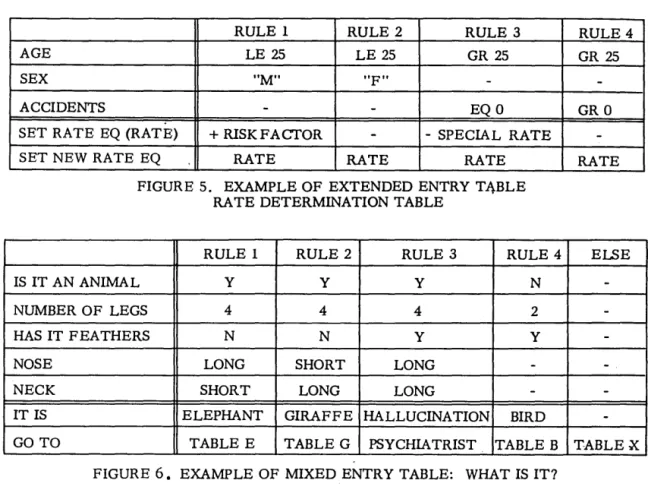
In an extended-entry table (Figure 5), the condition statements only identify the variables to be considered. The condition entries define the values (either absolute or relative) of the variables. In similar fashion, the action statements in an extended-entry table only identify the variables to be modified; the way they are to be modified is stated by the action entries.
The third type of decision table, the mixed-entry table, is shown in Figure 6. This combines both the limited and extended entry forms. Although the limited- and extended-entry forms can be mixed within a table, one form must be used exclusively with a horizontal row of the table.
As pointed out earlier, one of the primary advantages of decision tables is that they permit a complex decision-mak-ing process to be partitioned into its various component parts, each part of the process documented by an individual table. This-means that the tables must allow for a transfer of control from one table to another. This is accomplished with appropriate action entries, such as those shown in the last two lines of Figure 7. An action entry of this type will either unconditionally pass control to another table or provide for entry into another table and, then, the return to the original table and column, where the entry following .the one that caused the exit is picked up.
In the DET,\B-X language lIsed in Figure 7, this facility is provided by the "DO" statement and the "GO TO" state-ment. The example, Figure 7, implies the existence of seven other tables: AB-Process, .-\C-Process, A-Edit, B-Eclit. CoEdit, Errors, and Next Job. In Rule 1
or
the table shown, the action entry to execute "DO AB-Process" will cause table "AB-Process" to be entered, and, upon completion of that table, control will be returned to the Rule 1 action entry for the "DO AC-Process" action statement..\ table to which temporary control is transferred with a ·'DO" action should have no rules terminating with an action entry to execute a "GO TO" action, since this would contradict the return of control that is indicated by the controlling "DO" action. While the control-transfer ter-minology used here applies to the proposed DETAB-X language extension to COBOL, any other equivalent may be used where the tables are not to be compiled.
The final example given below illustrates the use of a limited-entry table in defining the logic of a simplified file-maintenance application. Starting and ending procedures are excluded, and would be normally found in other tables. The file names and data fields are:
Inputs: File Names 1. Master File
2. Cha nge File
Data Fields 1. STOCK-NR-A 2. ON-HAND-A I. STOCK-NR-C 2. QUANTITY 3. CHANGE-CODE
record to apply against it, write the master-file record into the new master file.
When an item from the change file does not correspond to a master-file record, it must be a "NEW ITEM." In this case, create a new master-file record from the change-file record.
When the stock number of the master file agrees with the stock numher of the change file, update the master-file record as follows:
Outputs: (I) If the change-rode is equal to '~REC," adjust quantity
on hanc\.
1. New Master File (same as master file) 2. Ship-Order File (same as change file)
The work to be done is as follows:
When an item from the master file does not have a change
(2) If the change-code is equal to "SHIP" and the quan-tity requested is available, adjust "ON-HAND-A" and write shipping order. If the quantity requested is not available, modify the change-code to read "BACK-ORDER" and write shipping order.
RULE 1 RULE 2 RULE 3
AGE LE 25 LE 25 GR 25
SEX "M" "Fit
-ACCIDENTS
-
-
EQOSET RATE EQ (RATE)
+
RISK FACTOR-
- SPECIAL RATESET NEW RATE EQ RATE RATE RATE
FIGURE 5. EXAMPLE OF EXTENDED ENTRY T1\BLE RATE DETERMINATION TABLE
RULE 1 RULE 2 RULE 3 RULE 4
IS IT AN ANIMAL Y Y Y N
NUMBER OF LEGS 4 4 4 2
HAS IT F EA THERS N N Y Y
NOSE LONG SHORT LONG
-NECK SHORT LONG LONG
-IT IS ELEPHANT GIRAFFE HALLUCINATION BIRD
GO TO TABLE E TABLE G PSYCHIA TRIST TABLE B
FIGURE
6.
EXAMPLE OF MIXED ENTRY TABLE: WHAT IS IT?RULE 4 GR 25
-GRO -RATE ELSE -TABLEX
RULE 1 RULE 2 RULE 3 ELSE
JOB-CODE EQ "A" "Bit "C"
ADD 1 TO A-COUNT B-COUNT C-COUNT
00 AB- PROCESS X X
-DO AC-PROCESS X
-
X00 A-EDIT B-EDIT C-EDIT
GO TO NEXT-JOB X X X
FIGURE
7.
EXAMPLE OF TRANSFER OF CONTROLCODE TEST TABLE
©
1 964 Auerbach Corporation and Info, Inc. -ERRORS X(3) If the change-code is equal to "AD JUST," apply quantity in change file to ON-HAND in master file. Table 8 shows this specification in tabular form. It is obvious that the tabular presentation, when compared to the text description, is more concise and permits easier com-prehension and checking of the logic involved.
Applications o,f Decision Tables
The advantage of decision tables varies with the com-plexity of the decision logic, not with the type of applica-tion. If the process is logically complex and involves many logical decision points, then decision tables generally will be the most effective method for expressing the logic of the problem. This will be so whether the application is file-processing, manufacturing, engineering-scientific, or the executive-control program of a real-time system.
Evidence of the power of the technique and the man-power economies that can be achieved is available from the experience of a number of large users, covering a wide range of applications. Most of the original work on de-veloping decision table techniques to the point of practical application has been done by General Electric and IBM, and users within General Electric provide the widest range
STOCK-NR-A EQ STOCK-NR-C STOCK-NR-A LR STOCK-NR-C STOCK-NR-A GR STOCK-NR-C CHANGE-CODE EQ "REC" CHANGE- CODE EQ "SHIP" CHANGE-CODE EQ "ADJUST" CHANGE-CODE EQ "NEW-ITEM" QUANTITY LR ON- HAND- A
MOVE (ON- HAND- A
+
QUANTITY) TO ON- HAND- AMOVE (ON- HAND- A-QUANTITY)"TO ON- HAND- A SET CHANGE CODE EQ "BACK-ORDER"
WRITE SHIP-ORDER FROM CHANGE WRITE NEW-MASTER FROM MASTER WRITE NEW-MASTER FROM CHANGE READ CHANGE
READ MASTER 00 ERROR ROUTINE GO TO TAB-006
of successfully implemented applications. Available litera-ture on decision tables, including reports presented at a Decision Tables Seminar, held in New York in September 1962, describe the use of the technique in, for example, manufacturing applications ranging from quality control and operational planning, through inventory control and production scheduling, to dispatching, shipping, and traffic control. In marketing, decision tables have been used to show the relationship between market requirements and engineering decisions. Companies have also reported suc-cess in using decision tables to design and implement com-plex file-processing systems involving problems with condi-tional decision chains, which could not be successfully resolved using flowcharting techniques.
While the detailed description of these, and other appli-cations, is not contained in the scope of this article, the bibliography at the end of this report will provide inter-ested users with detailed descriptions of these applications. Many basic advantages may be gained through the use of decision tables in the above mentioned applications, in-cluding (1) cutting the analysis and programming time needed to develop and implement the program by as much at 50%, (2) greatly simplified updating procedures, a"nd (3) drastic reductions in debugging effort, due to almost error-free development of the process logic.
RULEl RULE 2 RULE 3 RULE4 RULES RULE 6 ELSE
Y Y Y Y N N
--
-
-
-
Y N--
-
-
-
-
Y -N N Y N-
-
-Y Y-
N-
-
--
-
-
Y-
-
--
-
-
-
-
Y -N Y-
-
-
-
--
-
X X-
-
-X-
-
-
-
-
--
X-
-
-
-
-X X-
-
-
-
--
-
-
-
X-
--
-
-
-
-
X -X X X X-
X--
-
-
-
X-
--
-
-
-
-
-
X X X X X X X XFIGURE 8. FILE UPDATING ROUTINE FILE MAINTENANCE TABLE TAB-DOl