491
Simplified Abugidas
Chenchen Ding, Masao Utiyama, and Eiichiro Sumita Advanced Translation Technology Laboratory,
Advanced Speech Translation Research and Development Promotion Center, National Institute of Information and Communications Technology
3-5 Hikaridai, Seika-cho, Soraku-gun, Kyoto, 619-0289, Japan
{chenchen.ding, mutiyama, eiichiro.sumita}@nict.go.jp
Abstract
An abugida is a writing system where the consonant letters represent syllables with a default vowel and other vowels are de-noted by diacritics. We investigate the fea-sibility of recovering the original text writ-ten in an abugida after omitting subordi-nate diacritics and merging consonant let-ters with similar phonetic values. This is crucial for developing more efficient in-put methods by reducing the complexity in abugidas. Four abugidas in the south-ern Brahmic family, i.e., Thai, Burmese, Khmer, and Lao, were studied using a newswire 20,000-sentence dataset. We compared the recovery performance of a support vector machine and an LSTM-based recurrent neural network, finding that the abugida graphemes could be re-covered with94%– 97%accuracy at the top-1 level and 98% – 99% at the top-4
level, even after omitting most diacritics (10 – 30 types) and merging the remain-ing30–50characters into21graphemes.
1 Introduction
Writing systems are used to record utterances in a wide range of languages and can be organized into the hierarchy shown in Fig. 1. The sym-bols in a writing system generally represent either speech sounds (phonograms) or semantic units (logograms). Phonograms can be either segmen-tal or syllabic, with segmensegmen-tal systems being more phonetic because they use separate symbols (i.e., letters) to represent consonants and vowels. Seg-mental systems can be further subdivided depend-ing on their representation of vowels. Alphabets (e.g., the Latin, Cyrillic, and Greek scripts) are the most common and treat vowel and consonant
let-writing system
phonogram
logogram
segmental
syllabic abugida
[image:1.595.308.526.278.372.2]alphabet abjad
Figure 1: Hierarchy of writing systems.
ណន នន
ណូន
/noon/ /naen/ណណន /នួនnuən/ /nein/ននន vowel
diacritic omission
consonant character merging
N N
(a) ABUGIDA SIMPLIFICATION
…ជិតណណន…
… J T N N …
(b) RECOVERY
machine learning
methods
Figure 2: Overview of the approach in this study.
ters equally. In contrast, abjads (e.g., the Arabic and Hebrew scripts) do not write most vowels ex-plicitly. The third type, abugidas, also called al-phasyllabary, includes features from both segmen-tal and syllabic systems. In abugidas, consonant letters represent syllables with a default vowel, and other vowels are denoted by diacritics. Abugi-das thus denote vowels less explicitly than alpha-bets but more explicitly than abjads, while being less phonetic than alphabets, but more phonetic than syllabaries. Since abugidas combine segmen-tal and syllabic systems, they typically have more symbols than conventional alphabets.
TH ะั ั ั ั ั ั ั ั ั ั ั ั ั ั ั ั ั MYိ ိ ိ ိ ေိ ိ ိ ိ ိ KM ិ ិ ិ ិ ិ ិ ិ ើិ ើិ ើិ ើិ ែិ ៃិ
ើិ ើិ ិ ិ ិ ិ ិ ិ ិ ិ ិ ិ ិ ិ LO
ະិ ិ ិ ិ ិ ិ ិ ិ ិ ិ ຽិ ិ ិ ិ ិ ិ OMITTED
I II I II I II I II
MN K G U C J I Y T D N L P B M W R S H Q A E
THกขฃ คฅฆ ง จฉ ชซฌ ญ ย ฎฏฐดตถ ฑฒทธ ณน ลฦฬ บปผฝ พฟภ ม ว รฤ ศษส หฬ อ ๅ เแโใไ
MYကခ ဂဃ င စဆ ဇဈ ဉ ည ယိ ဋဌတထ ဍဎဒဓ ဏန လဠ ပဖ ဗဘ မ ဝိ ရြိ သဿ ဟိ အ ိ ိ ိ ိ
KMកខ គឃ ង ចឆ ជឈ ញ យ ដឋតថ ឌឍទធ ណន លឡ បផ ពភ ម វ រ ឝឞស ហ អ ិ ្
LO ກຂ ຄ ງ ຈ ຊ ຍ ຢ ດຕຖ ທ ນ ລ ບປຜຝ ພຟ ມ ວ ຣ ສ ຫຮ ອ ເແໂໃໄ
A
P
P
.
DENTAL PALATE
PRE-V. DE-V.
PLOSIVE
NAS.
MERGED
R-LIKE
S-LIKE
H-LIKE
LO
NG
-A
ZE
RO-C
.
LABIAL
PLOSIVE NAS. AP
P
.
PLOSIVE
NAS.
GUTTURAL
PLOSIVE
NAS. AP
P
[image:2.595.73.528.61.195.2].
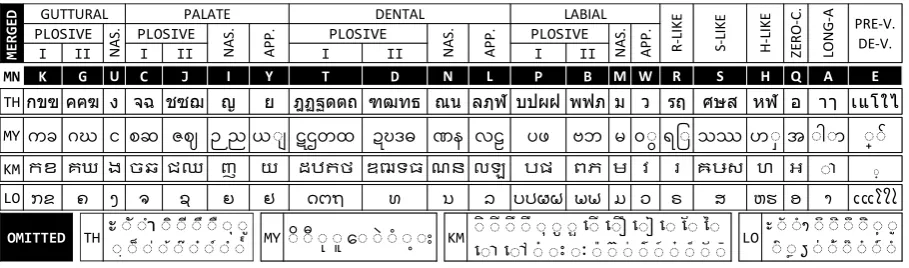
Figure 3: Merging and omission for Thai (TH), Burmese (MY), Khmer (KM), and Lao (LO) scripts. The
MNrow lists the mnemonics assigned to graphemes in our experiment. In this study, the mnemonics can be assigned arbitrarily, and we selected Latin letters related to the real pronunciation wherever possible.
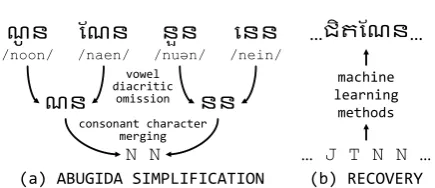
Fig. 2 gives an overview of this study, show-ing examples in Khmer. We simplify abugidas by omitting vowel diacritics and merging consonant letters with identical or similar phonetic values, as shown in(a). This simplification is intuitive, both orthographically and phonetically. To resolve the ambiguities introduced by the simplification, we use data-driven methods to recover the origi-nal texts, as shown in(b). We conducted experi-ments on four southern Brahmic scripts, i.e., Thai, Burmese, Khmer, and Lao scripts, with a unified framework, using data from the Asian Language Treebank (ALT) (Riza et al., 2016). The exper-iments show that the abugidas can be recovered satisfactorily by a recurrent neural network (RNN) using long short-term memory (LSTM) units, even when nearly all of the diacritics (10 – 30 types) have been omitted and the remaining30–50 char-acters have been merged into21graphemes. Thai gave the best performance, with 97% top-1 ac-curacy for graphemes and over 99% top-4 accu-racy. Lao, which gave the worst performance, still achieved the top-1 and top-4 accuracies of around94%and98%, respectively. The Burmese and Khmer results, which lay in-between the other two, were also investigated by manual evaluation.
2 Related Work
Some optimized keyboard layout have been pro-posed for specific abugidas (Ouk et al., 2008). Most studies on input methods have focused on Chinese and Japanese characters, where thousands of symbols need to be encoded and recovered. For Chinese characters, Chen and Lee (2000) made an early attempt to apply statistical methods to sentence-level processing, using a hidden Markov model. Others have examined max-entropy mod-els, support vector machines (SVMs), conditional
random fields (CRFs), and machine translation techniques (Wang et al., 2006;Jiang et al.,2007;
Li et al., 2009;Yang et al.,2012). Similar meth-ods have also been developed for character con-version in Japanese (Tokunaga et al.,2011). This study takes a similar approach to the research on Chinese and Japanese, transforming a less infor-mative encoding into strings in a natural and re-dundant writing system. Furthermore, our study can be considered as a specific lossy compression scheme on abugida textual data. Unlike images or audio, the lossy text compression has received lit-tle attention as it may cause difficulties with read-ing (Witten et al.,1994). However, we handle this issue within an input method framework, where the simplified encoding is not read directly.
3 Simplified Abugidas
We designed simplification schemes for several different scripts within a unified framework based on phonetics and conventional usages, without considering many language specific features. Our primary aim was to investigate the feasibility of re-ducing the complexity of abugidas and to establish methods of recovering the texts. We will consider language-specific optimization in a future work, via both data- and user-driven studies.
The simplification scheme is shown in Fig.3.1 Generally, the merges are based on the common distribution of consonant phonemes in most natu-ral languages, as well as the etymology of the char-acters in each abugida. Specifically, three or four
1
graphemes are preserved for the different articu-lation locations (i.e., guttural, palate, dental, and labial), that two for plosives, one for nasal (NAS.), and one for approximant (APP.) if present. Addi-tional consonants such as trills (R-LIKE), frica-tives (S-/H-LIKE), and empty (ZERO-C.) are also assigned their own graphemes. Although the simplification omits most diacritics, three types are retained, i.e., one basic mark common to nearly all Brahmic abugidas (LONG-A), the pre-posed vowels in Thai and Lao (PRE-V.), and the vowel-depressors (and/or consonant-stackers) in Burmese and Khmer (DE-V.). We assigned graphemes to these because we found they in-formed the spelling and were intuitive when typ-ing. The net result was the omission of18 types of diacritics in Thai,9in Burmese,27 in Khmer, and18in Lao, and the merging of the remaining
53types of characters in Thai,43in Burmese,37
in Khmer, and33in Lao, into a unified set of 21
graphemes. The simplification thus substantially reduces the number of graphemes, and represents a straightforward benchmark for further language-specific refinement to build on.
4 Recovery Methods
The recovery process can be formalized as a se-quential labeling task, that takes the simplified encoding as input, and outputs the writing units, composed of merged and omitted character(s) in the original abugidas, corresponding to each sim-plified grapheme. Although structured learning methods such as CRF (Lafferty et al.,2001) have been widely used, we found that searching for the label sequences in the output space was too costly, because of the number of labels to be recovered.2 Instead, we adopted non-structured point-wise prediction methods using a linear SVM (Cortes and Vapnik, 1995) and an LSTM-based RNN (Hochreiter and Schmidhuber,1997).
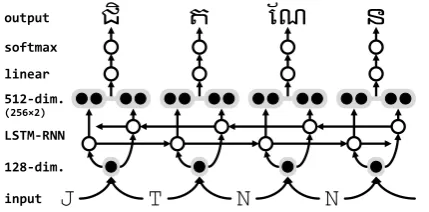
Fig. 4shows the overall structure of the RNN. After many experimentations, a general “shallow and broad” configuration was adopted. Specifi-cally, simplified grapheme bi-grams are first em-bedded into 128-dimensional vectors3 and then encoded in one layer of a bi-directional LSTM,
2One consonant character can be modified by multiple
di-acritics. In the ALT data used in this study, there are around
600–900types of writing units in each script, and there could be over1,000on larger textual data.
3Directly embedding uni-grams (single graphemes) did
not give good performance in our preliminary experiments.
J
T
N
N
ជិ
ត
ណែ
ន
128-dim. LSTM-RNN 512-dim.
input output
linear softmax
[image:3.595.310.525.64.170.2](256×2)
Figure 4: Structure of the RNN used in this study.
resulting in a final representation consisting of a 512-dimensional vector that concatenates two
256-dimensional vectors from the two directions. The number of dimensions used here is large be-cause we found that higher-dimensional vectors were more effective than the deeper structures for this task, as memory capacity was more important than classification ability. For the same reason, the representations obtained from the LSTM layer are transformed linearly before the softmax function is applied, as we found that non-linear transfor-mations, which are commonly used for final clas-sification, did not help for this task.
5 Experiments and Evaluation
We used raw textual data from the ALT,4 compris-ing around20,000sentences translated from En-glish. The data were divided into training, devel-opment, and test sets as specified by the project.5
For the SVM experiments, we used the off-the-shelf LIBLINEAR library (Fan et al., 2008) wrapped by the KyTea toolkit.6 Table 1 gives the recovery accuracies, demonstrating that recov-ery is not a difficult classification task, given well represented contextual features. In general, us-ing up to 5-gram features before/after the sim-plified grapheme yielded the best results for the baseline, except with Burmese, where7-gram fea-tures brought a small additional improvement. Be-cause Burmese texts use relatively more spaces than the other three scripts, longer contexts help more. Meanwhile, Lao produced the worst results, possibly because the omission and merging pro-cess was harsh: Lao is the most phonetic of the four scripts, with the least redundant spellings.
The LSTM-based RNN was implemented using
DyNet (Neubig et al., 2017), and it was trained
usingAdam(Kingma and Ba,2014) with an initial
4http://www2.nict.go.jp/astrec-att/
member/mutiyama/ALT/
5
Around18,000,1,000, and1,000sentences, resp.
learning rate of10−3. If the accuracy decreased on the development set, the learning rate was halved, and learning was terminated when there was no improvement on the development set for three it-erations. We did not use dropout (Srivastava et al.,
2014) but instead a voting ensemble over a set of differently initialized models trained in parallel, which is both more effective and faster.
As shown in Table 2, the RNN outperformed SVM on all scripts in terms of top-1 accuracy. A more lenient evaluation, i.e., top-n accuracy, showed a satisfactory coverage of around 98%
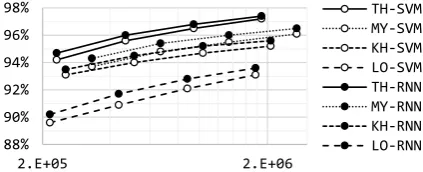
(Khmer and Lao) to99%(Thai and Burmese) con-sidering only the top four results. Fig.5shows the effect of changing the size of the training dataset by repeatedly halving it until it was one-eighth of its original size, demonstrating that the RNN out-performed SVM regardless of training data size. The LSTM-based RNN should thus be a substan-tially better solution than the SVM for this task.
We also investigated Burmese and Khmer fur-ther using manual evaluation. The results of RNN@1⊕16 in Table 2 were evaluated by native speakers, who examined the output writing units corresponding to each input simplified grapheme and classified the errors using four levels: 0) ac-ceptable, i.e., alternative spelling, 1) clear and easy to identify the correct result, 2) confusing but possible to identify the correct result, and 3) in-comprehensible. Table3shows the error distribu-tion. For Burmese, most of the errors are at lev-els 1 and 2, and Khmer has a wider distribution. For both scripts, around50%of the errors are se-rious (level 2 or 3), but the distributions suggest that they have different characteristics. We are cur-rently conducting a case study on these errors for further language-specific improvements.
6 Conclusion and Future Work
In this study, a scheme was used to substantially simplify four abugidas, omitting most diacritics and merging the remaining characters. An SVM and an LSTM-based RNN were then used to re-cover the original texts, showing that the simpli-fied abugidas could be recovered well. This illus-trates the feasibility of encoding abugidas less re-dundantly, which could help with the development of more efficient input methods.
As for the future work, we are planning to in-clude language-specific optimizations in the de-sign of the simplification scheme and to improve
Thai Burmese Khmer Lao Dev±3 96.1% 94.0% 94.6% 91.5%
Dev±5 97.1% 96.0% 95.7% 93.1%
Dev±7 97.0% 96.3% 95.7% 93.0%
Test 97.2% 96.1% 95.2% 93.1%
Leng. 76.0% 74.0% 77.6% 72.8%
Table 1: Top-1 recovery accuracy for the SVM. Here, “Dev±m” represents the results for the
de-velopment set when usingN-gram (N ∈ [1, m]) features withinm-grapheme windows of the sim-plified encodings, and “Test” represents the test set results when using the feature set that gave the best development set results. “Leng.” shows the ratio of the number of characters in the simplified en-codings compared with the original strings.
Thai Burmese Khmer Lao
SVM 97.2% 96.1% 95.2% 93.1%
RNN@1⊕4 97.2% 96.3%‡ 95.5%‡ 93.3%‡
RNN@1⊕8 97.3%† 96.4%‡ 95.6%‡ 93.6%‡
RNN@1⊕16 97.4%‡ 96.5%‡ 95.6%‡ 93.6%‡
RNN@2⊕16 98.8% 98.4% 97.5% 96.6%
RNN@4⊕16 99.2% 98.8% 98.1% 97.7%
[image:4.595.308.520.509.595.2]RNN@8⊕16 99.2% 98.9% 98.4% 97.9%
Table 2: Top-n accuracy on the test set for the LSTM-based RNN with an m-model ensemble (RNN@⊕nm). Here, † and‡mean the RNN outper-formed the SVM with statistical significance at
p <10−2 andp <10−3 level, respectively, mea-sured by bootstrap re-sampling.
88% 90% 92% 94% 96% 98%
2.E+05 2.E+06
TH-SVM MY-SVM KH-SVM LO-SVM TH-RNN MY-RNN KH-RNN LO-RNN
Figure 5: Top-1 accuracy on the test set (y-axis) for different training data sizes (x-axis, number of graphemes after simplification, logarithmic).
Level 0 1 2 3
Burmese 4.5% 51.0% 42.2% 2.2%
Khmer 22.5% 28.5% 16.3% 32.8%
Table 3: Recovery error distribution.
Acknowledgments
The experimental results of Burmese were evalu-ated by Dr. Win Pa Pa and Ms. Aye Myat Mon from University of Computer Studies, Yangon, Myanmar. The experimental resutls of Khmer were evaluated by Mr. Vichet Chea, Mr. Hour Kaing, Mr. Kamthong Ley, Mr. Vanna Chuon, and Mr. Saly Keo fromNational Institute of Posts, Telecommunications and ICT, Cambodia. We are grateful for their collaboration. We would like to thank Dr. Atsushi Fujita for his helpful comments.
References
Zheng Chen and Kai-Fu Lee. 2000. A new statistical approach to Chinese pinyin input. InProc. of ACL. pages 241–247.
Corinna Cortes and Vladimir Vapnik. 1995. Support-vector networks.Machine learning20(3):273–297.
Rong-En Fan, Kai-Wei Chang, Cho-Jui Hsieh, Xiang-Rui Wang, and Chih-Jen Lin. 2008. LIBLINEAR: A library for large linear classification. Journal of machine learning research9(Aug):1871–1874.
Sepp Hochreiter and J¨urgen Schmidhuber. 1997. Long short-term memory. Neural computation
9(8):1735–1780.
Wei Jiang, Yi Guan, Xiaolong Wang, and Bingquan Liu. 2007. Pinyin-to-character conversion model based on support vector machines. Journal of Chi-nese information processing21(2):100–105.
Diederik Kingma and Jimmy Ba. 2014. Adam: A method for stochastic optimization.arXiv preprint.
John Lafferty, Andrew McCallum, and Fernando C. N. Pereira. 2001. Conditional random fields: Prob-abilistic models for segmenting and labeling se-quence data. InProc. of ICML. pages 282–289.
Lu Li, Xuan Wang, Xiaolong Wang, and Yanbing Yu. 2009. A conditional random fields approach to Chinese pinyin-to-character conversion. Journal of Communication and Computer6(4):25–31.
Graham Neubig, Chris Dyer, Yoav Goldberg, Austin Matthews, Waleed Ammar, Antonios Anastasopou-los, Miguel Ballesteros, David Chiang, Daniel Clothiaux, Trevor Cohn, Kevin Duh, Manaal Faruqui, Cynthia Gan, Dan Garrette, Yangfeng Ji, Lingpeng Kong, Adhiguna Kuncoro, Gaurav Ku-mar, Chaitanya Malaviya, Paul Michel, Yusuke Oda, Matthew Richardson, Naomi Saphra, Swabha Swayamdipta, and Pengcheng Yin. 2017. DyNet: The dynamic neural network toolkit.arXiv preprint.
Phavy Ouk, Ye Kyaw Thu, Mitsuji Matsumoto, and Yoshiyori Urano. 2008. The design of Khmer word-based predictive non-QWERTY soft keyboard for
stylus-based devices. InProc. of VL/HCC. pages 225–232.
Hammam Riza, Michael Purwoadi, Gunarso, Teduh Uliniansyah, Aw Ai Ti, Sharifah Mahani Aljunied, Luong Chi Mai, Vu Tat Thang, Nguyen Phuong Thai, Rapid Sun, Vichet Chea, Khin Mar Soe, Khin Thandar Nwet, Masao Utiyama, and Chenchen Ding. 2016. Introduction of the Asian language tree-bank. InProc. of O-COCOSDA. pages 1–6.
Nitish Srivastava, Geoffrey E. Hinton, Alex Krizhevsky, Ilya Sutskever, and Ruslan Salakhutdi-nov. 2014. Dropout: A simple way to prevent neural networks from overfitting. Journal of machine learning research15(1):1929–1958.
Hiroyuki Tokunaga, Daisuke Okanohara, and Shinsuke Mori. 2011. Discriminative method for Japanese kana-kanji input method. InProc. of WTIM. pages 10–18.
Xuan Wang, Lu Li, Lin Yao, and Waqas Anwar. 2006. A maximum entropy approach to Chinese pinyin-to-character conversion. InProc. of SMC. pages 2956– 2959.
Ian H. Witten, Timothy C. Bell, Alistair Moffat, Craig G. Nevill-Manning, Tony C. Smith, and Harold Thimbleby. 1994. Semantic and generative models for lossy text compression. The Computer Journal37(2):83–87.