Proceedings of Workshop for NLP Open Source Software, pages 7–12 7
Stop Word Lists in Free Open-source Software Packages
Joel Nothman
Sydney Informatics Hub University of Sydney [email protected]
Hanmin Qin
Peking University [email protected]
Roman Yurchak
Symerio
Abstract
Open-source software (OSS) packages for natural language processing often in-clude stop word lists. Users may apply them without awareness of their surprising omissions (e.g.hasn’t but nothadn’t) and inclusions (e.g.computer), or their incom-patibility with particular tokenizers. Mo-tivated by issues raised about the Scikit-learn stop list, we investigate variation among and consistency within 52 popular English-language stop lists, and propose strategies for mitigating these issues.
1 Introduction
Open-source software (OSS) resources tend to be-come de-facto standards by virtue of their avail-ability and popular use. Resources include tok-enization rules and stop word lists, whose precise definitions are essential for reproducible and in-terpretable models. These resources can be se-lected somewhat arbitrarily by OSS contributors, such that their popularity within the community may not be a reflection of their quality, universal-ity or suitabiluniversal-ity for a particular task. Users may then be surprised by behaviors such as the word
computer being eliminated from their text analy-sis due to its inclusion in a popular stop list.
This paper brings to the community’s attention some issues recently identified in the Scikit-learn stop list. Despite is popular use, the current Scikit-learn maintainers cannot justify the use of this par-ticular list, and are unaware of how it was con-structed. This spurs us to investigate variation among and consistency within popular English-language stop lists provided in several popular lan-guage processing, retrieval and machine learning libraries. We then make recommendations for im-proving stop list provision in OSS.
2 Background
Stop words are presumed to be not informative as to the meaning of documents, and hence are de-fined by being unusually frequent, or by not being “content words”. Saif et al. (2014) lists several methods for constructing a stop word list, includ-ing: manual construction; words with high docu-ment frequencyor totalterm frequencyin a corpus; or by comparing term frequency statistics from a sample of documents with those in a larger col-lection.1 In practice, Manning et al. (2008) in-dicate that statistical approaches tend not to be used alone, but are combined with manual filter-ing. This paper notes ways in which statistical construction of stop lists may have introduced re-grettable errors.
Stop lists have been generated for other lan-guages, such as Chinese (Zou et al., 2006), Thai (Daowadung and Chen, 2012) and Farsi (Sadeghi and Vegas, 2014), using uses similar frequency threshold approaches, are susceptible to the same issues discussed here.
Most prior work focuses on assessing or im-proving the effectiveness of stop word lists, such asSchofield et al.’s (2017) recent critique of stop lists in topic modeling. Our work instead exam-ines what is available and widely used.
3 Case Study: Scikit-learn
Having become aware of issues with the Scikit-learn (Pedregosa et al., 2011) stop list,2 we be-gin by studying it. Scikit-learn provides out-of-the-box feature extraction tools which convert a collection of text documents to a matrix of token counts, optionally removing n-grams containing
1
They also investigate using supervised feature selection techniques, but the supervised learning context is inapplica-ble here.
given stop words. Being a popular library for ma-chine learning, many of its users take a naive ap-proach to language processing, and are unlikely to take a nuanced approach to stop word removal.
History While users are able to provide their own stop list, Scikit-learn provides an English-language list since July 2010. The list was initially disabled by default since the contributing author claimed that it did not improve accuracy for text classification (see commit41b0562). In Novem-ber 2010, another contributor argued to enable the list by default, saying that stop word removal is a reasonable default behavior (commit41128af). The developers disabled the list by default again in March 2012 (commita510d17).
The list was copied from the Glasgow Informa-tion Retrieval Group,3but it was unattributed until January 2012 (commit d4c4c6f). The list was altered in 2011 to remove the content word com-puter(commitcdf7df9), and in 2015 to correct the wordfifytofifty(commit3e4ebac).
This history gives a sense of how a stop word list may be selected and provided without great awareness of its content: its provenance was ini-tially disregarded; and some words were eventu-ally deemed inappropriate.
Critique Currently, the list in Scikit-learn has several issues. Firstly, the list is incompatible with the tokenizer provided along with it. It in-cludes words discarded by the default tokenizer, i.e., words less than 2 chars (e.g. i), and some abbreviated forms which will be split by the tok-enizer (e.g.hasnt). What’s more, it excludes encl-itics generated by the tokenizer (e.g.veofwe’ve). In April 2017, a maintainer proposed to addveto the list.4 Contributors argued this would break re-producibility across software versions, and the is-sue remains unresolved.
Secondly, there are some controversial words in the list, such assystemandcry. These words are considered to be informative and are seldom in-cluded in other stop lists. In March 2018, a user requested the removal of system and has gained approval from the community.5
Another issue is that the list has some
surpris-3
http://ir.dcs.gla.ac.uk/resources/ linguistic_utils/stop_words
4
https://github.com/scikit-learn/ scikit-learn/issues/8687
5https://github.com/scikit-learn/
scikit-learn/issues/10735
1970 1980 1990 2000 2010
Snowball Glasgow IR
rank.nl (Google)
scikit-learn MySql (InnoDB) MySql (MyIsam) SMART
NLTK
CoreNLP Lucene / Solr
[image:2.595.313.521.62.151.2]Stone, et al spaCy gensim postgres
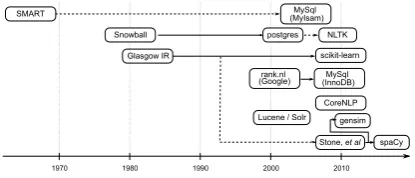
Figure 1: Family tree of popular stop word lists.
ing omissions. Compared to extensions of the Glasgow IR list from Stone et al.(2010) used by spaCy (Honnibal and Montani, 2017) and gen-sim (Reh˚uˇrek and Sojkaˇ ,2010), the list in Scikit-learn includes modalhas, but lacksdoes; includes intensifier very but excludes really; and includes light verbgetbut excludesmake.
The Glasgow IR list appears to have been con-structed from corpus statistics, although typo-graphic errors like fify suggest manual editing. However, we have not found any documentation about how the Glasgow IR list was constructed. Hence we know little about how to generate com-parable lists for other languages or domains.
In the remainder of this paper, we consider how similar issues apply to other open-source stop lists.
4 Datasets
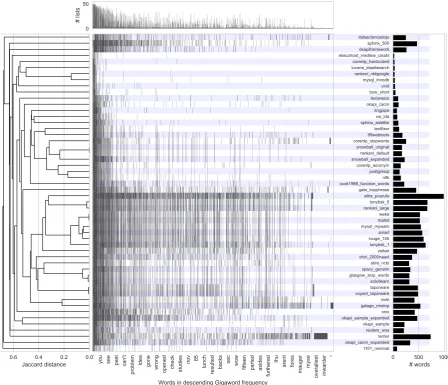
We conduct our experiments on Igor Brigadir’s collection of English-language stop word lists.6 We exclude 1 empty list, 2 lists which contain n-grams (n >1) and 1 list which is intended to aug-ment other lists (i.e. LEMUR’s forumstop). Fi-nally, we get 52 lists extracted from various search engines, libraries, and articles. The size of the lists varies (see the right part of Figure 2), from 24 words in the EBSCOhost medical databases list, to 988 words in the ATIRE search engine list.
5 Stop List Families
Through digging into project history, we construct a family tree of some popular stop lists (Figure 1) to show how popular OSS packages adopt or adapt existing lists. Solid lines in the figure correspond to inclusion without major modification, while dashed lines correspond to a more loose adapta-tion. For instance, the Glasgow IR list used by Scikit-learn was extended with 18 more words by
6https://github.com/igorbrigadir/
Stone et al. (2010), and this list was adopted by OSS packages gensim and spaCy in turn.
A more data driven approach identifies similar-ities among stop lists by clustering them with the Jaccard distance metric (J D(A, B) := 1−||AA∩∪BB|| where A and B are sets of stop words). In
Figure 2, we have plotted the same data with a heatmap of word inclusion in order of descending document frequency in the NYT section of Giga-word 5.0 (Parker et al.,2011). Here we take the maximum frequency under three tokenizers from Lucene, Scikit-learn and spaCy. Each of them has different approaches to enclitics (e.g.hasn’tis treated as hasn’t in Lucene; hasn in Scikit-learn andhas n’tin spaCy).
Looking at the heatmap, we see that stop words are largely concentrated around high document frequency. Some high frequency words are ab-sent from many stop lists because most stop lists assume particular tokenization strategies (See Sec-tion6.2). However, beyond the extremely frequent words, even the shortest lists vary widely in which words they then include. Some stop lists include many relatively low-frequency words. This is most noticeable for large lists like TERRIER and ATIRE-Puurula. TERRIER goes to pains to in-clude synthesized inflectional variants, even con-cerninger, and archaic forms, likecouldst.
Through the clusermap, we find some lists with very high within-cluster similarity (J D < 0.2): Ranks.nl old Google list and MySQL/InnoDB list; PostgreSQL list and NLTK list; Weka list, MAL-LET list, MySQL-MyISAM list, SMART list and ROUGE list; Glasgow IR list, Scikit-learn list and spaCy/Gensim list. Beyond these simple clusters, some lists appear to have surprisingly high over-lap (usually asymmetric): Stanford CoreNLP list appears to be an extension of Snowball’s original list; ATIRE-Puurula appears to be an extension of the Ranks.nl Large list.
6 Common Issues for Stop Word Lists
In section3, we find several issues in the stop word list from Scikit-learn. In this section, we explore how these problems manifest in other lists.
6.1 Controversial Words
We consider words which appear in less than 10% of lists to be controversial.7After excluding words
7Some false negatives will result from the shared origins
of lists detailed in the previous section, but we find very
simi-which do not begin with English characters, we get 2066 distinct stop words in the 52 lists. Among these words, 1396 (67.6%) words only appear in less than 10% of lists, and 807 (39.1%) words only appear in 1 list (see the bars at the top ofFigure 2), indicating that controversial words cover a large proportion. On the contrary, only 64 (3.1%) words are accepted by more than 80% lists. Among the 52 lists, 45 have controversial words.
We further investigate the document frequency of these controversial words using Google Books Ngrams (Michel et al.,2011). Figure 3shows the document frequency distribution. Note: We scale document frequency of controversial words by the max document frequency among all the words. Although peaked on rare words, some words are frequent (e.g.general,great,time), indicating that the problem is not trivial.
6.2 Tokenization and Stop Lists
Popular software libraries apply different tok-enization rules, particularly with respect to word-internal punctuation. By comparing how different stop lists handle the worddoesn’tinFigure 4, we see several approaches: most lists stopdoesn’t. A few stop doesn ordoesnt, but none stop both of these. Two stopdoesn’tas well asdoesnt, which may help them be robust to different choices of tokenizer, or may be designed to handle informal text where apostrophes may be elided.
However, we find tools providing lists that are inconsistent with their tokenizers. While most lists stop not, Penn Treebank-style tokenizers – pro-vided by CoreNLP, spaCy, NLTK and other NLP-oriented packages – also generate the token n’t. Of our dataset,n’t is only stopped by CoreNLP.8 Weka and Scikit-learn both have default tokeniz-ers which delimit tokens at punctuation including
’, yet neither stops words likedoesn.
We find similar results when repeating this anal-ysis on other negated models (e.g.hasn’t,haven’t,
wouldn’t), showing that stop lists are often tuned to particular tokenizers, albeit not always the default tokenizer provided by the corresponding package. More generally, we have not found any OSS package which documents how tokenization relates to the choice of stop list.
lar results if we remove near-duplicate lists (Jaccard distance
<0.2) from our experiments.
8We are aware that spaCy, in commitf708d74, recently
0.0 0.2 0.4 0.6
Jaccard distance
,
you see past can't
problem
idea gone
wrong opened check studies nov
85
lunch
resulted backs sec wow
fifteen parted asides
furthered
thu
arent fores mauger myse
overallest inwarder
¹
Words in descending Gigaword frequency 0
50
# lists
0 500 1000
# words t101_minimal
[image:4.595.74.523.62.447.2]okapi_cacm_expanded terrier reuters_wos okapi_sample okapi_sample_expanded onix galago_rmstop indri voyant_taporware taporware scikitlearn glasgow_stop_words spacy_gensim atire_ncbi choi_2000naacl zettair tonybsk_1 rouge_155 smart mysql_myisam mallet weka ranksnl_large tonybsk_6 atire_puurula gate_keyphrase cook1988_function_words nltk postgresql corenlp_acronym snowball_expanded ranksnl_default snowball_original corenlp_stopwords 99webtools textfixer sphinx_astellar vw_lda lingpipe okapi_cacm lexisnexis bow_short ovid mysql_innodb ranksnl_oldgoogle lucene_elastisearch corenlp_hardcoded ebscohost_medline_cinahl okapiframework sphinx_500 datasciencedojo
Figure 2: Word inclusion in clustered English stop word lists. Words are ordered by descending docu-ment frequency. The dendrogram on the left indicates minimum Jaccard distance between stop list pairs when merged. The bars on the right show the number of words in each list, and the bars on the top indicate the number of lists each word is found in.
Figure 3: Document frequency distribution of con-troversial words
6.3 Incompleteness
Stop lists generated exclusively from corpus statis-tics are bound to omit some inflectional forms of an included word, as well as related lexemes, such as less frequent members of a functional syn-tactic class. In particular, stop word list con-struction prefers frequency criteria over contex-tual indicators of a word’s function, despite Har-ris’s (1954) well-established theory that similar words (e.g. function words, light verbs, negated modals) should appear in similar contexts.
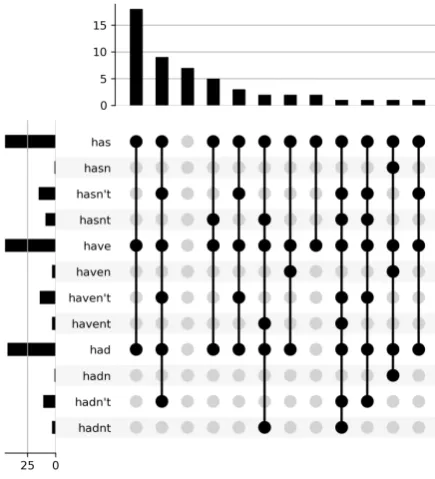
To continue the example of negated modals, we find inconsistencies in the inclusion ofhaveand its variants, summarized inFigure 5. Weka includes
has, but omits its negated forms, despite including
[image:4.595.92.271.574.679.2]Figure 4: Number of stop lists that include variants ofdoesn’tand their combinations.
Figure 5: Number of stop lists that include variants ofhaveand their combinations.
does. Several lists include has, hasnt, have and
had, but omitshaventandhadnt. Several lists that includehasandhaveforms omithadforms. These inclusions and omissions seem arbitrary.
Some negated modals like shan’t and mustn’t
are absent more often than other modals (e.g.
doesn’t,hasn’t), which may be an unsurprising ar-tifact of their frequency, or may be an ostensive omission because they are more marked.
TERRIER list (Ounis et al., 2005) appears to have generated inflectional variants, to the extent of includingconcerninger. This generally seems an advisable path towards improved consistency.
7 Improving Stop List Provision in OSS
Based on the analysis above, we propose strategies for better provision of stop lists in OSS:
Documentation Stop lists should be docu-mented with their assumptions about tokenization and other limitations (e.g. genre). Documentation should also include information on provenance and how the list was built.
Dynamic Adaptation Stop lists can be adapted dynamically to match the NLP pipeline. For ex-ample, stop lists can be adjusted according to the tokenizer chosen by the user (e.g. through apply-ing the tokenizer to the stop list); a word which is an inflectional variant of a stop word could also be removed
Quality Control The community should de-velop tools for identifying controversial terms in stop lists (e.g. words that are frequent in one corpus but infrequent in another), and to assist in assessing or mitigating incompleteness issues. For instance, future work could evaluate whether the nearest neighborhood of stop words in vector space can be used to identify incompleteness.
Tools for Automatic Generation A major limi-tation of published stop lists is their inapplicability to new domains and languages. We thus advocate language independent tools to assist in generating new lists, which could incorporate the quality con-trol tools above.
8 Conclusion
Stop word lists are a simple but useful tool for managing noise, with ubiquitous support in natu-ral language processing software. We have found that popular stop lists, which users often apply blindly, may suffer from surprising omissions and inclusions, or their incompatibility with particular tokenizers. Many of these issues may derive from generating stop lists using corpus statistics. We hence recommend better documentation, dynami-cally adapting stop lists during preprocessing, as well as creating tools for stop list quality control and automatically generating stop lists.
Acknowledgments
[image:5.595.74.292.275.515.2]References
P. Daowadung and Y. H. Chen. 2012. Stop word in readability assessment of thai text. InProceedings of 2012 IEEE 12th International Conference on Ad-vanced Learning Technologies, pages 497–499.
Zelig Harris. 1954. Distributional structure. Word, 10(23):146–162.
Matthew Honnibal and Ines Montani. 2017. spaCy 2: Natural language understanding with bloom embed-dings, convolutional neural networks and incremen-tal parsing. To appear.
Christopher D. Manning, Prabhakar Raghavan, and Hinrich Sch¨utze. 2008. Introduction to Information Retrieval. Cambridge University Press.
Jean-Baptiste Michel, Yuan Kui Shen, Aviva Presser Aiden, Adrian Veres, Matthew K. Gray, Joseph P. Pickett, Dale Hoiberg, Dan Clancy, Peter Norvig, Jon Orwant, Steven Pinker, Martin A. Nowak, and Erez Lieberman Aiden. 2011. Quantitative analysis of culture using millions of digitized books. Sci-ence, 331(6014):176–182.
Iadh Ounis, Gianni Amati, Vassilis Plachouras, Ben He, Craig Macdonald, and Douglas Johnson. 2005. Terrier information retrieval platform. In Proceed-ings of the 27th European Conference on Advances in Information Retrieval Research, pages 517–519.
Robert Parker, David Graff, Junbo Kong, Ke Chen, and Kazuaki Maeda. 2011. English Gigaword fifth edi-tion LDC2011T07. Linguistic Data Consortium.
Fabian Pedregosa, Ga¨el Varoquaux, Alexandre Gram-fort, Vincent Michel, Bertrand Thirion, Olivier Grisel, Mathieu Blondel, Peter Prettenhofer, Ron Weiss, Vincent Dubourg, Jake Vanderplas, Alexan-dre Passos, David Cournapeau, Matthieu Brucher, Matthieu Perrot, and ´Edouard Duchesnay. 2011. Scikit-learn: Machine learning in Python. Journal of Machine Learning Research, 12:2825–2830.
Radim ˇReh˚uˇrek and Petr Sojka. 2010. Software Frame-work for Topic Modelling with Large Corpora. In
Proceedings of the LREC 2010 Workshop on New Challenges for NLP Frameworks, pages 45–50, Val-letta, Malta. ELRA.
Mohammad Sadeghi and Jess Vegas. 2014. Automatic identification of light stop words for persian infor-mation retrieval systems. Journal of Information Science, 40(4):476–487.
Hassan Saif, Miriam Fern´andez, Yulan He, and Harith Alani. 2014. On stopwords, filtering and data spar-sity for sentiment analysis of Twitter. In Pro-ceedings of the Ninth International Conference on Language Resources and Evaluation. Proceedings., pages 810–817.
Alexandra Schofield, M˚ans Magnusson, and David Mimno. 2017. Pulling out the stops: Rethinking stopword removal for topic models. InProceedings of the 15th Conference of the European Chapter of the Association for Computational Linguistics: Vol-ume 2, Short Papers, pages 432–436.
Benjamin Stone, Simon Dennis, and Peter J. Kwantes. 2010. Comparing methods for single paragraph similarity analysis. Topics in Cognitive Science, 3(1):92–122.