Proceedings of the 56th Annual Meeting of the Association for Computational Linguistics-System Demonstrations, pages 87–92
87
A Web-scale system for scientific knowledge exploration
Zhihong Shen
Microsoft Research Redmond, WA, USA
Hao Ma
Microsoft Research Redmond, WA, USA
{zhihosh,haoma,kuansanw}@microsoft.com
Kuansan Wang
Microsoft Research Redmond, WA, USA
Abstract
To enable efficient exploration of Web-scale scientific knowledge, it is neces-sary to organize scientific publications into a hierarchical concept structure. In this work, we present a large-scale sys-tem to (1) identify hundreds of thou-sands of scientific concepts, (2) tag these identified concepts to hundreds of mil-lions of scientific publications by leverag-ing both text and graph structure, and (3) build a six-level concept hierarchy with a subsumption-based model. The sys-tem builds the most comprehensive cross-domain scientific concept ontology pub-lished to date, with more than 200 thou-sand concepts and over one million rela-tionships.
1 Introduction
Scientific literature has grown exponentially over the past centuries, with a two-fold increase ev-ery 12 years (Dong et al., 2017), and millions of new publications are added every month. Effi-ciently identifying relevant research has become an ever increasing challenge due to the unprece-dented growth of scientific knowledge. In order to assist researchers to navigate the entirety of sci-entific information, we present a deployed system that organizes scientific knowledge in a hierarchi-cal manner.
To enable a streamlined and satisfactory seman-tic exploration experience of scientific knowledge, three criteria must be met:
[image:1.595.303.528.221.318.2]• a comprehensive coverage on the broad spec-trum of academic disciplines and concepts (we call themconceptsorfields-of-study, ab-breviated asFoS, in this paper);
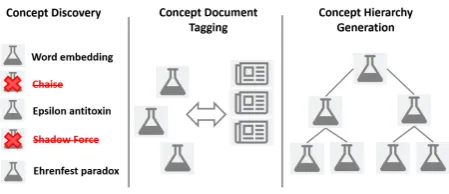
Figure 1: Three modules of the system: concept discovery, concept-document tagging, and con-cept hierarchy generation.
• a well-organized hierarchical structure of sci-entificconcepts;
• an accurate mapping between theseconcepts
and all forms of academic publications, in-cluding books, journal articles, conference papers, pre-prints, etc.
To build such a system on Web-scale, the fol-lowing challenges need to be tackled:
• Scalability: Traditionally, academic disci-pline and concept taxonomies have been cu-rated manually on a scale of hundreds or thousands, which is insufficient in modeling the richness of academic concepts across all domains. Consequently, the low concept cov-erage also limits the exploration experience of hundreds of millions of scientific publica-tions.
• Trustworthy representation: Traditional concept hierarchy construction approaches extract concepts from unstructured docu-ments, select representative terms to denote a concept, and build the hierarchy on top of them (Sanderson and Croft,1999;Liu et al.,
Concept Concept Hierarchy
discovery tagging building
Main scalability / trustworthy scalability / stability /
challenges representation coverage accuracy
Problem knowledge base multi-label topic hierarchy
formulation type prediction text classification construction
Solution / Wikipedia / KB / word embedding / extended
model(s) graph link analysis text + graph structure subsumption
Data scale 105 –106 109–1010 106 –107
Data update
[image:2.595.113.487.62.215.2]frequency monthly weekly monthly
Table 1: System key features at a glance.
contain erroneous topics with subpar quality which is not suitable for a production system.
• Temporal dynamics: Academic publica-tions are growing at an unprecedented pace (about 70K more papers per day according to our system) and new concepts are emerging faster than ever. This requires frequent inclu-sion on latest publications and re-evaluation in tagging and hierarchy-building results.
In this work, we present a Web-scale sys-tem with three modules—concept discovery, concept-document tagging, and concept-hierarchy generation—to facilitate scientific knowledge ex-ploration (see Figure1). This is one of the core components in constructing the Microsoft Aca-demic Graph (MAG), which enables a semantic search experience in the academic domain1. MAG is a scientific knowledge base and a heterogeneous graph with six types of academic entities: publica-tion, author, institupublica-tion, journal, conference, and field-of-study (i.e.,conceptorFoS). As of March 2018, it contains more than 170 million publica-tions with over one billion paper citation relation-ships, and is the largest publicly available aca-demic dataset to date2.
To generate high-quality concepts with com-prehensive coverage, we leverage Wikipedia ar-ticles as the source of concept discovery. Each Wikipedia article is anentityin a general knowl-edge base (KB). A KB entity associated with a Wikipedia article is referred to as a Wikipedia en-tity. We formulate concept discovery as a knowl-edge base type prediction problem (Neelakantan
1The details about where and how we obtain, aggregate,
and ingest academic publication information into the system is out-of-scope for this paper and for more information please refer to (Sinha et al.,2015).
2https://www.openacademic.ai/oag/
and Chang, 2015) and use graph link analysis to guide the process. In total, 228K academic con-cepts are identified from over five million English Wikipedia entities.
During the tagging stage, both textual informa-tion and graph structure are considered. The text from Wikipedia articles and papers’ meta informa-tion (e.g., titles, keywords, and abstracts) are used as the concept’s and publication’s textual repre-sentations respectively. Graph structural informa-tion is leveraged by using text from apublication’s neighboring nodes in MAG (its citations, refer-ences, and publishing venue) as part of the pub-lication’s representation with a discounting factor. We limit the search space for each publication to a constant range, reduce the complexity toO(N)for scalability, whereNis the number of publications. Close to one billion concept-publication pairs are established with associated confidence scores.
Together with the notion of subsump-tion (Sanderson and Croft,1999), this confidence score is then used to construct a six-level directed acyclic graph (DAG) hierarchy with over 200K nodes and more than one million edges.
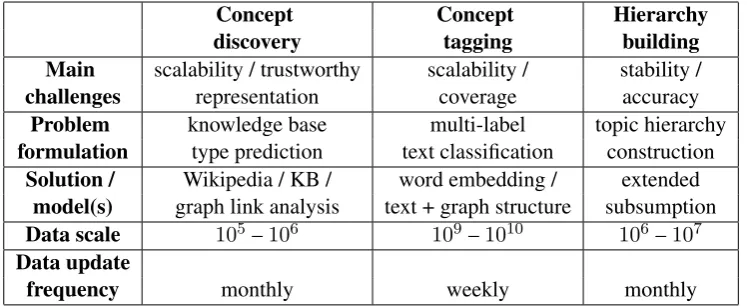
Our system is a deployed product with regular data refreshment and algorithm improvement. Key features of the system are summarized in Table1. The system is updated weekly or monthly to in-clude fresh content on the Web. Various docu-ment and language understanding techniques are experimented with and incorporated to incremen-tally improve the performance over time.
2 System Description
2.1 Concept Discovery
man-asphysics,medicine) and 294 second level (“L1”) sub-domains (examples aremachine learning, al-gebra) by referencing existing classification3 and get their correspondent Wikipedia entities in a general in-house knowledge base (KB).
It is well understood that entity types in a gen-eralKBare limited and far from complete. Enti-ties labeled withFoStype inKBare in the lower thousands and noisy for both in-house KB and latest Freebase dump4. The goal is to identify moreFoStype entities from over 5 million English Wikipedia entities in an in-house KB. We formu-late this task as a knowledge base type prediction problem, and focus on predicting only one specific type—FoS.
In addition to the above-mentioned “L0” and “L1” FoS, we manually review and identify over 2000 high-quality ones as initial seed FoS. We it-erate a few rounds between agraph link analysis
step for candidate exploration and an entity type based filtering and enrichment step for candidate fine-tuning based onKBtypes.
Graph link analysis: To drive the process of exploring new FoS candidates, we apply the in-tuition that if the majority of an entity’s nearest neighbours are FoS, then it is highly likely an FoS as well. To calculate nearest neighbours, a dis-tance measure between two Wikipedia entities is required. We use an effective and low-cost ap-proach based on Wikipedia link analysis to com-pute the semantic closeness (Milne and Witten,
2008). We label a Wikipedia entity as an FoS can-didate if there are more thanK neighbours in its topN nearest ones are in a current FoS set. Em-pirically,N is set to 100 andKis in [35, 45] range for best results.
Entity type based filtering and enrichment: The candidate set generated in the above step con-tains various types of entities, such as person,
event, protein, book topic, etc.5 Entities with obvious invalid types are eliminated (e.g. per-son) and entities with good types are further in-cluded (e.g. protein, such that all Wikipedia enti-ties which have labeled type asproteinare added).
3
http://science-metrix.com/en/ classification
4https://developers.google.com/
freebase/
5Entity types are obtained from the in-house KB, which
has higher type coverage compared with Freebase, details on how the in-house KB produces entity types is out-of-scope and not discussed in this paper.
graph link analysisin the next iteration.
More than 228K FoS have been identified with this iterative approach, based on over 2000 initial seed FoS.
2.2 Tagging Concepts to Publications
We formulate the concept tagging as a multi-label classification problem; i.e. each publication could be tagged with multiple FoS as appropriate. In a naive approach, the complexity could reachM·N to exhaust all possible pairs, whereM is 200K+ for FoS andN is close to 200M for publications. Such a naive solution is computationally expen-sive and wasteful, since most scientific publica-tions cover no more than 20 FoS based on empiri-cal observation.
We apply heuristics to cut candidate pairs ag-gressively to address the scalability challenge, to a level of 300–400 FoS per publication6. Graph structural information is incorporated in addition to textual information to improve the accuracy and coverage when limited or inadequate text of a con-ceptorpublicationis accessible.
We first definesimplerepresenting text(orSRT) andextended representing text (orERT).SRT is the text used to describe the academic entity it-self. ERT is the extension of SRT and leverages the graph structural information to include textual information from its neighbouring nodes in MAG. A publishing venue’s full name (i.e. the jour-nal name or the conference name) is itsSRT. The first paragraph of a concept’s Wikipedia article is used as itsSRT. Textual meta data, such as title, keywords, and abstract is a publication’sSRT.
We sample a subset of publications from a given venue and concatenate theirSRT. This is used as this venue’s ERT. For broad disciplines or do-mains (e.g. L0 and L1 FoS), Wikipedia text be-comes too vague and general to best represent its academic meanings. We manually curate such concept-venue pairs and aggregateERTof venues associated with a given concept to obtain theERT
for the concept. For example,SRT of a subset of papers from ACL are used to construct ERT for
ACL, and subsequently be part of theERTfor nat-ural language processingconcept. Apublication’s
ERT includes SRT from its citations, references andERTof its linked publishingvenue.
6We include all L0s and L1s and FoS entities spotted in
We use hps andhpe to denote the representation of apublication(p)’sSRTandERT,hvs andhvefor a venue(v)’s SRT andERT. Weight wis used to discount different neighbours’ impact as appropri-ate. Equation1and2formally define publication
ERTand venueERT calculation.
hpe =hps+ X
i∈Cit
wihps(i) +
X
j∈Ref
wjhps(j) +wvhve
(1)
hve =X
i∈V
hps(i) +hvs (2)
Four types of features are extracted from the text: bag-of-words (BoW), bag-of-entities (BoE), words (EoW), and embedding-of-entities (EoE). These features are concatenated for the vector representationhused in Equation1and
2. Theconfidence scoreof a concept-publication pair is the cosine similarity between these vector representations.
We pre-train the word embeddings by us-ing the skip-gram (Mikolov et al., 2013) on the academic corpus, with 13B words based on 130M titles and 80M abstracts from English sci-entific publications. The resulting model con-tains 250-dimensional vectors for 2 million words and phrases. We compare our model with pre-trained embeddings based on general text (such as Google News7 and Wikipedia8) and observe that the model trained from academic corpus performs better with higher accuracy on the concept-tagging task with more than 10% margin.
Conceptually, the calculation of publication and venue’sERT is to leverage neighbours’ informa-tion to represent itself. The MAG contains hun-dreds of millions of nodes with billions of edges, hence it is computationally prohibitive by optimiz-ing the node latent vector and weights simultane-ously. Therefore, in Equation1and2, we initial-izehps andhvs based on textual feature vectors de-fined above and adopt empirical weight values to directly computehpeandhve to make it scalable.
After calculating the similarity for about 50 bil-lion pairs, close to 1 bilbil-lion are finally picked based on the threshold set by the confidence score.
7
https://code.google.com/archive/p/ word2vec/
8https://fasttext.cc/docs/en/
pretrained-vectors.html
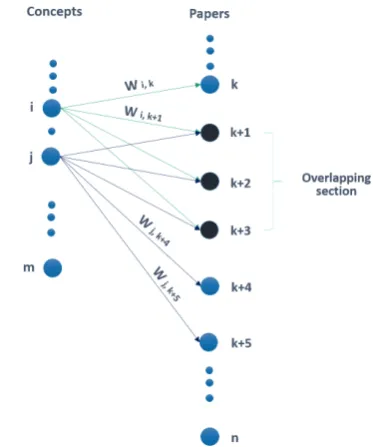
Figure 2: Extended subsumption for hierarchy generation.
2.3 Concept Hierarchy Building
In this subsection, we describe how to build a con-cept hierarchy based on concon-cept-document tag-ging results. We extend Sanderson and Croft’s early work (1999) which uses the notion of subsumption—a form of co-occurrence—to asso-ciate related terms. We say termxsubsumesyif yoccurs only in a subset of the documents thatx occurs in. In the hierarchy, x is the parent of y. In reality, it is hard foryto be a strict subset ofx. Sanderson and Croft’s work relaxed the subsump-tion to 80% (e.g.P(x|y)≥0.8, P(y|x)<1).
In our work, we extend the concept co-occurrence calculation weighted with the concept-document pair’s confidence score from previous step. More formally, we define a weighted rela-tive coveragescore between two conceptsiandj as below and illustrate in Figure2.
RC(i, j) = P
k∈(I∩J)wi,k
P
k∈Iwi,k −
P
k∈(I∩J)wj,k
P
k∈Jwj,k
(3)
SetIandJare documents tagged with concepts iandjrespectively.I∩Jis the overlapping set of documents that are tagged with bothiandj. wi,k
denotes the confidence score (or weights) between conceptiand documentk, which is the final con-fidence scorein the previous concept-publication tagging stage. When RC(i, j) is greater than a given positive threshold9,iis the child ofj. Since
[image:4.595.324.511.65.289.2]Figure 3: Deployed system homepage at March 2018, with all six types of entities statistics: over 228Kfields-of-study.
this approach does not enforce single parent for any FoS, it results in a directed acyclic graph (DAG) hierarchy.
With the proposed model, we construct a six level FoS hierarchy (from L0 and L5) on over 200K concepts with more than 1M parent-child pairs. Due to the high visibility, high impact and small size, the hierarchical relationships between L0 and L1 are manually inspected and adjusted if necessary. The remaining L2 to L5 hierarchical structures are produced completely automatically by the extended subsumption model.
One limitation of subsumption-based models is the intransitiveness of parent-child relationships. This model also lacks a type-consistency check between parents and children. More discussions on such limitations with examples will be in eval-uation section3.2.
3 Deployment and Evaluation
3.1 Deployment
The work described in this paper has been de-ployed in the production system of Microsoft Aca-demic Service10. Figure 3 shows the website homepage with entity statistics. The contents of MAG, including the full list of FoS, FoS hierarchy structure, and FoS tagging to papers, are accessi-ble via API, website, and full graph dump from
Open Academic Society11.
Figure4shows the example forword2vec con-cept. Concept definition with linked Wikipedia page, its immediate parents (machine learning,
artificial intelligence, natural language process-ing) in the hierarchical structure and its related
10
https://academic.microsoft.com/
11https://www.openacademic.ai/oag/
1. Concept discovery 94.75%
2. Concept tagging 81.20%
3. Build hierarchy 78.00%
Table 2: Accuracy results for each step.
concepts12(word embedding,artificial neural net-work, deep learning, etc.) are shown on the right rail pane. Top tagged publications (without
word2vecexplicitly stated in their text) are recog-nized via graph structure information based on ci-tation relationship.
3.2 Evaluation
For this deployed system, we evaluate the accu-racy on three steps (concept discovery, concept tagging, andhierarchy building) separately.
For each step, 500 data points are randomly sampled and divided into five groups with 100 data points each. On concept discovery, a data point is an FoS; on concept tagging, a data point is a concept-publication pair; and onhierarchy build-ing, a data point is a parent-child pair between two concepts. For the first two steps, each 100-data-points group is assigned to one human judge. The concept hierarchy results are by nature more con-troversial and prone to individual subjective bias, hence we assign each group of data to three judges and use majority voting to decide final results.
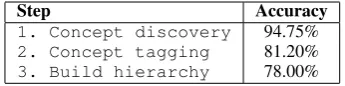
The accuracy is calculated by counting positive labels in each 100-data-points group and averag-ing over 5 groups for each step. The overall accu-racy is shown in Table2and some sampled hierar-chical results are listed in Table3.
Most hierarchy dissatisfaction is due to the in-transitiveness and type-inconsistent limitations of the subsumption model. For example, most pub-lications that discuss thepolycystic kidney disease
also mentionkidney; however, for all publications that mentionedkidney, only a small subset would mentionpolycystic kidney disease. According to the subsumption model,polycystic kidney disease
is the child ofkidney. It is not legitimate for a dis-easeas the child of anorgan. Leveraging the en-tity type information to fine-tune hierarchy results is in our plan to improve the quality.
12Details about how to generate related entities are
[image:5.595.330.503.62.105.2]Figure 4:Word2vecexample, with its parentFoS, relatedFoSand top tagged publications.
L5 L4 L3 L2 L1 L0
Convolutional Deep Deep belief Deep Artificial Machine Computer Belief Networks network learning neural network learning Science (Methionine synthase) Methionine Amino Biochemistry / Chemistry /
reductase synthase Methionine acid Molecular biology Biology (glycogen-synthase-D) Phosphorylase Glycogen
phosphatase kinase synthase Glycogen Biochemistry Chemistry Fr´echet Generalized extreme Extreme
distribution value distribution value theory Statistics Mathematics
Hermite’s Hermite Spline Mathematical
problem spline interpolation Interpolation analysis Mathematics
Table 3: Sample results forFoShierarchy.
4 Conclusion
In this work, we demonstrated a Web-scale pro-duction system that enables an easy exploration of scientific knowledge. We designed a system with three modules: concept discovery, concept tagging to publications, and concept hierarchy construc-tion. The system is able to cover latest scientific knowledge from the Web and allows fast iterations on new algorithms for document and language un-derstanding.
The system shown in this paper builds the largest cross-domain scientific concept ontology published to date, and it is one of the core components in the construction of the Microsoft Academic Graph, which is a publicly available academic knowledge graph—a data asset with tremendous value that can be used for many tasks in domains like data mining, natural language un-derstanding, science of science, and network sci-ence.
References
Yuxiao Dong, Hao Ma, Zhihong Shen, and Kuansan Wang. 2017. A century of science: Globalization of
scientific collaborations, citations, and innovations. InKDD, pages 1437–1446.
Xueqing Liu, Yangqiu Song, Shixia Liu, and Haixun
Wang. 2012. Automatic taxonomy construction
from keywords. InKDD, pages 1433–1441.
Tomas Mikolov, Ilya Sutskever, Kai Chen, Gregory S. Corrado, and Jeffrey Dean. 2013. Distributed repre-sentations of words and phrases and their composi-tionality. InNIPS, pages 3111–3119.
David Milne and Ian H. Witten. 2008. An effective, low-cost measure of semantic relatedness obtained
from wikipedia links. WIKIAI, pages 25–30.
Arvind Neelakantan and Ming-Wei Chang. 2015. In-ferring missing entity type instances for knowledge
base completion: New dataset and methods. In
NAACL, pages 515–525.
Mark Sanderson and W. Bruce Croft. 1999. Deriving concept hierarchies from text. InSIGIR, pages 206– 213.
Arnab Sinha, Zhihong Shen, Yang Song, Hao Ma, Dar-rin Eide, Bo-June Paul Hsu, and Kuansan Wang. 2015. An overview of microsoft academic service
[image:6.595.77.526.277.393.2]