Munich Personal RePEc Archive
Lineage-based Heterogeneity and
Cooperative Behavior in Rural China
He, Quqiong and Pan, Ying and Sarangi, Sudipta
Dongbei University of Finance and Economics, Fannie Mae, Virginia
Tech
August 2017
Online at
https://mpra.ub.uni-muenchen.de/80865/
1
Lineage-based Heterogeneity
and Cooperative Behavior in Rural China
1Quqiong He† Ying Pan‡ Sudipta Sarangi§
August 2017
Abstract
This paper investigates how lineages, the commonly found organizations in rural villages of China, affect people’s intra- and cross-lineage cooperative behavior. We use data from the Chinese Household Income Project Survey 2002, which exclusively contains information about the lineage structure in these villages allowing us to classify three levels of lineage-based heterogeneity. Our identification strategy relies on the exogeneity of lineage-based heterogeneity. We find evidence that people in a village with higher lineage-based heterogeneity are less likely to exhibit reciprocity behavior within lineages or contribute to the provision of public goods that are jointly shared across lineages. The estimation results remain robust to the inclusion of various control variables and additional background characteristics. Finally, we examine a number of other economic outcomes and find that more homogenous villages do better than other types of villages.
JEL classification: D71; O12; O17; H41
Keywords: Cooperation; Lineage Networks; Reciprocity; Local Public Goods; China
1 We are grateful to R. Carter Hill for several suggestions. We are thankful to the editor Daniel Berkowitz and two
anonymous referees for their helpful suggestions. We also thank Francis Bloch, Suqin Ge, Xavier Gine, Xu Lin,
Matthew Jackson, Chandan Jha, Xu Jintao and participants at the Networks and Development Conference at Louisiana
State University for their valuable comments.
†School of Economicsand the Center for Econometric Analysis and Forecasting, Dongbei University of Finance and
Economics, China. Email: [email protected]
‡Fannie Mae, Washington DC 20016. Email:[email protected]
§
Virginia Tech, 3016 Pamplin Hall, Blacksburg, Virginia 24061-0316, United States, and DIW Berlin, 10117 Berlin,
2 1. Introduction
Developing countries, including China, make tremendous efforts to promote rural development
and reduce poverty. Because the success of many economic endeavors, such as the exchange of
goods and services and the provision of public goods depend on cooperation, understanding the
nature of cooperative behavior is of vital importance. In developing areas where formal contract
enforcement is often weak, informal institutions such as lineages, tribes, or castes guide people’s behavior. In rural Chinese villages, for example, lineage solidarity, which is based on concepts of
family and shared patrilineal descent, still plays an important role in providing informal institutions
of accountability (Tsai, 2007). However, different villages have different lineage structures and
therefore are more or less heterogeneous. This paper seeks to understand how an informal
institution like clan lineage influences cooperation by examining villages with varying degrees of
lineage-based heterogeneity.
Existing studies have associated heterogeneity, including ethnic, linguistic, religious and tribal
heterogeneity, with trust (Alesina et al., 2002), economic growth (Easterly and Levine, 1997),
provision of public goods (Alesina et al., 1999) and the quality of governance (La Porta et al.,
1997). Our paper adds to this literature by investigating the effects of lineage-based heterogeneity
on both intra- and cross- lineage cooperative behavior simultaneously in the same villages in rural
China. To the best of our knowledge, this is the first paper that presents a full picture of cooperative
behavior by examining both intra-group and cross-group cooperation. Bowles and Gintis (2008)
state that cooperation can take the form of mutually beneficial transactions that may fail to
materialize without trust and reciprocity (intra-group), or it can take the form of the providing
public goods, which requires agreement and collective action (cross-group). Lineage networks
play an important role in institutional development because intra-group moral commitment reduces
enforcement cost, and social organizations spanning groups have a comparative advantage in
facilitating cross-group cooperation. In this paper, we measure intra-group cooperation by the
frequency of mutual help in monetary and non-monetary terms that occur between most familiar
individuals while varying the lineage homogeneity across the villages of these individuals.
Cross-group cooperation is measured by individual contributions to build village infrastructure and by
the share of the village budget that is spent on village public goods. With this setup, we exploit
not only both individual and village level variations but also the comparison between intra-and
3
We begin by examining intra-group cooperation. Empirical studies on intra-group cooperation
are rare. Conflict theory in sociology suggests that diversity fosters in-group solidarity as well as
out-group distrust (Blalock, 1967). However, Putnam (2007) claims that the fundamental
assumption behind the conflict theory: in-group trust and out-group trust are negatively correlated – is essentially unwarranted. In other words, bonding with own-group members is not necessarily at the cost of bridging with other groups. Putnam (2007) further argues that there might be the
possibility that diversity actually reduces both in-group solidarity and out-group trust and presents
some evidence from the United States. Thus, having heterogeneity in the lineage structure of the
villages allows us to see how the composition of the village and the extent of the presence of other
groups in the village affect intra-group cooperation. Our results support Putnam’s hypothesis where we find that more homogeneous villages demonstrate greater cooperation – just the possibility of repeated interaction within your own group can lead to more cooperation.
There is a large body of literature studying the impact of heterogeneity on the provision of
public goods. The findings generally indicate that heterogeneity in ethnicity, religion or social
class undermines cross-group cooperation and the provision of public goods (Alesina et al., 1999;
Banerjee, Iyer and Somanathan, 2005; Bandiera et al., 2005). In this paper, we present evidence
that villages that are more heterogeneous in terms of lineage spend a lower share of the village
budget on village public goods and villagers contribute less labor to build village infrastructures.
These findings are consistent with the burgeoning studies emphasizing the importance of tribal
structures. For example, Fukuyama (2011) provides new insights into China’s development and argues that it was shaped by two forces working in tandem: legalism and Confucianism. One of
the great constants in Chinese history is the importance of family, kinship and lineage ties for the
social fabric or organization. While legalism sought to centralize the state, Confucianism
supported patrimonial power and the importance of the family enabling the two forces to reinforce
each other. Although at certain periods one force may dominate the other, they were not in conflict
and work together to shape China’s transition. In rural China, local governments bear almost complete fiscal responsibility for local public good provision (Oi, 1996; Tsai, 2000). Before the
1980s, village leaders in rural China were generally appointed by the upper levels of the
4
of village committees so that villagers were able to elect their own leaders (Zhang et al., 2004).
This institutional shift not only improved the efficiency of local governance but also improved the
efficiency of public spending (Zhang et al., 2004; Wang and Yao, 2006; Brandt and Turner, 2007;
Luo et al., 2010). On the other hand Xu and Yao (2015) document that informal institutions such
as the lineage culture facilitate local governance.
A general concern in the literature is that the residential sorting process is endogenous (Easterly
and Levine, 1997; Alesina et al., 2002; Miguel and Gugerty, 2005). However, in our analysis the
village composition is independent of economic activities (Coleman, 1994; Peng, 2004). In other
words, the identification strategy of this paper relies on the assumption that the lineage structure
in a rural village, measured by surname patterns, is exogenous to cooperative behavior. 2 Shortly after communist China was founded in 1949, the central government established administrative
villages to strengthen the party’s rule and to build the commune system. 3 Administrative villages, the lowest level of administrative unit in China, also serve as the lowest rung of collective farming
in the commune system. To meet the needs of collective farming, administrative villages included
one or more adjacent lineages (Wang, 2006). Therefore, the lineage composition within a village
was exogenously determined by a shock – that of China’s administrative re-organization. In addition, in 1958, China enacted the household registration system, which inhibits free migration
and essentially ties rural people to the land where they were born. Thus, the lineage structure in
rural villages has remained stable since 1958 (Solinger, 1999).
Using data from the Chinese Household Income Project Survey (CHIPS) 2002, we find that
lineage-based heterogeneity has a negative effect on both the frequency of monetary and
non-monetary mutual help. It turns out that villagers do not treat them differently with regard to lineage
obligations and enforcement. Our results show that lineage-based heterogeneity has a negative
effect on cross-lineage cooperative behavior as well. In other words, people in
lineage-homogenous villages are more likely to engage in reciprocal behavior with their lineage members
and more likely to contribute to the provision of public goods that are jointly shared across lineages.
2 Despite the possibility that over time cooperative behavior may lead to larger families, this is unlikely to be a serious concern for us. In her seminal study of surname groups Tsai (2007) notes that surname patterns were largely determined exogenously in the pre-communist period by imperial land settlement policies and natural disasters. Moreover, the post-communist period of around fifty years is not long enough to have had a sizable impact on the population growth of cooperative families. Moreover, our heterogeneity variable is defined by village composition instead of lineage sizes. As we explain later, the village border is exogenously determined by the central government.
3 The goal of the reorganization was to facilitate the penetration and concentration of the Communist regime but did
5
Importantly, we provide additional support for the rice cultivation and cooperative behavior
hypothesis since the association between the lineage-based heterogeneity and the cooperative
behavior is stronger in the South. This also offers us more confidence regarding the causal effect
of lineage-based heterogeneity.
Our results are robust to the inclusion of various control variables and additional background
characteristics. The effect of lineage-based heterogeneity on cooperation are likely to imply
different economic outcomes in those villages after years of development. To explore the impact
of lineage-based heterogeneity on those villages’ economic outcomes, we investigate the villagers’ total financial assets at the end of 2002, income from farming, fishing and forestry, the percentage
of rural-urban migrant workers from each village, and the existence of a junior high school in each
village. The results generally suggest that the lineage culture not only fosters cooperation, but also
improves economic outcomes over time.
The remainder of this paper is organized as follows. In Section 2, we provide some background
information. Section 3 describes the data. Section 4 demonstrates the identification strategy and
the empirical models. Section 5 discusses the results. The last section concludes the paper.
2. Background
2.1Lineage Networks in rural China
A substantial existing literature explores the relationship between ethnic groups and economic
development.4 In China, there are a total of 56 ethnic groups, and the Han makes up the vast majority of the total population – around 91.6 percent. Among the other 55 minority ethnic groups,
44 occupy their own autonomous regions and the largest one is the Zhuang which consists of
around 1.3 percent of the total population (Dincer and Wang, 2011). While there is not much
variation in ethnicity in China, rural villages provides an ideal setting for the study of lineage
groups.5 Being exposed to similar social shocks at the provincial or national level, these villages have enough variation in lineage composition (Xu and Yao, 2015) to make them useful units of
observation.
4 See for instance Alesina et al., (1999); Alesina and La Ferrara, (2000); Alesina et al., (2001); Fearon and Laitin, (2000); Luttmer, (2001); Miguel and Gugerty, (2005); Putnam, (2007).
5 We do not take urban regions into account, because the lineage culture does not have much impact on urban life
6
In the long history of China, lineage culture has been a major driving force behind different
forms of social interaction from conflicts to cooperation and reciprocity. Lineage culture dates
back hundreds of years. Extended families related to the male’s line living in one settlement and form a lineage. All men in one lineage were descendants of a common ancestor. Male members
hold primary power in political leadership, moral authority, and social benefits. In short, the social
structure is patriarchal. Therefore, while female members could be from other ethnicities, lineages,
or villages, male members from the same lineage have the same surname and are consequently
from the same ethnicity. In imperial China, rural organizations and communities were in fact the
outgrowth of lineages. The size of the lineage ranged from a handful to a few hundred households.
Over generations, the common surname became the lineage identity and promoted solidarity
among lineage members (Peng, 2004). Lineage heads and sub-heads played a crucial role in rural
governance and were responsible for community affairs, public goods, rules and regulations for
lineage members and so on. Thus, lineage identity brought loyalty with it. Lineage members were
closely-bonded and held rituals to worship the same ancestors regularly (Tsai, 2007). They were
willing to contribute to, or sacrifice for the benefit of the entire lineage.
Different from some other traditional groups in the world, lineage organizations were preserved
in rural China even after radical social changes and are still one of the most important informal
institutions in the countryside. While the data is incomplete, Huang (1985) indicates as late as the
turn of the twentieth century most of the villages in the south were composed of members of one
lineage. In imperial China, the formal government was hardly able to reach rural areas (Kuhn
2002). After communist China was founded, Party Secretaries and Villagers’ Committees started to tighten control over villagers and take on the power to manage village affairs. To reach this
goal, the communist regime reorganized lineages by establishing administrative villages without
considering historical and traditional boundaries of these lineages and their common interests
(Wang, 2006). As a governing unit, an administrative village may include one or more adjacent
lineages. Lineages still play a significant role in cooperative actions such as resolving conflicts,
cooperation, and coordination, especially in southeastern China (Weber 1981, 1951; Freedman,
1958). Some qualities of lineage members such as familism, kinship loyalty and moral obligations
(Whyte, 1995; Peng, 2004) still persist. They hold rituals and plan collective activities regularly.
In the meantime, lineages are making efforts to share power with the formal government. For
7
2001, the obligations to contribute to the good of the lineage groups provide incentives for public
good provision. Greif and Tabellini (2015) argue that clans resumed their role in promoting mutual
aid, securing their own benefits as well as contributing to public goods. Xu and Yao (2015) find
that village leaders from larger lineages considerably increased local public good investment.
Freedman (1958) finds that lineage groups act as a substitute in places where formal institutions
are weak. He also finds that the lineage cultureis stronger in the South of China than in the North
and proposes three reasons to explain the difference. Firstly, the South is farther away from formal
government control since the political center of China is located in the North. This provides a
basis for the lineage culture to thrive in the South. Second, rice-cultivation in the South demands
extensive irrigation. Inter-household cooperation in irrigation could be the base from which the
lineage organizations emerged. Third, the population in the South has many immigrants from the
North. The exigencies of frontier life could stimulate the development of lineages. Talhelm et al.
(2014) offer another possible explanation for the lineage culture to thrive in the South – the history of farming rice in the south needs cooperation in extensive irrigation while in the North wheat
farmers can rely on rainfall. The need for irrigation fosters lineage-based rural organizations since lineage members’ stronger reciprocal and moral obligations could enforce cooperation. The Yangtze River in China splits the wheat-growing north from the rice-growing south. Talhelm et
al. (2014) point out the percentage of cultivated land devoted to rice paddies is more than 50
percent in each province in the rice-growing south (below the Yangtze River). In a follow up study
using incentivized experiments, Zhou (2017) finds greater cooperation among students from the
Southern provinces of Hunan and Zhejiang than from students of the Northern provinces of Hebei
and Shandong.
2.2Local Governance and Public Investment in Rural China
In rural China, local governments bear almost complete fiscal responsibility for local public goods
provision (Oi, 1996; Tsai, 2000). Before the 1980s, village leaders were generally appointed by
the upper levels of the government. Because of increasing conflicts between leaders and villagers
over taxes and fees, the Organic Law of Village Committees (draft) was first implemented in
Guangxi province at the end of 1980 (Fan, 2001; He et al., 2001). This law laid out comprehensive
provisions for the election of village committees so that villagers were able to elect their own
8
However, this promotion did not run smoothly. In most of the villages, committee members were
still appointed by the upper levels of government. According to the National Fixed-point Survey
conducted by the Research Center of Rural Economy in China, by 1994, only half of the villages had started the election process. In 1998, the revised version of the Organic Law of Village Committeeswas officially passed by the National People’s Congress and elections quickly spread
to villages all over the country. Wang and Yao (2006) report that since 1998, pure government
nomination has disappeared and the incidence of electing local leaders is now fully established.
Key differences between leaders appointed by the upper levels of government and leaders
elected by the local villagers lie in the degree of decentralization, participation, and accountability
(Dethier, 2000). They are also important for monitoring the delivery of public goods and services.
Zhang et al. (2004) are among the first to investigate how this institutional shift in village
governance affected public good provision. They find that elected leaders tend to spend more on
local public goods since elections have impose accountability in decision-making. They also
suggest that when decisions are made by the village committees rather by one or two individuals,
the efficiency of public spending is higher perhaps because of the reduction in wasteful spending
by village leaders.
Nevertheless, the institutional environment in China is not especially friendly towards the
democratic process. The upper levels of government often intrude in village elections and village
affairs creating a conflict for local leaders who may now have to satisfy both their local constituents
as well as the upper echelons of government. This has led some to question whether the elected
leaders truly serve the will of the villagers. To provide concrete answers, Wang and Yao (2006)
study the impact of village elections on the accountability of the village committee, local fiscal
sharing, and state taxation in rural China. They find that elections substantially increase the share
of public spending in the village budget, but reduce the shares of administrative costs and income
handed to the upper levels of government. These findings suggest that elections have enhanced the
accountability of the village committees, but weakened local fiscal sharing and the state’s grip. Luo et al. (2010) provide another explanation for the accountability of the selected leaders by
testing the potential mechanism behind the consistent relationship between elections and public
good provision. They find that the re-election incentives affect the behavior of incumbents even
in an early democratization situation, because the voters only reward good leaders. Brandt and
9
leaders to act in interest of their constituents. Kennedy et al. (2004) use a sample from Shaanxi
province and compare government-appointed candidates with candidates who were nominated by
villages. They find that nominated village leaders were more accountable to villager's decisions
regarding land reallocations.
2.3Why lineage composition matters?
Different from other solidarity groups, lineage group obligation is based on the concept of family.
In this sense, intra-lineage cooperation is important in two ways. Firstly, usually the households
in a lineage have been clustered in a settlement for generations, and this long-term connection as
well as the repeated nature of their interaction (possibility of needing help in the future) provides
them with incentives to help other lineage members (Coate and Ravallion, 1993). Second,
choosing not to help a lineage member would be like choosing to be disowned or to be denied
other lineage benefits by being ostracized (Basu, 1986). Moreover, the obligation may be stronger
as the size of the lineage increases (Pan, 2012).6 In a large lineage where everyone knows everyone else due to clustering over generations, a deviant may be denied future exchanges not
only with the person in need of assistance but also with many other lineage members as in Bloch,
Genicot and Ray (2008). In other words, the cost of defection potentially rises as the size of the
lineage increases. Consequently, reciprocity will be more often in large lineages than in small
lineages. We note that the size of a lineage in a homogeneous village, on average, is greater than
a lineage in a heterogeneous village. Thus, we hypothesize there is more frequent intra-lineage
reciprocity in homogenous villages than in heterogeneous villages.
For cross-lineage cooperation like public good provision, there are two streams of literature
investigating the relationship between social capital and public good provision. One is related to
informal institutions, explained by accountability, obligation and moral standing. Tsai (2007)
proposes a model of informal governmental accountability to explain public good provision in
rural China. Local officials have the incentive to provide public goods if villagers assign them
higher moral standing for doing so. In a more homogeneous village, the village leader is more
likely to be from the large lineage. Being in the large lineage, village leaders can earn authority
conferred by their lineage members and provide public goods for the good of their group (Tsai,
6 According to Posner's (1980) study of institutions in primitive societies, the reciprocity among lineage members can
10
2007; Xu and Yao, 2015). If they are not from the large lineage, they are less able to guarantee
the provision of public goods. The other one is related to formal institution. Alesina et al. (1999)
claims that ethnic groups have different preferences even over a seemingly neutral public good. If
there are many distinct preferences across groups, the chosen type of public goods is not preferred
by a large fraction of the population (Alesina et al., 1999). The costs of heterogeneity come from
the inability to agree on the common public goods (Alesina and La Ferrara, 2005). In that case,
individuals contribute fewer resources to public goods, because a large fraction of their resources
are used to provide public goods that are shared with other groups (Banerjee et al., 2001).
One has to pay attention to the fact that the institutional background in rural China is mixed.
A recent study in the context of rural China by Padró-i-Miquel et al. (2015) investigates the
interaction of the two theories and concludes that informal institutions like the lineage culture is
actually the pre-condition that enhances the performance of formal institutions. In other words, the
lineage culture and formal institutions are complements. Thus, in a more homogeneous village,
village leaders are more able to guarantee the provision of public goods. Villagers increase their
contributions because most of the beneficiaries of the public goods belong to their own groups.
Moreover, if rural China is moving towards democracy, we can expect more public good provision
because high social capital and formal institution compensates each other in this perspective.
3. Data and Descriptive Statistics
We use data from the rural part of the CHIPS 2002 survey.7 In this portion of the survey, 9200 randomly-selected households were interviewed from 961 villages in 22 provinces.8 Figure 1 presents a map of the provinces in China wherein the surveyed provinces have been shaded. As
explained in the previous section, the lineage culture is more developed in the South than in the
North. To investigate how this cultural difference affects the results, we adopt the grouping
strategy of Talhelm et al. (2014) and use the Yangtze River as the South-North divide to separate
the 22 provinces into two groups: Southern provinces and Northern provinces. As shown in Figure
1, the darker shade denotes Southern provinces which include ten provinces are classified as being
7 Our analysis is based on three questionnaires – the household level main rural questionnaire, the village level questionnaire and the social network questionnaire.
8 Although there are 34 province-level administrative units in China, the 22 provinces in the CHIPS 2002 data set
provide a nationally representative sample. The 22 provinces were selected from four distinct regions in China –
metropolitan, eastern, central, and western – to reflect variations in economic development and geography (Li et al,
11
in the South, while the lighter shade denote twelve Northern provinces.9 To better focus on the lineage culture, we exclude minority ethnic groups from our sample, since they are historically
herding areas and have different languages, cultures and religions (Talhelm et al., 2014).
In our sample, individual-level questions were answered mainly by heads of households or
other household members when household heads were not available.10 Those include questions about both the individuals and their families. For each village, the village-level questions were
answered by a village representative who was familiar with the geographic, demographic and
economic characteristics of the village. A village representative could be the party branch
secretary, the head of the village committee, or the village accountant, whoever was available
during the survey. In each village, around 10 to 15 families were surveyed. Table 1 presents
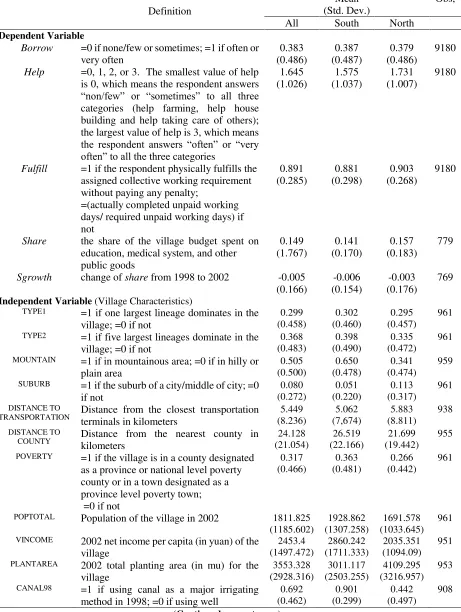
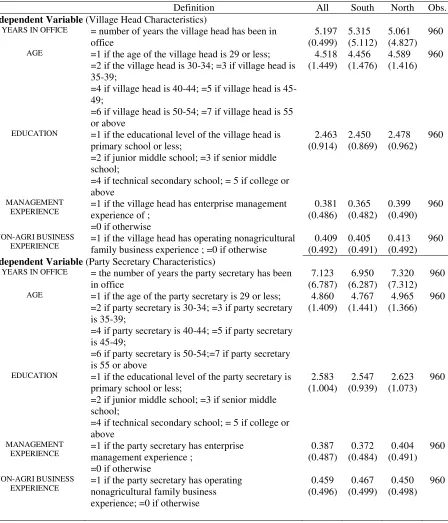
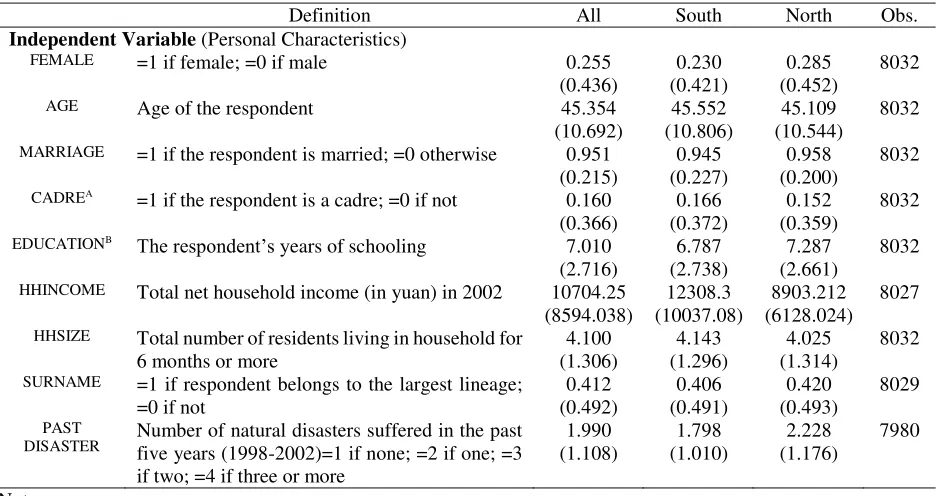
summary statistics for all variables that form the core of this analysis. In the following subsections,
we first explain how we measured lineage-based heterogeneity in our analysis, and we then discuss
cooperative behavior.
3.1Three Types of Villages
Although from our data we are not able to obtain the traditional heterogeneity index used in most
existing literature, two village-level questions in the survey make it possible for us to categorize
the 961 villages into one of three types based on the level of heterogeneity.11 The two questions are:
Q1. “Is the percentage of households belonging to the largest lineage in the village more than 50 percent?”
Q2. “Is the percentage of households belonging to the top five largest lineages in the village more than 50 percent?”
In the sample, villages that answered “yes” to Q1 are defined as Type 1 villages. Villages that answered “no” to Q1 and “yes” to Q2 are Type 2 villages. Villages that answered “no” to both Q1 and Q2 are Type 3 villages. Thus, Type 1 villages are the most homogenous villages, as the
majority of households in a Type 1 village are from the largest lineage. Type 3 villages are the
9The provinces in the “South” include Jiangsu, Zhejiang, Anhui, Jiangxi, Sichuan, Chongqing, Hubei, Hunan,
Guangdong, Guangxi, Yunnan and Guizhou. The provinces in the “North” include Beijing, Shandong, Hebei,
Liaoning, Jilin, Henan, Shannxi, Gansu, Xinjiang and Shanxi.
10 In the sample, about 97.8 percent of the respondents are household heads or their wives.
11 The traditional heterogeneity index is a Herfindahl-based index as shown in Alesina and La Ferrara (2002, 2003)
12
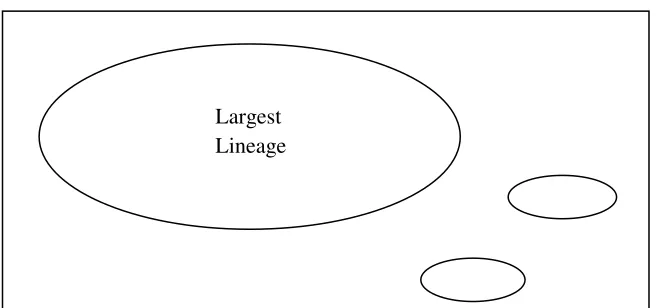
most heterogeneous villages as each village consists of a number of small lineages. Type 2 is a
medium-type village. Figure 2 provides a visual comparison of lineage structure for the three types
of villages. In our sample, 30 percent of the villages are Type 1 and 37 percent are Type 2. Table
2 lists the percentage of each type for each province.
An additional household-level question also provides lineage information:
“Does your family belong to the largest lineage in the village?”
This question enables us to calculate the percentage of the sampled largest-lineage households
in each village. Our calculations show that, on average, 71 percent of the sampled households in
Type 1 villages, 37 percent in Type 2 villages and 15 percent in Type 3 villages belong to the
largest local lineage. Note that Type 3 villages are the most heterogeneous villages while Type 1
villages are almost twice as homogenous as Type 2 villages.
We use Type 3 villages as the reference group and examine whether people in Types 1 and 2
villages are more cooperative. Therefore, we define two binary variables: TYPE1 and TYPE2.
TYPE1 is equal to 1 if the respondent belongs to a Type 1 village, and 0 otherwise. Similarly,
TYPE2 is 1 if the respondent belongs to a Type 2 village, and 0 otherwise.
3.2 Intra-lineage Reciprocity Variables
Our analysis focuses on both intra- and cross-lineage cooperative behavior. This section describes
the construction of intra-lineage reciprocity variables. To measure intra-lineage interaction, we
rely on the following question from the CHIPS 2002 survey:
“How often do you offer the following types of mutual help to your relatives and neighbors?”
The types of mutual help include (i) borrowing and lending money, (ii) helping with farming during the busy season, (iii) helping with house building, and (iv) caring for the elderly, the sick, and babies. Because extended families in rural China are usually established in the immediate
vicinity of each other in the same area (Holcombe, 1985; Ye and Wang, 2005; Wang, 2006; Greif
and Tabellini, 2011; Xu and Yao, 2015), we can assume that the respondent’s relatives and neighbors are mostly from his/her own lineage and make use of the responses to the above question
to proximate intra-lineage reciprocity. 12 Among the four types of help listed above, the first
12 Note that in the first type of village which is dominated by a single clan, it is highly likely that typical villagers
13
reflects monetary reciprocity while the other three capture the non-pecuniary favors, especially
those favors that require an investment of time. Therefore, we define two dependent variables:
borrow and help to separate monetary from non-monetary reciprocities. The binary variable
borrow takes the value 1 if the respondent answered that borrowing or lending money occurs often or very often, and zero if the respondent stated that this mutual help occurs rarely or never.
With regard to the other three types of mutual help, (ii), (iii) and (iv), we first construct a binary variable for each type in the same way as we did for borrow. We then define help by summing the three indicators. Hence, help takes values 0, 1, 2 or 3 where a greater number implies more mutual help regardless of the type of non-monetary help. For example, 0 means that all the three
binary help variables have the value 0. That is, the respondent answered mutual help in all three
types, (ii), (iii) and (iv), occurs rarely or never. Conversely, 3, the greatest possible number for
help, indicates all three binary variables take the value of 1. That is, the respondent answered mutual help in types (ii), (iii) and (iv) occurs often or very often.
3.3 Cross-lineage Cooperation Variables
We now explain how to measure cross-lineage reciprocity. A commonly used measurement of
cross-group cooperation in the literature is the provision of public goods (Alesina et al., 1999;
Banerjee et al., 2005). We adopt this idea by examining villagers’ physical effort in the provision of public goods and the share of the villages’ budgets spent on public goods. Village public goods, such as irrigation facilities, roads, and schools, are jointly consumed by all villagers, regardless of their lineage membership. Therefore, people’s willingness to invest in public goods reflects the cross-lineage reciprocities in any given village.
Solidarity groups play a key role in providing local public goods across rural areas in China.
During six months of fieldwork in 1999 and 2001 respectively, Tsai (2002) discovered the
widespread phenomenon that village officials rely on informal institutions such as lineage groups
to fund and manage public services. Before 2002, all villagers (between the ages of 18 and 65) in
China were required by law to provide unpaid labor to build local public goods, such as irrigation
14
systems, dams, roads, and school buildings. 13 The number of regulated days of unpaid work varied from place to place, but was usually between 7 and 21 days per year. If villagers could not
physically participate in the unpaid work, they were charged fines for each day they missed. The
villages could then use the collected fines to hire other people to replace the missing workers.
Since 2002, China has eventually waived this unpaid-labor duty and replaced it with “One -Issue-One-Meeting”, which also allowed the village authority to raise funds and free labor from villagers to finance local public good provision in a more democratic way (Chen and Ma, 2014). When
CHIPS 2002 was conducted, this reform had still not been implemented in 140 of the 961 surveyed
villages that provided us with data on the fulfillment of the unpaid-labor requirement. In these 140
villages, each surveyed household reported the number of days that they were required to work for
free and the number of days they actually completed in 2002. Based on this information, we
construct the variable fulfill, which is the ratio of the number of actually completed days to the number of required days, to measure the households’ physical effort in contributing to village public goods.
To investigate monetary contributions to public goods, we construct two additional village
level variables using data from 961 villages across China: (i) share, which measures the share of the village budget spent on education, the medical system, and other common expenditures (i.e.,
expenditures for environmental protection and public safety) and (ii) sgrowth,which measures the change in the share variable from 1998 to 2002. 14 As the revised version of the Organic Law of Village committees was passed in 1998 and the election has then spread quickly to all the villages, we also construct the sgrowth variable to investigate how village elections affect the relationship between lineage-based heterogeneity and public good provision.
13 This was mandated by the Regulations on Peasants’ Fees and Services (1992) announced by the State Council of
the People’s Republic of China. Before the tax-for-fee reform around 2002, households were required to supplylabor for free to local authorities mostly for the construction of local infrastructure. The number of regulated days varied with local needs. Local authorities were responsible for enforcing this regulation. The unpaid labor requirement should take place during the off-season for farming.
14 In CHIPS 2002, public goods include education, infrastructure, health and other common expenditures but share
15 3.4 Descriptive Statistics
Table 1 lists all the variables used in our analysis. The first column displays sample averages
while the next two columns illustrate the means in the South and the North respectively. The first
panel documents our outcome variables of interest. Consider borrow as an example. We find that 38.7 percent of the respondents in the South responded that borrowing and lending money occur
often or very often while the number of the respondents in the North is 0.8 percent lower.
We control for a set of village characteristics. Approximately half of the villages are located
in mountainous areas. Because village location plays an important role in the prevalence of lineage
culture (Freedman, 1965), we include other geographic controls, such as whether the village is
located in a city suburb, the distance to the nearest transportation terminals, and the distance to the
nearest county. As irrigation is the most important form of long-term cross-lineage cooperation in
rural China (Freedman, 1965), we control for this variable, denoted as CANAL98, which measures whether the village used a canal as the major irrigating method in 1998. We find that 69.2 percent
of the sample villages answered “yes” to this question. In rural China, the village is led by a village head (the chairman of the Village Committee) and a party secretary, and the village economy
depends heavily on village leadership (Oi, 1999). Thus, the characteristics of village leaders are
accounted for in our analysis. Five measures are used, including the number of years the village
leader has been in office, the age of the village leader, the education level of the village leader, the
enterprise management experience and the experience of operating a non-agricultural family
business.
The last panel of Table 1 documents detailed characteristics of the respondents, or the respondents’ family. Of the respondents, 16 percent were village cadres. 15 Villagers in rural China, on average, spent around seven years in school. Following the study of Alesina and La
Ferrara (2002), we construct a PAST DISASTER variable that takes a value of 1, 2, 3 or 4. A larger number indicates that the respondent suffered more natural disasters in the last five years (1998 – 2002). Alesina and La Ferrara (2002) include a similar indicator –“recent traumas”, in their model, which equals 1 if the respondent suffered a negative experience in the past year such as divorce,
diseases, accidents, or financial misfortune and zero otherwise. Their study shows “recent traumas”
15“Cadre” means administrators in China. In both Russia and China’s revolutionary eras, the word refers to a group of leaders active in promoting the revolution of the communist party. It no longer has any revolutionary implications
16
has a negative impact on trust. Due to data limitations, we do not have all the details on villagers’ past experiences, but only on disasters. Thus, our analysis includes PAST DISASTER instead to determine if the number of disasters suffered by the respondent affects his/her cooperative
behavior.
4. Identification Strategy and Estimable Models
Our main identification assumption is that lineage-based heterogeneity is exogenous with respect
to either intra-lineage or cross-lineage cooperative behavior. Prior to 1949, natural villages were
mostly the outgrowth of lineages who had settled in a place for a long period of time.16 While the data is incomplete, Huang (1985) illustrate as late as the turn of the twentieth century most (as
high as 87 percent) of the natural villages in the south were composed of members of one lineage. Recall that in a lineage, members are related to a male’s line so that male members hold primary power in political leadership, moral authority, and social benefits. In short, the social structure is
patriarchal. Therefore, while married female members could be from other ethnicities, lineages, or
villages, male members from the same lineage have the same surname.
Shortly after communist China was founded in 1949, the central government established
administrative villages by including one or more adjacent natural villages geographically.
Administrative villages were formed keeping two goals in mind. The first goal was to tighten
control over lineages after the Communist regime came into power. Administrative villages were
established as one governing unit across lineages boundaries and did not take into account the lineages’ common interest. Party penetration of villages was institutionalized and the Party branch replaced traditional village leaders such as lineage heads. The party branch was identified with
the interest of the party-state rather than lineage interests so lineage groups were not able to
manipulate this process (Wang, 2006). During the same period, many movements including the
notorious Great Leap Forward was launched in China, and communist China began to collectivize
farming. Another goal of village re-organization was to be able to facilitate the gathering of the
produce of farmers/peasants into the hands of the newly formed communist state. This has been
documented by Kuhn (2002). Therefore, the lineage composition within a village was
exogenously determined by a shock –that of China’s administrative re-organization.
16 There were some exceptions --- some pre-1949 villages might contain multiple lineages because of other reasons
17
Selective migration from one village to another was not frequent because of the tight lineage
bonds and the high moving costs (Freedman, 1958; Hsiao, 1960).17 Shrines and temples were built in each lineage to perform lineage worship and rituals, and to protect their members (Chang, 1955;
Tsai, 2007).18 Following the Great Leap Forward in the late 1950s, about 20 million of people died in the famine (Becker, 1996). Lineage members depended on each other to survive through
the disasters. In addition, in 1958, China enacted the household registration system, which inhibits
free migration and essentially ties rural people to the land where they were born.19 Thus, the lineage structure in rural villages has remained stable since 1958 (Solinger, 1999). To provide
additional evidence to support our results, in the robustness check section we add job
characteristics dummies and working location dummies into the baseline model and check how
these may affect our results.
Another concern could be whether cooperative behavior affects lineage structure in some
unobservable way. Previous studies provide some evidence to support our assumption suggesting
that this is not a concern. For example, Coleman (1994) argues that lineage networks are established exogenously “for noneconomic purposes but with economic consequences”. Essentially, shortly after 1949, administrative villages were formed to meet the needs of collective
farming, and to be better governed by the party branches. Solinger (1999) points out during the
Maoist period, strict policies against internal migration froze surname patterns in rural China,
which were largely determined exogenously by imperial land settlement policies and natural
disasters. Peng (2004) also states that the village composition is independent of economic
activities. Tsai (2007) even uses surname pattern as an instrumental variable in her study of
solidarity groups and local public good provision in rural China. It seems unlikely that the
17 According to a survey conducted by Lohmar et al. (2011) in over two hundred villages from nine presentative provinces in 1988 and 1995 respectively, about 0.5 percent of the rural labor force are rural-rural migrants in 1988 and about 3 percent in 1995. However, rural-rural migrations often occur because of marriage and family reunion
(Poncet, 2006) type events. Note that in China women typically move into their husbands’ villages if they are from
different places.
18 Though most of the shrines and temples were torn down during the Cultural Revolution, lineage members tried to
rebuild them in the late 1970s. They play an important role in the lineage religion (Tsai, 2007).
19 The household registration system has been partially relaxed since the 1980s. The surplus rural laborers pour into
cities in search of non-agricultural jobs. In China, rural-to-urban migration is non-voluntary, heavily regulated and controlled by the state (Chan et al., 1999; Poston and Yaukey, 1992). Only official and approved migration ensures urban job opportunities, and accompanying subsidies and benefits (Mallee, 1995). However, migration is granted
18
cooperative behavior (whether it be mutual help or public good provision) has had a significant
impact on village structure.
In the results section, we provide more empirical evidence for this assertion. We use different
types of villages based on lineage fragmentation to proxy heterogeneity. A variety of individual
and village controls are added sequentially into the models to check the sensitivity of our estimates
of interest. The identification strategy assumes that conditional on the baseline controls, our
measurement of lineage-based heterogeneity is not correlated with other unobserved factors that
influence villagers’ mutual help and cooperation, and public good provision. To examine these possibilities, we conduct several additional robustness checks in the results section. We use
individual level models to examine intra-lineage cooperative behavior and villagers’ physical contributions to public goods. These models are presented in subsection 4.1. When we study the
impact of lineage-based heterogeneity on the share of the village budget spent on public goods, we
use village-level models presented in subsection 4.2.
4.1Intra-lineage specification
Our basic model for intra-lineage relationships is
𝑜𝑢𝑡𝑐𝑜𝑚𝑒𝑖𝑗𝑝 = 𝛽1𝑇𝑌𝑃𝐸1𝑗𝑝+ 𝛽2𝑇𝑌𝑃𝐸2𝑗𝑝+ 𝑌𝑗𝑝𝛿 + 𝑋𝑖𝑗𝑝𝛾 + 𝛼𝑝+ 𝜀𝑖𝑗𝑝 (1)
where the subscripts indicate individual i in village j of province p. The outcome variables are latent variables, or respondents’ motivation, for monetary and non-monetary intra-lineage mutual help. Because borrow is a binary variable, we use a probit model to estimate the regression coefficients. Help is a discrete ordinal variable. More specifically, we classify the frequency of non-monetary help into 4 categories, with 3 thresholds. Therefore, we use an ordered probit model
to estimate the regression coefficients.
TYPE1 and TYPE2 are the village-type indicators. 𝑌𝑗𝑝 is a vector of other village characteristics
that include net income per capita, and its squared form so that we are able to test whether the
effect of per capita income on cooperative behavior is stronger or weaker as villages become
wealthier. 𝑌𝑗𝑝 also includes indicators for mountainous area, suburb, distance to the closest
transportation station, distance to the closest transportation terminal, poverty, total population,
total planting area, as well as a binary variable indicating whether the village used a canal as its
major irrigating method in 1998. 𝑋𝑖𝑗𝑝 is a vector of individual characteristics, which include age
19
behavior is stronger or weaker as people grow older. It also includes indicators for gender, years
of schooling, marital status, cadre, household income, and family size, and binary variables
indicating whether the individual belongs to the largest lineage in the village and the number of
natural disasters he/she suffered in the past five years (1998-2002). 𝛼𝑝 is a vector of province
fixed effects that rules out systematic differences between provinces.
If intra-lineage cooperation is more frequent in homogenous villages than in heterogeneous
villages, then 𝛽1 > 0, and 𝛽2 > 0. The identification strategy in this paper arises from the
exogenous predetermined heterogeneity. We use model (1) to examine whether intra-lineage
cooperation is more frequent in homogenous villages than in heterogeneous villages. Because the
lineage culture is traditionally more predominant in the South than in the North of China, to further
refine our identification, we separate the entire sample into two subsamples – Southern provinces and Northern provinces. We apply model (1) to each subsample and investigate whether the
difference is stronger in the South than in the North. If the answer is affirmative, this indicates
that the lineage-based heterogeneity affects people’s cooperative behavior. Moreover, it also suggests that our assumption regarding those in an individual’s neighborhood being from the same clan is a reasonable one.
4.2 Cross-lineage specification
The measurements of cross-lineage cooperation include fulfill, which is an individual-level outcome, and share and sgrowth, which are two village-level outcomes. The models for the fulfill
variable are the same as models (1) except that the fine charged for each missed day of unpaid
work is also included in 𝑌𝑗𝑝, in addition to all other village characteristics. The models for the
share variable are as follows:
𝑜𝑢𝑡𝑐𝑜𝑚𝑒𝑗𝑝 = 𝛽3𝑇𝑌𝑃𝐸1𝑗𝑝+ 𝛽4𝑇𝑌𝑃𝐸2𝑗𝑝+ 𝑌𝑗𝑝𝛿 + 𝛼𝑝+ 𝜀𝑗𝑝. (2)
If lineage-based heterogeneity discourages people from contributing to public goods, then 𝛽3,
and 𝛽4 > 0.
20
sgrowth is the outcome variable, we aim at examining how the provision of public goods responds to this policy change. The general model is:
𝑠ℎ𝑎𝑟𝑒𝑗𝑝𝑡 = 𝛽5𝑇𝑌𝑃𝐸1𝑗𝑝+ 𝛽6𝑇𝑌𝑃𝐸2𝑗𝑝+ 𝛽7𝑇 + 𝛽8𝑇𝑌𝑃𝐸1𝑗𝑝∗ 𝑇 + 𝛽9𝑇𝑌𝑃𝐸2𝑗𝑝∗ 𝑇 + 𝑌𝑗𝑝𝑡𝛿 + 𝜀𝑗𝑝𝑡 (3)
where 𝑇 is an year indicator. 𝑇 = 1 if the year is 2002; 𝑇 = 0 if the year is 1998.
In 1998, the model can be rewritten as:
𝑠ℎ𝑎𝑟𝑒𝑗𝑝,1998 = 𝛽5𝑇𝑌𝑃𝐸1𝑗𝑝+ 𝛽6𝑇𝑌𝑃𝐸2𝑗𝑝+𝑌𝑗𝑝,1998𝛿 + 𝜀𝑗𝑝,1998. (4)
In 2002, we rewrite (4) as
𝑠ℎ𝑎𝑟𝑒𝑗𝑝,2002 = 𝛽5𝑇𝑌𝑃𝐸1𝑗𝑝+ 𝛽6𝑇𝑌𝑃𝐸2𝑗𝑝+ 𝛽7+ 𝛽8𝑇𝑌𝑃𝐸1𝑗𝑝+ 𝛽9𝑇𝑌𝑃𝐸2𝑗𝑝+ 𝑌𝑗𝑝,2002𝛿 + 𝜀𝑗𝑝,2002. (5)
As 𝑠𝑔𝑟𝑜𝑤𝑡ℎ = 𝑠ℎ𝑎𝑟𝑒𝑗𝑝,2002 − 𝑠ℎ𝑎𝑟𝑒𝑗𝑝,1998 , we obtain the following model for the variable
sgrowth from (5) minus (4):
𝑠𝑔𝑟𝑜𝑤𝑡ℎ = 𝛽7+ 𝛽8𝑇𝑌𝑃𝐸1𝑗𝑝+ 𝛽9𝑇𝑌𝑃𝐸2𝑗𝑝+ ∆𝑌𝑗𝑝𝛿 + ∆𝜀𝑗𝑝 (6)
where ∆𝑌𝑗𝑝 indicates the change of village characteristics from 1998 to 2002.
In a more democratic environment, people are granted more rights to participate in collective
decisions. Accordingly, we can expect public-good provisions to increase faster in a more homogenous village because people’s decision to cooperate could be better realized in 2002. In other words, 𝛽8 𝑎𝑛𝑑 𝛽9> 0.
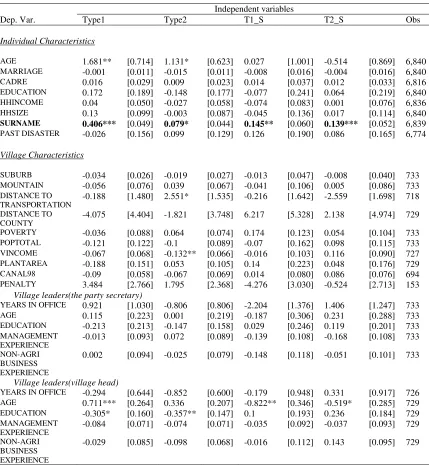
4.3Selection on Observables
To mitigate the possibility that other background characteristics may be the driving the relationship
between lineage-based heterogeneity and cooperative behavior. Now we examine whether our
analysis has selection on observables. To do this, we use the above models plus interaction terms
between the type variables and the South/North Dummy (denoted by T1_S and T2_S). Villager and village characteristics are the left-hand side variables. We test whether those characteristics
are different across the three types (evaluated by the coefficients of TYPE1 and TYPE2), and more importantly, whether those differences, if there is any, change from the South to the North
21
positive. “SURNAME” is a dummy indicator which is one if the individual is from the largest lineage in the village and zero otherwise. The four positive coefficients indicate that people in
Type 1 and Type 2 villages are more likely than Type 3 villagers to be from the largest local lineage,
and this situation is more apparent in the South than in the North. This exactly reflects that Type
1 and Type 2 villages are more homogenous than Type 3 villages and the difference in
lineage-based fraction across types of villages is more dramatic in the South than in the North. On top of
that, we do not see other variables have the same pattern as SURNAME. For the other variables, though the coefficients of TYPE1 and TYPE2 can be statistically different from zero, the coefficients of T1_S and T2_S are not.20 The results in Table 3 indicate that the three types of villages can be different in aspects other than the lineage-based fraction. Yet the other differences
do not change from the South to the North.
5 Main Empirical Results
In this section, we first explore how lineage-based heterogeneity affects intra-lineage cooperation
and cross-lineage cooperation using our baseline models. The results are robust after we
sequentially introduce a number of different controls. We then provide additional evidence to
support our analysis. In addition, for the individual level model, we cluster the standard errors by
village; for the village level model, we cluster the standard errors by county.
5.1 Intra-lineage and Cross-lineage Cooperation
Using model (1), we examine the impact of lineage-based heterogeneity on intra-lineage
relationships. Our goal is to investigate whether borrow or help is more likely to occur in Type 1 or Type 2 villages than in Type 3 villages. The main regression results are reported in Table 4.
Columns (1) and (4) illustrate the most basic regression results which compares the impact of the
three types of village structure on intra-lineage cooperation in rural areas. Columns (2), (3), (5)
and (6) examine the sensitivity of the results to the inclusion of additional individual and village
controls that can potentially have an impact on cooperative behavior. The results from column (1)
to (3) show that the estimated relationship between lineage-based homogeneity and the frequency
20 Expect for the Age variable, one possible reason is that the One Child Policy is more strictly enforced in the North
22
of monetary mutual help is positive and significant, which is also robust to a variety of controls.
To be more explicit, if we re-run regression (3) using a probit model, the marginal probit
coefficients of TYPE1 and TYPE2 calculated at the means indicate that frequent monetary help among lineage members is more likely to occur in Types 1 or 2 villages than in Type 3 villages by
9.3 and 6.7 percentage points, respectively. 21 The results from column (4) to (6) report similar results for non-pecuniary help. Villagers from Type 1 or 2 villages are more likely to offer physical
help to lineage members than villagers from Type 3 villages.
Tables 4 also report the coefficients of several interesting individual variables. First, borrow
increases with age while help does not. One explanation is that older people simply have more money to help. Another explanation is that lending is less likely to occur if there is asymmetric
information about the riskiness of the borrowers. Because older people are more experienced and
may have more information about other lineage members, they may be more likely to offer
monetary help than younger people. Non-pecuniary help, although it consumes time, is less risky.
Asymmetric information plays a less important role here. Similar explanations can be applied to
the association between being a cadre and borrow/help. Second, gender and marital status both have a significant negative relationship with borrow while their association with help is not significant. This may indicate that in rural China, women or married villagers are more risk-averse.
Third, the coefficients of HHINCOME are not significant for either monetary or non-monetary reciprocity within a lineage, thus, implying that it does not seem to be the case that people with
larger monetary budgets tend to help other lineage members more, giving more credence to the
asymmetric information explanation. Cadre is positively associated with monetary help but not non-monetary help. Asymmetric information is not an issue for a cadre because usually a cadre
member possesses larger information networks. However, working for the government indicates
they have less spare time to help others physically. Both borrow and help are positively associated with family size. Due to economies of scale, larger families may have more information about
other lineage members and also have more people available to provide help.
21Probit results are not reported here because linear models are more transparent and the clustering works better
23 5.2 Cross-lineage Relationships
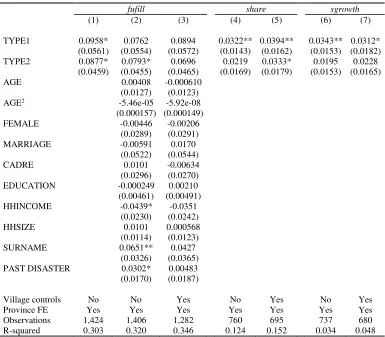
Next, we use model (2) to test whether homogeneous villages are more willing to contribute to
public goods than heterogeneous villages and present the main results in Table 5. The outcome
variables are fulfill for columns (1) to (3), share for columns (4) to (5) and sgrowth for columns (6) to (7). Recall that fulfill is an individual-level outcome variable measuring the respondent’s physical contribution to public goods, while the other two outcomes are village-level outcomes
regarding the share of the village budget spent on public goods. So there are individual controls
from columns (1) to (3). Column (1), (4) and (7) illustrate the most basic regression results which
compares the impact of the three types of village structure on cross-lineage cooperation in rural
areas. The other columns examine the robustness of the results to the inclusion of additional
village controls as same as those included in Table 4. The results from Table 5 show that the
estimated relationship between lineage-based homogeneity and collective action is generally
positive and significant. This is also robust to a variety of controls. To be more explicit, column
(3) reports that Type 1 villages averagely completed more required unpaid labor days than Type 3
villages by 8.9 percentage points but this coefficient is not significant. Column (5) shows that
Type 1 and Type 2 villages spend more of the village budget on public goods than Type 3 villages
by, respectively, 3.9 and 3.3 percentage points. The estimated coefficient of TYPE2 is only marginally significant. The above evidence indicates that cross-lineage cooperative behavior is
more likely to occur in homogeneous villages than in heterogeneous villages.
Columns (6) to (7) provides additional evidence for the above discussion, which examine how
lineage-based heterogeneity affected the change of share from 1998 to 2002. As shown in column (7), the increase in the share of the village budget that was spent on public goods is larger in Type
1 villages than Type 3 villages by 3.1 percentage points. As China continues to make progress in
switching to a democratic electoral process, median voters play increasingly more important roles
in village affairs. Thus, over time, their opinions are better accepted when the village committees
make decisions about how much to spend on public goods. Formal institution performs better with
the help of lineage culture. Thus accordingly, in 2002, we observe there was a greater increase in
24 5.3 Comparison between the South and North
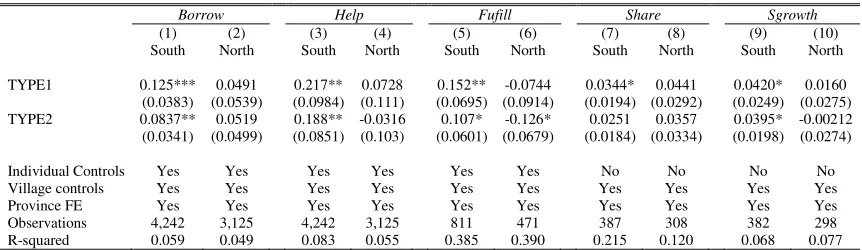
In this section, we split the entire sample into two subsamples – the South and the North, to
re-examine the association between lineage-based heterogeneity and cooperative behavior in rural
China. In Table 6, the odd columns report the regression results for all of the cooperation variables
using the sample in the South while the even columns use the sample in the North. Notice here
the South (North) represents provinces with relatively stronger (weaker) lineage culture.
In Table 6, column (1) and (3) imply mutual help, either monetary or non-monetary, happens
more frequently in Type 1 villages or Type 2 villages than in Type 3 villages in the South. By
contrast in column (2) and (4), there is no evidence that lineage-based heterogeneity has an impact
on mutual help in the North. Columns (5) to (10) show the results for cross-lineage mutual help.
Column (5) reports that in the South, Type 1 and Type 2 villages completed more required unpaid
labor days than Type 3 villages did by respectively, 15.2 and 10.7 percentage points. Column (7)
shows that Type 1 and Type 2 villages spend a greater share of the village budget on public goods
provision than Type 3 villages do by, respectively, 3.4 and 2.5 percentage points. The coefficient
of TYPE1 is marginally significant while the coefficient of TYPE2 is not. Column (9) shows that when we restrict the sample to the South, the share of public goods spending increases more in
Type 1 and Type 2 villages than in Type 3 villages by, respectively, 4.2 and 4 percentage points.
In columns (6), (8) and (10), the coefficients are no longer significant when we restrict the sample
to the North.
Our results show that overall in the South, the association between lineage-based
homogeneity and intra/cross-lineage behavior is positive and significant. In the North, however,
the significance goes away. This provides additional evidence to the causal impact of
lineage-based heterogeneity on cooperation.22
5.4 Robustness Checks
The discussion so far indicates that within-lineage reciprocity, whether monetary or non-monetary,
is more likely to occur in homogeneous villages than in heterogeneous villages. However this
22 Note that in a Type 1 village, two random villagers are more likely to be in the same lineage. So there may be a
25
result may arise because of unobserved variables. So in this section, we conduct alternative tests
to address this problem.
5.4.1 Job Characteristics
From the early 1970s, a large number of rural workers in China started to look for a job in urban
areas. This does not affect our identification strategy since the Chinese government has a strict
migration policy whereby migrants in China do not have access to institutional assistance from
local governments. However, one may be concerned that due to the rapid industrial development
in the southern part of China, stronger lineage networks make it easier for rural migrants to find a
job in the urban area, because of which rural migrants may need more help from their lineage
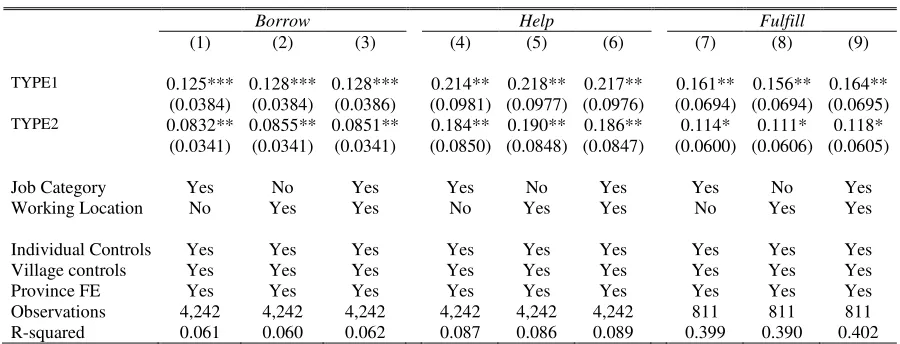
members, especially to take care of their family. To address this concern, we control for the respondents’ job categories and working locations.23 These results are reported in Table 7. In all specifications in Table 7, we include individual controls, village controls and province
fixed effects as in the baseline models. Column (1), (4) and (7) include job category dummies only;
column (2), (5) and (8) include working location dummies only; column (3), (6) and (9) include
both. Using sample data from the South, our results indicate that the coefficients on type variables
are consistent in all specification with and without job characteristic controls.
5.4.2 Village Leader Quality
Another concern maybe an omitted variable capturing the quality of village leaders. In imperial
China, a village was actually a lineage system. Lineage heads were responsible both for
administration and public affairs. After 1949, lineage systems were reorganized into an
administrative village and lineage heads were no longer in charge of village affairs. However, if
strong lineages are correlated with good qualities such as leadership or intelligence, then those
qualities may at the same time affect village affairs such as public good provision. To address this
concern, we include village head and the party secretary characteristics into our baseline model
and check how the results are affected. Those characteristics include age, education, management
experience, non-agriculture experience and years in office. These results are reported in Table 8.
23 Job category includes agriculture, forestry, miners, industry, construction, transportation, commerce, restaurants,