Munich Personal RePEc Archive
On the Validity of Probabilistic (and
Cost-Saving) Incentives in Dictator
Games: A Systematic Test
Walkowitz, Gari
17 January 2019
Online at
https://mpra.ub.uni-muenchen.de/91541/
On the Validity of Probabilistic (and Cost-Saving)
Incentives in Dictator Games: A Systematic Test
Gari Walkowitz
∗January 17, 2019
Abstract
Driven by methodological concerns, theoretical considerations, and previous evidence, we
sys-tematically test the validity of common dictator-game variants with probabilistic incentives.
We include four approaches and compare them to a standard dictator game: involving fewer re-ceivers than dictators; paying only some subjects or decisions; role uncertainty at the time of the
transfer decision. We also relate the dictator-game variants to established complementary indi-vidual difference measures of pro-sociality: social value orientation, personal values, a donation
to charity, and Big Five personality factors. Our data show that dictator behavior is quite sensi-tive to the applied methods. The standard version of the dictator game has the highest validity.
Involving fewer receivers than dictators and not paying for all decisions yields comparably valid results. By contrast, when only some subjects are paid or when subjects face uncertainty about
their final player role, the expected associations with complementary pro-sociality measures are distorted. Under role uncertainty, generosity is biased upwards. We conclude that the validity
of the dictator-game outcomes is highly sensitive to the applied methods.
Keywords: Dictator Game, Probabilistic Incentives, Social Value Orientation, Personal Values, Donation, Big Five Personality, Experiment, Methodology
JEL-Classification: C72, C91, D03
PsycINFO-Classification: 2260, 2360, 3020
∗
1
Introduction
The dictator game is a powerful and extensively used paradigm in the social sciences to study social preferences. It is very popular because of its simplicity.1 The standard version of the dictator game
entails dyads of randomly one-to-one matched dictators and receivers. Player roles are previously allocated by chance. The dictator takes one decision and determines her own payoff and the payoff of the matched receiver – who is inactive – by splitting a given prize. Despite the simple structure of the dictator game, experimenters often face constraints which complicate the implementation of the standard variant of the dictator game: available monetary funds or laboratory resources are limited; the number of available subjects is limited because they are scarce (e.g., managers), live in remote areas (e.g., foreign villages), or are hardly accessible due to legal regulation (e.g., prison inmates). Sometimes, researchers also need to make within-subject comparisons from multiple decisions, e.g., by contrasting a subject’s behavior across different games or in different player roles. Besides these requests, the dictator game in some cases solely serves as a “companion game” and adds an individual measure of generosity to the main experimental data.
To handle the above constraints and obtain the aspired data from the experimental subjects, re-searchers modify the standard protocol of the dictator game. There are different approaches: First, as the receiver is an inactive player, the number of receivers is reduced. An unbalanced matching is applied such that only some dictators are actually matched with receivers (e.g., Houser and Schunk, 2009)2. Second, only some players are paid after the dictators have taken a decision (e.g.,
Dufwen-berg and Muren, 2006; Holm and Engseld, 2005; Kahneman et al., 1986). Third, the dictator game is repeated or the subjects make several similarly structured decisions, including a dictator-game transfer, either in separate games or by applying the strategy method. For the subjects’ payoff, one decision is randomly chosen and paid out (e.g., Ashraf et al., 2006; Cappelen et al., 2007; Eckel and Grossman, 2000; Rankin, 2006). Fourth, introducing role uncertainty, all involved subjects first take a decision in the role of the dictator. Afterward, actual player roles are randomly assigned, the determined dictators are randomly matched with the receivers, and the players are paid accordingly (e.g., Charness and Rabin, 2002; Engelmann and Strobel, 2004; see also Iriberri and Rey-Biel, 2011). Many studies also combine random payment of decisions and role uncertainty to obtain a maximum amount of data and to enable within-subject comparisons. In this case, the subjects take several decisions as dictators. Afterwards, the payoff-determining decision is randomly chosen, actual player roles are randomly assigned, players are randomly matched and paid out (e.g., Andreoni and Miller, 2002; Andreoni and Vesterlund, 2001; Ashraf et al., 2006; Blanco et al., 2011; Castillo and Cross, 2008; Charness and Rabin, 2002; Engelmann and Strobel, 2004). Fifth, in some cases, the researchers do not offer the participants monetary incentives and let them take hypothetical decisions (Ben-Ner et al., 2008; Bühren and Kundt, 2015; Dalbert and Umlauft, 2009; Lönnqvist et al., 2011).
In the different variants of the dictator game, a distinct randomization procedure is applied – either with regard to the final matching of the players, how many players are actually paid, the deter-mination of the payoff-relevant decision, or the assignment of actual player roles. The different randomization procedures yieldprobabilistic incentives, i.e., different probabilities for how strongly
1
For an excellent metastudy on the empirical evidence from dictator-game experiments, see Engel (2011).
2
a dictator’s decision eventually determines her own payoff and that of a matched receiver. At the same time, fewer resources, such as subjects, sessions, money, etc., are required.
In this paper, we systematically test the impact of probabilistic incentives in dictator games – in-duced by the different forms of randomization found in the literature. Using a comprehensive and strictly controlled approach, we study the important question whether thesourceof randomization, i.e., unbalanced matching of dictators and receivers, random payment of players or decisions, or role uncertainty, alters generosity and underlying motivations. Furthermore, we investigate how the
degree of randomization, i.e., single (e.g., in case of unbalanced matching) and multiple randomiza-tions (e.g., in a situation with random payment of decisionsandrole uncertainty), interfere with the validity of observed dictator behavior.
Our study is driven by methodological and practical considerations, in conjunction with mixed evidence from previous studies. For example, in his metastudy on dictator-game behavior, Engel (2011) finds that the less a dictator is sure that her intended generosity affects the receiver, the less she transfers to the receiver. Moreover, when only some decisions of a dictator, or some dictators, are paid at random, no significant effect on generosity is detected (see also Bolle, 1990; Laury, 2005). Engel (2011) generally uses metaregressions. However, when applying individual data or when making different specifications in his models, the results differ (p. 591). Referring to the random payment of decisions in their experiment (including a dictator game), Ashraf et al. (2006) acknowledge: “While we control for design effects to the best of our ability, we cannot exclude the possibility that our design affects behavior differently than other, more standard, designs” (p. 197). Moreover, while some studies (e.g., Engelmann and Strobel, 2004) suggest that results are robust towards role uncertainty, Iriberri and Rey-Biel (2011), who directly study the impact of role uncertainty in a modified dictator game, find it to overestimate the prevalence of altruistic preferences.3 They conclude that “[...] our results definitely warn against the use of role uncertainty in future experimental designs aiming to identify different motives behind non-selfish behavior” (p. 171). In a similar vein, Charness and Rabin (2002) admit that “Our use of role reversal and multiple games in sessions may have generated different behavior than had each participant played just one role in one game” (p. 827). All in all, in the context of specific forms of randomization, it remains an open question how changing the incentive structure influences generosity and its foundations.
To the best of our knowledge, our study is the first to investigate systematically the different ran-domization procedures and their potential influence on dictator-game giving within a cohesive and controlled experimental approach. Our study adds the following contributions to the literature: i) We study and compare the impact of unbalanced matching, random payment of players or deci-sions, and role uncertainty using the same dictator game in all the treatments. ii) As far as we are aware, the role of unbalanced matching has not been studied so far. Depending on which field expert is asked, one gets divergent answers about the appropriateness of (secretly) involving fewer receivers than dictators with regard to deception issues or the validity of the results. iii) We include a combination of randomly paying decisions and role uncertainty, which is often done when social preferences are elicited. iv) To assess potential differences in the validity of dictator behavior across dictator-game variants, we relate subjects’ generosity to alternative individual difference measures
3
typically associated with generosity: social value orientation, personal values, an external donation, and Big-Five Personality factors. From this perspective, our study also provides potential new in-sights into previous results on the existing (or non-existing) associations of generosity with other individual differences measures.
Our data indicate that dictator behavior is quite sensitive to the specific game situation. The standard version of the dictator game has the highest validity.4 Unbalanced matching and
ran-dom payment of decisions do not significantly change dictator behavior and are comparable to the reference treatment without randomization. These procedures may therefore represent feasible cost-saving alternatives for conducting dictator-game studies under ressource constraints. At first sight, random payment of only some players does not affect the average amount transferred to the receiver. Yet, we find that the detected behavior does not sufficiently correlate with complementary measures of generosity. Furthermore, supporting previously expressed concerns by other researchers, role un-certainty (without repetition) biases transfers upwards and distorts the associations typically found with alternative measures of generosity.
The paper proceeds as follows: In the next section, we describe our experimental setup and the specific procedures that ensure strict control and comparability of the applied dictator-game vari-ants. We also make some theoretical considerations about the impact of probabilistic incentives on generosity. In Section 3, we present our results by showing dictator generosity and the validity of the distinct dictator-game variants with regard to their correlation with alternative generosity indicators. We will also assess the characteristics of the recruited subjects and their understanding and perception of the decision situation. In Section 4, we discuss our results.
2
The Experiment
2.1
Dictator-game variants
In all experiments, we study the same dictator game: the dictator determines the allocation ofe10
among herself and a receiver by choosing an integer amountx from e0 to e10 to be given to the
receiver. The basic structure of the dictator game is described with the same standard text in the instructions of all treatments, mapping different dictator-game variants. The treatment variations, i.e., the different randomization procedures, were made explicit in a separate subsequent paragraph.5
We implement six treatments. We deliberately exclude purely hypothetical decisions. Paying (at least some) subjects in the laboratory has become standard in experimental economics. It is argued that monetary incentives ensure that participants perceive their behavior as relevant, experience real emotions, and take decisions with real economic consequences (Falk and Heckman, 2009; Smith, 1976).6 In our treatments, we vary how 1) the dictators and the receivers are matched, 2) the
dictator decisions are payoff-relevant for either player, 3) the player roles are assigned. Table 1 provides an overview for all the treatments. It depicts their characteristics, the involved players,
4
For a general debate on the interpretation of generosity in give-variants of the dictator game, refer to List, 2007.
5
Instructions were provided in German. Please refer to Appendix A for the original instructions of all dictator-game variants and an English translation.
6
Table 1: Experimental Treatments
Treatment Feature Subjects Dictators Receivers Sessions PD PR
N–N
Reference treatment for all comparisons.
64 32 32 2 1.00 1.00
N-N/2
There are fewer receivers than dictators.
48 32 16 2 1.00 0.50
Pay50
Only 1/2 of the dictator-receiver dyads are paid.
64 32 32 2 0.50 0.50
Dec50
Only one out of two decisions from one subject is paid.
64 32 32 2 0.50 0.50
Rol50
Uncertainty about actual player role during decision.
32 32 0 1 0.50 0.50
DeRo25
Combination of the features from
Dec50 andRol50.
32 32 0 1 0.25 0.25
Total: 304 192 112 10
Notes. PD (PR) denotes the probability for a dictator’s decision to be payoff-relevant for the respective dictator (a
randomly regarded receiver) in a specific treatment.
and the probability for a dictator’s decision to be payoff-relevant for the respective dictator and for a randomly regarded receiver, respectively, when a dictator takes her decision in a specific dictator game. The probabilities depend on the applied randomization procedures.
N-N – Reference Treatment: Subjects are first randomly assigned a player role (dictator or receiver) with a probability of 1/2. After role assignment, there is the same numberN of dictators and receivers. Then, dictators and receivers are randomly matched, resulting inN dictator-receiver dyads. This implies that the dictators’ decisions determine for certain the dictators’ and the matched receivers’ payoffs. Finally, the dictator determines the allocation. All dictator decisions are paid. N-N represents the most common, but also most demanding, form of dictator-game implementation. It requires most resources (e.g., subjects, budget, time, and lab space) and serves as the “gold standard” for our comparisons.
parameters, less receivers are needed.
Pay50 – Probabilistic Payment: First, subjects are randomly assigned a player role (dictator or receiver) with a probability of 1/2. After role assignment, there is the same number N of dictators and receivers. Then, dictators and receivers are randomly matched, resulting inN dictator-receiver dyads. Finally, the dictator determines the allocation. For payoff determination, 1/2 of the dictator-receiver groups are randomly selected and paid out. This means that the dictators’ decisions determine their own and the matched receivers’ payoffs with a probability of 1/2. Pay50 costs less thanN-N, because only 1/2 of the subjects are actually paid.
Dec50 – Probabilistic Decision Selection: This treatment entails a second dictator-game de-cision. First, subjects are randomly assigned a player role with a probability of 1/2. After role assignment, there is the same amount N of dictators and receivers. Then, dictators and receivers are randomly matched, resulting in N dictator-receiver dyads. Dictators take the same decision as in N-N twice. For payoff determination, each decision is chosen with a probability of 1/2 and yields the payoffs for either player. This means that a dictator’s decision in one game determines her own payoff and the matched receiver’s payoff with a probability of 1/2. There is no intermediate feedback provided on the outcome of the first decision.7 Relative toN-N, twice as many observations
are collected. Moreover, the data allow for within-subject comparisons using multiple decisions.
Rol50 – Role Uncertainty: Here, we implement role uncertainty. First, all subjects determine the allocation in the role of a dictator. Then, they are randomly assigned their actual player role with a probability of 1/2. Consequently, there are as many dictators as there are receivers (N). Consecutively, dictators and receivers are randomly matched, resulting in N/2 dictator-receiver dyads. For payoff determination, the decision of the determined dictator is implemented. This implies that a subject’s decision determines her own payoff and another subject’s payoff with a probability of 1/2. Rol50 generates twice as many independent dictator observations relative to
N-N, using the same amount of subjects.
DeRo25 – Probabilistic Decision Selection and Role Uncertainty: This treatment combines the features of Dec50 (probabilistic decision selection) and Rol50 (role uncertainty). First, all subjects determine the allocation in two consecutive dictator games as in Dec50. To determine the players’ payoffs, subjects are randomly assigned their actual player role with a probability of 1/2. Consequently, there is the same numberN of dictators and receivers. Dictators and receivers are randomly matched, resulting in N dictator-receiver dyads. Then, one of the two decisions from the determined dictator is chosen with a probability of 1/2 and paid out. The procedure implies that a subject’s decision in one of the two dictator games determines her own payoff and another subject’s payoff with a probability of 1/4. In contrast toN-N, this treatment generates twice as many observations and requires only 1/2 of the subjects. It also permits within-subject comparisons.
7
2.2
Experimental procedures
General procedures. The experiment was conducted at the Cologne Laboratory for Economic Research (CLER), located at the University of Cologne. The lab has 32 cubicles, allowing us to include 16 dictator-receiver dyads in the standard version of the dictator game, i.e.,N=16. For each treatment, the number of sessions and involved subjects depended on the treatment features (see Table 1). We collected decisions from 32 dictators in each treatment. In total, 304 subjects (192 dictators) participated.8 Subjects were recruited via the online recruiting system ORSEE (Greiner,
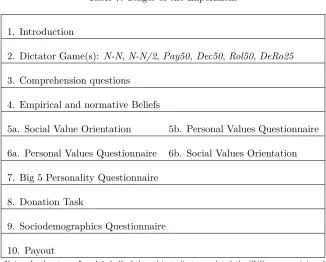
2015) and participated only in one session. After subjects had arrived at the laboratory, they drew a random code and were seated in separate and opaque cubicles. Subjects were not allowed to communicate. In case of any question, they had to raise their hand so that the experimenter could come and help. The experiment started after all subjects had read the instructions on paper, the experimenter had publicly read through the instructions, and questions regarding the structure of the experiment had been answered in private. The experiments were conducted on the computer, using the experimental platform z-Tree (Fischbacher, 2007), and lasted about one hour. After the main experimental task, subjects were asked to fill in a list of questionnaires with items on their understanding of the experiment, empirical and normative beliefs, social value orientation, personal values, Big Five personality, willingness to make a donation, and sociodemographic background. Concluding the session, subjects were compensated individually with a fixed amount of e4 for
showing up, along with the amount that they had earned in the experiment.9
Specific Controls. Due to the nature of the experiment, random treatment assignment was not possible within experimental sessions. Therefore, we took specific care of the following factors in order to keep the experimental conditions as constant as possible across dictator-game variants and sessions: i)Schedule: The experimental sessions were scheduled on a Tuesday or Wednesday, between 9:00 a.m. and 12:15 p.m., during the students’ summer term. In the treatments with two sessions, we placed one session on a Tuesday and the other one on a Wednesday in two different weeks.10
Further, we scheduled one session at 9 a.m. and one session at 11 a.m. Taken together, this ensured no bridging days, balanced week days and daytime, and a short time span for conducting the entire experiment.11 ii)Experimenter: To avoid experimenter effects (e.g., Roth et al., 1991; Zizzo, 2010),
the same experimenter conducted the experiment applying exactly the same experimental protocol. Instructions were neutrally written, avoiding terms like “dictator”, “giving”, or “fair”, because loaded instructions may alter dictator behavior (e.g., Burnham et al., 2000). iii)Sex: We strictly balanced the sex of the participants, because women tend to participate more often than men in experiments (e.g., Cleave et al., 2013) and typically transfer more than men in dictator games (e.g., Eckel and Grossman, 1998). For this purpose, males and females were separately invited to the same session. We ensured that 50% of the dictators were female by preparing different sets of cubicle codes for each sex. iv)Age: Our aim was to restrict the student sample to participants who were born between 1990 and 1999, yielding a typical age span for the current student cohort, because age might have a positive effect on generosity (e.g., Engel, 2011). v)Culture: To avoid variance in the subjects’ decisions due to the subjects’ cultural background (e.g., Henrich et al., 2005; Chuah et al., 2007), we only invited
8
For details on the recruited subjects’ characteristics, refer to Table 6 in subsection 3.3.
9
In Appendix B, the different stages of the experiment are depicted.
10
Dec50 took place only on a Tuesday.Pay50(which was added later) was played within one week.
11
subjects who indicated German as their mother tongue, which was used as an indicator for the subjects’ origin. vi)Experience: We restricted the subject pool to participants who had no previous experience with dictator-game experiments. Moreover, we aimed to invite only subjects who had not participated more than seven times in other experiments before.12 This procedure was chosen
to enroll subjects who hadsome experience with the situation and procedures typically applied in laboratory experiments. On the other hand, extensive personal experiences may cause the subjects to play interactive games in the lab as if they have some repetition, and the experimenter may have little to moderate this phenomenon (for a similar argument, see Levitt and List, 2007; Matthey and Regner, 2013, find that participation in previous experiments tends to increase the amount subjects allocate to themselves in dictator games). vii) Major: We also limited the share of business and economic students – the biggest group in our university’s laboratory subject pool and potentially familiar with the dictator game and less cooperative (e.g., Frank et al., 1993). viii) Laboratory: Finally, we would like to emphasize that our general laboratory setup (32 opaque cubicles,e4
show-up fee) is comparable to the majority of laboratories in the German speaking countries (Germany, Austria, Switzerland). An inquiry conducted prior to the experiment (we received 23 responses to 26 inquiries to the lab managers) yielded that, on average, laboratories are equipped with 26 cubicles and pay an average show up fee ofe4.20 to their subjects.
2.3
The impact of probabilistic incentives
Assuming self-regarding, purely money-maximizing preferences, dictator transfers would not differ among the six dictator-game variants. Dictators would keep the entire endowment for themselves. Further, according to the invariance hypothesis (Güth et al., 1982; Bolle, 1990), dictators would make the same decision in each treatment, independently of how their decision converts into actual payoffs when decision costs are small and anonymity is guaranteed (i.e., the dictator does not have to care about her image). However, following Camerer (2003), Cox (2010), and Smith (2010), who emphasize that dictator-game results are quite sensitive to procedural changes, and based on other findings, we consider two arguments suggesting behavioral differences across treatments.
The probability of being pivotal. First, in his metastudy on giving behavior in dictator games, Engel (2011) finds that the less a dictator is sure that her intended behavior becomes effective, i.e., determines the payoff of the receiver, the less she transfers to the receiver. In this case, generosity is less likely to enhance the receiver’s welfare. Likewise, low transfers are less likely to hurt the receiver (see also Andreoni and Bernheim, 2009). One possible explanation for this pattern can be derived from the dictator’s social image concerns: the less effective the dictator’s behavior becomes, the less she needs to care about her appearance in the eyes of the receiver. An inequity aversion model (e.g., Fehr and Schmidt, 1999) would make the same prediction, because a disutility from advantageous inequality becomes less likely when the receiver’s payoff is affected only with some probability smaller than one. Following these results, we expect dictator transfers to decrease, when it becomes less likely that the receiver is affected by the dictator’s decision (seePR in Table 1).
Expected payoffs. Second, in their review articles, Camerer et al. (1999) and Engel (2011) show that people are less generous when playing with higher stakes. Higher stakes are also found to reduce
12
transfers induced by presentation effects or image concerns. In our experiment, absolute stakes (the endowment) are held constant. Yet, the likelihood that a dictator can actually affect her own payoff decreases in most treatments relative to the reference treatment. According to the above results, if the dictator’s expected payoff becomes smaller, her transfers will increase and she can expose (more) socially desirable behavior at a lower cost (see PD in Table 1). An inequity aversion model would
predict, ceteris paribus, lower transfers, when the dictator can affect her own payoff only with some probability, but for sure determines the receiver’s wealth.13
Predictions. To predict behavior for the different variants of the dictator game, we consider a subject deciding in the role of a dictator at the moment of her decision.14 In the treatmentN-N
(our reference treatment), the subject knows that her decision is for sure payoff-relevant for herself and the matched receiver. In the treatment N-N/2, the dictator’s allocation decision becomes less effective and affects a randomly regarded receiver only with a probability of 1/2. The impact on her own payoff remains constant. Therefore, according to the first argument above, we expect the dictators to transfer less in N-N/2 as compared toN-N. The Fehr-Schmidt model on inequity aversion would predict the same tendency as the disutility from advantageous inequality becomes less likely.15
In the treatmentsPay50,Dec50, andRol50, the dictator’s decision affects the payoff of a randomly chosen receiver, but also her own payoff, only with a probability of 1/2 due to probabilistic payment or decision selection, or role uncertainty. The dictator’s decision becomes less effective, but her own stake also becomes relatively smaller compared toN-N.16Here, the above arguments conflict: on the
one hand, transfers may increase, because presentation effects or image concerns may become more prevalent, as they are less costly. On the other hand, transfers may decrease, because the dictators need to care less about their appearance in the eyes of the receiver. When we assume that dictators prefer to save money over spending money, i.e., that the first argument dominates the second one – as long as a dictator hassome stake (i.e., her decision influences her own payoff to some extent)17,
we expect lower transfers inPay50,Dec50, andRol50, respectively, relative toN-N.18One argument
which supports this assumption is that people tend to be self-servingly biased (e.g., Loewenstein et al., 1993), such that they care more for their own than for the payoff of other players. Fehr and Schmidt (1999) make a similar assumption in their model on inequity aversion: A player’s disutility from disadvantageous inequality is larger than her disutility if the player is better off than another player.
13
The case becomes more complicated when both the dictator’s and the receiver’s payoffs are probabilistic and when the probablities differ. This is not the case in our experiment.
14
For the treatmentsRol50 andDeRo25, this implies that the subject will not necessarily be assigned the role of the dictator for payoff determination afterwards.
15
Generally, the model predicts a maximum transfer ofx=5. The detailed calculations are shown in Appendix D.
16
Here, we make the assumption that the source of randomization (either through payment, decision, or role uncertainty) does not matter for the dictator. We will come back to the plausibility of this assumption in the discussion section.
17
This would not hold for a purely hypothetical decision. There, the probability of a dictator’s decision to become payoff-relevant for either player drops to zero. The dictator has no stake at all. Hence, based only on the second argument, hypothetical transfers would be driven by image concerns (towards the receiver and potentially also the experimenter) and are therefore higher than inN-N.
18
For the treatmentDeRo25, the same relation holds regarding the comparison withN-N and relative to Pay50, Dec50, and Rol50, respectively, because in DeRo25 a dictator affects her own payoff and the payoff of a randomly chosen receiver only with a probability of 1/4. The Fehr-Schmidt model would also partly predict lower transfers inPay50, Dec50, andRol50, as well as inDeRo25, respectively, relative toN-N. Forβ - parameters 0 and 0.25, the model predicts treatment-invariant transfers of x=0. For β=0.6, dictator transfers are equal to x=5 in the reference treatment N-N, andx=0 in the other treatments.19
3
Results
We first analyze dictator generosity across the different treatments and study the specific impact of unbalanced matching, probabilisitic payment or decision selection, and role uncertainty relative to the reference treatment.
3.1
Generosity
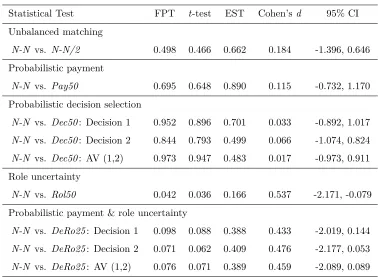
We show a characterization of the dictator transfers in each treatment in Table 2.20 Table 3 de-picts the results from different statistical tests for each treatment’s comparison with the reference treatmentN-N.
Comparing N-N (1.69) with N-N/2 (2.06), Pay50 (1.47), and Dec50 (1.63, 1.81)21, respectively,
we find no evidence that dictator transfers significantly differ. Detected effect sizes are rather low. Conversely, if we contrast dictator transfers from the reference treatment with Rol50 (2.81) and
DeRo25 (2.63, 2.75)22, we find them to be significantly higher, but not differently distributed.
Effect sizes range from moderate to strong.
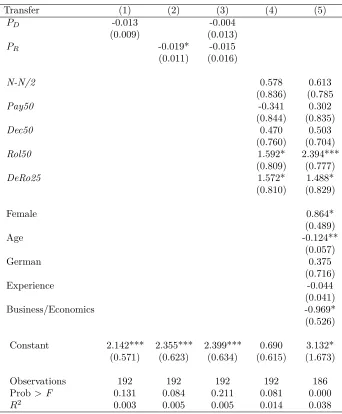
Next, we pool our data for regression analyses. In Table 4, we first assess whether the probability of a dictator’s decision to be payoff-relevant for herself (PD) or for the receiver (PR) systematically
affects transfers. Model 1 shows that the degree of how much a dictator’s decision can actually convert into her own payoff has no significant predictive power. Model 2 shows a weakly significant, but also very small and not robust (model 3) negative impact of the likelihood how much a dictator’s decision translates into the receiver’s payoff (cf. Engel, 2011). Pooled regressions, where treatment dummies predict transfers (models 4 and 5), replicate our non-parametric findings on transfers and also convey thatPD andPR do not systematically influence dictator transfers.
19β
=0, 0.25, and 0.6 are parameter values which are typically found in populations (Fehr and Schmidt, 1999), but see also Blanco et al. (2011) for lower values. Lower values would predict no treatment differences.
20
Figure 1 in Appendix E shows the distribution of transfers for each treatment.
21
34.37% of the dictators made a different transfer in the second game. First and second transfers are very similar inD50(p=0.271, Fisher-Pitman permutation test for paired replicates, henceforth: FPP).
22
Table 2: Transfers across Treatments
Treatment No. of Decisions AV SD Med Mode Min Max 0 ≥5
N-N 1 1.69 1.97 1 0 0 5 0.47 0.16
N-N/2 1 2.06 2.11 1.5 0 0 7 0.41 0.16
Pay50 1 1.47 1.83 0.5 0 0 5 0.50 0.13
Dec50 1 1.63 1.84 1 0 0 5 0.41 0.16
2 1.81 1.82 1 0 0 5 0.31 0.16
Rol50 1 2.81 2.21 4 0 0 7 0.31 0.28
DeRo25 1 2.63 2.34 3 0 0 10 0.28 0.22
2 2.75 2.46 3 0 0 10 0.28 0.22
All 2.19 2.13 2 0 0 10 0.34 0.18
Notes. AV (SD, Med, Min, Max) denotes Average, Standard deviation, Minimum, Maximum of the transfers. 0 (≥5) denotes the relative frequency of transfersx=0 (x≥5).
Table 3: Statistical Tests
Statistical Test FPT t-test EST Cohen’sd 95% CI
Unbalanced matching
N-N vs. N-N/2 0.498 0.466 0.662 0.184 -1.396, 0.646
Probabilistic payment
N-N vs. Pay50 0.695 0.648 0.890 0.115 -0.732, 1.170
Probabilistic decision selection
N-N vs. Dec50: Decision 1 0.952 0.896 0.701 0.033 -0.892, 1.017
N-N vs. Dec50: Decision 2 0.844 0.793 0.499 0.066 -1.074, 0.824
N-N vs. Dec50: AV (1,2) 0.973 0.947 0.483 0.017 -0.973, 0.911
Role uncertainty
N-N vs. Rol50 0.042 0.036 0.166 0.537 -2.171, -0.079
Probabilistic payment & role uncertainty
N-N vs. DeRo25: Decision 1 0.098 0.088 0.388 0.433 -2.019, 0.144
N-N vs. DeRo25: Decision 2 0.071 0.062 0.409 0.476 -2.177, 0.053
N-N vs. DeRo25: AV (1,2) 0.076 0.071 0.389 0.459 -2.089, 0.089
[image:12.612.116.494.381.658.2]Table 4: Pooled Regression Analysis on the Effects of Randomization
Transfer (1) (2) (3) (4) (5)
PD -0.013
(0.009)
-0.004 (0.013)
PR -0.019*
(0.011) -0.015 (0.016) N-N/2 0.578 (0.836) 0.613 (0.785 Pay50 -0.341 (0.844) 0.302 (0.835) Dec50 0.470 (0.760) 0.503 (0.704) Rol50 1.592* (0.809) 2.394*** (0.777) DeRo25 1.572* (0.810) 1.488* (0.829) Female 0.864* (0.489) Age -0.124** (0.057) German 0.375 (0.716) Experience -0.044 (0.041) Business/Economics -0.969* (0.526) Constant 2.142*** (0.571) 2.355*** (0.623) 2.399*** (0.634) 0.690 (0.615) 3.132* (1.673)
Observations 192 192 192 192 186
Prob > F 0.131 0.084 0.211 0.081 0.000
R2 0.003 0.005 0.005 0.014 0.038
3.2
Validity
To asses the validity of the different dictator-game variants further, we relate exposed dictator gen-erosity to three alternative individual difference measures of pro-sociality: social value orientation (SVO), personal values, and a naturally occurring decision situation on charitable giving, which cre-ates a – presumably commonly accepted – positive externality outside the laboratory (this approach is similar to Benz and Meier, 2008). Beyond that, we examine the association between subjects’ generosity and the Big Five personality factors across dictator-game variants.
Social value orientation. In the incentivized SVO slider measure (Murphy and Ackermann, 2014), subjects repeatedly choose between different own/other payoff allocations. The decisions resemble repeated dictator-game decisions. From the respondents’ aggregated decisions, a SVO angle can be calculated. A higher angle indicates a greater concern for the welfare of others. We expected the angle to be positively correlated with dictator transfers.23
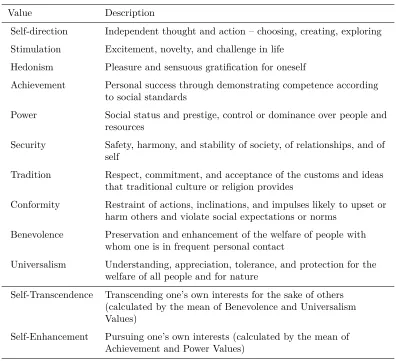
Personal values. In the non-incentivized Personal Values Questionnaire (Schwartz et al., 2012), subjects respond to questions on how similar they consider themselves to a described person. From their responses, the importance of ten basic values is derived for each individual (Schwartz, 1992). Among the basic values, we expect the values along the dimensions of Self-Transcendence (consisting of Benevolence and Universalism and mapping the ability to transcend one’s own interests for the sake of others) and the Self-Enhancement (consisting of Power and Achievement and mapping the importance of one’s will to pursue one’s own interests) to be positively (negatively) correlated with the dictators’ generosity.24 It was important for us to include a non-incentivized measure of
pro-sociality, because incentivized measures are potentially susceptible to spillover effects, i.e., subjects might try to balance behaviors across decisions (hedging or moral balancing effects, e.g., Merritt et al., 2010).
SVO and personal values are widely used in experimental economics and social psychology and have been shown to explain individual differences in dictator-game giving (e.g., Cornelissen et al., 2011; Lönnqvist et al., 2013). These two measures were elicited after the main experimental task. The application of both measures was balanced in each experimental session, i.e., half of the subjects first completed the SVO measure and half of the subjects started with the values questionnaire.
Donation. To make an external donation, we provided the subjects at the very end of the experi-ment with the opportunity to make a donation from their show-up fee in order to support a medical drug program against Malaria in Kenia run by Unicef.25 Subjects could donate any amount between
0 and 400 Cents (complete show-up fee). In the description of the donation call, we explicitly con-veyed that the donated money would actually be transferred to Unicef and that the subjects could check the transfer receipt afterward.26 We expected the donation to be positively correlated with
dictator transfers (Barr et al., 2010; Franzen and Pointner, 2013).
23
It has to be noted here that this well-established measure utilizes probabilistic payment and role uncertainty. First, all subjects take several distribution decisions. For payoff determination, subjects are randomly assigned the role of a dictator or a receiver. Dictators and receivers are randomly matched in pairs. In each pair, one dictator decision is randomly chosen and determines the pair’s payoff.
24
Please refer to Appendix F for the complete list and a short description of the ten basic values.
25
Detailed information on the program can be found at https://www.unicef.org/health/index_malaria.html.
26
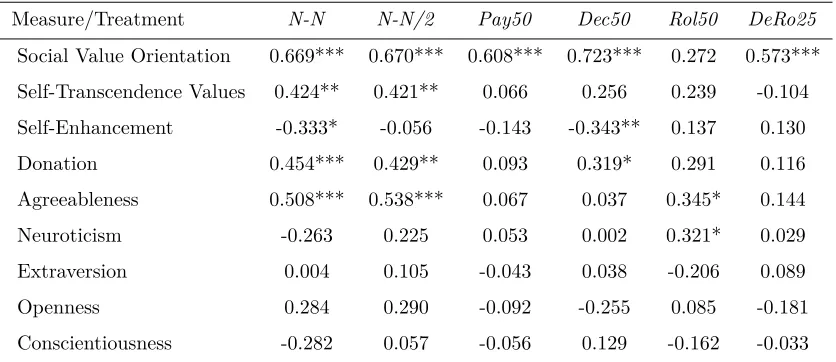
Table 5: Dictator Transfers and Alternative Measures of Generosity and Personality
Measure/Treatment N-N N-N/2 Pay50 Dec50 Rol50 DeRo25
Social Value Orientation 0.669*** 0.670*** 0.608*** 0.723*** 0.272 0.573***
Self-Transcendence Values 0.424** 0.421** 0.066 0.256 0.239 -0.104
Self-Enhancement -0.333* -0.056 -0.143 -0.343** 0.137 0.130
Donation 0.454*** 0.429** 0.093 0.319* 0.291 0.116
Agreeableness 0.508*** 0.538*** 0.067 0.037 0.345* 0.144
Neuroticism -0.263 0.225 0.053 0.002 0.321* 0.029
Extraversion 0.004 0.105 -0.043 0.038 -0.206 0.089
Openness 0.284 0.290 -0.092 -0.255 0.085 -0.181
Conscientiousness -0.282 0.057 -0.056 0.129 -0.162 -0.033
Notes. Spearman correlation coefficients. In D50 andDeRo25, correlations are calculated with dictators’ average transfers. Significance levels:∗∗∗ p<0.01,∗∗p<0.05,∗p<0.1.
Big Five personality. Subjects’ personality profiles were gathered after the SVO and values questionnaires using a 60-item personality measure (Konstabel et al., 2012) that captures the five personality factors Neuroticism, Extraversion, Openness, Agreeableness, and Conscientiousness con-ceptualized in the Five-Factor Model (Costa Jr and McCrae, 1992). Based on previous studies on the relationship between pro-social behavior and personality (e.g., Ben-Ner et al., 2008; Hilbig et al., 2014; Zhao and Smillie, 2015), we expected Agreeableness – which describes a person as kind, sym-pathetic, cooperative, warm, and considerate – to be positively associated with generosity.
Zero-order correlations are displayed in Table 5.27 For the SVO angle, we find significant moderate
to high positive correlations with dictator transfer in N-N, N-N/2, Pay50, andDec50. InDoRe25, the correlation is positive and moderate. InRol50, we do not find a positive correlation between the SVO angle and dictator transfers. Regarding values, inN-N,N-N/2, and partlyDec50, we observe the expected positive (negative) correlations between dictator transfers and Self-Transcendence (Self-Enhancement) values. InPay50,Rol50 andDeRo25, Self-Transcendence values show no significant correlations with the dictators’ generosity. Looking at the donations, we find significant moderate positive correlations in the treatments N-N, N-N/2, and Dec50. In Pay50, Rol50, and DeRo25, dictator transfers are not significantly correlated with the amount donated to Unicef. The internal factor reliabilities for the five personality factors are 0.859 (Neuroticism), 0.847 (Extraversion), 0.781 (Openness), 0.764 (Agreeableness), and 0.817 (Conscientiousness). Table 5 shows that only in the treatments N-N and N-N/2, we find the expected strong association of transferred amounts and Agreeableness. Finally, when we correlate pairwise Self-Transcendence Values, SVO angle, donation, and Agreeableness, respectively, we find them to be significantly correlated (see Table 12 in Appendix H). Correlation coefficients range from moderate to high. These results suggest that those variables measure kindred constructs and can be applied as additional controls.
27
3.3
Controls
As a last step, we run additional controls. We look at potential time effects, the characteristics of the recruited subjects, and how they perceived the decision situation. We also check if the different treatments evoke different social norms – dictator beliefs about what other dictators do and what the receivers expect them to do.
Time effects. The day (Tuesday is coded 1) and the daytime (9 a.m. is coded 1) of the experimental sessions were not significantly correlated with dictator transfers.28
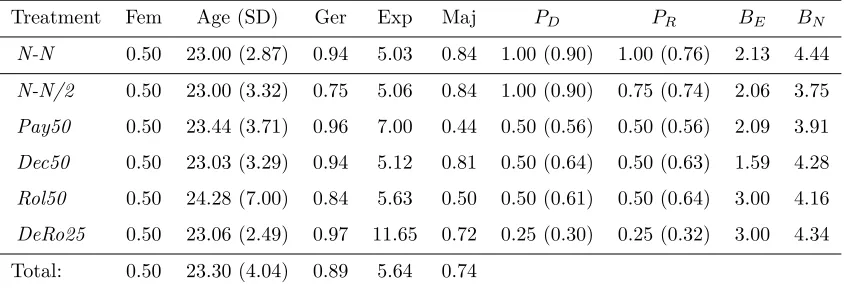
Subjects’ characteristics. Table 2 provides an overview on the characteristics of the recruited subjects deciding as dictators. The table conveys that we managed to select rather similar subjects into the different treatments. Sex (50% females) and age (average = 23.30 years) of the dictators is well-balanced. Further, a high percentage (89.06%) of the subjects was born in Germany (as described above, all invited subjects had previously indicated German as their mother tongue; this we took as a proxy for their nationality when we recruited them). Subjects had moderate experience (on average, 5.64 participations) with previous experiments. Past dictator-game experience was ruled out by the recruiting software. A share of 69.27% of the subjects majored in a discipline different from business or economics. From our selection criteria, sex (r=0.177, p=0.014, PBC), experience with previous experiments (ρ=-0.175,p=0.017, Spearman rank correlation, henceforth: SRC), and studying business or economics (r=-0.144,p=0.045, PBC) show a significant zero-order correlation with the (average) dictator transfer.29 In model 5 of Table 4, we display the results from a multiple
regression analysis, where we predict dictator generosity depending on a treatment dummy and the described subjects’ characteristics. The results suggest that when we add multiple controls, women tend to make higher transfers than men and that age and being a business/economics student is significantly negatively associated with transfers.30
Comprehension questions. To assess whether the dictators had correctly understood the decisive features of our treatments, we asked them after the main experimental task to indicate how likely it is that their decisions determine their own payoff and the payoff from a randomly regarded receiver (cf. PDandPRin Table 1).31 Overall, the dictators’ answers suggest that they had understood how
their decisions affect their own and the receiver’s payoff.32
Empirical and normative expectations. To examine whether the dictators perceive the decision situation differently depending on which dictator-game variant is played, we asked them to state two beliefs after the main experimental task. First, we asked them to estimate the average transfer of the other subjects deciding in the dictator role. Second, we asked them to state their second-order belief on what they should transfer from the perspective of the receivers (see, e.g., Bicchieri, 2006).33
28
Day: r=-0.045,p=0.539; daytime: r=0.040,p=0.583, Point biserial correlations (henceforth: PBC).
29
The other correlations are: Age: ρ=-0.094,p=0.193, SRC; Born in Germany: r=0.032,p=0.658, PBC.
30
The coefficient for Age contrasts with previous results (e.g., Engel, 2011). Yet, the coefficient is very small and the students are still very young in our sample due to the limitied age span. Our finding for females and studying business or economics corroborates the findings from Eckel and Grossman (1998) and Frank et al. (1993).
31
These probabilities are determined by the likelihood (depending on the treatment) that a subject – taking the decision as a dictator – is actually matched with a receiver, and is actually assigned the role of the dictator (receiver), and that a specific decision is actually chosen for payment.
32
Not all subjects provided correct answers. Since the structure of the games is simple and was carefully explained by the experimenter, our conjecture is that some subjects made mistakes in their explicit calculations or did not fully understand the questions about the game. Support for this conjecture comes from the treatmentN-N, which is the simplest of all. Even there, not all subjects provided the correct answers.
33
Table 6: Dictators’ Characteristics, Comprehension Questions, and Expectations
Treatment Fem Age (SD) Ger Exp Maj PD PR BE BN
N-N 0.50 23.00 (2.87) 0.94 5.03 0.84 1.00 (0.90) 1.00 (0.76) 2.13 4.44
N-N/2 0.50 23.00 (3.32) 0.75 5.06 0.84 1.00 (0.90) 0.75 (0.74) 2.06 3.75
Pay50 0.50 23.44 (3.71) 0.96 7.00 0.44 0.50 (0.56) 0.50 (0.56) 2.09 3.91
Dec50 0.50 23.03 (3.29) 0.94 5.12 0.81 0.50 (0.64) 0.50 (0.63) 1.59 4.28
Rol50 0.50 24.28 (7.00) 0.84 5.63 0.50 0.50 (0.61) 0.50 (0.64) 3.00 4.16
DeRo25 0.50 23.06 (2.49) 0.97 11.65 0.72 0.25 (0.30) 0.25 (0.32) 3.00 4.34
Total: 0.50 23.30 (4.04) 0.89 5.64 0.74
Notes.Fem (Age, SD, Ger, Exp, Maj) denotes the share of females (average age, the standard deviation of dictators’ age, the share of dictators born in Germany, the number of previous participations in experiments, and the share of dictators who have a different major subject than Business Administration or Economics).PD(PR) denotes the dictators’ median
(average) estimation of the probability for a dictator’s decision to be payoff-relevant for the respective dictator in a specific dictator game (the dictators’ median (average) estimation of the probability for a dictator’s decision to be payoff-relevant for a randomly regarded receiver in a specific dictator game). BE (BN) denotes the dictators’ empirical expectation
regarding the behavior of the other dictators (the dictators’ expectation regarding what they think the receivers expect them to transfer). In the treatmentRol50, one subject was 58 years old. When we exclude this subject from the average age calculation, the average age is 23.19 (SD=3.40). In the treatmentDeRo25, two subjects had participated in – curiously enough – 93 previous experiments. When we exclude these subjects from the average participation calculation, the average experience in previous experiments is 6.03.
Regarding the empirical expectations, we find no evidence that the dictators have different beliefs in
N-Nas compared toN-N/2,Pay50, andDec50.34 In the treatmentsRol50andDeRo25, the dictators
expect the other dictators to transfer significantly more than inN-N, what the other dictators also actually do (p=0.024; p=0.014, FPT) (see BE in Table 6). The normative expectations are very
similar across the treatments. This conveys that dictators’ normative perception of the dictator-game variants is comparable across treatments. Only inN-N/2, do the dictators believe that they should transfer somewhat less as compared toN-N (p=0.079, FPT) (see BN in Table 6).35
4
Discussion
We now discuss our findings from the different dictator-game variants with regard to average trans-fers, their relation to the complementary measures of generosity, and previous findings from the literature. As we have shown, thedegreeof how much a dictator’s decision can actually convert into both players’ payoffs has no robust significant impact on transfers. We will therefore examine how thesourceof randomization affects behavior in order to assess the suitability of each dictator-game variant as a reasonable complement to the standard version of the dictator game.
Reference treatment. InN-N, subjects transfer slightly less to the receivers (16.9%) as compared to what Engel (2011) reports on average generosity in student samples (24.7%). This might be an artefact of the methodological heterogeneity in the dictator games we analyze, respectively, or of the University of Cologne’s subject pool (for a comparable result, see Camerer, 2003). Most importantly,
evidence about whether payment increases accuracy or not is not conclusive (e.g., Costa-Gomes and Weizsäcker, 2008; Gächter and Renner, 2010).
34
p=0.927;p=0.996,p=0.129, Fisher-Pitman permutation test for two independent samples, henceforth: FPT.
35
generosity inN-N shows the expected associations with dictators’ social value orientation, personal values, inclination to make a donation, and personality (cf. Cornelissen et al., 2011; Lönnqvist et al., 2013; Benz and Meier, 2008; Hilbig et al., 2014). In this respect,N-N provides the most convincing results such that the experimenters can be assured that they actually measure what they intend to measure.
Unbalanced Matching. In N-N/2, we find no evidence that the dictators behave differently as compared to our reference treatment. The results are less pronounced with regard to their validity although the correlations with alternative measures of generosity are acceptable. The dictators seem not to strongly react towards a decrease in the effectivity of their choice concerning the payoff of the receiver. If there are plausible arguments for using unbalanced dictator-receiver groups in special cases, unbalanced matching may be a feasible alternative in order to gather necessary data (e.g., Houser and Schunk, 2009; see also Walkowitz, 2018, for a recent study with prison inmates).
With regard to transparency about the applied matching procedure, our results suggest that unbal-anced matching can be made transparent in order to avoid notions of deception.36 We also want to
emphasize thatN-N/2 is onlyonepossible variant for testing the effects of involving fewer receivers. In principle, only two receivers are needed to meet the requirement of a fully “random” matching of dictators and receivers. This variant would be the most conservative and efficient test for studying the impact of involving fewer receivers than dictators. We decided to involve twice as many dictators than receivers to maintain comparable incentives across our treatments. An interesting question for future research is whether our finding also holds when the number of receivers is further reduced.
Probabilistic payment. The results from Pay50 provide an illustrative case for the benefits of not only considering dictators’ average transfers, but also their underlying motivations. On the one hand, we find no evidence that the transfers are significantly different from the reference treatment. On the other hand, we find the transfers inPay50 to expose insufficient associations with alternative measures of generosity. Therefore, if researchers are interested in absolute average levels of generosity in the subject pool, paying only some subjects might be feasible. Yet, when generosity is tested and quantified against other competing motives, random payment might be misleading. Moreover, if the researchers are interested in underlying motivations, or when the dictator game adds an individual control for altruistic preferences to other experimental data, associations between the exposed behaviors might be biased when subjects are paid randomly.
Our results fromPay50 differ from Sefton (1992) – not with regard to the overall conclusion about the appropriatenes of random payment, but with regard to average behavior. In his experiment, dictators are significantly more generous in relation to the control treatment without random payment, when only 25% of the subjects are paid. The differences among his and our results might be due to the fact that, in our study, we pay more subjects (50% instead of 25%; this is closer to the reference treatment) and we have higher stakes (e10 to be split instead of $5; people are less generous when playing with
higher stakes; see, e.g., Camerer et al., 1999, and Engel, 2011). Further, as Table 6 shows, selected subjects in Pay50 have participated in more experiments (7 vs. 5.03 average participations) and the proportion of non-business/economics students is lower (44% vs. 84%). The multiple regression analysis in Table 4 shows that being a business/economics student indeed negatively correlates with
36
the dictators’ generosity in the whole study sample. Yet, we find no such significant correlation for thePay50 sub-sample (ρ=-0.117,p=0.523, SRC). The same holds for previous experience, which is not significantly correlated with generosity inPay50 (ρ=-0.286,p=0.119, SRC). Generally, if major subject and experience actually affected the subjects’ preferences, the strength of the correlations with complementary measures of generosity should not be affected, because the subjects’ preferences are only “shifted”. This is not the case inPay50, though.
Probabilistic decision selection. Using the data of Dec50 and a regression analysis (see Table 4), we can infer that the mere fact that a dictator takes a second, similarly structured, decision does not significantly influence her behavior. While a good proportion of the dictators takes a different decision in the second dictator game, we do not find broad differences with regard to the averages and the validity of the exposed behaviors in Dec50 relative to our reference treatment. Like in
N-N/2, the results are less strong, though, and we find no expected association with Agreeableness.
The results fromDec50 suggest that a probabilisitc payoff, caused by a randomization of the payoff-relevant tasks, does not sufficiently change dictator behavior. This corroborates previous results on how the elicitation and payment of multiple choices (e.g., via the strategy method) – without role uncertainty – influence behavior (Brandts and Charness, 2000; Engel, 2011; Laury, 2005; Azrieli et al., 2018).
Role uncertainty. In the treatment Rol50, the dictators transfer significantly higher amounts to the receivers as compared to the reference treatment. The same tendency can be observed in the treatment DeRo25, which combines a probabilistic decision selection with role uncertainty (see Iriberri and Rey-Biel, 2011, for a similar finding). Hence, in DeRo25, role uncertainty seems to dominate the effect of a randomly selected decision for payoff. Inflated generosity may become an issue when it is tested against other motives (see, however, Engelmann and Strobel, 2004, who state that – according to their data – role uncertainty does not change the relative importance of inequality aversion, efficiency, and maximin preferences, p. 867). Most importantly, the subjects’ transfers in
Rol50 andDeRo25 do not expose the expected correlations with other individual difference measures of generosity. Picking up the above quote from Iriberri and Rey-Biel (2011), dictator games with role uncertainty indeed seem to identify different motives behind observed non-selfish behavior. Therefore, when the dictator game adds a control for altruistic preferences to other experimental data, associations between the experimental tasks might be biased. This is of specific interest, because in this case experimenters typically want to elicit a data point from all participants – and a dictator game with role uncertainty offers a very convenient way for doing so, as the receivers are initially not needed.
InRol50, the recruited subjects are somewhat older relative to the reference treatment (due to an outlier) and the amount of students majoring in business or economics is higher (see Table 6). Both facts have not driven the transfers upwards, because the corresponding correlation coefficents are not significant, very small, and partly even negative inRol50.37 The same holds for the potential
impact of more experienced subjects inDeRo25 (see Table 2).38 As we have also shown in a multiple
transfers inRol50 orDeRo25 upwards.
Our analyses also convey the idea that dictators inRol50 andDeRo25 have higher empirical beliefs concerning the transfers of the other dictators relative to N-N and Dec50.39 We also find that
empirical expectations and transfers are highly correlated in all treatments (allρ>0.354,p<0.047, SRC). Hence, dictator transfers in Rol50 and DeRo25 relate to what the dictators believe about the behavior of the other dictators. Contrary to the other treatments, in Rol50 and DeRo25, the behavior of other subjects is potentially payoff-relevant for a subject. Although not strategically relevant, there is an inter-player dependence and the players may be forced to put themselves into the shoes of another player and into either player role. Therefore, transfers might reflect a notion of empathy or reciprocity toward other players who might affect a subject’s payoff (Batson et al., 1988). The results from our correlational analysis above, however, speak against this last interpretation. Alternatively, transfers might entail an element of “wishful” or “fearful” thinking40:
because subjects face the threat of ending up as receivers, they evaluate the game outcomes from the receiver’s perspective. They make a generous transfer and hope that they will be matched with an equally-minded dictator in case they are actually assigned the receiver role. Testing and disentagling these alternative explanations is an interesting path for future work.
Another important aspect for future methodological work relates to the fact that the applied (stan-dard) measure for social value orientation also comprises uncertainty about the decision-maker’s actual role. Nevertheless, individual SVO angles are highly positively correlated with dictator gen-erosity in almost all treatments and with the other social preference indicators. Based on our data, but also suporting a line of other studies which use the technique of combining random decision payment and role uncertainty (e.g., Charness and Rabin, 2002), our conjecture, as yet to be verified, is that, if experimental subjects take sufficient decisions under role uncertainty, the distorting effect of role uncertainty will become smaller.
As a final remark, we intended to link our results to the experimental studies cited in the introduc-tion, which use different forms of randomization. After a careful reading, we realized that this is an impossible endeavor for at least three reasons: First, dictator transfers in these studies depend on many treatment interventions that render comparisons very difficult. Second, different randomiza-tion techniques are combined. Third, average generosity in some cases cannot be calculated based on the information provided in the papers. However, our attempt underlines the need for a cohesive study for a better understanding of the impact of the different randomiziation procedures creating probabilistic incentives, but also that further evidence which warrants our findings is needed. For future research, we, therefore, also suggest to focus on other commonly used and more complex games. Even in a our simple setup without strategic interaction, we can detect significant influ-ences of randomization-based probabilistic incentives. Similar effects might occur and blur the link between preferences and behavior when the players are strategically connected (e.g., Blanco et al., 2011; Burks et al., 2003).
39
As shown, normative expectations do not significantly differ across these treatments.
40
References
Andreoni, J. and B. D. Bernheim (2009). Social image and the 50-50 norm: A theoretical and experimental analysis of audience effects. Econometrica 77(5), 1607–1636.
Andreoni, J. and J. Miller (2002). Giving according to garp: An experimental test of the consistency of preferences for altruism. Econometrica 70(2), 737–753.
Andreoni, J. and L. Vesterlund (2001). Which is the fair sex? gender differences in altruism. The Quarterly Journal of Economics 116(1), 293–312.
Ashraf, N., I. Bohnet, and N. Piankov (2006). Decomposing trust and trustworthiness.Experimental economics 9(3), 193–208.
Azrieli, Y., C. P. Chambers, and P. J. Healy (2018). Incentives in experiments: A theoretical analysis. Journal of Political Economy 126(4), 1472–1503.
Barr, A., A. Zeitlin, et al. (2010). Dictator games in the lab and in nature: External validity tested and investigated in ugandan primary schools. Technical report, Centre for the Study of African Economies, University of Oxford.
Batson, C. D., J. L. Dyck, J. R. Brandt, J. G. Batson, A. L. Powell, M. R. McMaster, and C. Griffitt (1988). Five studies testing two new egoistic alternatives to the empathy-altruism hypothesis.
Journal of personality and social psychology 55(1), 52.
Batson, C. D., D. Kobrynowicz, J. L. Dinnerstein, H. C. Kampf, and A. D. Wilson (1997). In a very different voice: unmasking moral hypocrisy. Journal of personality and social psychology 72(6), 1335.
Ben-Ner, A., A. Kramer, and O. Levy (2008). Economic and hypothetical dictator game experiments: Incentive effects at the individual level. The Journal of Socio-Economics 37(5), 1775–1784.
Benz, M. and S. Meier (2008). Do people behave in experiments as in the field? - evidence from donations. Experimental economics 11(3), 268–281.
Bicchieri, C. (2006). The Grammar of Society: The nature and dynamics of social norms (1 ed.). Cambridge University Press.
Blanco, M., D. Engelmann, and H. T. Normann (2011). A within-subject analysis of other-regarding preferences. Games and Economic Behavior 72(2), 321–338.
Bolle, F. (1990). High reward experiments without high expenditure for the experimenter? Journal of Economic Psychology 11(2), 157–167.
Brandts, J. and G. Charness (2000). Hot vs. cold: Sequential responses and preference stability in experimental games. Experimental Economics 2(3), 227–238.
Burks, S. V., J. P. Carpenter, and E. Verhoogen (2003). Playing both roles in the trust game.
Journal of Economic Behavior & Organization 51(2), 195–216.
Burnham, T., K. McCabe, and V. L. Smith (2000). Friend-or-foe intentionality priming in an extensive form trust game. Journal of Economic Behavior & Organization 43(1), 57–73.
Camerer, C. (2003). Behavioral game theory: Experiments in strategic interaction. Princeton Uni-versity Press.
Camerer, C. F., R. M. Hogarth, D. V. Budescu, and C. Eckel (1999). The effects of financial incentives in experiments: A review and capital-labor-production framework. In Elicitation of Preferences, pp. 7–48. Springer.
Cappelen, A. W., A. D. Hole, E. O. Sorensen, and B. Tungodden (2007). The pluralism of fairness ideals: An experimental approach. The American Economic Review 97(3), 818–827.
Castillo, M. E. and P. J. Cross (2008). Of mice and men: Within gender variation in strategic behavior. Games and Economic Behavior 64(2), 421–432.
Charness, G. and M. Rabin (2002). Understanding social preferences with simple tests. The Quar-terly Journal of Economics 117(3), 817–869.
Chuah, S.-H., R. Hoffmann, M. Jones, and G. Williams (2007). Do cultures clash? evidence from cross-national ultimatum game experiments.Journal of Economic Behavior & Organization 64(1), 35–48.
Cleave, B. L., N. Nikiforakis, and R. Slonim (2013). Is there selection bias in laboratory experiments? the case of social and risk preferences. Experimental Economics, 1–11.
Cornelissen, G., S. Dewitte, and L. Warlop (2011). Are social value orientations expressed automat-ically? decision making in the dictator game. Personality and Social Psychology Bulletin 37(8), 1080–1090.
Costa-Gomes, M. A. and G. Weizsäcker (2008). Stated beliefs and play in normal-form games.
Review of Economic Studies 75(3), 729–762.
Costa Jr, P. T. and R. R. McCrae (1992). Neo personality inventory–revised (neo-pi-r) and neo five-factor inventory (neo-ffi) professional manual. Odessa, FL: Psychological Assessment Resources.
Cox, J. C. (2010). Some issues of methods, theories, and experimental designs. Journal of economic behavior & organization 73(1), 24–28.
Dalbert, C. and S. Umlauft (2009). The role of the justice motive in economic decision making.
Journal of Economic Psychology 30(2), 172–180.
Dufwenberg, M. and A. Muren (2006). Generosity, anonymity, gender.Journal of Economic Behavior & Organization 61(1), 42–49.
Eckel, C. C. and P. J. Grossman (2000). Volunteers and pseudo-volunteers: The effect of recruitment method in dictator experiments. Experimental Economics 3(2), 107–120.
Engel, C. (2011). Dictator games: a meta study. Experimental Economics 14(4), 583–610.
Engelmann, D. and M. Strobel (2004). Inequality aversion, efficiency, and maximin preferences in simple distribution experiments. The American Economic Review 94(4), 857–869.
Falk, A. and J. J. Heckman (2009). Lab experiments are a major source of knowledge in the social sciences. Science 326(5952), 535–538.
Fehr, E. and K. M. Schmidt (1999). A theory of fairness, competition, and cooperation. The Quarterly Journal of Economics 114(3), 817.
Fischbacher, U. (2007). z-tree: Zurich toolbox for ready-made economic experiments. Experimental Economics 10(2), 171–178.
Frank, R. H., T. Gilovich, and D. T. Regan (1993). Does studying economics inhibit cooperation?
The Journal of Economic Perspectives 7(2), 159–171.
Franzen, A. and S. Pointner (2013). The external validity of giving in the dictator game.Experimental Economics 16(2), 155–169.
Gächter, S. and E. Renner (2010). The effects of (incentivized) belief elicitation in public goods experiments. Experimental Economics 13(3), 364–377.
Greiner, B. (2015). Subject pool recruitment procedures: Organizing experiments with ORSEE.
Journal of the Economic Science Association 1(1), 114–125.
Güth, W., R. Schmittberger, and B. Schwarze (1982). An experimental analysis of ultimatum bargaining. Journal of Economic Behavior & Organization 3, 367–388.
Henrich, J., R. Boyd, S. Bowles, C. Camerer, E. Fehr, H. Gintis, R. McElreath, M. Alvard, A. Barr, J. Ensminger, et al. (2005). "economic man" in cross-cultural perspective: Behavioral experiments in 15 small-scale societies. Behavioral and brain sciences 28(06), 795–815.
Hilbig, B. E., A. Glöckner, and I. Zettler (2014). Personality and prosocial behavior: Linking basic traits and social value orientations. Journal of Personality and Social Psychology 107(3), 529.
Holm, H. k. and P. Engseld (2005). Choosing bargaining partners - an experimental study on the impact of information about income, status and gender. Experimental Economics 8(3), 183–216.
Houser, D. and D. Schunk (2009). Social environments with competitive pressure: Gender effects in the decisions of german schoolchildren. Journal of Economic Psychology 30(4), 634–641.
Iriberri, N. and P. Rey-Biel (2011). The role of role uncertainty in modified dictator games. Exper-imental Economics 14(2), 160–180.
Kahneman, D., J. L. Knetsch, and R. H. Thaler (1986). Fairness and the assumptions of economics.
Konstabel, K., J.-E. Lönnqvist, G. Walkowitz, K. Konstabel, and M. Verkasalo (2012). The short five (s5): Measuring personality traits using comprehensive single items. European Journal of Personality 26(1), 13–29.
Laury, S. (2005). Pay one or pay all: Random selection of one choice for payment.
Levitt, S. D. and J. A. List (2007). What do laboratory experiments measuring social preferences reveal about the real world? The journal of economic perspectives 21(2), 153–174.
List, J. A. (2007). On the interpretation of giving in dictator games. Journal of Political Econ-omy 115(3), 482–493.
Loewenstein, G., S. Issacharoff, C. Camerer, and L. Babcock (1993). Self-serving assessments of fairness and pretrial bargaining. Journal of Legal Studies 22, 135.
Lönnqvist, J.-E., M. Verkasalo, and G. Walkowitz (2011). It pays to pay–big five personality in-fluences on co-operative behaviour in an incentivized and hypothetical prisoner’s dilemma game.
Personality and Individual Differences 50(2), 300–304.
Lönnqvist, J.-E., M. Verkasalo, P. C. Wichardt, and G. Walkowitz (2013). Personal values and proso-cial behaviour in strategic interactions: Distinguishing value-expressive from value-ambivalent behaviours. European Journal of Social Psychology 43(6), 554–569.
Matthey, A. and T. Regner (2013). On the independence of history: experience spill-overs between experiments. Theory and decision 75(3), 403–419.
Merritt, A. C., D. A. Effron, and B. Monin (2010). Moral self-licensing: When being good frees us to be bad. Social and personality psychology compass 4(5), 344–357.
Murphy, R. O. and K. A. Ackermann (2014). Social value orientation: Theoretical and measurement issues in the study of social preferences. Personality and Social Psychology Review 18(1), 13–41.
Rankin, F. W. (2006). Requests and social distance in dictator games.Journal of Economic Behavior & Organization 60(1), 27–36.
Roth, A. E., V. Prasnikar, M. Okuno-Fujiwara, and S. Zamir (1991). Bargaining and market behavior in jerusalem, ljubljana, pittsburgh, and tokyo: An experimental study. The American Economic Review 81(5), 1068–1095.
Schwartz, S. H. (1992). Universals in the content and structure of values: Theoretical advances and empirical tests in 20 countries. Advances in experimental social psychology 25, 1–65.
Schwartz, S. H., J. Cieciuch, M. Vecchione, E. Davidov, R. Fischer, C. Beierlein, A. Ramos, M. Verkasalo, J.-E. Lönnqvist, K. Demirutku, et al. (2012). Refining the theory of basic in-dividual values. Journal of personality and social psychology 103(4), 663.
Sefton, M. (1992). Incentives in simple bargaining games. Journ