ISSN Online: 2169-0529 ISSN Print: 2169-0510
DOI: 10.4236/anp.2017.64012 Oct. 17, 2017 141 Advances in Nanoparticles
Water Based Nanofluids: A Computational
Study on Temperature Distribution
in a Pipe Flow
Md. Ebrahim Khalil Bhuiyan, Mohammad Mahmudur Rahman Khan
*, Iqbal Mahmud
Department of Textile Engineering, Bangladesh University of Business and Technology, Dhaka, BangladeshAbstract
Fluid containing nanometer-sized particles (i.e. nanoparticles) is known as nanofluid. Three different nanofluids flowing in a pipe with heat source at the inlet and sink in the walls are studied. The base fluid is water. 20 nm size na-noparticle Al2O3 is mixed with base fluid with volume concentrations of 0.1%, 0.2% and 0.5%. Simulation is done using ANSYS Workbench 17.1. The result shows correlation between concentration of nanoparticle and temperature gradient at the outlet of the pipe.
Keywords
Nanofluid, Nanoparticle, Al2O3, CFD, ANSYS
1. Introduction
Nanofluids (nanoparticles fluid suspensions) [1] is the term introduced by Choi et al. [2]. Nanofluids based heat transfer fluids have better thermal properties than the host fluids. Solid nanoparticles such as metal or metal-oxide (ranging from 1 to 100 nm size) are diffused in traditional liquids e.g. water, ethylene glycol and engine oils etc. to prepare nanofluids. To gain highest possible ther-mal properties by dispersing nanoparticles (preferably less than 1 nm) uniformly at small possible volume concentration (preferably less than 1%) as well as maintaining a stable suspension is the main concern of nanofluids.
Transfer of heat energy has become a major task in industrial processes [3]. Heat must be added, removed or exchanged between process streams through-out various industrial processes. Study of nanofluid shows that it can be used as a high performance heat transfer medium. The diffused nanoperticles allow How to cite this paper: Bhuiyan, Md.E.K.,
Khan, M.M.R. and Mahmud, I. (2017) Water Based Nanofluids: A Computational Study on Temperature Distribution in a Pipe Flow. Advances in Nanoparticles, 6, 141-147. https://doi.org/10.4236/anp.2017.64012
Received: August 9, 2017 Accepted: October 14, 2017 Published: October 17, 2017
Copyright © 2017 by authors and Scientific Research Publishing Inc. This work is licensed under the Creative Commons Attribution International License (CC BY 4.0).
DOI: 10.4236/anp.2017.64012 142 Advances in Nanoparticles more heat transfer by increasing thermal conductivity of the nanofluids along with conduction and convection heat transfer coefficient. Behind the enhance-ment of thermal properties of nanofluids the main reasons are increenhance-ment of rela-tive surface area, effecrela-tive thermal conductivity, mixing fluctuation and turbu-lence of the fluid and among others [3].
In this study, three different nanofluids were studied inside a pipe with flow and heat transfer.
2. Problem Statement
A situation is considered where fluid is flowing through a pipe. The pipe is con-nected with both source and sink. Then three different types of nanofluids are investigated in respect to their temperature distribution at the outlet. The base fluid is water, which has been investigated at first to compare the nanofluids re-sults. Nanoparticle aluminum oxide is mixed with base fluid at volume concen-trations (0.1%, 0.2%, and 0.5%) to create three different nanofluids. These liq-uid-solid nanofluids are treated as single fluid in Fluent using their representa-tive thermal and physical properties. Experimental values [1] of the nanofluids have been used for this purpose (Table 1).
2.1. Physical Model
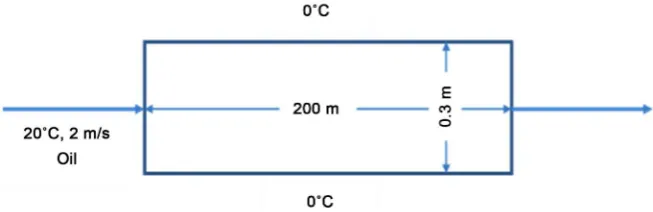
At the beginning a situation following the Example 8-3 [4] is reproduced using Fluent. Schematic diagram of the system is shown in Figure 1.
[image:2.595.209.536.465.571.2]At the inlet fluid is flowing with a constant temperature. The pipe wall is al-ways at 273.15 k temperature as according to Example 8-3 [4], the pipe goes through an ice lake with temperature 273.15 k.
[image:2.595.211.542.622.727.2]Figure 1. Schematic diagram of the system.
Table 1. Properties of nanofluids.
Property Volume Concentration of Al2O3 0.1% Al2O3 0.2% Al2O3 0.5% Al2O3
Density ρ (kg/m3) 1038 1042 1060
Specific heat Cp (j/kg∙k) 3200 2600 500
DOI: 10.4236/anp.2017.64012 143 Advances in Nanoparticles Continuity (Equation (1)), momentum (Equation (2)) and energy equations (Equation (3)) are solved to get result.
(
∂ ∂ + ∇ ⋅ρ t)
( )
ρV =0 (1)(
t)
(
)
ijρ ∂ ∂ +V ρ V⋅∇ V= −∇ +ρ ρg+ ∇ ⋅τ (2)
(
)
(
2)
ˆ ˆ
* d 2 d net in net in
e u P V gz n A Q W
t
ρ
∀ + +ρ
+ +ρ
⋅ +∂ =
∂
∫
∫
V (3)After reproducing, the result of Example 8-3, the properties of the fluid are changed to mimic nanofluids. Temperature gradient at the outlet of the pipe is studied and trend is identified with the volume concentrations of nano particles in the base fluid.
2.2. Numerical Procedure
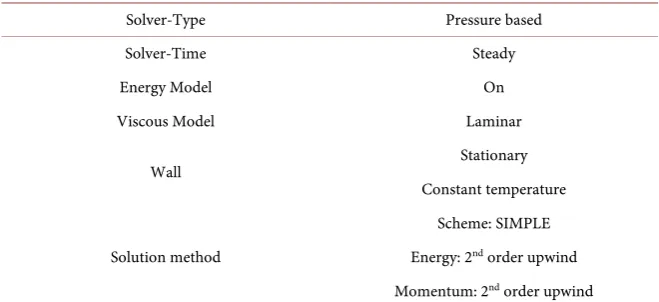
Considered geometry is two-dimensional planar. For simplicity, 3D geometry is avoided, which is a consideration for future cases. 2500 × 15 mesh grid is used for this simulation. Simulation parameters are provided in Table 2.
The flow is calculated laminar for every case studied in this paper. Reynolds number is less than critical Reynolds number 2300 in all cases considered.
2.3. Grid Size Convergence
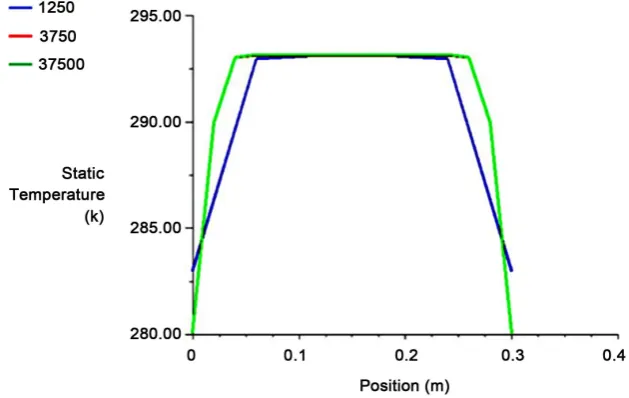
In order to avoid inaccurate result due to poor mesh density, different element numbers were used to analyze the mesh sensitivity. Three different element numbers (i.e., 1250, 3750, 37,500) have been used to compare temperature at the outlet of the pipe. It is found the element number converges after 3750 (Figure 2).
3. Results
Hagen-Poiseuille equation (Equation (4)) is used to compare the pressure drop along the pipe.
4 8 π LQ p R µ
[image:3.595.209.539.569.720.2]∆ = (4)
Table 2. Simulation parameters.
Solver-Type Pressure based
Solver-Time Steady
Energy Model On
Viscous Model Laminar
Wall Stationary
Constant temperature
Solution method
Scheme: SIMPLE Energy: 2nd order upwind
DOI: 10.4236/anp.2017.64012 144 Advances in Nanoparticles Figure 2. Mesh element convergence.
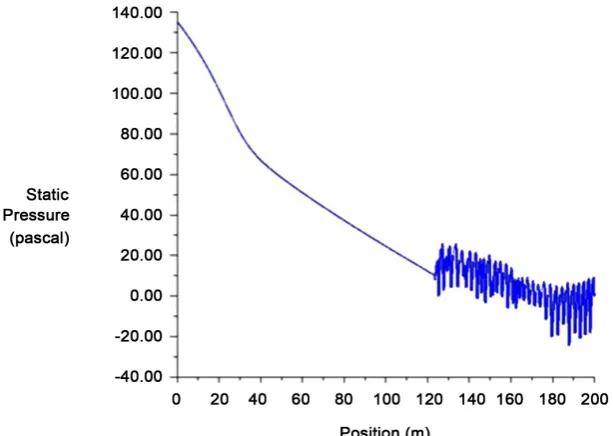
Here, µ (for water) = 0.001003 kg/m∙s, L (pipe length) = 200 m, v (fluid velocity) = 2 m/s, R (pipe radius) = 0.15 m, Q (=area of pipe cross section × v) represents discharge rate. The pressure drop along the pipe (Δp) is found 142.65 Pa. The simulated result from Fluent is in close proximity of the calculated value (Figure 3).
Noticeably pressure fluctuates at the end of the pipe length. This happens due to the local back flow.
Equation (5) is used to calculate temperature at the end of pipe.
(
)
expe s s i s p
T = −T T −T −hA mC (5)
1 2
10.45 10
h= − +v v (6)
Here, Te, Ts and Ti represent temperatures of outlet, surface and inlet of the pipe respectively; h—convective heat transfer coefficient of water, As—surface area of pipe, m—mass flow rate.
The calculated value of the temperature at the end of pipe is 302.93 K (Figure 4).
Flow is fully developed at some downstream distance of inlet (Figure 5). This distance is much higher than lower viscosity and dense fluid e.g. air (Figure 6).
4. Analysis on Nanofluids
DOI: 10.4236/anp.2017.64012 145 Advances in Nanoparticles Figure 3. Pressure distribution along pipe axis (water).
Figure 4. Temperature distribution at outlet (water).
DOI: 10.4236/anp.2017.64012 146 Advances in Nanoparticles Figure 6. Velocity contours (air).
Figure 7. Temperature distribution at the outlet.
smaller values. This shows that with a very small amount of addition of nano-particles, these nanofluids’ thermal properties can be varied to a large extent.
5. Conclusion
After investigating three nanofludis in a pipe flow in terms of their temperature distribution at the outlet, it is found that with increasing volume fraction of aluminum oxide, temperature at the outlet wall decreases. The initial conclusion suggests that nanofluids have a potential to work as an industrial thermal fluid with superior thermophysical properties.
References
[1] Singh, K., Sharma, S. and Gangacharyulu, D. (2013) Experimental Study of Ther-mophysical Properties of Al2O3/Water Nanofluid. IJRMET, 3, Issue 2.
DOI: 10.4236/anp.2017.64012 147 Advances in Nanoparticles Siginer, D.A. and Wang, H.P., Eds., Development and Applications of Non-Newtonian Flows, Vol. 12, ASME, New York, 99-105.
[3] Sivashanmugam, P. (2012) Application of Nanofluids in Heat Transfer. In: Kazi, S.N., Ed., An Overview of Heat Transfer Phenomena, InTech.
https://doi.org/10.5772/52496