Proceedings of the BioNLP 2019 workshop, pages 380–388 380
PANLP at MEDIQA 2019: Pre-trained Language Models, Transfer
Learning and Knowledge Distillation
Wei Zhu, Xiaofeng Zhou, Keqiang Wang, Xun Luo, Xiepeng Li, Yuan Ni, Guotong Xie Pingan Health Tech, Shanghai, China
{zhuwei972, zhouxiaofeng824, wangkeqiang265, luoxun492, lixiepeng538, niyuan442, xieguotong}@pingan.com.cn
Abstract
This paper describes the models designated for the MEDIQA 2019 shared tasks by the team PANLP. We take advantages of the recent ad-vances in pre-trained bidirectional transformer language models such as BERT (Devlin et al., 2018) and MT-DNN (Liu et al.,2019b). We find that pre-trained language models can sig-nificantly outperform traditional deep learning models. Transfer learning from the NLI task to the RQE task is also experimented, which proves to be useful in improving the results of fine-tuning MT-DNN large. A knowledge dis-tillation process is implemented, to distill the knowledge contained in a set of models and transfer it into an single model, whose perfor-mance turns out to be comparable with that ob-tained by the ensemble of that set of models. Finally, for test submissions, model ensemble and a re-ranking process are implemented to boost the performances. Our models partici-pated in all three tasks and ranked the 1st place for the RQE task, and the 2nd place for the NLI task, and also the 2nd place for the QA task.
1 Introduction
There are three tasks in the MEDIQA 2019 shared tasks (seeBen Abacha et al. (2019) for details of the tasks). The first one, NLI, consists in identi-fying three inference relations between two sen-tences: Entailment, Neutral and Contradiction. The second one, RQE, requires one to identify whether one question entails the other, where the definition ofentailmentis thata question A entails a question B if every answer to B is also a com-plete or partial answer to A. The third task, QA, considers not only the identification of entailment for the asked question among a set of retrieved questions, but also the ranks of retrieved answers. In this work, we demonstrate that we can achieve significant performance gains over tra-ditional deep learning models like ESIM (Chen
et al., 2016), by adapting pre-trained language models into the medical domain. Language model pre-training has shown to be effective for learn-ing universal language representations by lever-aging large amounts of unlabeled data. Some of the most famous examples are GPT-V2 (see Rad-ford et al., 2019) and BERT ( by Devlin et al.,
2018). These are neural network language models trained on text data using unsupervised objectives. For example, BERT is based on a multi-layer bidi-rectional Transformer, and is trained on plain text for masked word prediction and next sentence pre-diction tasks. To apply a pre-trained model to specific NLU tasks such as tasks for MEDIQA 2019 shared tasks, we often need to fine-tune the model with additional task-specific layers using task-specific training data. For example, Devlin et al. (2018) show that BERT can be fine-tuned this way to create state-of-the-art models for a range of NLU tasks, such as question answering and natural language inference.
We also tryout a transfer learning procedure, where an intermediate model obtained on the NLI task is used to be fine-tuned on the RQE task. Al-though this procedure cannot consistently improve the dev set performance for all the models, it is proven to be beneficial on the test set by adding variety to the model pool.
For test submissions, model ensemble is used to obtain more stable and unbiased predictions. We only adopt a simple ensemble model, that is, av-eraging the class probabilities of different models. After obtaining test predictions, for the NLI and RQE task, simple re-ranking operations among pairs with the same premise are used to boost the performance metrics.
The rest of the paper is organized as follows. In Section2, we demonstrate our experiments on the three tasks. In Section 3, transfer learning from NLI to RQE is presented. Section 4 elaborates on the knowledge distillation and the correspond-ing experimental results. Section5and Section6
present the model ensemble technique and the re-ranking strategies. Section7explains our submis-sion records in detail. Section8concludes and dis-cusses future work.
2 Pairwise Text Modeling
This section elaborates on the fundamental meth-ods we used for the three tasks.
2.1 RQE
The RQE task, as a pairwise text classifica-tion task, defined here involves a premise P = (p1, p2, ..., pm) of m words, which is a medical question posted online, and a hypothesis H = (h1, h2, ..., hn) of n words, which is a standard frequently asked question that is collected to build a QA system, and aims to find a logical relation-ship R between P and H. For the RQE task, relationship R is either true or false, indicating whether the premise entails the hypothesis or not. We mainly experiment on two groups of models, one using fixed pre-trained embedding1, the other employing pre-trained language models.
Traditional deep learning models typically use a fixed pre-trained word embedding to map words into low-dimensional vector space, and then use some kind of encoders to encode and pool the contexts of the premise to vector r1 and hy-pothesis H to r2. And the features provided to the classification layer is concat(r1, r2,||r1 −
r2||, r1 ∗ r2). (see Bowman et al., 2015) Then the classification output layer is usually a dense layer with soft-max output. We experiment with the following 4 traditional deep learning models. The first model, which will be called
Weighted-1We will refer to this type of models as traditional deep
learning models
Transformer-NLI model, encodes the sentences via a shared Weighted Transformer module (see
Ahmed et al.,2017for details). The second model, called RCNN-NLI, encodes the premise and hy-pothesis via the RCNN model (see Lai et al.,
2015). The third model we consider, is the decom-posable attention model by Parikh et al. (2016). The fourth model is the ESIM model byChen et al.
(2016), which is one of the most popular models in the natural language inference task. We will not elaborate on the specific architecture of the last two models since readers can refer to the original papers for details.
For the RQE task, the pre-trained language models we considered are as follows: (a) the orig-inal BERT models (both base and large models); (b) the Bio-BERT model by Lee et al. (2019) which is pre-trained on scientific literature in bio-medical domain; (c) the Sci-BERT model by Belt-agy et al.(2019) which is trained on academic pa-pers from the corpus of semanticscholar.org; (d) MT-DNN models (see Liu et al., 2019b), which are based on BERT and go through a multi-task learning procedure on the GLUE benchmark. On top of the transformer encoders from the pre-trained language model, we implement two kinds of output modules: (a) linear projection, which will be referred to as LP0, which is to take the hid-den state corresponding to the first token [CLS]
of the sentence pair; (b) a more sophisticated classification module called stochastic answer net-work (henceforth SAN) proposed by Liu et al.
(2017). Rather than directly predicting the entail-ment given the input, SAN maintains a state and iteratively refines its predictions.
When implementing the traditional deep learn-ing models, the Glove embeddlearn-ing (Pennington et al., 2014) is used. Before training, we use the Unified Medical System (UMLS) provided by provided by the National Library of Medicine2to replace all the abbreviations (e.g.,IBS) of a med-ical concept or entity to its full name, or to the same name that appears in the same pair. We tune the hyper-parameters on the dev set, and report the best performance obtained by each model in Ta-ble1.
Among the four traditional models, RCNN-NLI performs the worst. Although a power-ful model as shown in Ahmed et al. (2017),
2https://www.nlm.nih.gov/research/
Model valid acc
Weighted-Transformer-NLI 0.6821
RCNN-NLI 0.5530
Decomposable attention 0.6854
ESIM 0.7218
BERT base + linear projection 0.7815 BERT base + SAN 0.7119 BERT large + linear projection 0.7782 BERT large + SAN 0.7682 Bio-BERT + linear projection 0.4338 Bio-BERT + SAN 0.4305 Sci-BERT + linear projection 0.7547 Sci-BERT + SAN 0.5993 MT-DNN base + linear projection 0.8378
[image:3.595.190.408.62.292.2]MT-DNN base + SAN 0.7715 MT-DNN large + linear projection 0.7881 MT-DNN large + SAN 0.7815
Table 1: performances of different models on the valid set of the RQE task.
Weighted-Transformer-NLI cannot perform very well on this dataset. The ESIM model performs the best among the four. However the traditional deep learning models cannot perform well enough when compared with the results on the Round 1 leader board. We believe the reasons are as fol-lows. First, the dataset is relatively small, thus models like Weighted-Transformer-NLI will im-mediately over-fit. 3 Second, the distribution of training data for RQE task is different from the distributions of the dev and test data. We see most of the pairs in train set have approximately equal length, and there are 1, 445 pairs in which the premise and hypothesis are exactly the same. Meanwhile, in dev and test sets, the premise is usually much longer than the hypothesis.
When compared with traditional deep learning models, the pre-trained language models perform significantly better on the dev set. In addition, one can see that adding a sophisticated output module like SAN on top of the pre-trained lan-guage model tends to worsen the dev performance. Among all the BERT model family, the MT-DNN model (base model) performs best, and the orig-inal BERT base model performs slightly worse. Since the MT-DNN family are BERT models fine-tuned on GLUE benchmark via a multi-task learn-ing mechanism, and in GLUE eight out of nine
3Readers can refer toGuo et al.(2019) for more detailed
discussions on how transformer models performs unsatisfy-ingly on medium or small datasets, when directly trained from scratch.
layers to freeze valid acc
0 0.7782
1 0.8013
3 0.7914
6 0.7881
9 0.8179
10 0.8344
11 0.8378
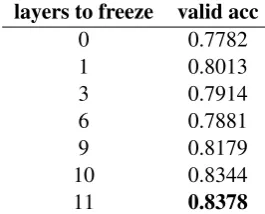
Table 2: performances of the MT-DNN base model with linear projection, when different number of lay-ers are freezed during fine-tuning on the RQE dataset
tasks are pairwise text modeling tasks, MT-DNN are more equipped to model pairwise text classifi-cation tasks on different domains than the original BERT model. And we can see that MT-DNN base performs better than MT-DNN large, which is in contradiction to the results on the GLUE bench-mark reported in Liu et al. (2019b). Sci-BERT and Bio-BERT model does not perform well. We believe the reasons are that the Sci-BERT and Bio-BERT models share the same feature that they are trained on scientific literature, in which the lan-guage is more formal and rigid. However, texts in RQE is drawn from online questions from medi-cal forums, thus Sci-BERT and Bio-BERT are not suitable for this task.
[image:3.595.348.481.336.443.2]Model valid acc
ESIM (byRomanov and Shivade,2018) 0.7440 InferSent (byRomanov and Shivade,2018) 0.7600 BERT base + linear projection 0.8186
BERT base + SAN 0.8143
BERT large + linear projection 0.8229
BERT large + SAN 0.8280
Bio-BERT + linear projection 0.6824
Bio-BERT + SAN 0.6882
Sci-BERT + linear projection 0.8466
Sci-BERT + SAN 0.8251
MT-DNN base + linear projection 0.8265
MT-DNN base + SAN 0.8287
[image:4.595.165.433.66.266.2]MT-DNN large + linear projection 0.8420 MT-DNN large + SAN 0.8327
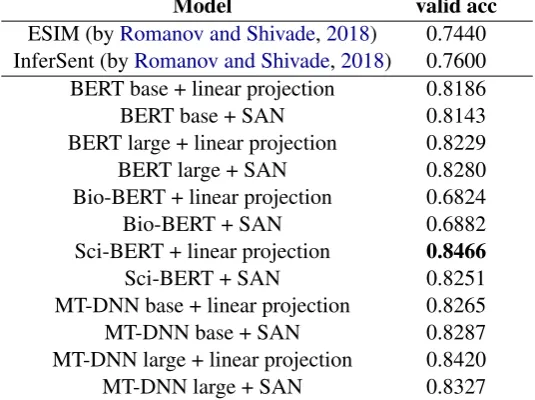
Table 3: performances of different models on the valid set of the NLI task.
we can see that freezing 11 lower layers of the MT-DNN base performs best. During training of dif-ferent models, even traditional deep learning mod-els, we notice that a model can easily over-fit on the training set of RQE, fine-tuning the whole lan-guage model will introduce much bias into the model. Meanwhile freezing the lower layers can alleviate over-fitting and maintain the generaliza-tion ability of the pre-trained models.
2.2 NLI
For the NLI task, we are tasked to identify the relationship R between the premise and the hy-pothesis, which is among the following three: en-tailment,neutral orcontradiction. Romanov and Shivade (2018) has done a thorough investiga-tion on how tradiinvestiga-tional deep learning models like ESIM and InferSent perform on the original NLI datasets. Thus to save time, we only implement with pre-trained language models for this task.
The BERT based models we tried are the same as we investigate on the RQE datasets, whose re-sults are reported in Table 3. It turns out, the BERT-based model significantly outperforms the traditional models. MT-DNN models still perform quite well, but the Sci-BERT with linear projec-tion achieves the highest accuracy on the dev set. The Bio-BERT model still cannot achieve satisfy-ing results. We find that models behave quite dif-ferently on NLI compared with the RQE datasets. First, on the NLI dataset, BERT large and the MT-DNN large, which is derived from BERT large, perform better than their base counterparts, BERT
base and MT-DNN base. Second, during tuning the hyper-parameters, we find that freezing layers leads to performance loss. Third, the SAN output module does not lead to significant performance change except for Sci-BERT, whereas on the RQE dataset adding SAN module usually leads to sig-nificant performance loss.
2.3 QA
On the basis of the results obtained on RQE and NLI task, we found that the MT-DNN models out-perform other pre-trained language models. Thus, with limited time, in the QA task we chose to di-rectly look into the MT-DNN models on the QA datasets.
The QA task requires us not only give a binary label to an answer, but also rank the answers of the same questions. There are two perspectives of treating such a task: classification and regres-sion. The classification model just distinguishes whether the question and the answer match, and the output of Softmax layer can be used to rank the answers. However, the regression model is able to predict the matching degree between questions and answers, and rank the answers according to the matching degree. The final result achieved is a combination of two models.
Model acc Spearman’s Rank Corr
MT-DNN base on QA-R 0.8248 0.1478
MT-DNN large on QA-R 0.8333 0.2054
[image:5.595.117.486.62.158.2]MT-DNN base + linear projection on QA-C 0.7479 0.0557 MT-DNN base + SAN on QA-C 0.7607 -0.0108 MT-DNN large + linear projection on QA-C 0.8333 0.0803 MT-DNN large + SAN on QA-C 0.8120 0.2146
Table 4: performances of different models on the valid set of the QA task. Here accuracy is calculated on the whole dev set.
Model dev acc
MT-DNN base 0.8378
MT-DNN base + transfer learning on NLI 0.8220
MT-DNN large 0.7881
MT-DNN large + transfer learning on NLI 0.7957
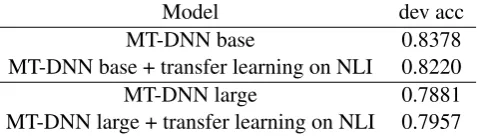
Table 5: The performance on the RQE dev set, when we apply transfer learning, compared with the performances obtained by directly fine-tuning the MT-DNN models on the RQE dataset.
with the leader board, we calculated accuracy and Spearman’s Rank Correlation Coefficient (hence-forth SRCC). As is shown in Table 4, BERT base can achieve accuracy of 0.7478 after fine-tuning. However, SRCC is 0.057, which is quite poor. The results demonstrate that a binary classifica-tion model helps us to get a fair accuracy score, but it omits all the ranking information like Ref-erenceRankandReferenceScorefrom the original data. Thus the resulting model can not tell whether an answer is better than another. Bearing that in mind, we decided to introduce a related but dif-ferent model to specialize in providing ranking in-formation, while leave the accuracy metric to the classification model.
The new model we are introducing treats the task at hand as a regression task. For a sample data, the input is a pair composed of a query and an answer. The target value is the relevance score between the query and the answer, which is de-fined as follows:
score=Ref erenceScore+1/Ref erenceRank.
(1) The reciprocal of theReferenceRank is used to enlarge the gaps of relevance scores among differ-ent answers. The dataset obtained with the above modification is called the QA-R dataset. The re-gression model is also built on the pre-trained lan-guage models by replacing the classification out-put module with a regression task header (see equation (2) ofLiu et al.,2019b). Table 4 shows that we can obtain a huge bump on SRCC with
the regression model. The best dev SRCC we can obtain is 0.148, which is the result of fine-tuning the MT-DNN large model. With a threshold for the relevance score, we can also get the classifi-cation label from the regression label. After ad-justing the threshold, we can also get accuracy of 0.8247. Thus, we can conclude that the regres-sion model works better in capturing the ranking information without reducing the accuracy of the model.
By observing the SRCC obtained at each epoch during training, we can see the following phe-nomenon: SRCC can improve from 0.125 to 0.273 after a single epoch, and suddenly drop to 0.023 on the next one. SRCC seems to be quite unstable, which will be problematical when making predic-tions for the unknown test set. This is a problem that we fail to solve at the end of competition and requires further investigations.
3 Transfer learning
[image:5.595.181.420.204.273.2]model perform slightly better.
4 knowledge distillation
In this section, we experiment on the idea of knowledge distillation (Hinton et al., 2015), to further boost the performance of single models. We implement knowledge distillation on each task separately.4 The procedure is as follows:
• train a set of models on each tasks. Follow-ingLiu et al. (2019a), the set of models are: MT-DNN base and MT-DNN large, with dif-ferent dropout rates ranged in0.1,0.3,0.5for the task specific output layers, while keep-ing the hyper-parameters of lower BERT en-coders the same with those in the previous section.
• ensemble the above models to get a label model (Ratner et al.,2018)5. This so-called label model is constructed by modeling a generative model over all the label func-tions, i.e., the single models, to maximize the log likelihood, give the label matrix (Ratner et al., 2017). The label model is a general-ization of the so-called teacher model in (Liu et al.,2019a), where the teacher model is sim-ply the average of class probabilities.
• The end model (or called the student model by Liu et al., 2019a) is trained on the soft targets given out by the label model. Here, training on the soft targets means the cross-entropy loss is averaged with the class prob-abilities as weights.
• Inference is the same for end model with other normal models.
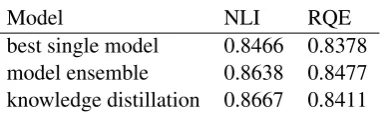
In Table6, we can see that knowledge distilla-tion can significantly improve the performance on the NLI task, and can even achieve better results than model ensemble. However, on the RQE task, knowledge distillation cannot perform better than model ensemble, but still outperforms the best sin-gle model.
4Liu et al. (2019a) extends the knowledge distillation to
multi-task learning setting, which is a direction we need to explore in future work.
5There are alternative terminologies for knowledge
distil-lation. We mainly followRatner et al.(2018).
5 Ensemble
Since the test set is small, one single model is too biased to achieve great results on the test dataset. Ensemble learning is an effective approach to im-prove model generalization, and has been used to achieve new state-of-the-art results in a wide range of natural language understanding (NLU) tasks (Devlin et al.,2018,Liu et al.,2017).
For the MEDIQA 2019 shared task, we only adopt a simple ensemble approach, that is, aver-aging the softmax outputs from different models, or different runs or epochs of the same model, and makes prediction based on these averaged class probabilities. All our submissions follow this en-semble strategy.6
6 Re-ranking strategies for the NLI and RQE tasks
The previous sections demonstrate how deep learning models perform on the task datasets. However, in order to obtain more competitive re-sults, one could adopt some simple heuristics.
For the NLI task, after observing the task datasets, we can see that one premise is grouped with three different hypothesis, and the latter are labeled withentailment,neutralandcontradiction
respectively. We call the three pairs with the same premise a group. Our sentence pair model does not know the idea of groups, thus the labels corre-sponding to the maximum class probabilities ob-tained by soft-max layer can conflict with one an-other. For example, two pairs in the same group may both be labeled asentailment. To eliminate the above conflicts, we adopt the following heuris-tic post-processing procedure:
• obtain the label predictions directly from the softmax output. If there is no conflict in a group, accept the predictions. Otherwise, in this group:
• Give thecontradictionlabel to the pair with the highest score for this label
• Between the remaining two pairs, decide which one should get theneutrallabel via the scores for this label
6
Model NLI RQE best single model 0.8466 0.8378 model ensemble 0.8638 0.8477 knowledge distillation 0.8667 0.8411
Table 6: Comparison of performances on the dev sets, among the best single model, ensemble model and the model obtained by knowledge distillation.
• the remaining pair get theentailmentlabel
For the RQE task, since the label is binary, and the number of pairs in a group in this task varies, the re-ranking heuristic is a little different, which is elaborated as follows.
• obtain the score of theentailmentlabel from the model
• for each group, rank the pairs by their scores.
• denote the number of pairs in a group asn, then we directly label the lastmax(1,[n/2]− 1)as negative pairs. and the top pair as posi-tive pair
• For the rest of pairs, we choose a threshold
t, if the score of a pair is higher thant, it is labeledentailment, otherwise it is labeled as
not entailment. We choose the threshold to obtain the highest accuracy on the dev set
7 Submission results
This section discusses the submission results on the leader boards.
First, let us look at the submission history on the RQE task (presented here in Table 7). The first submission is a single MT-DNN base model trained only on the training data, with re-ranking. On the second submission, we add the available dev set in, and re-train all the models. The en-semble of a MT-DNN base and a MT-DNN large after re-ranking push the test accuracy to 0.736. Then we tryout transfer learning on the third run, two runs of MT-DNN large, which go through the transfer learning process described in Section 3, achieves 0.745 after re-ranking. Adding the end model after knowledge distillation to the combina-tion in the third run makes the performance drops slightly to 0.740. For the final submission, we just ensemble all the models available, and achieve 0.749 on the test set, which ranks the first on the RQE task.
Table8presents the submission records on the NLI task. On the first submission, we experi-ment the model obtained by knowledge distilla-tion, which obtains 0.865 on accuracy. The sec-ond submission, we use a single MT-DNN large fine-tuned on the train set and post-processed for re-ranking. The accuracy is 0.916 for this sub-mission. Then the ensemble of four models, the 8-th epoch of 2 different runs of MT-DNN large, the 10-th epoch of 2 different runs of Sci-BERT, achieves an accuracy of 0.946 after re-ranking. The final submission combines MT-DNN large, Sci-BERT, MT-DNN large after knowledge distil-lation, obtains 0.966 after re-ranking, which ranks the third on the leader board.
For the QA task, the first two submissions are based on a single MT-DNN large model fine-tuned on QA-R data set, chosen from two different train-ing epochs. The first submission with accuracy of 0.73 is chosen because in this epoch of train-ing, we achieved the best Spearman’s rho result on the dev dataset; Similarly,the second submis-sion with accuracy of 0.733 is chosen at the epoch where we achieved best ACC result on the dev dataset. From the third round, we started apply-ing ensemble strategy by considerapply-ing some well performing epochs at different runs together. The two submissions with accuracy of 0.774 and 0.777 are the results of different processing strategies: max score and mean score. According to the re-sults obtained, we find that ”max score” strategy performs slightly better on SRCC, while ”mean score” works better on ACC.
8 Conclusion and discussions
[image:7.595.205.397.60.117.2]Submission No. test acc details
1 0.675 1 * MT-DNN base (trained on train set) + re-rank 2 0.736 1 * MT-DNN base + 1 * MT-DNN large + re-rank 3 0.745 2 * MT-DNN large (TL) + re-rank
4 0.740 1 * MT-DNN large (KD) + 2 * MT-DNN large (TL) + re-rank 5 0.749 2 * MT-DNN base + 2 * MT-DNN large (TL)
+ 1 * MT-DNN large (KD) + 1 * MT-DNN large + re-rank
Table 7: The submission results on the RQE task. Multiplication symbol ”*” here means multiple runs or epochs of the same model (with different random seed). ”TL” means the model go through transfer learning on the NLI task. ”KD” means the model is obtained via knowledge distillation. Without declaration, all the models here are trained on the train and dev set.
Submission No. test acc details
1 0.865 1 * MT-DNN large (KD)
2 0.916 1 * MT-DNN large (on train set) + re-rank 3 0.946 2 * MT-DNN large + 2 * Sci-BERT + re-rank 4 0.966 4 * MT-DNN large + 4 * Sci-BERT
[image:8.595.94.505.65.173.2]+ 2 * MT-DNN large (KD) + re-rank
Table 8: The submission records on the NLI task. Multiplication symbol ”*” here means multiple runs or epochs of the same model (with different random seed). ”KD” means the model is obtained via knowledge distillation. Without declaration, all the models here are trained on the train and dev set.
Submission No. test acc test Spearman’s rho details
1 0.730 0.236 MT-DNN large (epoch with best training SRCC) 2 0.736 0.204 MT-DNN large (epoch with best training ACC) 3 0.774 0.22 MT-DNN large ensemble(rank by max socre) 4 0.777 0.18 MT-DNN large ensemble(rank by mean socre) 5 0.772 0.204 MT-DNN large ensemble(rank by mean socre)
Table 9: The submission results on the QA task.
in the usual way. Our submission results, al-though including model ensemble and re-ranking, are strong demonstration of the power of language model pre-training, transfer learning and knowl-edge distillation.
However, due to the limited time and the fact that we participate all three tasks at once, we haven’t exhaustively explore all the possible ways to boost the performance on the leader board, e.g., utilizing external sources such as medical knowledge bases to rule out false positive answers. Multi-task learning is also a direction that we need to pay more attention to.
In addition, the heuristics adopted in the re-ranking strategies resemble the relevance re-ranking task (Huang et al., 2013), where one compares different pairs in a group to obtain the final deci-sions. Due to time constraint, we didn’t implement a pairwise relevance ranking model on top of the
MT-DNN model, but this research direction will be investigated by us in future work.
References
Karim Ahmed, Nitish Shirish Keskar, and Richard Socher. 2017. Weighted Transformer Network for Machine Translation. arXiv e-prints, page arXiv:1711.02132.
Iz Beltagy, Arman Cohan, and Kyle Lo. 2019. SciBERT: Pretrained Contextualized Embed-dings for Scientific Text. arXiv e-prints, page arXiv:1903.10676.
Asma Ben Abacha, Chaitanya Shivade, and Dina Demner-Fushman. 2019. Overview of the mediqa 2019 shared task on textual inference, question en-tailment and question answering. InProceedings of the BioNLP 2019 workshop, Florence, Italy, August 1, 2019. Association for Computational Linguistics.
[image:8.595.132.468.243.322.2]and Christopher D. Manning. 2015. A large anno-tated corpus for learning natural language inference. In Proceedings of the 2015 Conference on Empiri-cal Methods in Natural Language Processing, pages 632–642, Lisbon, Portugal. Association for Compu-tational Linguistics.
Qian Chen, Xiaodan Zhu, Zhenhua Ling, Si Wei, Hui Jiang, and Diana Inkpen. 2016. Enhanced LSTM for Natural Language Inference. arXiv e-prints, page arXiv:1609.06038.
Jacob Devlin, Ming-Wei Chang, Kenton Lee, and Kristina Toutanova. 2018. BERT: Pre-training of Deep Bidirectional Transformers for Lan-guage Understanding. arXiv e-prints, page arXiv:1810.04805.
Qipeng Guo, Xipeng Qiu, Pengfei Liu, Yun-fan Shao, Xiangyang Xue, and Zheng Zhang. 2019. Star-Transformer. arXiv e-prints, page arXiv:1902.09113.
Geoffrey Hinton, Oriol Vinyals, and Jeff Dean. 2015. Distilling the Knowledge in a Neural Network.
arXiv e-prints, page arXiv:1503.02531.
Po-Sen Huang, Xiaodong He, Jianfeng Gao, Li Deng, Alex Acero, and Larry Heck. 2013. Learning deep structured semantic models for web search using clickthrough data. InProceedings of the 22nd ACM international conference on Information & Knowl-edge Management, pages 2333–2338. ACM.
Siwei Lai, Liheng Xu, Kang Liu, and Jun Zhao. 2015. Recurrent convolutional neural networks for text classification.
Jinhyuk Lee, Wonjin Yoon, Sungdong Kim, Donghyeon Kim, Sunkyu Kim, Chan Ho So, and Jaewoo Kang. 2019. BioBERT: a pre-trained biomedical language representation model for biomedical text mining. arXiv e-prints, page arXiv:1901.08746.
Xiaodong Liu, Pengcheng He, Weizhu Chen, and Jian-feng Gao. 2019a. Improving Multi-Task Deep Neu-ral Networks via Knowledge Distillation for Natu-ral Language Understanding. arXiv e-prints, page arXiv:1904.09482.
Xiaodong Liu, Pengcheng He, Weizhu Chen, and Jian-feng Gao. 2019b. Multi-Task Deep Neural Net-works for Natural Language Understanding. arXiv e-prints, page arXiv:1901.11504.
Xiaodong Liu, Yelong Shen, Kevin Duh, and Jianfeng Gao. 2017. Stochastic Answer Networks for Ma-chine Reading Comprehension.arXiv e-prints, page arXiv:1712.03556.
Ankur P. Parikh, Oscar T¨ackstr¨om, Dipanjan Das, and Jakob Uszkoreit. 2016. A Decomposable Attention Model for Natural Language Inference. arXiv e-prints, page arXiv:1606.01933.
Jeffrey Pennington, Richard Socher, and Christo-pher D. Manning. 2014. Glove: Global vectors for word representation. InEmpirical Methods in Nat-ural Language Processing (EMNLP), pages 1532– 1543.
Alec Radford, Jeffrey Wu, Rewon Child, David Luan, Dario Amodei, and Ilya Sutskever. 2019. Language models are unsupervised multitask learners. OpenAI Blog, 1:8.
Alexander Ratner, Stephen H. Bach, Henry Ehren-berg, Jason Fries, Sen Wu, and Christopher R´e. 2017. Snorkel: Rapid Training Data Creation with Weak Supervision. arXiv e-prints, page arXiv:1711.10160.
Alexander Ratner, Braden Hancock, Jared Dunnmon, Frederic Sala, Shreyash Pandey, and Christopher R´e. 2018. Training Complex Models with Multi-Task Weak Supervision. arXiv e-prints, page arXiv:1810.02840.
Alexey Romanov and Chaitanya Shivade. 2018. Lessons from Natural Language Inference in the Clinical Domain. arXiv e-prints, page arXiv:1808.06752.