Proceedings of the 55th Annual Meeting of the Association for Computational Linguistics (Short Papers), pages 155–160 Vancouver, Canada, July 30 - August 4, 2017. c2017 Association for Computational Linguistics
Proceedings of the 55th Annual Meeting of the Association for Computational Linguistics (Short Papers), pages 155–160 Vancouver, Canada, July 30 - August 4, 2017. c2017 Association for Computational Linguistics
Exploiting Domain Knowledge via Grouped Weight Sharing
with Application to Text Categorization
Ye Zhang1 Matthew Lease2 Byron C. Wallace3
1Department of Computer Science, University of Texas at Austin 2School of Information, University of Texas at Austin
3College of Computer & Information Science, Northeastern University
[email protected], [email protected], [email protected]
Abstract
A fundamental advantage of neural mod-els for NLP is their ability to learn rep-resentations from scratch. However, in practice this often means ignoring existing external linguistic resources, e.g., Word-Net or domain specific ontologies such as the Unified Medical Language System (UMLS). We propose a general, novel method for exploiting such resources via weight sharing. Prior work on weight sharing in neural networks has considered it largely as a means of model compres-sion. In contrast, we treat weight shar-ing as a flexible mechanism for incorpo-rating prior knowledge into neural models. We show that this approach consistently yields improved performance on classifi-cation tasks compared to baseline strate-gies that do not exploit weight sharing. 1 Introduction
Neural models are powerful in part due to their ability to learn good representations of raw tex-tual inputs, mitigating the need for extensive task-specific feature engineering (Collobert et al., 2011). However, a downside of learning from scratch is failing to capitalize on prior linguistic or semantic knowledge, often encoded in existing resources such as ontologies. Such prior knowl-edge can be particularly valuable when estimating highly flexible models. In this work, we address how to exploit known relationships between words when training neural models for NLP tasks.
We propose exploiting the feature-hashing trick, originally proposed as a means of neural net-work compression (Chen et al., 2015). Here we instead view the partial parameter sharing induced by feature hashing as a flexible mechanism for ty-ing together network node weights that we believe
e11 e12 e13
good nice
e21 e22 e23
g13 g12 g11
g1:{good, nice, amazing}
g23 g22 g21
g2:{good, interesting} e31 e32 e33
interesting
[image:1.595.309.524.226.342.2]hi(j)
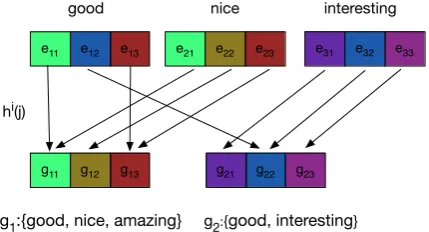
Figure 1: An example of grouped partial weight sharing. Here there are two groups. We stochas-tically select embedding weights to be shared be-tween words belonging to the same group(s).
to be similara priori. In effect, this acts as a reg-ularizer that constrains the model to learn weights that agree with the domain knowledge codified in external resources like ontologies.
More specifically, as external resources we use Brown clusters (Brown et al., 1992), WordNet (Miller,1995) and the Unified Medical Language System (UMLS) (Bodenreider,2004). From these we derive groups of words with similar meaning. We then use feature hashing to share a subset of weights between the embeddings of words that be-long to the same semantic group(s). This forces the model to respect prior domain knowledge, in-sofar as words similar under a given ontology are compelled to have similar embeddings.
Our contribution is a novel, simple and flexible method for injecting domain knowledge into neu-ral models via stochastic weight sharing. Results on seven diverse classification tasks (three senti-ment and four biomedical) show that our method consistently improves performance over (1) base-lines that fail to capitalize on domain knowledge, and (2) an approach that usesretrofitting(Faruqui et al.,2014) as a preprocessing step to encode do-main knowledge prior to training.
2 Grouped Weight Sharing
We incorporate similarity relations codified in ex-isting resources (here derived from Brown clus-ters, SentiWordNet and the UMLS) as prior knowledge in a Convolutional Neural Network (CNN).1To achieve this we construct a shared em-bedding matrix such that words knowna priorito be similar are constrained to share some fraction of embedding weights.
Concretely, suppose we have N groups of words derived from an external resource. Note that one could derive such groups in several ways; e.g., using the synsets in SentiWordNet. We denote groups by{g1, g2, ..., gN}. Each group is associ-ated with an embedding ggi, which we initialize
by averaging the pre-trained embeddings of each word in the group.
To exploit both grouped and independent word weights, we adopt a two-channel CNN model (Zhang et al., 2016b). The embedding matrix of the first channel is initialized with pre-trained word vectors. We denote this input byEp ∈RV×d (V is the vocabulary size anddthe dimension of the word embeddings). The second channel in-put matrix is initialized with our proposed weight-sharing embeddingEs ∈ RV×d. Esis initialized by drawing from bothEpand the external resource following the process we describe below.
Given an input text sequence of length l, we construct sequence embedding representations Wp ∈ Rl×d and Ws ∈ Rl×d using the cor-responding embedding matrices. We then apply independent sets of linear convolution filters on these two matrices. Each filter will generate a fea-ture map vectorv∈Rl−h+1(his the filter height).
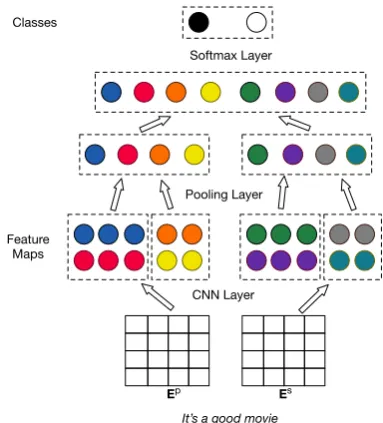
We perform 1-max pooling over each v, extract-ing one scalar per feature map. Finally, we con-catenate scalars from all of the feature maps (from both channels) into a feature vector which is fed to a softmax function to predict the label (Figure2).
We initializeEsas follows. Each rowei ∈Rd of Es is the embedding of word i. Words may belong to one or more groups. A mapping func-tionG(i)retrieves the groups that wordibelongs to, i.e., G(i) returns a subset of {g1, g2, ..., gN}, which we denote by {g(1i), g2(i)...gK(i)}, where K is the number of groups that contain word i. To initialize Es, for each dimension j of each word embeddingei, we use a hash functionhi to map
1The idea of sharing weights to reflect known similarity is
general and could be applied with other neural architectures.
It’s a good movie CNN Layer
Ep Es
Pooling Layer Softmax Layer
[image:2.595.319.511.61.273.2]Feature Maps Classes
Figure 2: Proposed two-channel model. The first channel input is a standard pre-trained embedding matrix. The second channel receives a partially shared embedding matrix constructed using exter-nal linguistic resources.
(hash) the index j to one of the K group IDs: hi : N → {g(1i), g2(i)...gK(i)}. Following ( Wein-berger et al., 2009; Shi et al., 2009), we use a second hash functionbto remove bias induced by hashing. This is a signing function, i.e., it maps
(i, j)tuples to{+1,−1}2. We then setei,jto the product ofghi(j),jandb(i, j).handbare both
ap-proximately uniform hash functions.Algorithm1 provides the full initialization procedure.
Algorithm 1Initialization ofEs 1: foriin{1, . . . , V}do
2: {g1(i), g(2i), . . . , gK(i)}:=G(i).
3: forj∈ {1, . . . , d}do 4: ei,j :=ghi(j),j·b(i, j)
5: end for 6: end for
For illustration, consider Figure1. Hereg1
con-tains three words: good,niceandamazing, while g2has two words:goodandinteresting. The group
embeddings gg1, gg2 are initialized as averages
over the pre-trained embeddings of the words they comprise. Here, embedding parameterse1,1 and
e2,1 are both mapped togg1,1, and thus share this
value. Similarly,e1,3 ande2,3 will share value at
gg1,3. We have elided the second hash functionb
from this figure for simplicity.
2Empirically, we found that using this signing function
During training, we update Ep as usual using back-propagation (Rumelhart et al.,1986). We up-dateEsand group embeddingsgin a manner sim-ilar to Chen et al.(2015). In the forward propa-gation before each training step (mini-batch), we derive the value ofei,jfromg:
ei,j :=ghi(j),j∗b(i, j) (1)
We use this newly updated ei,j to perform for-ward propagation in the CNN.
During backward propagation, we first compute the gradient ofEs, and then we use this to derive the gradient w.r.tgs. To do this, for each dimen-sionj inggk, we aggregate the gradients w.r.tE
s whose elements are mapped to this dimension:
∇ggk,j:= X
(i,j)
∇Esi,j·δhi(j)=gk·b(i, j) (2)
where δhi(j)=gk = 1 when hi(j) = gk, and 0
otherwise. Each training step involves execut-ing Equations1 and2. Once the shared gradient is calculated, gradient descent proceeds as usual. We update all parameters aside from the shared weights in the standard way.
The number of parameters in our approach scales linearly with the number of channels. But the gradients can actually be back-propagated in a distributed way for each channel, since the con-volutional and embedding layers are independent across these. Thus training time scales approxi-mately linearly with the number of parameters in one channel (if the gradient is back-propagated in a distributed way).
3 Experimental Setup
3.1 Datasets
We use three sentiment datasets: a movie review (MR) dataset (Pang and Lee, 2005)3; a customer review (CR) dataset (Hu and Liu,2004)4; and an opinion dataset (MPQA) (Wiebe et al.,2005)5.
We also use four biomedical datasets, which concern systematic reviews. The task here is to classify published articles describing clinical tri-als as relevant ornot to a well-specified clinical question. Articles deemed relevant are included in
3www.cs.cornell.edu/people/pabo/ movie-review-data/
4www.cs.uic.edu/˜liub/FBS/ sentiment-analysis.html
5mpqa.cs.pitt.edu/corpora/mpqa_corpus/
the corresponding review, which is a synthesis of all pertinent evidence (Wallace et al.,2010). We use data from reviews that concerned: clopido-grel (CL) for cardiovascular conditions (Dahabreh et al., 2013); biomarkers for assessing iron de-ficiency in anemia (AN) experienced by patients with kidney disease (Chung et al., 2012); statins (ST) (Cohen et al., 2006); and proton beam (PB) therapy (Terasawa et al.,2009).
3.2 Implementation Details and Baselines
We use SentiWordNet (Baccianella et al.,2010)6 for the sentiment tasks. SentiWordNet assigns to each synset of wordnet three sentiment scores: positivity, negativity and objectivity, constrained to sum to 1. We keep only the synsets with pos-itivity or negativity scores greater than 0, i.e., we remove synsets deemed objective. The synsets in SentiWordNet constitute our groups. We also use the Brown clustering algorithm7on the three senti-ment datasets. We generate 1000 clusters and treat each as a group.
For the biomedical datasets, we use the Medical Subject Headings (MeSH) terms8attached to each abstract to classify them. Each MeSH term has a tree number indicating the path from the root in the UMLS. For example, ‘Alagille Syndrome’ has tree number ‘C06.552.150.125’; periods denote tree splits, numbers are nodes. We induce groups com-prising MeSH terms that share the same first three parent nodes, e.g., all terms with ‘C06.552.150’ as their tree number prefix constitute one group.
We compare our approach to several baselines. All use pre-trained embeddings to initialize Ep, but we explore several approaches to exploiting Es: (1) randomly initializeEs; (2) initialize Es to reflect the group embedding g, but do not share weights during the training process, i.e., do not constrain their weights to be equal when we perform back-propagation; (3) use linguistic re-sources to retro-fit(Faruqui et al., 2014) the pre-trained embeddings, and use these to initializeEs. For retro-fitting, we first construct a graph de-rived from SentiWordNet. Then we run belief-propagation on the graph to encourage linked words to have similar vectors. This is a pre-processing step only; we do not impose weight sharing constraints during training.
6sentiwordnet.isti.cnr.it
7github.com/percyliang/brown-cluster 8www.nlm.nih.gov/bsd/disted/
total #instances vocabulary size #positive instances #negative instances
MR 10662 18765 5331 5331
CR 3773 5340 2406 1367
MPQA 10604 6246 3311 7293
AN 5653 5554 653 5000
CL 8288 3684 768 7520
ST 3464 2965 173 3291
[image:4.595.104.491.62.173.2]PB 4749 3086 243 4506
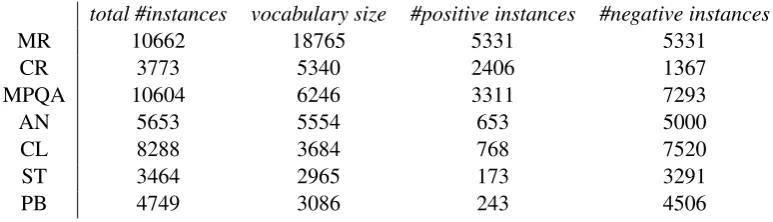
Table 1: Corpora statistics.
For the sentiment datasets we use three filter heights (3,4,5) for each of the two CNN channels. For the biomedical datasets, we use only one fil-ter height (1), because the inputs are unstructured MeSH terms.9 In both cases we use 100 filters of each unique height. For the sentiment datasets, we use Google word2vec (Mikolov et al., 2013)10 to initializeEp. For the biomedical datasets, we use word2vec trained on biomedical texts (Moen and Ananiadou, 2013)11 to initializeEp. For param-eter estimation, we use Adadelta (Zeiler, 2012). Because the biomedical datasets are imbalanced, we use downsampling (Zhang et al.,2016a;Zhang and Wallace,2015) to effectively train on balanced subsets of the data.
We developed our approach using the MR senti-ment dataset, tuning our approach to constructing groups from the available resources – experiments on other sentiment datasets were run after we fi-nalized the model and hyperparameters. Similarly, we used the anemia (AN) review as a development set for the biomedical tasks, especially w.r.t. con-structing groups from MeSH terms using UMLS.
4 Results
We replicate each experiment five times (each is a 10-fold cross validation), and report the mean (min, max) across these replications. Results on the sentiment and biomedical corpora in are pre-sented in Tables 2 and 3, respectively.12 These exploit different external resources to induce the word groupings that in turn inform weight shar-ing. We report AUC for the biomedical datasets because these are highly imbalanced (see Table1). Our method improves performance compared to all relevant baselines (including an approach that
9For this work we are ignoring title and abstract texts. 10code.google.com/archive/p/word2vec/ 11bio.nlplab.org/
12Sentiment task results are not directly comparable to
prior work due to different preprocessing steps.
also exploits external knowledge via retrofitting) in six of seven cases. Informing weight initial-izationusing external resources improves perfor-mance independently, but additional gains are re-alized by also enforcing sharing during training.
We note that our aim here is not necessarily to achieve state-of-art results on any given dataset, but rather to evaluate the proposed method for in-corporating external linguistic resources into neu-ral models via weight sharing. We have therefore compared to baselines that enable us to assess this.
5 Related Work
Neural Models for NLP. Recently there has been enormous interest in neural models for NLP gener-ally (Collobert et al.,2011;Goldberg,2016). Most relevant to this work, simple CNN based mod-els (which we have built on here) have proven extremely effective for text categorization (Kim, 2014;Zhang and Wallace,2015).
Exploiting Linguistic Resources. A potential drawback to learning from scratch in end-to-end neural models is a failure to capitalize on exist-ing knowledge sources. There have been efforts to exploit such resources specifically to induce bet-ter word vectors (Yu and Dredze, 2014; Faruqui et al.,2014;Yu et al.,2016;Xu et al.,2014). But these models do not attempt to exploit external resources jointly during training for a particular downstream task (which uses word embeddings as inputs), as we do here.
tree-Method MR CR MPQA p only 81.02 (80.84,81.24) 84.34 (84.21,84.53) 89.41 (89.22,89.58)
[image:5.595.110.493.62.172.2]p + r 81.25 (81.19,81.32) 84.33 (84.24,84.38) 89.63 (89.58,89.71) p + retro 81.35 (81.23,81.51) 84.16 (84.09,84.28) 89.61 (89.48,89.77) p + S (no sharing) 81.39 (81.32,81.43) 84.13 (84.06,84.21) 89.71 (89.67,89.75) p + B (no sharing) 81.50 (81.29,81.63) 84.60 (84.53,84.66) 89.57 (89.52,89.61) p + S (sharing) 81.69 (81.60,81.78) 84.34 (84.24,84.43) 89.84 (89.74,90.13) p + B (sharing) 81.83 (81.80,81.87) 84.68 (84.64,84.72) 89.97 (89.74,90.13)
Table 2: Accuracy mean (min, max) on sentiment datasets. ‘p’: channel initialized with the pre-trained embeddingsEp. ‘r’: channel randomly initialized. ‘retro’: initialized with retofitted embeddings. ‘S/B (no sharing)’: channel initialized withEs(using SentiWordNet or Brown clusters), but weights are not shared during training. ‘S/B (sharing)’: proposed weight-sharing method.
Method AN CL ST PB
p only 86.63 (86.57,86.67) 88.73 (88.51,89.00) 67.15 (66.00, 67.91) 90.11 (89.46, 91.03) p + r 85.67 (85.46,85.95) 88.87 (88.56,89.03) 67.72 (67.65,67.86) 90.12 (89.87,90.47) p + retro 86.46 (86.32,86.65) 89.27 (88.89,90.01) 67.78 (67.56,68.00) 90.07 (89.92,90.20) p + U 86.60 (86.32,87.01) 88.93 (88.67,89.13) 67.78 (67.71,67.85) 90.23 (89.84,90.47) p + U(s) 87.15 (87.00,87.29) 89.29 (89.09,89.51) 67.73 (67.58,67.88) 90.99 (90.46,91.59)
Table 3: AUC mean (min, max) on the biomedical datasets. Abbreviations are as in Table2, except here the external resource is the UMLS MeSH ontology (‘U’).‘U(s)’ is the proposed weight sharing method utilizing ULMS.
structured relations between tokens (e.g., derived from the UMLS) in topic modeling.
Weight-sharing in NNs. Recent work has con-sidered stochastically sharing weights in neural models. Notably, Chen et al. (2015). proposed randomly sharing weights in neural networks. Elsewhere, Han et al.(2015) proposed quantized weight sharing as an intermediate step in their deep compression model. In these works, the pri-mary motivation wasmodel compression, whereas here we view the hashing trick as a mechanism to encode domain knowledge.
6 Conclusion
We have proposed a novel method for incorporat-ing prior semantic knowledge into neural models via stochastic weight sharing. We have showed it generally improves text classification performance vs. model variants which do not exploit external resources and vs. an approach based on retrofitting prior to training. In future work, we will inves-tigate generalizing our approach beyond classifi-cation, and to inform weight sharing using other varieties and sources of linguistic knowledge.
Acknowledgements.This work was made possible by NPRP
grant NPRP 7-1313-1-245 from the Qatar National Research
Fund (a member of Qatar Foundation). The statements made herein are solely the responsibility of the authors.
References
Stefano Baccianella, Andrea Esuli, and Fabrizio Sebas-tiani. 2010. Sentiwordnet 3.0: An enhanced lexical resource for sentiment analysis and opinion mining. InLREC. volume 10, pages 2200–2204.
Olivier Bodenreider. 2004. The unified medical lan-guage system (umls): integrating biomedical termi-nology. Nucleic acids research32(suppl 1):D267– D270.
Peter F Brown, Peter V Desouza, Robert L Mercer, Vincent J Della Pietra, and Jenifer C Lai. 1992. Class-based n-gram models of natural language.
Computational linguistics18(4):467–479.
Wenlin Chen, James T Wilson, Stephen Tyree, Kilian Q Weinberger, and Yixin Chen. 2015. Compressing neural networks with the hashing trick. In ICML. pages 2285–2294.
Mei Chung, Denish Moorthy, Nira Hadar, Priyanka Salvi, Ramon C Iovin, and Joseph Lau. 2012.
[image:5.595.82.518.243.326.2]Aaron M Cohen, William R Hersh, K Peterson, and Po-Yin Yen. 2006. Reducing workload in systematic re-view preparation using automated citation classifica-tion. Journal of the American Medical Informatics Association13(2):206–219.
Ronan Collobert, Jason Weston, L´eon Bottou, Michael Karlen, Koray Kavukcuoglu, and Pavel Kuksa. 2011. Natural language processing (almost) from scratch. Journal of Machine Learning Research
12(Aug):2493–2537.
Issa J Dahabreh, Denish Moorthy, Jenny L Lamont, Minghua L Chen, David M Kent, and Joseph Lau. 2013. Testing of cyp2c19 variants and platelet reac-tivity for guiding antiplatelet treatment .
Finale Doshi-Velez, Byron C Wallace, and Ryan Adams. 2015. Graph-sparse lda: A topic model with structured sparsity. InAAAI Conference on Artificial Intelligence. pages 2575–2581.
Manaal Faruqui, Jesse Dodge, Sujay K Jauhar, Chris Dyer, Eduard Hovy, and Noah A Smith. 2014. Retrofitting word vectors to semantic lexicons.
arXiv preprint arXiv:1411.4166.
Yoav Goldberg. 2016. A primer on neural network models for natural language processing. Journal of Artificial Intelligence Research57:345–420.
Song Han, Huizi Mao, and William J Dally. 2015. Deep compression: Compressing deep neural net-works with pruning, trained quantization and huff-man coding. arXiv preprint arXiv:1510.00149.
Minqing Hu and Bing Liu. 2004. Mining and summa-rizing customer reviews. InProceedings of the 10th ACM SIGKDD international conference on Knowl-edge discovery and data mining. pages 168–177.
Yoon Kim. 2014. Convolutional neural net-works for sentence classification. arXiv preprint arXiv:1408.5882.
Tomas Mikolov, Kai Chen, Greg Corrado, and Jef-frey Dean. 2013. Efficient estimation of word representations in vector space. arXiv preprint arXiv:1301.3781.
George A Miller. 1995. Wordnet: a lexical database for english. Communications of the ACM 38(11):39– 41.
SPFGH Moen and Tapio Salakoski2 Sophia Anani-adou. 2013. Distributional semantics resources for biomedical text processing.
Bo Pang and Lillian Lee. 2005. Seeing stars: Exploit-ing class relationships for sentiment categorization with respect to rating scales. InProc. of the ACL.
D.E. Rumelhart, G.E. Hintont, and R.J. Williams. 1986. Learning representations by back-propagating errors.Nature323(6088):533–536.
Qinfeng Shi, James Petterson, Gideon Dror, John Langford, Alex Smola, and SVN Vishwanathan. 2009. Hash kernels for structured data. Journal of Machine Learning Research10(Nov):2615–2637. T. Terasawa, T. Dvorak, S. Ip, G. Raman, J. Lau, and
T. A. Trikalinos. 2009. Charged Particle Radiation Therapy for Cancer: A Systematic Review. Ann. Intern. Med..
Byron C Wallace, Thomas A Trikalinos, Joseph Lau, Carla Brodley, and Christopher H Schmid. 2010. Semi-automated screening of biomedical ci-tations for systematic reviews. BMC bioinformatics
11(1):55.
Kilian Weinberger, Anirban Dasgupta, John Langford, Alex Smola, and Josh Attenberg. 2009. Feature hashing for large scale multitask learning. In Pro-ceedings of the 26th Annual International Confer-ence on Machine Learning. pages 1113–1120. Janyce Wiebe, Theresa Wilson, and Claire Cardie.
2005. Annotating expressions of opinions and emo-tions in language. Language resources and evalua-tion39(2):165–210.
Chang Xu, Yalong Bai, Jiang Bian, Bin Gao, Gang Wang, Xiaoguang Liu, and Tie-Yan Liu. 2014. Rc-net: A general framework for incorporating knowl-edge into word representations. InProceedings of the 23rd ACM International Conference on Confer-ence on Information and Knowledge Management. ACM, pages 1219–1228.
Dani Yogatama and Noah A Smith. 2014. Linguistic structured sparsity in text categorization. In Meet-ing of the Association for Computational LMeet-inguis- Linguis-tics. pages 786–796.
Mo Yu and Mark Dredze. 2014. Improving lexical em-beddings with semantic knowledge. InACL. pages 545–550.
Zhiguo Yu, Trevor Cohen, Elmer V Bernstam, and Byron C Wallace. 2016. Retrofitting word vectors of mesh terms to improve semantic similarity mea-sures. Intl. Workshop on Health Text Mining and Information Analysis at EMNLPpages 43–51. Matthew D. Zeiler. 2012. Adadelta: An adaptive
learn-ing rate method.
Ye Zhang, Iain Marshall, and Byron C Wallace. 2016a. Rationale-augmented convolutional neu-ral networks for text classification. arXiv preprint arXiv:1605.04469.
Ye Zhang, Stephen Roller, and Byron C Wallace. 2016b. MGNC-CNN: A simple approach to exploit-ing multiple word embeddexploit-ings for sentence classifi-cation pages 1522–1527.
Ye Zhang and Byron C Wallace. 2015. A sensitiv-ity analysis of (and practitioners’ guide to) convo-lutional neural networks for sentence classification.