J. Range Manage.
55:
65-69 January 2002
Does ruminal retention time affect leafy spurge seed of varying maturity?
BRET E. OLSON AND ROSEANN T. WALLANDER
Authors are Professor and Research Associate, Department of Animal and Range Sciences, Montana State University, Bozeman, Mont. 59717-2900.
Abstract
Grazers ingest seeds of invasive forbs and may contribute to their spread by depositing viable seeds in uninfested areas.
Some mature seed pass through the gastrointestinal (GI) tract of ruminants, but grazers consume flowerheads of invasive species from anthesis to dehiscence. We collected seed from the Eurasian leafy spurge (Euphorbia esula L.) at 3 stages of maturity (soft dough, hard dough, mature). With seed collected from these dif- ferent stages, our objectives were to determine effects of 1) rate of passage through the GI tract of sheep on leafy spurge seed recovery, germinabilty and viability, 2) residence time in sheep rumen on seed germinability and viability, and 3) acid pepsin digestion, simulating the lower GI tract, on seed germinability and viability after different residence times in the rumen. More seed from the later stages of maturity were recovered in the manure. The greatest number of seed recovered only represented 3.9% of the number of ingested seed. Few seeds were recovered after day 4. Soft dough seed in manure would not germinate and was not viable, whereas hard dough and mature seed collected from manure during the first 4 day were viable. Pepsin had a slight effect on the number of mature seed recovered, but elimi- nated viability of recovered seed. Viability of non-pepsin treated seed from the hard dough and mature stages declined with greater residence time in the rumen. Thus, managers should be aware that livestock ingesting hard dough as well as mature seed may be dispersing viable weed seed.
Key Words: weed, Euphorbia esula, rumen, sheep
Leafy spurge (Euphorbia esula L.), a deep-rooted perennial, was introduced to North America from Russia in the early 1800s and has become a noxious weed in the north central United States and southern Canada (Best et al. 1980). Herbicides will not erad- icate extensive infestations of leafy spurge, although they can be used to control this noxious weed (Fay 1992). Sheep readily graze leafy spurge (Johnston and Peake 1960, Landgraf et al.
1984, Olson et al. 1996). Sheep will not eradicate leafy spurge, but they may be a cost-effective method to control leafy spurge (Fay 1991, Williams et al. 1996). However, sheep ingest leafy
We
thank Kathrin Olson-Rutz for reviewing the manuscript. This study
wassupported by the Montana Agricultural Experiment Station and the USDA
CSREES.Published with approval of the Director, Montana Agricultural Experiment
Station, as Journal No. J-2000-65.Manuscript accepted 15 Feb. 01.
Resumen
Los herbivoros ingieren semillas de hierbas invasoras y pueden contribuir a su diseminacion depositando semillas viables en areas no infestadas. Algunas semillas maduras pasan a traves del tracto gastrointestinal (TGI) de los ruminntes, pero los her- bivoros consumen inflorecencias de especies invasivas desde la antesis hasta la dehiscencia. Colectamos semilla de "Eurasian leafy spurge" (Euphorbia esula L.) en tres estados de madurez (masa blanda, masa dura y madura). Utilizamos la semilla colec-
tada en estas diferentes etapas de madurez para realizar un estu- dio con el objetivo de determinar los efectos de: 1) la tasa de paso a traves del TGI de los borregos en la recuperacion, ger- minabilidad y viabilidad de la semilla de "Leafy spruge" 2) el tiempo de residencia en el rumen del borrego en la germinabili- dad y viabilidad y 3) la digestion de acido pepsina, simulando el TGI bajo, en la germinabilidad y viabilidad de la semilla despues de diferentes tiempos de residencia en el rumen En las heces se recupero mas semilla de los estados de madurez mas avanzados.
El mayor numero de semillas recuperadas solo represento el 3.9% del total de semillas ingeridas. Pocas semillas se recuper- aron despues del cuarto dia. La semilla del estado de masa blan- da presente en las heces no germinarian y no fueron viables, mientras que la semilla madura y en estado de masa dura colec- tadas de las heces durante los primeros 4 dias fueron viables. La pepsina tuvo un efecto ligero en el numero de semillas maduras recuperadas, pero elimino la viabilidad de la semilla recuperada.
La viabilidad de la semilla madura o de masa dura no tratada con pepsina declino al aumentar el tiempo de residencia en el rumen. Asi los manejadores deben estar concientes de que el ganado que ingiere semilla en las etapas de masa dura y madura puede estar dispersando semilla viable de malezas.
spurge seed and deposit viable seed in their manure (Olson et al.
1997), thus they should be managed accordingly (Olson 1999).
Mature seed of some invasive species will pass through the gastrointestinal (GI) tract of ruminants. Most mature leafy spurge seed are digested completely in the GI tract, and viability of mature seed that pass through the GI tract is usually reduced (Lacey et al. 1992, Olson et al. 1997). However, grazers consume flowerheads from anthesis to dehiscence. Ripening of leafy spurge seed can extend from early July until fall (Hanson and Rudd 1933, Best et al. 1980). Seed in earlier stages of develop- ment may also pass through the animal and some may remain viable. For example, we collected fecal pellets of sheep grazing leafy spurge-infested rangeland from late June until early August
JOURNAL OF RANGE MANAGEMENT 55(1) January 2002
65(Olson et al. 1997); the sheep passed viable seed over a 4 week period.
However, we could not measure when or how many leafy spurge seed were ingested by sheep during that field study. Thus, we could not determine residence time, or the impact of digestion on seed viability.
For this study, we collected leafy spurge capsules (seed) at 3 stages of maturity (soft dough, hard dough, mature), and pulse-dosed sheep with a known amount of seed from these different stages. Our objectives were to determine
1)effects of rate of passage on seed recovery, ger- minabilty, and viability, 2) effects of resi- dence time in the rumen on seed ger- minability and viability, and 3) effects of acid pepsin digestion, simulating the lower GI tract, on seed germinability and viabili- ty after different residence times in the rumen.
Materials and Methods
The leafy spurge fruit develops from a superior three-celled ovary (Messersmith et al. 1985). This capsule dehisces when ripe to distribute the seeds. Color differ- ences in seedcoats have been used to determine seed maturity. Seed color changes from yellow, to yellow with brown tips, to brown, to grey brown, to mottled as seeds mature (Selleck et al.
1962, Wicks and Derscheid 1964). In con- trast, Bakke (1936) suggested that imma- ture seeds were grey and mature seeds were brown. Differences between age of maturity and seedcoat color may reflect that environments or biotypes differed at their collection sites. We distinguished immature from mature seeds using Selleck et al.'s (1962) and Wicks and Derscheid's (1964) approach. Yellow or partially yel- low seeds were considered immature.
We collected capsules (seeds) of leafy spurge
3times during the summer of 1994 (Lat 110°33'W, Long 45°46). The first collection (24 June 1994) coincided with the "soft dough" stage when seed is imma- ture and most capsules were easily cut with a fingernail (Stage 1). The second collection (19 July 1994) coincided with the "hard dough" stage when most cap- sules are indurate and difficult to cut with a fingernail (Stage 2). For the third collec- tion (10 August 1994), we harvested fully developed capsules and opened these cap- sules to remove mature seed (Stage 3). In the field, all leafy spurge seed does not mature at the same time (Olson et al.
1997). Some mature seed were present in collections of all
3stages (Stage 1, 25%;
Stage 2, 80%; Stage 3,100%). We did not remove mature seeds from these first 2 stages because they would be available to grazing animals.
Rate of Passage and Viability Capsules from Stages
1and 2, and mature seeds from Stage 3 were fed to 5
rumen-cannulated ewes in separate trials.
Each trial was separated by at least 14 days To ensure mastication of seed for each trial, 960 capsules (2,880 seed in Stage 3) were mixed with a small amount of barley and molasses in a feed bucket.
Sheep had been exposed to the barley- molasses mix earlier. Most of the sheep consumed this mixture within a few hours, and all capsules were consumed within 24 hours. Before and during each trial ewes were fed grass hay ad libitum, and had access to water and a mineral block.
Sheep were in individual pens with ply- wood floors. All manure from each sheep was collected every 24 hours for 6 days after feeding the capsules (seeds). Each sheep averaged 95 g manure day-' (dry weight). For each sheep, the 24 hour col- lection of manure was mixed, weighed while fresh, and divided into 9 subsam- ples. Three subsamples were selected ran- domly, and air-dried to determine mois- ture content. Three subsamples were selected randomly to recover seed. They were washed over sieves to remove excess organic material, and stored in a cool (2°C), dark location to prevent seed matu- ration until samples from all 6 days had been collected. Then, leafy spurge seed and capsules were identified and removed from this material, categorized (immature, mature, capsule), counted, and stored under cool, dark conditions. The remain- ing 3 subsamples of each 24 hour collec- tion were dried at 37° C and used in a dif- ferent study (unpublished).
We determined our ability to recover leafy spurge seed from manure by adding 30 leafy spurge seeds to each of 5 manure samples from penned sheep with no access to leafy spurge. These spiked manure sam- ples were washed according to procedures described above. All 30 seeds were recov- ered in each of the 5 manure samples.
To determine germinability, seeds were soaked in 10% (v/v) chlorine bleach solu- tion for 10 minutes to remove mold and bacteria, rinsed 3 times with distilled water, and then placed on moistened blot- ter paper. The number of recovered seed varied considerably. When more than 5 seeds were recovered, they were placed on moistened blotter paper in 5 petri plates.
When more than 100 seeds were recov-
ered, 20 seeds were tested on each of the 5 petri plates. Petri plates were placed in a shaded box in a greenhouse with day and night temperatures of 22° C and 16° C, respectively. By allowing diffuse short- wave radiation but preventing direct short- wave radiation from reaching the seeds, the shaded box mimicked a plant canopy.
Although alternating 30° C120° C maxi- mizes germination of leafy spurge seed (Hanson and Rudd 1933), most leaf spurge seed germinates in early spring in the field (Selleck et al. 1962). In their study, most seeds germinated after 10 days of maxi- mum air temperatures of 21
°or higher in late April, which is why we used the 22°
C116° C regimen. Photoperiod was approximately 16 hours day! 8 hours night during this 28 June-20 July period.
Distilled water was added as needed.
Germinated seeds (radicles > 10 mm) were counted every other day and removed.
After 3 weeks, seeds in these petri dish- es were stratified in cold (4°C), moist stor- age for 4 weeks. Germination of leafy spurge seed increases greatly when strati- fied for 4 weeks at 2-5° C, preceding a
constant 20°C treatment (Best et al.
1980). Petri dishes were returned to the greenhouse for 18 days, and germinability was tested as above. Photo period was approximately 14 hour day! 10 hour night during this 21 August-8 September peri- od. Germinability included seeds that germinated during the first test and those that germinated after stratification. Control seed which had not been fed and had been stored under cool, dark conditions were tested alongside recovered seed. We used 20 unfed seeds on each of 5 petri plates from each of the
3stages.
Seeds that did not germinate could be viable, i.e. will germinate later, or be non- viable. After the second germinability test, seeds that did not germinate were tested for viability using a 0.1% unbuffered tetra- zolium solution (Grabe 1970). Viability included seeds that tested positive with tetrazolium. Total viability included seeds that germinated and seeds that tested posi- tive with tetrazolium.
Residence Time, Acid Pepsin
Digestion
Effect of residence time in the rumen was tested by nylon bag technique with 5 rumen cannulated sheep. Sixteen nylon mesh bags (5 cm x 10 cm, 50 mm mesh) per stage, each containing 100 capsules (300 seed
-Stage 3), were placed in the rumen of each sheep. Four of the 16 bags were removed at each of 4 retention times
66
JOURNAL OF RANGE MANAGEMENT 55(1) January 2002
from each sheep: 12, 24, 48 and 72 hours.
The bags were rinsed immediately with cold water to remove as much rumen fluid as possible, and then placed on paper tow- els until the bags were dry, but the cap- sules were still moist. Two bags of each set of 4 bags were air-dried for 48 hours.
The other 2 were placed in a fresh, acid pepsin solution for 24 hours (Simao Neto and Jones 1987) to simulate conditions in the abomasum, then rinsed and dried as above. All seeds were tested for ger- minability and viability as described previ- ously. Control seeds that were not placed in the rumen or treated with acid pepsin (controls) were tested for germinability and viability at the same time. For these tests,
3subsamples of 30 seeds each were randomly selected from each nylon bag, including control seeds, and placed on 3 separate petri dishes. Mature and imma- ture seeds were distinguished by seed color, and added together to determine total seed.
Statistical Analyses
We used the same sheep in the "rate of passage" and "residence time" studies.
Each sheep was considered an experimen- tal unit. The number of recovered leafy spurge seeds was estimated by determin- ing the mean recovery from
3of 9 sub- samples, and then multiplying this mean by 9, which was an estimate of each sheep each 24 hour period. Number of mature seed recovered, germinability (%), viabili- ty (%), and total viability (%) were ana- lyzed with repeated measures analysis of variance (n = 5; SAS 1988). Seed stage
was the between treatment effect; day (manure collection) within stage was the within treatment effect.
For the residence time-acid pepsin digestion trial, number of intact seed and total seed viability (%) were analyzed with repeated measures analysis of variance.
Again, each sheep was an experimental unit. Seed stage was the between treatment effect; when the nylon bags were removed (0, 12, 24, 48, 72 hours) from the rumens of the sheep was the within treatment effect. Because there were only 5 experi- mental units (sheep), P-values less than 0.10 are presented (Gill 1981).
Results
Rate of Passage and Viability
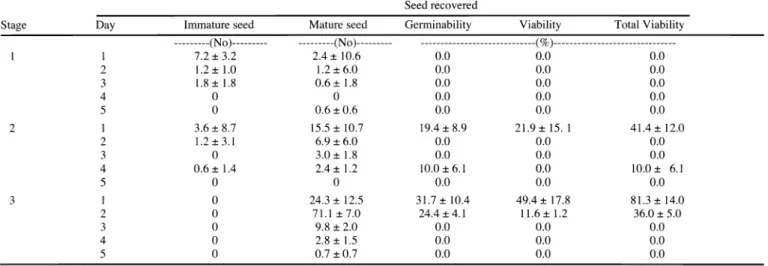
The number of mature seed recovered over the 5 day period varied by stage (day by stage, P = 0.02; Table 1), but consis- tently declined with time (day, P = 0.02).
Number of mature seed recovered was greatest for seed from Stage 3, intermedi- ate for seed from Stage 2, and least for seed from Stage
1(stage; P = 0.002).
However, for any
1day, the greatest num- ber of mature seed recovered (Stage 3, day 2) only represented 2.4% of the number of seed consumed. Summed across the 5 day collection period, recovery of mature seed was 0.2% for Stage 1, 1.5% for Stage 2, and 3.8% for Stage 3. Few seeds were recovered after day 4.
Immature seed did not germinate
because it did not contain a viable embryo.
Germinability of mature seed collected
over the 5 day varied by stage (day by stage, P = 0.01; Table 1). The relatively high germinability of Stage 2 seed from day 4 reflected germinability of seed from only
1of the 5 sheep (data not shown).
Overall, germinability was greatest for seed from Stage 3, intermediate for seed from Stage 2, and 0 for seed from Stage
1(stage; P = 0.07).
Viability was greatest for seed from Stage 3, intermediate for seed from Stage 2, and 0 for seed from Stage
1(stage, P = 0.09; Table 1). No viable seed were passed after day 2. Overall, total viability (ger- minability + viability) was greatest for seed from Stage 3, intermediate for seed from Stage 2, and 0 for seed from Stage
1(stage; P = 0.006).
Residence Time, Acid Pepsin
Digestion
We could not control residence time of seed in the GI tract in the rate of passage trial. In this trial, we controlled residence time of seed in the rumen, with and with- out acid pepsin digestion. The number of total seed recovered, which included mature seed, immature seed, and seed within capsules, was lowest from Stage
1(166 ± 3), intermediate from Stage 2 (226
± 2), and greatest from Stage 3 (300 ± 0;
stage, P < 0.0001). Overall, the total num- ber of seed was not affected by residence time in the rumen (hour by stage; P = 0.36).
Viability of control seed, seed that was not placed into the rumen, was 65, 75, and 84% for Stages 1-3, respectively.
Table
1.The number of immature and mature seed recovered (No), and germinability (%), viability (%), and total viability (%, total viability = ger- minability + viability) of mature seed from Stages 1-3 recovered over a
5day collection period. Each sheep received approximately 960 capsules (or 2,880 seed) of soft dough (Stage
1),hard dough (Stage 2), and mature seed (Stage 3). Some mature seed were present in seed fed for all
3stages (Stage
1,25%; Stage 2, 80%, Stage 3,100%). Immature seed (yellow seed coat) never germinated and was never viable. Means plus or minus
1SE (n
= 5sheep).
Seed recovered
Stage Day Immature seed seed Germinability Viability
---(No)--- ---(No)--- ---(%)---
1 1
7.2±3.2
10.6 0.02
1.2±1.0 1.2±6.0 0.0
3
1.8±1.8 0.6±1.8 0.0
0 0
0 0.0 0.0
2 1
3.6±8.7
10.7 19.4 ± 8.9 12
1.2±3.1
6.9 6.0 0.00
3.0±1.8 0.0
4
0.6±1.4 2.4±1.2 10.0±6.1
0 0
0 0 0 0
0
0.0
0.0 0.0JOURNAL OF RANGE MANAGEMENT 55(1) January 2002
67100
80
60
40
20
0
0
1224
o Stage 2
A Stage 3
36
48 60 72
Hours in rumen
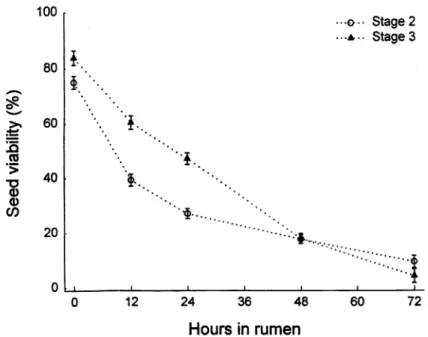
Fig.
1.Effect of residence time (h) in sheep rumen on total viability (%) of mature leafy spurge seed from Stages 2 and 3. Seed from Stage
1were not viable after exposure to the rumen. Some mature seed were present in collections of all 3 stages (Stage 1, 25%; Stage 2, 80%, Stage 3,100%). Total viability of seed which had not been placed in the rumen (0 h) was 65, 75, and 84% for Stages 1-3, respectively. Means plus or minus
1SE (n = 5 sheep).
Viability of pepsin treated seed from all 3
stages was 0, thus this treatment was removed from the statistical model.
Viability of non-pepsin treated seed varied with stage and time in the rumen (Fig. 1;
hour by stage; P = 0.0001). Other than control seed (0 hour), viability of seed from Stage
1was 0, whereas viability of seed from Stages 2 and 3 declined with time spent in the rumen.
Discussion
Rate of Passage and Viability
Some mature seed were present in col- lections of all 3 stages (Stage 1, 25%;
Stage 2, 80%, Stage 3, 100%). On most days, immature and mature seed were recovered in the same proportions that they were fed, indicating immature seeds were resistant to digestion, at least struc- turally. For legumes, soft seed is destroyed by digestion whereas hard seed is relative- ly resistant to digestion (Simao Neto and Jones 1987, Gardener et al. 1993).
The greatest number of seed recovered (Stage 3) only represented about 4% of the number of seed consumed. In another study with leafy spurge, 18% of seed fed to sheep and goats was recovered in the manure of both animal species (Lacey et al. 1992).
With a different invasive weed Centaurea
maculosa, 4% of the seed dosed was recov- ered in
1trial with ewes, whereas 17% of the seed dosed was recovered in a second trial with rams (Wallander et al. 1995).
Experimental protocol differed slightly between those trials; presumably these dif-
ferences were not related to gender.
Few seeds were recovered after day 4.
In related studies, most weed seeds pass within 4-5 days (Piggin 1978, Lacey et al.
1992, Wallander et al. 1995). Thus, ani- mals grazing weed infested areas with mature seed should not be moved to unin- fested areas for at least 4-5 days to pre- vent dispersal of viable seed.
Seed recovered from Stage
1did not germinate and was not viable, even though about 25% of the seed was mature.
Apparently, seed of leafy spurge at this early stage of development will not sur- vive the GI tract of sheep. Some seed in the hard dough and mature stages (Stages 2, 3) germinated and remained viable, especially when passed within 2 days of ingestion.
Only seed recovered within
1(Stage 2) to 2 days (Stage 3) would germinate or was viable, except for some Stage 2 seed recovered 4 days after ingestion. However, these seeds were recovered from the manure of only
1of the 5 sheep. Possibly, seed had been entrapped within the GI tract, and were released all at once.
No viable seed were recovered after day
4, which may reflect the effect of the GI tract on seed passage and seed viability.
Leafy spurge seed imbibes water quickly, beginning within 6 hours of exposure and continuing for an additional 42 hours (Selleck et al. 1962). Germinability was equal to (Stage 2) or less than (Stage 3) viability in seed recovered from the first day, whereas germinability was greater than viability on seed recovered on day 2 from Stage 3. This may reflect that ger- minability was enhanced by short-term residence time in the rumen. Lacey et al.
(1992) found that leafy spurge seed did not germinate after
1day in the rumen of sheep; seed recovered after 4 days were not viable. In a related study, viability of Centaurea maculosa seed was minimal after 5 days in the GI tract of sheep, but retained viability up to 10 days (end of trial) in mule deer (Wallander et al.
1995). Blackshaw and Rode (1991) also found that weed seeds survive for short periods of time in the rumen but viability drops off rapidly. The effect of different exposure periods in the rumen vary among different weed species (Harmon and Keim 1934), diets (Blackshaw and Rode 1991), and ruminants (Harmon and Keim 1934, Simao Neto et al. 1987).
Residence Time, Acid Pepsin
Digestion
Control seed not placed in the rumen from Stages 1-3 were 65, 75, and 84%
viable, respectively. Others have found viability of leafy spurge seed ranging from 51% to 90% (Hanson and Rudd 1933, Bakke 1936, Bowes and Thomas 1978, Lacey et al. 1992).
The survival of seed passing through the GI tract is influenced by residence time in the GI tract and exposure to digestive enzymes. Nylon bags placed in the rumen, such as in this study, can be used to simu- late different residence times in the rumen but do not expose seeds to digestive secre- tions in the lower GI tract, which is why we included the pepsin treatment. In addi- tion, using seed in nylon bags does not include the effects of mastication during prehension or rumination on the seed coat, which may be a key factor that influences digestion, disintegration, and viability of seed. This would explain why more seed were recovered in this trial compared with the "rate of passage" trial where seed were ingested by the sheep and passed through their entire GI tract.
Our pepsin treatment may have been excessive; none of the pepsin-treated seed were viable. In another nylon bag trial, a 24 hour pepsin treatment greatly reduced
68